Chiral Gravitational Wave Background from Audible Axion via Nieh-Yan Term
Pith reviewed 2026-05-23 17:14 UTC · model grok-4.3
The pith
Coupling an axion-like field to the Nieh-Yan term produces a chiral gravitational wave background through tachyonic instability during the radiation-dominated era.
A machine-rendered reading of the paper's core claim, the machinery that carries it, and where it could break.
Core claim
The interaction with the Nieh-Yan term leads to the direct and efficient production of gravitational waves during the radiation-dominated era, originating from the tachyonic instability of the gravitational perturbations with the Nieh-Yan term. The energy spectral density of the chiral gravitational wave background and the comoving energy density of axion-like fields are calculated, allowing exploration of the parameter space for detectable signals.
What carries the argument
The Nieh-Yan term coupling to the axion-like field, which induces tachyonic instability in tensor perturbations of the metric.
If this is right
- The resulting gravitational wave background is chiral and its energy spectral density can be computed numerically.
- Detectable signals are possible in pulsar timing arrays or space-based detectors for certain ranges of axion mass and decay constant.
- The comoving energy density of the axion-like fields is determined alongside the wave production.
- Production occurs efficiently during radiation domination without needing additional gauge field interactions.
Where Pith is reading between the lines
- The mechanism could provide a way to distinguish axion models by the chirality of the gravitational wave signal.
- Future detection of chiral gravitational waves in specific frequency bands could constrain the Nieh-Yan coupling strength.
- Extensions might consider how this affects the evolution of the axion field after the instability phase.
Load-bearing premise
The axion-like field remains in the regime where the Nieh-Yan coupling dominates the dynamics long enough for tachyonic growth to occur before the field oscillates or decays.
What would settle it
Absence of a chiral gravitational wave signal in the frequency range predicted for the explored axion parameter space in pulsar timing array data would challenge the mechanism.
Figures




read the original abstract
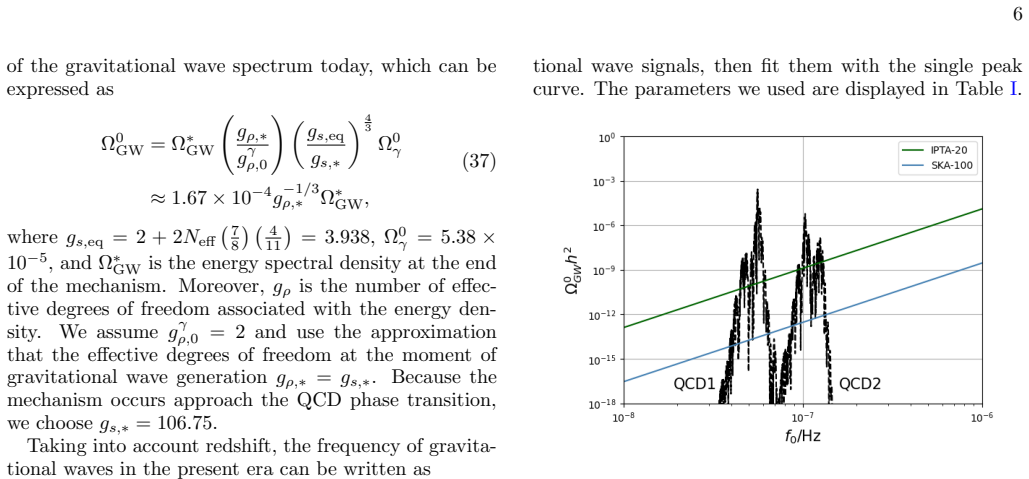
Axions and axion-like particles can be probed through gravitational waves indirectly, often referred to as "audible axions". The usual concept of audible axion relies on the coupling between the axions and the gauge fields. Here we consider an axion-like mechanism with coupling to the Nieh-Yan term. This interaction leads to the direct and efficient production of gravitational waves during the radiation-dominated era, originating from the tachyonic instability of the gravitational perturbations with the Nieh-Yan term. We calculate the energy spectral density of the chiral gravitational wave background and the comoving energy density of axion-like fields. Based on the numerical results, we explore the parameter space of axion masses and decay constants for detectable gravitational wave signals, either in pulsar timing arrays or space-based gravitational wave detections.
Editorial analysis
A structured set of objections, weighed in public.
Referee Report
Summary. The manuscript proposes that coupling an axion-like field to the Nieh-Yan term induces tachyonic instability in gravitational tensor perturbations during radiation domination, directly sourcing a chiral gravitational wave background. The authors compute the GW energy spectral density and axion comoving energy density numerically, then map the (m, f) parameter space to identify regions yielding signals detectable by pulsar timing arrays or space-based interferometers.
Significance. If the instability persists for sufficient e-folds before the axion oscillates or decays, the mechanism supplies a new, gauge-field-independent channel for audible axions to produce observable chiral GWs in the radiation era. The numerical evaluation of the spectral density and the explicit parameter-space scan constitute concrete, falsifiable outputs that could be confronted with PTA or LISA data.
major comments (2)
- [instability analysis and background evolution] The radiation-era background employed for the tensor-mode instability analysis does not evolve the axion equation of motion self-consistently once the Nieh-Yan term and potential m²φ are both active; the duration of the tachyonic window relative to the oscillation timescale set by m is therefore not demonstrated. This assumption is load-bearing for the claim of efficient GW production.
- [numerical results and parameter scan] The reported GW energy densities and the boundaries of the detectable (m, f) region rest on the initial conditions that keep the axion velocity constant long enough for growth; without a back-reaction calculation showing that Hubble friction and the potential do not terminate the window first, the numerical results cannot be taken as robust predictions.
minor comments (1)
- [introduction and setup] Notation for the Nieh-Yan coupling strength and the precise definition of the axion decay constant f should be stated explicitly at first use to avoid ambiguity with standard axion conventions.
Simulated Author's Rebuttal
We thank the referee for their careful reading and constructive comments on our manuscript. We appreciate the positive assessment of the potential significance of the proposed mechanism. We address each major comment below and will revise the manuscript to strengthen the analysis where indicated.
read point-by-point responses
-
Referee: [instability analysis and background evolution] The radiation-era background employed for the tensor-mode instability analysis does not evolve the axion equation of motion self-consistently once the Nieh-Yan term and potential m²φ are both active; the duration of the tachyonic window relative to the oscillation timescale set by m is therefore not demonstrated. This assumption is load-bearing for the claim of efficient GW production.
Authors: We acknowledge this limitation in the current analysis. The manuscript employs an approximation in which the axion velocity remains approximately constant during the radiation-dominated epoch of interest. To address the referee's concern, we will revise the manuscript to include a fully self-consistent numerical evolution of the axion background equation, incorporating both the potential and the Nieh-Yan term, and explicitly demonstrate that the tachyonic instability window persists for a sufficient number of e-folds before oscillations commence for the relevant (m, f) values. revision: yes
-
Referee: [numerical results and parameter scan] The reported GW energy densities and the boundaries of the detectable (m, f) region rest on the initial conditions that keep the axion velocity constant long enough for growth; without a back-reaction calculation showing that Hubble friction and the potential do not terminate the window first, the numerical results cannot be taken as robust predictions.
Authors: We agree that the robustness of the results would benefit from explicit checks against premature termination of the instability window. The current numerical results rely on the chosen initial conditions and the assumption that back-reaction remains subdominant. In the revised manuscript we will add estimates and additional numerical tests of back-reaction effects, confirming that Hubble friction and the mass term do not end the tachyonic growth before significant GW production occurs within the detectable regions of the (m, f) parameter space. revision: yes
Circularity Check
No circularity: spectrum computed from instability equations
full rationale
The paper solves the tensor perturbation equations with the Nieh-Yan coupling term to obtain the tachyonic growth and resulting GW energy density during radiation domination. No parameter is fitted to the target GW signal and then relabeled as a prediction; no self-citation supplies a load-bearing uniqueness theorem or ansatz; the derivation does not reduce any claimed result to its own inputs by construction. The numerical exploration of axion mass and decay-constant space follows directly from those mode solutions.
Axiom & Free-Parameter Ledger
free parameters (2)
- axion mass m
- axion decay constant f
axioms (2)
- domain assumption Radiation-dominated FLRW background with standard expansion history
- standard math Linearized gravitational perturbations around the background
Forward citations
Cited by 3 Pith papers
-
Detecting Chiral Gravitational Wave Background with a Dipole Pulsar Timing Array
A dipole pulsar timing array detects chiral nanohertz gravitational waves and extends PTA sensitivity into the microhertz regime.
-
Audible Axion Magnetogenesis: Linking Intergalactic Magnetic Fields and Gravitational Waves
Axion-like particles in the trapped misalignment mechanism produce observable gravitational waves while generating intergalactic magnetic fields that exceed blazar lower bounds in the parameter space promising for gra...
-
A Match Made in Heaven: Linking Observables in Inflationary Cosmology
In dynamical Chern-Simons inflation the parity-odd trispectrum is a double copy of the mixed bispectrum and parity-odd power spectrum via a prior factorization formula.
Reference graph
Works this paper leans on
-
[1]
Particle Dark Matter: Evidence, Candidates and Constraints
G. Bertone, D. Hooper, and J. Silk, Particle dark matter: Evidence, candidates and constraints, Phys. Rept. 405, 279 (2005), arXiv:hep-ph/0404175
work page internal anchor Pith review Pith/arXiv arXiv 2005
-
[2]
G. Bertone and D. Hooper, History of dark matter, Rev. Mod. Phys. 90, 045002 (2018), arXiv:1605.04909 [astro- ph.CO]
work page internal anchor Pith review Pith/arXiv arXiv 2018
- [3]
-
[4]
L. Hui, Wave Dark Matter, Ann. Rev. Astron. Astrophys. 59, 247 (2021), arXiv:2101.11735 [astro-ph.CO]
-
[5]
New Horizons: Scalar and Vector Ultralight Dark Matter,
D. Antypas et al., New Horizons: Scalar and Vector Ul- tralight Dark Matter, (2022), arXiv:2203.14915 [hep-ex]
- [6]
-
[7]
L. F. Abbott and P. Sikivie, A Cosmological Bound on the Invisible Axion, Phys. Lett. B 120, 133 (1983)
work page 1983
-
[8]
J. Preskill, M. B. Wise, and F. Wilczek, Cosmology of the Invisible Axion, Phys. Lett. B 120, 127 (1983)
work page 1983
-
[9]
T. Moroi and W. Yin, Light Dark Matter from Inflaton Decay, JHEP 03, 301, arXiv:2011.09475 [hep-ph]
- [10]
- [11]
- [12]
- [13]
-
[14]
R. D. Peccei and H. R. Quinn, CP Conservation in the Presence of Instantons, Phys. Rev. Lett. 38, 1440 (1977)
work page 1977
-
[15]
Wilczek, Problem of Strong P and T Invariance in the Presence of Instantons, Phys
F. Wilczek, Problem of Strong P and T Invariance in the Presence of Instantons, Phys. Rev. Lett. 40, 279 (1978)
work page 1978
-
[16]
P. Svrcek and E. Witten, Axions In String Theory, JHEP 06, 051, arXiv:hep-th/0605206
work page internal anchor Pith review Pith/arXiv arXiv
-
[17]
B. P. Abbott et al. (LIGO Scientific, Virgo), Observation of Gravitational Waves from a Binary Black Hole Merger, Phys. Rev. Lett. 116, 061102 (2016), arXiv:1602.03837 [gr-qc]
work page internal anchor Pith review Pith/arXiv arXiv 2016
-
[18]
Stochastic and resolvable gravitational waves from ultralight bosons
R. Brito, S. Ghosh, E. Barausse, E. Berti, V. Cardoso, I. Dvorkin, A. Klein, and P. Pani, Stochastic and resolv- able gravitational waves from ultralight bosons, Phys. Rev. Lett. 119, 131101 (2017), arXiv:1706.05097 [gr-qc]
work page internal anchor Pith review Pith/arXiv arXiv 2017
-
[19]
C. S. Machado, W. Ratzinger, P. Schwaller, and B. A. Stefanek, Audible Axions, JHEP 01, 053, arXiv:1811.01950 [hep-ph]
work page internal anchor Pith review Pith/arXiv arXiv
- [20]
-
[21]
Chern-Simons Modification of General Relativity
R. Jackiw and S. Y. Pi, Chern-Simons modification of general relativity, Phys. Rev. D 68, 104012 (2003), arXiv:gr-qc/0308071
work page internal anchor Pith review Pith/arXiv arXiv 2003
-
[22]
Chern-Simons Modified General Relativity
S. Alexander and N. Yunes, Chern-Simons Modi- fied General Relativity, Phys. Rept. 480, 1 (2009), arXiv:0907.2562 [hep-th]
work page internal anchor Pith review Pith/arXiv arXiv 2009
-
[23]
F. Bombacigno, F. Moretti, S. Boudet, and G. J. Olmo, Landau damping for gravitational waves in parity- violating theories, JCAP 02, 009, arXiv:2210.07673 [gr- qc]
-
[24]
Gauss-Bonnet Chern-Simons gravitational wave leptogenesis
S. Kawai and J. Kim, Gauss–Bonnet Chern–Simons gravitational wave leptogenesis, Phys. Lett. B 789, 145 (2019), arXiv:1702.07689 [hep-th]
work page internal anchor Pith review Pith/arXiv arXiv 2019
-
[25]
Z.-Z. Peng, Z.-M. Zeng, C. Fu, and Z.-K. Guo, Gen- eration of gravitational waves in dynamical Chern- Simons gravity, Phys. Rev. D 106, 124044 (2022), arXiv:2209.10374 [gr-qc]
- [26]
- [27]
- [28]
-
[29]
S. Sun and Y.-L. Zhang, Fast gravitational wave bursts from axion clumps, Phys. Rev. D 104, 103009 (2021), arXiv:2003.10527 [hep-ph]
- [30]
-
[31]
K. Ding, C. Fu, B. Xu, and Y.-L. Zhang, Chiral grav- itational wave background in millihertz from axion-like fields, SCIENTIA SINICA Physica, Mechanica, Astro- nomica 54, 270408 (2024)
work page 2024
- [32]
- [33]
- [34]
- [35]
- [36]
- [37]
- [38]
-
[39]
F. Zhang, J.-X. Feng, and X. Gao, Scalar induced gravitational waves in metric teleparallel gravity with the Nieh-Yan term, Phys. Rev. D 110, 023537 (2024), arXiv:2404.02922 [gr-qc]. 10
- [40]
-
[41]
H. Nieh and M. Yan, An identity in riemann–cartan ge- ometry, Journal of Mathematical Physics 23, 373 (1982)
work page 1982
-
[42]
H. T. Nieh, A Torsional Topological Invariant, inConfer- ence in Honor of C.N. Yang’s 85th Birthday: Statistical Physics, High Energy, Condensed Matter and Mathemat- ical Physics (2008) pp. 29–37, arXiv:1309.0915 [gr-qc]
work page internal anchor Pith review Pith/arXiv arXiv 2008
-
[43]
Cosmological Backgrounds of Gravitational Waves
C. Caprini and D. G. Figueroa, Cosmological Back- grounds of Gravitational Waves, Class. Quant. Grav.35, 163001 (2018), arXiv:1801.04268 [astro-ph.CO]
work page internal anchor Pith review Pith/arXiv arXiv 2018
-
[44]
T. Regimbau, The astrophysical gravitational wave stochastic background, Research in Astronomy and As- trophysics 11, 369 (2011)
work page 2011
-
[45]
Sensitivity curves for searches for gravitational-wave backgrounds
E. Thrane and J. D. Romano, Sensitivity curves for searches for gravitational-wave backgrounds, Phys. Rev. D 88, 124032 (2013), arXiv:1310.5300 [astro-ph.IM]
work page internal anchor Pith review Pith/arXiv arXiv 2013
-
[46]
Chirality oscillation of primordial gravitational waves during inflation
Y. Cai, Y.-T. Wang, and Y.-S. Piao, Chirality oscillation of primordial gravitational waves during inflation, JHEP 03, 024, arXiv:1608.06508 [astro-ph.CO]
work page internal anchor Pith review Pith/arXiv arXiv
-
[47]
Measuring chiral gravitational waves in Chern-Simons gravity with CMB bispectra
N. Bartolo, G. Orlando, and M. Shiraishi, Measuring chiral gravitational waves in Chern-Simons gravity with CMB bispectra, JCAP 01, 050, arXiv:1809.11170 [astro- ph.CO]
work page internal anchor Pith review Pith/arXiv arXiv
- [48]
- [49]
-
[50]
D. J. Reardon et al. , Search for an Isotropic Gravitational-wave Background with the Parkes Pul- sar Timing Array, Astrophys. J. Lett. 951, L6 (2023), arXiv:2306.16215 [astro-ph.HE]
work page internal anchor Pith review Pith/arXiv arXiv 2023
-
[51]
J. Antoniadis et al. (EPTA, InPTA:), The second data release from the European Pulsar Timing Array - III. Search for gravitational wave signals, Astron. Astrophys. 678, A50 (2023), arXiv:2306.16214 [astro-ph.HE]
work page internal anchor Pith review Pith/arXiv arXiv 2023
-
[52]
H. Xu et al. , Searching for the Nano-Hertz Stochastic Gravitational Wave Background with the Chinese Pulsar Timing Array Data Release I, Res. Astron. Astrophys. 23, 075024 (2023), arXiv:2306.16216 [astro-ph.HE]
work page internal anchor Pith review Pith/arXiv arXiv 2023
-
[53]
E. Belgacem and M. Kamionkowski, Chirality of the gravitational-wave background and pulsar-timing arrays, Phys. Rev. D 102, 023004 (2020), arXiv:2004.05480 [astro-ph.CO]
-
[54]
Barausse et al., Prospects for Fundamental Physics with LISA, Gen
E. Barausse et al. , Prospects for Fundamental Physics with LISA, Gen. Rel. Grav. 52, 81 (2020), arXiv:2001.09793 [gr-qc]
-
[55]
W.-H. Ruan, Z.-K. Guo, R.-G. Cai, and Y.-Z. Zhang, Taiji program: Gravitational-wave sources, Int. J. Mod. Phys. A 35, 2050075 (2020), arXiv:1807.09495 [gr-qc]
-
[56]
ASTROD-GW: Overview and Progress
W.-T. Ni, ASTROD-GW: Overview and Progress, Int. J. Mod. Phys. D 22, 1341004 (2013), arXiv:1212.2816 [astro-ph.IM]
work page internal anchor Pith review Pith/arXiv arXiv 2013
-
[57]
M. Venegas, Relic Density of Axion Dark Matter in Stan- dard and Non-Standard Cosmological Scenarios, (2021), arXiv:2106.07796 [hep-ph]
- [58]
-
[59]
Planck 2018 results. VI. Cosmological parameters
N. Aghanim et al. (Planck), Planck 2018 results. VI. Cosmological parameters, Astron. Astrophys. 641, A6 (2020), [Erratum: Astron.Astrophys. 652, C4 (2021)], arXiv:1807.06209 [astro-ph.CO]
work page internal anchor Pith review Pith/arXiv arXiv 2018
-
[60]
Hohmann, Teleparallel Gravity, Lect
M. Hohmann, Teleparallel Gravity, Lect. Notes Phys. 1017, 145 (2023), arXiv:2207.06438 [gr-qc]
-
[61]
J. W. Maluf, The teleparallel equivalent of general rela- tivity, Annalen Phys. 525, 339 (2013), arXiv:1303.3897 [gr-qc]
work page internal anchor Pith review Pith/arXiv arXiv 2013
-
[62]
S. Bahamonde, K. F. Dialektopoulos, C. Escamilla- Rivera, G. Farrugia, V. Gakis, M. Hendry, M. Hohmann, J. Levi Said, J. Mifsud, and E. Di Valentino, Teleparallel gravity: from theory to cosmology, Rept. Prog. Phys. 86, 026901 (2023), arXiv:2106.13793 [gr-qc]
-
[63]
Is Teleparallel Gravity really equivalent to General Relativity?
L. Combi and G. E. Romero, Is Teleparallel Gravity re- ally equivalent to General Relativity?, Annalen Phys. 530, 1700175 (2018), arXiv:1708.04569 [gr-qc]
work page internal anchor Pith review Pith/arXiv arXiv 2018
-
[64]
H. T. Nieh and R. Rauch, RIEMANN-CARTAN TYPE GRAVITATIONAL THEORIES SATISFYING BIRKHOFF’S THEOREM, Phys. Lett. A 81, 113 (1981)
work page 1981
-
[65]
G. Grilli di Cortona, E. Hardy, J. Pardo Vega, and G. Villadoro, The QCD axion, precisely, JHEP 01, 034, arXiv:1511.02867 [hep-ph]
work page internal anchor Pith review Pith/arXiv arXiv
-
[66]
Opening up the QCD axion window
P. Agrawal, G. Marques-Tavares, and W. Xue, Open- ing up the QCD axion window, JHEP 03, 049, arXiv:1708.05008 [hep-ph]
work page internal anchor Pith review Pith/arXiv arXiv
-
[67]
M. P. Hertzberg, M. Tegmark, and F. Wilczek, Axion Cosmology and the Energy Scale of Inflation, Phys. Rev. D 78, 083507 (2008), arXiv:0807.1726 [astro-ph]
work page internal anchor Pith review Pith/arXiv arXiv 2008
-
[68]
M. Gorghetto and G. Villadoro, Topological Susceptibil- ity and QCD Axion Mass: QED and NNLO corrections, JHEP 03, 033, arXiv:1812.01008 [hep-ph]
-
[69]
S. Borsanyi et al. , Calculation of the axion mass based on high-temperature lattice quantum chromodynamics, Nature 539, 69 (2016), arXiv:1606.07494 [hep-lat]
work page internal anchor Pith review Pith/arXiv arXiv 2016
-
[70]
Cosmological Perturbation in f(T) Gravity Revisited
K. Izumi and Y. C. Ong, Cosmological Perturbation in f(T) Gravity Revisited, JCAP 06, 029, arXiv:1212.5774 [gr-qc]
work page internal anchor Pith review Pith/arXiv arXiv
-
[71]
A. Chatzistavrakidis, G. Karagiannis, G. Manolakos, and P. Schupp, Axion gravitodynamics, Lense-Thirring ef- fect, and gravitational waves, Phys. Rev. D 105, 104029 (2022), arXiv:2111.04388 [gr-qc]
-
[72]
M. M. Sorkhi and Z. Ghalenovi, Study on Kalb–Ramond field localization in f(T ) gravity theory with a noncanon- ical scalar field, Int. J. Mod. Phys. A 38, 2350161 (2023)
work page 2023
-
[73]
Kachelriess, Quantum Fields — From the Hubble to the Planck Scale (Oxford University Press, 2022)
M. Kachelriess, Quantum Fields — From the Hubble to the Planck Scale (Oxford University Press, 2022)
work page 2022
-
[74]
Towards the Theory of Reheating After Inflation
L. Kofman, A. D. Linde, and A. A. Starobinsky, Towards the theory of reheating after inflation, Phys. Rev. D 56, 3258 (1997), arXiv:hep-ph/9704452
work page internal anchor Pith review Pith/arXiv arXiv 1997
- [75]
-
[76]
N. W. McLachlan, Theory and application of Mathieu functions (Clarendon Press, Oxford, 1947)
work page 1947
-
[77]
J. Antoniadis et al., The International Pulsar Timing Ar- ray second data release: Search for an isotropic gravita- tional wave background, Mon. Not. Roy. Astron. Soc. 510, 4873 (2022), arXiv:2201.03980 [astro-ph.HE]
-
[78]
R. M. Shannon et al. , Gravitational waves from bi- nary supermassive black holes missing in pulsar observa- tions, Science 349, 1522 (2015), arXiv:1509.07320 [astro- 11 ph.CO]
work page internal anchor Pith review Pith/arXiv arXiv 2015
-
[79]
C. L. Carilli and S. Rawlings, Science with the Square Kilometer Array: Motivation, key science projects, stan- dards and assumptions, New Astron. Rev.48, 979 (2004), arXiv:astro-ph/0409274
work page internal anchor Pith review Pith/arXiv arXiv 2004
-
[80]
Gravitational waves: Classification, Methods of detection, Sensitivities, and Sources
K. Kuroda, W.-T. Ni, and W.-P. Pan, Gravitational waves: Classification, Methods of detection, Sensitivities, and Sources, Int. J. Mod. Phys. D 24, 1530031 (2015), arXiv:1511.00231 [gr-qc]
work page internal anchor Pith review Pith/arXiv arXiv 2015
discussion (0)
Sign in with ORCID, Apple, or X to comment. Anyone can read and Pith papers without signing in.