A quantum nonlinear solver based on the asymptotic numerical method
Pith reviewed 2026-05-23 08:05 UTC · model grok-4.3
The pith
The quantum asymptotic numerical method converts nonlinear problems into sequences of linear equations solved on quantum hardware, demonstrated by 98% accuracy in a superconducting processor experiment.
A machine-rendered reading of the paper's core claim, the machinery that carries it, and where it could break.
Core claim
By basing the solver on high-order perturbation techniques and Taylor series expansions, the qANM transforms complex nonlinear systems into manageable sequences of linear equations that can be solved quantumly, with the variational quantum linear solver and quantum-enhanced Jacobi method enabling the process, as confirmed by simulator validations and an experimental run reaching 98% accuracy on noisy hardware.
What carries the argument
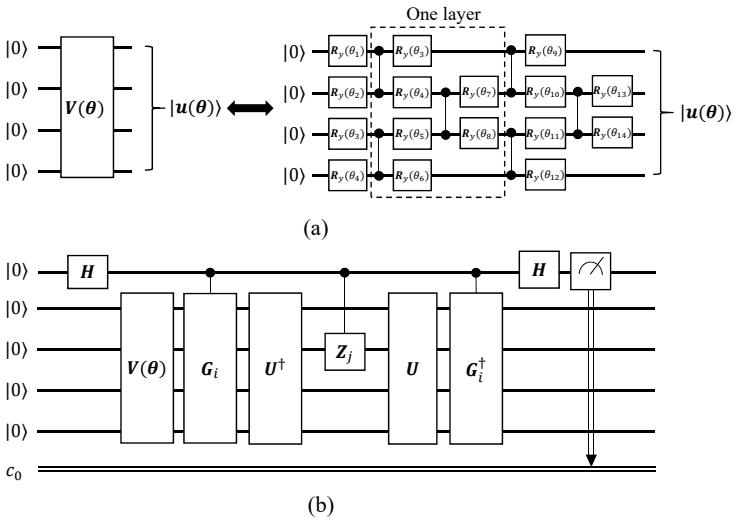
The qANM framework that uses high-order Taylor series expansions to linearize nonlinear problems, solved via variational quantum linear solver combined with quantum-enhanced Jacobi method.
If this is right
- The high-order ANM formulation captures the solution path effectively through Taylor series expansions.
- Integration with variational quantum linear solver allows handling of the resulting linear systems on quantum devices.
- Quantum-enhanced Jacobi method contributes to solving the sequence of equations.
- The method demonstrates robustness for nonlinear problems on near-term quantum hardware.
- Numerical simulations confirm the convergence of the method.
Where Pith is reading between the lines
- The approach may scale to more complex nonlinear problems in mechanics if noise can be further managed.
- Similar perturbation-based methods could be adapted for other quantum algorithms beyond linear solvers.
- Success on superconducting processors suggests potential applicability to other quantum hardware platforms.
Load-bearing premise
The high-order Taylor series expansions combined with the variational quantum linear solver and quantum-enhanced Jacobi method will remain stable and converge on noisy quantum hardware without requiring error mitigation techniques beyond those implicitly assumed.
What would settle it
An experiment repeating the proof-of-principle on the superconducting quantum processor that fails to achieve high accuracy in tracking the nonlinear solution path or shows divergence in the Taylor series expansions.
Figures





read the original abstract
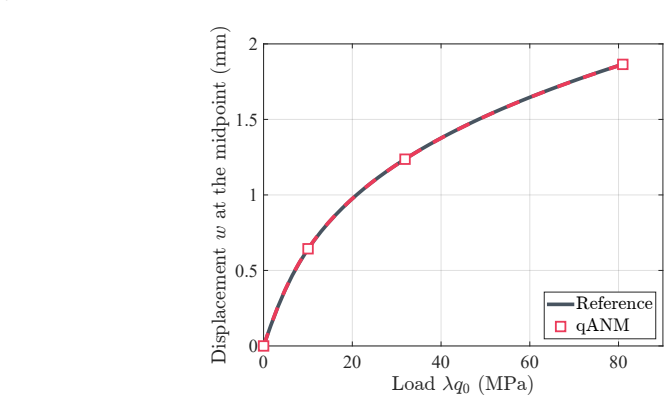
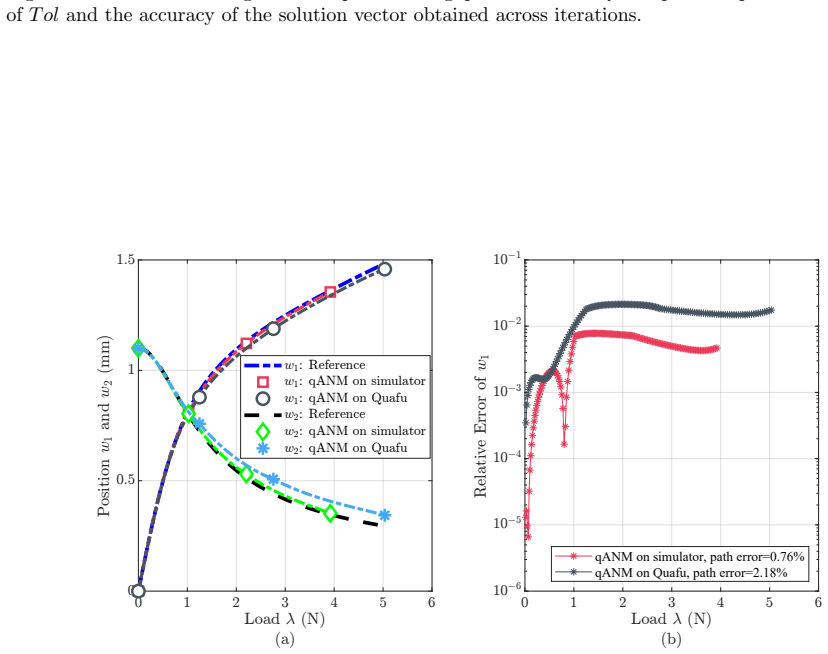
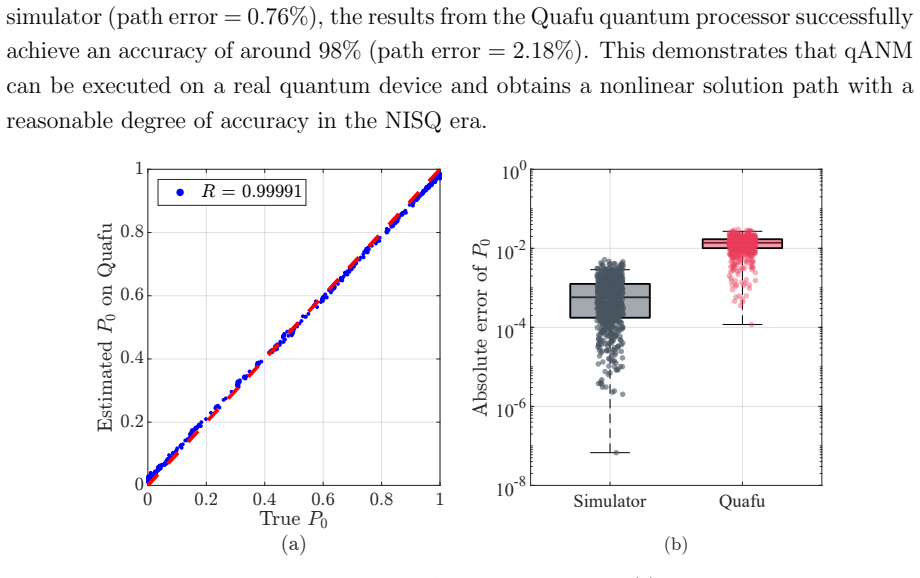
Quantum computing offers a promising avenue for advancing computational methods in science and engineering. In this work, we introduce the quantum asymptotic numerical method (qANM), a framework for solving nonlinear problems using quantum computing. Based on the principle of high-order perturbation techniques, the proposed method uses Taylor series expansions to transform complex nonlinear systems into sequences of linear equations. We integrate the method with the variational quantum linear solver and a quantum-enhanced Jacobi method. Numerical simulations on a quantum simulator validate the convergence of the method. In particular, the high-order ANM formulation demonstrates robustness in addressing nonlinear problems by effectively capturing the solution path through Taylor series expansions. Furthermore, a highlight of this work is a proof-of-principle experiment on a superconducting quantum processor. Despite the noise inherent in near-term quantum hardware, the experiment achieves 98% accuracy in tracking the nonlinear solution path. We believe this work provides a useful reference for applying quantum computing to nonlinear computational mechanics.
Editorial analysis
A structured set of objections, weighed in public.
Referee Report
Summary. The manuscript introduces the quantum asymptotic numerical method (qANM), which applies high-order Taylor series expansions to convert nonlinear problems into sequences of linear systems solved using the variational quantum linear solver (VQLS) and a quantum-enhanced Jacobi method. Validation is reported via numerical simulations on a quantum simulator demonstrating convergence, together with a proof-of-principle experiment on a superconducting quantum processor that achieves 98% accuracy in tracking the nonlinear solution path despite hardware noise.
Significance. If the experimental result holds, the work would constitute an early experimental bridge from quantum linear solvers to nonlinear problems in computational mechanics. The perturbation-based reduction to linear systems is a standard technique that aligns well with existing VQLS capabilities and could scale to larger nonlinear analyses if noise robustness is confirmed.
major comments (2)
- [Experimental Results] Experimental section: The central claim of 98% accuracy on a superconducting processor is load-bearing for the manuscript's contribution, yet no information is supplied on qubit count, circuit depth, ansatz choice, noise model, or error mitigation techniques. Without these details it is impossible to determine whether the reported accuracy reflects genuine robustness of the qANM+VQLS pipeline or depends on unstated low-noise conditions or post-processing.
- [Method Description] Method and convergence analysis: The high-order Taylor expansion is asserted to capture the solution path robustly, but no quantitative bound or numerical study is given on truncation error accumulation when each linear system is solved approximately by VQLS on noisy hardware. This directly affects the validity of the convergence claims made for both the simulator and the hardware experiment.
minor comments (1)
- [Abstract] The abstract states that simulations 'validate the convergence of the method' but does not identify the specific nonlinear test problem or the order of the Taylor expansion used.
Simulated Author's Rebuttal
We thank the referee for their constructive feedback, which helps strengthen the manuscript. We address each major comment below and will revise the paper to incorporate the requested details and analysis.
read point-by-point responses
-
Referee: [Experimental Results] Experimental section: The central claim of 98% accuracy on a superconducting processor is load-bearing for the manuscript's contribution, yet no information is supplied on qubit count, circuit depth, ansatz choice, noise model, or error mitigation techniques. Without these details it is impossible to determine whether the reported accuracy reflects genuine robustness of the qANM+VQLS pipeline or depends on unstated low-noise conditions or post-processing.
Authors: We agree that these implementation details are essential for evaluating the experimental result. In the revised manuscript we will add the qubit count, circuit depths, ansatz choice for VQLS, the noise model of the superconducting device, and any error-mitigation steps employed. The 98 % figure was obtained on the specific hardware configuration that will now be fully documented, allowing readers to assess the conditions under which the accuracy was achieved. revision: yes
-
Referee: [Method Description] Method and convergence analysis: The high-order Taylor expansion is asserted to capture the solution path robustly, but no quantitative bound or numerical study is given on truncation error accumulation when each linear system is solved approximately by VQLS on noisy hardware. This directly affects the validity of the convergence claims made for both the simulator and the hardware experiment.
Authors: We acknowledge the absence of a quantitative error-propagation study. While simulator results show convergence, we did not analyze how VQLS approximation errors accumulate across the Taylor orders on noisy hardware. The revised manuscript will include a dedicated numerical study of truncation-error accumulation under approximate linear solves, together with a discussion of its implications for the reported convergence on both simulator and hardware. revision: yes
Circularity Check
No circularity; derivation relies on standard perturbation theory and external quantum solvers
full rationale
The paper presents qANM as a combination of high-order Taylor series expansions (standard asymptotic numerical method) with VQLS and a quantum-enhanced Jacobi method. The 98% accuracy result is an experimental outcome on superconducting hardware, not a fitted parameter or self-referential prediction. No equations or steps in the provided abstract reduce the central claim to its own inputs by construction, and no load-bearing self-citations or uniqueness theorems are invoked. The method chain is self-contained against external benchmarks from classical ANM and variational quantum algorithms.
Axiom & Free-Parameter Ledger
axioms (2)
- standard math Taylor series expansions can be used to transform nonlinear systems into sequences of linear equations
- domain assumption Variational quantum linear solver and quantum-enhanced Jacobi method can be integrated with the perturbation sequence
Forward citations
Cited by 1 Pith paper
-
Abstract Theory of Bogoliubov Linearizations with Application to Nonlinear Thermodynamic Formalism
A general theory of Bogoliubov linearizations is established for nonlinear variational problems on convex compact spaces, with a connection to optimal transport proven and new results obtained in nonlinear thermodynam...
Reference graph
Works this paper leans on
-
[1]
C. Song, K. Xu, H. Li, Y.-R. Zhang, X. Zhang, W. Liu, Q. Guo, Z. Wang, W. Ren, J. Hao, H. Feng, H. Fan, D. Zheng, D.-W. Wang, H. Wang, S.-Y. Zhu, Generation of multicomponent atomic Schr¨ odinger cat states of up to 20 qubits, Science 365 (6453) (2019) 574–577
work page 2019
-
[2]
Z. Yan, Y.-R. Zhang, M. Gong, Y. Wu, Y. Zheng, S. Li, C. Wang, F. Liang, J. Lin, Y. Xu, C. Guo, L. Sun, C.-Z. Peng, K. Xia, H. Deng, H. Rong, J. Q. You, F. Nori, H. Fan, X. Zhu, J.-W. Pan, Strongly correlated quantum walks with a 12-qubit superconducting processor, Science 364 (6442) (2019) 753–756
work page 2019
- [3]
-
[4]
H.-S. Zhong, H. Wang, Y.-H. Deng, M.-C. Chen, L.-C. Peng, Y.-H. Luo, J. Qin, D. Wu, X. Ding, Y. Hu, P. Hu, X.-Y. Yang, W.-J. Zhang, H. Li, Y. Li, X. Jiang, L. Gan, G. Yang, L. You, Z. Wang, L. Li, N.-L. Liu, C.-Y. Lu, J.-W. Pan, Quantum computational advantage using photons, Science 370 (6523) (2020) 1460–1463
work page 2020
-
[5]
L. K. Grover, From Schr¨ odinger’s equation to the quantum search algorithm, Amer- ican Journal of Physics 69 (7) (2001) 769–777
work page 2001
-
[6]
O. M. Raisuddin, S. De, Feqa: Finite element computations on quantum annealers, Computer Methods in Applied Mechanics and Engineering 395 (2022) 115014
work page 2022
-
[7]
Y. Sato, H. C. Watanabe, R. Raymond, R. Kondo, K. Wada, K. Endo, M. Sugawara, N. Yamamoto, Variational quantum algorithm for generalized eigenvalue problems and its application to the finite-element method, Physical Review A 108 (2) (2023) 022429. 29
work page 2023
-
[8]
S. Jin, N. Liu, Y. Yu, Time complexity analysis of quantum difference methods for linear high dimensional and multiscale partial differential equations, Journal of Computational Physics 471 (2022) 111641
work page 2022
-
[9]
S. Jin, N. Liu, Y. Yu, Quantum simulation of partial differential equations: Applica- tions and detailed analysis, Physical Review A 108 (3) (2023) 032603
work page 2023
-
[10]
Y. Xu, J. Yang, Z. Kuang, Q. Huang, W. Huang, H. Hu, Quantum computing en- hanced distance-minimizing data-driven computational mechanics, Computer Meth- ods in Applied Mechanics and Engineering 419 (2024) 116675
work page 2024
- [11]
- [12]
-
[13]
K. Wils, B. Chen, A symbolic approach to discrete structural optimization using quantum annealing, Mathematics 11 (16) (2023) 3451
work page 2023
-
[14]
Y. Wang, J. E. Kim, K. Suresh, Opportunities and challenges of quantum comput- ing for engineering optimization, Journal of Computing and Information Science in Engineering 23 (6) (2023) 060817
work page 2023
-
[15]
B. Liu, M. Ortiz, F. Cirak, Towards quantum computational mechanics, Computer Methods in Applied Mechanics and Engineering 432 (2024) 117403
work page 2024
-
[16]
B. Liu, L. Zhu, Z. Yang, G. He, Quantum implementation of numerical methods for convection-diffusion equations: Toward computational fluid dynamics, Computer Physics Communications 33 (2023) 425–451
work page 2023
-
[17]
Z. Meng, J. Zhong, S. Xu, K. Wang, J. Chen, F. Jin, X. Zhu, Y. Gao, Y. Wu, C. Zhang, et al., Simulating unsteady flows on a superconducting quantum processor, Communications Physics 7 (1) (2024) 349
work page 2024
-
[18]
Z.-Y. Chen, T.-Y. Ma, C.-C. Ye, L. Xu, W. Bai, L. Zhou, M.-Y. Tan, X.-N. Zhuang, X.-F. Xu, Y.-J. Wang, et al., Enabling large-scale and high-precision fluid simulations on near-term quantum computers, Computer Methods in Applied Mechanics and Engineering 432 (2024) 117428
work page 2024
-
[19]
P. Trovalusci, R. Masiani, Non-linear micropolar and classical continua for anisotropic discontinuous materials, International Journal of Solids and Structures 40 (5) (2003) 1281–1297. 30
work page 2003
-
[20]
Wriggers, Nonlinear finite element methods, Springer Science & Business Media, 2008
P. Wriggers, Nonlinear finite element methods, Springer Science & Business Media, 2008
work page 2008
-
[21]
J. N. Reddy, An introduction to nonlinear finite element analysis: with applications to heat transfer, fluid mechanics, and solid mechanics, Oxford University Press, 2014
work page 2014
-
[22]
R. De Borst, M. A. Crisfield, J. J. Remmers, C. V. Verhoosel, Nonlinear finite element analysis of solids and structures, John Wiley & Sons, 2012
work page 2012
-
[23]
X. Han, J. Gao, M. Fleming, C. Xu, W. Xie, S. Meng, W. K. Liu, Efficient multiscale modeling for woven composites based on self-consistent clustering analysis, Computer Methods in Applied Mechanics and Engineering 364 (2020) 112929
work page 2020
-
[24]
A. Ferreira, J. Barbosa, Buckling behaviour of composite shells, Composite Struc- tures 50 (1) (2000) 93–98
work page 2000
-
[25]
A. W. Harrow, A. Hassidim, S. Lloyd, Quantum algorithm for linear systems of equations, Physical Review Letters 103 (15) (2009) 150502
work page 2009
-
[26]
S. K. Leyton, T. J. Osborne, A quantum algorithm to solve nonlinear differential equations, arXiv preprint arXiv:0812.4423 (2008)
work page internal anchor Pith review Pith/arXiv arXiv 2008
-
[27]
J.-P. Liu, H. Ø. Kolden, H. K. Krovi, N. F. Loureiro, K. Trivisa, A. M. Childs, Effi- cient quantum algorithm for dissipative nonlinear differential equations, Proceedings of the National Academy of Sciences 118 (35) (2021) e2026805118
work page 2021
-
[28]
C. Xue, Y. Wu, G. Guo, Quantum newton’s method for solving the system of non- linear equations, in: Spin, Vol. 11, World Scientific, 2021, p. 2140004
work page 2021
-
[29]
C. Bravo-Prieto, R. LaRose, M. Cerezo, Y. Subasi, L. Cincio, P. J. Coles, Variational quantum linear solver, Quantum 7 (2023) 1188
work page 2023
-
[30]
M. Ali, M. Kabel, Performance study of variational quantum algorithms for solving the poisson equation on a quantum computer, Physical Review Applied 20 (1) (2023) 014054
work page 2023
-
[31]
C. J. Trahan, M. Loveland, N. Davis, E. Ellison, A variational quantum linear solver application to discrete finite-element methods, Entropy 25 (4) (2023) 580
work page 2023
-
[32]
A. Pellow-Jarman, I. Sinayskiy, A. Pillay, F. Petruccione, Near term algorithms for linear systems of equations, Quantum Information Processing 22 (6) (2023) 258
work page 2023
-
[33]
Aaronson, Read the fine print, Nature Physics 11 (4) (2015) 291–293
S. Aaronson, Read the fine print, Nature Physics 11 (4) (2015) 291–293. 31
work page 2015
- [34]
- [35]
-
[36]
M. Potier-Ferry, Asymptotic numerical method for hyperelasticity and elastoplastic- ity: a review, Proceedings of the Royal Society A 480 (2285) (2024) 20230714
work page 2024
- [37]
-
[38]
H. Zahrouni, B. Cochelin, M. Potier-Ferry, Computing finite rotations of shells by an asymptotic-numerical method, Computer Methods in Applied Mechanics and Engi- neering 175 (1-2) (1999) 71–85
work page 1999
- [39]
-
[40]
Y. Hui, Q. Huang, G. De Pietro, G. Giunta, H. Hu, S. Belouettar, E. Carrera, Hierar- chical beam finite elements for geometrically nonlinear analysis coupled with asymp- totic numerical method, Mechanics of Advanced Materials and Structures 28 (24) (2021) 2487–2500
work page 2021
-
[41]
S. Nezamabadi, J. Yvonnet, H. Zahrouni, M. Potier-Ferry, A multilevel computa- tional strategy for handling microscopic and macroscopic instabilities, Computer Methods in Applied Mechanics and Engineering 198 (27-29) (2009) 2099–2110
work page 2009
-
[42]
Y. Hui, R. Xu, G. Giunta, G. De Pietro, H. Hu, S. Belouettar, E. Carrera, Multiscale CUF-FE2 nonlinear analysis of composite beam structures, Computers & Structures 221 (2019) 28–43
work page 2019
-
[43]
S. Du, H. Ben Dhia, An asymptotic numerical method to solve compliant Lennard- Jones-based contact problems involving adhesive instabilities, Computational Me- chanics 63 (6) (2019) 1261–1281
work page 2019
- [44]
-
[45]
Saad, Iterative methods for sparse linear systems, SIAM, 2003
Y. Saad, Iterative methods for sparse linear systems, SIAM, 2003
work page 2003
-
[46]
A. Javadi-Abhari, M. Treinish, K. Krsulich, C. J. Wood, J. Lishman, J. Gacon, S. Martiel, P. D. Nation, L. S. Bishop, A. W. Cross, B. R. Johnson, J. M. Gambetta, Quantum computing with Qiskit (2024). arXiv:2405.08810
work page internal anchor Pith review Pith/arXiv arXiv 2024
-
[47]
Beijing Academy of Quantum Information Sciences, Institute of Physics of the Chi- nese Academy of Sciences, Tsinghua University, Quafu Quantum Cloud Computing Cluster, https://quafu.baqis.ac.cn/ (2024)
work page 2024
-
[48]
M. Potier-Ferry, N. Damil, B. Braikat, J. Descamps, J.-M. Cadou, H. L. Cao, A. E. Hussein, Traitement des fortes non-lin´ earit´ es par la m´ ethode asymptotique num´ erique, Comptes Rendus de l’Acad´ emie des Sciences-Series IIB-Mechanics- Physics-Chemistry-Astronomy 324 (3) (1997) 171–177
work page 1997
- [49]
- [50]
-
[51]
L. Guillot, B. Cochelin, C. Vergez, A generic and efficient taylor series–based contin- uation method using a quadratic recast of smooth nonlinear systems, International Journal for Numerical Methods in Engineering 119 (4) (2019) 261–280
work page 2019
-
[52]
B. Cochelin, A path-following technique via an asymptotic-numerical method, Com- puters & Structures 53 (5) (1994) 1181–1192
work page 1994
- [53]
-
[54]
Y. Xu, J. Yang, X. Bai, Q. Huang, N. Damil, H. Hu, Material database construc- tion for data-driven computing via a continuous path-following method, Composite Structures 319 (2023) 117187
work page 2023
-
[55]
K. Jia, SANM: a symbolic asymptotic numerical solver with applications in mesh deformation, ACM Transactions on Graphics (TOG) 40 (4) (2021) 1–16
work page 2021
-
[56]
A. Kandala, A. Mezzacapo, K. Temme, M. Takita, M. Brink, J. M. Chow, J. M. Gambetta, Hardware-efficient variational quantum eigensolver for small molecules and quantum magnets, Nature 549 (7671) (2017) 242–246. 33
work page 2017
-
[57]
M. J. Powell, Direct search algorithms for optimization calculations, Acta Numerica 7 (1998) 287–336
work page 1998
-
[58]
Wendland, Numerical linear algebra: An introduction, Vol
H. Wendland, Numerical linear algebra: An introduction, Vol. 56, Cambridge Uni- versity Press, 2017
work page 2017
-
[59]
L. Zhao, Z. Zhao, P. Rebentrost, J. Fitzsimons, Compiling basic linear algebra sub- routines for quantum computers, Quantum Machine Intelligence 3 (2) (2021) 21
work page 2021
- [60]
-
[61]
V. Giovannetti, S. Lloyd, L. Maccone, Quantum random access memory, Physical Review Letters 100 (16) (2008) 160501
work page 2008
-
[62]
M. A. Nielsen, I. L. Chuang, Quantum computation and quantum information, 10th Edition, Cambridge University Press, USA, 2011
work page 2011
-
[63]
Strang, Computational science and engineering, SIAM, 2007
G. Strang, Computational science and engineering, SIAM, 2007
work page 2007
-
[64]
X. Bonet-Monroig, H. Wang, D. Vermetten, B. Senjean, C. Moussa, T. B¨ ack, V. Dun- jko, T. E. O’Brien, Performance comparison of optimization methods on variational quantum algorithms, Physical Review A 107 (3) (2023) 032407
work page 2023
- [65]
-
[66]
R. Iten, R. Colbeck, I. Kukuljan, J. Home, M. Christandl, Quantum circuits for isometries, Physical Review A 93 (3) (2016) 032318
work page 2016
-
[67]
Y. Li, S. C. Benjamin, Efficient variational quantum simulator incorporating active error minimization, Physical Review X 7 (2) (2017) 021050
work page 2017
-
[68]
S. Uno, Y. Suzuki, K. Hisanaga, R. Raymond, T. Tanaka, T. Onodera, N. Yamamoto, Modified grover operator for quantum amplitude estimation, New Journal of Physics 23 (8) (2021) 083031
work page 2021
- [69]
-
[70]
Preskill, Quantum computing in the NISQ era and beyond, Quantum 2 (2018) 79
J. Preskill, Quantum computing in the NISQ era and beyond, Quantum 2 (2018) 79
work page 2018
-
[71]
B. Cochelin, N. Damil, M. Potier-Ferry, M´ ethode Asymptotique Num´ erique, Herm` es- Lavoisier, Paris, 2007. 34
work page 2007
-
[72]
J. Choe, Q. Huang, J. Yang, H. Hu, An efficient approach to investigate the post- buckling behaviors of sandwich structures, Composite Structures 201 (2018) 377–388
work page 2018
-
[73]
J. Biamonte, P. Wittek, N. Pancotti, P. Rebentrost, N. Wiebe, S. Lloyd, Quantum machine learning, Nature 549 (7671) (2017) 195–202
work page 2017
- [74]
-
[75]
A. Kandala, K. Temme, A. D. C´ orcoles, A. Mezzacapo, J. M. Chow, J. M. Gambetta, Error mitigation extends the computational reach of a noisy quantum processor, Nature 567 (7749) (2019) 491–495
work page 2019
-
[76]
S. P. Timoshenko, J. M. Gere, Theory of elastic stability, Courier Corporation, 2012
work page 2012
-
[77]
Quantum algorithm for nonlinear differential equations,
S. Lloyd, G. De Palma, C. Gokler, B. Kiani, Z.-W. Liu, M. Marvian, F. Tennie, T. Palmer, Quantum algorithm for nonlinear differential equations, arXiv preprint arXiv:2011.06571 (2020)
-
[78]
S. Jin, N. Liu, Y. Yu, Time complexity analysis of quantum algorithms via linear representations for nonlinear ordinary and partial differential equations, Journal of Computational Physics 487 (2023) 112149
work page 2023
-
[79]
Y. Sato, R. Kondo, I. Hamamura, T. Onodera, N. Yamamoto, Hamiltonian sim- ulation for hyperbolic partial differential equations by scalable quantum circuits, Physical Review Research 6 (3) (2024) 033246
work page 2024
- [80]
discussion (0)
Sign in with ORCID, Apple, or X to comment. Anyone can read and Pith papers without signing in.