Design and Analysis of a Concatenated Code for Intersymbol Interference Wiretap Channels
Pith reviewed 2026-05-23 05:09 UTC · model grok-4.3
The pith
A concatenated LDPC-trellis scheme achieves tight lower bounds on secrecy capacity for ISI wiretap channels while driving the leakage upper bound to zero.
A machine-rendered reading of the paper's core claim, the machinery that carries it, and where it could break.
Core claim
The central claim is that the proposed concatenated scheme, built from outer LDPC codes nested inside inner trellis codes, attains tight lower bounds on the secrecy capacity of ISI wiretap channels; further, optimization of the irregular LDPC degree distributions reduces the upper bound on the information leakage rate to zero, meeting the weak secrecy criterion.
What carries the argument
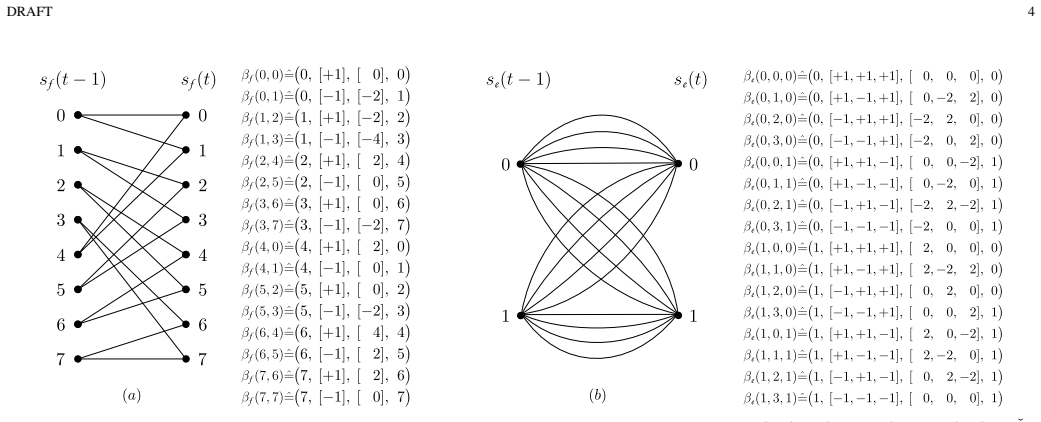
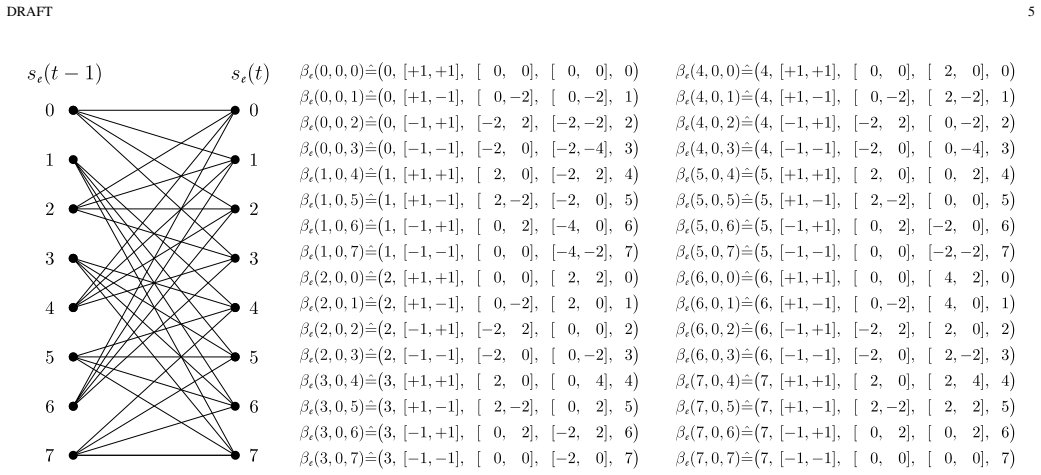
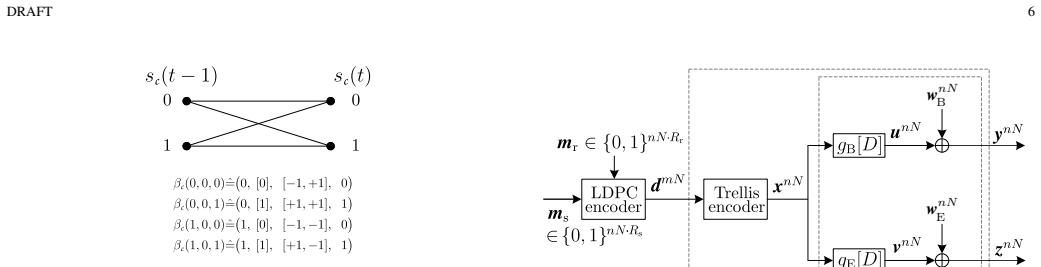
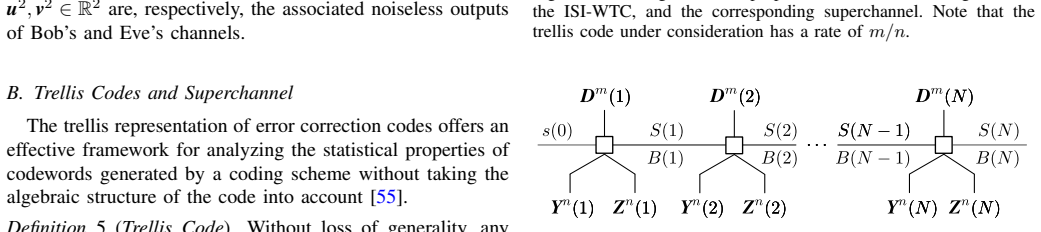
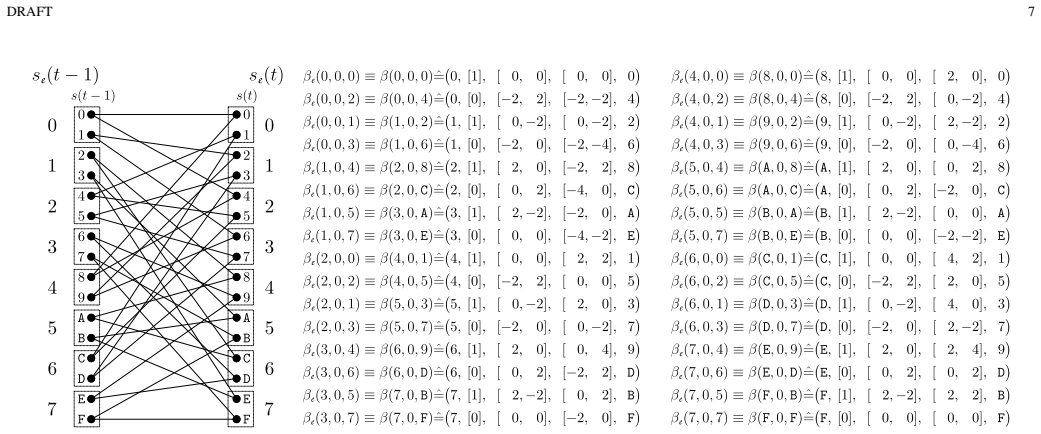
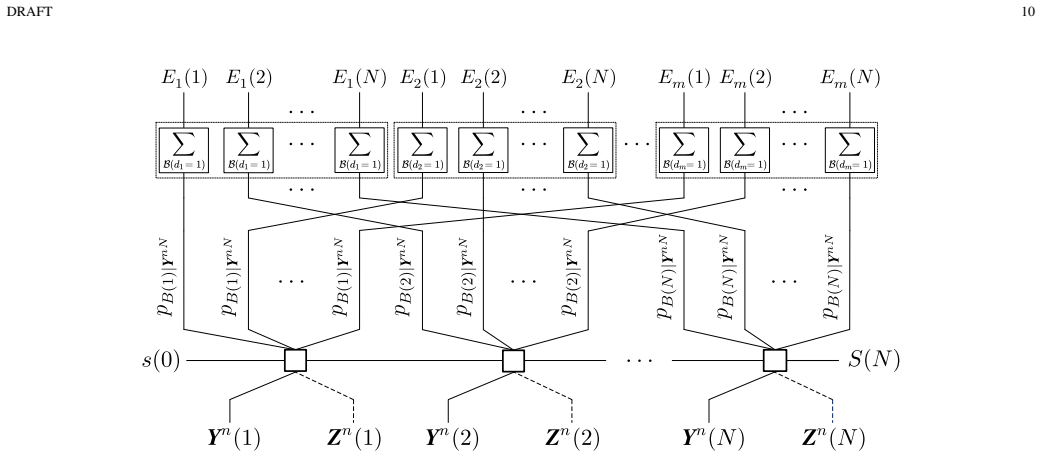
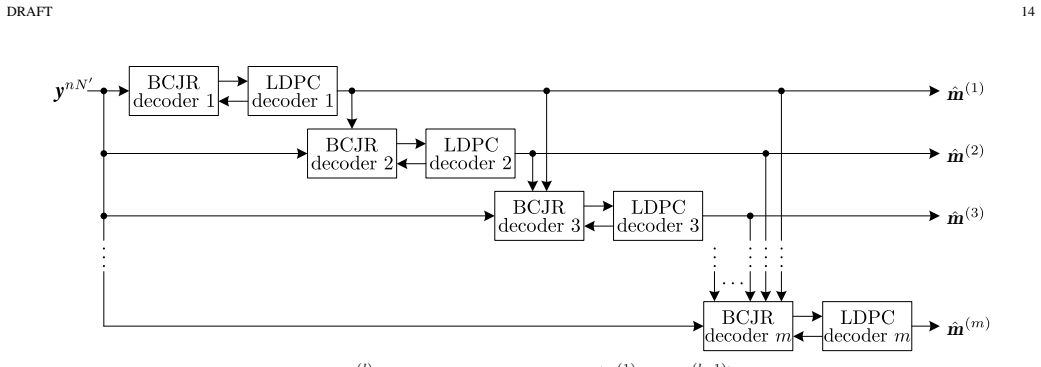
The nested wiretap-code structure in which outer LDPC codes generate uniformly distributed words that inner trellis codes reshape into a Markov process whose transition probabilities achieve the secrecy-capacity lower bound.
If this is right
- Reliable rates arbitrarily close to the secrecy capacity become achievable with finite-length codes over ISI wiretap channels.
- The same concatenated architecture can be reused for any channel whose secrecy capacity is achieved by a Markov input distribution.
- Weak secrecy is obtained solely by degree optimization rather than by explicit randomness extraction at the encoder.
Where Pith is reading between the lines
- If the inner trellis stage can be made rate-preserving for other memory channels, the same outer-code optimization may extend to non-ISI wiretap models.
- The leakage-bound reduction to zero suggests that finite-length LDPC ensembles can be tuned to satisfy strong secrecy in the limit, though the paper stops at the weak criterion.
Load-bearing premise
A trellis code exists that maps any uniform LDPC codeword sequence into the exact Markov process required by the secrecy capacity without rate loss or extra leakage.
What would settle it
Numerical optimization of the LDPC degree distributions fails to drive the computed upper bound on leakage below a positive constant, or the designed trellis code produces a stationary distribution that deviates measurably from the capacity-achieving Markov chain.
Figures


read the original abstract
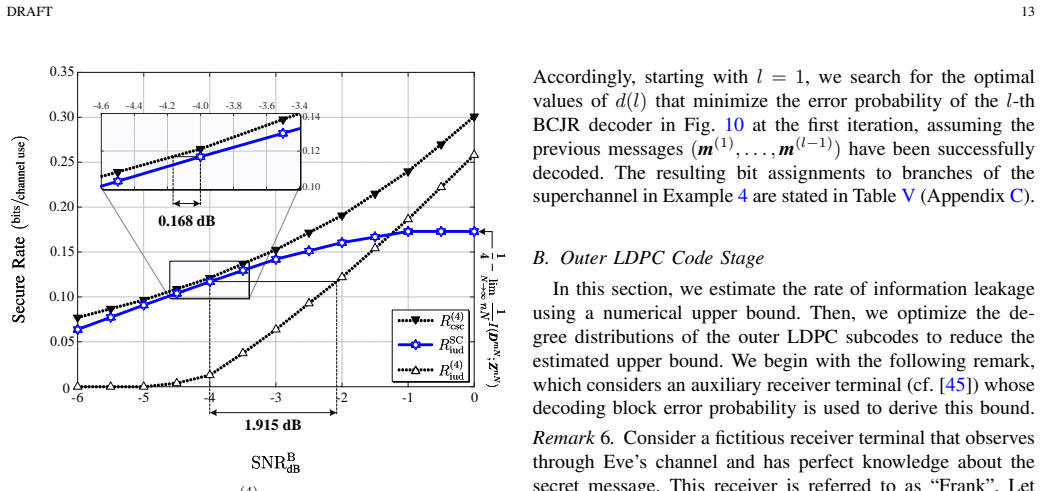
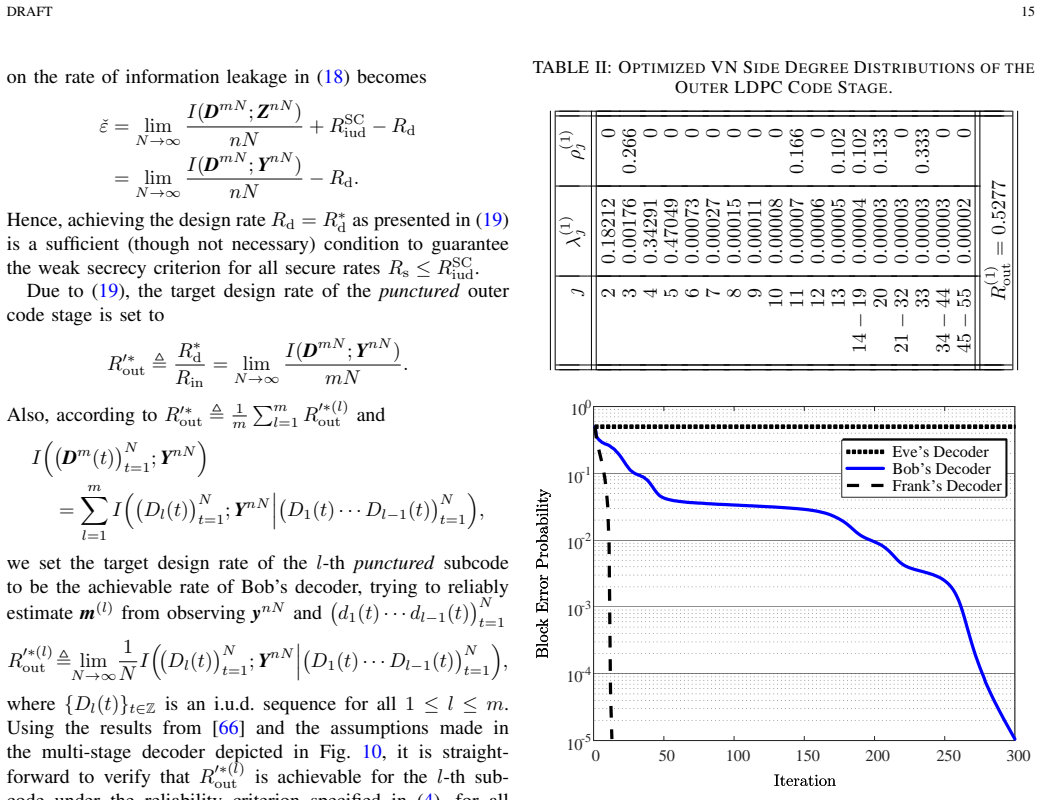
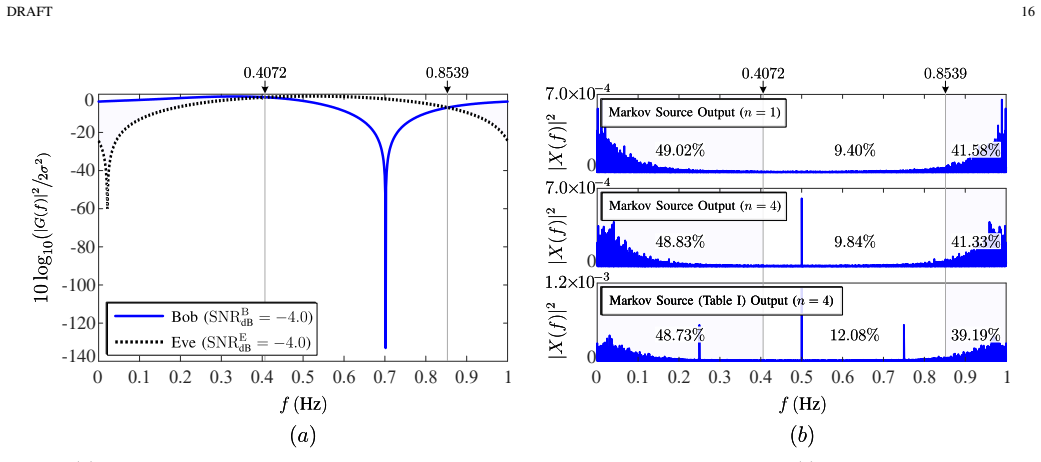
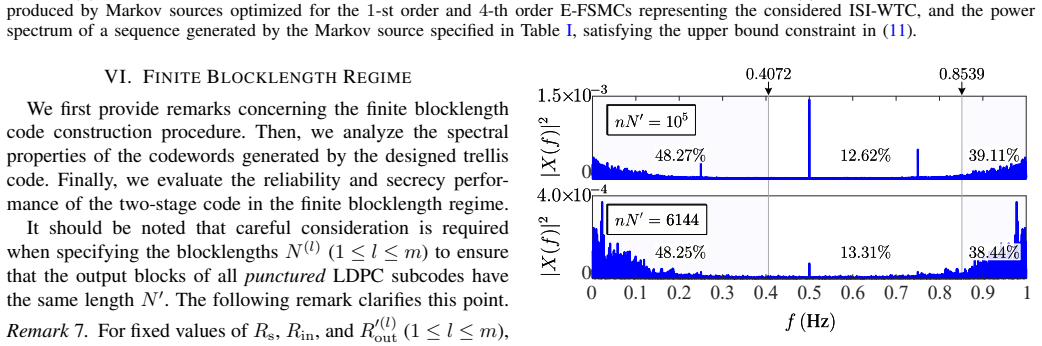
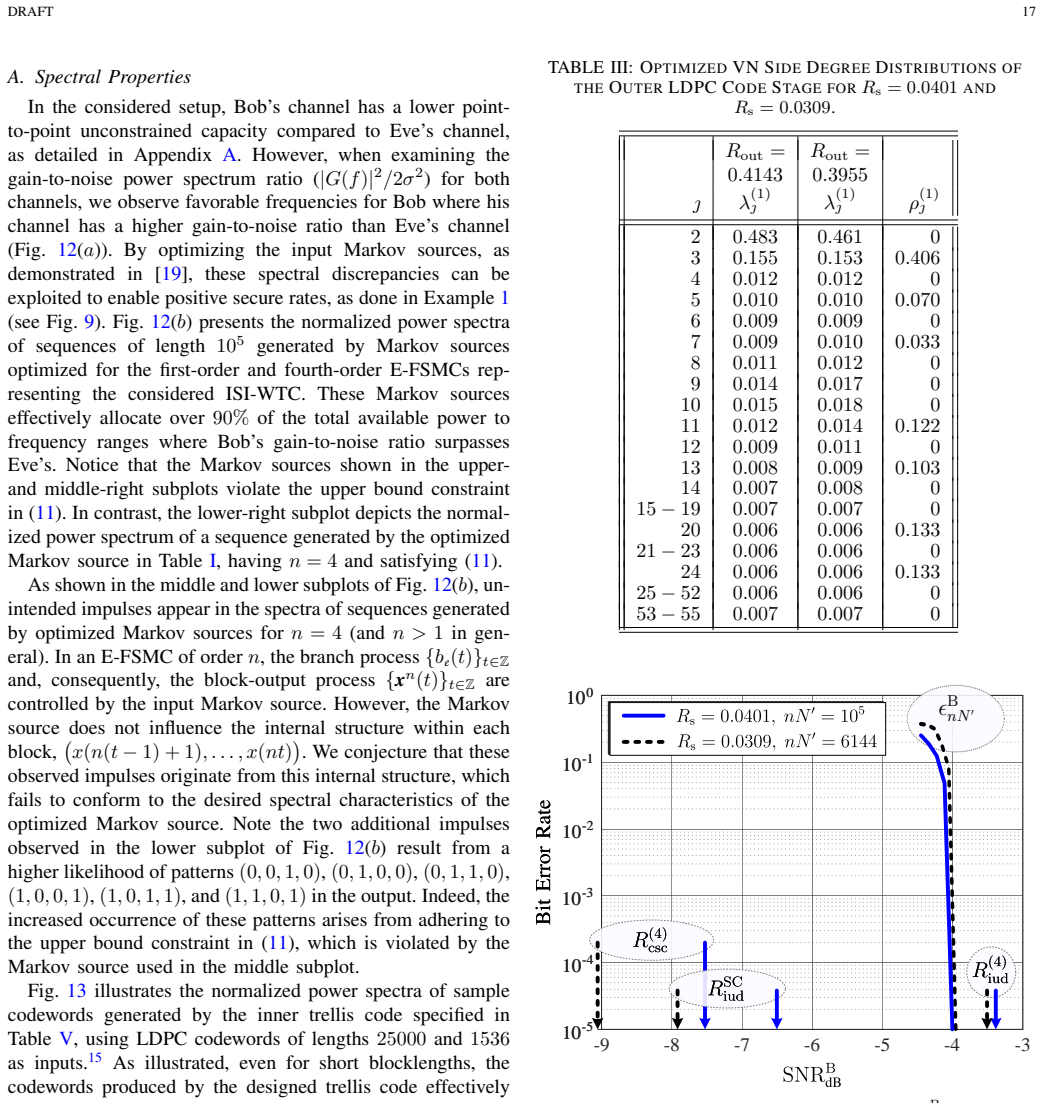
We propose a two-stage concatenated coding scheme for reliable and secure communication over intersymbol interference wiretap channels. We first establish the secrecy capacity. Then, motivated by the theoretical codes that achieve the secrecy capacity, our scheme integrates low-density parity-check (LDPC) codes in the outer stage, forming a nested structure of wiretap codes, with trellis codes in the inner stage to improve achievable secure rates. The trellis code is specifically designed to transform the uniformly distributed codewords produced by the LDPC code stage into a Markov process, achieving tight lower bounds on the secrecy capacity. We further estimate the information leakage rate of the proposed scheme using an upper bound. To meet the weak secrecy criterion, we optimize degree distributions of the irregular LDPC codes at the outer stage, essentially driving the estimated upper bound on the information leakage rate to zero.
Editorial analysis
A structured set of objections, weighed in public.
Referee Report
Summary. The manuscript proposes a two-stage concatenated coding scheme for ISI wiretap channels: an outer nested irregular LDPC wiretap code followed by an inner trellis code that maps uniform LDPC outputs to a stationary Markov process. It first claims to establish the secrecy capacity, then asserts that the scheme achieves tight lower bounds on this capacity; degree-distribution optimization is used to drive an upper bound on the information leakage rate to zero, meeting the weak secrecy criterion.
Significance. If the trellis mapping preserves the exact input statistics required for the secrecy-capacity lower bound without rate loss and if the leakage bound is independent of the optimized degrees, the construction would supply a practical, optimizable coding scheme for a non-trivial class of wiretap channels with memory. The explicit use of nested wiretap codes and the Markov-motivated inner stage are concrete contributions that could be useful for further work on channels with ISI.
major comments (2)
- [Abstract / trellis inner code] Abstract and trellis-code design section: the central claim that the inner trellis code converts uniform i.i.d. LDPC codewords into the precise stationary Markov process that attains the secrecy-capacity lower bound, without rate loss or secrecy degradation, is load-bearing; no generator matrix, state diagram, transition-probability verification, or rate calculation is referenced to confirm that the marginal distribution and rate are exactly preserved.
- [Leakage bound and degree optimization] Leakage estimation and LDPC optimization: the information leakage rate is bounded above and the bound is then driven to zero by optimizing the free parameters (LDPC degree distributions); it is unclear whether the upper bound expression remains independent of these parameters or whether the optimization step effectively defines the reported leakage value, which would undermine the claim of an independently verified achievable rate.
minor comments (2)
- [Abstract] The abstract states that secrecy capacity is established but supplies no outline of the derivation or the channel model assumptions; a short paragraph in the introduction would improve readability.
- [Notation] Notation for the Markov process statistics and the resulting secrecy rate expressions should be introduced once and used consistently; several symbols appear without prior definition in the abstract-level description.
Simulated Author's Rebuttal
We thank the referee for the careful review and constructive feedback. Below we respond point-by-point to the major comments, indicating where revisions will be made to improve clarity.
read point-by-point responses
-
Referee: [Abstract / trellis inner code] Abstract and trellis-code design section: the central claim that the inner trellis code converts uniform i.i.d. LDPC codewords into the precise stationary Markov process that attains the secrecy-capacity lower bound, without rate loss or secrecy degradation, is load-bearing; no generator matrix, state diagram, transition-probability verification, or rate calculation is referenced to confirm that the marginal distribution and rate are exactly preserved.
Authors: The trellis code is constructed specifically to map the uniform i.i.d. outputs of the outer LDPC stage onto the exact stationary Markov process that attains the secrecy-capacity lower bound. We will revise the manuscript to include the generator matrix, state diagram, explicit transition-probability verification, and rate calculation demonstrating that the marginal distribution and rate are preserved without loss or secrecy degradation. revision: yes
-
Referee: [Leakage bound and degree optimization] Leakage estimation and LDPC optimization: the information leakage rate is bounded above and the bound is then driven to zero by optimizing the free parameters (LDPC degree distributions); it is unclear whether the upper bound expression remains independent of these parameters or whether the optimization step effectively defines the reported leakage value, which would undermine the claim of an independently verified achievable rate.
Authors: The upper bound on the information leakage rate is derived as an explicit function of the LDPC degree distributions (and other fixed parameters) prior to any optimization. The subsequent optimization identifies degree distributions for which the bound evaluates to zero, confirming that the weak secrecy criterion is met. The bound expression itself is independent of the particular optimized values; the optimization merely demonstrates that suitable parameters exist. We will add a clarifying sentence in the revised manuscript to emphasize this separation. revision: partial
Circularity Check
Derivation chain is self-contained with no circular reductions
full rationale
The paper first establishes the secrecy capacity of the ISI wiretap channel. It then constructs a concatenated scheme motivated by theoretical capacity-achieving codes, with the inner trellis code designed to map uniform LDPC outputs to the required Markov process and the outer irregular LDPC degree distributions optimized to drive an independent upper bound on leakage to zero. This is standard parameter optimization for meeting a design criterion rather than a fitted input renamed as prediction or any self-definitional reduction. No load-bearing self-citation, uniqueness theorem, or ansatz smuggling is present in the text. The central claims rest on explicit design choices whose correctness can be checked externally via the resulting rates and bounds.
Axiom & Free-Parameter Ledger
free parameters (1)
- LDPC degree distributions
axioms (1)
- domain assumption Secrecy capacity of the ISI wiretap channel can be established and used as a benchmark for the concatenated scheme.
discussion (0)
Sign in with ORCID, Apple, or X to comment. Anyone can read and Pith papers without signing in.