Ionic Associations and Hydration in the Electrical Double Layer of Water-in-Salt Electrolytes
Pith reviewed 2026-05-23 05:41 UTC · model grok-4.3
The pith
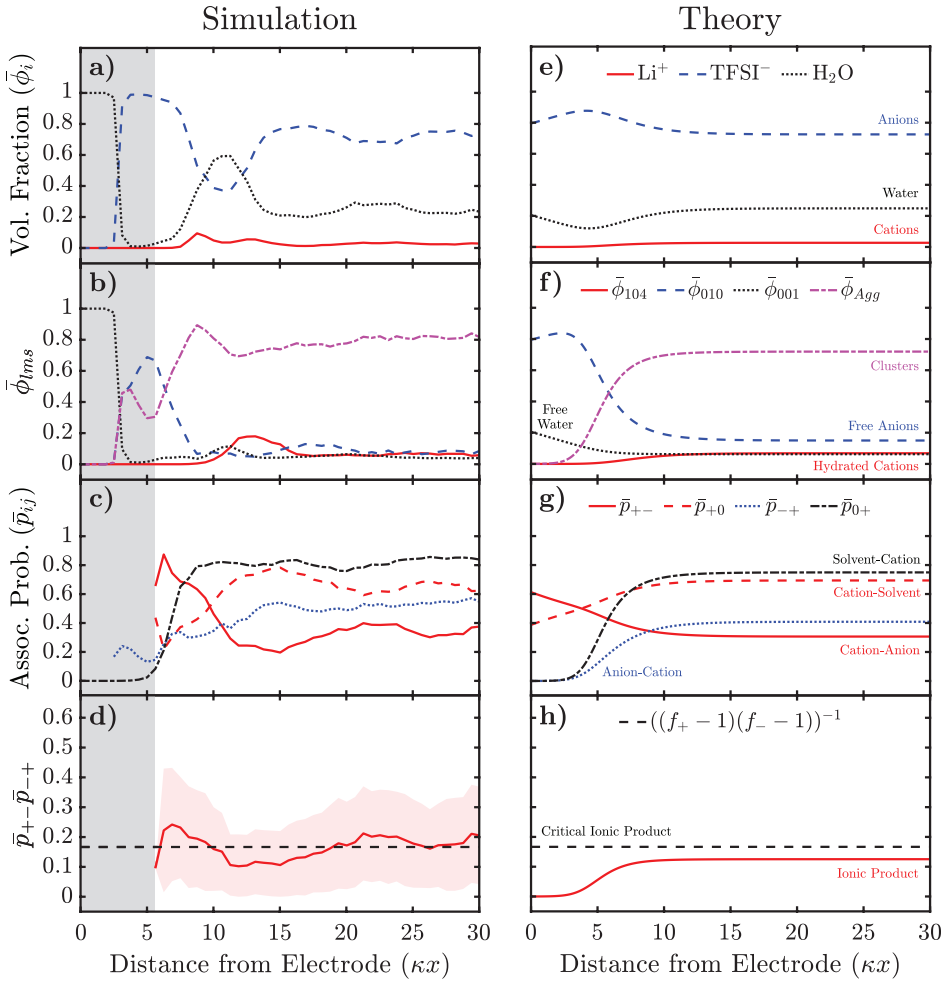
A continuum theory for water-in-salt electrolytes predicts asymmetric electrical double layer structure due to voltage-dependent ionic clustering into Cayley tree aggregates.
A machine-rendered reading of the paper's core claim, the machinery that carries it, and where it could break.
Core claim
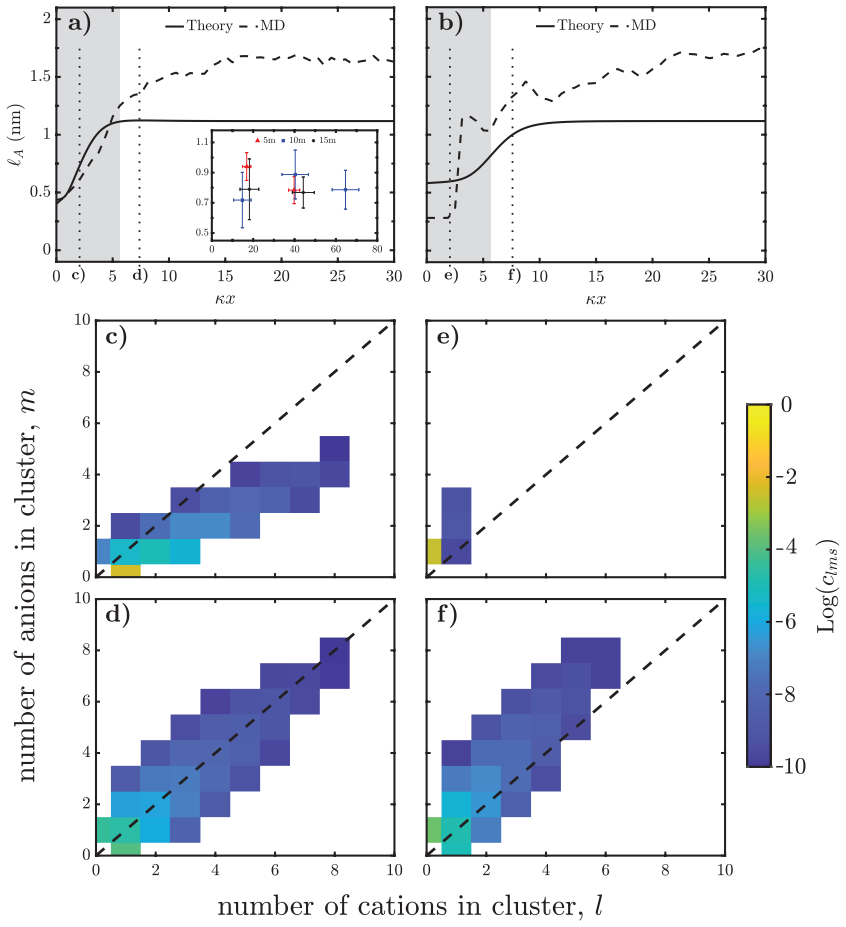
We develop a theory for the electrical double layer of water-in-salt electrolytes that consistently accounts for thermoreversible associations of species into Cayley tree aggregates. The theory predicts an asymmetric structure of the EDL: at negative voltages hydrated Li+ dominate and cluster aggregation is initially slightly enhanced before disintegration at larger voltages, while at positive voltages clusters are strictly diminished compared to the bulk. Atomistic molecular dynamics simulations provide validation with good qualitative agreement, and electrochemical impedance measurements of differential capacitance also show reasonable agreement.
What carries the argument
The consistent incorporation of thermoreversible associations of ions into Cayley tree aggregates within a continuum electrical double layer theory, parameterized from bulk molecular dynamics data.
If this is right
- At negative voltages, hydrated Li+ ions dominate the interface.
- Cluster aggregation is initially slightly enhanced at moderate negative voltages before disintegrating at larger magnitudes.
- At positive voltages, ionic clusters are diminished compared to the bulk electrolyte.
- The model agrees qualitatively with molecular dynamics simulations of the EDL.
- Differential capacitance from the theory matches electrochemical impedance spectroscopy data reasonably well.
Where Pith is reading between the lines
- The predicted asymmetry may cause different rates of solid-electrolyte interphase formation at each electrode polarity.
- The modeling approach could be applied to other concentrated electrolytes to predict interface effects on stability or transport.
- Device-level tests with controlled voltage polarity could reveal whether the asymmetry affects overall cell performance.
- Adding interface-specific adjustments to the bulk-derived parameters might improve quantitative matches to experiment.
Load-bearing premise
That thermoreversible associations of species into Cayley tree aggregates can be consistently incorporated into a continuum EDL theory and that bulk MD data suffice to parameterize the interface model without additional interface-specific fitting.
What would settle it
Molecular dynamics simulations or spectroscopic measurements at the interface showing symmetric cluster behavior or no initial enhancement of aggregation at moderate negative voltages would contradict the predicted asymmetry.
Figures





read the original abstract
Water-in-Salt-Electrolytes (WiSEs) are an exciting class of concentrated electrolytes finding applications in energy storage devices because of their expanded electrochemical stability window, good conductivity and cation transference number, and fire-extinguishing properties. These distinct properties are thought to originate from the presence of an anion-dominated ionic network and interpenetrating water channels for cation transport, which indicates that associations in WiSEs are crucial to understanding their properties. Currently, associations have mainly been investigated in the bulk, while little attention has been given to the electrolyte structure near electrified interfaces. Here, we develop a theory for the electrical double layer (EDL) of WiSEs, where we consistently account for the thermoreversible associations of species into Cayley tree aggregates. The theory predicts an asymmetric structure of the EDL. At negative voltages, hydrated Li$^+$ dominate and cluster aggregation is initially slightly enhanced before disintegration at larger voltages. At positive voltages when compared to the bulk, clusters are strictly diminished. Performing atomistic molecular dynamics (MD) simulations of the EDL of WiSE provides EDL data for validation and bulk data for parameterization of our theory. Validating the predictions of our theory against MD showed good qualitative agreement. Furthermore, we performed electrochemical impendence measurements to determine the differential capacitance of the studied LiTFSI WiSE and also found reasonable agreement with our theory. Overall, the developed approach can be used to investigate ionic aggregation and solvation effects in the EDL, which amongst other properties, can be used to understand the pre-cursers for solid-electrolyte interphase formation.
Editorial analysis
A structured set of objections, weighed in public.
Referee Report
Summary. The paper develops a continuum EDL theory for water-in-salt electrolytes that grafts thermoreversible Cayley-tree ionic association equilibria (parameterized from bulk MD) onto a modified Poisson-Boltzmann framework. It predicts an asymmetric EDL structure in which, at negative voltages, hydrated Li+ dominate and clustering is initially slightly enhanced before disintegrating at larger voltages, while at positive voltages clusters are strictly diminished relative to bulk. The theory is validated against MD simulations of the EDL (showing good qualitative agreement) and against EIS measurements of differential capacitance (reasonable agreement).
Significance. If the result holds, the work supplies a practical route to incorporate association effects into continuum models of concentrated-electrolyte interfaces, which is relevant for understanding voltage-dependent solvation and aggregation that precede SEI formation in WiSE-based devices. The explicit asymmetry prediction and the linkage to both simulation and capacitance data give the framework immediate utility for electrolyte screening, even if quantitative error metrics are not yet supplied.
major comments (2)
- [Theory parameterization and validation sections] The association constants are obtained solely from bulk MD and then used both to construct the EDL model and to validate its predictions against the same class of simulation. This circularity is load-bearing for the central claim of transferable Cayley-tree equilibria; any position- or field-dependent shift in the underlying free energies would change the reported cluster profiles and the predicted asymmetry (see the skeptic note on transferability).
- [EDL structure predictions] The model assumes that the association equilibria remain position-independent even though local ion density, water coordination, and electric-field strength vary sharply within a few angstroms of the electrode. No auxiliary calculation or sensitivity test is presented to quantify how violations of this assumption would alter the negative-bias enhancement versus positive-bias depletion behavior that constitutes the main result.
minor comments (2)
- [Abstract] The abstract states 'good qualitative agreement' and 'reasonable agreement' with MD and EIS but supplies no quantitative metrics, R² values, or error bars, nor any discussion of how post-hoc choices in the MD force-field parameterization propagate into the EDL predictions.
- [Abstract] Typographical errors: 'impendence' (should be 'impedance') and 'pre-cursers' (should be 'precursors').
Simulated Author's Rebuttal
We thank the referee for their thoughtful comments on our manuscript. We address each major comment below and agree that further clarification on the model's assumptions is needed.
read point-by-point responses
-
Referee: [Theory parameterization and validation sections] The association constants are obtained solely from bulk MD and then used both to construct the EDL model and to validate its predictions against the same class of simulation. This circularity is load-bearing for the central claim of transferable Cayley-tree equilibria; any position- or field-dependent shift in the underlying free energies would change the reported cluster profiles and the predicted asymmetry (see the skeptic note on transferability).
Authors: The association constants are derived from bulk MD simulations that are independent of the EDL simulations. The EDL MD simulations serve as validation data and were not used to fit any parameters. This structure avoids direct circularity. The agreement with EDL MD supports the applicability of the bulk-derived model to the interface. We recognize that the transferability assumption regarding position- or field-dependent free energies is central and not explicitly tested beyond the overall validation. We will add text in the revised manuscript to discuss this assumption more explicitly and its implications for the asymmetry prediction. revision: partial
-
Referee: [EDL structure predictions] The model assumes that the association equilibria remain position-independent even though local ion density, water coordination, and electric-field strength vary sharply within a few angstroms of the electrode. No auxiliary calculation or sensitivity test is presented to quantify how violations of this assumption would alter the negative-bias enhancement versus positive-bias depletion behavior that constitutes the main result.
Authors: The continuum model is formulated under the assumption of position-independent association equilibria to maintain computational tractability and consistency with the bulk parameterization. We agree that this is a significant approximation given the sharp variations near the electrode. No sensitivity test is provided in the current work. In the revised version, we will incorporate a discussion of this limitation and include a simple sensitivity analysis, for instance by perturbing the association constants as a function of position or field strength to assess robustness of the asymmetric behavior. revision: yes
Circularity Check
No significant circularity; model derivation and validation remain independent
full rationale
The paper constructs a continuum EDL model by incorporating thermoreversible Cayley-tree associations into a modified Poisson-Boltzmann framework. Association parameters are obtained from bulk MD and the resulting predictions are compared to separate EDL MD profiles plus experimental EIS capacitance data. No equation reduces to its own input by construction, no fitted quantity is relabeled as a prediction, and no load-bearing step relies on a self-citation chain or imported uniqueness theorem. The transferability assumption is an explicit modeling choice whose validity is tested against held-out EDL data rather than enforced by the fitting procedure itself.
Axiom & Free-Parameter Ledger
free parameters (1)
- association constants / energies
axioms (1)
- domain assumption Ionic associations form thermoreversible Cayley tree aggregates
invented entities (1)
-
Cayley tree aggregates at the interface
no independent evidence
Lean theorems connected to this paper
-
IndisputableMonolith/Cost/FunctionalEquation.leanwashburn_uniqueness_aczel unclear?
unclearRelation between the paper passage and the cited Recognition theorem.
thermoreversible associations of species into Cayley tree aggregates... λ+− = exp{−βΔf+−}... parameterized from bulk MD simulations
-
IndisputableMonolith/Foundation/AbsoluteFloorClosure.leanreality_from_one_distinction unclear?
unclearRelation between the paper passage and the cited Recognition theorem.
modified Poisson-Boltzmann equation... κ = sqrt(e²β(c+ + c−)/v0ϵ0ϵr)
What do these tags mean?
- matches
- The paper's claim is directly supported by a theorem in the formal canon.
- supports
- The theorem supports part of the paper's argument, but the paper may add assumptions or extra steps.
- extends
- The paper goes beyond the formal theorem; the theorem is a base layer rather than the whole result.
- uses
- The paper appears to rely on the theorem as machinery.
- contradicts
- The paper's claim conflicts with a theorem or certificate in the canon.
- unclear
- Pith found a possible connection, but the passage is too broad, indirect, or ambiguous to say the theorem truly supports the claim.
Forward citations
Cited by 1 Pith paper
-
Theory of Cation Solvation in the Helmholtz Layer of Li-ion Battery Electrolytes
A theory of Li+ solvation in the Helmholtz layer, parameterized from bulk MD, finds binding probabilities remain equal to bulk values, supporting bulk solvation as a proxy for SEI studies.
Reference graph
Works this paper leans on
-
[1]
A new class of Solvent-in-Salt elec- trolyte for high-energy rechargeable metallic lithium batteries
(1) Suo, L.; Hu, Y.-S.; Li, H.; Armand, M.; Chen, L. A new class of Solvent-in-Salt elec- trolyte for high-energy rechargeable metallic lithium batteries. Nat. Commun. 2013, 4,
work page 2013
-
[2]
(2) Suo, L.; Borodin, O.; Gao, T.; Olguin, M.; Ho, J.; Fan, X.; Luo, C.; Wang, C.; Xu, K. ”Water-in-salt” electrolyte enables high-voltage aqueous lithium-ion chemistries. Sci- ence 2015, 350, 938–43. (3) Smith, L.; Dunn, B. Opening the window for aqueous electrolytes. Science 2015, 350, 918–918. (4) Wang, J.; Yamada, Y.; Sodeyama, K.; Chiang, C. H.; Tate...
work page 2015
-
[3]
(29) Han, K. S.; Yu, Z.; Wang, H.; Redfern, P. C.; Ma, L.; Cheng, L.; Chen, Y.; Hu, J. Z.; Curtiss, L. A.; Xu, K., et al. Origin of Unusual Acidity and Li+ Diffusivity in a Series of Water-in-Salt Electrolytes. The Journal of Physical Chemistry B 2020, (30) Andersson, R.; ˚Ar´ en, F.; Franco, A. A.; Johansson, P. Ion Transport Mechanisms via Time-Dependen...
work page 2020
-
[4]
(40) Bazant, M. Z.; Storey, B. D.; Kornyshev, A. A. Double Layer in Ionic Liquids: Over- screening versus Crowding. Phys. Rev. Lett. 2011, 106, 046102. 102 (41) McEldrew, M.; Goodwin, Z. A.; Bi, S.; Bazant, M. Z.; Kornyshev, A. A. Theory of Ion Aggregation and Gelation in Super-Concentrated Electrolytes. J. Chem. Phys. 2020, 152, 234506. (42) McEldrew, M....
work page 2011
-
[5]
(47) Stockmayer, W. H. Theory of molecular size distribution and gel formation in branched-chain polymers. The Journal of chemical physics 1943, 11, 45–55. (48) Stockmayer, W. H. Theory of molecular size distribution and gel formation in branched polymers II. General cross linking. The Journal of Chemical Physics 1944, 12, 125–
work page 1943
-
[6]
(49) Stockmayer, W. H. Molecular distribution in condensation polymers. J. Polym. Sci. 1952, 9, 69–71. (50) Tanaka, F. Theory of thermoreversible gelation. Macromolecules 1989, 22, 1988–1994. 103 (51) Tanaka, F. Thermodynamic theory of network-forming polymer solutions
work page 1952
-
[7]
(52) Tanaka, F.; Stockmayer, W
Macro- molecules 1990, 23, 3784–3789. (52) Tanaka, F.; Stockmayer, W. H. Thermoreversible gelation with junctions of variable multiplicity. Macromolecules 1994, 27, 3943–3954. (53) Tanaka, F.; Ishida, M. Thermoreversible gelation of hydrated polymers. J. Chem. Soc. Faraday Trans. 1995, 91, 2663–2670. (54) Ishida, M.; Tanaka, F. Theoretical study of the po...
work page 1990
-
[8]
(58) Goodwin, Z. A.; McEldrew, M.; de Souza, J. P.; Bazant, M. Z.; Kornyshev, A. A. Gelation, Clustering and Crowding in the Electrical Double Layer of Ionic Liquids. J. Chem. Phys. 2022, 157, 094106. (59) Goodwin, Z. A.; Kornyshev, A. A. Cracking Ion Pairs in the Electrical Double Layer of Ionic Liquids. Electrochim. Acta 2022, 434, 141163. (60) Markiewi...
work page 2022
-
[9]
(63) Kornyshev, A. A. Double-Layer in Ionic Liquids: Paradigm Change? J. Phys. Chem. B 2007, 111, 5545–5557. (64) Bazant, M. Z.; Kilic, M. S.; Storey, B. D.; Ajdari, A. Towards an understanding of induced-charge electrokinetics at large applied voltages in concentrated solutions. Advances in colloid and interface science 2009, 152, 48–88. (65) Hughes, B. ...
work page 2007
-
[10]
Dipolar Poisson-Boltzmann equation: ions and dipoles close to charge interfaces
(66) Abrashkin, A.; Andelman, D.; Orland, H. Dipolar Poisson-Boltzmann equation: ions and dipoles close to charge interfaces. Phys. Rev. Lett. 2007, 99, 077801. (67) Gongadze, E.; van Rienen, U.; Kralj-Igliˇ c, V.; Igliˇ c, A. Spatial variation of permittivity of an electrolyte solution in contact with a charged metal surface: A mini review. Computer meth...
work page 2007
-
[11]
(83) Chu, K. T.; Bazant, M. Z. Surface conservation laws at microscopically diffuse inter- faces. Journal of colloid and interface science 2007, 315, 319–329. (84) Mason, P.; Ansell, S.; Neilson, G.; Rempe, S. Neutron scattering studies of the hydra- tion structure of Li+. The Journal of Physical Chemistry B 2015, 119, 2003–2009. (85) Hanwell, M. D.; Curt...
work page 2007
-
[12]
(89) Goodwin, Z. A. H.; Kornyshev, A. A. Underscreening, overscreening and double-layer capacitance. Electrochem. Commun. 2017, 82, 129–133. (90) Brug, G.; van den Eeden, A. L.; Sluyters-Rehbach, M.; Sluyters, J. H. The analysis of electrode impedances complicated by the presence of a constant phase element.Journal of electroanalytical chemistry and inter...
work page 2017
-
[13]
(92) Chu, K. T.; Bazant, M. Z. Surface conservation laws at microscopically diffuse inter- faces. J. Colloid Interface Sci. 2007, 315, 319–329. (93) Hoane, A. G.; Zheng, Q.; Maldonado, N. D.; Espinosa-Marzal, R. M.; Gewirth, A. A. Impact of Multivalent Cations on Interfacial Layering in Water-In-Salt Electrolytes. ACS Applied Energy Materials 2024, (94) B...
-
[14]
Electrochimica Acta 2011, 56, 7243–7245
and an ionic liquid’. Electrochimica Acta 2011, 56, 7243–7245. (101) Pajkossy, T. Response to the Commentary of Marcel Dr¨ uschler and Bernhard Roling on ‘The interface between Au (1 1
work page 2011
-
[15]
Intrinsic limitations of impedance measure- ments in determining electric double layer capacitances
and an ionic liquid’. Electrochimica Acta 2011, 56, 7246–7247. (102) Wang, H.; Pilon, L. Intrinsic limitations of impedance measurements in determining electric double layer capacitances. Electrochimica Acta 2012, 63, 55–63. (103) Roling, B.; Dr¨ uschler, M. Comments on “Intrinsic limitations of impedance measure- ments in determining electric double laye...
work page 2011
-
[16]
The decay of correlations in ionic fluids
(139) Leote de Carvalho, R.; Evans, R. The decay of correlations in ionic fluids. Molecular Physics 1994, 83, 619–654. (140) Goodwin, Z. A. H.; de Souza, J. P.; Bazant, M. Z.; Kornyshev, A. A. Mean-Field Theory of the Electrical Double Layer in Ionic Liquids. Encyclopedia of Ionic Liquids 2021, 1–13. (141) Fraggedakis, D.; McEldrew, M.; Smith, R. B.; Kris...
work page 1994
-
[17]
Fast Parallel Algorithms for Short-Range Molecular Dynamics
(148) Plimpton, S. Fast Parallel Algorithms for Short-Range Molecular Dynamics. J. Com- put. Phys. 1995, 117, 1 –
work page 1995
-
[18]
(149) Mart´ ınez, L.; Andrade, R.; Birgin, E. G.; Mart´ ınez, J. M. PACKMOL: a package for building initial configurations for molecular dynamics simulations. J. Comput. Chem. 2009, 30, 2157–2164. (150) Lopes, J. N. C.; P´ adua, A. A. CL&P: A generic and systematic force field for ionic liquids modeling. Theoretical Chemistry Accounts 2012, 131,
work page 2009
-
[19]
(152) Wertheim, M. S. Fluids with highly directional attractive forces. I. Statistical thermo- dynamics. Journal of statistical physics 1984, 35, 19–34. 114 (153) Wertheim, M. S. Fluids with highly directional attractive forces. II. Thermodynamic perturbation theory and integral equations. Journal of statistical physics 1984, 35, 35–47. (154) Wertheim, M....
work page 1984
-
[20]
E.; Tribollet, B.; Vivier, V.; Frateur, I.; Musiani, M
(165) Hirschorn, B.; Orazem, M. E.; Tribollet, B.; Vivier, V.; Frateur, I.; Musiani, M. Determination of effective capacitance and film thickness from constant-phase-element parameters. Electrochimica acta 2010, 55, 6218–6227. (166) Small, L. J.; Wheeler, D. R. Influence of analysis method on the experimentally ob- served capacitance at the gold-ionic liq...
work page 2010
discussion (0)
Sign in with ORCID, Apple, or X to comment. Anyone can read and Pith papers without signing in.