REVIEW 4 major objections 5 minor 10 references
A Comprehensive Framework for Semantic Similarity Analysis of Human and AI-Generated Text Using Transformer Architectures and Ensemble Techniques
T0 review · 4 major / 5 minor · reviewed 2026-08-10 · deepseek-v4-flash
Pith's one-line read An ensemble of DeBERTa, Bi-LSTM, and attention pooling scores human-AI text similarity at 87.5% Pearson correlation, the paper reports.
desk verdict Unsupported SOTA claim: no dataset, no baselines, and the regression target is never shown to be AI-text detection. read the letter →
The pith
A machine-rendered reading of the paper's core claim, the machinery that carries it, and where it could break.
The reading
What carries the argument
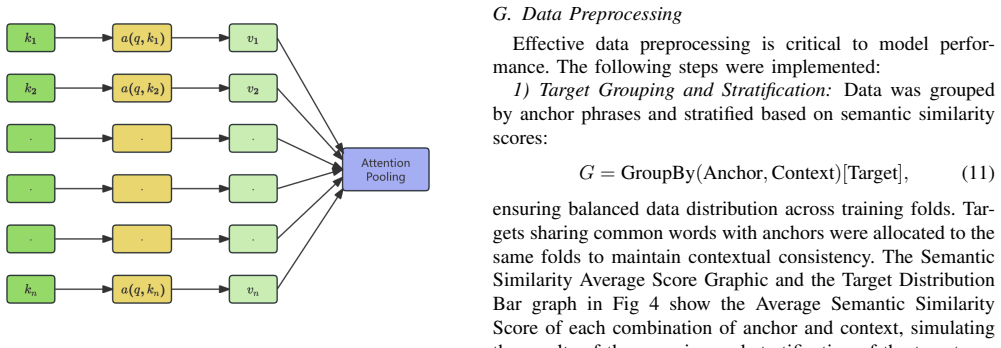
The load-bearing machinery is a four-stage feature pipeline: DeBERTa-v3-large, a pre-trained transformer with disentangled attention that supplies contextualized token embeddings; two Bi-LSTM layers that fold forward and backward sequential dependencies into those embeddings; a linear attention pooling step that computes a learned weighted average $X_{\mathrm{pool}} = \sum_{t=1}^{T}\alpha_t X_{\mathrm{lstm},t}$ over the sequence; and a fully connected head that maps the pooled vector to a similarity score. Around this core, the paper adds adversarial weight perturbation during fine-tuning, dynamic target shuffling, sector-level context concatenation, an Electra-based branch with widened output dimensions for ensemble diversity, and a final ensemble. The same pipeline is optimized by Pearson-correlation loss with MSE as a secondary term. This machinery converts the paper's hypothesis—that human and AI text differ in how semantic relationships are structured—into a trainable regression from text pairs to similarity scores.
What would settle it
Run the same ensemble on a direct human-versus-AI binary classification dataset and require it to beat a plain fine-tuned DeBERTa-v3-large classifier; if it does not, the claimed connection between semantic-similarity scoring and AI-text detection is unsupported.
Extended reading notes
Core claim
The central claim is that human and AI text, even when they convey similar meanings, differ in how semantic relationships are structured and maintained, and that this difference is learnable. On the paper's own terms, the ensemble of a pre-trained DeBERTa-v3-large encoder, Bi-LSTM enhancement, linear attention pooling, adversarial weight perturbation, dynamic target shuffling, sector-level context integration, and Electra-based variant branches reaches state-of-the-art performance on its evaluation, with the final ensemble at 87.5% Pearson correlation, 0.011 MSE, 91.2% F1-score, and 94.7% AUC. The authors take this as proof that the framework is useful for AI-generated text detection and for text-comparison tasks such as patent search and examination.
Load-bearing premise
The whole result rests on the assumption that the semantic-similarity labels in the training data are correct and that predicting those labels is equivalent to detecting AI-generated text.
Editorial extensions
If this is right
- The ensemble's reported metric values imply that a semantic-similarity score, not just a binary label, can carry reliable signal about whether text is human- or AI-written.
- The ablation table indicates each added component—Bi-LSTM, linear attention pooling, target shuffling, ensemble—improves Pearson, MSE, F1, and AUC, so the design choices are mutually reinforcing.
- The framework is claimed to transfer to text-comparison tasks beyond detection, including patent search and examination.
- The use of adversarial weight perturbation and sector-level contexts is claimed to improve robustness and cross-domain generalization for weakly supervised data.
Reading between the lines
- The paper evaluates semantic-similarity regression, not direct human-versus-AI classification; an extension would be to feed the same pooled representation into a binary classifier and test whether the advantage survives.
- If the learned pooling weights are inspected, the model could reveal which semantic relations most separate human from AI text, turning the detector into an explainability tool.
- Because the dataset is not described in enough detail for replication, the individual gains from AWP, target shuffling, and sector-level context should be re-run on a public corpus before treating them as general.
Signed reviews
Editorial analysis
A structured set of objections, weighed in public.
Referee Report
Summary. The paper proposes a semantic-similarity model for detecting AI-generated text, combining a DeBERTa-v3-large backbone, Bi-LSTMs, linear attention pooling, and several augmentation and ensemble techniques. The model is trained to predict an undisclosed semantic-similarity score using Pearson and MSE losses, and the authors report an ablation study with Pearson correlation, MSE, F1, and AUC. The paper claims state-of-the-art performance for AI-generated text detection, but it never defines a binary detection task, never describes or releases its dataset, and never compares against any external baseline.
Significance. If the approach actually achieved state-of-the-art detection of AI-generated text, it would be of practical interest to content moderation and academic integrity. The architecture is plausible and the ablation shows consistent incremental gains on the authors' internal metrics. However, the significance is entirely conditional: the central claim rests on an equivalence between predicting an unpublished semantic-similarity score and detecting AI-generated text, and the paper provides no evidence for that equivalence. No code, data, or external comparison is provided, so the work is not currently verifiable or reproducible. The reported F1 and AUC numbers are not anchored to any defined classification task, making the contribution, as it stands, an unvalidated regression exercise rather than a demonstrated detection method.
major comments (4)
- [Section V, Table I] The state-of-the-art claim in the abstract and Section VI is not supported by any external comparison. Table I reports only the authors' own ablation variants (DeBERTa, +LSTM, +attention pooling, +target shuffling, ensemble), with no baseline detectors, no standard benchmark dataset, and no significance tests or error bars. A within-model ablation gain from 86.1% to 87.5% Pearson or 91.2% to 94.7% AUC does not establish superiority over existing AI-text detectors, so the central claim of the paper is unsubstantiated.
- [Sections III.G, IV, V] The paper never defines the detection task that it claims to address. The model is trained to regress semantic similarity scores (Eq. 4, Eq. 9), and the data is described only as grouped by anchor/context (Eq. 11) with 'semantic similarity scores' as targets. However, F1-score (Eq. 17) and AUC (Eq. 18) are defined for binary classification and reported in Table I, with no explanation of what constitutes a positive or negative class, what threshold is used, or how a regression score is converted into a human-versus-AI decision. Without this, the reported F1 and AUC are uninterpretable, and the paper's stated purpose of detecting AI-generated text is not actually evaluated.
- [Section III.G] The dataset is not described in sufficient detail to assess validity or reproducibility. The paper does not state the source of the anchor/context pairs, how the semantic similarity labels were obtained or verified, the size of the dataset, or whether the labels are in any way related to human versus AI authorship. This is load-bearing because if the similarity labels do not actually distinguish human from AI-generated text, the entire approach cannot detect AI-generated text. The missing dataset description and lack of release prevent any independent verification of the central claim.
- [Section VI] The conclusion introduces 'patent search and examination processes' as a practical application, which is not mentioned anywhere in the methodology or experiments and is unrelated to the stated task of AI-generated text detection. This suggests a lack of clarity about what the method is actually for and further blurs the connection between the regression task and the claimed detection capability.
minor comments (5)
- [Abstract] The keyword line contains a typo: 'Kerwords' should be 'Keywords'.
- [Throughout] The word 'pipline' is used in captions and text (e.g., Fig. 1, Fig. 2); it should be 'pipeline'.
- [Section IV] Equations (15) and (16) are identical in form to the loss functions in Equations (9) and (10). The paper should clarify the relationship between training losses and evaluation metrics; as written, it reads as using the same quantities for both, which is standard but should be stated explicitly.
- [Section II] References [7] and [8] concern chatbot user satisfaction and e-commerce product recommendation; their relevance to AI-generated text detection is asserted but not explained, and they appear to be tangential.
- [Section III.F] The section heading 'F . Loss Function' has a misplaced space, and the loss-function section is a single paragraph but uses numbered equations; please fix the formatting.
Circularity Check
No circularity: the derivation is a standard supervised regression pipeline; the paper's weaknesses are missing validation and external comparison, not circular reasoning.
full rationale
The paper's derivation chain is a standard supervised-learning pipeline: a DeBERTa encoder (Eq. 1), Bi-LSTM (Eq. 2), linear attention pooling (Eq. 3), and a fully connected head producing a scalar similarity score (Eq. 4), trained with Pearson and MSE losses (Eqs. 9-10) and evaluated with the same correlation and MSE metrics (Eqs. 15-16) together with binary F1 and AUC (Eqs. 17-18). Using the same objective for training loss and evaluation metric is standard practice and does not presuppose the conclusion. There are no self-citations, no imported uniqueness theorems, and no fitted parameter relabeled as a prediction. The paper's real limitation is evidential rather than circular: the target labels are only described as 'semantic similarity scores' (Eq. 11), no explicit binary human-versus-AI task or decision rule is defined, and the 'state-of-the-art' claim in Section VI is not supported by external baselines. These gaps undermine empirical verification but do not reduce the derivation to its own inputs, so no circular step can be quoted and exhibited.
Assumptions & free parameters
free parameters (5)
- DeBERTa learning rate =
2e-5
- LSTM/FC learning rate =
1e-3
- AWP start epoch =
2
- Ensemble composition =
unspecified
- Sequence length =
unspecified
assumptions (5)
- domain assumption Semantic similarity labels in the dataset are accurate and meaningful
- domain assumption The semantic similarity regression task is a valid proxy for AI-generated text detection
- domain assumption DeBERTa-v3-large representations transfer to this domain
- domain assumption Pearson correlation is the right objective for the task
- standard math Standard definitions of Pearson correlation, MSE, precision, recall, and AUC are valid
Cite this review
Pith. "Pith review of A Comprehensive Framework for Semantic Similarity Analysis of Human and AI-Generated Text Using Transformer Architectures and Ensemble Techniques." pith.science (2026). https://pith.science/paper/ECJD2SFH
@misc{pith2026250114288,
  author       = {Pith},
  title        = {Pith review of: A Comprehensive Framework for Semantic Similarity Analysis of Human and AI-Generated Text Using Transformer Architectures and Ensemble Techniques},
  year         = {2026},
  howpublished = {\url{https://pith.science/paper/ECJD2SFH}},
  note         = {Machine review of arXiv:2501.14288}
}
read the original abstract
The rapid advancement of large language models (LLMs) has made detecting AI-generated text an increasingly critical challenge. Traditional methods often fail to capture the nuanced semantic differences between human and machine-generated content. We therefore propose a novel approach based on semantic similarity analysis, leveraging a multi-layered architecture that combines a pre-trained DeBERTa-v3-large model, Bi-directional LSTMs, and linear attention pooling to capture both local and global semantic patterns. To enhance performance, we employ advanced input and output augmentation techniques such as sector-level context integration and wide output configurations. These techniques enable the model to learn more discriminative features and generalize across diverse domains. Experimental results show that this approach works better than traditional methods, proving its usefulness for AI-generated text detection and other text comparison tasks.
Figures


Figures from the paper (2 more)


Reference graph
Works this paper leans on
-
[1]
X. Yan, Y. Xiao, and Y. Jin, ``Generative large language models explained [ai-explained],'' IEEE Computational Intelligence Magazine, vol. 19, no. 4, pp. 45--46, 2024
work page 2024
-
[2]
J. Gui, Z. Sun, Y. Wen, D. Tao, and J. Ye, ``A review on generative adversarial networks: Algorithms, theory, and applications,'' IEEE transactions on knowledge and data engineering, vol. 35, no. 4, pp. 3313--3332, 2021
work page 2021
-
[3]
R. Zellers, A. Holtzman, H. Rashkin, Y. Bisk, A. Farhadi, F. Roesner, and Y. Choi, ``Defending against neural fake news,'' Advances in neural information processing systems, vol. 32, 2019
work page 2019
-
[5]
I. Beltagy, K. Lo, and A. Cohan, ``Scibert: A pretrained language model for scientific text,'' arXiv preprint arXiv:1903.10676, 2019
arXiv 1903
-
[6]
E. Dehaerne, B. Dey, S. Halder, S. De Gendt, and W. Meert, ``Code generation using machine learning: A systematic review,'' Ieee Access, vol. 10, pp. 82\,434--82\,455, 2022
work page 2022
-
[7]
J. Lu, ``Enhancing chatbot user satisfaction: A machine learning approach integrating decision tree, tf-idf, and bertopic,'' Preprints, November 2024. [Online]. Available: https://doi.org/10.20944/preprints202411.0867.v1
-
[8]
S. Li, ``Harnessing multimodal data and mult-recall strategies for enhanced product recommendation in e-commerce,'' Preprints, September 2024. [Online]. Available: https://doi.org/10.20944/preprints202409.2417.v1
- [9]
Show all 10 references
-
[10]
Schick and H
T. Schick and H. Sch \"u tze, ``Exploiting cloze questions for few shot text classification and natural language inference,'' arXiv preprint arXiv:2001.07676, 2020
2001 arXiv
-
[11]
QDB kZUX; I` [ U +
11em plus .33em minus .07em 4000 4000 100 4000 4000 500 `\.=1000 = #1 \@IEEEnotcompsoconly \@IEEEcompsoconly #1 * [1] 0pt [0pt][0pt] #1 * [1] 0pt [0pt][0pt] #1 * \| ** #1 \@IEEEauthorblockNstyle \@IEEEcompsocnotconfonly \@IEEEauthorblockAstyle \@IEEEcompsocnotconfonly \@IEEEco...
2024 arXiv
Reviewed August 10, 2026 · model on record in the stance chip above.
Discussion (0). Continue with ORCID to comment.