Black-hole spectroscopy from a giant quantum vortex
Pith reviewed 2026-05-23 02:47 UTC · model grok-4.3
The pith
Multiple quasinormal modes of a rotating black hole are extracted from noise-driven waves around a giant quantum vortex in superfluid helium-4.
A machine-rendered reading of the paper's core claim, the machinery that carries it, and where it could break.
Core claim
Multiple QNMs can be extracted from noise-driven interface waves surrounding a giant quantum vortex in superfluid helium-4, which emulates a spacetime geometry indicative of a rotating black hole. By resolving waves with different azimuthal periodicity, both fundamental modes and their higher-frequency overtones are excited and oscillate at frequencies given by the size of the system.
What carries the argument
Giant quantum vortex in superfluid helium-4 whose interface waves emulate the quasinormal-mode spectrum of a Kerr black hole, with azimuthal mode numbers mapping to black-hole angular momentum.
If this is right
- In finite-sized systems the real frequencies of QNMs shift while their damping rates reduce, thereby enhancing their detectability compared with unbounded settings.
- Both fundamental modes and higher-frequency overtones are excited and can be separated by resolving different azimuthal periodicities.
- Gravity simulators can now complement numerical and observational approaches to black-hole spectroscopy.
- Similar finite-size or environmental effects on the QNM spectrum may arise in astrophysical scenarios due to the interstellar medium or dark matter.
Where Pith is reading between the lines
- Varying the vortex radius or rotation rate in future runs could map how the entire QNM spectrum depends on system size, testing the finite-size corrections predicted by the analogy.
- The same interface-wave technique might be adapted to other analogue spacetimes to study environmental modifications to ringdown that are difficult to model in full general relativity.
- If the damping reduction scales with system size, larger quantum vortices could make even higher overtones measurable, providing a laboratory test bed for the information carried by sub-dominant modes.
Load-bearing premise
The fluid-interface waves in the finite-sized quantum vortex reproduce the quasinormal-mode spectrum including damping rates of a Kerr black hole in general relativity.
What would settle it
Measured oscillation frequencies or damping rates of the resolved azimuthal waves that deviate systematically from the Kerr quasinormal-mode predictions for the equivalent mass and spin would falsify the mapping.
Figures
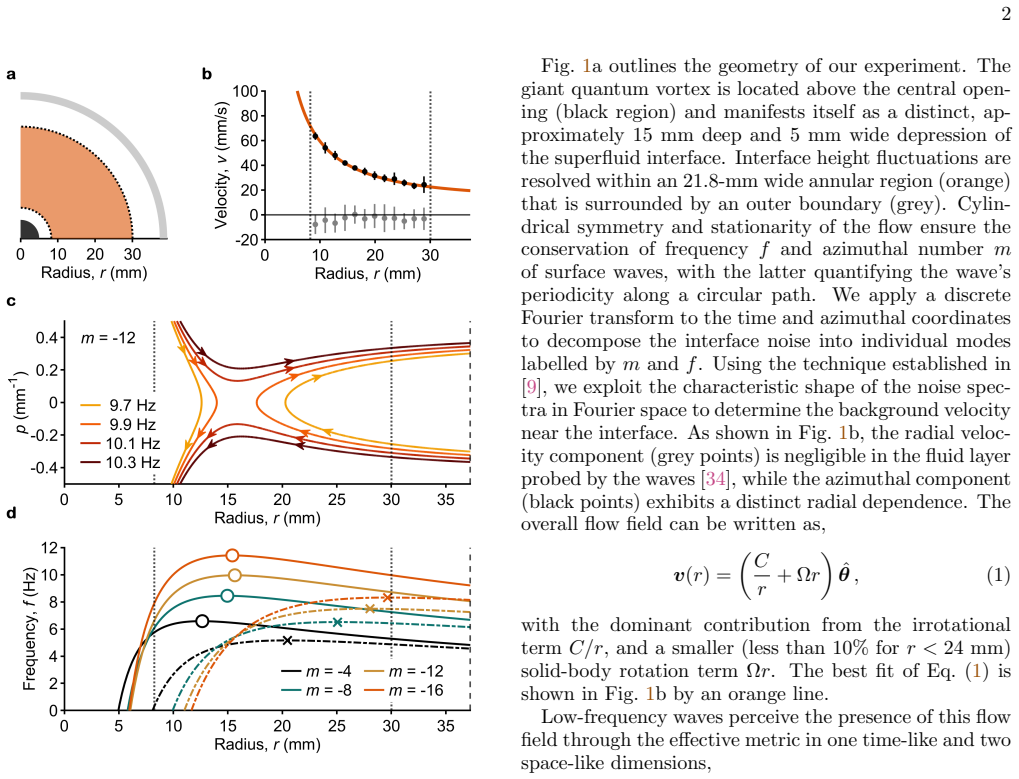


read the original abstract
Black-hole spectroscopy aims to infer the fundamental properties of black holes by analysing the spectrum of gravitational waves emitted as they settle into equilibrium. These resonances, known as quasinormal modes (QNMs), decay rapidly, which limits the time-domain analysis of gravitational-wave data or numerical simulations to the longest-lived mode, except for a particularly loud event. Owing to the analogy between fields in curved spacetime and waves propagating in a flowing medium, QNMs can be equally excited in a laboratory. In these finite-sized systems, the QNM spectrum is expected to alter: compared to their counterparts in unbounded settings, the real frequencies of QNMs shift while their damping rates (imaginary frequencies) reduce, thereby enhancing their detectability. Here we show that multiple QNMs can be extracted from noise-driven interface waves surrounding a giant quantum vortex in superfluid helium-4, which emulates a spacetime geometry indicative of a rotating black hole. By resolving waves with different azimuthal periodicity, we find that both fundamental modes and their higher-frequency overtones are excited, and oscillate at frequencies given by the size of our system. Since similar effects may arise in astrophysical scenarios due to the interstellar medium or dark matter, gravity simulators now complement numerical and observational approaches to black-hole spectroscopy.
Editorial analysis
A structured set of objections, weighed in public.
Referee Report
Summary. The manuscript claims to perform black-hole spectroscopy in an analog system by extracting multiple quasinormal modes (QNMs), including fundamentals and overtones, from noise-driven interface waves around a giant quantum vortex in superfluid helium-4. The vortex is said to emulate a rotating black-hole spacetime; waves with different azimuthal periodicities are resolved, and the observed frequencies are reported to be set by the finite system size, with finite-size effects shifting real parts and reducing damping rates relative to unbounded cases.
Significance. If the extracted frequencies and damping rates are shown to match the QNM spectrum computed from the measured superfluid velocity profile via the effective metric, the work would supply a laboratory realization of analog spectroscopy that accesses overtones and illustrates finite-size modifications potentially relevant to astrophysical environments. The experimental resolution of azimuthal modes constitutes a technical step forward for analog gravity.
major comments (2)
- [Abstract] Abstract: the claim that the observed waves constitute QNMs of the Kerr-like analog geometry is load-bearing, yet the text states only that frequencies 'oscillate at frequencies given by the size of our system.' An explicit, quantitative comparison of both real frequencies and (unmentioned) damping rates to the spectrum obtained by solving the wave equation on the measured velocity profile is required to distinguish the analog QNMs from generic confined-wave dispersion; without this comparison the spectroscopy interpretation does not follow.
- [Abstract] The mapping from azimuthal periodicity to black-hole angular-momentum modes must be validated against the effective-metric prediction; azimuthal resolution alone does not establish that the observed spectrum reproduces the damping rates or the specific frequency ratios expected from the vortex flow rather than boundary or superfluid dispersion effects.
minor comments (1)
- The abstract would be strengthened by quoting at least one measured frequency, its uncertainty, and the corresponding theoretical value from the effective metric.
Simulated Author's Rebuttal
We thank the referee for their thoughtful review and constructive suggestions. We address the major comments point by point below and agree that explicit quantitative comparisons will strengthen the spectroscopy interpretation.
read point-by-point responses
-
Referee: [Abstract] Abstract: the claim that the observed waves constitute QNMs of the Kerr-like analog geometry is load-bearing, yet the text states only that frequencies 'oscillate at frequencies given by the size of our system.' An explicit, quantitative comparison of both real frequencies and (unmentioned) damping rates to the spectrum obtained by solving the wave equation on the measured velocity profile is required to distinguish the analog QNMs from generic confined-wave dispersion; without this comparison the spectroscopy interpretation does not follow.
Authors: We agree that an explicit side-by-side comparison of both real frequencies and damping rates to the QNM spectrum computed from the measured velocity profile via the effective metric is necessary to firmly establish the analog QNM interpretation over generic confined-wave effects. The manuscript already reports that finite-size effects shift real parts and reduce damping relative to unbounded cases, and the velocity profile is measured, but we will add a new figure and accompanying text in the revised manuscript that solves the wave equation on the effective metric and directly overlays the predicted frequencies and damping rates with the extracted experimental values for each azimuthal mode. revision: yes
-
Referee: [Abstract] The mapping from azimuthal periodicity to black-hole angular-momentum modes must be validated against the effective-metric prediction; azimuthal resolution alone does not establish that the observed spectrum reproduces the damping rates or the specific frequency ratios expected from the vortex flow rather than boundary or superfluid dispersion effects.
Authors: We acknowledge the need to validate the mode identification beyond azimuthal periodicity alone. The manuscript associates different azimuthal periodicities with black-hole angular-momentum modes on the basis of the vortex flow, but to address this directly we will include in the revision a quantitative comparison of the observed frequency ratios and damping rates against the predictions of the effective metric for the corresponding modes. This will help rule out dominant contributions from boundary or intrinsic superfluid dispersion. revision: yes
Circularity Check
No significant circularity detected
full rationale
The paper reports an experimental extraction of multiple quasinormal modes from noise-driven interface waves in a finite-sized quantum vortex analog of a Kerr black hole. Frequencies are stated to be set by system size, with the central claim resting on resolution of azimuthal modes and comparison to the effective metric derived from the measured superfluid velocity profile. This comparison is presented as an empirical result rather than a definitional equivalence, a fitted parameter renamed as prediction, or a self-citation chain that reduces the claim to its own inputs. No self-definitional steps, uniqueness theorems imported from prior author work, or ansatzes smuggled via citation are evident in the abstract or described derivation. The result is self-contained against external benchmarks of wave measurements in the analog system.
Axiom & Free-Parameter Ledger
axioms (1)
- domain assumption The established analogy between waves in a flowing fluid and fields in curved spacetime extends to the quasinormal-mode spectrum of a rotating black hole.
Lean theorems connected to this paper
-
IndisputableMonolith/Foundation/RealityFromDistinction.leanreality_from_one_distinction unclear?
unclearRelation between the paper passage and the cited Recognition theorem.
effective rotating curved spacetime is induced by a giant quantum vortex... gij ∝ (−c²+v², −v; −v, 1) ... Res(ω)=R(ω)exp(2i∫p dr)−1
-
IndisputableMonolith/Cost/FunctionalEquation.leanwashburn_uniqueness_aczel unclear?
unclearRelation between the paper passage and the cited Recognition theorem.
WKB approximation... light-ring frequencies... quasibound states
What do these tags mean?
- matches
- The paper's claim is directly supported by a theorem in the formal canon.
- supports
- The theorem supports part of the paper's argument, but the paper may add assumptions or extra steps.
- extends
- The paper goes beyond the formal theorem; the theorem is a base layer rather than the whole result.
- uses
- The paper appears to rely on the theorem as machinery.
- contradicts
- The paper's claim conflicts with a theorem or certificate in the canon.
- unclear
- Pith found a possible connection, but the passage is too broad, indirect, or ambiguous to say the theorem truly supports the claim.
Forward citations
Cited by 2 Pith papers
-
Analog regular black holes and black hole mimickers for surface-gravity waves in fluids
Surface-gravity waves in shallow water can be configured with central and graded drainage to analogize regular black holes and mimickers, enabling lab study of their instabilities.
-
Spectroscopy of analogue black holes using simulation-based inference
Simulation-based inference reliably extracts physical parameters from noisy spectra of analogue black holes.
Reference graph
Works this paper leans on
-
[1]
K. Destounis and F. Duque, Black-hole spectroscopy: Quasinormal modes, ringdown stability and the pseu- dospectrum, in Compact Objects in the Universe , edited by E. Papantonopoulos and N. Mavromatos (Springer Nature Switzerland, Cham, 2024) p. 155–202
work page 2024
-
[2]
K. D. Kokkotas and B. G. Schmidt, Quasi-normal modes of stars and black holes, Living Rev. Relativ. 2, 2 (1999)
work page 1999
-
[3]
R. A. Konoplya and A. Zhidenko, Quasinormal modes of black holes: From astrophysics to string theory, Rev. Mod. Phys. 83, 793–836 (2011)
work page 2011
- [4]
-
[5]
V. Baibhav et al. , Agnostic black hole spectroscopy: Quasinormal mode content of numerical relativity wave- forms and limits of validity of linear perturbation theory, Phys. Rev. D 108, 104020 (2023)
work page 2023
-
[6]
P. J. Nee, S. H. V¨ olkel, and H. P. Pfeiffer, Role of black hole quasinormal mode overtones for ringdown analysis, Phys. Rev. D 108, 044032 (2023)
work page 2023
-
[7]
E. Barausse, V. Cardoso, and P. Pani, Can environmental effects spoil precision gravitational-wave astrophysics?, Phys. Rev. D 89, 104059 (2014)
work page 2014
-
[8]
V. Cardoso, K. Destounis, F. Duque, R. P. Macedo, and A. Maselli, Black holes in galaxies: Environmental im- pact on gravitational-wave generation and propagation, Phys. Rev. D 105, L061501 (2022)
work page 2022
-
[9]
P. ˇSvanˇ caraet al., Rotating curved spacetime signatures from a giant quantum vortex, Nature 628, 66–70 (2024)
work page 2024
-
[10]
L. Solidoro, S. Patrick, R. Gregory, and S. Weinfurt- ner, Quasinormal modes in semi-open systems (2024), arXiv:2406.11013 [gr-qc]
-
[11]
C.-L. Hung et al. , From cosmology to cold atoms: Ob- servation of Sakharov oscillations in a quenched atomic superfluid, Science 341, 1213–1215 (2013)
work page 2013
- [12]
-
[13]
M. Jacquet et al. , Polariton fluids for analogue gravity physics, Phil. Trans. R. Soc. A 378, 20190225 (2020)
work page 2020
-
[14]
N. Navon et al. , Quantum gases in optical boxes, Nat. Phys. 17, 1334–1341 (2021)
work page 2021
-
[15]
C. Viermann et al., Quantum field simulator for dynam- ics in curved spacetime, Nature 611, 260–264 (2022)
work page 2022
-
[16]
C. Barcel´ o, S. Liberati, and M. Visser, Analogue gravity, Living Rev. Relativ. 14, 3 (2011)
work page 2011
-
[17]
Berti et al., Testing general relativity with present and future astrophysical observations, Class
E. Berti et al., Testing general relativity with present and future astrophysical observations, Class. Quantum Grav. 32, 243001 (2015)
work page 2015
-
[18]
S. Weinfurtner, E. W. Tedford, M. C. J. Penrice, W. G. Unruh, and G. A. Lawrence, Measurement of stimulated Hawking emission in an analogue system, Phys. Rev. Lett. 106, 021302 (2011)
work page 2011
- [19]
-
[20]
V. I. Kolobov, K. Golubkov, J. R. Mu˜ noz de Nova, and J. Steinhauer, Observation of stationary spontaneous Hawking radiation and the time evolution of an analogue black hole, Nat. Phys. 17, 362–367 (2021)
work page 2021
-
[21]
Torres et al., Rotational superradiant scattering in a vortex flow, Nat
T. Torres et al., Rotational superradiant scattering in a vortex flow, Nat. Phys. 13, 833–836 (2017)
work page 2017
-
[22]
Cromb et al., Amplification of waves from a rotating body, Nat
M. Cromb et al., Amplification of waves from a rotating body, Nat. Phys. 16, 1069–1073 (2020)
work page 2020
-
[23]
M. C. Braidotti et al. , Measurement of Penrose super- radiance in a photon superfluid, Phys. Rev. Lett. 128, 013901 (2022)
work page 2022
-
[24]
V. Cardoso, J. P. S. Lemos, and S. Yoshida, Quasinormal modes and stability of the rotating acoustic black hole: Numerical analysis, Phys. Rev. D 70, 124032 (2004)
work page 2004
-
[25]
S. Patrick, A. Coutant, M. Richartz, and S. Weinfurtner, Black hole quasibound states from a draining bathtub vortex flow, Phys. Rev. Lett. 121, 061101 (2018)
work page 2018
- [26]
-
[27]
A. Geelmuyden, S. Erne, S. Patrick, C. F. Barenghi, and S. Weinfurtner, Sound-ring radiation of expanding vortex clusters, Phys. Rev. Res. 4, 023099 (2022)
work page 2022
-
[28]
M. J. Jacquet et al. , Quantum vacuum excitation of a quasinormal mode in an analog model of black hole space- time, Phys. Rev. Lett. 130, 111501 (2023)
work page 2023
-
[29]
C. Burgess, S. Patrick, T. Torres, R. Gregory, and F. K¨ onig, Quasinormal modes of optical solitons, Phys. Rev. Lett. 132, 053802 (2024). 7
work page 2024
- [30]
-
[31]
R. J. Donnelly and C. F. Barenghi, The observed prop- erties of liquid helium at the saturated vapor pressure, J. Phys. Chem. Ref. Data 27, 1217–1274 (1998)
work page 1998
- [32]
-
[33]
S. Wildeman, Real-time quantitative Schlieren imaging by fast Fourier demodulation of a checkered backdrop, Exp. Fluids 59, 97 (2018)
work page 2018
-
[34]
A. Andersen, T. Bohr, B. Stenum, J. J. Rasmussen, and B. Lautrup, Anatomy of a bathtub vortex, Phys. Rev. Lett. 91, 104502 (2003)
work page 2003
-
[35]
S. Patrick and S. Weinfurtner, Superradiance in disper- sive black hole analogues, Phys. Rev. D 102, 084041 (2020)
work page 2020
-
[36]
B¨ uhler,Waves and Mean Flows (Cambridge Univer- sity Press, Cambridge, 2014)
O. B¨ uhler,Waves and Mean Flows (Cambridge Univer- sity Press, Cambridge, 2014)
work page 2014
-
[37]
V. Cardoso, A. S. Miranda, E. Berti, H. Witek, and V. T. Zanchin, Geodesic stability, Lyapunov exponents, and quasinormal modes, Phys. Rev. D 79, 064016 (2009)
work page 2009
- [38]
-
[39]
K. Akiyama et al. (The Event Horizon Telescope Collab- oration), First M87 Event Horizon Telescope results. I. the shadow of the supermassive black hole, Astrophys. J. Lett. 875, L1 (2019)
work page 2019
- [40]
-
[41]
T. F. M. Spieksma, V. Cardoso, G. Carullo, M. Della Rocca, and F. Duque, Black hole spectroscopy in environments: Detectability prospects, Phys. Rev. Lett. 134, 081402 (2025)
work page 2025
- [42]
-
[43]
E. Cannizzaro, A. Caputo, L. Sberna, and P. Pani, Plasma-photon interaction in curved spacetime: Formal- ism and quasibound states around nonspinning black holes, Phys. Rev. D 103, 124018 (2021)
work page 2021
-
[44]
O. A. Hannuksela et al., Probing the existence of ultra- light bosons with a single gravitational-wave measure- ment, Nat. Astron. 3, 447–451 (2019)
work page 2019
-
[45]
T. F. M. Spieksma, E. Cannizzaro, T. Ikeda, V. Car- doso, and Y. Chen, Superradiance: Axionic couplings and plasma effects, Phys. Rev. D 108, 063013 (2023)
work page 2023
-
[46]
G. T. Horowitz and V. E. Hubeny, Quasinormal modes of AdS black holes and the approach to thermal equilibrium, Phys. Rev. D 62, 024027 (2000)
work page 2000
-
[47]
V. Cardoso and J. P. S. Lemos, Quasinormal modes of Schwarzschild anti-de Sitter black holes: Electromagnetic and gravitational perturbations, Phys. Rev. D64, 084017 (2001)
work page 2001
-
[48]
V. Cardoso, R. Konoplya, and J. P. S. Lemos, Quasinor- mal frequencies of Schwarzschild black holes in anti-de Sitter space-times: A Complete study on the asymptotic behavior, Phys. Rev. D 68, 044024 (2003)
work page 2003
- [49]
-
[50]
H. Yang, A. Zimmerman, and L. Lehner, Turbulent black holes, Phys. Rev. Lett. 114, 081101 (2015)
work page 2015
-
[51]
M. Visser and S. Weinfurtner, Vortex analogue for the equatorial geometry of the Kerr black hole, Class. Quan- tum Gravity 22, 2493 (2005)
work page 2005
-
[52]
H. Yano, K. Ohyama, K. Obara, and O. Ishikawa, Obser- vation of the spiral flow and vortex induced by a suction pump in superfluid 4He, J. Phys. Conf. Ser. 969, 012002 (2018)
work page 2018
-
[53]
C. F. Barenghi, L. Skrbek, and K. R. Sreenivasan, Quantum Turbulence (Cambridge University Press, Cam- bridge, 2023)
work page 2023
-
[54]
R. P. Feynman, Application of quantum mechanics to liquid helium, in Progress in Low Temperature Physics , Vol. 1, edited by C. J. Gorter (Elsevier, Amsterdam,
-
[55]
S. E. Perez Bergliaffa, K. Hibberd, M. Stone, and M. Visser, Wave equation for sound in fluids with vor- ticity, Physica D 191, 121–136 (2004)
work page 2004
-
[56]
L. A. Oliveira, C. L. Benone, and L. C. B. Crispino, Er- goregion instability in a fluid with vorticity, Phys. Rev. D 110, 124047 (2024)
work page 2024
-
[57]
S. Patrick and L. Solidoro, Quasinormal modes in lorentz violating black hole analogues (2025), arXiv:2007.06671 [gr-qc]
- [58]
-
[59]
S. Iyer and C. M. Will, Black-hole normal modes: A WKB approach. I. Foundations and application of a higher-order WKB analysis of potential-barrier scatter- ing, Phys. Rev. D 35, 3621–3631 (1987)
work page 1987
-
[60]
Torres, Estimate of the superradiance spectrum in dis- persive media, Philos
T. Torres, Estimate of the superradiance spectrum in dis- persive media, Philos. Trans. R. Soc. A 378, 20190236 (2020)
work page 2020
-
[61]
E. R. Tracy, A. J. Brizard, A. S. Richardson, and A. N. Kaufman, Ray Tracing and Beyond: Phase Space Methods in Plasma Wave Theory (Cambridge University Press, Cambridge, 2014)
work page 2014
-
[62]
S. Patrick and T. Torres, Primer on the analog black hole bomb with capillary-gravity waves, Phys. Rev. D 110, 124068 (2024). 8 METHODS A. Experimental set-up The simulation of a curved spacetime indicative of ro- tating black holes [51] is based on a draining vortex flow of superfluid helium. The flow is initiated and main- tained due to a centrifugal pu...
work page 2024
discussion (0)
Sign in with ORCID, Apple, or X to comment. Anyone can read and Pith papers without signing in.