Theory of magnetoroton bands in moir\'e materials
Pith reviewed 2026-05-23 01:48 UTC · model grok-4.3
The pith
Periodic potentials in moiré materials reshape the magnetoroton modes of fractional quantum Hall states.
A machine-rendered reading of the paper's core claim, the machinery that carries it, and where it could break.
Core claim
The magnetoroton collective modes of fractional quantum Hall states are altered by external periodic potentials. Within the single-mode approximation the low-energy neutral excitations are governed by an effective Hamiltonian written in terms of three-point density correlation functions; Monte Carlo evaluation of these functions then determines how the magnetoroton dispersion changes with potential strength, producing testable trends in THz absorption and a soft-mode transition to charge-density-wave order at a critical potential amplitude.
What carries the argument
Single-mode-approximation effective Hamiltonian for magnetoroton excitations expressed via three-point density correlation functions.
If this is right
- THz absorption spectra of both FCI and FQH states display systematic trends that vary with the strength of the periodic potential.
- A soft-mode instability drives a phase transition from the FQH state to a charge-density-wave state at a finite external potential amplitude.
- The same three-point-correlation framework describes both graphene-on-hBN fractional quantum Hall states and twisted-MoTe2 fractional Chern insulator states.
Where Pith is reading between the lines
- The derived trends could be used to map out the boundary between incompressible fractional states and compressible phases in other moiré lattices.
- If the single-mode approximation holds, similar calculations would predict how magnetoroton bands evolve under additional tuning parameters such as magnetic-field tilt.
- Direct comparison of the estimated critical potential with transport or spectroscopy data in existing devices would test whether the transition is indeed soft-mode driven.
Load-bearing premise
The single-mode approximation stays quantitatively accurate for the low-energy neutral excitations once the external periodic potential is added.
What would settle it
THz absorption measurements in twisted MoTe2 that fail to show the predicted shifts in magnetoroton dispersion, or that exhibit no softening at the estimated critical potential strength, would falsify the central claims.
Figures




read the original abstract
The recent realization of Hofstadter spectra and fractional Chern insulators in moir\'e materials has introduced a new ingredient, a periodic lattice potential, to the study of quantum Hall phases. While the fractionalized states in moir\'e systems are expected to be in the same universality class as their counterparts in Landau levels, the periodic potential can have qualitative and quantitative effects on physical observables. Here, we examine how the magnetoroton collective modes of fractional quantum Hall (FQH) states are altered by external periodic potentials. Employing a single-mode-approximation, we derive an effective Hamiltonian for the low-energy neutral excitations expressed in terms of three-point density correlation functions, which are computed using Monte Carlo. Our analysis is applicable to FQH states in graphene with a hexagonal boron nitride (hBN) substrate and also to fractional Chern insulator (FCI) states in twisted MoTe$_2$ bilayers. We predict experimentally testable trends in the THz absorption characteristics of FCI and FQH states and estimate the external potential strength at which a soft-mode phase transition occurs between FQH and charge density wave states.
Editorial analysis
A structured set of objections, weighed in public.
Referee Report
Summary. The manuscript develops a single-mode approximation (SMA) framework to construct an effective Hamiltonian for the low-energy neutral (magnetoroton) excitations of fractional quantum Hall (FQH) and fractional Chern insulator (FCI) states in the presence of a periodic moiré potential. The Hamiltonian is expressed solely in terms of three-point density correlation functions, which are evaluated by Monte Carlo sampling. The approach is applied to graphene/hBN and twisted MoTe2 systems, yielding predictions for THz absorption spectra and an estimate of the potential strength at which a soft-mode instability drives a transition from the FQH/FCI state to a charge-density-wave state.
Significance. If the central approximation holds, the work supplies a computationally tractable route to neutral-mode dispersions that incorporates the moiré potential without additional fitting parameters, directly linking microscopic correlations to measurable THz response and to the location of a soft-mode phase boundary. The Monte Carlo evaluation of three-point functions is a reproducible, parameter-free element that strengthens the approach.
major comments (2)
- [Abstract] Abstract: the quantitative estimate of the external-potential strength at which the soft-mode FQH/FCI-to-CDW transition occurs rests on the assumption that the SMA remains accurate once the periodic potential is added and that higher-order mode mixing stays negligible near gap closure; no comparison to exact diagonalization, no finite-size scaling of the Monte Carlo three-point functions, and no explicit check of the approximation in the vicinity of the transition are reported.
- [Abstract] Abstract: the predicted THz absorption line shapes and trends likewise depend on the effective Hamiltonian capturing the lowest neutral branch without significant corrections from the periodic potential; the manuscript supplies no validation data or error estimates that would quantify the accuracy of this extrapolation from the pure Landau-level case.
minor comments (1)
- [Abstract] The abstract would be clearer if it stated the system sizes employed for the Monte Carlo sampling of the three-point functions and the range of potential amplitudes explored.
Simulated Author's Rebuttal
We thank the referee for the positive assessment of the work's significance and for identifying key limitations in the validation of the single-mode approximation. We respond point by point to the major comments below.
read point-by-point responses
-
Referee: [Abstract] Abstract: the quantitative estimate of the external-potential strength at which the soft-mode FQH/FCI-to-CDW transition occurs rests on the assumption that the SMA remains accurate once the periodic potential is added and that higher-order mode mixing stays negligible near gap closure; no comparison to exact diagonalization, no finite-size scaling of the Monte Carlo three-point functions, and no explicit check of the approximation in the vicinity of the transition are reported.
Authors: We agree that the transition estimate assumes the SMA continues to capture the lowest neutral branch after the moiré potential is introduced. Exact diagonalization benchmarks are not reported because they are computationally prohibitive for the system sizes and fillings relevant to moiré FCI/FQH states. The Monte Carlo three-point functions are evaluated exactly (within sampling error) for the unperturbed state, but no dedicated finite-size scaling near gap closure was performed. In the revised manuscript we will add an explicit discussion of these assumptions, the regime of expected validity, and references to prior SMA benchmarks in Landau levels, thereby qualifying the reported transition strength as an SMA-based estimate. revision: partial
-
Referee: [Abstract] Abstract: the predicted THz absorption line shapes and trends likewise depend on the effective Hamiltonian capturing the lowest neutral branch without significant corrections from the periodic potential; the manuscript supplies no validation data or error estimates that would quantify the accuracy of this extrapolation from the pure Landau-level case.
Authors: The THz predictions are obtained from the SMA effective Hamiltonian constructed from the three-point correlations. No new validation data or quantitative error estimates for the moiré case are provided. We will revise the manuscript to include a dedicated paragraph on possible corrections from higher-mode mixing induced by the periodic potential and to note that the reported trends are qualitative predictions within the SMA framework, with Monte Carlo statistical uncertainties indicated where applicable. revision: partial
- Direct exact-diagonalization validation of the SMA in the presence of the moiré potential
- Finite-size scaling of the Monte Carlo three-point functions in the vicinity of the soft-mode transition
Circularity Check
No circularity: effective Hamiltonian uses independent Monte Carlo three-point functions
full rationale
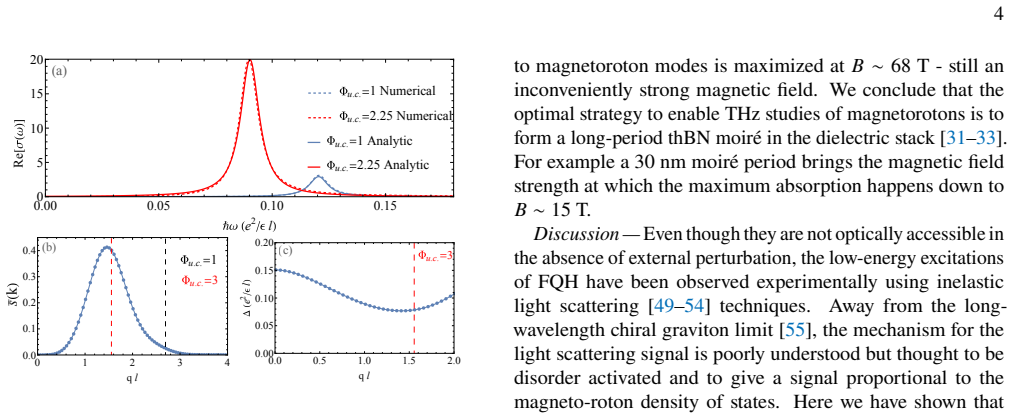
The derivation applies the single-mode approximation to obtain an effective Hamiltonian expressed solely in terms of three-point density correlation functions. These functions are computed separately via Monte Carlo and serve as external inputs rather than being fitted to or defined by the resulting predictions. No self-definitional steps, fitted-input-as-prediction, self-citation load-bearing, or other enumerated circular patterns appear. The central claims rest on the validity of the SMA assumption and the accuracy of the Monte Carlo inputs, which are independent of the output trends and transition estimate.
Axiom & Free-Parameter Ledger
axioms (1)
- domain assumption Single-mode approximation accurately captures the low-energy neutral excitations of FQH states even in the presence of a periodic potential
Forward citations
Cited by 2 Pith papers
-
Exciton-roton mode in moir\'e fractional Chern insulators
Hybridization between magneto-roton and moiré interband excitations in twisted MoTe2 creates an optically active exciton-roton mode with a characteristic roton minimum that is absent in continuum fractional quantum Ha...
-
Collective excitations in chiral spin liquid: chiral roton and long-wavelength nematic mode
Numerical calculations reveal a chiral p-wave roton mode at finite momentum and a d-wave nematic mode at zero momentum in the SU(2) symmetric chiral spin liquid phase of the J1-J2-Jχ model.
Reference graph
Works this paper leans on
-
[1]
D. R. Hofstadter, Energy levels and wave functions of bloch electrons in rational and irrational magnetic fields, Phys. Rev. B 14, 2239 (1976)
work page 1976
-
[2]
F. H. Claro and G. H. Wannier, Magnetic subband structure of electrons in hexagonal lattices, Phys. Rev. B19, 6068 (1979)
work page 1979
-
[3]
F. Claro, Spectrum of tight binding electrons in a square lattice with magnetic field, physica status solidi (b)104, K31 (1981)
work page 1981
-
[4]
A. H. MacDonald, Landau-level subband structure of electrons on a square lattice, Phys. Rev. B28, 6713 (1983)
work page 1983
-
[5]
A. H. MacDonald, Quantized hall effect in a hexagonal periodic potential, Phys. Rev. B29, 3057 (1984)
work page 1984
-
[6]
C. R. Dean, L. Wang, P. Maher, C. Forsythe, F. Ghahari, Y. Gao, J. Katoch, M. Ishigami, P. Moon, M. Koshino, T. Taniguchi, K. Watanabe, K. L. Shepard, J. Hone, and P. Kim, Hofstadter’s butterfly and the fractal quantum hall effect in moir´e superlattices, Nature 497, 598 (2013)
work page 2013
-
[7]
L. A. Ponomarenko, R. V. Gorbachev, G. L. Yu, D. C. Elias, R. Jalil, A. A. Patel, A. Mishchenko, A. S. Mayorov, C. R. Woods, J. R. Wallbank, M. Mucha-Kruczynski, B. A. Piot, M. Potemski, I. V. Grigorieva, K. S. Novoselov, F. Guinea, V. I. Fal’ko, and A. K. Geim, Cloning of dirac fermions in graphene superlattices, Nature 497, 594 (2013)
work page 2013
-
[8]
R. Bistritzer and A. H. MacDonald, Moir´e butterflies in twisted bilayer graphene, Phys. Rev. B84, 035440 (2011)
work page 2011
-
[9]
E. Y. Andrei, D. K. Efetov, P. Jarillo-Herrero, A. H. MacDonald, K. F. Mak, T. Senthil, E. Tutuc, A. Yazdani, and A. F. Young, The marvels of moir ´e materials, Nature Reviews Materials 6, 201 (2021)
work page 2021
-
[10]
Y. Xie, A. T. Pierce, J. M. Park, D. E. Parker, E. Khalaf, P. Led- with, Y. Cao, S. H. Lee, S. Chen, P. R. Forrester,et al., Fractional chern insulators in magic-angle twisted bilayer graphene, Nature 600, 439 (2021)
work page 2021
-
[11]
C. R. Kometter, J. Yu, T. Devakul, A. P. Reddy, Y. Zhang, B. A. Foutty, K. Watanabe, T. Taniguchi, L. Fu, and B. E. Feldman, Hofstadter states and re-entrant charge order in a semiconductor moir´e lattice, Nature Physics 19, 1861 (2023)
work page 2023
-
[12]
H. Li, U. Kumar, K. Sun, and S.-Z. Lin, Spontaneous frac- tional chern insulators in transition metal dichalcogenide moir´e superlattices, Phys. Rev. Research3, L032070 (2021)
work page 2021
-
[13]
T. Neupert, L. Santos, C. Chamon, and C. Mudry, Fractional quantum hall states at zero magnetic field, Phys. Rev. Lett.106, 236804 (2011)
work page 2011
-
[14]
K. Sun, Z. Gu, H. Katsura, and S. Das Sarma, Nearly flatbands with nontrivial topology, Phys. Rev. Lett.106, 236803 (2011)
work page 2011
-
[15]
D. N. Sheng, Z.-C. Gu, K. Sun, and L. Sheng, Fractional quantum hall effect in the absence of landau levels, Nature Communica- tions 2, 389 (2011)
work page 2011
-
[16]
N. Regnault and B. A. Bernevig, Fractional chern insulator, Phys. Rev. X 1, 021014 (2011)
work page 2011
-
[17]
Y.-L. Wu, B. A. Bernevig, and N. Regnault, Zoology of fractional chern insulators, Phys. Rev. B85, 075116 (2012)
work page 2012
-
[18]
J. Cai, E. Anderson, C. Wang, X. Zhang, X. Liu, W. Holtzmann, Y. Zhang, F. Fan, T. Taniguchi, K. Watanabe, Y. Ran, T. Cao, L. Fu, D. Xiao, W. Yao, and X. Xu, Signatures of fractional quantum anomalous hall states in twisted mote2, Nature 622, 63 (2023)
work page 2023
-
[19]
Y. Zeng, Z. Xia, K. Kang, J. Zhu, P. Kn¨ uppel, C. Vaswani, K. Watanabe, T. Taniguchi, K. F. Mak, and J. Shan, Thermo- dynamic evidence of fractional chern insulator in moir´e mote2, Nature 622, 69 (2023)
work page 2023
-
[20]
H. Park, J. Cai, E. Anderson, Y. Zhang, J. Zhu, X. Liu, C. Wang, W. Holtzmann, C. Hu, Z. Liu, T. Taniguchi, K. Watanabe, J.-H. Chu, T. Cao, L. Fu, W. Yao, C.-Z. Chang, D. Cobden, D. Xiao, and X. Xu, Observation of fractionally quantized anomalous hall effect, Nature 622, 74 (2023)
work page 2023
-
[21]
F. Xu, Z. Sun, T. Jia, C. Liu, C. Xu, C. Li, Y. Gu, K. Watan- abe, T. Taniguchi, B. Tong, J. Jia, Z. Shi, S. Jiang, Y. Zhang, X. Liu, and T. Li, Observation of integer and fractional quantum anomalous hall effects in twisted bilayermote2, Phys. Rev. X13, 031037 (2023)
work page 2023
-
[22]
Z. Lu, T. Han, Y. Yao, A. P. Reddy, J. Yang, J. Seo, K. Watanabe, T. Taniguchi, L. Fu, and L. Ju, Fractional quantum anomalous Hall effect in multilayer graphene, Nature626, 759 (2024)
work page 2024
-
[23]
X.-G. Wen, Topological orders and edge excitations in fractional quantum hall states, Advances in Physics44, 405 (1995)
work page 1995
-
[24]
R. B. Laughlin, Anomalous quantum hall effect: An incompress- ible quantum fluid with fractionally charged excitations, Phys. Rev. Lett.50, 1395 (1983)
work page 1983
-
[25]
S. M. Girvin, A. H. MacDonald, and P. M. Platzman, Magneto- roton theory of collective excitations in the fractional quantum hall effect, Phys. Rev. B33, 2481 (1986)
work page 1986
-
[26]
S. M. Girvin, A. H. MacDonald, and P. M. Platzman, Collective- excitation gap in the fractional quantum hall effect, Phys. Rev. Lett. 54, 581 (1985)
work page 1985
- [27]
-
[28]
Y. Zhang, Y.-W. Tan, H. L. Stormer, and P. Kim, Experimental observation of the quantum hall effect and berry’s phase in graphene, Nature 438, 201 (2005)
work page 2005
-
[29]
K. S. Novoselov, Z. Jiang, Y. Zhang, S. V. Morozov, H. L. Stormer, U. Zeitler, J. C. Maan, G. S. Boe- binger, P. Kim, and A. K. Geim, Room-temperature quan- tum hall effect in graphene, Science 315, 1379 (2007), https://www.science.org/doi/pdf/10.1126/science.1137201
-
[30]
E. M. Spanton, A. A. Zibrov, H. Zhou, T. Taniguchi, K. Watanabe, M. P. Zaletel, and A. F. Young, Observation of fractional chern insulators in a van der waals heterostructure, Science 360, 62 (2018)
work page 2018
-
[31]
P. Zhao, C. Xiao, and W. Yao, Universal superlattice potential for 2d materials from twisted interface inside h-bn substrate, npj 2D Materials and Applications 5, 38 (2021)
work page 2021
-
[32]
C. R. Woods, P. Ares, H. Nevison-Andrews, M. J. Holwill, R. Fabregas, F. Guinea, A. K. Geim, K. S. Novoselov, N. R. Walet, and L. Fumagalli, Charge-polarized interfacial super- lattices in marginally twisted hexagonal boron nitride, Nature Communications 12, 347 (2021)
work page 2021
-
[33]
D. S. Kim, R. C. Dominguez, R. Mayorga-Luna, D. Ye, J. Embley, T. Tan, Y. Ni, Z. Liu, M. Ford, F. Y. Gao, S. Arash, K. Watanabe, T. Taniguchi, S. Kim, C.-K. Shih, K. Lai, W. Yao, L. Yang, X. Li, and Y. Miyahara, Electrostatic moir ´e potential from twisted hexagonal boron nitride layers, Nature Materials 23, 65 (2024)
work page 2024
-
[34]
J. Shi, N. Morales-Dur ´an, E. Khalaf, and A. H. MacDonald, Adiabatic approximation and aharonov-casher bands in twisted 6 homobilayer transition metal dichalcogenides, Phys. Rev. B110, 035130 (2024)
work page 2024
-
[35]
N. Morales-Dur´an, N. Wei, J. Shi, and A. H. MacDonald, Magic Angles and Fractional Chern Insulators in Twisted Homobilayer Transition Metal Dichalcogenides, Phys. Rev. Lett.132, 096602 (2024)
work page 2024
-
[36]
Fractional quantum Hall (FQH) states are sometimes referred to as fractional Chern insulator (FCI) states whenever a periodic external potential is present. In this manuscript we reserve the term FCI for states in which the quantum Hall effect survives to zero magnetic field
-
[37]
See supplemental material for (a) Details on the Brillouin-zone- folded Hamiltonian and the expressions for the optical conductiv- ity, (b) A derivation of the expression for the projected three-point correlation function, (c) A numerical examination of the long- wavelength limit of the three-point function entering optical conductivities, and (d) Line tr...
-
[38]
The single-mode approximation is expected to be accurate for 𝒒 small. For filling factor𝜈 = 1/3 the SMA accurately approximates the neutral gap for |𝒒| up to the magnetoroton minimum. For large |𝒒| the SMA energy is the oscillator-strength weighted average over a continuum of neutral excitations and the neutral excitations with the lowest energy are quasi...
-
[39]
We note that the quasi-particle-quasi-hole excitations in the large 𝒒 limit do not couple strongly to the magnetorotons, hence we do not consider them in our derivation
- [40]
-
[41]
T. Devakul, V. Cr´epel, Y. Zhang, and L. Fu, Magic in twisted transition metal dichalcogenide bilayers, Nature Communications 12, 6730 (2021)
work page 2021
-
[42]
N. Morales-Dur´an, J. Wang, G. R. Schleder, M. Angeli, Z. Zhu, E. Kaxiras, C. Repellin, and J. Cano, Pressure-enhanced frac- tional chern insulators along a magic line in moir ´e transition metal dichalcogenides, Phys. Rev. Res.5, L032022 (2023)
work page 2023
-
[43]
A. C. Balram and S. Pu, Positions of the magnetoroton minima in the fractional quantum hall effect, The European Physical Journal B 90, 124 (2017)
work page 2017
-
[44]
C. Wang, X.-W. Zhang, X. Liu, Y. He, X. Xu, Y. Ran, T. Cao, and D. Xiao, Fractional chern insulator in twisted bilayer mote2, Phys. Rev. Lett.132, 036501 (2024)
work page 2024
-
[45]
R. L. Peterson, Formal theory of nonlinear response, Reviews of Modern Physics 39, 69 (1967)
work page 1967
-
[46]
S. Gravel and N. Ashcroft, Nonlinear response theories and effective pair potentials, Physical Review B—Condensed Matter and Materials Physics 76, 144103 (2007)
work page 2007
- [47]
-
[48]
In that figure we used a Lorentzian representation of the delta function 𝛿(𝑥) ≈ 𝜖2/𝜋(𝑥2 + 𝜖2), 𝜖 = 0.005
-
[49]
A. Pinczuk, B. S. Dennis, L. N. Pfeiffer, and K. West, Observation of collective excitations in the fractional quantum hall effect, Phys. Rev. Lett.70, 3983 (1993)
work page 1993
-
[50]
M. Kang, A. Pinczuk, B. S. Dennis, L. N. Pfeiffer, and K. W. West, Observation of multiple magnetorotons in the fractional quantum hall effect, Phys. Rev. Lett.86, 2637 (2001)
work page 2001
-
[51]
C. F. Hirjibehedin, I. Dujovne, A. Pinczuk, B. S. Dennis, L. N. Pfeiffer, and K. W. West, Splitting of long-wavelength modes of the fractional quantum hall liquid at 𝜈 = 1/3, Phys. Rev. Lett.95, 066803 (2005)
work page 2005
-
[52]
J. G. Groshaus, I. Dujovne, Y. Gallais, C. F. Hirjibehedin, A. Pinczuk, Y.-W. Tan, H. Stormer, B. S. Dennis, L. N. Pfeiffer, and K. W. West, Spin texture and magnetoroton excitations at 𝜈 = 1/3, Phys. Rev. Lett.100, 046804 (2008)
work page 2008
-
[53]
I. V. Kukushkin, J. H. Smet, V. W. Scarola, V. Uman- sky, and K. von Klitzing, Dispersion of the excitations of fractional quantum hall states, Science 324, 1044 (2009), https://www.science.org/doi/pdf/10.1126/science.1171472
-
[54]
C. Hirjibehedin, I. Dujovne, I. Bar-Joseph, A. Pinczuk, B. Dennis, L. Pfeiffer, and K. West, Resonant enhancement of inelastic light scattering in the fractional quantum hall regime at𝜈 = 1/3, Solid State Communications 127, 799 (2003), advances in Studies of Electrons in Low Dimensional Structures
work page 2003
- [55]
-
[56]
C. Forsythe, X. Zhou, K. Watanabe, T. Taniguchi, A. Pasupathy, P. Moon, M. Koshino, P. Kim, and C. R. Dean, Band structure en- gineering of 2d materials using patterned dielectric superlattices, Nature nanotechnology 13, 566 (2018)
work page 2018
-
[57]
J. Sun, S. A. Akbar Ghorashi, K. Watanabe, T. Taniguchi, F. Camino, J. Cano, and X. Du, Signature of correlated insulator in electric field controlled superlattice, Nano Letters 24, 13600 (2024)
work page 2024
-
[58]
C. Repellin, T. Neupert, Z. Papi´c, and N. Regnault, Single-mode approximation for fractional chern insulators and the fractional quantum hall effect on the torus, Phys. Rev. B90, 045114 (2014)
work page 2014
- [59]
- [60]
- [61]
- [62]
-
[63]
X. Hu, D. Xiao, and Y. Ran, Hyperdeterminants and composite fermion states in fractional chern insulators, Phys. Rev. B109, 245125 (2024)
work page 2024
-
[64]
J. F. Mendez-Valderrama, D. Mao, and D. Chowdhury, Low- energy optical sum rule in moir´e graphene, Phys. Rev. Lett.133, 196501 (2024)
work page 2024
-
[65]
A. C. Balram, G. J. Sreejith, and J. K. Jain, Splitting of the girvin-macdonald-platzman density wave and the nature of chiral gravitons in the fractional quantum hall effect, Phys. Rev. Lett. 133, 246605 (2024)
work page 2024
-
[66]
R. K. Dora and A. C. Balram, Static structure factor and the dispersion of the girvin-macdonald-platzman density-mode for fractional quantum hall fluids on the haldane sphere (2024), arXiv:2410.00165 [cond-mat.str-el]
work page internal anchor Pith review Pith/arXiv arXiv 2024
-
[67]
R. K. Kamilla, X. G. Wu, and J. K. Jain, Excitons of composite fermions, Phys. Rev. B54, 4873 (1996)
work page 1996
-
[68]
R. K. Kamilla, X. G. Wu, and J. K. Jain, Composite fermion theory of collective excitations in fractional quantum hall effect, Phys. Rev. Lett.76, 1332 (1996)
work page 1996
-
[69]
S. M. Girvin and T. Jach, Formalism for the quantum hall effect: 7 Hilbert space of analytic functions, Phys. Rev. B29, 5617 (1984)
work page 1984
-
[70]
THEORY OF MAGNETOROTON BANDS IN MOIR´E MATERIALS
G. Giuliani and G. Vignale, Quantum Theory of the Electron Liquid (Cambridge University Press, 2005). 8 SUPPLEMENTAL MATERIAL FOR “THEORY OF MAGNETOROTON BANDS IN MOIR´E MATERIALS” Brillouin-zone-folded Hamiltonian As commented in the main text, the periodic potential will couple the ground state |Ψ0⟩ to excitations with momentum equal to a reciprocal lat...
work page 2005
discussion (0)
Sign in with ORCID, Apple, or X to comment. Anyone can read and Pith papers without signing in.