High-Pressure Tuning of Electrical Transport in Freestanding Oxide Films
Pith reviewed 2026-05-23 02:34 UTC · model grok-4.3
The pith
Freestanding SrIrO3 films exhibit a semimetal-insulator transition at 2.5 GPa and an insulator-metal transition at 9 GPa under hydrostatic pressure.
A machine-rendered reading of the paper's core claim, the machinery that carries it, and where it could break.
Core claim
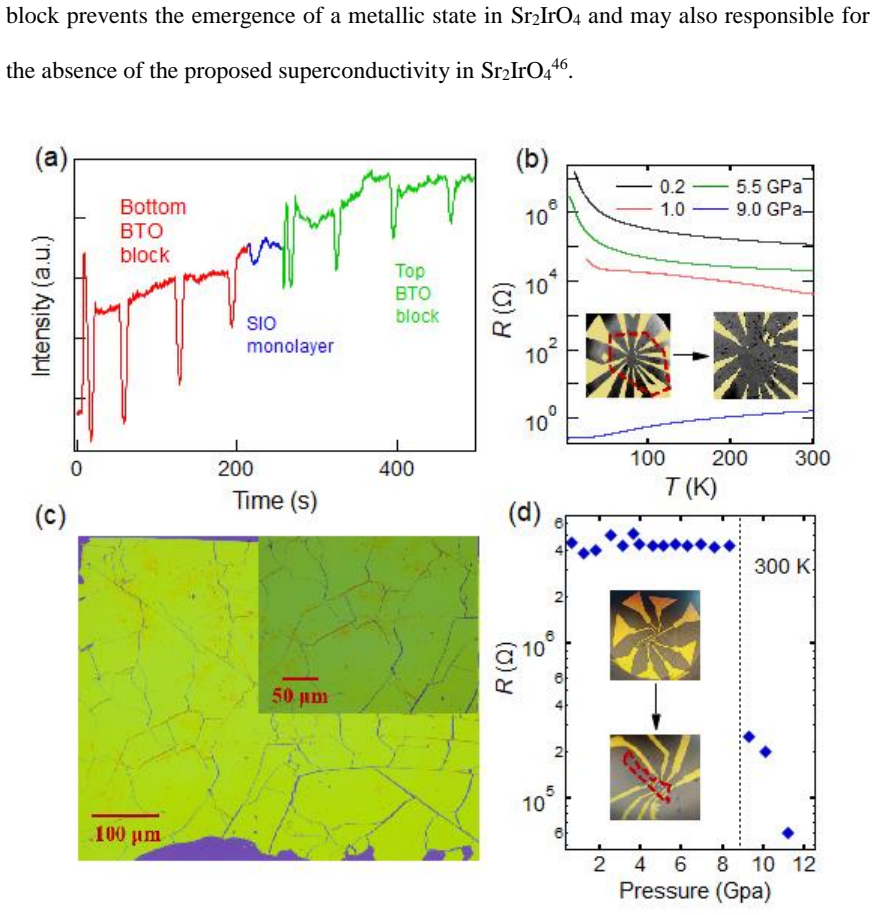
We develop an approach that enables high-pressure transport measurements in freestanding oxide films by enhancing their mechanical robustness and integrating them with nanoscale high-pressure devices. As a demonstration, we investigate the resistivity of perovskite SrIrO3 films under hydrostatic pressure and uncover a pressure-driven semimetal-insulator transition near 2.5 GPa, followed by an insulator-metal transition around 9 GPa. In the monolayer limit, SrIrO3 remains insulating and robust against pressure up to 5.5 GPa. The contrasting pressure-dependent phase diagrams of three- and two-dimensional iridates reveal a strong interplay between dimensionality and hydrostatic pressure in the
What carries the argument
Integration of mechanically robust freestanding oxide films with nanoscale high-pressure devices for uniform hydrostatic pressure transport measurements.
If this is right
- The method establishes a general platform for exploring pressure-driven phenomena in low-dimensional quantum materials.
- Three- and two-dimensional iridates display contrasting pressure-dependent phase diagrams.
- Monolayer SrIrO3 stays insulating up to 5.5 GPa.
- Hydrostatic pressure can drive multiple electronic phase changes in perovskite oxide films.
Where Pith is reading between the lines
- The platform could be applied to other freestanding 2D oxides to map their pressure phase diagrams free of substrate strain.
- The observed dimensionality dependence may guide models of how reduced thickness alters correlation-driven gaps under compression.
- If the transitions prove reproducible across samples, pressure becomes a viable tuning knob for 2D iridate devices.
Load-bearing premise
The nanoscale high-pressure devices apply uniform hydrostatic pressure to the freestanding films without introducing mechanical damage, strain gradients, or contact artifacts that could mimic the observed transitions.
What would settle it
Repeating the resistivity measurements on identical freestanding SrIrO3 films inside a conventional diamond-anvil cell and finding no transitions or different critical pressures would show the changes arise from device-specific effects rather than hydrostatic pressure.
Figures
read the original abstract
Electrical transport in oxide thin films under high pressure remains largely unexplored due to the lack of a universal experimental strategy. Here we develop an approach that enables high-pressure transport measurements in freestanding oxide films by enhancing their mechanical robustness and integrating them with nanoscale high-pressure devices. As a demonstration, we investigate the resistivity of perovskite SrIrO3 films under hydrostatic pressure and uncover a pressure-driven semimetal-insulator transition near 2.5 GPa, followed by an insulator-metal transition around 9 GPa. In the monolayer limit, SrIrO3 remains insulating and robust against pressure up to 5.5 GPa. The contrasting pressure-dependent phase diagrams of three- and two-dimensional iridates reveal a strong interplay between dimensionality and hydrostatic pressure in correlated oxides. Our work establishes a general platform for exploring pressure-driven phenomena in low-dimensional quantum materials.
Editorial analysis
A structured set of objections, weighed in public.
Referee Report
Summary. The manuscript introduces a method for high-pressure electrical transport measurements on freestanding oxide films by integrating them with nanoscale high-pressure devices to enhance mechanical robustness. Using perovskite SrIrO3 as a demonstration, it reports a pressure-driven semimetal-insulator transition near 2.5 GPa followed by an insulator-metal transition around 9 GPa in thicker films, while monolayer films remain insulating and robust up to 5.5 GPa. The work contrasts the pressure-dependent phase diagrams of three- and two-dimensional iridates to highlight the role of dimensionality.
Significance. If the transitions are confirmed to arise from uniform hydrostatic pressure without artifacts, the work would establish a useful experimental platform for studying pressure effects in low-dimensional correlated oxides, where such measurements have been limited. The observed dimensionality dependence in SrIrO3 phase behavior would be of interest to researchers in quantum materials and oxide electronics.
major comments (2)
- [Abstract] Abstract and Results: The reported transition pressures (near 2.5 GPa and around 9 GPa) are stated without error bars, raw resistivity curves, or statistics from multiple devices, which is load-bearing for establishing the existence and precision of the semimetal-insulator and insulator-metal transitions.
- [Methods] Methods (device integration): No post-experiment characterization (e.g., imaging or local pressure calibration at the film site) or control measurements are described to rule out mechanical damage, strain gradients, or electrode artifacts as the source of the resistivity changes, directly affecting attribution to hydrostatic pressure.
minor comments (1)
- [Abstract] Abstract: The reference to 'three- and two-dimensional iridates' should specify whether data or discussion of other iridates beyond SrIrO3 appears in the main text.
Simulated Author's Rebuttal
We thank the referee for their constructive feedback and positive assessment of the work's significance. We address each major comment below and will revise the manuscript accordingly to strengthen the presentation of the data and methods.
read point-by-point responses
-
Referee: [Abstract] Abstract and Results: The reported transition pressures (near 2.5 GPa and around 9 GPa) are stated without error bars, raw resistivity curves, or statistics from multiple devices, which is load-bearing for establishing the existence and precision of the semimetal-insulator and insulator-metal transitions.
Authors: We agree that error bars, raw curves, and multi-device statistics are necessary to substantiate the transition pressures. In the revised manuscript we will add the raw resistivity versus pressure data (including all measured devices) to the main text or SI, report transition pressures with uncertainties derived from the inflection points across N=3 independent devices for the thicker films, and include a brief statistical summary of the observed transitions. These additions will be placed in the Results section. revision: yes
-
Referee: [Methods] Methods (device integration): No post-experiment characterization (e.g., imaging or local pressure calibration at the film site) or control measurements are described to rule out mechanical damage, strain gradients, or electrode artifacts as the source of the resistivity changes, directly affecting attribution to hydrostatic pressure.
Authors: We acknowledge that explicit post-experiment checks and controls are important for ruling out artifacts. In the revised Methods section we will add descriptions of post-release optical and SEM imaging of the films and electrodes to confirm absence of visible mechanical damage or delamination. We will also include control measurements on bare substrate/electrode devices under identical pressure conditions to demonstrate that resistivity changes originate from the oxide film. Local pressure calibration details (via ruby fluorescence at the sample site) will be expanded. revision: yes
Circularity Check
Purely experimental report; no derivations or self-referential predictions present
full rationale
This is an experimental paper reporting resistivity measurements on freestanding SrIrO3 films under pressure. The abstract and described content contain no equations, models, fitted parameters, or predictions that reduce to inputs by construction. No self-citation chains or ansatzes are invoked as load-bearing steps. The central claims rest on observed transitions, with the weakest point being an experimental assumption (uniform hydrostatic pressure) rather than any definitional or fitted circularity. This is the expected outcome for a measurement-focused study.
Axiom & Free-Parameter Ledger
axioms (1)
- domain assumption Freestanding oxide films can be mechanically reinforced and integrated with nanoscale pressure devices while preserving intrinsic electronic properties.
Lean theorems connected to this paper
-
IndisputableMonolith/Foundation/RealityFromDistinction.leanreality_from_one_distinction unclear?
unclearRelation between the paper passage and the cited Recognition theorem.
developed an in-house route to investigate the electrical transport properties of oxide films under high pressures, by improving the elasticity of freestanding oxide films and the robustness of high-pressure techniques on nano-devices
What do these tags mean?
- matches
- The paper's claim is directly supported by a theorem in the formal canon.
- supports
- The theorem supports part of the paper's argument, but the paper may add assumptions or extra steps.
- extends
- The paper goes beyond the formal theorem; the theorem is a base layer rather than the whole result.
- uses
- The paper appears to rely on the theorem as machinery.
- contradicts
- The paper's claim conflicts with a theorem or certificate in the canon.
- unclear
- Pith found a possible connection, but the passage is too broad, indirect, or ambiguous to say the theorem truly supports the claim.
Reference graph
Works this paper leans on
-
[1]
Tuning the electronic properties of J_eff=1/2 correlated semimetal in epitaxial perovskite SrIrO3
1 Ahn, C. H., Rabe, K. M. & Triscone, J. M. Ferroelectricity at the nanoscale: Local polarization in oxide thin films and heterostructures. Science 303, 488-491 (2004). 2 Hwang, H. Y. et al. Emergent phenomena at oxide interfaces. Nat. Mater. 11, 103- 113 (2012). 3 Zubko, P., Gariglio, S., Gabay, M., Ghosez, P. & Triscone, J.-M. Interface Physics in Compl...
work page internal anchor Pith review Pith/arXiv arXiv 2004
discussion (0)
Sign in with ORCID, Apple, or X to comment. Anyone can read and Pith papers without signing in.