Observation of a gapped phase in the one-dimensional S = {frac{1}{2}} Heisenberg antiferromagnetic chain Cu(Ampy)ClBr
Pith reviewed 2026-05-23 00:38 UTC · model grok-4.3
The pith
Cu(Ampy)ClBr displays gapped magnetic excitations at low temperatures with no long-range order.
A machine-rendered reading of the paper's core claim, the machinery that carries it, and where it could break.
Core claim
In the spin-1/2 Heisenberg antiferromagnetic chain compound Cu(Ampy)ClBr, neither long-range magnetic order nor spin freezing appears down to 0.06 K, yet the zero-field magnetic specific heat and the 1H NMR spin-lattice relaxation rate both exhibit an exponential temperature dependence at low temperatures. This behavior demonstrates the presence of gapped magnetic excitations within a one-dimensional frustrated spin chain that remains dynamically active.
What carries the argument
Exponential temperature dependence of zero-field magnetic specific heat and 1H NMR spin-lattice relaxation rate, used to identify gapped magnetic excitations.
If this is right
- Short-range spin correlations develop below approximately 9 K but do not condense into long-range order.
- The anisotropic triangular chain geometry suppresses conventional antiferromagnetic ordering.
- Persistent spin dynamics persist to at least 0.088 K, consistent with a gapped but fluctuating ground state.
- The system furnishes a concrete example of a gapped phase in a spin-1/2 chain tuned by next-nearest-neighbor interactions.
Where Pith is reading between the lines
- The gap size inferred from the exponential fits could be compared with theoretical predictions for the ratio of next-nearest to nearest-neighbor couplings in the frustrated chain model.
- Similar exponential signatures might appear in other Cu2+ chain compounds that also realize anisotropic triangular lattices.
- Field-dependent measurements could test whether the gap closes or remains finite under applied magnetic field.
Load-bearing premise
The observed exponential decay in specific heat and NMR rates arises solely from intrinsic gapped magnetic excitations rather than impurities, phonons, or fitting choices.
What would settle it
Observation of power-law rather than exponential temperature dependence in the magnetic specific heat below 1 K would falsify the gapped-excitations claim.
Figures



read the original abstract
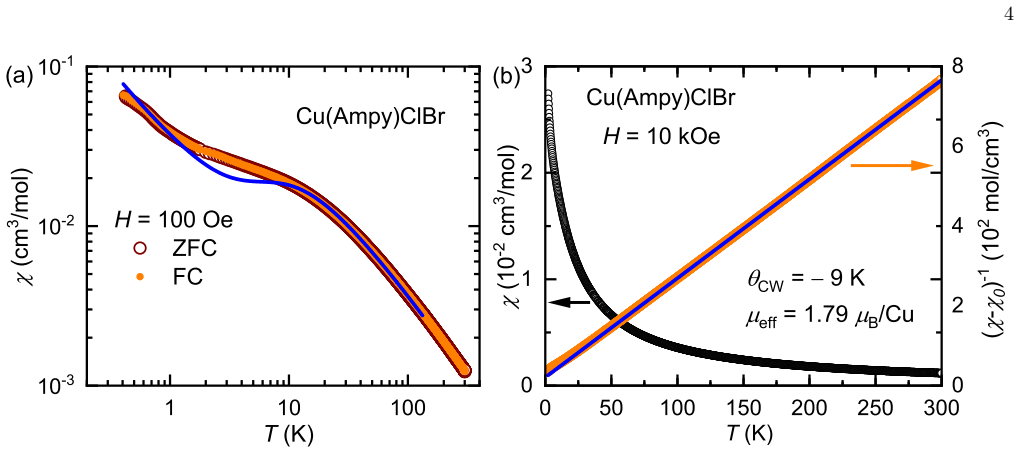
Spin-1/2 Heisenberg antiferromagnetic frustrated spin chain systems display exotic ground states with unconventional excitations and distinct quantum phase transitions as the ratio of next-nearest-neighbor to nearest-neighbor coupling is tuned. We present a comprehensive investigation of the structural, magnetic, and thermodynamics properties of the spin-1/2 compound, Cu(Ampy)ClBr (Ampy= C$_6$H$_8$N$_2$ = 2-(Aminomethyl)pyridine) via x-ray diffraction, magnetization, specific heat, $^1$H nuclear magnetic resonance (NMR), electron spin resonance (ESR), and muon spin relaxation ($\mu$SR) techniques. The crystal structure features an anisotropic triangular chain lattice of magnetic Cu$^{2+}$ ions. Our bulk and local probe experiments detect neither long-range magnetic ordering nor spin freezing down to 0.06 K despite the presence of moderate antiferromagnetic interaction between Cu$^{2+}$ spins as reflected by a Curie-Weiss temperature of about $-9$ K from the bulk susceptibility data. A broad maximum is observed at about 9 K in magnetic susceptibility and specific heat data, indicating the onset of short-range spin correlations. At low temperatures, the zero-field magnetic specific heat and the $^1$H NMR spin-lattice relaxation rate follow an exponential temperature dependence, indicating the presence of gapped magnetic excitations. Furthermore, persistent spin dynamics down to 0.088 K observed by zero-field $\mu$SR evidences lack of any static magnetism.
Editorial analysis
A structured set of objections, weighed in public.
Referee Report
Summary. The manuscript reports a multi-probe experimental study of the spin-1/2 compound Cu(Ampy)ClBr featuring an anisotropic triangular chain lattice of Cu^{2+} ions. Key claims include absence of long-range magnetic order or spin freezing down to 0.06 K, a broad maximum near 9 K in susceptibility and specific heat signaling short-range correlations, exponential temperature dependence in zero-field magnetic specific heat and ^{1}H NMR 1/T_{1} indicating gapped excitations, and persistent spin dynamics in zero-field μSR down to 0.088 K despite a Curie-Weiss temperature of -9 K.
Significance. If the reported exponential dependence is shown to be intrinsic, the work would provide concrete evidence for a gapped quantum disordered phase in a frustrated S=1/2 chain, complementing theoretical predictions for the J_{1}-J_{2} Heisenberg model and adding to the limited set of real materials exhibiting such behavior without conventional ordering.
major comments (2)
- [Abstract and thermodynamics section] Abstract and thermodynamics section: the central claim that the zero-field magnetic specific heat follows an exponential temperature dependence (indicating a gap) rests on subtraction of the phonon background. No details are given on the subtraction procedure (Debye/Einstein fit, isostructural reference, or lattice coefficient determination), the precise temperature window, the functional form fitted (e.g., T^{-1/2}exp(−Δ/T) versus simple exp(−Δ/T)), or goodness-of-fit metrics. A modest residual T^{3} term or low-T impurity upturn can produce an apparently activated form over a limited range, directly undermining the gapped-phase conclusion.
- [NMR section] NMR section: the reported exponential dependence of the ^{1}H spin-lattice relaxation rate 1/T_{1} likewise requires explicit demonstration that additive contributions from dilute paramagnetic defects have been excluded or modeled. Without such analysis or quoted fit parameters, the inference that the activated form arises purely from gapped spin excitations remains unverified and is load-bearing for the overall interpretation.
minor comments (1)
- [Title and abstract] The title refers to a 'one-dimensional' chain while the abstract describes an 'anisotropic triangular chain lattice'; a brief clarification of the effective dimensionality and role of interchain coupling would improve consistency.
Simulated Author's Rebuttal
We thank the referee for the careful reading of our manuscript and the constructive comments. We address the two major points below and will incorporate additional details into a revised version to strengthen the presentation of the specific-heat and NMR analyses.
read point-by-point responses
-
Referee: [Abstract and thermodynamics section] Abstract and thermodynamics section: the central claim that the zero-field magnetic specific heat follows an exponential temperature dependence (indicating a gap) rests on subtraction of the phonon background. No details are given on the subtraction procedure (Debye/Einstein fit, isostructural reference, or lattice coefficient determination), the precise temperature window, the functional form fitted (e.g., T^{-1/2}exp(−Δ/T) versus simple exp(−Δ/T)), or goodness-of-fit metrics. A modest residual T^{3} term or low-T impurity upturn can produce an apparently activated form over a limited range, directly undermining the gapped-phase conclusion.
Authors: We agree that the current manuscript does not provide sufficient detail on the phonon-background subtraction. In the revised version we will add an explicit description of the procedure, including the model employed (Debye–Einstein fit to the high-temperature lattice contribution), the temperature window used for the fit and for extracting the magnetic specific heat, the precise functional form fitted to the low-T magnetic data together with any prefactor, and the associated goodness-of-fit metrics. We will also discuss the possible influence of a residual T^{3} term or dilute-impurity upturn and demonstrate that the activated behavior remains robust after these checks. revision: yes
-
Referee: [NMR section] NMR section: the reported exponential dependence of the ^{1}H spin-lattice relaxation rate 1/T_{1} likewise requires explicit demonstration that additive contributions from dilute paramagnetic defects have been excluded or modeled. Without such analysis or quoted fit parameters, the inference that the activated form arises purely from gapped spin excitations remains unverified and is load-bearing for the overall interpretation.
Authors: We acknowledge the need for explicit treatment of possible paramagnetic-defect contributions to 1/T_{1}. The revised manuscript will include an analysis that quantifies or bounds such contributions (e.g., via concentration estimates or temperature-dependent modeling) and will report the fit parameters for the activated regime. This will confirm that the observed exponential dependence is dominated by the intrinsic gapped excitations rather than defect-induced relaxation. revision: yes
Circularity Check
No circularity: purely experimental observations with no derivation chain
full rationale
The paper reports direct measurements (XRD, magnetization, specific heat, NMR, ESR, μSR) on Cu(Ampy)ClBr. The central claim rests on observed exponential T-dependence in C_mag and 1/T1 after standard background subtraction, plus absence of ordering down to 0.06 K. No equations, ansatzes, uniqueness theorems, or self-citations are invoked to derive a result from itself. The exponential form is a fit to data, not a prediction that reduces by construction to the fit. This is standard experimental reporting with no load-bearing self-referential steps.
Axiom & Free-Parameter Ledger
axioms (1)
- domain assumption Exponential temperature dependence in zero-field specific heat and NMR relaxation rate indicates gapped magnetic excitations in spin systems.
Reference graph
Works this paper leans on
-
[1]
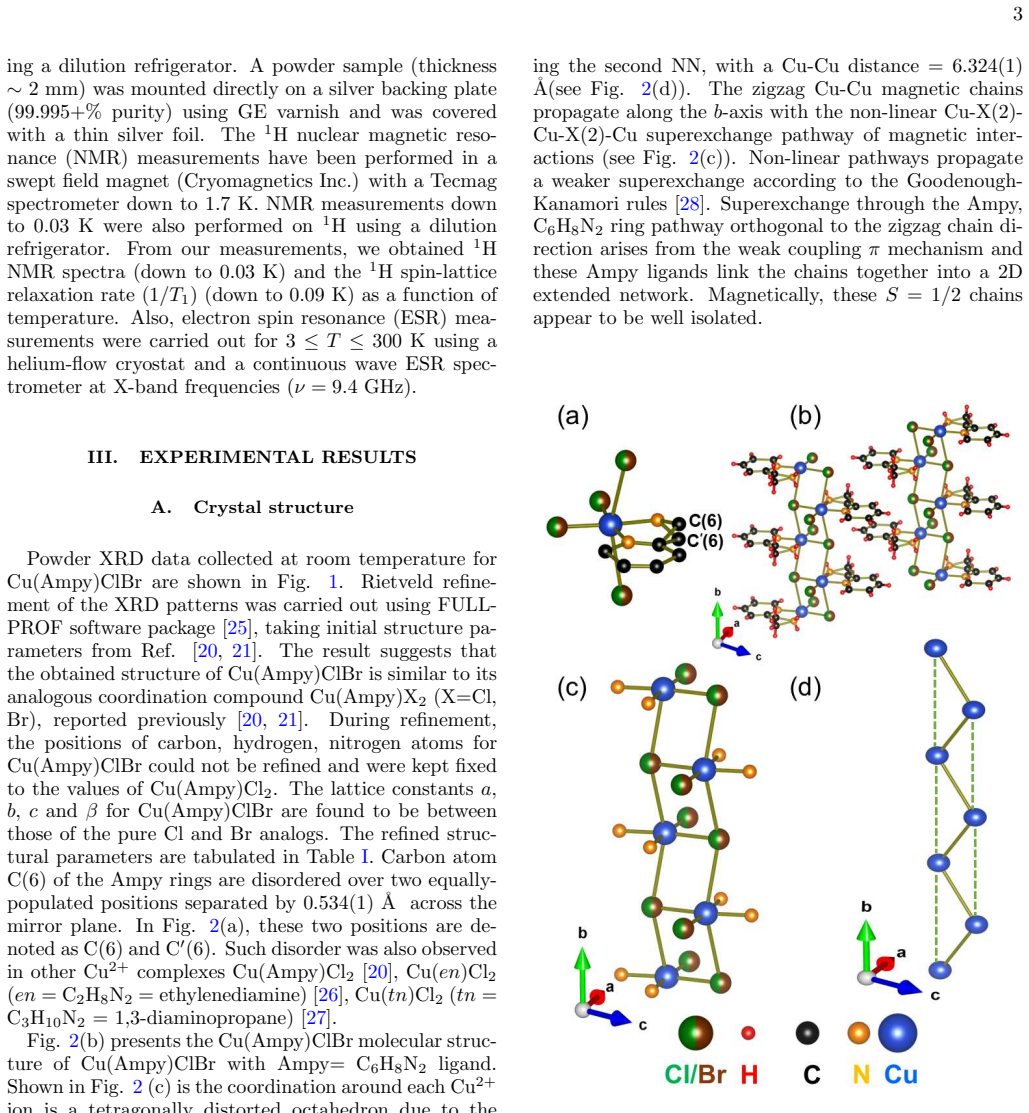
Rietveld refine- ment of the XRD patterns was carried out using FULL- PROF software package [ 25], taking initial structure pa- rameters from Ref. [ 20, 21]. The result suggests that the obtained structure of Cu(Ampy)ClBr is similar to its analogous coordination compound Cu(Ampy)X 2 (X=Cl, Br), reported previously [ 20, 21]. During refinement, the positions...
work page 2068
-
[2]
We also fitted the data using a single exponential form, ∼ exp(− ∆ /k BT ), with ∆ /k B = 2
14(1) K is not quite satisfactory. We also fitted the data using a single exponential form, ∼ exp(− ∆ /k BT ), with ∆ /k B = 2 . 28(5) K; however, this deviates from activated behavior below 1 K (see Fig. 6(c)). In any case, based on the Cmag data analysis, it can be inferred that the Cu(Ampy)ClBr exhibits a gapped ground state. The magnetic specific heat b...
-
[3]
90 kOe in the temperature range 0 . 03 − 180 K. The black dotted line is the reference position. FWHM with decreasing temperature can be attributed to the increase of bulk χ and consequently a greater dis- tribution of local susceptibilities. The position of the central line remains unchanged with temperature, con- firming a weak hyperfine coupling of 1H wi...
-
[4]
and (5) as described in the text. (b) 1H spin-lattice relaxation rate (1 /T 1) as a function of T at 67.7 MHz, 101.5 MHz and 194.83 MHz (closed symbol: faster component, open sym- bol: slower component). The solid line represents the best-fit curve obtained using the double exponential behavior, and the short dashed line indicates a single-exponential fit w...
work page 2021
-
[5]
A. Vasiliev, O. Volkova, E. Zvereva, and M. Markina, Milestones of low-D quantum magnetism, npj Quant. Mater. 3, 18 (2018)
work page 2018
-
[6]
V. Zapf, M. Jaime, and C. D. Batista, Bose-Einstein con- densation in quantum magnets, Rev. Mod. Phys. 86, 563 (2014)
work page 2014
-
[7]
Giamarchi, Quantum physics in one dimension , Vol
T. Giamarchi, Quantum physics in one dimension , Vol. 121 (Oxford University Press, 2003)
work page 2003
-
[8]
Tomonaga, Remarks on Bloch’s method of sound waves applied to many-fermion problems, Prog
S. Tomonaga, Remarks on Bloch’s method of sound waves applied to many-fermion problems, Prog. Theor. Phys. 5, 544 (1950)
work page 1950
-
[9]
Luttinger, An exactly soluble model of a many-fermion system, J
J. Luttinger, An exactly soluble model of a many-fermion system, J. Math. Phys. 4, 1154 (1963)
work page 1963
-
[10]
F. D. M. Haldane, General relation of correlation expo- nents and spectral properties of one-dimensional fermi systems: Application to the anisotropic S = 1 2 Heisen- berg chain, Phys. Rev. Lett. 45, 1358 (1980)
work page 1980
-
[11]
C. K. Majumdar and D. K. Ghosh, On next-nearest- neighbor interaction in linear chain. I, Journal of Math- ematical Physics 10, 1388 (1969)
work page 1969
-
[12]
K. Okamoto and K. Nomura, Fluid-dimer critical point in S = 1/ 2 antiferromagnetic Heisenberg chain with next nearest neighbor interactions, Phys. Lett. A 169, 433 (1992)
work page 1992
-
[13]
K. Uematsu, T. Hikihara, and H. Kawamura, Frustration-induced quantum spin liquid behavior in the s= 1/2 random-bond Heisenberg antiferromagnet on the zigzag chain, J. Phys. Soc. Jpn. 90, 124703 (2021)
work page 2021
-
[14]
M. Hase, I. Terasaki, and K. Uchinokura, Observation of the spin-Peierls transition in linear Cu 2+ (spin-1/2) chains in an inorganic compound CuGeO 3, Phys. Rev. Lett. 70, 3651 (1993)
work page 1993
-
[15]
J. Riera and A. Dobry, Magnetic susceptibility in the spin-Peierls system CuGeO 3, Phys. Rev. B 51, 16098 (1995)
work page 1995
- [16]
-
[17]
J. P. Pouget, L. P. Regnault, M. Ain, B. Hennion, J. P. Renard, P. Veillet, G. Dhalenne, and A. Revcolevschi, Structural Evidence for a Spin Peierls Ground state in the Quasi-One-Dimensional Compound CuGeO 3, Phys. Rev. Lett. 72, 4037 (1994)
work page 1994
- [18]
-
[19]
L. Capogna, M. Mayr, P. Horsch, M. Raichle, R. K. Kre- mer, M. Sofin, A. Maljuk, M. Jansen, and B. Keimer, Helicoidal magnetic order in the spin-chain compound NaCu2O2, Phys. Rev. B 71, 140402 (2005)
work page 2005
-
[20]
S. Lebernegg, O. Janson, I. Rousochatzakis, S. Nishi- moto, H. Rosner, and A. A. Tsirlin, Frustrated spin chain physics near the Majumdar-Ghosh point in szenicsite Cu3(MoO4)(OH)4, Phys. Rev. B 95, 035145 (2017)
work page 2017
-
[21]
T. Ami, M. K. Crawford, R. L. Harlow, Z. R. Wang, D. C. Johnston, Q. Huang, and R. W. Erwin, Magnetic susceptibility and low-temperature structure of the linear chain cuprate Sr 2CuO3, Phys. Rev. B 51, 5994 (1995)
work page 1995
-
[22]
N. Motoyama, H. Eisaki, and S. Uchida, Magnetic sus- ceptibility of ideal spin 1/2 antiferromagnetic chain sys- tems, Sr 2CuO3 and SrCuO 2, Phys. Rev. Lett. 76, 3212 (1996)
work page 1996
-
[23]
M. Takigawa, O. A. Starykh, A. W. Sandvik, and R. R. P. Singh, Nuclear relaxation in the spin-1 / 2 antiferromag- netic chain compound sr 2cuo3 : comparison between the- ories and experiments, Phys. Rev. B 56, 13681 (1997)
work page 1997
-
[24]
C. J. O’Connor, E. E. Eduok, F. R. Fronczek, and O. Kahn, Synthesis, magnetic properties and molecular structure of CuLCl 2, where L = 2- aminomethylpyridine (amp) and 2,2 ′-aminoethylpyridine (aep). One-dimensional antiferromagnetic interactions in Cu(amp)Cl2, Inorg. Chim. Acta 105, 107 (1985)
work page 1985
-
[25]
H. M. Helis, W. H. Goodman, R. B. Wilson, J. A. Morgan, and D. J. Hodgson, A novel halogen- bridged system: synthesis and structures of Dibromo[2- (2-aminomethyl)pyridine] copper(II) and Dibromo(2- methyl-1,2-diaminopropane) copper(II), Inorg. Chem. 16, 2412 (1977)
work page 1977
-
[26]
H. Kikuchi, H. Nagasawa, Y. Ajiro, T. Asano, and T. Goto, Susceptibility and high-field magnetization of one-dimensional S = 1 / 2 Heisenberg antiferromagnet with next-nearest exchange interaction, Physica B: Con- densed Matter 284, 1631 (2000)
work page 2000
-
[27]
See supplemental material at [url will be inserted by the production group] for the supporting results and discus- sion, which include [ 20, 22].,
-
[28]
M. Hagiwara, Y. Narumi, K. Kindo, N. Maeshima, K. Okunishi, T. Sakai, and M. Takahashi, High-field magnetization of an S = 1 / 2 zigzag chain compound (N2H5)CuCl3, Physica B: Condensed Matter 294, 83 (2001)
work page 2001
-
[29]
J. Rodr ´ ıguez-Carvajal, Recent advances in magnetic structure determination by neutron powder diffraction, Phys. B (Amsterdam) 192, 55 (1993)
work page 1993
-
[30]
D. Harvey and C. Lock, Dichloro(ethylenediamine) cop- per (II), Acta Cryst. C 42, 799 (1986)
work page 1986
-
[31]
R. Tarasenko, O. Vinnik, J. ˇSebesta, D. Legut, J. Chovan, E. ˇCiˇ zm´ ar, J. Streˇ cka, K. Kar ˇlov´ a, P. J. Baker, L. Kotvytska, M. Orend´ aˇ c, and A. Orend´ aˇ cov´ a, Extraordinary two-dimensionality in the S = 1/ 2 spatially anisotropic triangular quantum magnet Cu(1, 3− diaminopropane)Cl2 with modulated structure, Phys. Rev. B 108, 214432 (2023)
work page 2023
-
[32]
Goodenough, Magnetism and the Chemical Bond (In- terscience Wiley, 1963)
J. Goodenough, Magnetism and the Chemical Bond (In- terscience Wiley, 1963)
work page 1963
-
[33]
G. A. Bain and J. F. Berry, Diamagnetic corrections and Pascal’s constants, J. Chem. Educ. 85, 532 (2008)
work page 2008
-
[34]
C. Domb and A. Miedema, Chapter VI magnetic transi- tions, Prog. Low Temp. Phys., 4, 296 (1964)
work page 1964
-
[35]
S. Guchhait, D. V. Ambika, S. Mohanty, Y. Furukawa, and R. Nath, Magnetic properties of the frustrated spin- 1/2 capped-kagome antiferromagnet (CsBr)Cu 5V2O10, Phys. Rev. B 110, 174447 (2024)
work page 2024
-
[36]
D. C. Johnston, R. K. Kremer, M. Troyer, X. Wang, A. Kl¨ umper, S. L. Bud’ko, A. F. Panchula, and P. C. Canfield, Thermodynamics of spin S = 1 / 2 antiferro- magnetic uniform and alternating-exchange heisenberg chains, Phys. Rev. B 61, 9558 (2000)
work page 2000
-
[37]
G. E. Granroth, S. Maegawa, M. W. Meisel, J. Krzystek, L.-C. Brunel, N. S. Bell, J. H. Adair, B. H. Ward, G. E. Fanucci, L.-K. Chou, and D. R. Talham, Magnetic stud- ies of end-chain spin effects in the haldane-gap material Ni(C3H10N2)2N3(ClO4), Phys. Rev. B 58, 9312 (1998)
work page 1998
-
[38]
Kittel, Introduction To Solid State Physics (John Wi- ley & Sons, Inc., Hoboken, NJ, 2005)
C. Kittel, Introduction To Solid State Physics (John Wi- ley & Sons, Inc., Hoboken, NJ, 2005)
work page 2005
-
[39]
J. L. Manson, A. G. Baldwin, B. L. Scott, J. Bendix, R. E. Del Sesto, P. A. Goddard, Y. Kohama, H. E. Tran, S. Ghannadzadeh, J. Singleton, T. Lancaster, J. S. M¨ oller, S. J. Blundell, F. L. Pratt, V. S. Zapf, J. Kang, C. Lee, M.-H. Whangbo, and C. Baines, [Ni(HF 2)(3- Clpy)4]BF4 (py = pyridine): Evidence for spin ex- change along strongly distorted FHF –...
work page 2012
-
[40]
A. Pustogow, T. Le, H.-H. Wang, Y. Luo, E. Gati, H. Schubert, M. Lang, and S. E. Brown, Impurity mo- ments conceal low-energy relaxation of quantum spin liq- uids, Phys. Rev. B 101, 140401 (2020)
work page 2020
- [41]
-
[42]
G. Simutis, S. Gvasaliya, M. M ˚ ansson, A. L. Cherny- shev, A. Mohan, S. Singh, C. Hess, A. T. Savici, A. I. Kolesnikov, A. Piovano, T. Perring, I. Zaliznyak, B. B¨ uchner, and A. Zheludev, Spin Pseudogap in Ni- Doped SrCuO 2, Phys. Rev. Lett. 111, 067204 (2013)
work page 2013
-
[43]
B. Sana, M. Barik, S. Lee, U. Jena, M. Baenitz, J. Sichelschmidt, S. Luther, H. K¨ uhne, K. Sethupathi, M. S. R. Rao, K. Y. Choi, and P. Khuntia, Possible real- ization of a randomness-driven quantum disordered state in the S = 1/ 2 antiferromagnet Sr 3CuTa2O9, Phys. Rev. B 110, 134412 (2024)
work page 2024
-
[44]
C. A. Corrˆ ea, M. Poupon, V. Petˇ r ´ ıˇ cek, R. Tarasenko, M. Mih´ alik, D. Legut, U. D. Wdowik, and A. Orend´ aˇ cov´ a, Phase transformation in quasi-two- dimensional quantum antiferromagnet Cu(tn)Cl 2 (tn = 1,3-Diaminopropane), J. Phys. Chem. C 126, 14573 (2022)
work page 2022
-
[45]
Z. G. Soos, K. T. McGregor, T. T. P. Cheung, and A. J. Silverstein, Antisymmetric and anisotropic exchange in ferromagnetic copper(II) layers, Phys. Rev. B 16, 3036 (1977)
work page 1977
-
[46]
R. D. Willett and R. J. Wong, Experimental evi- dence for phonon modulation of antisymmetric exchange from the temperature dependence of EPR linewidths in 15 (RNH3)2CuX4 salts, J. Magn. Reson. 42, 446 (1981)
work page 1981
-
[47]
S. J. Blundell, R. De Renzi, T. Lancaster, and F. L. Pratt, Muon Spectroscopy: An Introduction (Oxford University Press, 2021)
work page 2021
-
[48]
C. Balz, B. Lake, J. Reuther, H. Luetkens, R. Sch¨ onemann, T. Herrmannsd¨ orfer, Y. Singh, A. Nazmul Islam, E. M. Wheeler, J. A. Rodriguez- Rivera, T. Guidi, G. Simeoni, C. Baines, and H. Ryll, Physical realization of a quantum spin liquid based on a complex frustration mechanism, Nature Phys. 12, 942 (2016)
work page 2016
-
[49]
F. L. Pratt, S. J. Blundell, P. A. Pattenden, W. Hayes, K. H. Chow, A. P. Monkman, T. Ishiguro, K. Ishida, and K. Nagamine, Spin dynamics in conducting polymers studied by µ SR, Hyperfine Interact. 106, 33 (1997)
work page 1997
-
[50]
F. L. Pratt, S. J. Blundell, T. Lancaster, C. Baines, and S. Takagi, Low-temperature spin diffusion in a highly ideal S = 1 / 2 heisenberg antiferromagnetic chain stud- ied by muon spin relaxation, Phys. Rev. Lett. 96, 247203 (2006)
work page 2006
-
[51]
S. Lee, R. Klauer, J. Menten, W. Lee, S. Yoon, H. Luetkens, P. Lemmens, A. M¨ oller, and K.-Y. Choi, Unconventional spin excitations in the S = 3 / 2 triangu- lar antiferromagnet RbAg 2Cr[VO4]2, Phys. Rev. B 101, 224420 (2020)
work page 2020
-
[52]
E. Kermarrec, A. Zorko, F. Bert, R. H. Colman, B. Koteswararao, F. Bouquet, P. Bonville, A. Hillier, A. Amato, J. van Tol, A. Ozarowski, A. S. Wills, and P. Mendels, Spin dynamics and disorder effects in the S = 1/ 2 kagome Heisenberg spin-liquid phase of kapella- site, Phys. Rev. B 90, 205103 (2014)
work page 2014
-
[53]
W. Lee, S. Yoon, S. Jeon, Y. Cai, K. Kojima, L. T. Nguyen, R. J. Cava, K.-Y. Choi, and S. Lee, Random singlet-like state in the dimer-based triangular antiferro- magnet Ba 6Y2Rh2Ti2O17− δ , Phys. Rev. Res. 6, 023225 (2024)
work page 2024
- [54]
-
[55]
A. G. Redfield, On the theory of relaxation processes, IBM J. Res. Dev. 1, 19 (1957)
work page 1957
-
[56]
R. S. Hayano, Y. J. Uemura, J. Imazato, N. Nishida, T. Yamazaki, and R. Kubo, Zero-and low-field spin re- laxation studied by positive muons, Phys. Rev. B 20, 850 (1979)
work page 1979
-
[57]
C. A. Kuntscher, S. Schuppler, P. Haas, B. Gorshunov, M. Dressel, M. Grioni, F. Lichtenberg, A. Herrnberger, F. Mayr, and J. Mannhart, Extremely small energy gap in the quasi-one-dimensional conducting chain compound SrNbO3. 41, Phys. Rev. Lett. 89, 236403 (2002)
work page 2002
-
[58]
J.-E. Weber, C. Kegler, N. B¨ uttgen, H.-A. Krug von Nidda, A. Loidl, and F. Lichtenberg, Nmr, epr, and bulk susceptibility measurements of one-dimensional SrNbO3. 41, Phys. Rev. B 64, 235414 (2001) . Supplemental Material: Observation of a gapped phase in the one-dimensiona l S = 1 2 Heisenberg antiferromagnetic chain Cu(Ampy)ClBr Saikat Nandi, 1, ∗ Moni...
work page 2001
-
[59]
C. J. O’Connor, E. E. Eduok, F. R. Fronczek, and O. Kahn, Synt hesis, magnetic properties and molecular structure of CuLCl2, where L = 2-aminomethylpyridine (amp) and 2,2 ′-aminoethylpyridine (aep). One-dimensional antiferromagnet ic interactions in Cu(amp)Cl 2, Inorg. Chim. Acta 105, 107 (1985)
work page 1985
-
[60]
H. Kikuchi, H. Nagasawa, Y. Ajiro, T. Asano, and T. Goto, Sus ceptibility and high-field magnetization of one-dimension al S = 1 /2 Heisenberg antiferromagnet with next-nearest exchange interac tion, Physica B: Condensed Matter 284, 1631 (2000)
work page 2000
discussion (0)
Sign in with ORCID, Apple, or X to comment. Anyone can read and Pith papers without signing in.