Synthetic Function Demonstrations Improve Generation in Low-Resource Programming Languages
Pith reviewed 2026-05-22 23:09 UTC · model grok-4.3
The pith
Generating synthetic textbook-quality function demonstrations from documentation enables effective finetuning for low-resource languages like Excel formulas.
A machine-rendered reading of the paper's core claim, the machinery that carries it, and where it could break.
Core claim
By collating language documentation to augment a teacher model, synthetic training data of textbook-quality function demonstrations can be generated. Finetuning student models on these demonstrations improves performance on the WikiTQ and TAT-QA datasets and provides advantages over standard RAG approaches, which yield only modest gains because student models remain unfamiliar with the target domain.
What carries the argument
The synthetic function demonstration generation pipeline, which turns collated documentation into finetuning examples via a teacher model for subsequent student model adaptation.
If this is right
- Finetuned student models achieve higher performance on tabular question-answering datasets than unfine-tuned counterparts.
- The finetuning approach delivers larger gains than retrieval-augmented generation in domains unfamiliar to the student model.
- Synthetic demonstrations can substitute for naturally occurring program examples paired with human comments.
- The method applies at least to the Excel Formulas domain as a concrete low-resource case.
Where Pith is reading between the lines
- The method could accelerate adaptation to entirely new library functions by bootstrapping from documentation alone.
- Stronger teacher models may systematically improve weaker student models across a range of structured generation tasks.
- Similar pipelines might reduce dependence on human-authored comments when introducing support for additional low-resource languages.
Load-bearing premise
The synthetic demonstrations produced by the teacher model are of textbook quality and sufficiently representative to serve as effective finetuning data without introducing significant errors or biases.
What would settle it
If student models finetuned on the generated synthetic demonstrations show no accuracy improvement on WikiTQ or TAT-QA relative to the same models without this finetuning step, the central claim would be refuted.
Figures



read the original abstract
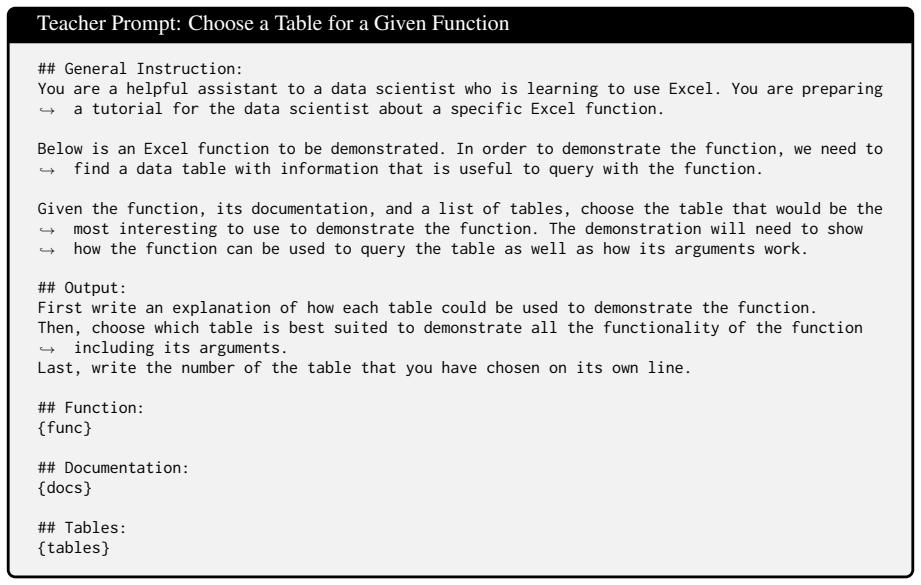
A key consideration when training an LLM is whether the target language is more or less resourced, for example English compared to Welsh, or Python compared to Excel. Typical training data for programming languages consists of real program demonstrations coupled with explanatory human-written comments. In this work we present a novel approach to the creation of such data for low resource programming languages, which lack naturally occurring data. Our process generates synthetic, textbook-quality demonstrations of how to use library functions, which we show makes for good model finetuning data. We demonstrate in an example domain of Excel Formulas. First, we collate language documentation, then we use this to augment a powerful teacher model which generates synthetic training data, and finally finetune student models on the demonstrations. Our technique improves student performance on 2 question-answering datasets: WikiTQ and TAT-QA. We also show advantages of finetuning over standard RAG approaches, which can offer only modest improvement due to the unfamiliarity of the target domain to student models.
Editorial analysis
A structured set of objections, weighed in public.
Referee Report
Summary. The paper presents a pipeline for low-resource programming languages (exemplified by Excel Formulas) that collates language documentation, uses a teacher model to generate synthetic textbook-quality function demonstrations, and finetunes student models on this data. The central claim is that this yields improved performance on the WikiTQ and TAT-QA question-answering datasets relative to baselines, while also outperforming standard RAG approaches that suffer from domain unfamiliarity.
Significance. If the reported gains hold under detailed scrutiny, the work offers a practical, scalable route to high-quality synthetic training data for domains lacking natural demonstrations. The explicit comparison to RAG and the end-to-end pipeline (documentation collation to evaluation) are strengths that could generalize beyond Excel to other low-resource languages.
minor comments (2)
- [Abstract] The abstract asserts performance gains on WikiTQ and TAT-QA but does not report effect sizes, exact baselines, or statistical tests; adding these would strengthen the summary for readers.
- Clarify the precise definition of 'textbook-quality' demonstrations and any filtering steps applied to teacher outputs to allow replication.
Simulated Author's Rebuttal
We thank the referee for their positive summary, recognition of the pipeline's strengths, and recommendation for minor revision. No specific major comments were raised in the report.
Circularity Check
No significant circularity; empirical claims rest on reported experiments
full rationale
The paper describes a pipeline (collate docs → teacher generation of synthetic demos → student finetuning → evaluation on WikiTQ/TAT-QA) and reports performance gains. No equations, fitted parameters renamed as predictions, or self-citation chains appear in the provided text. The central claim is an empirical improvement that can be falsified by the experiments themselves and does not reduce to any input by construction. This matches the most common honest non-finding for experimental NLP papers.
Axiom & Free-Parameter Ledger
Reference graph
Works this paper leans on
-
[1]
A survey on llm-based code generation for low-resource and domain-specific programming lan- guages. Preprint, arXiv:2410.03981. Denis Kocetkov, Raymond Li, Loubna Ben Allal, Jia Li, Chenghao Mou, Carlos Muñoz Ferrandis, Yacine Jernite, Margaret Mitchell, Sean Hughes, Thomas Wolf, Dzmitry Bahdanau, Leandro von Werra, and Harm de Vries. 2022. The stack: 3 t...
-
[2]
The argument A being demonstrated
-
[3]
A natural language query Q which requires the use of F and A executed on the table T to compute a solution. Write the query in a natural and realistic way, as if an interested person were trying to analyze the data table to solve a problem. ,→ ,→ Make the query specific so there is only one correct answer. For example, to demonstrate a string manipulation...
-
[4]
A brief explanation of what F does in general (not related to the query Q or table T)
-
[5]
When explaining the steps, only use values mentioned in the query Q or references into the table T
A step by step explanation of how to use F and A to solve the query Q given T. When explaining the steps, only use values mentioned in the query Q or references into the table T. Use the syntax section of the function F 's documentation to explain how the arguments are used. ,→ ,→
-
[6]
The answer to the query Q. After any reasoning, restate the answer on its own line at the end, e.g. "True", "False", "5", etc.,→
-
[7]
The final Excel formula using F and A to solve the query Q
-
[8]
Write the parameter name and required/optional for each of the final arguments given to F as a list, e.g. "param1 <required>", "param2 <optional>", etc.,→ Write examples which demonstrate the required arguments, then examples for each of the optional arguments. Format the examples as a JSON list according to the following structure: ```json [ {{ "func": s...
-
[9]
First, copy the description of the example formula
-
[10]
Next, if the formula contains contains a cell reference (e.g. A2), then copy the portion of the table containing the referred data (and not the example rows) so that the formula can be evaluated.,→
-
[11]
Then, copy the formula itself into a code block
-
[12]
Last, copy the output of the formula below the code block. If there are no examples present in the article, write "[No examples provided]". Demonstration: This article describes the formula syntax and usage of the ABS function in Microsoft Excel. Description Returns the absolute value of a number. The absolute value of a number is the number without its s...
discussion (0)
Sign in with ORCID, Apple, or X to comment. Anyone can read and Pith papers without signing in.