Les Houches 2023 -- Physics at TeV Colliders: Report on the Standard Model Precision Wishlist
Pith reviewed 2026-05-22 20:17 UTC · model grok-4.3
The pith
The 2023 Les Houches report updates the wishlist of fixed-order calculations needed for Standard Model precision at the LHC.
A machine-rendered reading of the paper's core claim, the machinery that carries it, and where it could break.
Core claim
Recent progress has occurred in fixed-order computations for LHC applications, and specific processes and missing higher-order corrections are required to reach the theoretical accuracy that matches the anticipated experimental precision, as determined by community consensus at the 2023 Les Houches workshop.
What carries the argument
The Standard Model precision wishlist, a catalog of processes and required perturbative orders that guides LHC phenomenology calculations.
Load-bearing premise
The processes and corrections highlighted represent the highest-priority gaps based on current experimental plans and community consensus at the 2023 workshop.
What would settle it
Experimental results showing that the listed processes and corrections do not set the limiting precision or that other processes have become more urgent with updated data.
Figures

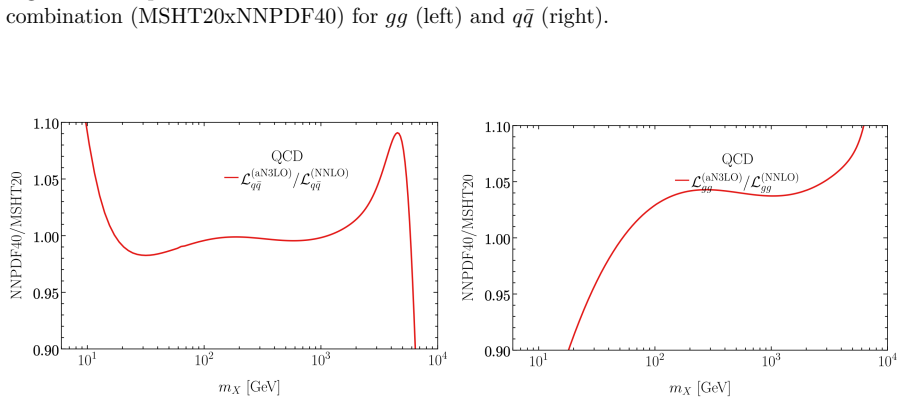
read the original abstract
Les Houches returned to an in-person format in 2023 and the bi-yearly tradition of updating the standard model precision wishlist has continued. In this work we review recent progress (since Les Houches 2021) in fixed-order computations for LHC applications. In addition, necessary ingredients for such calculations such as parton distribution functions, amplitudes, and subtraction methods are discussed. Finally, we indicate processes and missing higher-order corrections that are required to reach the theoretical accuracy that matches the anticipated experimental precision.
Editorial analysis
A structured set of objections, weighed in public.
Referee Report
Summary. The manuscript is the 2023 update of the Les Houches Standard Model precision wishlist. It reviews fixed-order progress since the 2021 edition for LHC processes, covers supporting ingredients (PDFs, amplitudes, subtraction methods), and lists specific processes together with the higher-order corrections required to reach the theoretical accuracy matching anticipated experimental precision.
Significance. As a community consensus document that compiles recent advances and identifies priority calculations, the report provides a useful reference point for theorists and phenomenologists working on LHC precision. Its value lies in documenting the current state of the field and focusing effort on the corrections needed to keep theory uncertainties below experimental targets.
minor comments (1)
- The abstract and introduction could more explicitly state the time window covered (post-2021) and the criteria used to select the listed processes, to help readers quickly locate the updates relative to the previous wishlist.
Simulated Author's Rebuttal
We thank the referee for their positive assessment of the manuscript and their recommendation to accept.
Circularity Check
No significant circularity identified
full rationale
This is a community status report compiling workshop consensus on recent fixed-order progress and a wishlist of needed higher-order corrections for LHC processes. Its central claim is descriptive (progress occurred; these items are required to match anticipated precision) rather than a deductive or calculational assertion. No internal derivations, equations, predictions, or fitted quantities are produced that could reduce to inputs by construction. The prioritization is presented as the outcome of the 2023 Les Houches discussions, with no self-citation load-bearing steps or ansatz smuggling. The document is self-contained against external benchmarks as a summary report.
Axiom & Free-Parameter Ledger
Forward citations
Cited by 10 Pith papers
-
The spectrum of Feynman-integral geometries at two loops
Two-loop Feynman integrals involve Riemann spheres, elliptic curves, hyperelliptic curves of genus 2 and 3, K3 surfaces, and a rationalizable Del Pezzo surface of degree 2.
-
All-loop four-quark Bethe-Salpeter kernel
The all-loop bare perturbative part of the four-quark Bethe-Salpeter kernel is computed analytically in the large-Nf limit of massless QCD.
-
Two-loop leading-color QCD corrections for Higgs plus two-jet production in the heavy-top limit
Analytic expressions for the finite remainders of two-loop leading-color helicity amplitudes in Higgs plus two-jet production are obtained in the heavy-top effective theory using numerical unitarity and a new partial-...
-
Complete NLO corrections to off-shell $\boldsymbol{t\bar{t}}$ production in the $\boldsymbol{\ell+j}$ decay channel
Complete NLO QCD plus EW corrections are calculated for off-shell ttbar production in the lepton-plus-jets channel, including all doubly, singly and non-resonant diagrams with their interferences.
-
Two-loop all-plus helicity amplitudes for self-dual Higgs boson with gluons via unitarity cut constraints
Two-loop all-plus helicity amplitudes for self-dual Higgs plus gluons are obtained via four-dimensional unitarity cuts into one-loop and tree amplitudes plus finite-field tensor reduction.
-
Non-factorisable electroweak virtual corrections to single-resonant processes
Non-factorisable two-loop EW virtual corrections to single-resonant processes reduce to an iteration of the one-loop result plus a new light-fermion contribution in dimensional regularization and are specific to singl...
-
Les Houches study on inclusive jet production at NNLO+NNLL
NNLL resummation shows that scale variations drastically underestimate higher-order uncertainties in NNLO inclusive jet cross sections for typical jet radii, rendering such estimates unreliable.
-
Inclusive charm and bottom quark pair production cross sections at hadron colliders at next-to-next-to-leading-order accuracy
NNLO QCD calculations using the MaunaKea code enhance c cbar and b bbar production cross sections by up to a factor of two over NLO predictions, reduce scale uncertainties, and match experimental data from 10 GeV to 1...
-
The status of theory in the electroweak sector: Radiative corrections, salient features, approximations
Electroweak radiative corrections are essential for accurate collider predictions, with current techniques and progress illustrated through di-boson production, vector-boson scattering, and tri-boson production.
-
Precision calculations for electroweak multi-boson processes
Electroweak corrections reach about -16% for like-sign WW scattering and -7% for triple-W production at the LHC, even for integrated cross sections, and the paper discusses approximations to full off-shell calculations.
Reference graph
Works this paper leans on
- [1]
-
[2]
A. Tricoli, M. Schönherr, and P. Azzurri,Vector Bosons and Jets in Proton Collisions, Rev. Mod. Phys.93(2021) no. 2, 025007,arXiv:2012.13967 [hep-ex]. 3, 30
-
[3]
Heinrich,Collider Physics at the Precision Frontier, Phys
G. Heinrich,Collider Physics at the Precision Frontier, Phys. Rept.922(2021) 1–69, arXiv:2009.00516 [hep-ph]. 3
-
[4]
R. Covarelli, M. Pellen, and M. Zaro,Vector-Boson scattering at the LHC: Unraveling the electroweak sector, Int. J. Mod. Phys. A36(2021) no. 16, 2130009, arXiv:2102.10991 [hep-ph]. 3, 34
-
[5]
K. Jakobs and G. Zanderighi,The profile of the Higgs boson: status and prospects, Phil. Trans. Roy. Soc. Lond. A382(2023) no. 2266, 20230087,arXiv:2311.10346 [hep-ph]. 3
-
[6]
S. P. Jones,An Overview of Standard Model Calculations for Higgs Boson Production & Decay, LHEP2023(2023) 442. 3, 15
work page 2023
- [7]
-
[8]
T. Carli, D. Clements, A. Cooper-Sarkar, C. Gwenlan, G. P. Salam, F. Siegert, P. Starovoitov, and M. Sutton,A posteriori inclusion of parton density functions in NLO QCD final-state calculations at hadron colliders: The APPLGRID Project, Eur. Phys. J. C66(2010) 503–524,arXiv:0911.2985 [hep-ph]. 3
work page internal anchor Pith review Pith/arXiv arXiv 2010
-
[9]
fastNLO: Fast pQCD Calculations for PDF Fits
T. Kluge, K. Rabbertz, and M. Wobisch,FastNLO: Fast pQCD calculations for PDF fits, in14th International Workshop on Deep Inelastic Scattering, pp. 483–486. 9, 2006. arXiv:hep-ph/0609285. 3
work page internal anchor Pith review Pith/arXiv arXiv 2006
-
[10]
S. Carrazza, E. R. Nocera, C. Schwan, and M. Zaro,PineAPPL: combining EW and QCD corrections for fast evaluation of LHC processes, JHEP12(2020) 108, arXiv:2008.12789 [hep-ph]. 3
-
[11]
J. Campbell, J. Huston, and F. Krauss,The Black Book of Quantum Chromodynamics : a Primer for the LHC Era. Oxford University Press, 2018. 4, 19
work page 2018
-
[12]
New CTEQ global analysis of quantum chromodynamics with high-precision data from the LHC
T.-J. Hou et al.,New CTEQ global analysis of quantum chromodynamics with high-precision data from the LHC, Phys. Rev. D103(2021) no. 1, 014013, arXiv:1912.10053 [hep-ph]. 4
work page internal anchor Pith review Pith/arXiv arXiv 2021
- [13]
- [14]
-
[15]
X. Jing et al.,Quantifying the interplay of experimental constraints in analyses of parton distributions, Phys. Rev. D108(2023) no. 3, 034029,arXiv:2306.03918 [hep-ph]. 4
-
[16]
M. Constantinou et al.,Lattice QCD Calculations of Parton Physics, arXiv:2202.07193 [hep-lat]. 4
-
[17]
NNPDF Collaboration, R. D. Ball et al.,Parton distributions from high-precision collider data, Eur. Phys. J. C77(2017) no. 10, 663,arXiv:1706.00428 [hep-ph]. 4
work page internal anchor Pith review Pith/arXiv arXiv 2017
- [18]
-
[19]
A. Courtoy, J. Huston, P. Nadolsky, K. Xie, M. Yan, and C. P. Yuan,Parton distributions need representative sampling, Phys. Rev. D107(2023) no. 3, 034008, arXiv:2205.10444 [hep-ph]. 4
- [20]
-
[21]
S. Alekhin, M. V. Garzelli, S. O. Moch, and O. Zenaiev,NNLO PDFs driven by top-quark data, Eur. Phys. J. C85(2025) no. 2, 162,arXiv:2407.00545 [hep-ph]. 4
-
[22]
L. A. Harland-Lang and R. S. Thorne,On the Consistent Use of Scale Variations in PDF Fits and Predictions, Eur. Phys. J. C79(2019) no. 3, 225,arXiv:1811.08434 [hep-ph]. 5
work page internal anchor Pith review Pith/arXiv arXiv 2019
- [23]
-
[24]
Z. Kassabov, M. Ubiali, and C. Voisey,Parton distributions with scale uncertainties: a Monte Carlo sampling approach, JHEP03(2023) 148,arXiv:2207.07616 [hep-ph]. 5
-
[25]
J. McGowan, T. Cridge, L. A. Harland-Lang, and R. S. Thorne,Approximate N3LO parton distribution functions with theoretical uncertainties: MSHT20aN3LO PDFs, Eur. Phys. J. C83(2023) no. 3, 185,arXiv:2207.04739 [hep-ph]. [Erratum: Eur.Phys.J.C 83, 302 (2023)]. 5, 6
-
[26]
A. Cooper-Sarkar, T. Cridge, F. Giuli, L. A. Harland-Lang, F. Hekhorn, J. Huston, G. Magni, S. Moch, and R. S. Thorne,A Benchmarking of QCD Evolution at ApproximateN 3LO,arXiv:2406.16188 [hep-ph]. 6
-
[27]
G. Falcioni, F. Herzog, S. Moch, A. Pelloni, and A. Vogt,Four-loop splitting functions in QCD – the gluon-gluon case –, Phys. Lett. B860(2025) 139194,arXiv:2410.08089 [hep-ph]. 6
-
[28]
J. Ablinger, A. Behring, J. Blümlein, A. De Freitas, A. von Manteuffel, C. Schneider, and K. Schönwald,The three-loop single-mass heavy flavor corrections to deep-inelastic scattering, PoSLL2024(2024) 047,arXiv:2407.02006 [hep-ph]. 6
- [29]
-
[30]
MSHT, NNPDF Collaboration, T. Cridge et al.,Combination of aN3LO PDFs and implications for Higgs production cross-sections at the LHC,arXiv:2411.05373 [hep-ph]. 6
- [31]
- [32]
- [33]
- [34]
-
[35]
A. Barontini, N. Laurenti, and J. Rojo,NNPDF progress and the path to proton structure at N3LO accuracy, PoSDIS2024(2025) 039. 7
work page 2025
-
[36]
Travaglini et al.,The SAGEX review on scattering amplitudes, J
G. Travaglini et al.,The SAGEX review on scattering amplitudes, J. Phys. A55(2022) no. 44, 443001,arXiv:2203.13011 [hep-th]. 8
-
[37]
Weinzierl,Feynman Integrals, arXiv e-prints (Jan., 2022) arXiv:2201.03593 [2201.03593]
S. Weinzierl,Feynman Integrals. A Comprehensive Treatment for Students and Researchers. UNITEXT for Physics. Springer, 2022.arXiv:2201.03593 [hep-th]. 8
-
[38]
The SAGEX review on scat tering amplitudes Chapter 3: Mathematical structures in Feynman integrals,
S. Abreu, R. Britto, and C. Duhr,The SAGEX review on scattering amplitudes Chapter 3: Mathematical structures in Feynman integrals, J. Phys. A55(2022) no. 44, 443004, arXiv:2203.13014 [hep-th]. 8
-
[39]
J. Blümlein and C. Schneider,The SAGEX review on scattering amplitudes Chapter 4: Multi-loop Feynman integrals, J. Phys. A55(2022) no. 44, 443005,arXiv:2203.13015 [hep-th]. 8
-
[40]
F. Febres Cordero, A. von Manteuffel, and T. Neumann,Computational Challenges for Multi-loop Collider Phenomenology: A Snowmass 2021 White Paper, Comput. Softw. Big Sci.6(2022) no. 1, 14,arXiv:2204.04200 [hep-ph]. 8
-
[41]
F. V. Tkachov,A theorem on analytical calculability of 4-loop renormalization group functions, Phys. Lett. B100(1981) 65–68. 8
work page 1981
-
[42]
K. G. Chetyrkin and F. V. Tkachov,Integration by parts: The algorithm to calculate β-functions in 4 loops, Nucl. Phys. B192(1981) 159–204. 8
work page 1981
-
[43]
High-precision calculation of multi-loop Feynman integrals by difference equations
S. Laporta,High-precision calculation of multiloop Feynman integrals by difference equations, Int. J. Mod. Phys. A15(2000) 5087–5159,arXiv:hep-ph/0102033. 8
work page internal anchor Pith review Pith/arXiv arXiv 2000
-
[44]
Differential Equations for Two-Loop Four-Point Functions
T. Gehrmann and E. Remiddi,Differential equations for two-loop four-point functions, Nucl. Phys. B580(2000) 485–518,arXiv:hep-ph/9912329. 8
work page internal anchor Pith review Pith/arXiv arXiv 2000
-
[45]
O. V. Tarasov,Connection between Feynman integrals having different values of the space-time dimension, Phys. Rev. D54(1996) 6479–6490,arXiv:hep-th/9606018. 8
work page internal anchor Pith review Pith/arXiv arXiv 1996
-
[46]
R. N. Lee,Space-time dimensionality D as complex variable: Calculating loop integrals using dimensional recurrence relation and analytical properties with respect to D, Nucl. Phys. B830(2010) 474–492,arXiv:0911.0252 [hep-ph]. 8
work page internal anchor Pith review Pith/arXiv arXiv 2010
-
[47]
Automatic Integral Reduction for Higher Order Perturbative Calculations
C. Anastasiou and A. Lazopoulos,Automatic integral reduction for higher order perturbative calculations, JHEP07(2004) 046,arXiv:hep-ph/0404258. 8
work page internal anchor Pith review Pith/arXiv arXiv 2004
-
[48]
A. V. Smirnov,Algorithm FIRE – Feynman Integral REduction, JHEP10(2008) 107, arXiv:0807.3243 [hep-ph]. 8
work page internal anchor Pith review Pith/arXiv arXiv 2008
-
[49]
A. V. Smirnov and V. A. Smirnov,FIRE4, LiteRed and accompanying tools to solve integration by parts relations, Comput. Phys. Commun.184(2013) 2820–2827, arXiv:1302.5885 [hep-ph]. 8
work page internal anchor Pith review Pith/arXiv arXiv 2013
-
[50]
A. V. Smirnov,FIRE5: A C++ implementation of Feynman Integral REduction, Comput. Phys. Commun.189(2015) 182–191,arXiv:1408.2372 [hep-ph]. 8
work page internal anchor Pith review Pith/arXiv arXiv 2015
- [51]
- [52]
-
[53]
R. N. Lee,Presenting LiteRed: a tool for the Loop InTEgrals REDuction, arXiv:1212.2685 [hep-ph]. 8
work page internal anchor Pith review Pith/arXiv arXiv
-
[54]
R. N. Lee,LiteRed 1.4: a powerful tool for reduction of multiloop integrals, J. Phys. Conf. Ser.523(2014) 012059,arXiv:1310.1145 [hep-ph]. 8 43
work page internal anchor Pith review Pith/arXiv arXiv 2014
-
[55]
Reduze - Feynman Integral Reduction in C++
C. Studerus,Reduze – Feynman integral reduction in C++, Comput. Phys. Commun. 181(2010) 1293–1300,arXiv:0912.2546 [physics.comp-ph]. 8
work page internal anchor Pith review Pith/arXiv arXiv 2010
-
[56]
Reduze 2 - Distributed Feynman Integral Reduction
A. von Manteuffel and C. Studerus,Reduze 2 - Distributed Feynman Integral Reduction, arXiv:1201.4330 [hep-ph]. 8
work page internal anchor Pith review Pith/arXiv arXiv
-
[57]
Kira - A Feynman Integral Reduction Program
P. Maierhöfer, J. Usovitsch, and P. Uwer,Kira—A Feynman integral reduction program, Comput. Phys. Commun.230(2018) 99–112,arXiv:1705.05610 [hep-ph]. 8
work page internal anchor Pith review Pith/arXiv arXiv 2018
-
[58]
P. Maierhöfer and J. Usovitsch,Kira 1.2 Release Notes,arXiv:1812.01491 [hep-ph]. 8
work page internal anchor Pith review Pith/arXiv arXiv
-
[59]
Integral Reduction with Kira 2.0 and Finite Field Methods
J. Klappert, F. Lange, P. Maierhöfer, and J. Usovitsch,Integral reduction with Kira 2.0 and finite field methods, Comput. Phys. Commun.266(2021) 108024, arXiv:2008.06494 [hep-ph]. 8
work page internal anchor Pith review Pith/arXiv arXiv 2021
- [60]
- [61]
-
[62]
J. Klappert and F. Lange,Reconstructing rational functions with FireFly, Comput. Phys. Commun.247(2020) 106951,arXiv:1904.00009 [cs.SC]. 8
-
[63]
J. Klappert, S. Y. Klein, and F. Lange,Interpolation of dense and sparse rational functions and other improvements in FireFly, Comput. Phys. Commun.264(2021) 107968,arXiv:2004.01463 [cs.MS]. 8
-
[64]
FiniteFlow: multivariate functional reconstruction using finite fields and dataflow graphs
T. Peraro,FiniteFlow: multivariate functional reconstruction using finite fields and dataflow graphs, JHEP07(2019) 031,arXiv:1905.08019 [hep-ph]. 8
work page internal anchor Pith review Pith/arXiv arXiv 2019
-
[65]
A novel approach to integration by parts reduction
A. von Manteuffel and R. M. Schabinger,A novel approach to integration by parts reduction, Phys. Lett. B744(2015) 101–104,arXiv:1406.4513 [hep-ph]. 8
work page internal anchor Pith review Pith/arXiv arXiv 2015
-
[66]
V. Magerya,Rational Tracer: a Tool for Faster Rational Function Reconstruction, arXiv:2211.03572 [physics.data-an]. 8
-
[67]
Liu,Reconstruction of rational functions made simple, Phys
X. Liu,Reconstruction of rational functions made simple, Phys. Lett. B850(2024) 138491,arXiv:2306.12262 [hep-ph]. 8
-
[68]
Maier,Scaling up to Multivariate Rational Function Reconstruction, arXiv:2409.08757 [hep-ph]
A. Maier,Scaling up to Multivariate Rational Function Reconstruction, arXiv:2409.08757 [hep-ph]. 8
-
[69]
H. Frellesvig, F. Gasparotto, S. Laporta, M. K. Mandal, P. Mastrolia, L. Mattiazzi, and S. Mizera,Decomposition of Feynman Integrals by Multivariate Intersection Numbers, JHEP03(2021) 027,arXiv:2008.04823 [hep-th]. 8
-
[70]
G. Fontana and T. Peraro,Reduction to master integrals via intersection numbers and polynomial expansions, JHEP08(2023) 175,arXiv:2304.14336 [hep-ph]. 8
-
[71]
G. Brunello, V. Chestnov, G. Crisanti, H. Frellesvig, M. K. Mandal, and P. Mastrolia, Intersection numbers, polynomial division and relative cohomology, JHEP09(2024) 015,arXiv:2401.01897 [hep-th]. 8
-
[72]
G. Brunello, G. Crisanti, M. Giroux, P. Mastrolia, and S. Smith,Fourier calculus from intersection theory, Phys. Rev. D109(2024) no. 9, 094047,arXiv:2311.14432 [hep-th]. 8
-
[73]
G. Crisanti and S. Smith,Feynman integral reductions by intersection theory with orthogonal bases and closed formulae, JHEP09(2024) 018,arXiv:2405.18178 [hep-th]. 8
-
[74]
G. Brunello, V. Chestnov, and P. Mastrolia,Intersection Numbers from Companion 44 Tensor Algebra,arXiv:2408.16668 [hep-th]. 8
-
[75]
M. Heller and A. von Manteuffel,MultivariateApart: Generalized partial fractions, Comput. Phys. Commun.271(2022) 108174,arXiv:2101.08283 [cs.SC]. 8
-
[76]
G. De Laurentis and B. Page,Ansätze for scattering amplitudes from p-adic numbers and algebraic geometry, JHEP12(2022) 140,arXiv:2203.04269 [hep-th]. 8
- [77]
-
[78]
Feynman Diagrams and Differential Equations
M. Argeri and P. Mastrolia,Feynman Diagrams and Differential Equations, Int. J. Mod. Phys. A22(2007) 4375–4436,arXiv:0707.4037 [hep-ph]. 8
work page internal anchor Pith review Pith/arXiv arXiv 2007
-
[79]
J. M. Henn,Lectures on differential equations for Feynman integrals, J. Phys. A48 (2015) 153001,arXiv:1412.2296 [hep-ph]. 8
work page internal anchor Pith review Pith/arXiv arXiv 2015
-
[80]
Analytic form of the two-loop planar five-gluon all-plus-helicity amplitude in QCD
T. Gehrmann, J. M. Henn, and N. A. Lo Presti,Analytic form of the two-loop planar five-gluon all-plus-helicity amplitude in QCD, Phys. Rev. Lett.116(2016) no. 6, 062001,arXiv:1511.05409 [hep-ph]. [Erratum: Phys.Rev.Lett. 116, 189903 (2016)]. 8
work page internal anchor Pith review Pith/arXiv arXiv 2016
discussion (0)
Sign in with ORCID, Apple, or X to comment. Anyone can read and Pith papers without signing in.