Non-Gaussianity of Tensor Induced Density Perturbations
Pith reviewed 2026-05-22 19:56 UTC · model grok-4.3
The pith
Tensor-induced density perturbations from primordial gravitational waves exhibit non-Gaussianity whose bispectrum shape depends on the underlying GW spectrum.
A machine-rendered reading of the paper's core claim, the machinery that carries it, and where it could break.
Core claim
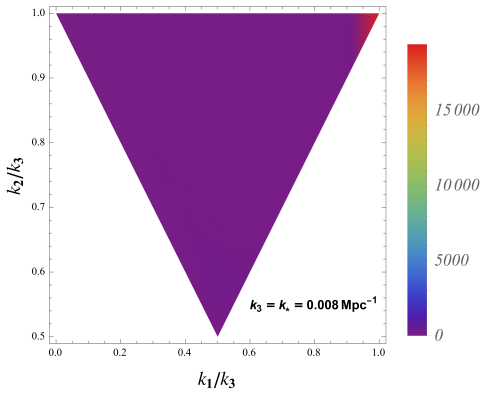
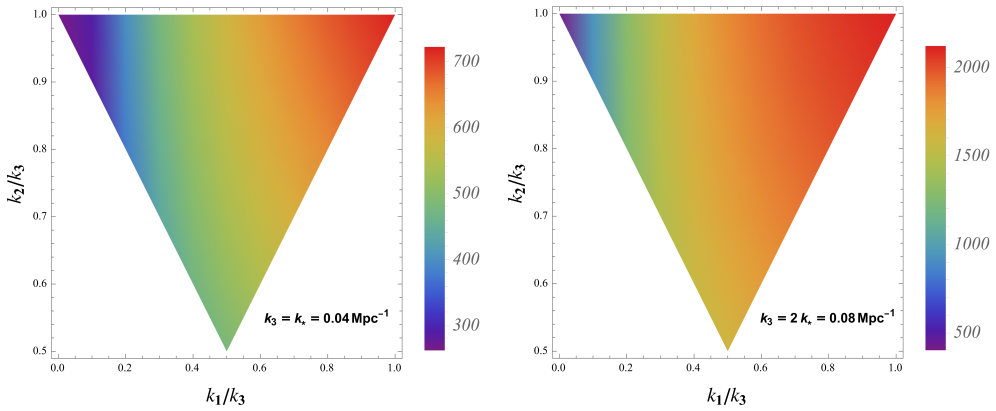
The second-order matter density contrast induced by primordial gravitational waves arises from the quadratic term in the tensor energy density and follows a chi-squared distribution, leading to significant non-Gaussianity. The bispectrum of these tensor-induced scalar modes is inherently sensitive to the underlying GWs spectrum, with Gaussian-bump and monochromatic sources producing a strong signal peaking in the equilateral configuration.
What carries the argument
The quadratic dependence of GW energy density on tensor perturbations, which sources the second-order density contrast and produces its chi-squared distribution whose bispectrum encodes the GW spectrum shape.
If this is right
- Galaxy surveys can detect the non-Gaussianity as a distinct signature of primordial GWs.
- The equilateral bispectrum peak for bump-like and monochromatic GW spectra provides a way to distinguish different primordial sources.
- Tensor-induced density perturbations offer a probe of GWs that is complementary to direct detection or scalar-induced effects.
- The chi-squared nature of the density field implies observable higher-order correlations beyond the bispectrum.
Where Pith is reading between the lines
- Large-scale structure data from future surveys could be used to place new constraints on the amplitude and tilt of primordial GW spectra.
- This non-Gaussianity might contribute to scale-dependent bias signals in galaxy clustering, affecting cosmological parameter inference.
- The mechanism suggests that other second-order induced perturbations could carry similar spectrum-dependent non-Gaussian features.
Load-bearing premise
The second-order matter density contrast is sourced solely by the quadratic term in the tensor energy density, with higher-order scalar and vector contributions remaining negligible on the relevant scales.
What would settle it
A null detection of the predicted equilateral bispectrum peak in galaxy clustering statistics on scales where monochromatic or Gaussian-bump GW sources are expected would contradict the claimed sensitivity of the bispectrum to the GW spectrum.
Figures


read the original abstract
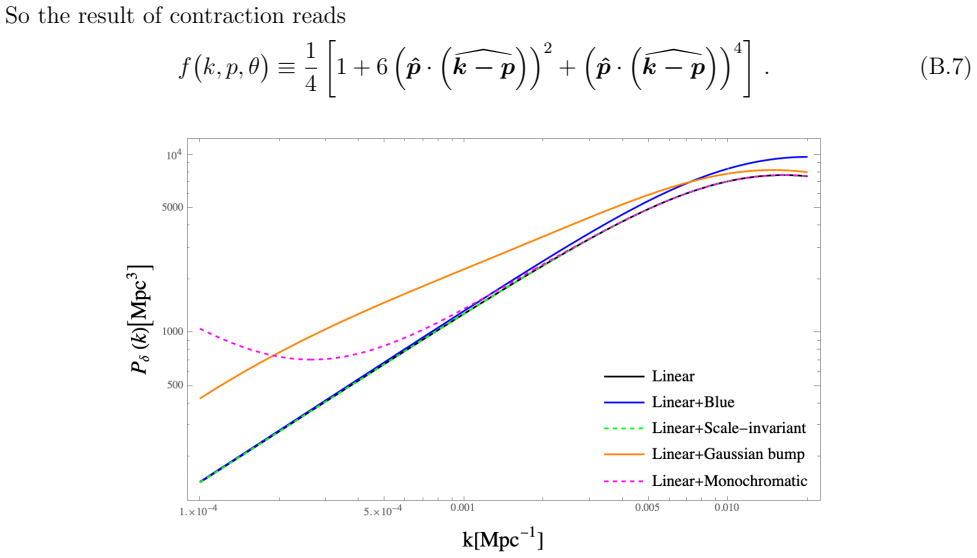
We investigate the non-Gaussianity of second-order matter density perturbations induced by primordial gravitational waves (GWs). These tensor-induced scalar modes arise from local fluctuations in the GWs energy density, which is quadratic in tensor perturbations. The resulting second-order density contrast follows a chi-squared distribution, naturally exhibiting significant non-Gaussianity. We compute the bispectrum of these tensor-induced scalar modes and analyze its dependence on various primordial GWs power spectra, including scale-invariant, blue-tilted, Gaussian-bump, and monochromatic sources. We find that the bispectrum shape is inherently sensitive to the underlying GWs spectrum by construction. In particular, Gaussian-bump and monochromatic sources produce a strong signal peaking in the equilateral configuration, similar to the effect of scalar-induced tensor modes. Our findings reveal a new way to probe primordial GWs via galaxy surveys and highlight a unique feature of tensor-induced density perturbations, otherwise mimicking linear ones on sub-horizon scales.
Editorial analysis
A structured set of objections, weighed in public.
Referee Report
Summary. The paper claims that second-order matter density perturbations induced by primordial gravitational waves exhibit significant non-Gaussianity because the GW energy density is quadratic in the tensor perturbations, yielding a chi-squared distribution for the density contrast. The authors compute the bispectrum of these tensor-induced scalar modes for several primordial GW power spectra (scale-invariant, blue-tilted, Gaussian-bump, and monochromatic) and report that the bispectrum shape is sensitive to the underlying spectrum, with Gaussian-bump and monochromatic sources producing a strong equilateral peak similar to scalar-induced tensor modes. This is presented as a new probe of primordial GWs via galaxy surveys.
Significance. If the central results hold, the work supplies an explicit, spectrum-dependent mapping from primordial tensor power spectra to the bispectrum of induced density perturbations, offering a potentially falsifiable signature for large-scale structure observations that is otherwise degenerate with linear modes on sub-horizon scales. The direct integration over the tensor power spectrum using standard second-order kernels is a clear strength.
major comments (1)
- [§3 (formalism and kernel)] The derivation of the second-order density contrast assumes it arises solely from the quadratic term in the tensor energy density with higher-order scalar and vector contributions negligible. This assumption is load-bearing for the claimed equilateral peaking in the Gaussian-bump and monochromatic cases (see the bispectrum results), yet no quantitative estimate of the neglected terms is provided for localized spectra where they could be comparable on sub-horizon scales and alter both amplitude and configuration dependence.
minor comments (2)
- [Figures 3-5] Figure captions and axis labels for the bispectrum plots could more explicitly state the normalization and the range of wavenumbers used.
- [§6] A short paragraph comparing the predicted bispectrum amplitude to expected noise levels in upcoming surveys (e.g., Euclid or LSST) would improve the observational discussion.
Simulated Author's Rebuttal
We thank the referee for their thorough review and constructive feedback on our manuscript. The major comment raises an important point about the assumptions underlying our derivation, and we address it directly below. We maintain that the leading-order quadratic contribution is the appropriate focus for this work, but we agree that additional justification will improve clarity.
read point-by-point responses
-
Referee: The derivation of the second-order density contrast assumes it arises solely from the quadratic term in the tensor energy density with higher-order scalar and vector contributions negligible. This assumption is load-bearing for the claimed equilateral peaking in the Gaussian-bump and monochromatic cases (see the bispectrum results), yet no quantitative estimate of the neglected terms is provided for localized spectra where they could be comparable on sub-horizon scales and alter both amplitude and configuration dependence.
Authors: We agree that the second-order density contrast is derived from the quadratic tensor energy density term, following the standard approach in the literature on induced gravitational perturbations. Higher-order scalar and vector contributions enter at higher orders in the perturbative expansion and are suppressed by additional factors of the small tensor amplitude. For the localized spectra considered, the bispectrum shape is determined by the convolution structure of the quadratic term, which produces the equilateral peak by construction. Nevertheless, we acknowledge that an explicit order-of-magnitude estimate for sub-horizon scales would strengthen the presentation. In the revised version we will add a brief discussion in §3 providing such an estimate, demonstrating that the neglected terms remain subdominant (by at least an order of magnitude) for the amplitudes and wavenumbers relevant to the Gaussian-bump and monochromatic cases, without altering the reported configuration dependence. revision: yes
Circularity Check
No significant circularity; bispectrum follows from standard second-order kernels applied to arbitrary tensor spectra.
full rationale
The central derivation integrates the tensor power spectrum against fixed second-order perturbation kernels to obtain the bispectrum; this is a direct computation whose shape dependence on the input spectrum (scale-invariant, bump, monochromatic) is a mathematical consequence of the quadratic energy-density source, not a redefinition or fit. No load-bearing self-citation, no parameter fitted to the target observable, and no uniqueness theorem imported from prior work by the same authors. The stated assumption that higher-order scalar/vector terms are negligible is an explicit approximation, not a hidden tautology that forces the reported equilateral peak.
Axiom & Free-Parameter Ledger
free parameters (1)
- overall amplitude of primordial tensor spectrum
axioms (2)
- standard math Second-order cosmological perturbation theory on an expanding FLRW background
- domain assumption Primordial tensor perturbations are Gaussian
Forward citations
Cited by 2 Pith papers
-
Tracing Primordial Gravitational Waves via non-Gaussian Signatures of Halo Bias
Tensor-induced non-Gaussianity from primordial gravitational waves generates a unique scale-dependent halo bias correction that can reach order-one amplitude for rare high-redshift halos at z=7.
-
Primordial Black Hole from Tensor-induced Density Fluctuation: First-order Phase Transitions and Domain Walls
Tensor perturbations from first-order phase transitions and domain wall annihilation induce curvature fluctuations at second order that form primordial black holes, allowing asteroid-mass PBHs to comprise all dark mat...
Reference graph
Works this paper leans on
-
[1]
The Inflationary Universe: A Possible Solution to the Horizon and Flatness Problems,
A. H. Guth, “The Inflationary Universe: A Possible Solution to the Horizon and Flatness Problems,” Phys. Rev. D , vol. 23, pp. 347–356, 1981
work page 1981
-
[2]
P. A. R. Ade et al., “BICEP2 / Keck Array x: Constraints on Primordial Gravitational Waves using Planck, WMAP, and New BICEP2/Keck Observations through the 2015 Season,”Phys. Rev. Lett., vol. 121, p. 221301, 2018
work page 2015
-
[3]
A Probe of primordial gravity waves and vorticity,
M. Kamionkowski, A. Kosowsky, and A. Stebbins, “A Probe of primordial gravity waves and vorticity,” Phys. Rev. Lett. , vol. 78, pp. 2058–2061, 1997
work page 2058
-
[4]
Signature of gravity waves in polarization of the microwave background,
U. Seljak and M. Zaldarriaga, “Signature of gravity waves in polarization of the microwave background,” Phys. Rev. Lett. , vol. 78, pp. 2054–2057, 1997
work page 2054
-
[5]
A New Type of Isotropic Cosmological Models Without Singularity,
A. A. Starobinsky, “A New Type of Isotropic Cosmological Models Without Singularity,” Phys. Lett. B , vol. 91, pp. 99–102, 1980
work page 1980
-
[6]
Particle physics models of inflation and the cosmological density perturbation,
D. H. Lyth and A. Riotto, “Particle physics models of inflation and the cosmological density perturbation,” Phys. Rept., vol. 314, pp. 1–146, 1999
work page 1999
-
[7]
Gravitational waves from infla- tion,
M. C. Guzzetti, N. Bartolo, M. Liguori, and S. Matarrese, “Gravitational waves from infla- tion,” Riv. Nuovo Cim. , vol. 39, no. 9, pp. 399–495, 2016
work page 2016
-
[8]
Cosmological Backgrounds of Gravitational Waves,
C. Caprini and D. G. Figueroa, “Cosmological Backgrounds of Gravitational Waves,” Class. Quant. Grav., vol. 35, no. 16, p. 163001, 2018
work page 2018
-
[9]
L. A. Boyle and A. Buonanno, “Relating gravitational wave constraints from primordial nu- cleosynthesis, pulsar timing, laser interferometers, and the CMB: Implications for the early Universe,” Phys. Rev. D , vol. 78, p. 043531, 2008
work page 2008
-
[10]
Gravitational Wave Production right after a Primordial Black Hole Evaporation,
K. Inomata, M. Kawasaki, K. Mukaida, T. Terada, and T. T. Yanagida, “Gravitational Wave Production right after a Primordial Black Hole Evaporation,” Phys. Rev. D , vol. 101, no. 12, p. 123533, 2020
work page 2020
-
[11]
Anisotropies and non-Gaussianity of the Cosmological Gravitational Wave Background,
N. Bartolo, D. Bertacca, S. Matarrese, M. Peloso, A. Ricciardone, A. Riotto, and G. Tasinato, “Anisotropies and non-Gaussianity of the Cosmological Gravitational Wave Background,” Phys. Rev. D , vol. 100, no. 12, p. 121501, 2019
work page 2019
-
[12]
Characterizing the cosmological gravitational wave background: Anisotropies and non- Gaussianity,
N. Bartolo, D. Bertacca, S. Matarrese, M. Peloso, A. Ricciardone, A. Riotto, and G. Tasi- nato, “Characterizing the cosmological gravitational wave background: Anisotropies and non- Gaussianity,” Phys. Rev. D , vol. 102, no. 2, p. 023527, 2020
work page 2020
-
[13]
Probing anisotropies of the Stochastic Gravitational Wave Background with LISA,
N. Bartolo et al. , “Probing anisotropies of the Stochastic Gravitational Wave Background with LISA,” JCAP, vol. 11, p. 009, 2022
work page 2022
-
[14]
Gravitational wave experiments and early universe cosmology,
M. Maggiore, “Gravitational wave experiments and early universe cosmology,” Phys. Rept. , vol. 331, pp. 283–367, 2000
work page 2000
-
[15]
The Quest for B Modes from Inflationary Gravitational Waves,
M. Kamionkowski and E. D. Kovetz, “The Quest for B Modes from Inflationary Gravitational Waves,” Ann. Rev. Astron. Astrophys. , vol. 54, pp. 227–269, 2016
work page 2016
-
[16]
Improved Calculation of the Primordial Gravitational Wave Spectrum in the Standard Model,
Y. Watanabe and E. Komatsu, “Improved Calculation of the Primordial Gravitational Wave Spectrum in the Standard Model,” Phys. Rev. D , vol. 73, p. 123515, 2006. 17
work page 2006
-
[17]
Probing the early history of cosmic reionization by future cosmic microwave background experiments,
H. Sakamoto, K. Ahn, K. Ichiki, H. Moon, and K. Hasegawa, “Probing the early history of cosmic reionization by future cosmic microwave background experiments,” The Astrophysical Journal, vol. 930, no. 2, p. 140, 2022
work page 2022
-
[18]
CMB-S4: Forecasting Constraints on Primordial Gravitational Waves,
K. Abazajian et al., “CMB-S4: Forecasting Constraints on Primordial Gravitational Waves,” Astrophys. J., vol. 926, no. 1, p. 54, 2022
work page 2022
-
[19]
Measuring the spectrum of primor- dial gravitational waves with CMB, PTA and Laser Interferometers,
P. Campeti, E. Komatsu, D. Poletti, and C. Baccigalupi, “Measuring the spectrum of primor- dial gravitational waves with CMB, PTA and Laser Interferometers,” JCAP, vol. 01, p. 012, 2021
work page 2021
-
[20]
Improved reconstruction of a stochastic gravitational wave background with LISA,
R. Flauger, N. Karnesis, G. Nardini, M. Pieroni, A. Ricciardone, and J. Torrado, “Improved reconstruction of a stochastic gravitational wave background with LISA,” JCAP, vol. 01, p. 059, 2021
work page 2021
-
[21]
Probing Cosmic Inflation with the LiteBIRD Cosmic Microwave Background Polarization Survey,
E. Allys et al., “Probing Cosmic Inflation with the LiteBIRD Cosmic Microwave Background Polarization Survey,” PTEP, vol. 2023, no. 4, p. 042F01, 2023
work page 2023
-
[22]
I. Caporali, G. Capurri, W. Del Pozzo, A. Ricciardone, and L. Valbusa Dall’Armi, “Impact of correlated noise on the reconstruction of the stochastic gravitational wave background with Einstein Telescope,” 1 2025
work page 2025
-
[23]
Science with the Einstein Telescope: a comparison of different designs,
M. Branchesi et al., “Science with the Einstein Telescope: a comparison of different designs,” JCAP, vol. 07, p. 068, 2023
work page 2023
-
[24]
Gravitational waves from inflation in LISA: reconstruction pipeline and physics interpretation,
M. Braglia et al. , “Gravitational waves from inflation in LISA: reconstruction pipeline and physics interpretation,” JCAP, vol. 11, p. 032, 2024
work page 2024
-
[25]
The Science of the Einstein Telescope,
A. Abac et al. , “The Science of the Einstein Telescope,” 3 2025
work page 2025
-
[26]
The NANOGrav 15 yr Data Set: Search for Signals from New Physics,
A. Afzal et al. , “The NANOGrav 15 yr Data Set: Search for Signals from New Physics,” Astrophys. J. Lett. , vol. 951, no. 1, p. L11, 2023
work page 2023
-
[27]
European Pulsar Timing Array Limits On An Isotropic Stochastic Gravitational-Wave Background,
L. Lentati et al. , “European Pulsar Timing Array Limits On An Isotropic Stochastic Gravitational-Wave Background,” Mon. Not. Roy. Astron. Soc. , vol. 453, no. 3, pp. 2576– 2598, 2015
work page 2015
-
[28]
J. Antoniadis et al. , “The second data release from the European Pulsar Timing Array - IV. Implications for massive black holes, dark matter, and the early Universe,”Astron. Astrophys., vol. 685, p. A94, 2024
work page 2024
-
[29]
H. Xu et al. , “Searching for the Nano-Hertz Stochastic Gravitational Wave Background with the Chinese Pulsar Timing Array Data Release I,” Res. Astron. Astrophys. , vol. 23, no. 7, p. 075024, 2023
work page 2023
-
[30]
D. J. Reardon et al. , “The Gravitational-wave Background Null Hypothesis: Characterizing Noise in Millisecond Pulsar Arrival Times with the Parkes Pulsar Timing Array,” Astrophys. J. Lett., vol. 951, no. 1, p. L7, 2023
work page 2023
-
[31]
Upper Limits on the Isotropic Gravitational Radiation Background from Pulsar Timing Analysis,
R. w. Hellings and G. s. Downs, “Upper Limits on the Isotropic Gravitational Radiation Background from Pulsar Timing Analysis,” Astrophys. J. Lett. , vol. 265, pp. L39–L42, 1983. 18
work page 1983
-
[32]
A. Sesana, A. Vecchio, and M. Volonteri, “Gravitational waves from resolvable massive black hole binary systems and observations with Pulsar Timing Arrays,” Mon. Not. Roy. Astron. Soc., vol. 394, p. 2255, 2009
work page 2009
-
[33]
The Astrophysics of Nanohertz Gravitational Waves,
S. Burke-Spolaor et al. , “The Astrophysics of Nanohertz Gravitational Waves,” Astron. As- trophys. Rev., vol. 27, no. 1, p. 5, 2019
work page 2019
-
[34]
The NANOGrav 12.5 yr Data Set: Search for an Isotropic Stochastic Gravitational-wave Background,
Z. Arzoumanian et al., “The NANOGrav 12.5 yr Data Set: Search for an Isotropic Stochastic Gravitational-wave Background,” Astrophys. J. Lett. , vol. 905, no. 2, p. L34, 2020
work page 2020
-
[35]
Second order perturbations of the Einstein-de Sitter universe,
S. Matarrese, S. Mollerach, and M. Bruni, “Second order perturbations of the Einstein-de Sitter universe,” Phys. Rev. D , vol. 58, p. 043504, 1998
work page 1998
-
[36]
K. Kohri and T. Terada, “Semianalytic calculation of gravitational wave spectrum nonlinearly induced from primordial curvature perturbations,” Phys. Rev. D , vol. 97, no. 12, p. 123532, 2018
work page 2018
-
[37]
Scalar Induced Gravitational Waves Review,
G. Dom` enech, “Scalar Induced Gravitational Waves Review,”Universe, vol. 7, no. 11, p. 398, 2021
work page 2021
-
[38]
K. Inomata, K. Kohri, T. Nakama, and T. Terada, “Gravitational Waves Induced by Scalar Perturbations during a Gradual Transition from an Early Matter Era to the Radiation Era,” JCAP, vol. 10, p. 071, 2019. [Erratum: JCAP 08, E01 (2023)]
work page 2019
-
[39]
Gravitational Wave Spectrum Induced by Primordial Scalar Perturbations,
D. Baumann, P. J. Steinhardt, K. Takahashi, and K. Ichiki, “Gravitational Wave Spectrum Induced by Primordial Scalar Perturbations,” Phys. Rev. D , vol. 76, p. 084019, 2007
work page 2007
-
[40]
A Cosmological Signature of the SM Higgs Insta- bility: Gravitational Waves,
J. R. Espinosa, D. Racco, and A. Riotto, “A Cosmological Signature of the SM Higgs Insta- bility: Gravitational Waves,” JCAP, vol. 09, p. 012, 2018
work page 2018
-
[41]
Fully non-Gaussian Scalar-Induced Gravitational Waves,
G. Perna, C. Testini, A. Ricciardone, and S. Matarrese, “Fully non-Gaussian Scalar-Induced Gravitational Waves,” JCAP, vol. 05, p. 086, 2024
work page 2024
-
[42]
Scalar-Induced Gravitational Waves in Modified Gravity,
A. A. Kugarajh, M. Traforetti, A. Maselli, S. Matarrese, and A. Ricciardone, “Scalar-Induced Gravitational Waves in Modified Gravity,” 2 2025
work page 2025
-
[43]
Reconstructing Primordial Curvature Perturbations via Scalar-Induced Gravitational Waves with LISA,
J. E. Gammal et al., “Reconstructing Primordial Curvature Perturbations via Scalar-Induced Gravitational Waves with LISA,” 1 2025
work page 2025
-
[44]
Observation of Gravitational Waves from a Binary Black Hole Merger,
B. P. Abbott et al., “Observation of Gravitational Waves from a Binary Black Hole Merger,” Phys. Rev. Lett. , vol. 116, no. 6, p. 061102, 2016
work page 2016
-
[45]
Seeking Inflation Fossils in the Cosmic Microwave Background,
L. Dai, D. Jeong, and M. Kamionkowski, “Seeking Inflation Fossils in the Cosmic Microwave Background,” Phys. Rev. D , vol. 87, no. 10, p. 103006, 2013
work page 2013
-
[46]
Clustering Fossils from the Early Universe,
D. Jeong and M. Kamionkowski, “Clustering Fossils from the Early Universe,” Phys. Rev. Lett., vol. 108, p. 251301, 2012
work page 2012
-
[47]
Primordial gravity wave fossils and their use in testing inflation,
K. W. Masui and U.-L. Pen, “Primordial gravity wave fossils and their use in testing inflation,” Phys. Rev. Lett. , vol. 105, p. 161302, 2010
work page 2010
-
[48]
Inflationary tensor fossils in large-scale structure,
E. Dimastrogiovanni, M. Fasiello, D. Jeong, and M. Kamionkowski, “Inflationary tensor fossils in large-scale structure,” JCAP, vol. 12, p. 050, 2014. 19
work page 2014
-
[49]
A. Ricciardone and G. Tasinato, “Anisotropic tensor power spectrum at interferometer scales induced by tensor squeezed non-Gaussianity,” JCAP, vol. 02, p. 011, 2018
work page 2018
-
[50]
Primordial gravitational waves in supersolid inflation,
A. Ricciardone and G. Tasinato, “Primordial gravitational waves in supersolid inflation,” Phys. Rev. D , vol. 96, no. 2, p. 023508, 2017
work page 2017
-
[51]
Bending of light by gravity waves,
N. Kaiser and A. H. Jaffe, “Bending of light by gravity waves,” Astrophys. J. , vol. 484, pp. 545–554, 1997
work page 1997
-
[52]
Large-Scale Structure with Gravitational Waves I: Galaxy Clus- tering,
D. Jeong and F. Schmidt, “Large-Scale Structure with Gravitational Waves I: Galaxy Clus- tering,” Phys. Rev. D , vol. 86, p. 083512, 2012
work page 2012
-
[53]
Large-Scale Structure with Gravitational Waves II: Shear,
F. Schmidt and D. Jeong, “Large-Scale Structure with Gravitational Waves II: Shear,” Phys. Rev. D, vol. 86, p. 083513, 2012
work page 2012
-
[54]
Non-Linear Theory of Gravitational Instability in the Expanding Universe,
K. Tomita, “Non-Linear Theory of Gravitational Instability in the Expanding Universe,”Prog. Theor. Phys., vol. 37, no. 5, pp. 831–846, 1967
work page 1967
-
[55]
Signatures of Primordial Gravitational Waves on the Large-Scale Structure of the Universe,
P. Bari, A. Ricciardone, N. Bartolo, D. Bertacca, and S. Matarrese, “Signatures of Primordial Gravitational Waves on the Large-Scale Structure of the Universe,” Phys. Rev. Lett., vol. 129, no. 9, p. 091301, 2022
work page 2022
-
[56]
P. Bari, D. Bertacca, N. Bartolo, A. Ricciardone, S. Giardiello, and S. Matarrese, “An an- alytical study of the primordial gravitational-wave-induced contribution to the large-scale structure of the Universe,” JCAP, vol. 07, p. 034, 2023
work page 2023
-
[57]
Euclid preparation. VII. Forecast validation for Euclid cosmological probes,
A. Blanchard et al. , “Euclid preparation. VII. Forecast validation for Euclid cosmological probes,” Astron. Astrophys., vol. 642, p. A191, 2020
work page 2020
-
[58]
Overview of the DESI Legacy Imaging Surveys,
A. Dey et al. , “Overview of the DESI Legacy Imaging Surveys,” Astron. J., vol. 157, no. 5, p. 168, 2019
work page 2019
-
[59]
O. Dor´ eet al. , “Science Impacts of the SPHEREx All-Sky Optical to Near-Infrared Spectral Survey: Report of a Community Workshop Examining Extragalactic, Galactic, Stellar and Planetary Science,” 6 2016
work page 2016
-
[60]
D. J. Bacon et al. , “Cosmology with Phase 1 of the Square Kilometre Array: Red Book 2018: Technical specifications and performance forecasts,” Publ. Astron. Soc. Austral., vol. 37, p. e007, 2020
work page 2018
-
[61]
A Reference Survey for Supernova Cosmology with the Nancy Grace Roman Space Telescope,
B. M. Rose et al. , “A Reference Survey for Supernova Cosmology with the Nancy Grace Roman Space Telescope,” 11 2021
work page 2021
-
[62]
The Impact of Observing Strategy on Cosmological Constraints with LSST,
M. Lochner et al. , “The Impact of Observing Strategy on Cosmological Constraints with LSST,” Astrophys. J. Supp. , vol. 259, no. 2, p. 58, 2022
work page 2022
-
[63]
Inflation without an Inflaton,
D. Bertacca, R. Jimenez, S. Matarrese, and A. Ricciardone, “Inflation without an Inflaton,” 12 2024
work page 2024
-
[64]
Non-Gaussianity from inflation: The- ory and observations,
N. Bartolo, E. Komatsu, S. Matarrese, and A. Riotto, “Non-Gaussianity from inflation: The- ory and observations,” Phys. Rept., vol. 402, pp. 103–266, 2004
work page 2004
-
[65]
M. Liguori, E. Sefusatti, J. R. Fergusson, and E. P. S. Shellard, “Primordial non-Gaussianity and Bispectrum Measurements in the Cosmic Microwave Background and Large-Scale Struc- ture,” Adv. Astron., vol. 2010, p. 980523, 2010. 20
work page 2010
-
[66]
M. Celoria and S. Matarrese, “Primordial Non-Gaussianity,” Proc. Int. Sch. Phys. Fermi , vol. 200, pp. 179–215, 2020
work page 2020
-
[67]
Tests for primordial nonGaus- sianity,
L. Verde, R. Jimenez, M. Kamionkowski, and S. Matarrese, “Tests for primordial nonGaus- sianity,” Mon. Not. Roy. Astron. Soc. , vol. 325, p. 412, 2001
work page 2001
-
[68]
Scale-dependent gravitational waves from a rolling axion,
R. Namba, M. Peloso, M. Shiraishi, L. Sorbo, and C. Unal, “Scale-dependent gravitational waves from a rolling axion,” JCAP, vol. 01, p. 041, 2016
work page 2016
-
[69]
Primordial Gravitational Waves from Axion- Gauge Fields Dynamics,
E. Dimastrogiovanni, M. Fasiello, and T. Fujita, “Primordial Gravitational Waves from Axion- Gauge Fields Dynamics,” JCAP, vol. 01, p. 019, 2017
work page 2017
-
[70]
B. Thorne, T. Fujita, M. Hazumi, N. Katayama, E. Komatsu, and M. Shiraishi, “Finding the chiral gravitational wave background of an axion-SU(2) inflationary model using CMB observations and laser interferometers,” Phys. Rev. D , vol. 97, no. 4, p. 043506, 2018
work page 2018
-
[71]
Cosmological Perturbation Theory,
H. Kodama and M. Sasaki, “Cosmological Perturbation Theory,” Prog. Theor. Phys. Suppl. , vol. 78, pp. 1–166, 1984
work page 1984
-
[72]
PostNewtonian cosmological dynamics in Lagrangian coor- dinates,
S. Matarrese and D. Terranova, “PostNewtonian cosmological dynamics in Lagrangian coor- dinates,” Mon. Not. Roy. Astron. Soc. , vol. 283, pp. 400–418, 1996
work page 1996
-
[73]
Contributions to the relativistic mechanics of continuous media,
J. Ehlers, “Contributions to the relativistic mechanics of continuous media,” Abh. Akad. Wiss. Lit. Mainz. Nat. Kl. , vol. 11, pp. 793–837, 1961
work page 1961
-
[74]
A. Raychaudhuri, “Relativistic cosmology. 1.,” Phys. Rev., vol. 98, pp. 1123–1126, 1955
work page 1955
-
[75]
The Maximal Amount of Gravita- tional Waves in the Curvaton Scenario,
N. Bartolo, S. Matarrese, A. Riotto, and A. Vaihkonen, “The Maximal Amount of Gravita- tional Waves in the Curvaton Scenario,” Phys. Rev. D , vol. 76, p. 061302, 2007
work page 2007
-
[76]
J. A. Peacock, Cosmological physics. Cambridge University Press, 2010
work page 2010
-
[77]
S. M. Carroll, “The Cosmological constant,” Living Rev. Rel. , vol. 4, p. 1, 2001
work page 2001
-
[78]
Planck 2018 results. VI. Cosmological parameters,
N. Aghanim et al. , “Planck 2018 results. VI. Cosmological parameters,” Astron. Astrophys., vol. 641, p. A6, 2020. [Erratum: Astron.Astrophys. 652, C4 (2021)]
work page 2018
-
[79]
Large Nongaussianity in Axion Inflation,
N. Barnaby and M. Peloso, “Large Nongaussianity in Axion Inflation,” Phys. Rev. Lett. , vol. 106, p. 181301, 2011
work page 2011
-
[80]
Parity violation in the Cosmic Microwave Background from a pseudoscalar infla- ton,
L. Sorbo, “Parity violation in the Cosmic Microwave Background from a pseudoscalar infla- ton,” JCAP, vol. 06, p. 003, 2011
work page 2011
discussion (0)
Sign in with ORCID, Apple, or X to comment. Anyone can read and Pith papers without signing in.