Finite-Precision Conjugate Gradient Method for Massive MIMO Detection
Pith reviewed 2026-05-22 21:13 UTC · model grok-4.3
The pith
Finite-precision arithmetic in conjugate gradient reduces the computational cost of massive MIMO detection.
A machine-rendered reading of the paper's core claim, the machinery that carries it, and where it could break.
Core claim
The authors develop finite-precision CG (FP-CG) detection to address the computational bottleneck in each iteration of CG for massive MIMO, offering analyses of accuracy, convergence, and complexity under finite-precision arithmetic, and introduce a heuristic for precision selection. They further propose FP-BJ-CG by integrating block-Jacobi preconditioning to reduce iterations, with corresponding performance analysis.
What carries the argument
Finite-precision conjugate gradient (FP-CG) detection and its block-Jacobi preconditioned extension (FP-BJ-CG), which reduce per-iteration cost and iteration count respectively.
Load-bearing premise
The analysis assumes that the finite-precision arithmetic model accurately reflects real hardware without unmodeled effects such as rounding-mode dependencies or overflow.
What would settle it
Running the FP-CG algorithm on actual hardware with the chosen precisions and observing whether the measured complexity, convergence rate, and detection accuracy match the paper's predictions.
Figures



read the original abstract
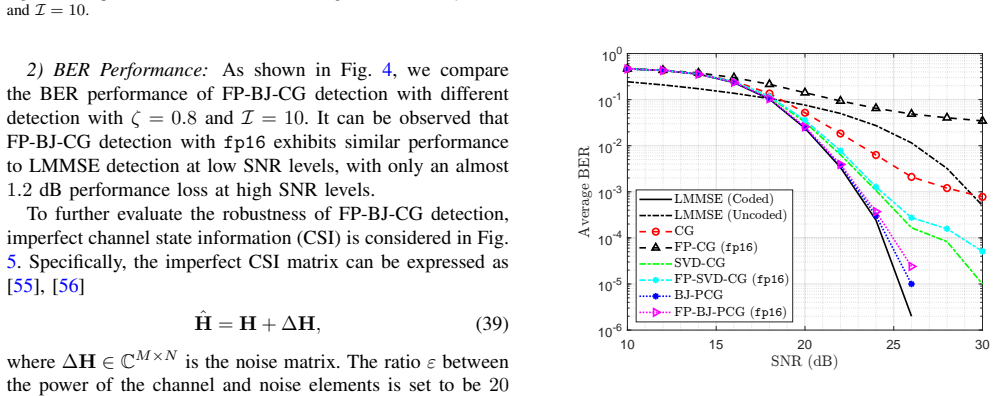
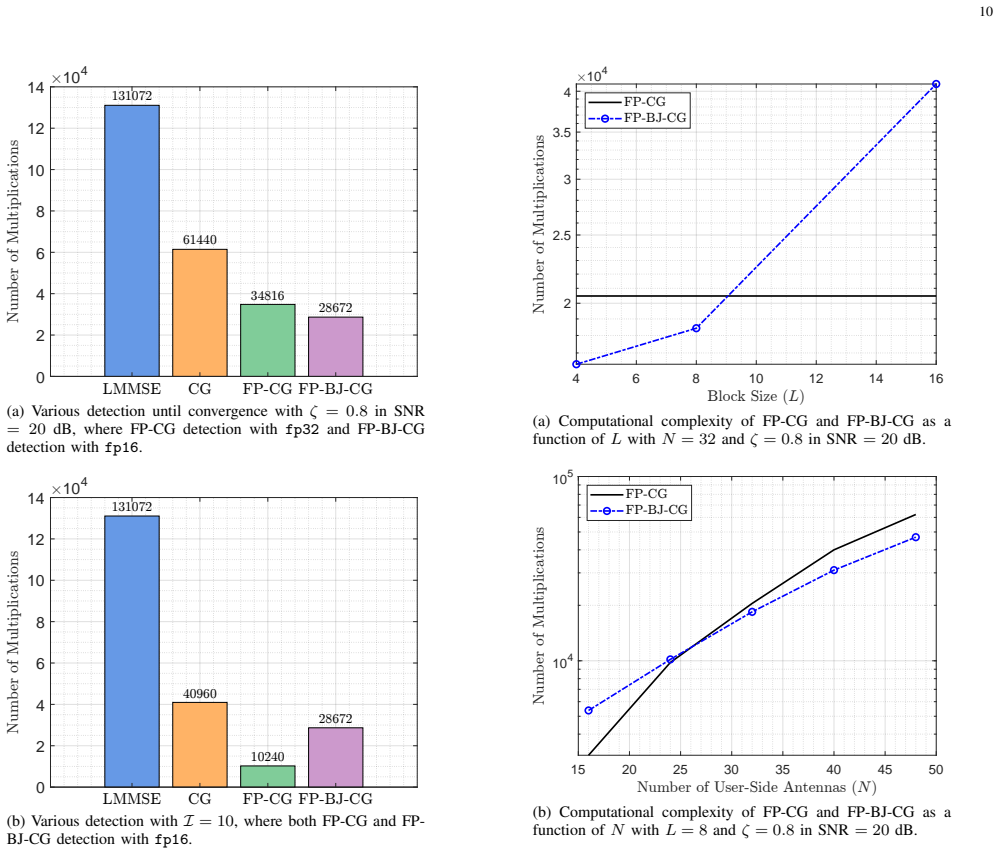
The implementation of the conjugate gradient (CG) method for massive MIMO detection is computationally challenging, especially for a large number of users and correlated channels. In this paper, we propose a low computational complexity CG detection from a finite-precision perspective. First, we develop a finite-precision CG (FP-CG) detection to mitigate the computational bottleneck of each CG iteration and provide the attainable accuracy, convergence, and computational complexity analysis to reveal the impact of finite-precision arithmetic. A practical heuristic is presented to select suitable precisions. Then, to further reduce the number of iterations, we propose a joint finite-precision and block-Jacobi preconditioned CG (FP-BJ-CG) detection. The corresponding performance analysis is also provided. Finally, simulation results validate the theoretical insights and demonstrate the superiority of the proposed detection.
Editorial analysis
A structured set of objections, weighed in public.
Referee Report
Summary. The paper proposes finite-precision conjugate gradient (FP-CG) detection for massive MIMO to mitigate per-iteration computational bottlenecks, along with analyses of attainable accuracy, convergence, and complexity under finite-precision arithmetic and a heuristic for precision selection. It extends the approach to joint finite-precision and block-Jacobi preconditioned CG (FP-BJ-CG) with corresponding analysis, and reports simulation results validating the claims and demonstrating superiority.
Significance. If the finite-precision error model and heuristic hold under realistic hardware conditions, the work could enable lower-complexity CG-based detectors for massive MIMO with correlated channels by allowing reduced bit widths while preserving convergence and accuracy, offering a practical bridge between theory and implementation.
major comments (3)
- [Section III] The finite-precision arithmetic model underlying the accuracy and convergence analysis (Section III) employs standard relative-error bounds per operation but does not address hardware-specific effects such as rounding-mode dependence or overflow in inner products and Gram-Schmidt-like steps; this model is load-bearing for the attainable-accuracy and iteration-count claims.
- [Section IV] The practical heuristic for selecting suitable precisions (Section IV) is presented without validation against cycle-accurate fixed-point hardware or unmodeled effects, leaving its generality and the claimed complexity reductions unconfirmed.
- [Section VI] The simulation results (Section VI) validating the theoretical insights and superiority of FP-BJ-CG appear to rely on idealized emulation rather than hardware-specific implementations, which directly affects the strength of the performance claims.
minor comments (2)
- [Section II] Notation for finite-precision quantities (e.g., bit-width variables) should be introduced consistently in the first use and cross-referenced in the complexity expressions.
- Figure captions could explicitly state the channel correlation model and SNR range used to allow direct comparison with the analysis assumptions.
Simulated Author's Rebuttal
We thank the referee for the constructive comments. We address each major comment below with clarifications and indicate revisions where appropriate to strengthen the manuscript.
read point-by-point responses
-
Referee: [Section III] The finite-precision arithmetic model underlying the accuracy and convergence analysis (Section III) employs standard relative-error bounds per operation but does not address hardware-specific effects such as rounding-mode dependence or overflow in inner products and Gram-Schmidt-like steps; this model is load-bearing for the attainable-accuracy and iteration-count claims.
Authors: We agree that the analysis in Section III relies on the standard relative-error model, which is the conventional approach for deriving attainable accuracy and convergence bounds in finite-precision iterative methods. This model enables general insights without tying the results to a particular hardware platform. We will add a short discussion in Section III noting that overflow can be addressed via scaling or saturation arithmetic (standard in fixed-point designs) and that rounding-mode effects are typically second-order for the precision levels considered. A comprehensive treatment of all hardware-specific behaviors would require architecture-specific assumptions not aligned with the paper's general scope. revision: partial
-
Referee: [Section IV] The practical heuristic for selecting suitable precisions (Section IV) is presented without validation against cycle-accurate fixed-point hardware or unmodeled effects, leaving its generality and the claimed complexity reductions unconfirmed.
Authors: The heuristic is obtained by applying the error bounds from Section III to select the minimal precision that preserves the target accuracy and convergence rate. Its performance is then verified via the fixed-point simulations of Section VI. We will revise Section IV to state the underlying assumptions more explicitly and note that the complexity savings follow directly from the reduced bit-width arithmetic under the adopted model. Cycle-accurate hardware validation lies outside the theoretical focus of the current work. revision: partial
-
Referee: [Section VI] The simulation results (Section VI) validating the theoretical insights and superiority of FP-BJ-CG appear to rely on idealized emulation rather than hardware-specific implementations, which directly affects the strength of the performance claims.
Authors: The simulations employ a standard fixed-point arithmetic emulator to isolate the effects of reduced precision on CG convergence and detection performance. This approach is consistent with prior literature on finite-precision analysis of iterative detectors. We will expand the simulation-setup paragraph in Section VI to describe the emulation method in greater detail and to relate the observed iteration counts and BER directly to the analytic bounds. Hardware-specific implementations would provide complementary evidence but are not required to substantiate the theoretical claims presented. revision: partial
- Empirical validation of the precision-selection heuristic and performance claims on cycle-accurate fixed-point hardware or real FPGA/ASIC implementations.
Circularity Check
No circularity: derivation extends standard CG with independent finite-precision analysis
full rationale
The paper applies established conjugate gradient theory to massive MIMO detection and layers on finite-precision arithmetic analysis using conventional relative-error models for operations within each iteration. The attainable accuracy, convergence, and complexity bounds are derived directly from these models without any fitted parameters from the paper's data being renamed as predictions. The precision-selection heuristic is presented as a practical rule of thumb rather than a self-referential output. No self-citations, uniqueness theorems, or ansatzes from prior author work are load-bearing; the central claims remain self-contained against external CG literature and standard floating-point analysis.
Axiom & Free-Parameter Ledger
free parameters (1)
- precision-selection heuristic parameters
axioms (1)
- domain assumption Finite-precision arithmetic effects on CG iteration can be bounded using standard rounding-error analysis
Forward citations
Cited by 2 Pith papers
-
Low-rank Preconditioning in Beamspace Domain For Massive MU-MIMO Long-Term Beamforming
Low-rank preconditioner from top eigenpairs of the covariance matrix via randomized EVD with QRC, applied in beamspace, reduces CG iterations by 2-3x for long-term beamforming while matching exact inversion SINR.
-
Interference Suppression for Massive MU-MIMO Long-Term Beamforming with Matrix Inversion Approximation
Subspace nulling on long-term statistics preconditions the LTBF covariance matrix to reduce CG iterations and improve numerical stability in massive MU-MIMO.
Reference graph
Works this paper leans on
-
[1]
Energy and spectral effi- ciency of very large multiuser MIMO systems,
H. Q. Ngo, E. G. Larsson, and T. L. Marzetta, “Energy and spectral effi- ciency of very large multiuser MIMO systems,”IEEE Trans. Commun., vol. 61, no. 4, pp. 1436–1449, 2013
work page 2013
-
[2]
Massive MIMO detection techniques: A survey,
M. A. Albreem, M. Juntti, and S. Shahabuddin, “Massive MIMO detection techniques: A survey,”IEEE Commun. Surv. Tut., vol. 21, no. 4, pp. 3109–3132, 2019
work page 2019
-
[3]
Multiuser detection in massive spatial modulation MIMO with low-resolution ADCs,
S. Wang, Y . Li, and J. Wang, “Multiuser detection in massive spatial modulation MIMO with low-resolution ADCs,”IEEE Trans. Wireless Commun., vol. 14, no. 4, pp. 2156–2168, 2015
work page 2015
-
[4]
Supervised and semi-supervised learning for MIMO blind detection with low-resolution ADCs,
L. V . Nguyen, D. T. Ngo, N. H. Tran, A. L. Swindlehurst, and D. H. N. Nguyen, “Supervised and semi-supervised learning for MIMO blind detection with low-resolution ADCs,”IEEE Trans. Wireless Commun., vol. 19, no. 4, pp. 2427–2442, 2020
work page 2020
-
[5]
Realizing in-memory baseband processing for ultrafast and energy-efficient 6G,
Q. Zenget al., “Realizing in-memory baseband processing for ultrafast and energy-efficient 6G,”IEEE Int. Things J., vol. 11, no. 3, pp. 5169– 5183, 2024
work page 2024
-
[6]
Rethinking massive MIMO detection: A memristor approach,
Y . Fang, L. Chen, C. You, and H. Yin, “Rethinking massive MIMO detection: A memristor approach,”IEEE Commun. Lett., vol. 27, no. 12, pp. 3350–3354, 2023
work page 2023
-
[7]
Y .-H. Ren, S. Yang, J.-H. Bi, and Y .-X. Zhang, “Accelerating maximum- likelihood detection in massive MIMO: A new paradigm with memristor crossbar based in-memory computing circuit,”IEEE Trans. Veh. Tech- nol., vol. 73, no. 12, pp. 19 745–19 750, 2024
work page 2024
-
[8]
Low-complexity symbol detection for massive MIMO uplink based on Jacobi method,
B. Y . Kong and I.-C. Park, “Low-complexity symbol detection for massive MIMO uplink based on Jacobi method,” inProc. IEEE 27th Annu. Int. Symp. Pers., Indoor, Mobile Radio Commun. (PIMRC), 2016, pp. 1–5
work page 2016
-
[9]
Efficient soft-output Gauss–Seidel data detector for massive MIMO systems,
C. Zhang, Z. Wu, C. Studer, Z. Zhang, and X. You, “Efficient soft-output Gauss–Seidel data detector for massive MIMO systems,”IEEE Trans. Circuits Syst. I: Reg. Papers, vol. 68, no. 12, pp. 5049–5060, 2021. 14 TABLE II COMPUTATIONALCOMPLEXITY OF GENERATING THE DIFFERENT PRECONDITIONING MATRICES Preconditioning methods BJ IC (1) UW-SVD Computational Comple...
work page 2021
-
[10]
Low-complexity SSOR- based precoding for massive MIMO systems,
T. Xie, L. Dai, X. Gao, X. Dai, and Y . Zhao, “Low-complexity SSOR- based precoding for massive MIMO systems,”IEEE Commun. Lett., vol. 20, no. 4, pp. 744–747, 2016
work page 2016
-
[11]
Randomized iterative methods for low-complexity large-scale MIMO detection,
Z. Wang, R. M. Gower, Y . Xia, L. He, and Y . Huang, “Randomized iterative methods for low-complexity large-scale MIMO detection,” IEEE Trans. Signal Process., vol. 70, pp. 2934–2949, 2022
work page 2022
-
[12]
Q. Wu, J. Kuang, J. Tao, J. Chen, and W. J. Gross, “DsMLP: A learning-based multi-layer perception for MIMO detection implemented by dynamic stochastic computing,”IEEE Trans. Signal Process., vol. 70, pp. 6392–6403, 2022
work page 2022
-
[13]
Adaptive preconditioned iterative linear detection and architecture for massive MU-MIMO uplink,
Y . Xueet al., “Adaptive preconditioned iterative linear detection and architecture for massive MU-MIMO uplink,”J. Signal Process. Syst., vol. 90, pp. 1453–1467, 2018
work page 2018
-
[14]
Massive MIMO detection based on Barzilai-Borwein algorithm,
J. Jin, Z. Zhang, X. You, and C. Zhang, “Massive MIMO detection based on Barzilai-Borwein algorithm,” inProc. IEEE Int. Workshop Signal Process. Syst. (SiPS), 2018, pp. 152–157
work page 2018
-
[15]
Fast-converging and low-complexity linear massive MIMO detection with L-BFGS method,
L. Li and J. Hu, “Fast-converging and low-complexity linear massive MIMO detection with L-BFGS method,”IEEE Trans. Veh. Technol., vol. 71, no. 10, pp. 10 656–10 665, 2022
work page 2022
-
[16]
Conjugate gradient- based soft-output detection and precoding in massive MIMO systems,
B. Yin, M. Wu, J. R. Cavallaro, and C. Studer, “Conjugate gradient- based soft-output detection and precoding in massive MIMO systems,” inProc. IEEE Global Commun. Conf., 2014, pp. 3696–3701
work page 2014
-
[17]
Jac-PCG based low- complexity precoding for extremely large-scale MIMO systems,
B. Xu, J. Zhang, J. Li, H. Xiao, and B. Ai, “Jac-PCG based low- complexity precoding for extremely large-scale MIMO systems,”IEEE Trans. Veh. Technol., vol. 72, no. 12, pp. 16 811–16 816, 2023
work page 2023
-
[18]
A fast-convergent pre- conditioned conjugate gradient detection for massive MIMO uplink,
Y . Xue, C. Zhang, S. Zhang, and X. You, “A fast-convergent pre- conditioned conjugate gradient detection for massive MIMO uplink,” in Proc. IEEE Int. Conf. Digit. Signal Process. (DSP), 2016, pp. 331–335
work page 2016
-
[19]
Efficient pre-conditioned descent search detector for massive MU-MIMO,
C. Zhanget al., “Efficient pre-conditioned descent search detector for massive MU-MIMO,”IEEE Trans. Veh. Techn., vol. 69, no. 5, pp. 4663– 4676, 2020
work page 2020
-
[20]
Accelerating iteratively linear detectors in multi-user (ELAA-)MIMO systems with UW-SVD,
J. Liu, Y . Ma, J. Wang, and R. Tafazolli, “Accelerating iteratively linear detectors in multi-user (ELAA-)MIMO systems with UW-SVD,”IEEE Trans. Wireless Commun., vol. 23, no. 11, pp. 16 711–16 724, 2024
work page 2024
-
[21]
L. Liuet al., “Energy- and area-efficient recursive-conjugate-gradient- based MMSE detector for massive MIMO systems,”IEEE Trans. Signal Process., vol. 68, pp. 573–588, 2020
work page 2020
-
[22]
Learned conjugate gradient descent network for massive MIMO detection,
Y . Wei, M.-M. Zhao, M. Hong, M.-J. Zhao, and M. Lei, “Learned conjugate gradient descent network for massive MIMO detection,”IEEE Trans. Signal Process., vol. 68, pp. 6336–6349, 2020
work page 2020
-
[23]
Decentralized baseband processing for massive MU-MIMO systems,
K. Liet al., “Decentralized baseband processing for massive MU-MIMO systems,”IEEE J. Emerg. Sel. Topics Circuits Syst., vol. 7, no. 4, pp. 491–507, 2017
work page 2017
-
[24]
N. J. Higham,Accuracy and stability of numerical algorithms, 2nd ed. Philadelphia, PA, USA: SIAM, 2002
work page 2002
-
[25]
Mixed precision algorithms in numerical linear algebra,
N. J. Higham and T. Mary, “Mixed precision algorithms in numerical linear algebra,”Acta Numer., vol. 31, pp. 347–414, 2022
work page 2022
-
[26]
DeepSeek-V2: A Strong, Economical, and Efficient Mixture-of-Experts Language Model
A. Liuet al., “Deepseek-v2: A strong, economical, and efficient mixture- of-experts language model,”arXiv preprint arXiv:2405.04434, 2024
work page internal anchor Pith review Pith/arXiv arXiv 2024
-
[27]
A. Liuet al., “Deepseek-v3 technical report,”arXiv preprint arXiv:2412.19437, 2024
work page internal anchor Pith review Pith/arXiv arXiv 2024
-
[28]
LLaMA: Open and Efficient Foundation Language Models
H. Touvronet al., “Llama: Open and efficient foundation language models,”arXiv preprint arXiv:2302.13971, 2023
work page internal anchor Pith review Pith/arXiv arXiv 2023
-
[29]
LOSEC: Local semantic capture empowered large time series model for IoT-enabled data centers,
Y . Sunet al., “LOSEC: Local semantic capture empowered large time series model for IoT-enabled data centers,”IEEE Int. Things J., pp. 1–1, 2025
work page 2025
-
[30]
Vlsi design of large- scale soft-output MIMO detection using conjugate gradients,
B. Yin, M. Wu, J. R. Cavallaro, and C. Studer, “Vlsi design of large- scale soft-output MIMO detection using conjugate gradients,” in2015 IEEE International Symposium on Circuits and Systems (ISCAS), 2015, pp. 1498–1501
work page 2015
-
[31]
Finite-alphabet MMSE equalization for all-digital massive MU-MIMO mmwave communication,
O. Casta ˜neda, S. Jacobsson, G. Durisi, T. Goldstein, and C. Studer, “Finite-alphabet MMSE equalization for all-digital massive MU-MIMO mmwave communication,”IEEE J. Sel. Areas Commun., vol. 38, no. 9, pp. 2128–2141, 2020
work page 2020
-
[32]
Finite-precision arithmetic transceiver for massive MIMO systems,
Y . Fang, L. Chen, Y . Chen, and H. Yin, “Finite-precision arithmetic transceiver for massive MIMO systems,”IEEE J. Sel. Areas Commun., vol. 43, no. 3, pp. 688–704, 2025
work page 2025
-
[33]
Channel capacity of MIMO architecture using the exponential correlation matrix,
S. Loyka, “Channel capacity of MIMO architecture using the exponential correlation matrix,”IEEE Commun. Lett., vol. 5, no. 9, pp. 369–371, 2001
work page 2001
-
[34]
Fifty years of MIMO detection: The road to large-scale MIMOs,
S. Yang and L. Hanzo, “Fifty years of MIMO detection: The road to large-scale MIMOs,”IEEE Commun. Surv. Tut., vol. 17, no. 4, pp. 1941– 1988, 2015
work page 1941
-
[35]
Dynamic conjugate gradient unfolding for symbol detection in time-varying massive MIMO,
T. Olutayo and B. Champagne, “Dynamic conjugate gradient unfolding for symbol detection in time-varying massive MIMO,”IEEE Open J. Veh. Technol., vol. 5, pp. 792–806, 2024
work page 2024
-
[36]
OFDM numerology design for 5G New Radio to support IoT, eMBB, and MBSFN,
A. A. Zaidiet al., “OFDM numerology design for 5G New Radio to support IoT, eMBB, and MBSFN,”IEEE Commun. Stand. Mag., vol. 2, no. 2, pp. 78–83, 2018
work page 2018
-
[37]
NVIDIA, “NVIDIA A100 dataset letter,” 2020, last accessed 3 April 2025. [Online]. Avail- able: https://www.nvidia.com/content/dam/en-zz/Solutions/Data-Center/ a100/pdf/nvidia-a100-datasheet-us-nvidia-1758950-r4-web.pdf
work page 2020
-
[38]
Estimating the attainable accuracy of recursively com- puted residual methods,
A. Greenbaum, “Estimating the attainable accuracy of recursively com- puted residual methods,”SIAM J. Matrix Anal. Appl., vol. 18, no. 3, pp. 535–551, 1997
work page 1997
-
[39]
A. Greenbaum, H. Liu, and T. Chen, “On the convergence rate of variants of the conjugate gradient algorithm in finite precision arithmetic,”SIAM J. Sci. Comput., vol. 43, no. 5, pp. S496–S515, 2021
work page 2021
-
[40]
Meurant,The Lanczos and conjugate gradient algorithms: from theory to finite precision computations
G. Meurant,The Lanczos and conjugate gradient algorithms: from theory to finite precision computations. SIAM, 2006
work page 2006
-
[41]
A new approach to probabilistic rounding error analysis,
N. J. Higham and T. Mary, “A new approach to probabilistic rounding error analysis,”SIAM J. Sci. Comput., vol. 41, no. 5, pp. A2815–A2835, 2019
work page 2019
-
[42]
On the condition number distribution of complex Wishart matrices,
M. Matthaiou, M. R. Mckay, P. J. Smith, and J. A. Nossek, “On the condition number distribution of complex Wishart matrices,”IEEE Trans. Commun., vol. 58, no. 6, pp. 1705–1717, 2010
work page 2010
-
[43]
Bounds for eigenvalues of spatial correlation matrices with the exponential model in MIMO systems,
H. Lim, Y . Jang, and D. Yoon, “Bounds for eigenvalues of spatial correlation matrices with the exponential model in MIMO systems,” IEEE Trans. Wireless Commun., vol. 16, no. 2, pp. 1196–1204, 2017
work page 2017
-
[44]
Eigenvalues and condition numbers of random matrices,
A. Edelman, “Eigenvalues and condition numbers of random matrices,” SIAM J. Matrix Anal. A., vol. 9, no. 4, pp. 543–560, 1988
work page 1988
-
[45]
A domain decomposition approach for preconditioning in massive MIMO systems,
A. Bentrcia, “A domain decomposition approach for preconditioning in massive MIMO systems,”Arab. J. Sci. Eng., vol. 44, no. 3, pp. 1757– 1767, 2019
work page 2019
-
[46]
An efficient detector for massive MIMO based on improved matrix partition,
H. Wanget al., “An efficient detector for massive MIMO based on improved matrix partition,”IEEE Trans. Signal Process., vol. 69, pp. 2971–2986, 2021
work page 2021
-
[47]
Aspects of favorable propagation in massive MIMO,
H. Q. Ngo, E. G. Larsson, and T. L. Marzetta, “Aspects of favorable propagation in massive MIMO,” inProc. Eur. Signal Process. Conf. (EUSIPCO), 2014, pp. 76–80
work page 2014
-
[48]
Efficient implementation of a class of preconditioned conjugate gradient methods,
S. C. Eisenstat, “Efficient implementation of a class of preconditioned conjugate gradient methods,”SIAM J. Sci. Stat. Comput., vol. 2, no. 1, pp. 1–4, 1981
work page 1981
-
[49]
Saad,Iterative methods for sparse linear systems
Y . Saad,Iterative methods for sparse linear systems. SIAM, 2003
work page 2003
-
[50]
L. Sanguinetti, E. Bj ¨ornson, and J. Hoydis, “Toward massive MIMO 2.0: Understanding spatial correlation, interference suppression, and pilot contamination,”IEEE Trans. Commun., vol. 68, no. 1, pp. 232–257, 2020
work page 2020
-
[51]
The condition number of equivalence transformations that block diagonalize matrix pencils,
J. Demmel, “The condition number of equivalence transformations that block diagonalize matrix pencils,”SIAM J. Numer. Anal., vol. 20, no. 3, pp. 599–610, 1983
work page 1983
-
[52]
Nearly optimal block-Jacobi preconditioning,
J. Demmel, “Nearly optimal block-Jacobi preconditioning,”SIAM J. Matrix Anal. Appl., vol. 44, no. 1, pp. 408–413, 2023
work page 2023
-
[53]
Simulating low precision floating-point arithmetic,
N. J. Higham and S. Pranesh, “Simulating low precision floating-point arithmetic,”SIAM J. Sci. Comput., vol. 41, no. 5, pp. C585–C602, 2019
work page 2019
-
[54]
A class of fast and accurate summation algorithms,
P. Blanchard, N. J. Higham, and T. Mary, “A class of fast and accurate summation algorithms,”SIAM J. Sci. Comput., vol. 42, no. 3, pp. A1541– A1557, 2020. 15
work page 2020
-
[55]
A new randomized iterative detection algorithm for uplink large-scale MIMO systems,
Z. Wang, W. Xu, Y . Xia, Q. Shi, and Y . Huang, “A new randomized iterative detection algorithm for uplink large-scale MIMO systems,” IEEE Trans. Commun., vol. 71, no. 9, pp. 5093–5107, 2023
work page 2023
-
[56]
Low-complexity Tomlinson-Harashima precoding update algorithm for massive MIMO system,
Y . Fang, L. Chen, Y . Chen, H. Yin, and G. Wei, “Low-complexity Tomlinson-Harashima precoding update algorithm for massive MIMO system,”IEEE Trans. Commun., vol. 72, no. 4, pp. 2063–2078, 2024
work page 2063
-
[57]
L. Isserlis, “On a formula for the product-moment coefficient of any order of a normal frequency distribution in any number of variables,” Biometrika, vol. 12, no. 1/2, pp. 134–139, 1918
work page 1918
-
[58]
On a moment theorem for complex Gaussian processes,
I. Reed, “On a moment theorem for complex Gaussian processes,”IRE Trans. Inf. Theory, vol. 8, no. 3, pp. 194–195, 1962
work page 1962
discussion (0)
Sign in with ORCID, Apple, or X to comment. Anyone can read and Pith papers without signing in.