Design of a Storage Ring based on a Fixed Field Alternating Gradient Configuration with an Internal Target for Heavy-Ion Beams with Stochastic Charge State Conversions
Pith reviewed 2026-05-22 19:07 UTC · model grok-4.3
The pith
A scaling FFA ring matches closed orbits and betatron functions for different charge states at the internal target to suppress emittance growth in heavy-ion beams.
A machine-rendered reading of the paper's core claim, the machinery that carries it, and where it could break.
Core claim
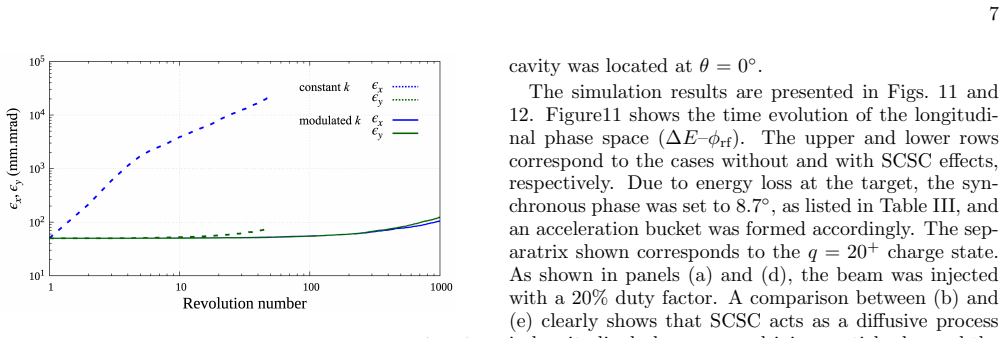
The authors present a design of a storage ring based on a scaling fixed field alternating gradient configuration that matches the closed orbits and betatron functions of beams with different atomic charges at the location of an internal target. Through full 6D beam tracking simulations, they demonstrate that this matching effectively suppresses transverse emittance growth even when stochastic charge state conversions occur after the target.
What carries the argument
Scaling fixed field alternating gradient (FFA) lattice that simultaneously matches closed orbits and betatron functions for all relevant charge states precisely at the target location.
If this is right
- Heavy-ion beams can circulate multiple times through an internal target without significant emittance increase.
- Energy recovery internal target systems become practical for heavy ions, not just protons.
- The beam can be recovered and reused after energy loss compensation by rf cavities.
- Transverse beam quality is preserved despite random charge state changes.
Where Pith is reading between the lines
- This matching technique could be applied to other lattice designs or ion species to enable similar recycling.
- Future experiments might test the design with actual heavy-ion beams to confirm simulation results.
- Integration with other beam cooling methods could further improve performance.
Load-bearing premise
Ions always reach the same equilibrated charge state distribution after the target no matter their initial charge, and a single scaling FFA lattice can match orbits and betatron functions for every charge state right at the target.
What would settle it
A measurement of transverse emittance after multiple passes through the target in a constructed FFA ring, or a 6D simulation that includes the actual charge state distribution and shows growth.
Figures






read the original abstract
In the general use of a heavy-ion accelerator, an accelerated beam impinged on a target is spoiled into a beam dump. To make more efficient use of the beam, recycling of the beam passed through the target is proposed in the framework of the so-called energy recovery internal target (ERIT). In the ERIT system, the target is irradiated inside the circulating beam by recovering the energy lost in the target using rf cavities. So far, such a system has been realized only for proton beams. Here, the ERIT system for heavy-ion beam is demonstrated for the first time. A challenging issue is the circulation of all ions with different atomic charge. An ion has a probability of equilibrated charge state distribution after passing through the target, independent of the initial charge state. This phenomenon of stochastic charge state conversion (SCSC) causes rapid beam-emittance growth. To solve this problem, we developed a method to match the closed orbits and betatron functions of the beams in different charge states at the target location in a ring based on a scaling fixed field alternating gradient (FFA) lattice structure. We present the design of such an FFA ring and show, through full 6D beam tracking simulations, that transverse emittance growth can be effectively suppressed even in the presence of SCSC.
Editorial analysis
A structured set of objections, weighed in public.
Referee Report
Summary. The manuscript presents the design of a storage ring based on a scaling fixed-field alternating gradient (FFA) lattice for heavy-ion beams with an internal target. It addresses stochastic charge state conversions (SCSC) by developing a method to match closed orbits and betatron functions for beams of different charge states precisely at the target location. The authors describe the FFA ring design and use full 6D beam tracking simulations to claim that transverse emittance growth is effectively suppressed despite SCSC.
Significance. If the matching conditions can be rigorously satisfied and the simulation results hold, this would represent a meaningful extension of the energy recovery internal target (ERIT) concept from protons to heavy ions. Enabling efficient beam recycling in the presence of charge-state stochasticity could improve beam utilization in nuclear physics and related accelerator applications. The FFA-based approach to multi-rigidity orbit and optics matching at a single point is innovative and, if validated, could influence future internal-target ring designs.
major comments (2)
- [Lattice design and matching method] The central claim rests on the ability of a single scaling FFA lattice to support closed orbits for every post-target charge state (different rigidities) that intersect the target at identical position and angle while sharing the same betatron functions there. § on lattice design and matching: the scaling property alone does not automatically guarantee this coincidence; explicit constraints on field index, sector angles, and target azimuth must be derived and shown to be satisfied by the chosen parameters. Without this derivation the suppression mechanism remains unproven.
- [Beam tracking simulations] Table or figure on simulation results: the 6D tracking is presented as demonstrating effective suppression, yet no quantitative emittance growth numbers (e.g., growth factor per turn or final normalized emittance with versus without matching) are reported. This gap prevents assessment of whether the residual growth is negligible or still load-bearing for practical operation.
minor comments (2)
- [Abstract] Abstract: no lattice parameters, no explicit matching conditions, and no numerical emittance values are given, making it difficult for readers to gauge the scale of the result from the summary alone.
- [Notation and equations] Notation: symbols for charge state q, rigidity, and Twiss parameters should be defined at first use and used consistently in all equations describing the multi-charge matching.
Simulated Author's Rebuttal
We thank the referee for the careful and constructive review of our manuscript. We address each major comment below and will revise the manuscript to improve clarity and provide the requested details.
read point-by-point responses
-
Referee: [Lattice design and matching method] The central claim rests on the ability of a single scaling FFA lattice to support closed orbits for every post-target charge state (different rigidities) that intersect the target at identical position and angle while sharing the same betatron functions there. § on lattice design and matching: the scaling property alone does not automatically guarantee this coincidence; explicit constraints on field index, sector angles, and target azimuth must be derived and shown to be satisfied by the chosen parameters. Without this derivation the suppression mechanism remains unproven.
Authors: We agree that an explicit derivation strengthens the central claim. Our matching method combines the scaling FFA orbit equation with constraints on the field index k and sector geometry to enforce identical position, angle, and betatron functions at the target azimuth for multiple rigidities. In the revised manuscript we will add a dedicated derivation subsection showing the explicit conditions on k, sector angles, and target location that satisfy the multi-rigidity matching, together with verification that the chosen parameters fulfill these conditions. revision: yes
-
Referee: [Beam tracking simulations] Table or figure on simulation results: the 6D tracking is presented as demonstrating effective suppression, yet no quantitative emittance growth numbers (e.g., growth factor per turn or final normalized emittance with versus without matching) are reported. This gap prevents assessment of whether the residual growth is negligible or still load-bearing for practical operation.
Authors: We acknowledge that quantitative metrics are necessary for a full assessment. In the revised version we will include a new table (or expanded figure caption) reporting the transverse emittance growth factors per turn and the final normalized emittances obtained from the 6D tracking, for both the matched and unmatched cases. This will allow direct evaluation of the residual growth under SCSC. revision: yes
Circularity Check
No significant circularity; design and simulation are independent
full rationale
The paper develops a lattice-matching method for closed orbits and betatron functions across charge states at one target point in a scaling FFA ring, then validates emittance suppression via full 6D tracking simulations. The matching is achieved through explicit design choices (field index, sector geometry, target placement) rather than being tautological or forced by the scaling property alone. No load-bearing step reduces by construction to a fitted input, self-citation chain, or renamed known result. The central claim retains independent content from the simulation evidence and is self-contained against external benchmarks.
Axiom & Free-Parameter Ledger
free parameters (1)
- FFA lattice parameters for multi-charge orbit matching
axioms (1)
- domain assumption An ion acquires an equilibrated charge state distribution after target passage independent of initial charge state
Lean theorems connected to this paper
-
IndisputableMonolith.Foundation.RealityFromDistinctionreality_from_one_distinction unclear?
unclearRelation between the paper passage and the cited Recognition theorem.
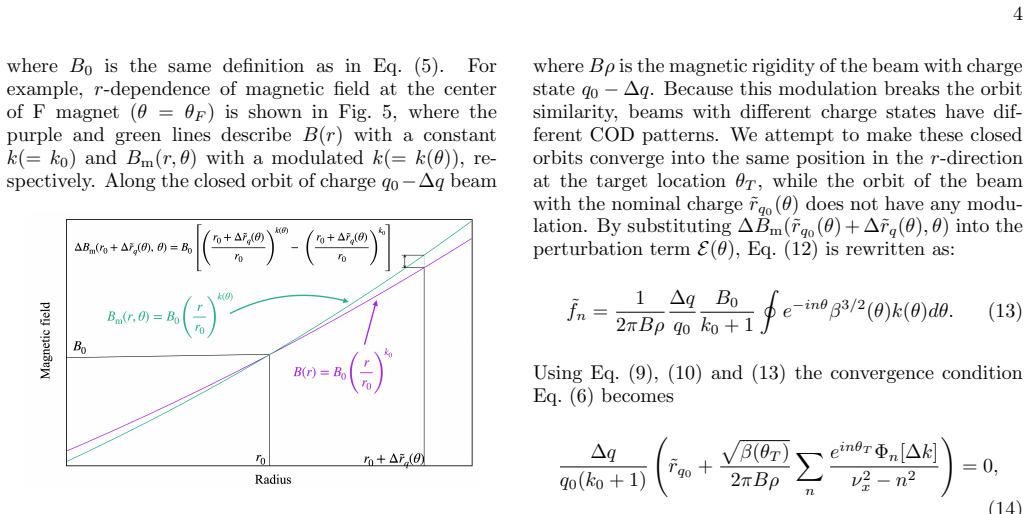
magnetic field distribution in the median plane of a scaling FFA ring is B(r)∝r^{k0} ... Δr̃q(θ)=−(Δq/q0) r̃q0(θ)/(k0+1)
-
IndisputableMonolith.Cost.FunctionalEquationwashburn_uniqueness_aczel unclear?
unclearRelation between the paper passage and the cited Recognition theorem.
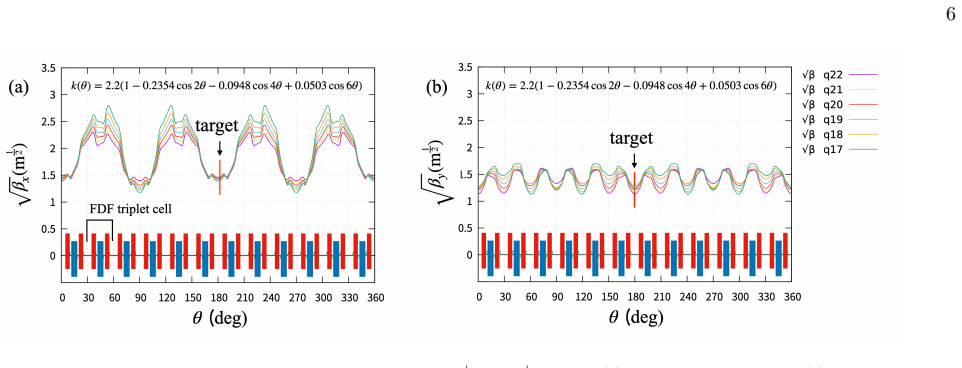
modulated k(θ)=k0(1+λcod cos(nθ)+λβx cos(pxθ)+λβy cos(pyθ)) ... optimized λcod,λβx,λβy to minimize emittance growth
What do these tags mean?
- matches
- The paper's claim is directly supported by a theorem in the formal canon.
- supports
- The theorem supports part of the paper's argument, but the paper may add assumptions or extra steps.
- extends
- The paper goes beyond the formal theorem; the theorem is a base layer rather than the whole result.
- uses
- The paper appears to rely on the theorem as machinery.
- contradicts
- The paper's claim conflicts with a theorem or certificate in the canon.
- unclear
- Pith found a possible connection, but the passage is too broad, indirect, or ambiguous to say the theorem truly supports the claim.
Reference graph
Works this paper leans on
-
[1]
The upper and lower rows correspond to the cases without and with SCSC effects, respectively
Figure11 shows the time evolution of the longitudi- nal phase space (∆ E–ϕrf). The upper and lower rows correspond to the cases without and with SCSC effects, respectively. Due to energy loss at the target, the syn- chronous phase was set to 8.7◦, as listed in Table III, and an acceleration bucket was formed accordingly. The sep- aratrix shown corresponds...
work page 2000
-
[2]
M. Ikegami et al. , Heavy ion storage ring without linear dispersion, Physical Review Special Topics - Accelerators and Beams 7, 120101 (2004)
work page 2004
-
[3]
M. Steck et al. , Heavy-ion storage rings and their use in precision experiments with highly charged ions, Progress in Particle and Nuclear Physics 115, 103811 (2020)
work page 2020
-
[4]
B. Franzke, Heavy ion storage rings for atomic physics, IEEE Transactions on Nulcear Science , 3297 (1985)
work page 1985
-
[5]
T. Kandler et al. , A case study for charge state breeding of heavy ions in the storage ring, esr, Nuclear Instru- ments and Methods in Physics Resarch Section B 107, 357 (1996)
work page 1996
- [6]
-
[7]
Y. Litvinov and R. Chen, Radioactive decays of stored highly charged ions, the european physical journal A102 (2023)
work page 2023
-
[8]
M. Ghazaly, An electrostatic storage ring for atomic and molecular physics, at kacst – a status report, EPJ Web of Conference 84, 05003 (2015)
work page 2015
-
[9]
D. Olsen et al. , The histrap proposal: Heavy ion stor- age ring for atomic physics, Proceedings of the Eleventh International Conference on Cyclotrons and their Appli- cations, Tokyo, Japan , 134 (1986)
work page 1986
-
[10]
B. Franzke, Review of heavy ion storage rings, Nuclear Instruments and Methods in Physics Research B 142, 441 (1998)
work page 1998
-
[11]
D. Savin, Can heavy ion storage rings contribute to our understanding of the charge state distributions in cosmic atomic plasmas?, Journal of Physics: Conference Series 88, 012071 (2007)
work page 2007
-
[12]
Y. Oganesian et al., Dubna project of the heavy ion stor- age ring complex k4-kio, Proceedings of the 13th Interna- tional Conference on Cyclotrons and their Applications, Vancouver, BC, Canada , 290 (1992)
work page 1992
-
[13]
F. Gu´ erard et al. , Production of [(211)At]-astatinated radiopharmaceuticals and applications in targeted α- particle therapy, Cancer Biotherapy and Radiopharma- ceuticals 1, 1 (2013)
work page 2013
- [14]
-
[15]
Y. Mori, Development of ffag accelerators and their ap- plications for intense secondary particle production, Nu- clear Instruments and Methods in Physics Resarch Sec- tion A 562, 591 (2006)
work page 2006
- [16]
-
[17]
K. Symon et al. , Fixed-field alternating gradient particle accelerators, Physical Review 103, 1837 (1956)
work page 1956
-
[18]
S. Machida and R. Fenning, Beam transport line with scaling fixed field alternating gradient type magnets, Physical Review Special Topics - Accelerators and Beams 13, 084001 (2010)
work page 2010
-
[19]
A. Steinberg et al. , Design of a large energy acceptance beamline using fixed field accelerator optics, Physal Re- view Accelerator Beams 27, 071601 (2024)
work page 2024
-
[20]
Y. Ishi et al. , A conceptual design of ffa ring for super heavy element production adopting the erit mechanism, Proceedings of IPAC’23, Venice, Italy , 955 (2023)
work page 2023
-
[21]
J.-B. Lagrange et al. , Applications of advanced scaling ffag accelerator, Proceedings of IPAC’10, Kyoto, Japan , 4503 (2010)
work page 2010
- [22]
-
[23]
H. Okita et al. , Experimental study of multiplex en- ergy recovery internal target ring, Nuclear Instruments and Methods in Physics Resarch Section A 953, 162988 (2020)
work page 2020
-
[24]
E. Courant and H. Snyder, Theory of the alternating- gradient synchrotron, Annals of Physics 3, 1 (1958)
work page 1958
- [25]
-
[26]
W. M¨ oller and W. Eckstein, Tridyn — a trim simulation code including dynamic composition changes, Nuclear In- struments and Methods 2, 814 (1984)
work page 1984
discussion (0)
Sign in with ORCID, Apple, or X to comment. Anyone can read and Pith papers without signing in.