A Tutorial on Structural Identifiability of Epidemic Models Using StructuralIdentifiability.jl
Pith reviewed 2026-05-22 14:34 UTC · model grok-4.3
The pith
Structural identifiability analysis using StructuralIdentifiability.jl shows that epidemic model parameters can often be recovered only as combinations rather than individually, depending on observed variables and initial conditions.
A machine-rendered reading of the paper's core claim, the machinery that carries it, and where it could break.
Core claim
The paper presents a reproducible framework for integrating global structural identifiability analysis into epidemic modeling workflows using StructuralIdentifiability.jl, illustrated across SEIR models with asymptomatic transmission, vector-borne models, and systems incorporating hospitalization and mortality; it establishes that identifiability depends critically on model structure, observed variables, and initial-condition assumptions, and that identifiable parameter combinations may exist even when individual parameters are not globally identifiable.
What carries the argument
StructuralIdentifiability.jl package, which applies algebraic methods to determine global identifiability of parameters in systems of ordinary differential equations given specified observation functions and initial conditions.
If this is right
- Identifiability analysis should precede parameter fitting in epidemic model calibration to avoid non-unique estimates.
- Changing which compartments or variables are observed can render previously non-identifiable parameters identifiable or create identifiable combinations.
- Compartmental diagrams with embedded identifiability results provide a practical tool for communicating findings to interdisciplinary teams.
- The same workflow applies across model classes including SEIR variants, vector-borne diseases, and models with hospitalization and mortality.
Where Pith is reading between the lines
- The tutorial framework could be tested on models with time-dependent transmission rates or age-structured populations to check whether identifiability patterns change.
- Combining this structural analysis with practical identifiability checks under noisy data would give a fuller picture of what can be reliably estimated in real outbreaks.
- Similar step-by-step tutorials using the same package could be developed for ODE models in ecology or pharmacology to broaden adoption beyond infectious disease applications.
Load-bearing premise
The tutorial assumes that the StructuralIdentifiability.jl package correctly implements the algebraic algorithms for checking global identifiability without errors or unstated limitations for the specific epidemic ODE structures and observation functions used in the examples.
What would settle it
Simulate noise-free data from one of the example models under the package's reported identifiability results and attempt to fit the model; if a parameter labeled globally identifiable yields inconsistent estimates across different initial conditions or observation choices, that would contradict the analysis for that model.
Figures






read the original abstract
Structural identifiability is the theoretical ability to uniquely recover model parameters from ideal, noise-free data and is a prerequisite for reliable parameter estimation in epidemic modeling. Despite its importance for calibration and inference, structural identifiability analysis remains underused and inconsistently applied in infectious disease modeling. This paper presents a user-oriented methodological tutorial demonstrating how global structural identifiability analysis can be systematically integrated into epidemic modeling workflows. We provide a reproducible framework for conducting structural identifiability analysis of ordinary differential equation models using the Julia package StructuralIdentifiability.jl. The workflow is illustrated across commonly used epidemic models, including SEIR variants with asymptomatic and presymptomatic transmission, vector-borne disease models, and systems incorporating hospitalization and disease-induced mortality. We also introduce a visual communication strategy that embeds identifiability results directly into compartmental diagrams, facilitating interpretation and interdisciplinary communication. Our results show that identifiability depends critically on model structure, the choice of observed variables, and assumptions about initial conditions, and that identifiable parameter combinations may exist even when individual parameters are not globally identifiable. Emphasizing transparent implementation, interpretation, and communication, this work provides practical guidance and comparative insights across model classes. The tutorial is designed as both a reference and a teaching resource for researchers and educators seeking to incorporate structural identifiability analysis into epidemic model development. All code and annotated diagrams are publicly available to ensure reproducibility and reuse.
Editorial analysis
A structured set of objections, weighed in public.
Referee Report
Summary. This manuscript is a tutorial demonstrating the use of the Julia package StructuralIdentifiability.jl to perform global structural identifiability analysis on ordinary differential equation epidemic models. It illustrates the workflow on SEIR variants with asymptomatic/presymptomatic transmission, vector-borne models, and extensions incorporating hospitalization and disease-induced mortality. The paper claims that identifiability depends critically on model structure, choice of observed variables, and initial-condition assumptions, that identifiable parameter combinations may exist even when individual parameters are not globally identifiable, and that results can be communicated effectively via annotated compartmental diagrams. All code is made publicly available for reproducibility.
Significance. If the package correctly implements the underlying algorithms for the illustrated ODE systems and observation maps, the tutorial provides a clear, practical, and reproducible framework that could help integrate structural identifiability checks into standard epidemic modeling practice. The emphasis on visual communication of results and the public code repository are strengths that support reuse and teaching. The work addresses a genuine gap in consistent application of identifiability analysis within infectious disease modeling.
major comments (1)
- The tutorial presents identifiability conclusions for the concrete models (e.g., SEIR with asymptomatic transmission and the vector-borne example) solely as outputs from StructuralIdentifiability.jl. No cross-validation against manual differential-algebra derivations, known analytic results for these standard models, or outputs from alternative packages such as SIAN or DAISY is provided for any of the examples. This is load-bearing for the central claim that the workflow can be systematically integrated, because the reported rankings and identifiable combinations rest on the unverified behavior of the package for the specific observation functions and initial-condition assumptions used.
minor comments (3)
- The manuscript would benefit from a short subsection or paragraph explicitly stating the version of StructuralIdentifiability.jl used and any known limitations of the package for epidemic ODE classes.
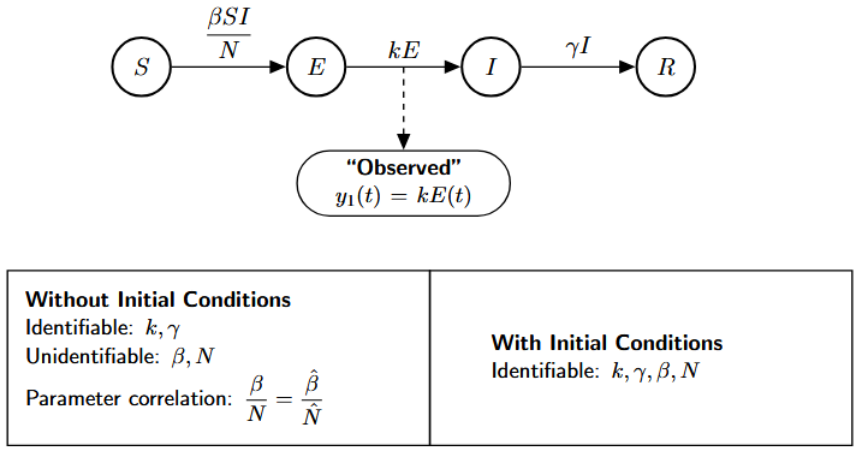
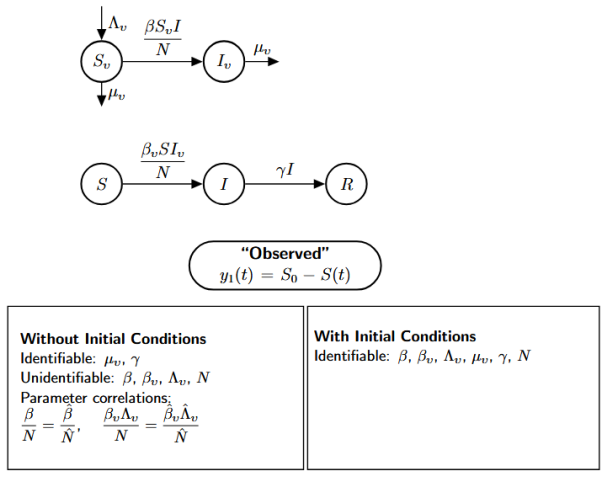
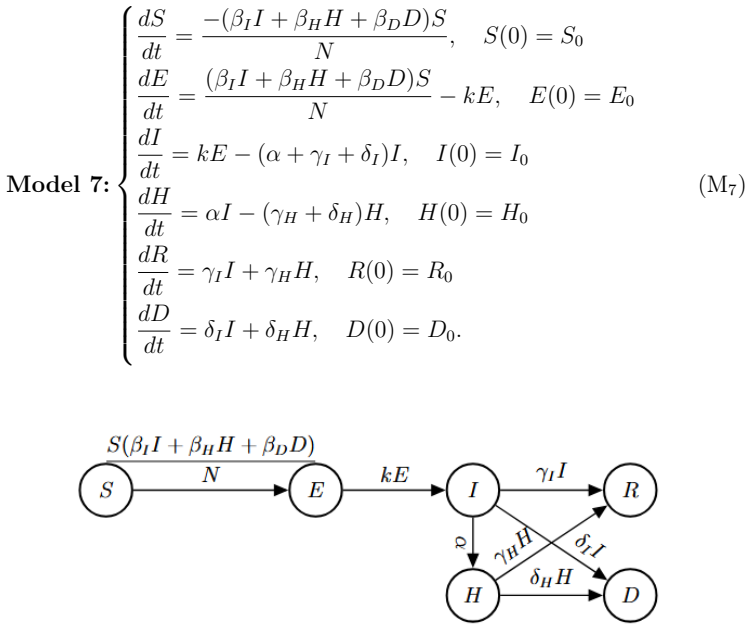
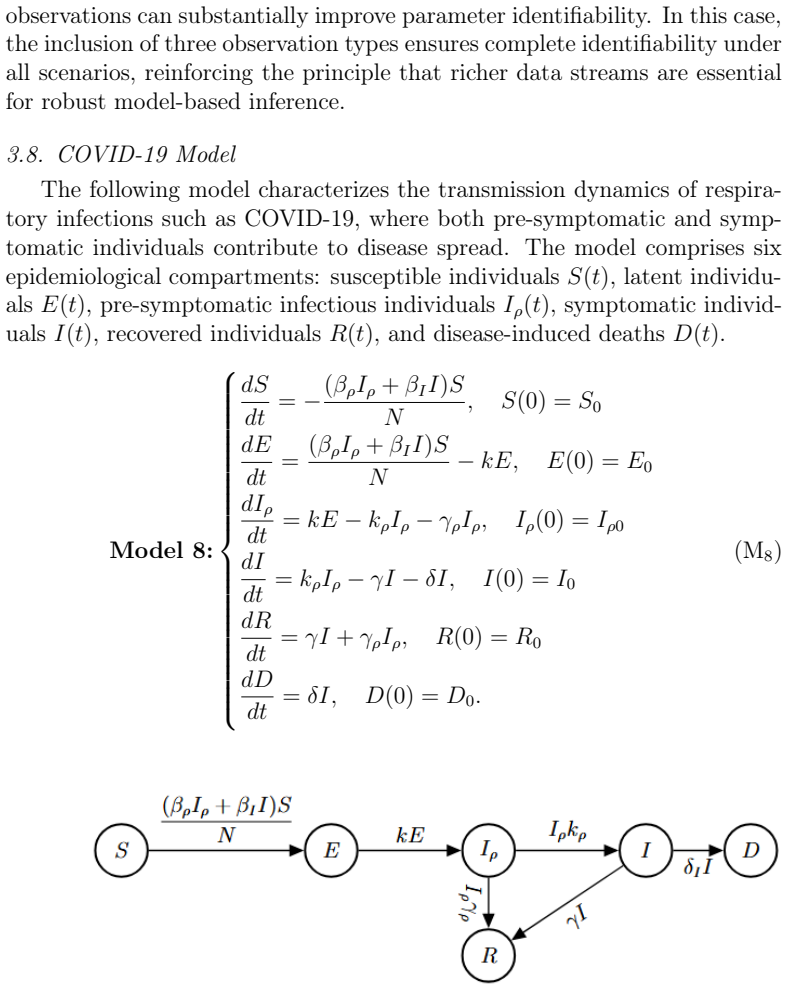
- Figure captions for the compartmental diagrams could more explicitly describe which parameters or combinations are shown as identifiable versus non-identifiable.
- A brief comparison table summarizing identifiability outcomes across the different model classes and observation scenarios would improve readability and allow readers to quickly grasp the dependence on structure and observations.
Simulated Author's Rebuttal
We thank the referee for the constructive and positive assessment, including the recommendation for minor revision. We address the single major comment below by agreeing that additional validation would strengthen the manuscript and outlining the planned changes.
read point-by-point responses
-
Referee: The tutorial presents identifiability conclusions for the concrete models (e.g., SEIR with asymptomatic transmission and the vector-borne example) solely as outputs from StructuralIdentifiability.jl. No cross-validation against manual differential-algebra derivations, known analytic results for these standard models, or outputs from alternative packages such as SIAN or DAISY is provided for any of the examples. This is load-bearing for the central claim that the workflow can be systematically integrated, because the reported rankings and identifiable combinations rest on the unverified behavior of the package for the specific observation functions and initial-condition assumptions used.
Authors: We agree that cross-validation would improve the tutorial's robustness and help readers trust the workflow. In the revised manuscript we will add a dedicated subsection (likely in Section 3 or as an appendix) that (i) recalls known analytic identifiability results for the classic SEIR model from the literature and shows that StructuralIdentifiability.jl reproduces them under the same observation and initial-condition assumptions, and (ii) provides a side-by-side comparison with SIAN outputs for the simpler SEIR variants. For the more complex vector-borne and hospitalization models we will note that exhaustive manual derivations become intractable and instead cite the original validation benchmarks of StructuralIdentifiability.jl together with the public code repository so that readers can reproduce or extend the checks. These additions directly address the load-bearing concern while preserving the tutorial's practical focus. revision: yes
Circularity Check
No circularity: tutorial reuses external package on standard models without self-referential derivations
full rationale
The paper is a user-oriented tutorial demonstrating the application of the existing StructuralIdentifiability.jl package to common compartmental epidemic models (SEIR variants, vector-borne, hospitalization extensions). It presents no new derivations, parameter fits, predictions, or uniqueness theorems that reduce to the paper's own inputs or self-citations. Identifiability results are shown as outputs of the external tool applied to standard ODE structures and observation functions, with emphasis on reproducibility via public code. The central claims concern workflow integration and dependence on model structure/observations/initial conditions, which are supported by the package's algebraic methods rather than any internal loop or fitted renaming. This is self-contained instructional content against external benchmarks.
Axiom & Free-Parameter Ledger
axioms (1)
- standard math Standard algebraic and differential-algebraic methods for testing global structural identifiability apply without modification to the compartmental ODE models considered.
Lean theorems connected to this paper
-
IndisputableMonolith/Cost/FunctionalEquation.leanwashburn_uniqueness_aczel unclear?
unclearRelation between the paper passage and the cited Recognition theorem.
We provide a reproducible workflow for conducting structural identifiability analysis of ordinary differential equation models using the Julia package StructuralIdentifiability.jl... assess_identifiability(ode)... find_identifiable_functions(ode)
-
IndisputableMonolith/Foundation/RealityFromDistinction.leanreality_from_one_distinction unclear?
unclearRelation between the paper passage and the cited Recognition theorem.
SEIR model... y1(t) = k*E(t)... assess_identifiability results for beta, gamma, k, N under known/unknown ICs
What do these tags mean?
- matches
- The paper's claim is directly supported by a theorem in the formal canon.
- supports
- The theorem supports part of the paper's argument, but the paper may add assumptions or extra steps.
- extends
- The paper goes beyond the formal theorem; the theorem is a base layer rather than the whole result.
- uses
- The paper appears to rely on the theorem as machinery.
- contradicts
- The paper's claim conflicts with a theorem or certificate in the canon.
- unclear
- Pith found a possible connection, but the passage is too broad, indirect, or ambiguous to say the theorem truly supports the claim.
Forward citations
Cited by 2 Pith papers
-
A Replica Exchange Markov Chain Monte Carlo Method for Disconnected Implicit Manifolds via Tubular Relaxation
A replica exchange MCMC algorithm couples constrained and relaxed chains to sample from disconnected implicit manifolds defined by nonlinear constraints.
-
A Tutorial on Symbolic Structural Identifiability Analysis of ODE Models in Julia
A tutorial on using StructuralIdentifiability.jl to assess local and global identifiability in ODE models with examples from epidemiology, pharmacokinetics, and systems biology.
Reference graph
Works this paper leans on
-
[1]
Brauer, Compartmental models in epidemiology, in: F
F. Brauer, Compartmental models in epidemiology, in: F. Brauer, P. van den Driessche, J. Wu (Eds.), Mathematical Epidemiology, volume 1945ofLecture Notes in Mathematics, Springer, 2008, pp.19–79.doi:10. 1007/978-3-540-78911-6_2
work page 2008
-
[2]
J. Arino, F. Brauer, P. van den Driessche, J. Watmough, J. Wu, A final size relation for epidemic models, Mathematical Biosciences and Engineering 4 (2007) 159–175. doi:10.3934/mbe.2007.4.159
-
[3]
G. Chowell, N. W. Hengartner, C. Castillo-Chavez, P. W. Fenimore, J. M. Hyman, The basic reproductive number of ebola and the effects of public health measures: The cases of congo and uganda, Journal of Theoretical Biology 229 (2004) 119–126. doi:10.1016/j.jtbi.2004. 03.006. 68
-
[4]
R. M. Anderson, C. Fraser, A. C. Ghani, C. A. Donnelly, S. Riley, N. M. Ferguson, G. M. Leung, T. H. Lam, A. J. Hedley, L.-M. Ho, et al., Epidemiology, transmission dynamics and control of sars: The 2002–2003 epidemic, Philosophical Transactions of the Royal Society of London. Series B: Biological Sciences 359 (2004) 1091–1105. doi:10. 1098/rstb.2004.1490
-
[5]
O. Saucedo, M. Martcheva, A. Annor, Computing human-to-human avian influenzar 0 via transmission chains and parameter estimation, Mathematical Biosciences and Engineering 16 (2019) 3465–3487
work page 2019
-
[6]
P. Yan, G. Chowell, Quantitative Methods for Investigating Infectious Disease Outbreaks, Springer, 2019. doi:10.1007/978-3-030-21923-9
-
[7]
H. T. Banks, H. T. Tran, Mathematical and Experimental Modeling of Physical and Biological Processes, Chapman and Hall/CRC, 2009
work page 2009
- [8]
-
[9]
K. Roosa, G. Chowell, Assessing parameter identifiability in compart- mental dynamic models using a computational approach: Application to infectious disease transmission models, Theoretical Biology and Medical Modelling 16 (2019) 1. doi:10.1186/s12976-018-0097-6
-
[10]
A. F. Villaverde, A. Barreiro, A. Papachristodoulou, Structural iden- tifiability of dynamic systems biology models, PLOS Computational Biology 12 (2016) e1005153. doi:10.1371/journal.pcbi.1005153
-
[11]
M. C. Eisenberg, S. L. Robertson, J. H. Tien, Identifiability and estimation of multiple transmission pathways in cholera and water- borne disease, Journal of Theoretical Biology 324 (2013) 84–102. doi:10.1016/j.jtbi.2012.12.021
-
[12]
G. Massonis, J. R. Banga, A. F. Villaverde, Structural identifiability and observability of compartmental models of the covid-19 pandemic, Annual Reviews in Control 51 (2021) 441–459. 69
work page 2021
-
[13]
E. A. Dankwa, A. F. Brouwer, C. A. Donnelly, Structural identifiability ofcompartmentalmodelsforinfectiousdiseasetransmissionisinfluenced by data type, Epidemics 41 (2022) 100643
work page 2022
- [14]
-
[15]
M. Heinrich, M. Rosenblatt, F.-G. Wieland, H. Stigter, J. Timmer, On structural and practical identifiability: Current status and update of results, Current Opinion in Systems Biology 41 (2025) 100546
work page 2025
-
[16]
X. Rey Barreiro, A. F. Villaverde, Benchmarking tools for a priori identifiability analysis, Bioinformatics 39 (2023) btad065
work page 2023
-
[17]
G. Bellu, M. P. Saccomani, S. Audoly, L. D’Angiò, Daisy: A new software tool to test global identifiability of biological and physiological systems, Computer Methods and Programs in Biomedicine 88 (2007) 52–61. doi:10.1016/j.cmpb.2007.07.002
-
[18]
G. Chowell, S. Dahal, Y. R. Liyanage, A. Tariq, N. Tuncer, Structural identifiability analysis of epidemic models based on differential equa- tions: A tutorial-based primer, Journal of Mathematical Biology 87 (2023) 79
work page 2023
-
[19]
R. Dong, C. Goodbrake, H. Harrington, G. Pogudin, Differential elimi- nation for dynamical models via projections with applications to struc- tural identifiability, SIAM Journal on Applied Algebra and Geometry 7 (2023) 194–235. doi:10.1137/22M1469067
-
[20]
H. Pohjanpalo, System identifiability based on the power series ex- pansion of the solution, Mathematical Biosciences 41 (1978) 21–33. doi:10.1016/0025-5564(78)90063-9
-
[21]
E. Walter, Y. Lecourtier, Global approaches to identifiability testing for linear and nonlinear state space models, Mathematical Biosciences 59 (1982) 1–20. doi:10.1016/0025-5564(82)90045-0
-
[22]
S. Vajda, K. R. Godfrey, H. Rabitz, Similarity transformation approach to identifiability analysis of nonlinear compartmental models, Math- ematical Biosciences 93 (1989) 217–248. doi:10.1016/0025-5564(89) 90054-7. 70
-
[23]
G. Joly-Blanchard, L. Denis-Vidal, Some remarks about an identifiabil- ity result of nonlinear systems, Automatica 34 (1998) 1151–1152
work page 1998
- [24]
-
[25]
Y. R. Liyanage, G. Chowell, G. Pogudin, N. Tuncer, Structural and practical identifiability of phenomenological growth models for epidemic forecasting, Viruses 17 (2025) 496
work page 2025
-
[26]
H. Miao, X. Xia, A. S. Perelson, H. Wu, On identifiability of nonlinear ode models and applications in viral dynamics, SIAM review 53 (2011) 3–39
work page 2011
-
[27]
O. Saucedo, A. Laubmeier, T. Tang, B. Levy, L. Asik, T. Pollington, O. Prosper, Comparative analysis of practical identifiability methods for an SEIR model, AIMS Mathematics 9 (2024) 24722–24761
work page 2024
-
[28]
T. S. Ligon, F. Fröhlich, O. T. Chiş, J. R. Banga, E. Balsa-Canto, J. Hasenauer, Genssi 2.0: multi-experiment structural identifiability analysis of sbml models, Bioinformatics 34 (2018) 1421–1423
work page 2018
-
[29]
S.Díaz-Seoane, X.ReyBarreiro, A.F.Villaverde, Strike-goldd4.0: user- friendly, efficient analysis of structural identifiability and observability, Bioinformatics 39 (2023) btac748
work page 2023
-
[30]
F. Anstett-Collin, L. Denis-Vidal, G. Millérioux, A priori identifiability: An overview on definitions and approaches, Annual Reviews in Control 50 (2020) 139–149
work page 2020
- [31]
-
[32]
M. P. Saccomani, S. Audoly, L. D’Angiò, Parameter identifiability of nonlinear systems: the role of initial conditions, Automatica 39 (2003) 619–632
work page 2003
-
[33]
J.H.A.Guillaume, J.D.Jakeman, S.Marsili-Libelli, M.Asher, P.Brun- ner, B. Croke, M. C. Hill, A. J. Jakeman, K. J. Keesman, S. Razavi, 71 et al., Introductory overview of identifiability analysis: A guide to evalu- ating whether you have the right type of data for your modeling purpose, Environmental Modelling & Software 119 (2019) 418–432
work page 2019
-
[34]
C. Cobelli, J. J. Distefano, Parameter and structural identifiability con- cepts and ambiguities: A critical review and analysis, American Journal of Physiology-Regulatory, Integrative and Comparative Physiology 239 (1980) R7–R24
work page 1980
-
[35]
R. Bellman, K. J. Åström, On structural identifiability, Mathematical Biosciences 7 (1970) 329–339
work page 1970
-
[36]
J. Distefano, C. Cobelli, On parameter and structural identifiabil- ity: Nonunique observability/reconstructibility for identifiable systems, other ambiguities, and new definitions, IEEE Transactions on Auto- matic Control 25 (1980) 830–833. doi:10.1109/TAC.1980.1102363
-
[37]
M. Ollivier, Le Problème de l’Identifiabilité Structurelle Globale: Ap- proche Théorique, Méthodes Effectives et Bornes de Complexité, Ph.d. thesis, École Polytechnique, Paris, 1990
work page 1990
-
[38]
H. Hong, A. Ovchinnikov, G. Pogudin, C. Yap, Global identifiability of differential models, Communications on Pure and Applied Mathematics 73 (2020) 1831–1879. doi:10.1002/cpa.21921
-
[39]
Pogudin, Generalized first integrals and structural identifiability, 2024
G. Pogudin, Generalized first integrals and structural identifiability, 2024. URL:https : / / github . com / SciML / StructuralIdentifiability . jl / issues / 63, accessed: 2025-10- 11
work page 2024
- [40]
-
[41]
N. Meshkat, C. Kuo, J. r. DiStefano, On finding and using identifiable parameter combinations in nonlinear dynamic systems biology models and COMBOS: A novel web implementation, PLos One 9 (2014). 72
work page 2014
-
[42]
H. Hong, A. Ovchinnikov, G. Pogudin, C. Yap, Sian: software for structural identifiability analysis of ode models, Bioinfor- matics 35 (2019) 2873–2874. URL:https : / / doi . org / 10 . 1093 / bioinformatics / bty1069. doi:10 . 1093 / bioinformatics / bty1069. arXiv:https://academic.oup.com/bioinformatics/article-pdf/35/16/2873/50719225/bty1069.pdf
work page 2019
-
[43]
A. F. Villaverde, A. Barreiro, A. Papachristodoulou, Structural identifi- ability of dynamic systems biology models, PLoS computational biology 12 (2016)
work page 2016
-
[44]
A. F. Villaverde, N. Tsiantis, J. R. Banga, Full observability and es- timation of unknown inputs, states and parameters of nonlinear bi- ological models, Journal of The Royal Society Interface 16 (2019) 20190043. URL:https://doi.org/10.1098/rsif.2019.0043. doi:10. 1098/rsif.2019.0043
-
[45]
F.-G. Wieland, A. L. Hauber, M. Rosenblatt, C. Tönsing, J. Timmer, On structural and practical identifiability, Current opinion in systems biology 25 (2021) 60–69
work page 2021
-
[46]
N. Metropolis, S. Ulam, The monte carlo method, Journal of the Amer- ican Statistical Association 44 (1949) 335–341
work page 1949
-
[47]
H. T. Banks, S. Hu, W. C. Thompson, Modeling and Inverse Problems in the Presence of Uncertainty, CRC Press, 2014
work page 2014
-
[48]
D. J. Venzon, S. H. Moolgavkar, A method for computing profile- likelihood-based confidence intervals, Journal of the Royal Statistical Society: Series C (Applied Statistics) 37 (1988) 87–94. 73
work page 1988
discussion (0)
Sign in with ORCID, Apple, or X to comment. Anyone can read and Pith papers without signing in.