New Methods for Offline GstLAL Analyses
Pith reviewed 2026-05-19 10:14 UTC · model grok-4.3
The pith
New methods allow GstLAL offline analyses to achieve 50 to 100 percent higher sensitivity for high-mass gravitational wave sources while cutting computation time.
A machine-rendered reading of the paper's core claim, the machinery that carries it, and where it could break.
Core claim
By reusing matched filtering data products from a prior online analysis, integrating results from a separate high-mass search, modifying the likelihood ratio ranking statistic, and updating the background estimation procedure, the offline GstLAL analysis demonstrates a cumulative 50% to 100% increase in sensitivity within the highest mass parameter space on a one-week O3 data segment, while also improving the accuracy of significance estimates and reducing computational demands.
What carries the argument
The reuse of matched filtering data products from online analyses, together with adjustments to the likelihood ratio and background models, which together enable efficient and more sensitive offline searches.
If this is right
- More gravitational wave events from high-mass black hole mergers can be detected with the same data.
- Computational costs decrease, allowing analysis of longer or more frequent data segments.
- False positive rates decrease due to better background modeling, leading to more trustworthy candidate rankings.
- Online and offline workflows become integrated, speeding up the overall detection pipeline for observing runs.
Where Pith is reading between the lines
- These techniques could potentially be extended to other gravitational wave detection algorithms to achieve similar efficiency gains.
- With increased sensitivity in high-mass space, population studies of black holes may reveal new insights into formation channels.
- If the methods hold for full datasets, they support scaling analyses to handle the higher data volumes expected in future observing runs.
Load-bearing premise
That the sensitivity improvements observed in the single one-week O3 data segment will hold for the entire dataset and under O4 observing conditions without being influenced by specific tuning on that segment.
What would settle it
Performing the same analysis on multiple additional independent segments of O3 or early O4 data and checking if the reported sensitivity increase in the high-mass regime persists consistently.
Figures




read the original abstract
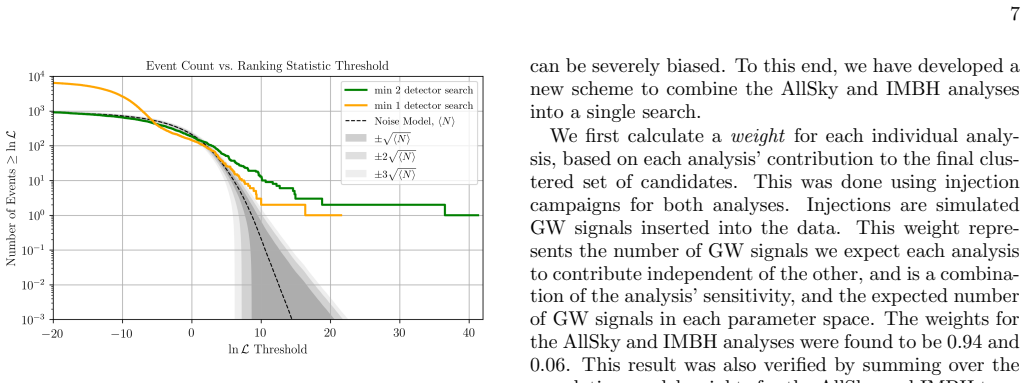
In this work, we present new methods implemented in the GstLAL offline gravitational wave search. These include a technique to reuse the matched filtering data products from a GstLAL online analysis, which hugely reduces the time and computational resources required to obtain offline results; a technique to combine these results with a separate search for heavier black hole mergers, enabling detections from a larger set of gravitational wave sources; changes to the likelihood ratio which increases the sensitivity of the analysis; and two separate changes to the background estimation, allowing more precise significance estimation of gravitational wave candidates. Some of these methods increase the sensitivity of the analysis, whereas others correct previous mis-estimations of sensitivity by eliminating false positives. These methods have been adopted for GstLAL's offline results during the fourth observing run of LIGO, Virgo, and KAGRA (O4). To test these new methods, we perform an offline analysis over one chunk of O3 data, lasting from May 12 19:36:42 UTC 2019 to May 21 14:45:08 UTC 2019, and compare it with previous GstLAL results over the same period of time. We show that cumulatively these methods afford around a 50% - 100% increase in sensitivity in the highest mass space, while simultaneously increasing the reliability of results, and making them more reusable and computationally cheaper.
Editorial analysis
A structured set of objections, weighed in public.
Referee Report
Summary. The paper introduces several updates to the GstLAL offline gravitational-wave search pipeline: reuse of matched-filtering data products from the online analysis to reduce computational cost, combination with a dedicated heavy black-hole search, modifications to the likelihood ratio, and two changes to background estimation. These are tested by re-analyzing a single one-week O3 segment (12–21 May 2019) and comparing the results to a prior GstLAL run on the same data, with the claim that the cumulative changes produce a 50–100 % sensitivity gain in the highest-mass regime while also improving reliability and reusability.
Significance. If the reported sensitivity gains are confirmed on broader data sets, the work would materially improve the efficiency and reach of offline searches for high-mass binary black holes and has already been adopted for O4. The explicit computational savings from data-product reuse and the correction of prior false-positive mis-estimations are concrete practical advances.
major comments (1)
- Validation section / Results: the 50–100 % sensitivity increase in the high-mass regime is demonstrated solely on the single one-week O3 interval (May 12 19:36:42 UTC to May 21 14:45:08 UTC). Because high-mass BBH events are rare, this short segment may sample atypical noise or injection statistics; without additional segments, full-O3 runs, or explicit cross-validation, it is unclear whether the gain is robust or partly driven by segment-specific tuning of the ranking statistic or background model.
minor comments (2)
- Abstract: the quantitative sensitivity claim is stated without specifying the exact figure of merit (sensitive volume, detection efficiency at fixed FAR, etc.), the precise background-model modifications, or any accompanying statistical uncertainties or systematic checks.
- Methods: clarify whether the likelihood-ratio changes and the two background-estimation updates are applied sequentially or jointly, and how any potential correlation between them is accounted for in the final significance assignment.
Simulated Author's Rebuttal
We thank the referee for their careful reading and constructive feedback on our manuscript. We address the major comment below.
read point-by-point responses
-
Referee: Validation section / Results: the 50–100 % sensitivity increase in the high-mass regime is demonstrated solely on the single one-week O3 interval (May 12 19:36:42 UTC to May 21 14:45:08 UTC). Because high-mass BBH events are rare, this short segment may sample atypical noise or injection statistics; without additional segments, full-O3 runs, or explicit cross-validation, it is unclear whether the gain is robust or partly driven by segment-specific tuning of the ranking statistic or background model.
Authors: We agree that validation on a single one-week segment has inherent limitations for assessing robustness, especially for rare high-mass events. This particular interval was selected to enable a direct, apples-to-apples comparison with the prior GstLAL offline results on identical data, while still containing a representative mix of O3 noise conditions and allowing a computationally feasible injection campaign. Sensitivity gains are quantified via a large set of injected signals spanning the target parameter space rather than relying on the (few) real high-mass events in the segment. The methodological updates themselves—data-product reuse, merger with the heavy black-hole search, revised likelihood ratio, and improved background estimation—are general and have already been deployed in GstLAL’s O4 offline analyses on substantially larger datasets. In the revised manuscript we will add explicit discussion of the segment choice, the role of the injection campaign, and the ongoing broader validation through O4 to address this concern. revision: partial
Circularity Check
No significant circularity; empirical validation stands independent of inputs
full rationale
The paper introduces concrete methodological changes (data-product reuse, search combination, likelihood-ratio adjustments, background-model refinements) and validates them by executing the updated pipeline on a fixed one-week O3 segment and directly comparing detection statistics and sensitivity metrics against prior GstLAL runs on identical data. No equations, fitted parameters, or predictions are presented that reduce by construction to the same quantities used to define or tune the methods. Any self-citations to earlier GstLAL work supply context for the baseline but are not invoked as uniqueness theorems or load-bearing justifications for the reported sensitivity gains; those gains are measured outcomes on external gravitational-wave data rather than algebraic identities or reparameterizations of the input assumptions.
Axiom & Free-Parameter Ledger
Forward citations
Cited by 5 Pith papers
-
GW240925 and GW250207: Astrophysical Calibration of Gravitational-wave Detectors
The first informative astrophysical calibration of gravitational-wave detectors is reported using GW240925 and GW250207.
-
Beyond FINDCHIRP: Breaking the memory wall and optimal FFTs for Gravitational-Wave Matched-Filter Searches with Ratio-Filter Dechirping
Ratio-Filter Dechirping converts gravitational-wave matched filtering from a memory-bound FFT into a cache-efficient FIR convolution, delivering a measured 8x speedup in the core loop.
-
GW250114: testing Hawking's area law and the Kerr nature of black holes
GW250114 data confirm the remnant black hole ringdown frequencies lie within 30% of Kerr predictions and that the final horizon area is larger than the sum of the progenitors' areas to high credibility.
-
Searches for Binary Mergers with Sub-solar Mass Components in Data from the First Part of LIGO--Virgo--KAGRA's Fourth Observing Run
No sub-solar mass binary merger candidates found in LIGO data from May 2023 to January 2024, yielding merger rate upper limits of 110-10000 Gpc^{-3}yr^{-1} and constraints on primordial black hole dark matter fractions.
-
GstLAL O4 Online Results Paper
GstLAL produced low-latency alerts for 250 astrophysically plausible gravitational-wave candidates during O4, providing the first upload for 222 and the sole upload for 75, with 88 percent of significant catalog event...
Reference graph
Works this paper leans on
-
[1]
setup stage (a) template bank creation stage (b) power spectral density (PSD) measurement stage (c) singular value decomposition (SVD) of tem- plates and template whitening stage
-
[2]
data processing stage (a) matched filtering stage (b) rank stage A. Template bank creation stage For O4, two GstLAL template banks, namely the stellar-mass black hole and intermediate-mass black hole (IMBH) banks were generated using manifold [42, 43], which is a binary-tree approach to template bank gener- ation. All templates in both banks neglect eccen...
-
[3]
AllSky template bank The AllSky template bank includes templates in the binary neutron star (BNS), neutron star–black hole bi- nary (NSBH), and binary black hole (BBH) parameter spaces [44], consisting of 1815963 templates in total. This bank is used for the GstLAL online analysis, as well as for the bulk of the GstLAL offline results. It extends from com...
-
[4]
IMBH template bank In contrast to the AllSky bank, the IMBH bank is much smaller, and is only used to augment the GstLAL offline results in the IMBH parameter space. The IMBH bank covers the mass parameter space higher than what the AllSky template bank targets, as shown in Table II. The lower limit of m1 is set to 203 M⊙ such that the IMBH bank is an ext...
-
[5]
Population model Population models provide weights to templates which represent our prior knowledge of the astrophysical distri- bution of GW sources [47]. This is used in the likelihood ratio (LR) calculation, as well as to compute probabilities of astrophysical origin of candidates [48]. In O4, the pop- ulation models for both the AllSky and IMBH banks ...
work page 2048
-
[6]
Since Ref. [53] already tests the online rank fea- ture and concludes it is equivalent to a traditional offline analysis, we do not test that feature here, and directly set up an offline analysis over the data instead of running an online analysis and setting up an online rank based FIG. 6. Effect of applying the new extinction model on the noise LR histo...
work page 2019
-
[7]
IMBH analysis Here, we assess how much sensitivity we gain by com- bining the IMBH search with the AllSky search, com- pared to just the sensitivity of the AllSky search. The VT ratio of the O4 combined AllSky+IMBH search to that of the VT of the O4 AllSky search is shown in Fig. 8. In addition to the 6% - 7% sensitivity improvement in the IMBH space as s...
-
[8]
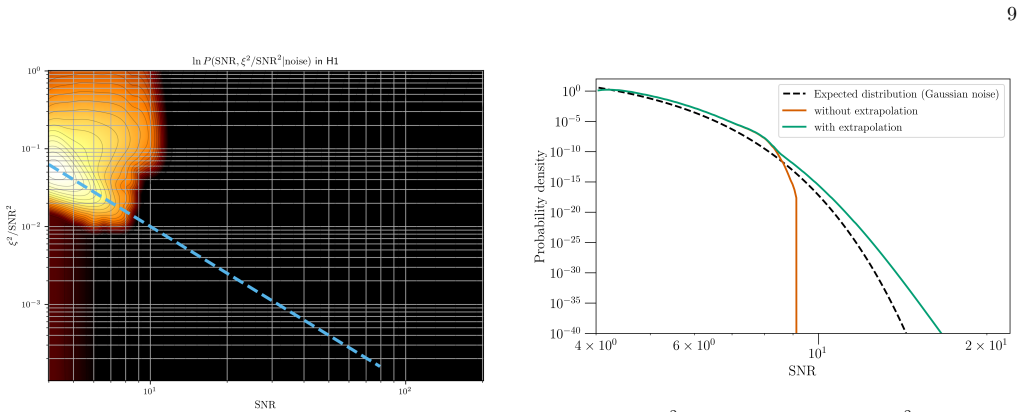
Extrapolation in ρ − ξ2 noise model As mentioned previously, the extrapolation in ρ − ξ2 noise model removes false positives in GW candidates. This implies that real GW signals can also be down- ranked accordingly and not be recovered as significantly as it would be without the extrapolation. To this end, we compare the V T s between with and without the ...
-
[9]
Reliability of results The new extinction model and LR improvements en- sure the FARs of candidates are more accurate, and the extrapolation in ρ − ξ2 noise model reduces the risk of false positives in the candidate set. All of these con- tribute to the O4 results being more reliable then before. This effect is difficult to measure since wrongly assigned ...
-
[10]
B. P. Abbott et al. (LIGO Scientific, Virgo), Phys. Rev. Lett. 116, 061102 (2016), arXiv:1602.03837 [gr-qc]
work page internal anchor Pith review Pith/arXiv arXiv 2016
-
[11]
Ligo-virgo-kagra cumulative detection plot - o1-o4b,
L. Collaboration, “Ligo-virgo-kagra cumulative detection plot - o1-o4b,” (2024)
work page 2024
-
[12]
B. P. Abbott et al. (LIGO Scientific and Virgo Collabo- rations), Phys. Rev. Lett. 116, 221101 (2016)
work page 2016
-
[13]
B. P. Abbott et al. (The LIGO Scientific Collabora- tion and the Virgo Collaboration), Phys. Rev. Lett. 121, 161101 (2018)
work page 2018
-
[14]
B. P. Abbott et al. (LIGO Scientific Collaboration and Virgo Collaboration), Phys. Rev. Lett. 123, 011102 (2019)
work page 2019
-
[15]
Abbottet al.(LIGO Scientific, KAGRA, VIRGO), As- trophys
R. Abbott et al. (LIGO Scientific, KAGRA, VIRGO), As- trophys. J. Lett.915, L5 (2021), arXiv:2106.15163 [astro- ph.HE]
-
[16]
B. P. Abbott et al. (LIGO Scientific, Virgo), Phys. Rev. X 9, 031040 (2019), arXiv:1811.12907 [astro-ph.HE]
work page internal anchor Pith review Pith/arXiv arXiv 2019
-
[17]
Physical Review X 11, 021053 (2021)
work page 2021
-
[18]
The LIGO Scientific Collaboration, The Virgo Collabo- ration, R. Abbott, et al., “Gwtc-2.1: Deep extended cat- alog of compact binary coalescences observed by ligo and virgo during the first half of the third observing run,” (2021)
work page 2021
-
[19]
R. Abbott et al. (LIGO Scientific, VIRGO, KAGRA), “GWTC-3: Compact Binary Coalescences Observed by LIGO and Virgo During the Second Part of the Third Observing Run,” (2021), arXiv:2111.03606 [gr-qc]
work page internal anchor Pith review Pith/arXiv arXiv 2021
-
[20]
B. P. Abbott et al. (The LIGO Scientific Collaboration and the Virgo Collaboration), Phys. Rev. D 100, 104036 (2019)
work page 2019
-
[21]
S.-C. Yang, W.-B. Han, and G. Wang, Monthly No- tices of the Royal Astronomical Society: Letters 499, L53 (2020), https://academic.oup.com/mnrasl/article- pdf/499/1/L53/54638219/mnrasl 499 1 l53.pdf
work page 2020
-
[22]
Tests of General Relativity with GWTC-3
R. Abbott, H. Abe, F. Acernese, K. Ackley, N. Adhikari, R. Adhikari, V. Adkins, V. Adya, C. Affeldt, D. Agarwal, et al., arXiv preprint arXiv:2112.06861 (2021)
work page internal anchor Pith review Pith/arXiv arXiv 2021
-
[23]
J. M. Ezquiaga, Physics Letters B 822, 136665 (2021)
work page 2021
-
[24]
D. C. H. J. . K. V. . R. D. . T. L. . . S. D. . V. S. . Y. S. . . 245 and L. C. O. C. A. I. . . H. G. . . H. D. A. . . M. C. . . P. D. . V. S. . 247, Nature 551, 85 (2017)
work page 2017
-
[25]
T. L. S. Collaboration and the Virgo Collaboration, The Astrophysical Journal 909, 218 (2021)
work page 2021
-
[26]
S. Wu, Z. Cao, and Z.-H. Zhu, Monthly No- tices of the Royal Astronomical Society 495, 466 (2020), https://academic.oup.com/mnras/article- pdf/495/1/466/33387647/staa1176.pdf
work page 2020
-
[27]
H.-T. Wang, P.-C. Li, J.-L. Jiang, G.-W. Yuan, Y.-M. Hu, and Y.-Z. Fan, The European Physical Journal C 81, 769 (2021)
work page 2021
-
[28]
Y. Bouffanais, M. Mapelli, F. Santoliquido, N. Giacobbo, U. N. Di Carlo, S. Rastello, M. C. Artale, and G. Iorio, Monthly Notices of the Royal Astronomical Society 507, 5224 (2021), https://academic.oup.com/mnras/article- pdf/507/4/5224/40392757/stab2438.pdf
work page 2021
-
[29]
T. L. S. Collaboration and the Virgo Collaboration, The Astrophysical Journal Letters 882, L24 (2019)
work page 2019
-
[30]
T. L. S. Collaboration and the Virgo Collaboration, The Astrophysical Journal Letters 913, L7 (2021)
work page 2021
-
[31]
The population of merging compact binaries inferred using gravitational waves through GWTC-3
R. Abbott et al. (KAGRA, VIRGO, LIGO Scientific), Phys. Rev. X13, 011048 (2023), arXiv:2111.03634 [astro- ph.HE]
work page internal anchor Pith review Pith/arXiv arXiv 2023
-
[32]
J. Aasi et al. (LIGO Scientific), Class. Quant. Grav. 32, 074001 (2015), arXiv:1411.4547 [gr-qc]
work page internal anchor Pith review Pith/arXiv arXiv 2015
-
[33]
Advanced Virgo: a 2nd generation interferometric gravitational wave detector
F. Acernese et al. (VIRGO), Class. Quant. Grav. 32, 024001 (2015), arXiv:1408.3978 [gr-qc]
work page internal anchor Pith review Pith/arXiv arXiv 2015
-
[34]
T. Akutsu et al. , Progress of Theoretical and Exper- imental Physics 2021 (2020), 10.1093/ptep/ptaa125, 05A101, https://academic.oup.com/ptep/article- pdf/2021/5/05A101/37974994/ptaa125.pdf
-
[35]
Analysis Framework for the Prompt Discovery of Compact Binary Mergers in Gravitational-wave Data
C. Messick et al. , Phys. Rev. D 95, 042001 (2017), arXiv:1604.04324 [astro-ph.IM]
work page internal anchor Pith review Pith/arXiv arXiv 2017
-
[36]
S. Sachdev et al., “The GstLAL Search Analysis Methods for Compact Binary Mergers in Advanced LIGO’s Second and Advanced Virgo’s First Observing Runs,” (2019), arXiv:1901.08580 [gr-qc]
work page internal anchor Pith review Pith/arXiv arXiv 2019
-
[37]
2020.https://arxiv.org/abs/2010.050823
K. Cannon et al. , “GstLAL: A software framework for gravitational wave discovery,” (2020), arXiv:2010.05082 [astro-ph.IM]
-
[38]
C. Hanna et al. , Phys. Rev. D101, 022003 (2020), arXiv:1901.02227 [gr-qc]
-
[39]
Toward Early-Warning Detection of Gravitational Waves from Compact Binary Coalescence
K. Cannon et al. , Astrophys. J. 748, 136 (2012), arXiv:1107.2665 [astro-ph.IM]
work page internal anchor Pith review Pith/arXiv arXiv 2012
-
[40]
Likelihood-Ratio Ranking Statistic for Compact Binary Coalescence Candidates with Rate Estimation
K. Cannon, C. Hanna, and J. Peoples, “Likelihood- Ratio Ranking Statistic for Compact Binary Coales- cence Candidates with Rate Estimation,” (2015), arXiv:1504.04632 [astro-ph.IM]
work page internal anchor Pith review Pith/arXiv arXiv 2015
-
[41]
L. Tsukada, P. Joshi, S. Adhicary, R. George, A. Guimaraes, C. Hanna, R. Magee, A. Zimmerman, P. Baral, A. Baylor, K. Cannon, S. Caudill, B. Cousins, J. D. E. Creighton, B. Ewing, H. Fong, P. Godwin, R. Harada, Y.-J. Huang, R. Huxford, J. Kennington, S. Kuwahara, A. K. Y. Li, D. Meacher, C. Messick, S. Morisaki, D. Mukherjee, W. Niu, A. Pace, C. Posnan- s...
-
[42]
T. Venumadhav, B. Zackay, J. Roulet, L. Dai, and M. Zaldarriaga, Phys. Rev. D 100, 023011 (2019)
work page 2019
-
[43]
B. Zackay, L. Dai, T. Venumadhav, J. Roulet, and M. Zaldarriaga, Physical Review D 104 (2021), 10.1103/physrevd.104.063030
- [44]
- [45]
-
[46]
T. D. Canton, A. H. Nitz, B. Gadre, G. S. C. Davies, V. Villa-Ortega, T. Dent, I. Harry, and L. Xiao, The Astrophysical Journal 923, 254 (2021)
work page 2021
-
[47]
G. S. Davies, T. Dent, M. T´ apai, I. Harry, C. McIsaac, and A. H. Nitz, Physical Review D 102 (2020), 10.1103/physrevd.102.022004
-
[49]
Q. Chu, Physical Review D 105 (2022), 10.1103/Phys- RevD.105.024023
-
[50]
Q. Chu, Low-latency detection and localization of gravi- tational waves from compact binary coalescences , Ph.D. 16 thesis, The University of Western Australia (2017)
work page 2017
-
[51]
C. Hanna, J. Kennington, S. Sakon, S. Privitera, M. Fer- nandez, J. Wang, C. Messick, A. Pace, K. Cannon, P. Joshi, R. Huxford, S. Caudill, C. Chan, B. Cousins, J. D. E. Creighton, B. Ewing, H. Fong, P. Godwin, R. Magee, D. Meacher, S. Morisaki, D. Mukherjee, H. Ohta, S. Sachdev, D. Singh, R. Tapia, L. Tsukada, D. Tsuna, T. Tsutsui, K. Ueno, A. Viets, L. ...
work page 2023
- [52]
-
[53]
B. Ewing, R. Huxford, D. Singh, L. Tsukada, C. Hanna, Y.-J. Huang, P. Joshi, A. K. Y. Li, R. Magee, C. Mes- sick, A. Pace, A. Ray, S. Sachdev, S. Sakon, R. Tapia, S. Adhicary, P. Baral, A. Baylor, K. Cannon, S. Caudill, S. S. Chaudhary, M. W. Coughlin, B. Cousins, J. D. E. Creighton, R. Essick, H. Fong, R. N. George, P. Godwin, R. Harada, J. Kennington, S...
-
[54]
S. Sakon et al., “Template bank for compact binary merg- ers in the fourth observing run of Advanced LIGO, Ad- vanced Virgo, and KAGRA,” (2022), arXiv:2211.16674 [gr-qc]
-
[55]
Ligo sensitivity (190 mpc) (used for o4 simulations),
“Ligo sensitivity (190 mpc) (used for o4 simulations),” (2022)
work page 2022
-
[56]
H. K. Y. Fong, From simulations to signals: Analyz- ing gravitational waves from compact binary coalescences, Ph.D. thesis, Toronto U. (2018)
work page 2018
-
[57]
A. Ray et al. , “When to Point Your Telescopes: Gravitational Wave Trigger Classification for Real- Time Multi-Messenger Followup Observations,” (2023), arXiv:2306.07190 [gr-qc]
-
[58]
S. Morisaki and V. Raymond, Phys. Rev. D 102, 104020 (2020), arXiv:2007.09108 [gr-qc]
- [59]
-
[60]
P. Joshi, L. Tsukada, and C. Hanna, “Background Fil- ter: A method for removing signal contamination during significance estimation of a GstLAL anaysis,” (2023), arXiv:2305.18233 [gr-qc]
-
[61]
K. Cannon, C. Hanna, and D. Keppel, Phys. Rev. D 88, 024025 (2013), arXiv:1209.0718 [gr-qc]
work page internal anchor Pith review Pith/arXiv arXiv 2013
-
[62]
P. Joshi, W. Niu, C. Hanna, R. Huxford, D. Singh, L. Tsukada, S. Adhicary, P. Baral, A. Baylor, K. Can- non, S. Caudill, M. W. Coughlin, B. Cousins, J. D. E. Creighton, B. Ewing, H. Fong, R. N. George, S. Ghosh, P. Godwin, R. Harada, Y.-J. Huang, C. Messick, S. Morisaki, D. Mukherjee, A. Pace, C. Posnansky, A. Ray, S. Sachdev, S. Sakon, U. Shah, R. Tapia,...
work page internal anchor Pith review Pith/arXiv arXiv 2025
-
[63]
S. S. Chaudhary et al., “Low-latency alert products and their performance in anticipation of the fourth ligo-virgo- kagra observing run,” (in prep) (2023)
work page 2023
-
[64]
A. Buonanno, B. R. Iyer, E. Ochsner, Y. Pan, and B. S. Sathyaprakash, Phys. Rev. D 80, 084043 (2009)
work page 2009
-
[65]
A. Boh´ e, L. Shao, A. Taracchini, A. Buonanno, S. Babak, I. W. Harry, I. Hinder, S. Ossokine, M. P¨ urrer, V. Ray- mond, T. Chu, H. Fong, P. Kumar, H. P. Pfeiffer, M. Boyle, D. A. Hemberger, L. E. Kidder, G. Lovelace, M. A. Scheel, and B. Szil´ agyi, Phys. Rev. D 95, 044028 (2017)
work page 2017
-
[66]
S. Khan, S. Husa, M. Hannam, F. Ohme, M. P¨ urrer, X. J. Forteza, and A. Boh´ e, Phys. Rev. D 93, 044007 (2016)
work page 2016
-
[67]
T. Callister, J. Kanner, T. Massinger, S. Dhurandhar, and A. Weinstein, Classical and Quantum Gravity 34, 155007 (2017)
work page 2017
-
[68]
Ligo Scientific Collaboration, VIRGO Collaboration, and Kagra Collaboration, General Coordinates Network 36236, 1 (2024)
work page 2024
-
[69]
The statistical significance of this candidate was subse- quently estimated to be lower after collecting more noise triggers and the update alert was sent [66]
-
[70]
Messick, Detecting Gravitational Waves for Multi- Messenger Astro, Ph.D
C. Messick, Detecting Gravitational Waves for Multi- Messenger Astro, Ph.D. thesis (2019)
work page 2019
-
[71]
Gwtc-2 data release: Sensitivity of matched filter searches to binary black hole merger populations,
L. S. Collaboration and V. Collaboration, “Gwtc-2 data release: Sensitivity of matched filter searches to binary black hole merger populations,” https://dcc.ligo.org/ P2000217/public
- [72]
-
[73]
S. Ghosh, K. Chandra, and A. Pai, Physical Review D 109 (2024), 10.1103/physrevd.109.064015
- [74]
-
[75]
Ligo Scientific Collaboration, VIRGO Collaboration, and Kagra Collaboration, General Coordinates Network 36812, 1 (2024)
work page 2024
discussion (0)
Sign in with ORCID, Apple, or X to comment. Anyone can read and Pith papers without signing in.