Non-Markovian thermal reservoirs for autonomous entanglement distribution
Pith reviewed 2026-05-19 07:25 UTC · model grok-4.3
The pith
Two qubits driven by a narrow-bandwidth thermal source settle into an entangled steady state.
A machine-rendered reading of the paper's core claim, the machinery that carries it, and where it could break.
Core claim
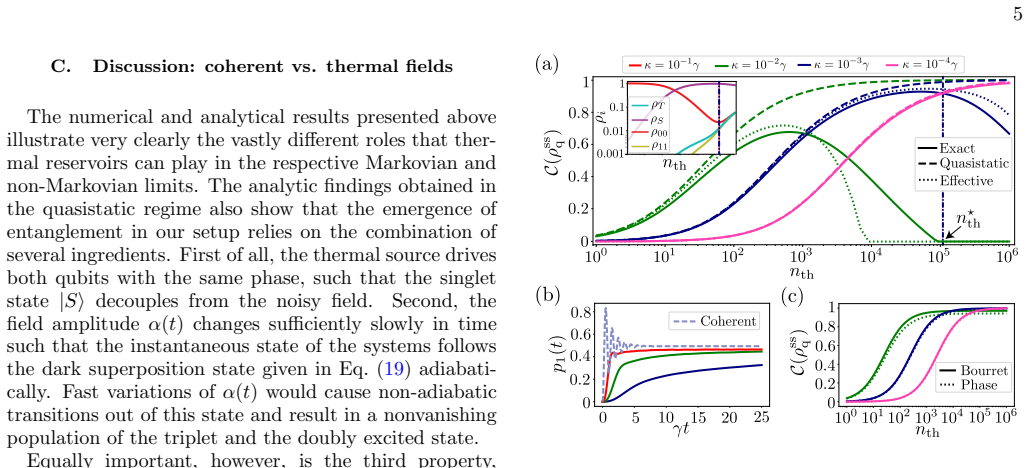
The qubits relax into an entangled steady state once the bandwidth of the thermal source is sufficiently reduced. This is explained by the appearance of a quasiadiabatic dark state that protects the entanglement in the non-Markovian regime, while nonadiabatic corrections lead to breakdown at high temperatures.
What carries the argument
The quasiadiabatic dark state, a protected state that emerges when the thermal reservoir bandwidth is reduced and shields the entanglement from decoherence.
If this is right
- The non-Markovian character of the reservoir enables autonomous entanglement distribution using only thermal noise.
- Filtered room-temperature noise serves as a passive resource for entangling distant superconducting qubits in a cryogenic link.
- Solid-state spin qubits can be entangled via a phononic quantum channel using this approach.
- The entangled state persists until nonadiabatic effects dominate at higher temperatures.
Where Pith is reading between the lines
- This method could allow entanglement generation without the need for the entire source to be cooled cryogenically.
- Similar non-Markovian effects might be engineered in other dissipative quantum systems for preparing entangled states.
- Experimental tests could tune the filter bandwidth on thermal noise and check for qubit entanglement.
- The idea might extend to networks with more than two qubits for distributed quantum resources.
Load-bearing premise
The coupling between the thermal reservoir and the qubits is modeled such that a dark state can form and protect entanglement when the bandwidth is narrowed.
What would settle it
If measurements show that the two qubits remain in a separable state regardless of how narrow the thermal source bandwidth becomes, the central claim would be falsified.
Figures




read the original abstract
We describe a novel scheme for the generation of stationary entanglement between two separated qubits that are driven by a purely thermal photon source. While in this scenario the qubits remain in a separable state at all times when the source is broadband, i.e. Markovian, the qubits relax into an entangled steady state once the bandwidth of the thermal source is sufficiently reduced. We explain this phenomenon by the appearance of a quasiadiabatic dark state and identify the most relevant nonadiabatic corrections that eventually lead to a breakdown of the entangled state, once the temperature is too high. This effect demonstrates how the non-Markovianity of an otherwise incoherent reservoir can be harnessed for quantum communication applications in optical, microwave, and phononic networks. As two specific examples, we discuss the use of filtered room-temperature noise as a passive resource for entangling distant superconducting qubits in a cryogenic quantum link or solid-state spin qubits in a phononic quantum channel.
Editorial analysis
A structured set of objections, weighed in public.
Referee Report
Summary. The manuscript proposes a scheme for autonomous generation of stationary entanglement between two separated qubits driven by a thermal photon source. It claims that broadband (Markovian) sources leave the qubits in a separable state at all times, whereas sufficiently narrow bandwidth (non-Markovian regime) causes relaxation into an entangled steady state. The mechanism is attributed to the emergence of a quasiadiabatic dark state; nonadiabatic corrections are identified that destroy the protection at high temperature. Concrete examples are given for filtered room-temperature noise entangling superconducting qubits in a cryogenic link and solid-state spins in a phononic channel.
Significance. If the central claim is robust, the result is significant: it demonstrates that non-Markovianity of an incoherent thermal reservoir can be turned into a passive resource for entanglement distribution, removing the need for coherent drives. This is potentially useful for simplifying quantum links in microwave and phononic networks. The explicit identification of the dark-state protection and its breakdown conditions adds mechanistic insight beyond purely numerical observations.
major comments (2)
- [§3.2, Eq. (15)] §3.2, Eq. (15): The quasiadiabatic dark state is constructed from the specific filtered Lorentzian spectral density and the form of the qubit-reservoir interaction Hamiltonian. The manuscript does not test whether the entangled steady state survives under changes to the spectral shape (e.g., Gaussian or power-law tails), which is load-bearing for the claim that the effect is a generic consequence of non-Markovianity rather than an artifact of the chosen reservoir model.
- [§5.1, Fig. 4] §5.1, Fig. 4: The numerical evidence for the entangled steady state is shown only for the nominal parameter set; no systematic scan over reservoir correlation time versus temperature is provided to quantify the boundary where nonadiabatic corrections dominate, weakening the practical applicability statements for room-temperature noise.
minor comments (2)
- [§4] The definition of the quasiadiabatic dark state in §4 is introduced after the main results; moving a concise statement of its form to the introduction would improve readability.
- [Eq. (7)] Notation for the filtered noise spectrum is introduced in Eq. (7) but reused with slight redefinitions in later sections; a single consolidated table of symbols would reduce confusion.
Simulated Author's Rebuttal
We thank the referee for the careful reading of our manuscript and for the constructive comments. We address each major comment below and have revised the manuscript to strengthen the presentation of the results.
read point-by-point responses
-
Referee: [§3.2, Eq. (15)] §3.2, Eq. (15): The quasiadiabatic dark state is constructed from the specific filtered Lorentzian spectral density and the form of the qubit-reservoir interaction Hamiltonian. The manuscript does not test whether the entangled steady state survives under changes to the spectral shape (e.g., Gaussian or power-law tails), which is load-bearing for the claim that the effect is a generic consequence of non-Markovianity rather than an artifact of the chosen reservoir model.
Authors: We agree that explicit checks for other spectral shapes would better support the generality of the non-Markovian entanglement mechanism. The Lorentzian form is a standard model for filtered thermal noise, but to address the concern we have added new numerical results in the revised manuscript using a Gaussian spectral density with matched bandwidth and temperature. These simulations, presented in an additional panel of Fig. 3, show that the steady-state entanglement persists in the non-Markovian regime with comparable concurrence values and similar nonadiabatic breakdown at high temperature. We have also inserted a short paragraph in Sec. 3.2 explaining that the quasiadiabatic dark-state protection relies primarily on the existence of a finite correlation time rather than the precise lineshape, provided the spectrum remains narrow compared with the qubit-reservoir coupling. revision: yes
-
Referee: [§5.1, Fig. 4] §5.1, Fig. 4: The numerical evidence for the entangled steady state is shown only for the nominal parameter set; no systematic scan over reservoir correlation time versus temperature is provided to quantify the boundary where nonadiabatic corrections dominate, weakening the practical applicability statements for room-temperature noise.
Authors: We appreciate the suggestion to quantify the operating regime more systematically. While the original Fig. 4 and the analytic discussion in Sec. 4 already delineate the relevant timescales, we have added a new supplementary figure (Fig. S1) that maps the steady-state concurrence as a function of reservoir correlation time and temperature for the superconducting-qubit example. The scan confirms that entanglement remains robust for correlation times longer than approximately 1 ns at temperatures up to 300 K when the filter bandwidth is chosen appropriately, thereby supporting the practical statements for room-temperature noise in cryogenic links. The main text in Sec. 5.1 has been updated to reference this parameter map. revision: yes
Circularity Check
No circularity: entangled steady state derived from explicit non-Markovian dynamics
full rationale
The paper constructs the quasiadiabatic dark state and resulting entangled steady state directly from the master equation or equivalent dynamical equations that incorporate the filtered thermal reservoir spectrum, correlation functions, and qubit-reservoir interaction Hamiltonian. The dark state appears as a consequence of reduced bandwidth in the non-Markovian regime rather than being presupposed or fitted to the target entanglement; nonadiabatic corrections are likewise obtained from the same model. No load-bearing step reduces by definition or self-citation to the final result, and the derivation remains independent of the entanglement measure itself.
Axiom & Free-Parameter Ledger
free parameters (1)
- thermal source bandwidth
axioms (1)
- standard math Master-equation description of qubit-reservoir interaction
invented entities (1)
-
quasiadiabatic dark state
no independent evidence
Lean theorems connected to this paper
-
IndisputableMonolith/Cost/FunctionalEquation.leanwashburn_uniqueness_aczel unclear?
unclearRelation between the paper passage and the cited Recognition theorem.
the qubits relax into an entangled steady state once the bandwidth of the thermal source is sufficiently reduced... quasiadiabatic dark state
-
IndisputableMonolith/Foundation/ArithmeticFromLogic.leanLogicNat ≃ Nat recovery unclear?
unclearRelation between the paper passage and the cited Recognition theorem.
Bourret approximation... matrix continued fraction expansion
What do these tags mean?
- matches
- The paper's claim is directly supported by a theorem in the formal canon.
- supports
- The theorem supports part of the paper's argument, but the paper may add assumptions or extra steps.
- extends
- The paper goes beyond the formal theorem; the theorem is a base layer rather than the whole result.
- uses
- The paper appears to rely on the theorem as machinery.
- contradicts
- The paper's claim conflicts with a theorem or certificate in the canon.
- unclear
- Pith found a possible connection, but the passage is too broad, indirect, or ambiguous to say the theorem truly supports the claim.
Forward citations
Cited by 2 Pith papers
-
Entanglement of two optical emitters mediated by a terahertz channel
Steady-state entanglement with concurrence above 0.9 is generated between optical emitters by optically tuning Rabi-split dressed states to couple via a THz channel and collective dissipation.
-
Generation of Quantum Entanglement in Autonomous Thermal Machines: Effects of Non-Markovianity, Hilbert Space Structure, and Quantum Coherence
A quantum autonomous thermal machine generates entanglement in an external two-qubit system only under thermodynamic cycle A, which exhibits stronger non-Markovianity and higher coherence.
Reference graph
Works this paper leans on
-
[1]
In this new basis, the resulting stochastic mas- ter equation for ˜µq(t) ≡ ˜µq(θ(t), t) reads ˙˜µq(t) = [L0 + r0 (L+ + L−)] ˜µq(t) − i ˙θ 2[Sz, ˜µq(t)]. (37) This equation must be interpreted as a Stratonovich stochastic differential equation, where ˙θ and ˜µq(θ(t), t) are not independent. To proceed, we convert Eq. (37) to Itˆ o form, after which we can ...
-
[2]
Optimally placed qubits By considering, in a first step, the ideal configuration where all qubits are located at the nodes of the standing wave, i.e. k0zi = 2 πni with ni = 0 , 1, 2, ..., the master equation for this setup reads ˙ρ = − i[H1 + H2, ρ] + D[√κa + √γσ − 1 + √γσ − 2 ]ρ + κ(nth + 1)D[a]ρ + κnthD[a†]ρ. (49) We see that in this configuration the q...
work page 2000
-
[3]
General configurations Finally, we investigate the case of arbitrary qubit posi- tions zi, which in a bidirectional waveguide affects both the coherent and the incoherent interactions between the qubits and the cavity. In this general case, the equation of motion for the two-qubit operator reads ˙µ(t) = −i[H ′ α(t), µ(t)] + γD[Lcos]µ(t), (51) where Lcos =...
-
[4]
Parameters For a specific estimate, we first consider the basic setup discussed in Ref. [14], where two orbital states of the SiV center with a splitting of ωq,i/(2π) ≈ 50 GHz are coupled to a narrow phonon waveguide in diamond with a decay rate of γ/(2π) ≈ 1 MHz and a bare dephasing time of about Tϕ ≈ 10 µs. For this example, a temperature of T = 300 K t...
-
[5]
However, for our specific example, we can restrict this hierarchy to values of m = 0, ±1, ±2
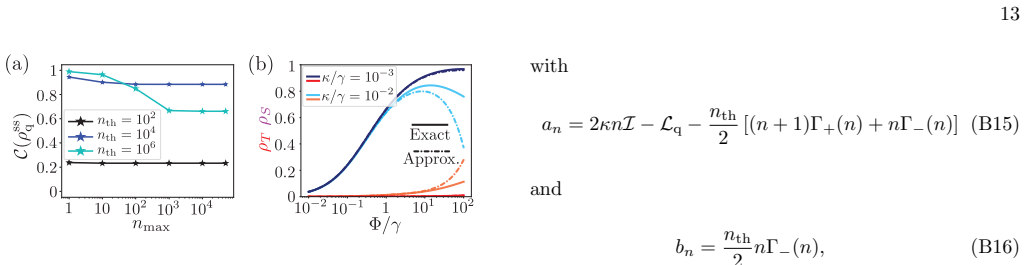
Numerics In this general formulation, we obtain an infinite set of coupled equations for n and m. However, for our specific example, we can restrict this hierarchy to values of m = 0, ±1, ±2. This restriction arises from the fact that our two-qubit system can support at most two excitations and ( L±)k = 0 for k > 2. Further, in the steady state, the opera...
-
[6]
A numerical jus- tification of this approximation is already given in the inset of Fig
Three-level approximation To go beyond numerics and derive approximate an- alytic results, we make a three-level approximation by omitting transitions to the state |11⟩. A numerical jus- tification of this approximation is already given in the inset of Fig. 3(a), where the population ρ11 is negligible 13 FIG. 7. (a) Convergence of the continued fraction i...
-
[7]
For a general continued fraction, a closed expres- sion can be found by [39] F = b0 a0 + b1 a1+
Theory of continued fractions After having reduced our solution for the steady-state populations to two continued fractions, we can apply known methods to solve them in terms of their continu- ants. For a general continued fraction, a closed expres- sion can be found by [39] F = b0 a0 + b1 a1+... = lim n→∞ Pn Qn , (B30) where the so-called continuants ful...
-
[8]
J. I. Cirac, P. Zoller, H. J. Kimble, and H. Mabuchi, Quantum state transfer and entanglement distribution among distant nodes in a quantum network, Phys. Rev. Lett. 78, 3221 (1997)
work page 1997
-
[9]
H. J. Kimble, The quantum internet, Nature (London) 453, 1023 (2008)
work page 2008
-
[10]
T. E. Northup and R. Blatt, Quantum information trans- fer using photons, Nat. Photonics 8, 356 (2014)
work page 2014
- [11]
-
[12]
B. Vermersch, P.-O. Guimond, H. Pichler, and P. Zoller, Quantum State Transfer via Noisy Photonic and Phononic Waveguides, Phys. Rev. Lett 118, 133601 (2017)
work page 2017
- [13]
-
[14]
A. Reiserer and G. Rempe, Cavity-based quantum net- works with single atoms and optical photons, Rev. Mod. Phys. 87, 1379 (2015)
work page 2015
-
[15]
P. Magnard, S. Storz, P. Kurpiers, J. Sch¨ ar, F. Marxer, J. Lu¨ utolf, T. Walter, J.-C. Besse, M. Gabureac, K. Reuer, A. Akin, B. Royer, A. Blais, and A. Wallraff, Microwave quantum link between superconducting circuits housed in spatially separated cryogenic systems, Phys. Rev. Lett. 125, 260502 (2020)
work page 2020
-
[16]
W. K. Yam, M. Renger, S. Gandorfer, F. Fesquet, M. Handschuh, K. E. Honasoge, F. Kronowetter, Y. No- jiri, M. Partanen, M. Pfeiffer, H. van der Vliet, A. J. Matthews, J. Govenius, R. N. Jabdaraghi, M. Prunnila, A. Marx, F. Deppe, R. Gross, and K. G. Fedorov, npj Quantum Inf. 11, 87 (2025)
work page 2025
- [17]
-
[18]
S. J. M. Habraken, K. Stannigel, M. D. Lukin, P. Zoller, and P. Rabl, Continuous mode cooling and phonon routers for phononic quantum networks, New J. Phys. 14, 115004 (2012)
work page 2012
-
[19]
M. V. Gustafsson, T. Aref, A. F. Kockum, M. K. Ekstr¨ om, G. Johansson, and P. Delsing, Propagating phonons coupled to an artificial atom, Science 346, 207 (2014)
work page 2014
-
[20]
M. J. A. Schuetz, E. M. Kessler, G. Giedke, L. M. K. Vandersypen, M. D. Lukin, and J. I. Cirac, Universal quantum transducers based on surface acoustic waves, Phys. Rev. X 5, 031031 (2015)
work page 2015
-
[21]
M.-A. Lemonde, S. Meesala, A. Sipahigil, M. J. A. Schuetz, M. D. Lukin, M. Loncar, and P. Rabl, Phonon networks with silicon-vacancy centers in diamond waveg- uides, Phys. Rev. Lett. 120, 213603 (2018)
work page 2018
-
[22]
A. Bienfait, K. J. Satzinger, Y. P. Zhong, H.-S. Chang, M.-H. Chou, C. R. Conner, E. Dumur, J. Grebel, G. A. Peairs, R. G. Povey, and A. N. Cleland, Phonon- mediated quantum state transfer and remote qubit en- tanglement, Science 364, 368 (2019)
work page 2019
- [23]
-
[24]
J. B. Brask, G. Haack, N. Brunner, and M. Huber, Autonomous quantum thermal machine for generating steady-state entanglement, New J. Phys. 17, 113029 (2015)
work page 2015
-
[25]
S. Khandelwal, B. Annby-Andersson, G. F. Diotallevi, A. Wacker, and A. Tavakoli, Maximal steady-state en- tanglement in autonomous quantum thermal machines, npj Quantum Inf. 11, 28 (2025)
work page 2025
-
[26]
C. H. Bennett, G. Brassard, S. Popescu, B. Schumacher, J. A. Smolin, and W. K. Wootters, Purification of noisy entanglement and faithful teleportation via noisy chan- nels, Phys. Rev. Lett. 76, 722 (1996)
work page 1996
-
[27]
W. D¨ ur, H.-J. Briegel, J. Cirac, and P. Zoller, Quantum repeaters based on entanglement purification, Phys. Rev. A 56, 169 (1999)
work page 1999
-
[28]
J. I. Cirac, A. K. Ekert, S. F. Huelga, and C. Mac- chiavello, Distributed quantum computation over noisy channels, Phys. Rev. A 59, 4249 (1999)
work page 1999
-
[29]
H. Yan, Y. Zhong, H. -S. Chang, A. Bienfait, M. -H. Chou, C. R. Conner, E. Dumur, J. Grebel, R. G. Povey, and A. N. Cleland, Entanglement purification and protec- tion in a superconducting quantum network, Phys. Rev. Lett. 128, 080504 (2022)
work page 2022
-
[30]
K. M. Sliwa, M. Hatridge, A. Narla, S. Shankar, L. Frun- zio, R. J. Schoelkopf, and M. H. Devoret, Reconfigurable josephson circulator/directional amplifier, Phys. Rev. X 5, 041020 (2015)
work page 2015
-
[31]
J. Kerckhoff, K. Lalumiere, B. J. Chapman, A. Blais, and K. W. Lehnert, On-chip superconducting microwave circulator from synthetic rotation, Phys. Rev. Applied 4, 034002 (2015)
work page 2015
-
[32]
B. J. Chapman, E. I. Rosenthal, J. Kerckhoff, B. A. Moores, L. R. Vale, J. A. B. Mates, G. C. Hilton, K. Lalumiere, A. Blais, and K. W. Lehnert, Widely Tun- able On-Chip Microwave Circulator for Superconducting Quantum Circuits, Phys. Rev. X 7, 041043 (2017)
work page 2017
- [33]
- [34]
-
[35]
Y.-Y. Wang, S. van Geldern, T. Connolly, Y.-X. Wang, A. Shilcusky, A. McDonald, A. A. Clerk, and C. Wang, Low-Loss Ferrite Circulator as a Tunable Chiral Quan- tum System, Phys. Rev. Applied 16, 064066 (2021)
work page 2021
-
[36]
P.-O. Guimond, B. Vermersch, M. L. Juan, A. Sharafiev, G. Kirchmair, and P. Zoller, A unidirectional on-chip photonic interface for superconducting circuits, npj Quantum Inf. 6, 32 (2020)
work page 2020
-
[37]
N. Gheeraert, S. Kono, and Y. Nakamura, Programmable directional emitter and receiver of itinerant microwave photons in a waveguide, Phys. Rev. A 102, 053720 (2020)
work page 2020
-
[38]
B. Kannan, et al. , On-demand directional microwave photon emission using waveguide quantum electrody- namics, Nature Phys. 19, 394 (2023)
work page 2023
- [39]
- [40]
-
[41]
H. J. Carmichael, Quantum Trajectory Theory for Cas- caded Open Systems, Phys. Rev. Lett. 70, 2273 (1993)
work page 1993
-
[42]
C. W. Gardiner, Driving a Quantum System with the Output Field From Another Driven Quantum System, Phys. Rev. Lett. 70, 2269 (1993)
work page 1993
-
[43]
C. W. Gardiner and P. Zoller, Quantum noise, Springer, Berlin (2004)
work page 2004
-
[44]
J. Agust´ ı, Y. Minoguchi, J. M. Fink, and P. Rabl, Long- distance distribution of qubit-qubit entanglement using Gaussian-correlated photonic beams, Phys. Rev. A 105, 062454 (2022)
work page 2022
-
[45]
H. Ritsch and P. Zoller, Systems driven by colored squeezed noise: The atomic absorption spectrum, Phys. Rev. A 38, 4657 (1988)
work page 1988
-
[46]
H. Risken, The Fokker-Planck Equation: Methods of So- lutions and Applications , Springer, Berlin (2004). 17
work page 2004
-
[47]
S. Hill and W. K. Wootters, Entanglement of a Pair of Quantum Bits, Phys. Rev. Lett. 78, 5022 (1997)
work page 1997
-
[48]
R. Horodecki, P. Horodecki, M. Horodecki, and K. Horodecki, Quantum entanglement, Rev. Mod. Phys.81, 865 (2009)
work page 2009
-
[49]
C. Gonzalez-Ballestero, Tutorial: projector approach to master equations for open quantum systems, Quantum 8, 1454 (2024)
work page 2024
-
[50]
H. J. Carmichael, Statistical methods in quantum optics 2: Non-classical fields , Springer, Berlin (2007)
work page 2007
-
[51]
K. Stannigel, P. Rabl, and P. Zoller, Driven-dissipative preparation of entangled states in cascaded quantum- optical networks, New J. Phys. 14, 063014 (2012)
work page 2012
-
[52]
H. Pichler, T. Ramos, A. J. Daley, and P. Zoller, Quan- tum optics of chiral spin networks, Phys. Rev. A 91, 042116 (2015)
work page 2015
-
[53]
P. Groszkowski, A. Seif, J. Koch, and A. A. Clerk, Simple master equations for describing driven systems subject to classical non-Markovian noise, Quantum 7, 972 (2023)
work page 2023
-
[54]
C. Gardiner and P. Zoller, The quantum world of ultra- cold atoms and light. Book I, Foundations of Quantum Optics, Imperial College Press, London (2014)
work page 2014
-
[55]
G. S. Agarwal, Quantum statistical theory of optical- resonance phenomena in fluctuating laser fields, Phys. Rev. A 18, 1490 (1978)
work page 1978
-
[56]
Zoller, Resonant multiphoton ionization by finite- bandwidth chaotic fields, Phys
P. Zoller, Resonant multiphoton ionization by finite- bandwidth chaotic fields, Phys. Rev. A 19, 1151 (1979)
work page 1979
-
[57]
P. Zoller, ac Stark splitting in double optical reso- nance and resonance fluorescence by a nonmonochro- matic chaotic field, Phys. Rev. A 20, 1019 (1979)
work page 1979
-
[58]
J. I. Cirac, H. Ritsch, and P. Zoller, Two-level system interacting with a finite-bandwidth thermal cavity mode, Phys. Rev. A 44, 4541 (1991)
work page 1991
-
[59]
C. Hepp, T. M¨ uller, V. Waselowski, J. N. Becker, B. Pin- gault, H. Sternschulte, D. Steinm¨ uller-Nethl, A. Gali, J. R. Maze, M. Atat¨ ure, and C. Becher, Electronic struc- ture of the silicon vacancy color center in diamond, Phys. Rev. Lett. 112, 036405 (2014)
work page 2014
-
[60]
S. Meesala, Y.-I. Sohn, B. Pingault, L. Shao, H. A. Atikian, J. Holzgrafe, M. G¨ undogan, C. Stavrakas, A. Sipahigil, C. Chia, R. Evans, M. J. Burek, M. Zhang, L. Wu, J. L. Pacheco, J. Abraham, E. Bielejec, M. D. Lukin, M. Atat¨ ure, and M. Loncar, Strain engineering of the silicon vacancy center in diamond, Phys. Rev. B 97, 205444 (2018)
work page 2018
-
[61]
M. C. Kuzyk and H. Wang, Scaling Phononic Quantum Networks of Solid-State Spins with Closed Mechanical Subsystems, Phys. Rev. X 8, 041027 (2018)
work page 2018
- [62]
- [63]
-
[64]
I. Arrazola, Y. Minoguchi, M.-A. Lemonde, A. Sipahigil, and P. Rabl, Toward high-fidelity quantum information processing and quantum simulation with spin qubits and phonons, Phys. Rev. B 110, 045419 (2024)
work page 2024
-
[65]
M. R. Vanner, J. Hofer, G. D. Cole, and M Aspelmeyer, Cooling-by-measurement and mechanical state tomogra- phy via pulsed optomechanics, Nat. Commun. 4, 2295 (2013)
work page 2013
- [66]
-
[67]
M.-A. Lemonde, V. Peano, P. Rabl, and D. G. Angelakis, Quantum state transfer via acoustic edge states in a 2D optomechanical array, New J. Phys. 21, 113030 (2019)
work page 2019
-
[68]
P. S. Shah, F. Yang, C. Joshi, and M. Mirhosseini, Stabi- lizing Remote Entanglement via Waveguide Dissipation, PRX Quantum 5, 030346 (2024)
work page 2024
-
[69]
G. Joe, C. Chia, B. Pingault, M. Haas, M. Chalup- nik, E. Cornell, K. Kuruma, B. Machielse, N. Sinclair, S. Meesala, and M. Loncar, High Q-factor diamond op- tomechanical resonators with silicon vacancy centers at millikelvin temperatures, Nano Lett. 24, 6831 (2024)
work page 2024
-
[70]
D. D. Sukachev, A. Sipahigil, C. T. Nguyen, M. K. Bhaskar, R. E. Evans, F. Jelezko, and M. D. Lukin, The silicon-vacancy spin qubit in diamond: Quantum mem- ory exceeding ten milliseconds and single-shot state read- out, Phys. Rev. Lett. 119, 223602 (2017)
work page 2017
-
[71]
P. Flajolet and R. Sedgewick, Analytic combinatorics , Cambridge University Press (2009)
work page 2009
-
[72]
H. Pichler and P. Zoller, Photonic Circuits with Time Delays and Quantum Feedback, Phys. Rev. Lett. 116, 093601 (2016)
work page 2016
- [73]
discussion (0)
Sign in with ORCID, Apple, or X to comment. Anyone can read and Pith papers without signing in.