Recognition: unknown
Entanglement of two optical emitters mediated by a terahertz channel
Pith reviewed 2026-05-09 21:25 UTC · model grok-4.3
The pith
Two polar emitters reach steady-state entanglement with concurrence above 0.9 through a shared terahertz photon channel controlled entirely by visible light.
A machine-rendered reading of the paper's core claim, the machinery that carries it, and where it could break.
Core claim
Strong visible driving of two polar emitters forms Rabi-split dressed eigenstates whose THz transitions couple to a shared photonic mode. The resulting collective dissipative dynamics, together with coherent optical driving via a detuned sideband, generate a steady entangled state with concurrence C greater than 0.9. All coherent control and state tomography occur through optical means, establishing a visible-THz quantum interface for qubit-qubit entanglement.
What carries the argument
Rabi-split dressed eigenstates of the polar emitters whose THz transitions couple to a common photonic mode, inducing collective dissipation that, with optical driving, stabilizes high-concurrence steady-state entanglement.
If this is right
- High-concurrence steady-state entanglement becomes attainable with experimentally realistic parameters for loss and detuning.
- The interplay between collective dissipation and optical driving suffices to stabilize the entangled state without external THz fields.
- Both coherent manipulation and tomography of the entangled state can be performed using only visible-light fields.
- The approach supplies a practical hybrid interface that satisfies the entanglement requirement for THz quantum technologies.
Where Pith is reading between the lines
- The same optical-dressing technique could link more than two emitters into larger THz-mediated entangled states.
- Optical accessibility of the THz channel may allow direct integration with existing visible-wavelength quantum optics setups.
- The method offers a route to test THz quantum networks using only standard laser sources and detectors.
Load-bearing premise
The optically driven dressed states must retain enough coherence for their THz transitions to couple effectively to the photonic mode and let collective dissipation dominate before losses or detunings destroy the entanglement.
What would settle it
If optical quantum state tomography on the emitters shows steady-state concurrence remaining below 0.5 or fails to display the predicted signatures of THz-mediated collective decay under the stated driving conditions, the mechanism does not hold.
Figures


read the original abstract
Quantum technologies in the terahertz (THz) require a coherent interface between addressable qubits and THz quantum channels -- a capacity that so far, remains largely underdeveloped. Here, we propose and demonstrate the generation of steady-state entanglement between polar quantum emitters, mediated by THz photons. We exploit strong visible-light driving of the emitters to create Rabi-split dressed eigenstates whose energy separation can be optically tuned into the THz regime. The polar nature of the emitters activates THz transitions within these eigenstates, allowing them to couple to a THz photonic mode that induces collective dissipative dynamics. A coherent driving and control of these effective THz emitters is achieved by using a sideband optical drive with detuning close to the THz transition frequency. The resulting interplay of collective dissipation and driving activates a mechanism to generate steady-state entanglement with high values of the concurrence ($C>0.9$), attainable under experimentally feasible parameters. Crucially, both coherent manipulation and quantum state tomography are implemented entirely through optical means, avoiding direct THz control and detection. This establishes a hybrid visible-THz quantum interface in which a THz channel mediates qubit-qubit entanglement (a key operational requirement for THz quantum technologies) while remaining optically accessible.
Editorial analysis
A structured set of objections, weighed in public.
Referee Report
Summary. The manuscript proposes a hybrid visible-THz quantum interface in which two polar optical emitters are driven by strong visible light into Rabi-split dressed eigenstates whose THz-scale separation enables coupling to a THz photonic mode. The resulting collective dissipative dynamics, combined with a detuned sideband optical drive, are claimed to produce steady-state entanglement with concurrence C>0.9 under experimentally feasible parameters; all coherent control and tomography are performed optically, avoiding direct THz hardware.
Significance. If the central claim holds, the work supplies a practical route to THz-mediated qubit entanglement that remains fully addressable with visible optics. This addresses a recognized gap in THz quantum technologies by converting an otherwise inaccessible channel into an optically controllable resource, with potential relevance for hybrid quantum networks.
major comments (2)
- [Abstract] The abstract asserts that the interplay of collective dissipation and driving yields C>0.9 under realistic loss and detuning, yet no master-equation derivation, steady-state solution, or parameter scan is supplied to establish that the effective THz coupling rate exceeds the combined optical-drive dephasing, cavity loss, and emitter linewidths. Without these, the hierarchy required for the mechanism cannot be verified.
- [Mechanism description (implied in abstract)] The weakest assumption—that Rabi-split dressed states maintain sufficient coherence for THz transitions to dominate—requires explicit bounds on the optical Rabi frequency, AC-Stark shifts, and THz Q-factor. The text does not quantify how these compete with the collective decay rate that is supposed to generate the entanglement.
minor comments (2)
- [Abstract] The word 'demonstrate' in the abstract is imprecise for a theoretical proposal; 'propose' would be more accurate.
- [Abstract] Notation for the dressed-state splitting and the sideband detuning should be introduced with a clear diagram or equation in the main text.
Simulated Author's Rebuttal
We thank the referee for the positive evaluation of the work's significance and for the detailed comments on the abstract and mechanism. We address each point below, referring to the existing derivations in the manuscript while agreeing that additional explicit quantification and a parameter scan will improve clarity. The revised manuscript incorporates these clarifications.
read point-by-point responses
-
Referee: [Abstract] The abstract asserts that the interplay of collective dissipation and driving yields C>0.9 under realistic loss and detuning, yet no master-equation derivation, steady-state solution, or parameter scan is supplied to establish that the effective THz coupling rate exceeds the combined optical-drive dephasing, cavity loss, and emitter linewidths. Without these, the hierarchy required for the mechanism cannot be verified.
Authors: The master equation is derived in Section II by starting from the driven Jaynes-Cummings Hamiltonian for the optical transitions, including the THz mode coupling to the polar emitters, and performing adiabatic elimination of the fast optical degrees of freedom under strong driving to obtain an effective two-level system for the THz transitions with collective decay. The steady-state density matrix is obtained by solving the resulting Lindblad equation numerically, as shown in Section III, yielding C>0.9 when the effective THz rate exceeds optical dephasing and cavity loss. A parameter scan over Rabi frequency, detuning, and loss rates appears in Figure 4. We agree the abstract is too terse on this hierarchy; the revised version now includes a one-sentence outline of the effective model and rate comparison, with the full derivation retained in the main text. revision: yes
-
Referee: [Mechanism description (implied in abstract)] The weakest assumption—that Rabi-split dressed states maintain sufficient coherence for THz transitions to dominate—requires explicit bounds on the optical Rabi frequency, AC-Stark shifts, and THz Q-factor. The text does not quantify how these compete with the collective decay rate that is supposed to generate the entanglement.
Authors: We accept that explicit bounds strengthen the claim. In the revised manuscript we add Subsection II.C deriving the conditions: optical Rabi frequency Ω must satisfy Ω ≫ γ_opt to preserve dressed-state coherence while keeping the splitting in the THz range via detuning Δ with |Δ| < Ω; the AC-Stark shift is bounded by Ω²/Δ. The collective THz decay rate Γ_coll ≈ g²/κ (g the THz coupling, κ the cavity decay) must exceed residual optical-drive dephasing ≈ γ_opt (Ω/Δ)². For THz Q > 10⁴ and realistic polar-emitter parameters this hierarchy holds for Ω ≈ 10 GHz, as confirmed by the numerical scans in the existing Figure 5. We have inserted these analytic bounds and a short comparison table in the revised text. revision: yes
Circularity Check
No circularity in the proposed THz-mediated entanglement mechanism
full rationale
The paper proposes generating steady-state entanglement via collective dissipation in optically dressed polar emitters coupled to a THz mode. This follows from standard master-equation treatments of driven two-level systems with collective decay rates, without any self-definitional steps, fitted parameters renamed as predictions, or load-bearing self-citations. The abstract and structure present the mechanism as arising from established quantum-optics principles (Rabi dressing, polar THz transitions, sideband driving) applied to a new hybrid visible-THz interface. No equations or claims reduce to their own inputs by construction; the concurrence values are presented as outcomes of the dynamics under feasible parameters, not tautologies. The derivation chain is self-contained against external benchmarks of open-system quantum optics.
Axiom & Free-Parameter Ledger
axioms (2)
- domain assumption Strong visible driving creates Rabi-split dressed eigenstates whose energy separation is optically tunable into the THz regime
- domain assumption Polar emitters couple to a THz photonic mode that induces collective dissipative dynamics
Reference graph
Works this paper leans on
-
[1]
(8) and lie in the kernel of the jump operators in Eq
General conditions This dissipative structure enables the stabilization of a dark state [45, 53] given by |D⟩= ˜c2 1 | ˜+ ˜−⟩ −˜c2 2 | ˜− ˜+⟩.(10) For|D⟩to be a dark state, it must simultaneously be the eigenstate of the Hamiltonian in Eq. (8) and lie in the kernel of the jump operators in Eq. (9). As we elab- orate in Appendix B, these two requirements t...
-
[2]
Symmetric cavity coupling In the following, we will assume a symmetric coupling to the cavity (Γ 1 = Γ 2), which is optimal for entangle- ment generation and results in a simpler, more transpar- ent set of conditions for the stabilization of a dark state. Adding this extra condition, the set of requirements for the tunable optical parameters can be writte...
-
[3]
(b) ConcurrenceC(blue, solid) and Liouvillian gapλ—computed numerically (solid, red) and analytically from Eq
(Bottom) Formation of secondary Mollow spectra upon activation of the sideband drive Ω sb, which should be spectrally overlapping at the end of Step 3. (b) ConcurrenceC(blue, solid) and Liouvillian gapλ—computed numerically (solid, red) and analytically from Eq. (16) (dotted black)—versus the detuning ∆ (with ˜ΩR fixed). (c) Stationary concurrenceCand (d)...
-
[4]
Crucially, there is a non-monotonic dependence of the degree of entangle- ment on the angle ˜θ, leading to a nontrivial optimal value that maximizes entanglement
Tradeoff between entanglement and stabilization rate The conditions above do not fix the values of ˜ΩR and ∆, which remain free tunable parameters whose ratio de- termines the secondary dressing angle ˜θ. Crucially, there is a non-monotonic dependence of the degree of entangle- ment on the angle ˜θ, leading to a nontrivial optimal value that maximizes ent...
-
[5]
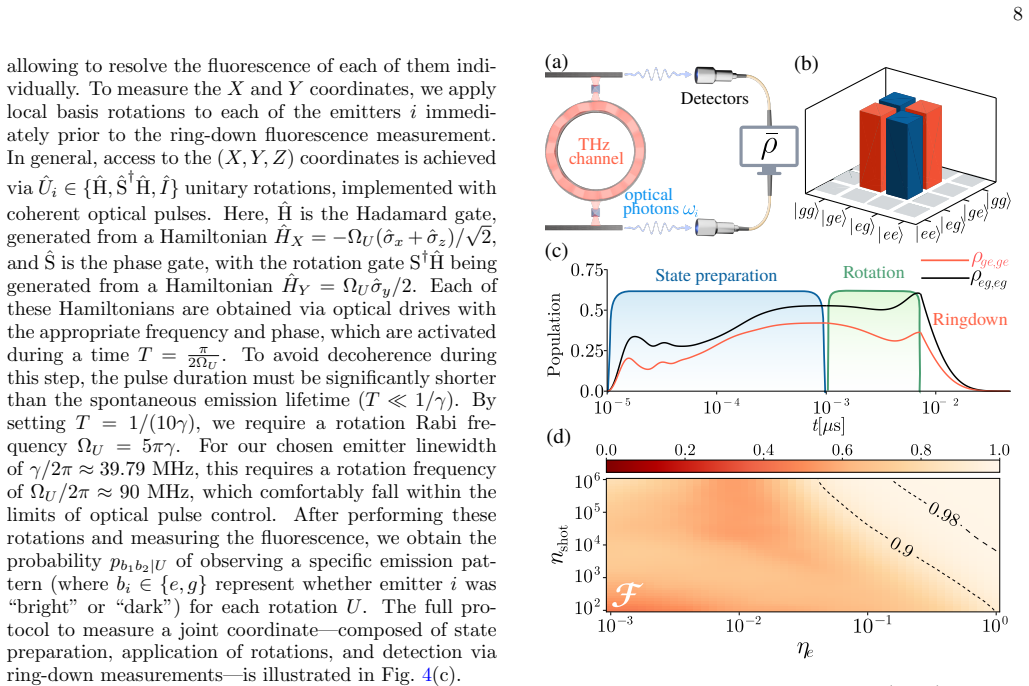
Practical implementation strategy We now translate the insights and conditions dis- cussed above into a fully optical experimental strategy for preparing and optimizing the entangled steady-state. This strategy consists of a sequence of steps based solely on tuning optical parameters guided by spectral measure- ments, as detailed below and illustrated in ...
-
[6]
Tinkham,Introduction to Superconductivity: Second Edition(Courier Corporation, 2004)
M. Tinkham,Introduction to Superconductivity: Second Edition(Courier Corporation, 2004)
2004
- [7]
-
[8]
Chremmos, O
I. Chremmos, O. Schwelb, and N. Uzunoglu, eds., Photonic Microresonator Research and Applications, Springer Series in Optical Sciences, Vol. 156 (Springer US, Boston, MA, 2010)
2010
-
[9]
K. J. Vahala, Optical microcavities, Nature424, 839 (2003)
2003
-
[10]
A. F. Koenderink, A. Al` u, and A. Polman, Nanopho- tonics: Shrinking light-based technology, Science348, 516 (2015)
2015
-
[11]
Asano, Y
T. Asano, Y. Ochi, Y. Takahashi, K. Kishimoto, and S. Noda, Photonic crystal nanocavity with a Q factor ex- ceeding eleven million, Optics Express25, 1769 (2017)
2017
-
[12]
Todorov, S
Y. Todorov, S. Dhillon, and J. Mangeney, THz quantum gap: Exploring potential approaches for generating and detecting non-classical states of THz light, Nanophoton- ics13, 1681 (2024)
2024
-
[13]
Buchwald, Programmatic perspectives with tech- nical examples for THz materials characterization, in Micro- and Nanotechnology Sensors, Systems, and Ap- plications III, Vol
W. Buchwald, Programmatic perspectives with tech- nical examples for THz materials characterization, in Micro- and Nanotechnology Sensors, Systems, and Ap- plications III, Vol. 8031 (SPIE, 2011) pp. 117–133
2011
-
[14]
Kawase, T
K. Kawase, T. Shibuya, S. Hayashi, and K. Suizu, THz imaging techniques for nondestructive inspec- tions, Comptes Rendus Physique Terahertz Electronic and Optoelectronic Components and Systems,11, 510 (2010)
2010
-
[15]
H. Guerboukha, K. Nallappan, and M. Skorobogatiy, Toward real-time terahertz imaging, Advances in Op- tics and Photonics, Vol. 10, Issue 4, pp. 843-938 10.1364/AOP.10.000843 (2018)
-
[16]
Son, Principle and applications of terahertz molec- ular imaging, Nanotechnology24, 214001 (2013)
J.-H. Son, Principle and applications of terahertz molec- ular imaging, Nanotechnology24, 214001 (2013)
2013
-
[17]
M. Koch, D. M. Mittleman, J. Ornik, and E. Castro- Camus, Terahertz time-domain spectroscopy, Nat Rev Methods Primers3, 48 (2023)
2023
-
[18]
J. Li, X. Deng, Y. Li, J. Hu, W. Miao, C. Lin, J. Jiang, and S. Shi, Terahertz Science and Technology in Astron- omy, Telecommunications, and Biophysics, Research8, 0586 (2025)
2025
-
[19]
R. M. Woodward, B. E. Cole, V. P. Wallace, R. J. Pye, D. D. Arnone, E. H. Linfield, and M. Pepper, Terahertz pulse imaging in reflection geometry of human skin can- cer and skin tissue, Physics in Medicine & Biology47, 3853 (2002)
2002
-
[20]
Tonouchi, Cutting-edge terahertz technology, Nature Photonics1, 97 (2007)
M. Tonouchi, Cutting-edge terahertz technology, Nature Photonics1, 97 (2007)
2007
-
[21]
Amini, F
T. Amini, F. Jahangiri, Z. Ameri, and M. A. Hemma- tian, A Review of Feasible Applications of THz Waves in Medical Diagnostics and Treatments, J Lasers Med Sci12, e92 (2021)
2021
-
[22]
Siegel, Terahertz technology, IEEE Transactions on Microwave Theory and Techniques50, 910 (2002)
P. Siegel, Terahertz technology, IEEE Transactions on Microwave Theory and Techniques50, 910 (2002)
2002
-
[23]
S. Kono, K. Koshino, Y. Tabuchi, A. Noguchi, and Y. Nakamura, Quantum non-demolition detection of an itinerant microwave photon, Nature Physics14, 546 (2018)
2018
-
[24]
Reiserer, S
A. Reiserer, S. Ritter, and G. Rempe, Nondestructive Detection of an Optical Photon, Science342, 1349 (2013)
2013
-
[25]
Blais, A
A. Blais, A. L. Grimsmo, S. M. Girvin, and A. Wallraff, Circuit quantum electrodynamics, Reviews of Modern Physics93, 025005 (2021)
2021
-
[26]
H. J. Manetsch, G. Nomura, E. Bataille, X. Lv, K. H. Leung, and M. Endres, A tweezer array with 6,100 highly coherent atomic qubits, Nature647, 60 (2025)
2025
-
[27]
Iles-Smith, M
J. Iles-Smith, M. K. Svendsen, A. Rubio, M. Wubs, and N. Stenger, On-demand heralded MIR single-photon source using a cascaded quantum system, Science Ad- vances11, eadr9239 (2025)
2025
- [28]
-
[29]
Martin-Cano, M
D. Martin-Cano, M. L. Nesterov, A. I. Fernandez- Dominguez, F. J. Garcia-Vidal, L. Martin-Moreno, and E. Moreno, Domino plasmons for subwavelength tera- hertz circuitry, Optics Express18, 754 (2010)
2010
-
[30]
W. Chen, P. Roelli, H. Hu, S. Verlekar, S. P. Amirtharaj, A. I. Barreda, T. J. Kippenberg, M. Kovylina, E. Verhagen, A. Mart´ ınez, and C. Gal- land, Continuous-wave frequency upconversion with a molecular optomechanical nanocavity, Science374, 1264 (2021)
2021
-
[31]
Chikkaraddy, R
R. Chikkaraddy, R. Arul, L. A. Jakob, and J. J. Baum- berg, Single-molecule mid-infrared spectroscopy and de- tection through vibrationally assisted luminescence, Na- ture Photonics17, 865 (2023)
2023
-
[32]
I. Y. Chestnov, V. A. Shahnazaryan, A. P. Alodjants, and I. A. Shelykh, Terahertz Lasing in Ensemble of Asymmetric Quantum Dots, ACS Photonics4, 2726 (2017). 13
2017
-
[33]
Groiseau, A
C. Groiseau, A. I. Fern´ andez-Dom´ ınguez, D. Mart´ ın- Cano, and C. S. Mu˜ noz, Single-Photon Source Over the Terahertz Regime, PRX Quantum5, 010312 (2024)
2024
-
[34]
M. S. Sherwin, A. Imamoglu, and T. Montroy, Quantum computation with quantum dots and terahertz cavity quantum electrodynamics, Physical Review A60, 3508 (1999)
1999
-
[35]
K. C. Lee, M. R. Sprague, B. J. Sussman, J. Nunn, N. K. Langford, X.-M. Jin, T. Champion, P. Michel- berger, K. F. Reim, D. England, D. Jaksch, and I. A. Walmsley, Entangling macroscopic diamonds at room temperature, Science334, 1253 (2011)
2011
-
[36]
Narla, S
A. Narla, S. Shankar, M. Hatridge, Z. Leghtas, K. M. Sliwa, E. Zalys-Geller, S. O. Mundhada, W. Pfaff, L. Frunzio, R. J. Schoelkopf, and M. H. Devoret, Ro- bust Concurrent Remote Entanglement Between Two Superconducting Qubits, Physical Review X6, 031036 (2016)
2016
-
[37]
H. J. Kimble, The quantum internet, Nature453, 1023 (2008)
2008
-
[38]
Pezz` e, A
L. Pezz` e, A. Smerzi, M. K. Oberthaler, R. Schmied, and P. Treutlein, Quantum metrology with nonclassical states of atomic ensembles, Reviews of Modern Physics 90, 035005 (2018)
2018
-
[39]
D. P. Divincenzo, Topics in Quantum Computers, in Mesoscopic Electron Transport, edited by L. L. Sohn, L. P. Kouwenhoven, and G. Sch¨ on (Springer Nether- lands, Dordrecht, 1997) pp. 657–677
1997
-
[40]
Srinivasa, J
V. Srinivasa, J. M. Taylor, and J. R. Petta, Cavity- Mediated Entanglement of Parametrically Driven Spin Qubits via Sidebands, PRX Quantum5, 020339 (2024)
2024
-
[41]
Kraus and J
B. Kraus and J. I. Cirac, Discrete Entanglement Dis- tribution with Squeezed Light, Physical Review Letters 92, 013602 (2004)
2004
-
[42]
Kraus, H
B. Kraus, H. P. B¨ uchler, S. Diehl, A. Kantian, A. Micheli, and P. Zoller, Preparation of entangled states by quantum Markov processes, Physical Review A78, 042307 (2008)
2008
-
[43]
Gonzalez-Tudela, D
A. Gonzalez-Tudela, D. Martin-Cano, E. Moreno, L. Martin-Moreno, C. Tejedor, and F. J. Garcia- Vidal, Entanglement of Two Qubits Mediated by One- Dimensional Plasmonic Waveguides, Physical Review Letters106, 020501 (2011)
2011
-
[44]
Krauter, C
H. Krauter, C. A. Muschik, K. Jensen, W. Wasilewski, J. M. Petersen, J. I. Cirac, and E. S. Polzik, Entangle- ment Generated by Dissipation and Steady State Entan- glement of Two Macroscopic Objects, Physical Review Letters107, 080503 (2011)
2011
-
[45]
C. A. Muschik, E. S. Polzik, and J. I. Cirac, Dissipa- tively driven entanglement of two macroscopic atomic ensembles, Physical Review A83, 052312 (2011)
2011
-
[46]
K. Stannigel, P. Rabl, and P. Zoller, Driven-dissipative preparation of entangled states in cascaded quantum- optical networks, New Journal of Physics14, 063014 (2012), arXiv:1112.1690 [quant-ph]
-
[47]
Pichler, T
H. Pichler, T. Ramos, A. J. Daley, and P. Zoller, Quan- tum optics of chiral spin networks, Physical Review A 91, 042116 (2015)
2015
-
[48]
Didier, J
N. Didier, J. Guillaud, S. Shankar, and M. Mirrahimi, Remote entanglement stabilization and concentration by quantum reservoir engineering, Physical Review A 98, 012329 (2018)
2018
-
[49]
J. You, Z. Liao, S.-W. Li, and M. S. Zubairy, Waveguide quantum electrodynamics in squeezed vacuum, Physical Review A97, 023810 (2018)
2018
-
[50]
L. C. G. Govia, A. Lingenfelter, and A. A. Clerk, Stabilizing two-qubit entanglement by mimicking a squeezed environment, Physical Review Research4, 023010 (2022)
2022
-
[51]
Agust´ ı, Y
J. Agust´ ı, Y. Minoguchi, J. M. Fink, and P. Rabl, Long- distance distribution of qubit-qubit entanglement using Gaussian-correlated photonic beams, Physical Review A105, 062454 (2022)
2022
-
[52]
P. M. Harrington, E. J. Mueller, and K. W. Murch, Engineered dissipation for quantum information science, Nature Reviews Physics4, 660 (2022)
2022
-
[53]
Agust´ ı, X
J. Agust´ ı, X. H. H. Zhang, Y. Minoguchi, and P. Rabl, Autonomous Distribution of Programmable Multiqubit Entanglement in a Dual-Rail Quantum Network, Phys- ical Review Letters131, 250801 (2023)
2023
-
[54]
Lingenfelter, M
A. Lingenfelter, M. Yao, A. Pocklington, Y.-X. Wang, A. Irfan, W. Pfaff, and A. A. Clerk, Exact Results for a Boundary-Driven Double Spin Chain and Resource- Efficient Remote Entanglement Stabilization, Physical Review X14, 021028 (2024)
2024
-
[55]
Vivas-Via˜ na, D
A. Vivas-Via˜ na, D. Mart´ ın-Cano, and C. S. Mu˜ noz, Dis- sipative stabilization of maximal entanglement between nonidentical emitters via two-photon excitation, Physi- cal Review Research6, 043051 (2024)
2024
-
[56]
Non-Markovian thermal reservoirs for autonomous entanglement distribution
J. Agust´ ı, C. M. F. Schneider, K. G. Fedorov, S. Filipp, and P. Rabl, Non-Markovian thermal reser- voirs for autonomous entanglement distribution (2025), arXiv:2506.20742 [quant-ph]
work page internal anchor Pith review Pith/arXiv arXiv 2025
- [57]
- [58]
-
[59]
Y. Lin, J. P. Gaebler, F. Reiter, T. R. Tan, R. Bowler, A. S. Sørensen, D. Leibfried, and D. J. Wineland, Dissi- pative production of a maximally entangled steady state of two quantum bits, Nature504, 415 (2013)
2013
-
[60]
Vakil and N
A. Vakil and N. Engheta, Transformation Optics Using Graphene, Science332, 1291 (2011)
2011
-
[61]
P. A. Huidobro, A. Y. Nikitin, C. Gonz´ alez-Ballestero, L. Mart´ ın-Moreno, and F. J. Garc´ ıa-Vidal, Superradi- ance mediated by graphene surface plasmons, Physical Review B85, 155438 (2012)
2012
-
[62]
I. G. Savenko, O. V. Kibis, and I. A. Shelykh, Asymmet- ric quantum dot in a microcavity as a nonlinear optical element, Physical Review A85, 053818 (2012)
2012
-
[63]
Shammah, C
N. Shammah, C. C. Phillips, and S. De Liberato, Tera- hertz emission from ac Stark-split asymmetric intersub- band transitions, Physical Review B89, 235309 (2014)
2014
-
[64]
De Liberato, Lasing from dressed dots, Nature Pho- tonics12, 4 (2018)
S. De Liberato, Lasing from dressed dots, Nature Pho- tonics12, 4 (2018)
2018
-
[65]
Pompe, M
R. Pompe, M. Hensen, M. Otten, S. K. Gray, and W. Pfeiffer, Pure dephasing induced single-photon para- metric down-conversion in a strongly coupled plasmon- exciton system, Physical Review B108, 115432 (2023)
2023
-
[66]
C. Groiseau, M. ´A. Mart´ ınez-Garc´ ıa, D. Mart´ ın-Cano, and C. S. Mu˜ noz, Deterministic single-photon source 14 over the terahertz regime (2025), arXiv:2509.26486 [quant-ph]
-
[67]
D. F. V. James, P. G. Kwiat, W. J. Munro, and A. G. White, Measurement of qubits, Physical Review A64, 052312 (2001)
2001
-
[68]
J. B. Altepeter, E. R. Jeffrey, and P. G. Kwiat, Photonic State Tomography, inAdvances In Atomic, Molecular, and Optical Physics, Vol. 52 (Academic Press, 2005) pp. 105–159
2005
-
[69]
Huang, R
H.-Y. Huang, R. Kueng, and J. Preskill, Predicting many properties of a quantum system from very few measurements, Nature Physics16, 1050 (2020)
2020
- [70]
-
[71]
S. Srinivasan, B. Pokharel, G. Quiroz, and B. Boots, Scalable Measurement Error Mitigation via Iterative Bayesian Unfolding (2022), arXiv:2210.12284 [quant- ph]
-
[72]
B. S. Williams, Terahertz quantum-cascade lasers, Na- ture Photonics1, 517 (2007)
2007
-
[73]
Walls and G
D. Walls and G. J. Milburn, eds.,Quantum Optics (Springer, Berlin, Heidelberg, 2008)
2008
-
[74]
Gonz´ alez-Tudela and J
A. Gonz´ alez-Tudela and J. I. Cirac, Markovian and non- Markovian dynamics of quantum emitters coupled to two-dimensional structured reservoirs, Physical Review A96, 043811 (2017)
2017
-
[75]
M. O. Scully and M. S. Zubairy,Quantum Optics(Cam- bridge University Press, Cambridge, 1997)
1997
-
[76]
Beaudoin, J
F. Beaudoin, J. M. Gambetta, and A. Blais, Dissipa- tion and ultrastrong coupling in circuit QED, Physical Review A84, 043832 (2011)
2011
-
[77]
Settineri, V
A. Settineri, V. Macr´ ı, A. Ridolfo, O. Di Stefano, A. F. Kockum, F. Nori, and S. Savasta, Dissipation and ther- mal noise in hybrid quantum systems in the ultrastrong- coupling regime, Physical Review A98, 053834 (2018)
2018
-
[78]
Breuer and F
H.-P. Breuer and F. Petruccione,The Theory of Open Quantum Systems(Oxford University Press, 2007)
2007
-
[79]
Mercurio, S
A. Mercurio, S. Abo, F. Mauceri, E. Russo, V. Macr` ı, A. Miranowicz, S. Savasta, and O. Di Stefano, Pure De- phasing of Light-Matter Systems in the Ultrastrong and Deep-Strong Coupling Regimes, Physical Review Let- ters130, 123601 (2023)
2023
-
[80]
Carmichael, An Open Systems Approach to Quan- tum Optics: Lectures Presented at the Universite Libre De Bruxelles, October 28 to November 4, 1991 (1993)
H. Carmichael, An Open Systems Approach to Quan- tum Optics: Lectures Presented at the Universite Libre De Bruxelles, October 28 to November 4, 1991 (1993)
1991
discussion (0)
Sign in with ORCID, Apple, or X to comment. Anyone can read and Pith papers without signing in.