Hardware-Aware Quantum Kernel Design Based on Graph Neural Networks
Pith reviewed 2026-05-19 07:56 UTC · model grok-4.3
The pith
Dual graph neural networks select quantum circuits that make effective kernels on noisy hardware.
A machine-rendered reading of the paper's core claim, the machinery that carries it, and where it could break.
Core claim
By representing candidate quantum circuits as directed acyclic graphs that encode gate operations, qubit interactions, and noise properties, a dual graph neural network predictor estimates probability of successful trials and kernel-target alignment. This surrogate evaluation identifies task-specific quantum kernels that balance hardware constraints and model expressivity, producing higher classification accuracy on benchmark datasets under realistic noise.
What carries the argument
dual graph neural network predictor that scores directed acyclic graph encodings of hardware-aware quantum circuits for PST and KTA
If this is right
- The chosen quantum kernels produce higher classification accuracy than existing baselines on Credit Card, MNIST-5, and FMNIST-4 datasets.
- Hardware constraints and model expressivity are balanced effectively under realistic noise conditions.
- Feature selection reduces input dimensionality while preserving compatibility with near-term devices.
- Surrogate metrics from the GNN reduce the need for exhaustive circuit execution during kernel selection.
Where Pith is reading between the lines
- The graph representation of circuits could be reused to optimize other near-term quantum algorithms that face similar connectivity and noise limits.
- Pairing the predictor with online hardware feedback loops might create adaptive kernel design systems that improve over multiple runs.
- If the GNN generalizes across devices, the same trained model might transfer to new quantum processors with only minor retraining.
Load-bearing premise
The dual GNN predictor, trained on simulated or limited hardware data, can accurately forecast probability of successful trials and kernel-target alignment for unseen circuits without requiring full execution on the target device.
What would settle it
Selecting the top kernels according to the GNN predictions and measuring their actual classification accuracy on physical NISQ hardware for the Credit Card, MNIST-5, or FMNIST-4 datasets would directly test whether the predicted performance gains hold.
Figures




read the original abstract
Quantum kernels hold significant promise for achieving computational advantages in quantum machine learning (QML), yet their effectiveness critically depends on the design of expressive and hardware-compatible feature maps, a challenge that is particularly pronounced on Noisy Intermediate-Scale Quantum (NISQ) devices with limited qubits, gate errors, and restricted connectivity. In this work, we propose a hardware-aware framework for automated quantum kernel design that integrates quantum device characteristics with learning-based evaluation. Specifically, candidate quantum circuits explored within the hardware-aware circuit space are represented as directed acyclic graphs (DAGs) encoding hardware-specific information such as gate operations, qubit interactions, and noise properties, while a dual graph neural network (GNN) predictor is employed to estimate key surrogate metrics, including probability of successful trials (PST) and kernel-target alignment (KTA), enabling efficient and accurate assessment of circuit fidelity and kernel performance to facilitate the identification of task-specific quantum kernels. Furthermore, feature selection is incorporated to reduce input dimensionality and ensure compatibility with near-term devices. Extensive experiments on multiple benchmark datasets, including Credit Card (CC), MNIST-5, and FMNIST-4, demonstrate that our method consistently outperforms existing baselines in classification accuracy, effectively balancing hardware constraints and model expressivity under realistic noise conditions. These results highlight the potential of combining hardware-aware design with deep learning techniques to advance practical quantum kernel methods and facilitate their deployment on near-term quantum hardware.
Editorial analysis
A structured set of objections, weighed in public.
Referee Report
Summary. The paper proposes a hardware-aware framework for automated quantum kernel design in QML. Candidate circuits are encoded as DAGs incorporating gate operations, qubit connectivity, and noise properties; a dual GNN surrogate then predicts PST and KTA to rank kernels without full hardware execution. Feature selection reduces dimensionality for NISQ compatibility. Experiments on Credit Card, MNIST-5, and FMNIST-4 datasets report consistent accuracy gains over baselines under realistic noise.
Significance. If the GNN surrogate generalizes reliably, the method would provide a practical route to hardware-compatible kernel selection, addressing a key bottleneck in deploying expressive quantum kernels on NISQ devices. The combination of graph-based circuit representation with learned performance predictors is a timely contribution to quantum machine learning.
major comments (2)
- [Results] Results section: the central claim of consistent outperformance on CC, MNIST-5, and FMNIST-4 lacks reported baseline accuracies, error bars, statistical significance tests, or details on how post-hoc feature selection was performed and validated. Without these, the empirical support for the hardware-aware mechanism cannot be fully assessed.
- [Method] Method / GNN predictor subsection: the dual GNN is trained on simulated or limited hardware data to forecast PST and KTA for unseen DAG-encoded circuits; no quantitative validation (e.g., prediction error on held-out hardware-aware circuits, ranking correlation with actual PST/KTA) is provided. This is load-bearing for the headline claim that selected kernels deliver the reported gains.
minor comments (2)
- [Introduction] Notation for PST and KTA should be defined at first use with explicit formulas or references to prior definitions.
- [Figures] Figure captions for circuit DAG examples should include the specific hardware noise model parameters used.
Simulated Author's Rebuttal
We thank the referee for the constructive feedback on our manuscript. The comments highlight important aspects of empirical rigor and validation that we will address in the revision to strengthen the presentation of our hardware-aware quantum kernel design framework.
read point-by-point responses
-
Referee: [Results] Results section: the central claim of consistent outperformance on CC, MNIST-5, and FMNIST-4 lacks reported baseline accuracies, error bars, statistical significance tests, or details on how post-hoc feature selection was performed and validated. Without these, the empirical support for the hardware-aware mechanism cannot be fully assessed.
Authors: We agree that the results section would benefit from explicit reporting of baseline accuracies, error bars, and statistical tests to allow full assessment of the claimed gains. In the revised manuscript we will add a comprehensive table listing mean accuracies and standard deviations (from repeated runs with different random seeds) for our method and all baselines on each dataset. We will also include p-values from paired t-tests or Wilcoxon tests to establish statistical significance. For the post-hoc feature selection, we will expand the description to specify the exact procedure (e.g., mutual information or recursive elimination), the validation strategy used to avoid overfitting, and any ablation results confirming its contribution. revision: yes
-
Referee: [Method] Method / GNN predictor subsection: the dual GNN is trained on simulated or limited hardware data to forecast PST and KTA for unseen DAG-encoded circuits; no quantitative validation (e.g., prediction error on held-out hardware-aware circuits, ranking correlation with actual PST/KTA) is provided. This is load-bearing for the headline claim that selected kernels deliver the reported gains.
Authors: We recognize that quantitative validation of the dual GNN surrogate is necessary to support its use for kernel selection. In the revision we will add a dedicated validation subsection (or appendix) reporting prediction performance on held-out circuits, including mean absolute error and root-mean-square error for both PST and KTA predictions, as well as Spearman rank correlation coefficients between predicted and ground-truth values. We will also clarify the data generation process (simulated noise models versus any limited hardware runs) and the train/test split to demonstrate generalization to unseen DAGs. revision: yes
Circularity Check
No significant circularity; derivation relies on trained surrogate and external benchmark validation.
full rationale
The paper trains a dual GNN on circuit DAGs (with hardware features) to predict PST and KTA as surrogates, then uses those predictions to select kernels before measuring classification accuracy on held-out benchmark datasets (CC, MNIST-5, FMNIST-4). This is a standard surrogate-model pipeline: the GNN parameters are fitted to training data, the selection step applies the fitted model to new circuits, and the headline accuracy numbers are obtained from actual kernel evaluations (or simulations) of the chosen circuits rather than being algebraically identical to the GNN outputs or to any fitted parameter inside the same equations. No self-citation chain is invoked to justify uniqueness or to close the loop, and the final performance metric is not redefined in terms of the surrogate predictions themselves. The framework is therefore self-contained against external benchmarks.
Axiom & Free-Parameter Ledger
free parameters (1)
- GNN training hyperparameters and feature-selection thresholds
axioms (1)
- domain assumption Graph representation of quantum circuits captures all hardware-specific information relevant to PST and KTA.
Lean theorems connected to this paper
-
IndisputableMonolith/Cost/FunctionalEquation.leanwashburn_uniqueness_aczel unclear?
unclearRelation between the paper passage and the cited Recognition theorem.
candidate quantum circuits ... represented as directed acyclic graphs (DAGs) encoding hardware-specific information such as gate operations, qubit interactions, and noise properties, while a dual graph neural network (GNN) predictor is employed to estimate ... PST and KTA
-
IndisputableMonolith/Foundation/RealityFromDistinction.leanreality_from_one_distinction unclear?
unclearRelation between the paper passage and the cited Recognition theorem.
Extensive experiments on ... Credit Card (CC), MNIST-5, and FMNIST-4 ... outperform existing baselines
What do these tags mean?
- matches
- The paper's claim is directly supported by a theorem in the formal canon.
- supports
- The theorem supports part of the paper's argument, but the paper may add assumptions or extra steps.
- extends
- The paper goes beyond the formal theorem; the theorem is a base layer rather than the whole result.
- uses
- The paper appears to rely on the theorem as machinery.
- contradicts
- The paper's claim conflicts with a theorem or certificate in the canon.
- unclear
- Pith found a possible connection, but the passage is too broad, indirect, or ambiguous to say the theorem truly supports the claim.
Forward citations
Cited by 2 Pith papers
-
Quantum Injection Pathways for Implicit Graph Neural Networks
Independent quantum signal injection into graph DEQs yields higher test accuracy and fewer solver iterations than state-dependent or backbone-dependent injection and classical equilibrium models on NCI1, PROTEINS, and...
-
Recent Advances in Quantum Architecture Search
A survey of core concepts, representative methodologies, applications, challenges, and future directions in Quantum Architecture Search for variational quantum algorithms.
Reference graph
Works this paper leans on
-
[1]
This selection aims to improve hardware efficiency and main- tain higher circuit fidelity
Subgraph selection in device topology Due to the non-negligible differences in noise levels across individual qubits and qubit couplings within quan- tum devices, we perform a selection process to identify a set of N qubits that are less affected by noise. This selection aims to improve hardware efficiency and main- tain higher circuit fidelity. Fig. 2 il...
-
[2]
This process ensures that the generated circuits are hardware-aware
Generating candidate circuits based on the subgraph After selecting a high-fidelity subgraph, denoted as G, we generate M candidate quantum circuits based on the structure of G and the set of quantum gates supported by the device, denoted as S. This process ensures that the generated circuits are hardware-aware. For example, as shown in Step 1 of Fig. 1, ...
-
[3]
During the candidate circuit generation process, we guide the selection of 2-qubit gate between different cou- pled qubits based on their gate errors. Specifically, the probability of inserting a 2-qubit gate between qubits qi and qj, denoted as P (qi, qj | ej), is defined as follows: P (qi, qj | ej) = 1/ejP j 1/ej (7) where the 2-qubit gate error ej corr...
-
[4]
Data embedding in circuits Inspired by the advantages of randomized data em- bedding over fixed embedding discussed in [7], we adopt a simple strategy for data embedding, as illustrated in Fig. 3: in each quantum circuit, a subset of parame- terized 1-qubit gates is randomly selected to embed the data, with each selected gate corresponding to one di- mens...
-
[5]
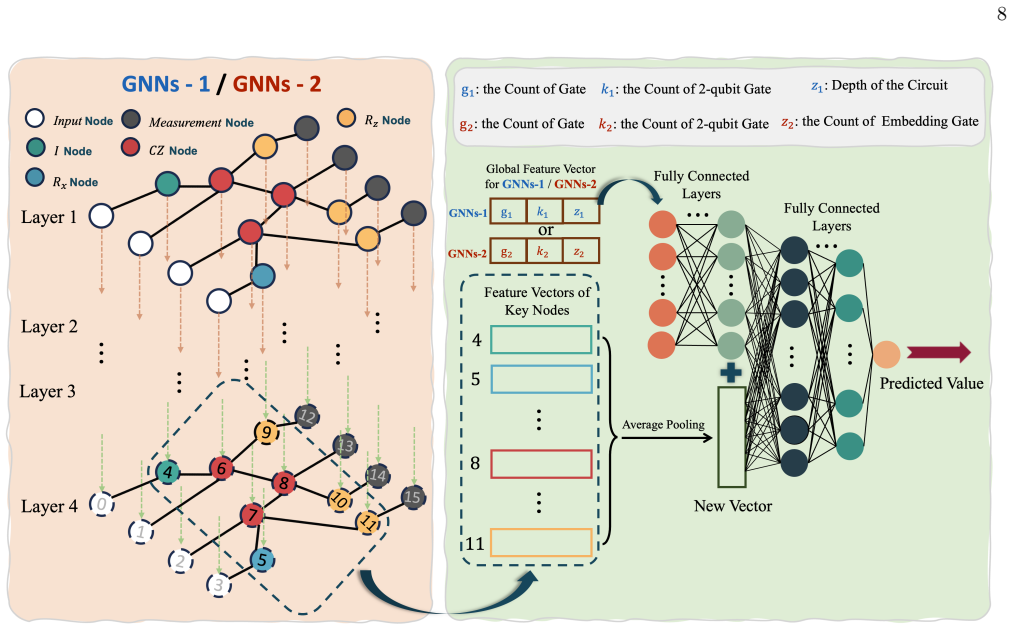
These two networks share an overall similar architec- ture but differ in certain details due to the differences in their prediction targets. In the following, we provide a detailed description of the GNNs construction process, covering the aspects of construction of the dataset, graph construction, node features, target values, and construc- tion of GNNs
-
[6]
Construction of the dataset The primary motivation for constructing GNNs predic- tors is to enable rapid predictions on a large set of can- didate circuits after training with only a small amount of data. To build the dataset for training the GNNs, we adopt a random sampling strategy: a subset of circuits is randomly selected from the previously generated...
-
[7]
Graph construction FIG. 4. The conversion of quantum circuit to graph structure. Motivated by the intuitive similarity between quantum circuits and graph structures, we represent quantum cir- cuits using directed acyclic graphs (DAGs). In this rep- resentation, each node corresponds to a qubit, a quan- tum gate, or a measurement operation, while the edges...
-
[8]
Node features For each node in the graph structure, we construct a feature vector to represent its associated properties. Fea- tures include index, node type, target qubit, tag, relax- ation time ( T1) and dephasing time ( T2) of the target qubits, gate error, and readout error. The specific node features for GNNs-1 and GNNs-2 are shown in Fig. 5. The fea...
-
[9]
Target values To evaluate the impact of noise on different quantum circuits, the concept of fidelity is introduced, which quan- tifies the closeness between two quantum states. In noisy quantum computations, fidelity is typically used to mea- sure the difference between the quantum state generated by a noisy circuit and that generated by a noiseless clas-...
-
[10]
The computed PST is used as the target label for training the GNNs-1 model. FIG. 6. The computation process of PST. GNNs-2 is designed to predict a metric known as Kernel-Target Alignment (KTA), which has been shown to be positively correlated with training accuracy. The relationship between KTA and training accuracy is ana- lyzed in [23], where KTA is va...
-
[11]
Construction of GNNs We design similar graph neural network (GNN) archi- tectures for GNNs-1 and GNNs-2, as illustrated in Fig
-
[12]
Both models adopt a four-layer structure, where each layer is followed by an attention mechanism. The in- corporation of attention allows the network to dynam- ically assign weights to edges during message passing, thereby enabling more effective capture of circuit charac- teristics. Between layers, LeakyReLU is used as the ac- tivation function. After gr...
-
[13]
While GNNs-1 and GNNs-2 share the same overall ar- chitecture, they differ in the composition of their global feature vector. Specifically, GNNs-1 takes as global fea- tures g1: the count of gate, k1: the count of 2-qubit gate, and z1: depth of the circuit. In contrast, GNNs-2 uses g2: the count of gate, k2: the count of 2-qubit gate, and z2: the count of...
work page 2000
-
[14]
Our HaQGNN method achieves the highest classifi- cation accuracy among all compared approaches, with particularly significant improvements observed on the larger 133-qubit IBM Torino device. This performance gain can be attributed to the hardware-aware nature of HaQGNN, which allows the method to generate quantum circuits that are adapted to the physical ...
-
[15]
R. P. Feynman, Simulating physics with computers, in Feynman and computation (cRc Press, 2018) pp. 133– 153
work page 2018
-
[16]
J. Biamonte, P. Wittek, N. Pancotti, P. Rebentrost, N. Wiebe, and S. Lloyd, Quantum machine learning, Na- ture 549, 195 (2017)
work page 2017
-
[17]
Preskill, Quantum computing in the nisq era and be- yond, Quantum 2, 79 (2018)
J. Preskill, Quantum computing in the nisq era and be- yond, Quantum 2, 79 (2018)
work page 2018
-
[18]
Classification with Quantum Neural Networks on Near Term Processors
E. Farhi and H. Neven, Classification with quantum neu- ral networks on near term processors, arXiv preprint arXiv:1802.06002 (2018)
work page internal anchor Pith review Pith/arXiv arXiv 2018
- [19]
- [20]
-
[21]
S. Anagolum, N. Alavisamani, P. Das, M. Qureshi, and Y. Shi, ´Eliv´ agar: Efficient quantum circuit search for classification, in Proceedings of the 29th ACM Inter- national Conference on Architectural Support for Pro- gramming Languages and Operating Systems, Volume 2 (2024) pp. 336–353
work page 2024
-
[22]
H. Wang, Y. Ding, J. Gu, Y. Lin, D. Z. Pan, F. T. Chong, and S. Han, Quantumnas: Noise-adaptive search for robust quantum circuits, in 2022 IEEE International Symposium on High-Performance Computer Architecture (HPCA) (IEEE, 2022) pp. 692–708
work page 2022
- [23]
-
[24]
M. Y. Niu, A. Zlokapa, M. Broughton, S. Boixo, M. Mohseni, V. Smelyanskyi, and H. Neven, Entangling quantum generative adversarial networks, Physical Re- view Letters 128, 220505 (2022)
work page 2022
-
[25]
M. S. Rudolph, N. B. Toussaint, A. Katabarwa, S. Johri, B. Peropadre, and A. Perdomo-Ortiz, Generation of high- resolution handwritten digits with an ion-trap quantum 14 (a) Rx gate errors of different qubits on IBM Torino (sorted in descending order) (b) Readout assignment errors of different qubits on IBM Torino (sorted in descending order) FIG. 13. Noi...
work page 2022
-
[26]
Zoufal, Generative quantum machine learning, arXiv preprint arXiv:2111.12738 (2021)
C. Zoufal, Generative quantum machine learning, arXiv preprint arXiv:2111.12738 (2021)
- [27]
-
[28]
Y. Liu, S. Arunachalam, and K. Temme, A rigorous and robust quantum speed-up in supervised machine learn- ing, Nature Physics 17, 1013 (2021)
work page 2021
-
[29]
M. Schuld and N. Killoran, Quantum machine learning in feature hilbert spaces, Physical review letters 122, 040504 (2019)
work page 2019
-
[30]
V. Havl´ ıˇ cek, A. D. C´ orcoles, K. Temme, A. W. Harrow, A. Kandala, J. M. Chow, and J. M. Gambetta, Super- vised learning with quantum-enhanced feature spaces, Nature 567, 209 (2019)
work page 2019
- [31]
-
[32]
J. Preskill, Quantum computing in the nisq era and be- yond, Bulletin of the American Physical Society 64, 9 (2019)
work page 2019
- [33]
- [34]
-
[35]
S. Wang, M. Cerezo, Z. Holmes, and T. Supanut, Ex- ponential concentration and untrainability in quantum kernel methods,
-
[36]
X. Wang, Y. Du, Y. Luo, and D. Tao, Towards under- standing the power of quantum kernels in the nisq era, Quantum 5, 531 (2021)
work page 2021
- [37]
-
[38]
T. Hubregtsen, D. Wierichs, E. Gil-Fuster, P.-J. H. Derks, P. K. Faehrmann, and J. J. Meyer, Training quan- tum embedding kernels on near-term quantum comput- ers, Physical Review A 106, 042431 (2022)
work page 2022
-
[39]
J. R. Glick, T. P. Gujarati, A. D. Corcoles, Y. Kim, A. Kandala, J. M. Gambetta, and K. Temme, Covariant quantum kernels for data with group structure, Nature Physics 20, 479 (2024)
work page 2024
-
[40]
G. Gentinetta, D. Sutter, C. Zoufal, B. Fuller, and S. Wo- erner, Quantum kernel alignment with stochastic gra- dient descent, in 2023 IEEE International Conference on Quantum Computing and Engineering (QCE) , Vol. 1 (IEEE, 2023) pp. 256–262
work page 2023
-
[41]
S. Altares-L´ opez, A. Ribeiro, and J. J. Garc´ ıa-Ripoll, Automatic design of quantum feature maps, Quantum Science and Technology 6, 045015 (2021)
work page 2021
-
[42]
R. Pellow-Jarman, A. Pillay, I. Sinayskiy, and F. Petruc- cione, Hybrid genetic optimization for quantum feature map design, Quantum Machine Intelligence 6, 45 (2024)
work page 2024
-
[43]
E. Torabian and R. V. Krems, Compositional optimiza- tion of quantum circuits for quantum kernels of support vector machines, Physical Review Research 5, 013211 (2023)
work page 2023
- [44]
-
[45]
H. Wang, Z. Liang, J. Gu, Z. Li, Y. Ding, W. Jiang, Y. Shi, D. Z. Pan, F. T. Chong, and S. Han, Torchquan- tum case study for robust quantum circuits, in Proceed- ings of the 41st IEEE/ACM International Conference on Computer-Aided Design , ICCAD ’22 (Association for Computing Machinery, New York, NY, USA, 2022)
work page 2022
- [46]
-
[47]
B. Khemani, S. Patil, K. Kotecha, and S. Tanwar, A review of graph neural networks: concepts, architectures, techniques, challenges, datasets, applications, and future directions, Journal of Big Data 11, 18 (2024)
work page 2024
-
[48]
Y. Zhang, Social network user profiling for anomaly de- tection based on graph neural networks, arXiv preprint arXiv:2503.19380 (2025)
-
[49]
Z. He, H. Chen, Y. Zhou, H. Situ, Y. Li, and L. Li, Self- supervised representation learning for bayesian quan- tum architecture search, Physical Review A 111, 032403 (2025)
work page 2025
- [50]
-
[51]
S. Chen, A. Wulamu, Q. Zou, H. Zheng, L. Wen, X. Guo, H. Chen, T. Zhang, and Y. Zhang, Md- gnn: A mechanism-data-driven graph neural network for molecular properties prediction and new material discov- ery, Journal of Molecular Graphics and Modelling 123, 108506 (2023)
work page 2023
-
[52]
Z. Shui and G. Karypis, Heterogeneous molecular graph neural networks for predicting molecule properties, in 2020 IEEE International Conference on Data Mining (ICDM) (IEEE, 2020) pp. 492–500
work page 2020
-
[53]
S. Wu, F. Sun, W. Zhang, X. Xie, and B. Cui, Graph neural networks in recommender systems: a survey, ACM Computing Surveys 55, 1 (2022)
work page 2022
-
[54]
C. Gao, X. Wang, X. He, and Y. Li, Graph neural net- works for recommender system, in Proceedings of the fif- teenth ACM international conference on web search and data mining (2022) pp. 1623–1625
work page 2022
-
[55]
A. S. Mahdi and N. M. Shati, A survey on fake news detection in social media using graph neural networks, Journal of Al-Qadisiyah for Computer Science and Math- ematics 16, 23 (2024)
work page 2024
-
[56]
H. Yang, Z. Li, and Y. Qi, Predicting traffic propagation flow in urban road network with multi-graph convolu- tional network, Complex & Intelligent Systems 10, 23 (2024)
work page 2024
-
[57]
R. Guan, Z. Li, W. Tu, J. Wang, Y. Liu, X. Li, C. Tang, and R. Feng, Contrastive multi-view subspace cluster- ing of hyperspectral images based on graph convolutional networks, IEEE Transactions on Geoscience and Remote Sensing (2024)
work page 2024
- [58]
-
[59]
C. Wang, Y. Wang, P. Ding, S. Li, X. Yu, and B. Yu, Ml-fgat: Identification of multi-label protein subcellu- lar localization by interpretable graph attention networks and feature-generative adversarial networks, Computers in Biology and Medicine 170, 107944 (2024)
work page 2024
-
[60]
N. Cristianini, J. Shawe-Taylor, A. Elisseeff, and J. Kan- dola, On kernel-target alignment, Advances in neural in- formation processing systems 14 (2001). 16
work page 2001
-
[61]
J. E. Camargo and F. A. Gonz´ alez, A multi-class kernel alignment method for image collection summarization, in Progress in Pattern Recognition, Image Analysis, Com- puter Vision, and Applications: 14th Iberoamerican Con- ference on Pattern Recognition, CIARP 2009, Guadala- jara, Jalisco, Mexico, November 15-18, 2009. Proceedings 14 (Springer, 2009) pp. 545–552
work page 2009
-
[62]
M. D. Buhmann, Radial basis functions, Acta numerica 9, 1 (2000)
work page 2000
-
[63]
O. Chapelle, P. Haffner, and V. N. Vapnik, Support vec- tor machines for histogram-based image classification, IEEE transactions on Neural Networks 10, 1055 (1999)
work page 1999
-
[64]
Y. Du, T. Huang, S. You, M.-H. Hsieh, and D. Tao, Quantum circuit architecture search for variational quan- tum algorithms, npj Quantum Information 8, 62 (2022)
work page 2022
-
[65]
S. Cantori, D. Vitali, and S. Pilati, Supervised learning of random quantum circuits via scalable neural networks, Quantum Science and Technology 8, 025022 (2023)
work page 2023
discussion (0)
Sign in with ORCID, Apple, or X to comment. Anyone can read and Pith papers without signing in.