SelvaBox: A high-resolution dataset for tropical tree crown detection
Pith reviewed 2026-05-19 06:43 UTC · model grok-4.3
The pith
SelvaBox supplies over 83,000 labeled tropical tree crowns from drone imagery to improve detection accuracy and enable zero-shot transfer to new forests.
A machine-rendered reading of the paper's core claim, the machinery that carries it, and where it could break.
Core claim
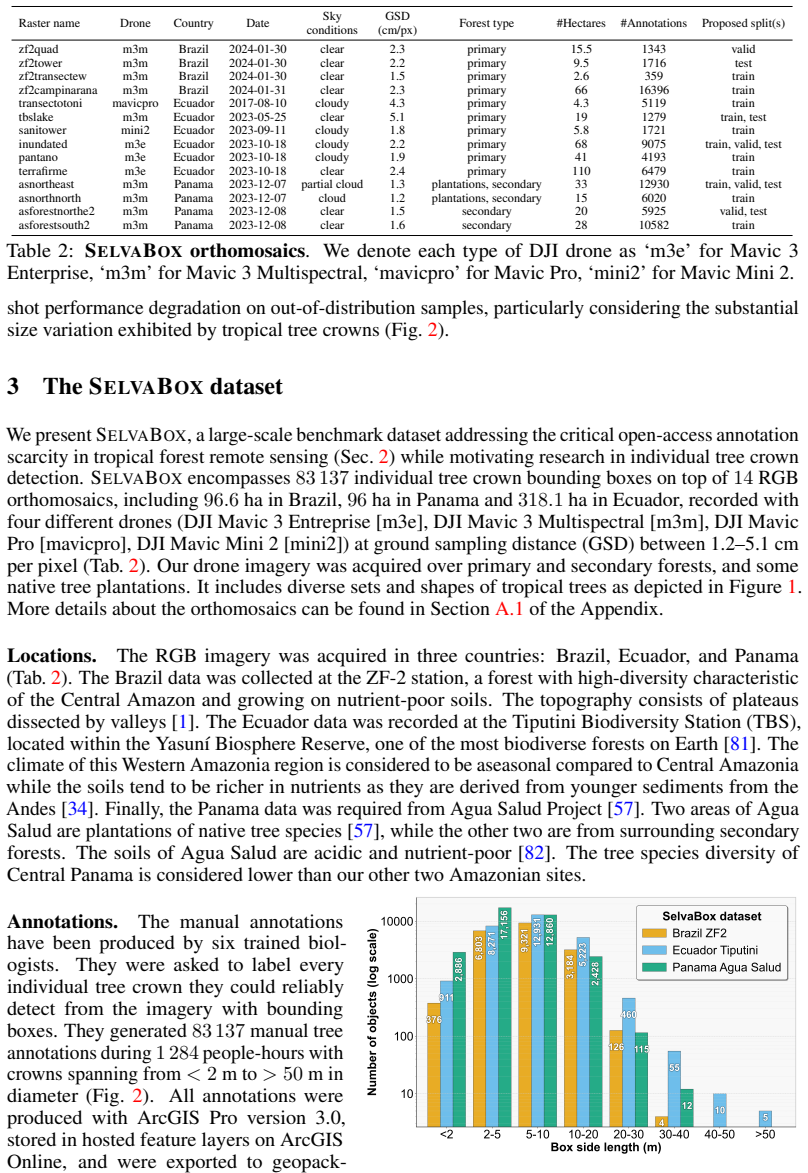
SelvaBox is a new collection of high-resolution drone images covering tropical forests in three countries and carrying manual annotations for more than 83,000 tree crowns. Benchmarks run on this collection establish that higher-resolution input images raise detection accuracy, and that models trained solely on SelvaBox match or exceed prior methods in zero-shot detection on entirely separate tropical crown datasets. A unified training scheme that combines SelvaBox with three other datasets at resolutions between 3 and 10 cm per pixel produces a single detector that places first or second on every evaluated dataset.
What carries the argument
The SelvaBox dataset of manually annotated high-resolution drone images containing more than 83,000 tropical tree crowns.
If this is right
- Higher-resolution drone imagery becomes a practical requirement for accurate crown detection in tropical settings.
- Zero-shot use of SelvaBox-trained models lowers the labeling effort needed for new forest sites.
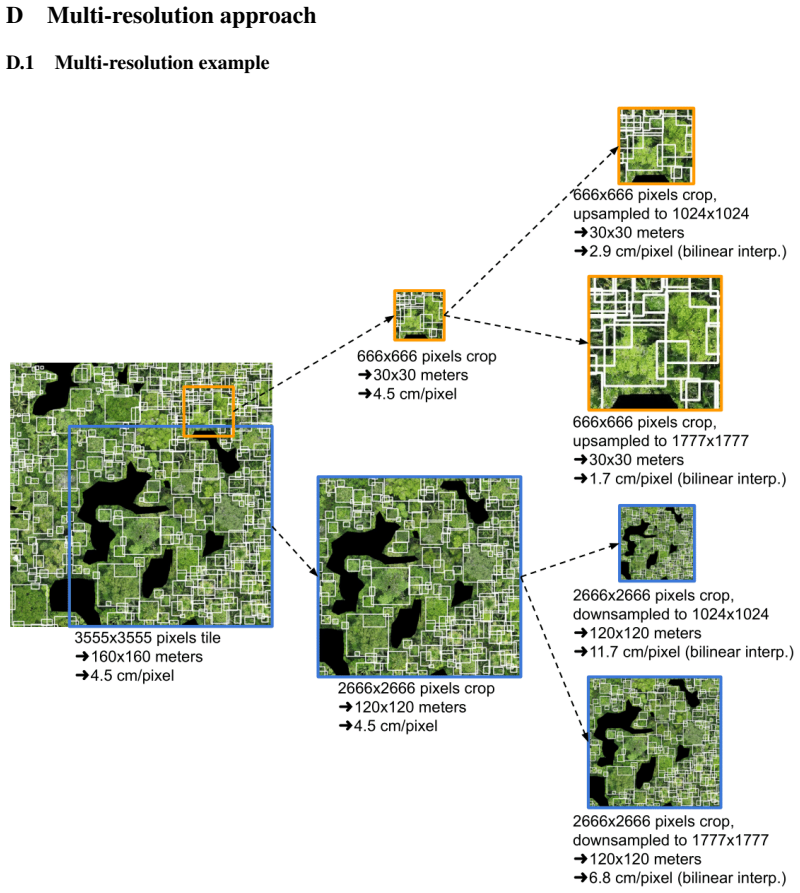
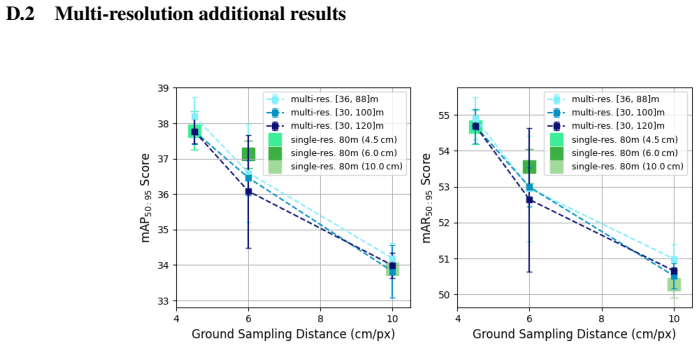
- A single multi-resolution training pipeline can unify data collected at different pixel scales and still deliver top performance.
- Better crown detectors support more precise tracking of forest structure changes driven by climate or human activity.
Where Pith is reading between the lines
- The dataset could support improved large-scale estimates of biomass or carbon storage once crown sizes are linked to tree volume models.
- Similar high-resolution labeling efforts in other ecosystems might reveal whether the resolution benefit holds outside the tropics.
- Public release of the data and weights allows rapid testing of whether newer detection architectures gain even more from the extra scale.
Load-bearing premise
The manual labeling process produces accurate and consistent ground-truth annotations across the 83,000 crowns.
What would settle it
An experiment showing that models trained exclusively on SelvaBox fall short of competing methods on new unseen tropical crown datasets, or that lower-resolution inputs produce equal or higher detection scores than higher-resolution inputs.
Figures





read the original abstract
Detecting individual tree crowns in tropical forests is essential to study these complex and crucial ecosystems impacted by human interventions and climate change. However, tropical crowns vary widely in size, structure, and pattern and are largely overlapping and intertwined, requiring advanced remote sensing methods applied to high-resolution imagery. Despite growing interest in tropical tree crown detection, annotated datasets remain scarce, hindering robust model development. We introduce SelvaBox, the largest open-access dataset for tropical tree crown detection in high-resolution drone imagery. It spans three countries and contains more than 83,000 manually labeled crowns - an order of magnitude larger than all previous tropical forest datasets combined. Extensive benchmarks on SelvaBox reveal two key findings: (1) higher-resolution inputs consistently boost detection accuracy; and (2) models trained exclusively on SelvaBox achieve competitive zero-shot detection performance on unseen tropical tree crown datasets, matching or exceeding competing methods. Furthermore, jointly training on SelvaBox and three other datasets at resolutions from 3 to 10 cm per pixel within a unified multi-resolution pipeline yields a detector ranking first or second across all evaluated datasets. Our dataset, code, and pre-trained weights are made public.
Editorial analysis
A structured set of objections, weighed in public.
Referee Report
Summary. The paper introduces SelvaBox, the largest open-access dataset for tropical tree crown detection, containing more than 83,000 manually labeled crowns from high-resolution drone imagery across three countries. Through benchmarks, it claims that higher-resolution inputs consistently improve detection accuracy, that models trained solely on SelvaBox achieve competitive zero-shot performance on unseen tropical datasets (matching or exceeding prior methods), and that joint multi-resolution training with other datasets produces a detector that ranks first or second across evaluations.
Significance. If the annotations prove reliable, SelvaBox would be a valuable resource addressing data scarcity in tropical remote sensing, enabling more robust models for ecological monitoring. The reported resolution scaling and zero-shot transfer results, if substantiated by rigorous validation, would provide actionable guidance for high-resolution aerial imagery applications in complex forest environments.
major comments (2)
- [Dataset description] Dataset creation and labeling section: No inter-annotator agreement, consistency metrics, expert validation subset, or label-noise analysis is reported for the 83,000 crowns. Since the paper explicitly notes that tropical crowns are 'largely overlapping and intertwined,' making boundary decisions subjective, this omission directly affects the reliability of all mAP scores, resolution-gain claims, and zero-shot generalization results.
- [Benchmarks and experiments] Experimental setup and results sections: The manuscript omits error bars, standard deviations across runs, exact train/test split ratios, and cross-validation details. Without these, the statistical significance of the 'consistent' accuracy boosts from higher resolution and the competitive zero-shot performance cannot be properly assessed.
minor comments (2)
- [Abstract] The abstract states that joint training uses 'resolutions from 3 to 10 cm per pixel' but does not name the three additional datasets or detail the unified multi-resolution pipeline architecture.
- [Results tables] Tables comparing SelvaBox-trained models to baselines would benefit from explicit column headers indicating whether results are zero-shot or fine-tuned.
Simulated Author's Rebuttal
We thank the referee for their constructive comments on our manuscript introducing SelvaBox. We address each major point below and describe the revisions that will be incorporated to strengthen the presentation of dataset quality and experimental rigor.
read point-by-point responses
-
Referee: [Dataset description] Dataset creation and labeling section: No inter-annotator agreement, consistency metrics, expert validation subset, or label-noise analysis is reported for the 83,000 crowns. Since the paper explicitly notes that tropical crowns are 'largely overlapping and intertwined,' making boundary decisions subjective, this omission directly affects the reliability of all mAP scores, resolution-gain claims, and zero-shot generalization results.
Authors: We agree that the subjective nature of delineating overlapping and intertwined tropical crowns, as stated in the manuscript, makes annotation quality assessment important. The original submission did not include these metrics. In the revised version we will add a dedicated paragraph in the Dataset creation and labeling section that reports inter-annotator agreement (mean IoU and percentage agreement) computed on a 500-image multi-annotator subset, together with a label-noise analysis that quantifies boundary variability. We will also describe the annotation protocol, including training of annotators and expert oversight, to support the reliability of the reported mAP, resolution-scaling, and zero-shot results. revision: yes
-
Referee: [Benchmarks and experiments] Experimental setup and results sections: The manuscript omits error bars, standard deviations across runs, exact train/test split ratios, and cross-validation details. Without these, the statistical significance of the 'consistent' accuracy boosts from higher resolution and the competitive zero-shot performance cannot be properly assessed.
Authors: We concur that additional statistical detail is needed to allow readers to evaluate the significance of the resolution and generalization findings. The revised manuscript will include error bars (standard deviation over five independent training runs with different random seeds) on all tables and figures in the Experimental setup and results sections. We will also state the precise train/test split ratios used for each benchmark and clarify whether any form of cross-validation was performed. These changes will make the strength of the higher-resolution accuracy gains and zero-shot competitiveness directly assessable. revision: yes
Circularity Check
No circularity: benchmarks use held-out and external test sets
full rationale
The paper introduces SelvaBox and reports empirical detection accuracies from standard train/test splits on its own data plus zero-shot transfer to completely separate external tropical crown datasets. These mAP numbers are computed against manual annotations on data the models were not trained on, rather than reducing by construction to any fitted parameter, self-definition, or self-citation chain. No equations, uniqueness theorems, or ansatzes are invoked that collapse the claimed results back into the inputs.
Axiom & Free-Parameter Ledger
axioms (1)
- domain assumption Manual annotations of tree crowns in drone imagery are accurate and consistent enough to serve as reliable ground truth for model evaluation.
Lean theorems connected to this paper
-
IndisputableMonolith/Foundation/RealityFromDistinction.leanreality_from_one_distinction unclear?
unclearRelation between the paper passage and the cited Recognition theorem.
Extensive benchmarks on SelvaBox reveal two key findings: (1) higher-resolution inputs consistently boost detection accuracy; and (2) models trained exclusively on SelvaBox achieve competitive zero-shot detection performance...
What do these tags mean?
- matches
- The paper's claim is directly supported by a theorem in the formal canon.
- supports
- The theorem supports part of the paper's argument, but the paper may add assumptions or extra steps.
- extends
- The paper goes beyond the formal theorem; the theorem is a base layer rather than the whole result.
- uses
- The paper appears to rely on the theorem as machinery.
- contradicts
- The paper's claim conflicts with a theorem or certificate in the canon.
- unclear
- Pith found a possible connection, but the passage is too broad, indirect, or ambiguous to say the theorem truly supports the claim.
Forward citations
Cited by 1 Pith paper
-
ResAF-Net: An Anchor-Free Attention-Based Network for Tree Detection and Agricultural Mapping in Palestine
ResAF-Net detects trees in satellite imagery for Palestinian agriculture, reaching 82% recall and 63% mAP@0.5 on the MillionTrees validation set and deployed in a web GIS.
Reference graph
Works this paper leans on
-
[1]
M. R. M. Amaral, A. J. N. Lima, F. G. Higuchi, J. dos Santos, and N. Higuchi. Dynamics of Tropical Forest Twenty-Five Years after Experimental Logging in Central Amazon Mature Forest. Forests, 10(2):89, Feb. 2019. 4
work page 2019
- [2]
-
[3]
J. Ball, T. Jackson, S. Hickman, and X. J. Koay. Crown data for "accurate delineation of individual tree crowns in tropical forests from aerial rgb imagery using mask r-cnn", Apr. 2023. 5
work page 2023
-
[4]
J. G. C. Ball, S. H. M. Hickman, T. D. Jackson, X. J. Koay, J. Hirst, W. Jay, M. Archer, M. Aubry-Kientz, G. Vincent, and D. A. Coomes. Accurate delineation of individual tree crowns in tropical forests from aerial RGB imagery using Mask R-CNN. Remote Sensing in Ecology and Conservation, 9(5):641–655, Oct. 2023. 2, 3, 5, 6
work page 2023
-
[5]
S. M. A. Bashir and Y . Wang. Small Object Detection in Remote Sensing Images with Residual Feature Aggregation-Based Super-Resolution and Object Detector Network. Remote Sensing, 13(9):1854, May 2021. Publisher: MDPI AG. 2
work page 2021
- [6]
- [7]
-
[8]
G. B. Bonan. Forests and Climate Change: Forcings, Feedbacks, and the Climate Benefits of Forests. Science, 320(5882):1444–1449, June 2008. 2
work page 2008
-
[9]
N. I. Bountos, A. Ouaknine, I. Papoutsis, and D. Rolnick. FoMo: Multi-Modal, Multi-Scale and Multi-Task Remote Sensing Foundation Models for Forest Monitoring. Proceedings of the AAAI Conference on Artificial Intelligence, 39(27):27858–27868, Apr. 2025. 2, 3
work page 2025
-
[10]
M. Brandt, C. J. Tucker, A. Kariryaa, K. Rasmussen, C. Abel, J. Small, J. Chave, L. V . Rasmussen, P. Hiernaux, A. A. Diouf, L. Kergoat, O. Mertz, C. Igel, F. Gieseke, J. Schöning, S. Li, K. Melocik, J. Meyer, S. Sinno, E. Romero, E. Glennie, A. Montagu, M. Dendoncker, and R. Fensholt. An unexpectedly large count of trees in the West African Sahara and Sa...
work page 2020
-
[11]
T. Brandtberg and F. Walter. Automated delineation of individual tree crowns in high spatial resolution aerial images by multiple-scale analysis.Machine Vision and Applications, 11(2):64– 73, Oct. 1998. 3
work page 1998
-
[12]
R. J. W. Brienen, O. L. Phillips, T. R. Feldpausch, E. Gloor, T. R. Baker, J. Lloyd, G. Lopez- Gonzalez, A. Monteagudo-Mendoza, Y . Malhi, S. L. Lewis, et al. Long-term decline of the Amazon carbon sink. Nature, 519(7543):344–348, Mar. 2015. 2 10
work page 2015
- [13]
-
[14]
M. Cloutier, M. Germain, and E. Laliberté. Quebec trees dataset, Sept. 2023. 5
work page 2023
-
[15]
M. Cloutier, M. Germain, and E. Laliberté. Influence of temperate forest autumn leaf phenology on segmentation of tree species from UA V imagery using deep learning.Remote Sensing of Environment, 311:114283, Sept. 2024. 2, 3, 5
work page 2024
-
[16]
D. S. Culvenor. TIDA: an algorithm for the delineation of tree crowns in high spatial resolution remotely sensed imagery. Computers & Geosciences, 28(1):33–44, Feb. 2002. 3
work page 2002
-
[17]
S. J. Davies, I. Abiem, K. Abu Salim, S. Aguilar, D. Allen, A. Alonso, K. Anderson-Teixeira, A. Andrade, G. Arellano, et al. ForestGEO: Understanding forest diversity and dynamics through a global observatory network. Biological Conservation, 253:108907, Jan. 2021. 2
work page 2021
-
[18]
R. A. F. de Lima, O. L. Phillips, A. Duque, J. S. Tello, S. J. Davies, A. A. de Oliveira, S. Muller, E. N. Honorio Coronado, E. Vilanova, A. Cuni-Sanchez, T. R. Baker, C. M. Ryan, A. Malizia, S. L. Lewis, H. ter Steege, J. Ferreira, B. S. Marimon, H. T. Luu, G. Imani, L. Arroyo, C. Blundo, D. Kenfack, M. N. Sainge, B. Sonké, and R. Vásquez. Making forest ...
work page 2022
-
[19]
M. Erikson. Species classification of individually segmented tree crowns in high-resolution aerial images using radiometric and morphologic image measures. Remote Sensing of Environ- ment, 91(3-4):469–477, June 2004. 3
work page 2004
-
[20]
A. Esquivel-Muelbert, T. R. Baker, K. G. Dexter, S. L. Lewis, R. J. W. Brienen, T. R. Feld- pausch, J. Lloyd, A. Monteagudo-Mendoza, L. Arroyo, Álvarez-Dávila, et al. Compositional response of Amazon forests to climate change. Global Change Biology, 25(1):39–56, 2019. 2
work page 2019
- [21]
-
[22]
H. Fu, H. Zhao, J. Jiang, Y . Zhang, G. Liu, W. Xiao, S. Du, W. Guo, and X. Liu. Automatic detection tree crown and height using Mask R-CNN based on unmanned aerial vehicles images for biomass mapping. Forest Ecology and Management, 555:121712, Mar. 2024. 3
work page 2024
-
[23]
J. R. G. Braga, V . Peripato, R. Dalagnol, M. P. Ferreira, Y . Tarabalka, L. E. O. C. Aragão, H. F. De Campos Velho, E. H. Shiguemori, and F. H. Wagner. Tree Crown Delineation Algorithm Based on a Convolutional Neural Network. Remote Sensing, 12(8):1288, Apr. 2020. 3
work page 2020
-
[24]
N. C. Galuszynski, R. Duker, A. J. Potts, and T. Kattenborn. Automated mapping of Por- tulacaria afra canopies for restoration monitoring with convolutional neural networks and heterogeneous unmanned aerial vehicle imagery. PeerJ, 10:e14219, Oct. 2022. 3
work page 2022
-
[25]
Y . Gan, Q. Wang, and A. Iio. Tree Crown Detection and Delineation in a Temperate Decid- uous Forest from UA V RGB Imagery Using Deep Learning Approaches: Effects of Spatial Resolution and Species Characteristics. Remote Sensing, 15(3):778, Jan. 2023. 3
work page 2023
-
[26]
R. C. Gatti, P. B. Reich, J. G. P. Gamarra, T. Crowther, C. Hui, A. Morera, J.-F. Bastin, S. de-Miguel, G.-J. Nabuurs, J.-C. Svenning, J. M. Serra-Diaz, et al. The number of tree species on Earth. Proceedings of the National Academy of Sciences, 119(6):e2115329119, Feb
-
[27]
C. Gaydon and F. Roche. PureForest: A Large-Scale Aerial Lidar and Aerial Imagery Dataset for Tree Species Classification in Monospecific Forests. In Proceedings of the Winter Conference on Applications of Computer Vision (WACV), pages 5895–5904, Feb. 2025. 2
work page 2025
-
[28]
F. A. Gougeon. A Crown-Following Approach to the Automatic Delineation of Individual Tree Crowns in High Spatial Resolution Aerial Images. Canadian Journal of Remote Sensing, 21(3):274–284, Aug. 1995. 3 11
work page 1995
-
[29]
Z. Hao, L. Lin, C. J. Post, E. A. Mikhailova, M. Li, Y . Chen, K. Yu, and J. Liu. Automated tree- crown and height detection in a young forest plantation using mask region-based convolutional neural network (Mask R-CNN). ISPRS Journal of Photogrammetry and Remote Sensing , 178:112–123, Aug. 2021. 3
work page 2021
-
[30]
N. L. Harris, D. A. Gibbs, A. Baccini, R. A. Birdsey, S. De Bruin, M. Farina, L. Fatoyinbo, M. C. Hansen, M. Herold, R. A. Houghton, P. V . Potapov, D. R. Suarez, R. M. Roman-Cuesta, S. S. Saatchi, C. M. Slay, S. A. Turubanova, and A. Tyukavina. Global maps of twenty-first century forest carbon fluxes. Nature Climate Change, 11(3):234–240, Mar. 2021. 2
work page 2021
-
[31]
K. He, G. Gkioxari, P. Dollar, and R. Girshick. Mask R-CNN. In 2017 IEEE International Conference on Computer Vision (ICCV), pages 2980–2988, Venice, Oct. 2017. IEEE. 3
work page 2017
-
[32]
K. He, X. Zhang, S. Ren, and J. Sun. Deep Residual Learning for Image Recognition. In Proceedings of 2016 IEEE Conference on Computer Vision and Pattern Recognition, CVPR ’16, pages 770–778. IEEE, June 2016. 6
work page 2016
-
[33]
J. Henrich, J. v. Delden, D. Seidel, T. Kneib, and A. Ecker. TreeLearn: A deep learning method for segmenting individual trees from ground-based LiDAR forest point clouds. Ecological Informatics, 84:102888, Dec. 2024. arXiv:2309.08471 [cs]. 2
-
[34]
C. Hoorn, F. P. Wesselingh, H. ter Steege, M. A. Bermudez, A. Mora, J. Sevink, I. Sanmartin, A. Sanchez-Meseguer, C. L. Anderson, J. P. Figueiredo, C. Jaramillo, D. Riff, F. R. Negri, H. Hooghiemstra, J. Lundberg, T. Stadler, T. Sarkinen, and A. Antonelli. Amazonia Through Time: Andean Uplift, Climate Change, Landscape Evolution, and Biodiversity. Science...
work page 2010
- [35]
-
[36]
T. Kattenborn, J. Eichel, S. Wiser, L. Burrows, F. E. Fassnacht, and S. Schmidtlein. Convolu- tional Neural Networks accurately predict cover fractions of plant species and communities in Unmanned Aerial Vehicle imagery. Remote Sensing in Ecology and Conservation, 6(4):472– 486, Dec. 2020. 3
work page 2020
-
[37]
T. Kattenborn, J. Leitloff, F. Schiefer, and S. Hinz. Review on Convolutional Neural Networks (CNN) in vegetation remote sensing. ISPRS Journal of Photogrammetry and Remote Sensing, 173:24–49, Mar. 2021. 3
work page 2021
-
[38]
T. Kattenborn, J. Lopatin, M. Förster, A. C. Braun, and F. E. Fassnacht. UA V data as alternative to field sampling to map woody invasive species based on combined Sentinel-1 and Sentinel-2 data. Remote Sensing of Environment, 227:61–73, June 2019. 3
work page 2019
-
[39]
T. Kattenborn, F. Schiefer, J. Frey, H. Feilhauer, M. D. Mahecha, and C. F. Dormann. Spatially autocorrelated training and validation samples inflate performance assessment of convolutional neural networks. ISPRS Open Journal of Photogrammetry and Remote Sensing, 5:100018,
- [40]
-
[41]
A. Kirillov, E. Mintun, N. Ravi, H. Mao, C. Rolland, L. Gustafson, T. Xiao, S. Whitehead, A. C. Berg, W.-Y . Lo, P. Dollár, and R. Girshick. Segment Anything, Apr. 2023. arXiv:2304.02643 [cs]. 3
work page internal anchor Pith review Pith/arXiv arXiv 2023
-
[42]
N. Lang, W. Jetz, K. Schindler, and J. D. Wegner. A high-resolution canopy height model of the Earth. Nature Ecology & Evolution, 7(11):1778–1789, Sept. 2023. 2
work page 2023
-
[43]
I. Lefebvre and E. Laliberté. UA V LiDAR, UA V Imagery, Tree Segmentations and Ground Mesurements for Estimating Tree Biomass in Canadian (Quebec) Plantations, July 2024. 3, 5 12
work page 2024
-
[44]
F. Li, H. Zhang, S. Liu, J. Guo, L. M. Ni, and L. Zhang. Dn-detr: Accelerate detr training by introducing query denoising. In Proceedings of the IEEE/CVF Conference on Computer Vision and Pattern Recognition, pages 13619–13627, 2022. 3
work page 2022
-
[45]
F. Li, H. Zhang, H. Xu, S. Liu, L. Zhang, L. M. Ni, and H.-Y . Shum. Mask DINO: Towards a Unified Transformer-Based Framework for Object Detection and Segmentation. InProceedings of the IEEE/CVF Conference on Computer Vision and Pattern Recognition (CVPR), pages 3041–3050, June 2023. 3
work page 2023
-
[46]
W. Li, H. Fu, L. Yu, and A. Cracknell. Deep Learning Based Oil Palm Tree Detection and Counting for High-Resolution Remote Sensing Images. Remote Sensing, 9(1):22, Dec. 2016. 3
work page 2016
-
[47]
Y . Li, Q. Huang, X. Pei, Y . Chen, L. Jiao, and R. Shang. Cross-Layer Attention Network for Small Object Detection in Remote Sensing Imagery. IEEE Journal of Selected Topics in Applied Earth Observations and Remote Sensing, 14:2148–2161, 2021. Publisher: Institute of Electrical and Electronics Engineers (IEEE). 2
work page 2021
-
[48]
T.-Y . Lin, P. Goyal, R. Girshick, K. He, and P. Dollar. Focal Loss for Dense Object Detection. In 2017 IEEE International Conference on Computer Vision (ICCV), pages 2999–3007, Venice, Oct. 2017. IEEE. 3
work page 2017
-
[49]
T.-Y . Lin, M. Maire, S. Belongie, J. Hays, P. Perona, D. Ramanan, P. Dollár, and C. L. Zitnick. Microsoft coco: Common objects in context. In D. Fleet, T. Pajdla, B. Schiele, and T. Tuytelaars, editors, Computer Vision – ECCV 2014, pages 740–755, Cham, 2014. Springer International Publishing. 5
work page 2014
-
[50]
M. Liu, T. Yu, X. Gu, Z. Sun, J. Yang, Z. Zhang, X. Mi, W. Cao, and J. Li. The Impact of Spatial Resolution on the Classification of Vegetation Types in Highly Fragmented Planting Areas Based on Unmanned Aerial Vehicle Hyperspectral Images. Remote Sensing, 12(1):146, Jan. 2020. 3
work page 2020
-
[51]
S. Liu, F. Li, H. Zhang, X. Yang, X. Qi, H. Su, J. Zhu, and L. Zhang. DAB-DETR: Dy- namic Anchor Boxes are Better Queries for DETR. In International Conference on Learning Representations, 2022. 3
work page 2022
-
[52]
Y . Liu, H. You, X. Tang, Q. You, Y . Huang, and J. Chen. Study on Individual Tree Segmentation of Different Tree Species Using Different Segmentation Algorithms Based on 3D UA V Data. Forests, 14(7):1327, June 2023. Publisher: MDPI AG. 2
work page 2023
-
[53]
Z. Liu, H. Hu, Y . Lin, Z. Yao, Z. Xie, Y . Wei, J. Ning, Y . Cao, Z. Zhang, L. Dong, F. Wei, and B. Guo. Swin Transformer V2: Scaling Up Capacity and Resolution. In 2022 IEEE/CVF Conference on Computer Vision and Pattern Recognition (CVPR), pages 11999–12009, 2022. 2
work page 2022
-
[54]
Z. Liu, Y . Lin, Y . Cao, H. Hu, Y . Wei, Z. Zhang, S. Lin, and B. Guo. Swin Transformer: Hierarchical Vision Transformer using Shifted Windows. In 2021 IEEE/CVF International Conference on Computer Vision (ICCV), pages 9992–10002, 2021. 2, 6
work page 2021
-
[55]
J. A. Lutz, T. J. Furniss, D. J. Johnson, S. J. Davies, D. Allen, A. Alonso, K. J. Anderson- Teixeira, A. Andrade, J. Baltzer, Becker, et al. Global importance of large-diameter trees. Global Ecology and Biogeography, 27(7):849–864, 2018. 2
work page 2018
-
[56]
Z. Ma, Y . Dong, J. Zi, F. Xu, and F. Chen. Forest-PointNet: A Deep Learning Model for Vertical Structure Segmentation in Complex Forest Scenes. Remote Sensing, 15(19):4793, Sept. 2023. Publisher: MDPI AG. 2
work page 2023
-
[57]
C. Mayoral, M. van Breugel, A. Cerezo, and J. S. Hall. Survival and growth of five Neotropical timber species in monocultures and mixtures. Forest Ecology and Management, 403:1–11, Nov. 2017. 4 13
work page 2017
-
[58]
C. Mosig, J. Vajna-Jehle, M. D. Mahecha, Y . Cheng, H. Hartmann, D. Montero, S. Junttila, S. Horion, S. Adu-Bredu, D. Al-Halbouni, M. Allen, J. Altman, et al. deadtrees.earth - An Open-Access and Interactive Database for Centimeter-Scale Aerial Imagery to Uncover Global Tree Mortality Dynamics, Oct. 2024. 3
work page 2024
-
[59]
R. Näsi, E. Honkavaara, P. Lyytikäinen-Saarenmaa, M. Blomqvist, P. Litkey, T. Hakala, N. Vil- janen, T. Kantola, T. Tanhuanpää, and M. Holopainen. Using UA V-Based Photogrammetry and Hyperspectral Imaging for Mapping Bark Beetle Damage at Tree-Level. Remote Sensing, 7(11):15467–15493, Nov. 2015. 3
work page 2015
-
[60]
M. Onishi and T. Ise. Explainable identification and mapping of trees using UA V RGB image and deep learning. Scientific Reports, 11(1):903, Jan. 2021. 3
work page 2021
-
[61]
M. Oquab, T. Darcet, T. Moutakanni, H. V . V o, M. Szafraniec, V . Khalidov, P. Fernandez, D. HAZIZA, F. Massa, A. El-Nouby, M. Assran, N. Ballas, W. Galuba, R. Howes, P.-Y . Huang, S.-W. Li, I. Misra, M. Rabbat, V . Sharma, G. Synnaeve, H. Xu, H. Jegou, J. Mairal, P. Labatut, A. Joulin, and P. Bojanowski. DINOv2: Learning Robust Visual Features without S...
work page 2024
-
[62]
A. Ouaknine, T. Kattenborn, E. Laliberté, and D. Rolnick. OpenForest: a data catalog for machine learning in forest monitoring. Environmental Data Science, 4:e15, 2025. 2, 3
work page 2025
-
[63]
Y . Pan, R. A. Birdsey, J. Fang, R. Houghton, P. E. Kauppi, W. A. Kurz, O. L. Phillips, A. Shvidenko, S. L. Lewis, J. G. Canadell, P. Ciais, R. B. Jackson, S. W. Pacala, A. D. McGuire, S. Piao, A. Rautiainen, S. Sitch, and D. Hayes. A Large and Persistent Carbon Sink in the World’s Forests.Science, 333(6045):988–993, Aug. 2011. Publisher: American Associa...
work page 2011
-
[64]
S. Puliti, E. R. Lines, J. Müllerová, J. Frey, Z. Schindler, A. Straker, M. J. Allen, L. Winiwarter, N. Rehush, H. Hristova, B. Murray, K. Calders, N. Coops, B. Höfle, L. Irwin, et al. Bench- marking tree species classification from proximally sensed laser scanning data: Introducing the for-species20k dataset. Methods in Ecology and Evolution , 16(4):801–...
work page 2025
- [65]
- [66]
-
[67]
C. J. Reed, R. Gupta, S. Li, S. Brockman, C. Funk, B. Clipp, K. Keutzer, S. Candido, M. Uyt- tendaele, and T. Darrell. Scale-MAE: A Scale-Aware Masked Autoencoder for Multiscale Geospatial Representation Learning. In Proceedings of the IEEE/CVF International Confer- ence on Computer Vision (ICCV), pages 4088–4099, Oct. 2023. 3
work page 2023
-
[68]
G. Reiersen, D. Dao, B. Lütjens, K. Klemmer, K. Amara, A. Steinegger, C. Zhang, and X. Zhu. ReforesTree: A Dataset for Estimating Tropical Forest Carbon Stock with Deep Learning and Aerial Imagery. Proceedings of the AAAI Conference on Artificial Intelligence, 36(11):12119–12125, June 2022. 2, 3, 5
work page 2022
-
[69]
S. Ren, K. He, R. Girshick, and J. Sun. Faster R-CNN: towards real-time object detection with region proposal networks. In Proceedings of the 29th International Conference on Neural Information Processing Systems - Volume 1, NIPS’15, pages 91–99, Cambridge, MA, USA,
- [70]
-
[71]
S. Ren, K. He, R. Girshick, and J. Sun. Faster r-cnn: Towards real-time object detection with region proposal networks. In C. Cortes, N. Lawrence, D. Lee, M. Sugiyama, and R. Garnett, editors, Advances in Neural Information Processing Systems, volume 28. Curran Associates, Inc., 2015. 6 14
work page 2015
-
[72]
T. Ren, S. Liu, F. Li, H. Zhang, A. Zeng, J. Yang, X. Liao, D. Jia, H. Li, H. Cao, J. Wang, Z. Zeng, X. Qi, Y . Yuan, J. Yang, and L. Zhang. detrex: Benchmarking detection transformers,
-
[73]
D. Rolnick, A. Aspuru-Guzik, S. Beery, B. Dilkina, P. L. Donti, M. Ghassemi, H. Kerner, C. Monteleoni, E. Rolf, M. Tambe, and A. White. Position: Application-Driven Innovation in Machine Learning. In R. Salakhutdinov, Z. Kolter, K. Heller, A. Weller, N. Oliver, J. Scarlett, and F. Berkenkamp, editors, Proceedings of the 41st International Conference on Ma...
work page 2024
-
[74]
A. A. D. Santos, J. Marcato Junior, M. S. Araújo, D. R. Di Martini, E. C. Tetila, H. L. Siqueira, C. Aoki, A. Eltner, E. T. Matsubara, H. Pistori, R. Q. Feitosa, V . Liesenberg, and W. N. Gonçalves. Assessment of CNN-Based Methods for Individual Tree Detection on Images Captured by RGB Cameras Attached to UA Vs.Sensors, 19(16):3595, Aug. 2019. 3
work page 2019
-
[75]
F. Schiefer, T. Kattenborn, A. Frick, J. Frey, P. Schall, B. Koch, and S. Schmidtlein. Mapping forest tree species in high resolution UA V-based RGB-imagery by means of convolutional neural networks. ISPRS Journal of Photogrammetry and Remote Sensing, 170:205–215, Dec
-
[76]
R. Solovyev, W. Wang, and T. Gabruseva. Weighted boxes fusion: Ensembling boxes from different object detection models. Image and Vision Computing, 107:104117, 2021. 9
work page 2021
- [77]
-
[78]
J. Tolan, H.-I. Yang, B. Nosarzewski, G. Couairon, H. V . V o, J. Brandt, J. Spore, S. Majumdar, D. Haziza, J. Vamaraju, T. Moutakanni, P. Bojanowski, T. Johns, B. White, T. Tiecke, and C. Couprie. Very high resolution canopy height maps from RGB imagery using self-supervised vision transformer and convolutional decoder trained on aerial lidar. Remote Sen...
work page 2024
-
[79]
H. Touvron, M. Cord, M. Douze, F. Massa, A. Sablayrolles, and H. Jegou. Training data- efficient image transformers & distillation through attention. In M. Meila and T. Zhang, editors, Proceedings of the 38th International Conference on Machine Learning, volume 139 of Proceedings of Machine Learning Research, pages 10347–10357. PMLR, July 2021. 3
work page 2021
- [80]
discussion (0)
Sign in with ORCID, Apple, or X to comment. Anyone can read and Pith papers without signing in.