Thermochemical models of outer core convection with heterogeneous core-mantle boundary heat flux
Pith reviewed 2026-05-19 06:11 UTC · model grok-4.3
The pith
Outer core convection models with heterogeneous CMB heat flux produce diverse local and global stable regions.
A machine-rendered reading of the paper's core claim, the machinery that carries it, and where it could break.
Core claim
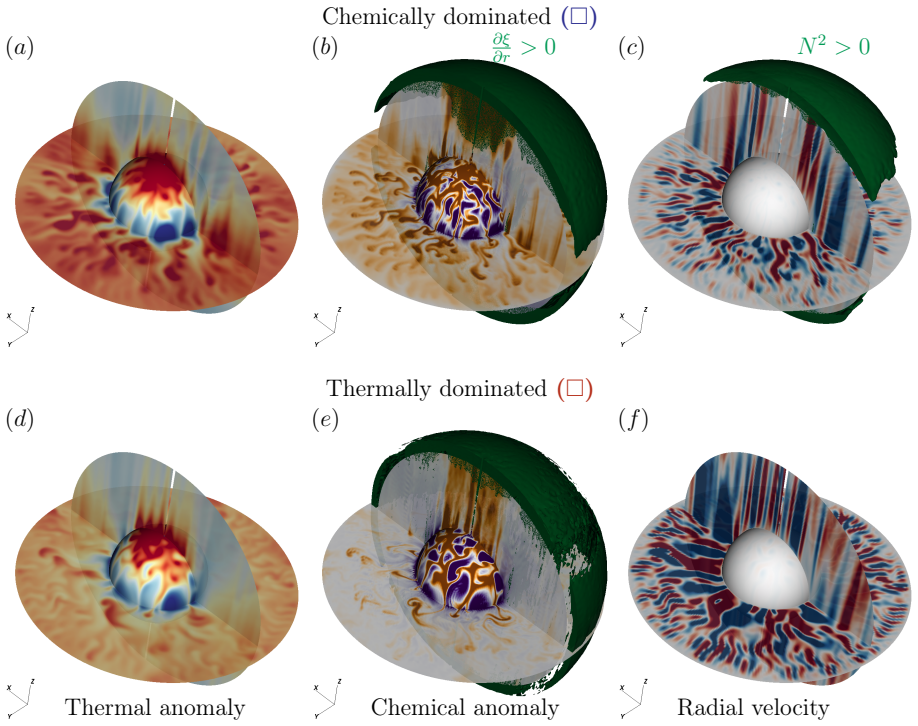
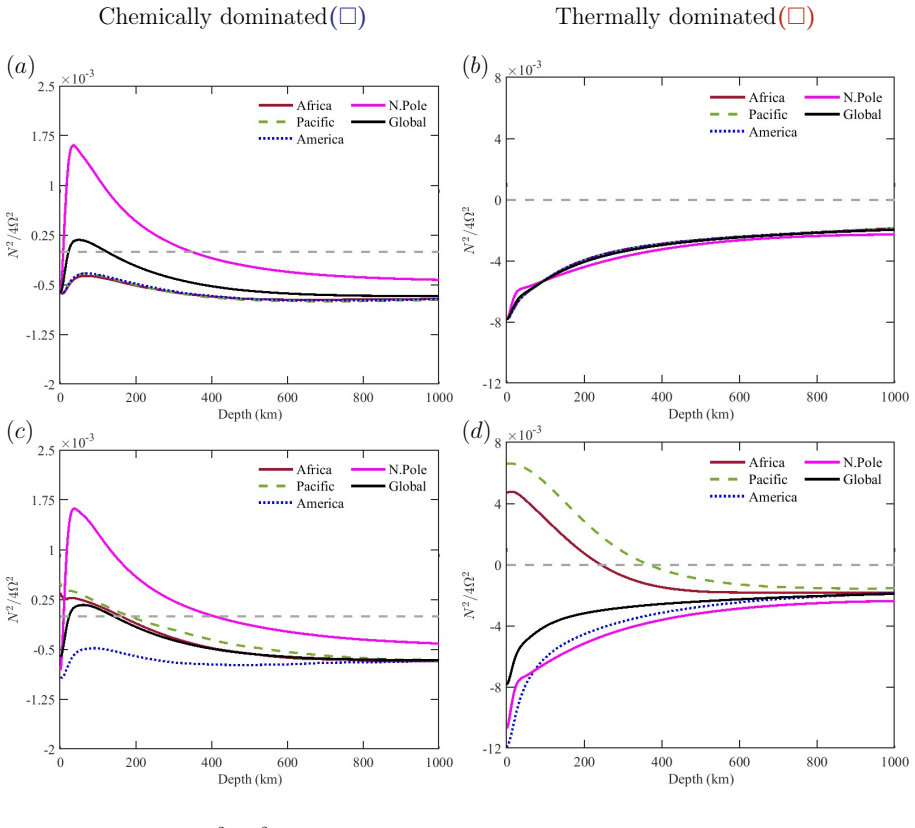
Convection in Earth's outer core is driven by the release of heat and light elements at the inner core boundary. A key question is whether these buoyancy sources drive convection throughout the core, or whether a stable layer exists just below the core-mantle boundary. Simulations incorporating CMB heat flux heterogeneities produce locally stable regional inversion lenses rather than a global layer, allowing stable and unstable regions to coexist. Purely chemical simulations accumulate light elements below the CMB, forming locally stable regions near the poles or global layers depending on compositional forcing strength. These chemically stratified regions persist in thermochemical cases, a
What carries the argument
Regional inversion lenses formed by heterogeneous core-mantle boundary heat flux, which create locally stable zones amid thermochemical convection and allow stable and convective regions to coexist.
If this is right
- Stable regions form in a range of locations, thicknesses, and strengths that depend on the relative thermal and compositional forcing.
- Chemically stratified stable zones persist even when thermal buoyancy is strongly destabilizing.
- Heterogeneous heat flux produces thermally stratified local stable regions that coexist with convection.
- These regions reach thicknesses and strengths that could be detected seismically and might imprint on geomagnetic observations.
Where Pith is reading between the lines
- Seismic data could be used to map the specific locations and extents of these stable regions in the real core.
- The diversity of stable morphologies suggests that single global-layer models may oversimplify core dynamics.
- Coupling these convection models to evolving mantle heat flux patterns could test whether stable regions migrate over geological time.
Load-bearing premise
The fixed Ekman number, Prandtl numbers, limited Rayleigh number ranges, and imposed heterogeneous heat flux pattern are assumed to capture essential Earth-like core behavior without full mantle coupling or realistic diffusivities.
What would settle it
Seismic observations showing no thick, strong stable layers near the core-mantle boundary or geomagnetic records lacking predicted signatures from regional stable zones would rule out the simulated stable regions.
Figures



read the original abstract
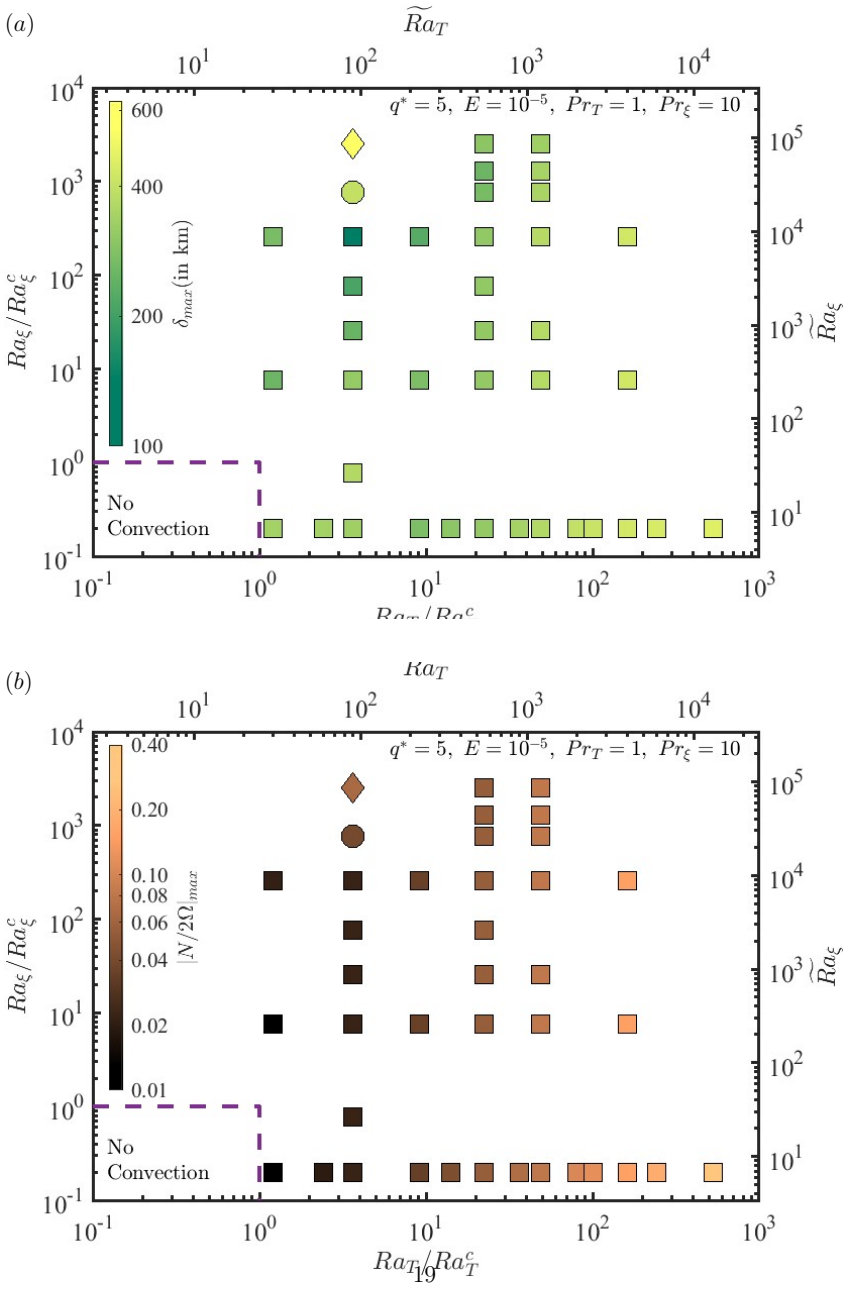
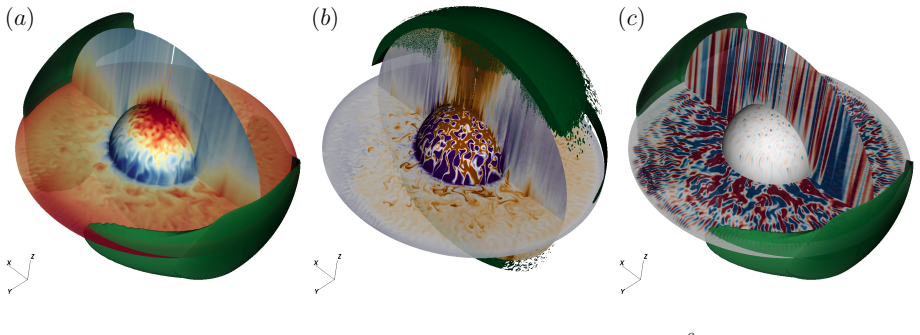
Convection in Earth's outer core is driven by the release of heat and light elements at the inner core boundary. A key question is whether these buoyancy sources drive convection throughout the core, or whether a stable layer exists just below the core-mantle boundary (CMB). Recent simulations incorporating CMB heat flux heterogeneities propose locally stable ``regional inversion lenses'' (RILs) rather than a global layer, allowing stable and unstable regions to coexist. However, these simulations combine thermal and compositional anomalies, ignoring differences in diffusivities and boundary conditions. Here we simulate thermal, chemical, and thermochemical convection at Ekman number $E=10^{-5}$, with thermal and chemical flux Rayleigh numbers $\widetilde{Ra}_T=30-4000$ and $\widetilde{Ra}_\xi=30-100000$, and Prandtl numbers $Pr_T=1$ and $Pr_\xi=10$. Purely chemical simulations accumulate light elements below the CMB, forming locally stable regions near the poles or global layers, depending on $\widetilde{Ra}_\xi$. These chemically stratified regions persist in thermochemical simulations even when thermal forcing is destabilising. Introducing heterogeneous CMB heat flux produces thermally stratified RILs even with strongly destabilising compositional buoyancy. Our simulations reveal a diverse range of locations, properties, and morphologies of stable regions depending on $\widetilde{Ra}_T$ and $\widetilde{Ra}_\xi$, they can have a seismically detectable thickness and strength and might also have a signature in geomagnetic observations.
Editorial analysis
A structured set of objections, weighed in public.
Referee Report
Summary. The manuscript reports numerical simulations of thermal, chemical, and thermochemical convection in a spherical shell model of Earth's outer core at fixed Ekman number E=10^{-5} and Prandtl numbers Pr_T=1, Pr_ξ=10. With thermal and chemical flux Rayleigh numbers scanned over modest ranges and with imposed heterogeneous CMB heat flux, the authors find that chemically stratified regions form and persist even under destabilizing thermal buoyancy, while heterogeneous thermal forcing produces regional inversion lenses (RILs). The work concludes that these stable regions exhibit diverse locations, thicknesses, and morphologies that could be seismically detectable and carry geomagnetic signatures.
Significance. If the reported stable-region properties prove robust, the results would advance understanding of possible coexisting stable and convective regions in the outer core by explicitly separating thermal and compositional buoyancy sources under heterogeneous boundary conditions. The systematic exploration of purely chemical, thermal, and combined cases, together with the identification of RILs rather than global layers, provides a useful parameter-space map. Credit is due for the clear demonstration that chemically stable regions survive in thermochemical runs and for the discussion of observable signatures.
major comments (2)
- [Abstract and Simulation Setup] Abstract and parameter choices: the central claim that stable regions 'can have a seismically detectable thickness and strength' and 'might also have a signature in geomagnetic observations' rests on simulations performed exclusively at E=10^{-5} (Earth value ~10^{-15}), Pr_T=1, Pr_ξ=10, and limited Ra_T, Ra_ξ ranges. No sensitivity tests or scaling arguments are presented to show that RIL thickness, location, or persistence survive at lower Ekman number or altered diffusivity ratios, where the relative importance of thermal versus compositional buoyancy and the penetration of downwellings can change substantially.
- [Methods / Numerical Methods] Numerical validation: the manuscript reports outcomes from simulations at the stated parameter values but supplies no information on grid resolution, time-step convergence, or benchmark comparisons against known solutions for rotating convection or double-diffusive cases. Without these checks, it is impossible to confirm that the reported layer thicknesses and morphologies are free of numerical artifacts, which directly affects the reliability of the seismically detectable strength claim.
minor comments (2)
- [Introduction / Governing Equations] The notation for the flux Rayleigh numbers (widetilde{Ra}_T and widetilde{Ra}_ξ) is introduced in the abstract but should be defined explicitly with reference to the governing equations in the main text.
- [Results / Figures] Figures illustrating stable-region morphology would benefit from quantitative insets or tables reporting measured layer thickness and buoyancy frequency for each Ra combination.
Simulated Author's Rebuttal
We thank the referee for the positive evaluation of the significance of our results on coexisting stable and convective regions in thermochemical core convection and for the constructive comments. We address each major comment below and will revise the manuscript to incorporate the requested clarifications and discussion.
read point-by-point responses
-
Referee: Abstract and parameter choices: the central claim that stable regions 'can have a seismically detectable thickness and strength' and 'might also have a signature in geomagnetic observations' rests on simulations performed exclusively at E=10^{-5} (Earth value ~10^{-15}), Pr_T=1, Pr_ξ=10, and limited Ra_T, Ra_ξ ranges. No sensitivity tests or scaling arguments are presented to show that RIL thickness, location, or persistence survive at lower Ekman number or altered diffusivity ratios, where the relative importance of thermal versus compositional buoyancy and the penetration of downwellings can change substantially.
Authors: We agree that E=10^{-5} is larger than the estimated Earth value and that the manuscript would benefit from explicit discussion of this limitation. This Ekman number was selected to enable a broad scan of thermal and chemical Rayleigh numbers within available computational resources while still capturing rotational effects. The persistence of chemically stable regions under destabilizing thermal buoyancy is driven primarily by the diffusivity contrast (Pr_ξ=10 versus Pr_T=1), which favors compositional stratification; this mechanism is expected to remain qualitatively robust at lower E, although quantitative layer thicknesses may decrease. In the revised manuscript we will add a dedicated subsection in the Discussion that references existing scaling relations for stable-layer thickness with Ekman number and Prandtl ratio, and that estimates how the reported RIL properties might change at more extreme parameters. This addition will qualify the detectability claims without requiring new simulations. revision: yes
-
Referee: Numerical validation: the manuscript reports outcomes from simulations at the stated parameter values but supplies no information on grid resolution, time-step convergence, or benchmark comparisons against known solutions for rotating convection or double-diffusive cases. Without these checks, it is impossible to confirm that the reported layer thicknesses and morphologies are free of numerical artifacts, which directly affects the reliability of the seismically detectable strength claim.
Authors: We acknowledge that the original manuscript omitted explicit numerical validation details. All simulations were performed at resolutions sufficient to resolve the Ekman boundary layers and the radial structure of the stable regions (typically 128–256 radial points and spherical harmonic degrees up to 128–256, with time steps satisfying a Courant number <0.5). Internal resolution-doubling tests on representative cases confirmed that layer thicknesses and morphologies converged to within a few percent. In the revised manuscript we will insert a new paragraph in the Methods section that reports the grid parameters, time-stepping criteria, and convergence tests. We will also add a short appendix comparing our purely thermal convection diagnostics (e.g., Nusselt numbers and flow morphology) against published benchmark solutions for rotating spherical-shell convection at E=10^{-5}. These additions will directly address concerns about numerical artifacts affecting the seismically detectable strength claim. revision: yes
Circularity Check
No significant circularity: results are direct numerical outputs
full rationale
The paper reports outcomes from direct numerical integration of the thermochemical convection equations at fixed Ekman number E=10^{-5}, Prandtl numbers Pr_T=1 and Pr_xi=10, and scanned ranges of flux Rayleigh numbers. Stable-region locations, thicknesses, and morphologies are computed results under the chosen boundary conditions and parameter values; they are not obtained by fitting a parameter to a subset of the same data and then relabeling it a prediction, nor by any self-referential definition that equates an output to an input by construction. No load-bearing analytical step reduces the reported diversity or detectability claims to quantities defined inside the paper itself. The work is therefore self-contained as a computational survey.
Axiom & Free-Parameter Ledger
free parameters (3)
- Ekman number E =
10^{-5}
- Prandtl numbers Pr_T and Pr_xi =
1 and 10
- Thermal and chemical flux Rayleigh numbers =
30-4000 and 30-100000
axioms (2)
- standard math Boussinesq approximation for buoyancy-driven flow
- domain assumption Imposed heterogeneous CMB heat flux boundary condition
Lean theorems connected to this paper
-
IndisputableMonolith/Foundation/RealityFromDistinction.leanreality_from_one_distinction unclear?
unclearRelation between the paper passage and the cited Recognition theorem.
We employ a numerical model of rotating convection of a Boussinesq fluid... non-dimensional numbers... Ekman number (E), thermal and chemical flux Rayleigh numbers... Prandtl numbers
-
IndisputableMonolith/Cost/FunctionalEquation.leanwashburn_uniqueness_aczel unclear?
unclearRelation between the paper passage and the cited Recognition theorem.
N²/4Ω² = r*E² (RaT/PrT ∂T*/∂r* + Raξ/Prξ ∂ξ*/∂r*)
What do these tags mean?
- matches
- The paper's claim is directly supported by a theorem in the formal canon.
- supports
- The theorem supports part of the paper's argument, but the paper may add assumptions or extra steps.
- extends
- The paper goes beyond the formal theorem; the theorem is a base layer rather than the whole result.
- uses
- The paper appears to rely on the theorem as machinery.
- contradicts
- The paper's claim conflicts with a theorem or certificate in the canon.
- unclear
- Pith found a possible connection, but the passage is too broad, indirect, or ambiguous to say the theorem truly supports the claim.
discussion (0)
Sign in with ORCID, Apple, or X to comment. Anyone can read and Pith papers without signing in.