REVIEW 3 major objections 5 minor 93 references
Hyperspectral Anomaly Detection Methods: A Survey and Comparative Study
T0 review · 3 major / 5 minor · reviewed 2026-08-06 · deepseek-v4-flash
Pith's one-line read This benchmark of ten detectors on 17 hyperspectral datasets finds that the gated-transformer model GT-HAD is the most accurate detector, while the classical RX statistic is the fastest by a wide margin.
desk verdict A competent survey whose headline claim about deep-learning accuracy is contradicted by its own Table 5; only GT-HAD leads, not the deep-learning category as a whole. read the letter →
The pith
A machine-rendered reading of the paper's core claim, the machinery that carries it, and where it could break.
The reading
What carries the argument
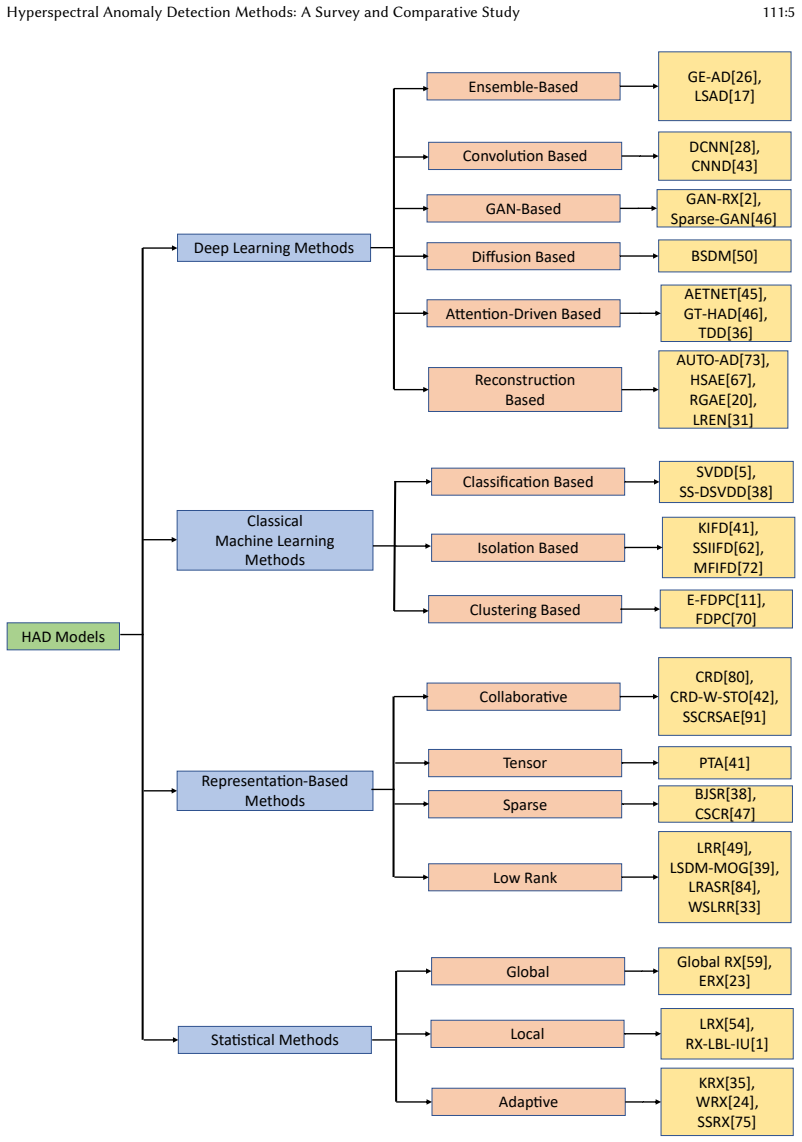
The load-bearing artifact is the comparative protocol behind Table 5: ten algorithms (RX, LRX, CRD, PTA, KIFD, Auto-AD, RGAE, TDD, LREN, GT-HAD) run on 17 public benchmark scenes and scored by area under the ROC curve, execution time, color anomaly maps, and box-whisker separability maps. Table 5 is the accuracy-versus-runtime plane from which the headline claims are read, and the box plots provide a second, distribution-level view of why some methods compress background scores while others let them overlap with anomalies. The paper's proposed four-family taxonomy supplies the organising structure, grouping methods by their background-modeling mechanism so that the comparison can be stated per family.
What would settle it
Rerun the ten detectors on the same 17 datasets with fully documented hyperparameters, seeds, training splits, and hardware. If GT-HAD's average AUC no longer exceeds CRD's and KIFD's, or if a tuned statistical detector matches GT-HAD's accuracy at a fraction of the runtime, the headline accuracy ranking is an artifact of the supplied code and settings rather than of the methods themselves.
Extended reading notes
Core claim
In the authors' own account, the discovery is stated in Section 5.3.1: across all datasets, deep learning models — particularly GT-HAD — generally achieve the highest detection accuracy, with an average AUC of 0.9733, and this accuracy typically costs more computation than traditional statistical methods. The RX detector is the fastest by an order of magnitude, averaging 0.40 seconds per scene at 0.9390 average AUC, which the paper identifies as the natural choice for real-time and resource-constrained applications. In between, CRD is the best non-deep-learning method (average AUC 0.9567), KIFD matches it closely (average AUC 0.9529) but is the slowest method on average (57.51 seconds), and Auto-AD offers a balanced alternative (0.9273 AUC at 8.05 seconds). The paper further reports that TDD and LREN produce very low AUC scores on several scenes, reading this as instability tied to specific datasets rather than general competitiveness.
Load-bearing premise
The ranking in Table 5 assumes that the source codes provided to the authors by algorithm developers are faithful implementations of the published methods and were run with fairly tuned, comparable settings; the paper reports no hyperparameters, training splits, random seeds, or hardware.
Editorial extensions
If this is right
- Choose by operating regime: GT-HAD when accuracy dominates and compute is available, RX when scenes must be processed in real time, with the remaining eight methods forming intermediate trade-off points.
- CRD is the strongest non-deep baseline in this comparison, so teams barred from deep learning still have a high-accuracy option.
- The very low AUC values reported for TDD and LREN on several scenes imply that such models should be validated per dataset before deployment rather than trusted on average scores.
- Auto-AD's combination of 0.9273 AUC and 8.05 seconds makes it the most plausible deep model for near-real-time use without heavy GPU resources.
- For research planning, the results put the open problem as closing the accuracy gap between statistical and deep methods, not merely raising average AUC on benchmark scenes.
Reading between the lines
- Because the benchmark runs code supplied by the method developers, the ranking is best read as a shared-effort result; a public rerun with fixed seeds, hyperparameters, training splits, and hardware would let anyone audit the ordering.
- The 0.034-AUC advantage of GT-HAD over RX comes at roughly a 76x runtime cost, which the paper leaves implicit but which defines a quality-per-second frontier that mission planners could use directly.
- A testable extension of the taxonomy would be to run the same ten detectors on synthetic scenes with controlled noise levels, isolating sensitivity to sensor noise from raw detection power.
- Table 5 shows almost as much spread within each family as between families, which suggests that dataset properties may govern performance more than family identity.
Editorial analysis
A structured set of objections, weighed in public.
Referee Report
Summary. This manuscript presents a survey of hyperspectral anomaly detection (HAD) methods organized into four categories: statistical, representation-based, classical machine learning, and deep learning. The authors propose a taxonomy, review recent advances including attention, diffusion, and ensemble models, and report an empirical comparison of ten algorithms (RX, LRX, CRD, PTA, KIFD, Auto-AD, RGAE, TDD, LREN, GT-HAD) on 17 benchmark datasets in terms of AUC and execution time. The paper concludes that deep learning models, particularly GT-HAD, achieve the highest detection accuracy while statistical methods such as RX are the fastest.
Significance. If the empirical results were fully supported, the paper would be a valuable reference for practitioners, because it compares diverse methods on a common set of public datasets and reports both accuracy and runtime. The authors make their results transparent in Table 5, which allows independent verification. The survey also covers recent deep learning paradigms that are missing from earlier reviews. However, the central claim about deep learning's overall superiority is not supported by the paper's own numbers, and the experimental protocol is insufficiently documented. The paper therefore needs substantial revision before its conclusions can be accepted.
major comments (3)
- [Abstract and Section 5.3.1, Table 5] The claim that 'deep learning models achieved the highest detection accuracy' is not supported by Table 5. Averaging the five deep-learning columns (Auto-AD, RGAE, TDD, LREN, GT-HAD) gives (0.9273 + 0.8846 + 0.6468 + 0.8297 + 0.9733)/5 ≈ 0.8523, which is below RX (0.9390), CRD (0.9567), and KIFD (0.9529) in the same table. Only GT-HAD individually has the highest reported average AUC. Moreover, recomputing the GT-HAD column average from the 17 dataset rows yields approximately 0.9700, not the printed 0.9733. The abstract and conclusion should be corrected to attribute the top average to GT-HAD rather than to the deep-learning category, and the reported GT-HAD average should be reconciled with the table.
- [Section 5.3 and Table 5] The comparative evaluation omits any description of the experimental protocol. No hardware, software, hyperparameter settings, training/validation split details, random seeds, or number of runs are reported. Because the paper's secondary conclusion ('statistical models demonstrated exceptional speed') is based on execution times, and the accuracy ranking depends on fair tuning of each method, the absence of these details makes the benchmark irreproducible and the speed comparisons potentially unfair. The authors should add an experimental-setup subsection with per-method hyperparameters, the sources of the implementations (e.g., original authors' code), hardware specifications, and, ideally, multiple runs with variance estimates.
- [Section 5.3.1, 'Categorical Analysis'] The claim that GT-HAD 'consistently emerges as the top performer' is based on point estimates from a single evaluation. No confidence intervals, standard deviations, or significance tests are reported, and random seeds are not given. Because deep-learning methods are stochastic, the observed AUC differences among the top methods (e.g., GT-HAD 0.9733 vs. CRD 0.9567) may not be stable. The authors should either provide multiple-run statistics or temper the categorical language to reflect that the ranking is a single-run observation.
minor comments (5)
- [Section 3.4.6] The sentence 'By using the strengths of different models, GT-HAD enhances anomaly detection accuracy' appears to confuse GE-AD with GT-HAD; the ensemble method GE-AD is the one that combines multiple models, while GT-HAD is the gated transformer described in Section 3.4.4.
- [Section 5.3.1] The heading 'Quantitative Analysis' introduces a paragraph about color anomaly maps and box-and-whisker plots; this should be 'Qualitative Analysis' or 'Visual Analysis' to match the content.
- [Section 3.3.1.1] Describing SVDD as 'a supervised machine learning method' is inaccurate; SVDD is typically trained in a one-class or unsupervised setting, and the surrounding text itself notes that it removes the Gaussian assumption without discussing supervision.
- [Table 6] The time complexity for KIFD, listed as O(MK) + O(M log M), omits the cost of kernel principal component analysis, which is typically O(M^2 K) or O(M^3); this entry should be revised or qualified to avoid misleading readers about KIFD's scalability.
- [Section 5.1 and Table 4] The abstract and Section 5.3 state that 17 datasets are evaluated, but Table 4 lists 23 rows when subcategories are counted, and the comparison in Table 5 omits some of these rows; the authors should clarify which 17 datasets correspond to the evaluation and why the others were excluded.
Circularity Check
Empirical survey with no derivation chain; the headline accuracy claim is internally inconsistent with Table 5, but that is a correctness/aggregation issue, not circularity.
full rationale
This paper is a survey plus an empirical benchmark, not a derivation chain. The central accuracy claim in Section 5.3.1 and the abstract is supported by measured AUC values in Table 5, obtained by running ten algorithms on seventeen public datasets. The reported numbers are empirical results rather than consequences of the conclusions, so the claim is not definitionally circular. The claim that 'deep learning models, particularly GT-HAD, generally achieve the highest detection accuracy (average AUC: 0.9733)' is, however, internally inconsistent: the 0.9733 is GT-HAD's individual column average, not a deep-learning category average. Averaging the five deep-learning AUC means from Table 5 (Auto-AD 0.9273, RGAE 0.8846, TDD 0.6468, LREN 0.8297, GT-HAD 0.9733) gives approximately 0.8523, which is below RX (0.9390), CRD (0.9567), and KIFD (0.9529). That is a reporting or aggregation error, not a circular step. The only self-citation is the descriptive mention of SSIIFD [62] in Section 3.3.2, which is not load-bearing for the benchmark ranking. Reproducibility limitations are present: Section 5.3 reports no hyperparameters, training splits, random seeds, or hardware, and the Acknowledgments thank algorithm authors for source codes, but these caveats concern external validity and reproducibility rather than circularity. No fitted parameter is renamed as a prediction, no uniqueness theorem is imported from the authors' prior work, and no ansatz is smuggled in via citation. The derivation, such as it is, is self-contained as an empirical comparison, so the circularity score is 0.
Assumptions & free parameters
free parameters (1)
- Per-algorithm hyperparameters and training settings =
not reported
assumptions (4)
- domain assumption Anomalies are rare and spectrally distinct from the background.
- domain assumption Pixel-level AUC against ground truth is a valid accuracy metric for HAD.
- domain assumption The benchmark datasets are representative of real-world HAD deployment conditions.
- ad hoc to paper Third-party source codes correctly implement the published methods and were run fairly.
Cite this review
Pith. "Pith review of Hyperspectral Anomaly Detection Methods: A Survey and Comparative Study." pith.science (2026). https://pith.science/paper/5GOMEMGI
@misc{pith2026250705730,
  author       = {Pith},
  title        = {Pith review of: Hyperspectral Anomaly Detection Methods: A Survey and Comparative Study},
  year         = {2026},
  howpublished = {\url{https://pith.science/paper/5GOMEMGI}},
  note         = {Machine review of arXiv:2507.05730}
}
read the original abstract
Hyperspectral images are high-dimensional datasets comprising hundreds of contiguous spectral bands, enabling detailed analysis of materials and surfaces. Hyperspectral anomaly detection (HAD) refers to the technique of identifying and locating anomalous targets in such data without prior information about a hyperspectral scene or target spectrum. This technology has seen rapid advancements in recent years, with applications in agriculture, defence, military surveillance, and environmental monitoring. Despite this significant progress, existing HAD methods continue to face challenges such as high computational complexity, sensitivity to noise, and limited generalisation across diverse datasets. This study presents a comprehensive comparison of various HAD techniques, categorising them into statistical models, representation-based methods, classical machine learning approaches, and deep learning models. We evaluated these methods across 17 benchmarking datasets using different performance metrics, such as ROC, AUC, and separability map to analyse detection accuracy, computational efficiency, their strengths, limitations, and directions for future research. Our findings highlight that deep learning models achieved the highest detection accuracy, while statistical models demonstrated exceptional speed across all datasets. This survey aims to provide valuable insights for researchers and practitioners working to advance the field of hyperspectral anomaly detection methods.
Figures


Figures from the paper (2 more)


Reference graph
Works this paper leans on
-
[1]
N. Acito, S. Matteoli, M. Diani, and G. Corsini. 2013. Complexity-aware algorithm architecture for real-time enhancement of local anomalies in hyperspectral images. J. Real-Time Image Process. 8, 1 (March 2013), 53–68. doi:10.1007/s11554-011-0205-x
-
[2]
Sertac Arisoy, Nasser M. Nasrabadi, and Koray Kayabol. 2021. GAN-based hyperspectral anomaly detection. In 2020 28th European Signal Processing Conference (EUSIPCO) (2021). IEEE, 1891–1895. https://ieeexplore.ieee.org/abstract/ document/9287675/
-
[3]
Jing Bai, Shaojie Huang, Zhu Xiao, Xianmin Li, Yongdong Zhu, Amelia C. Regan, and Licheng Jiao. 2022. Few-Shot Hyperspectral Image Classification Based on Adaptive Subspaces and Feature Transformation. IEEE Transactions on Geoscience and Remote Sensing 60 (2022), 1–17. doi:10.1109/TGRS.2022.3149947
-
[4]
Bandaragoda, Kai Ming Ting, David Albrecht, Fei Tony Liu, Ye Zhu, and Jonathan R
Tharindu R. Bandaragoda, Kai Ming Ting, David Albrecht, Fei Tony Liu, Ye Zhu, and Jonathan R. Wells. 2018. Isolation-based anomaly detection using nearest-neighbor ensembles. Computational Intelligence 34, 4 (2018), 968–998. arXiv:https://onlinelibrary.wiley.com/doi/pdf/10.1111/coin.12156 doi:10.1111/coin.12156 111:30 A.Pant et al
-
[5]
A. Banerjee, P. Burlina, and C. Diehl. 2006. A support vector method for anomaly detection in hyperspectral imagery. IEEE Transactions on Geoscience and Remote Sensing 44, 8 (2006), 2282–2291. doi:10.1109/TGRS.2006.873019
-
[6]
Dinh, Israel Leyva-Mayorga, Shashi Raj Pandey, Eva Lagunas, and Petar Popovski
Van-Phuc Bui, Thinh Q. Dinh, Israel Leyva-Mayorga, Shashi Raj Pandey, Eva Lagunas, and Petar Popovski. 2024. Semantic Image Encoding and Communication for Earth Observation With LEO Satellites. IEEE Transactions on Cognitive Communications and Networking (2024), 1–1. doi:10.1109/tccn.2024.3451724
-
[7]
Yuanhao Cai, Jing Lin, Xiaowan Hu, Haoqian Wang, Xin Yuan, Yulun Zhang, Radu Timofte, and Luc Van Gool
-
[8]
Yang Cao, Haolong Xiang, Hang Zhang, Ye Zhu, and Kai Ming Ting. 2024. Anomaly Detection Based on Isolation Mechanisms: A Survey. arXiv:2403.10802 [cs.LG] https://arxiv.org/abs/2403.10802
work page Pith review arXiv 2024
Show all 93 references
-
[9]
Yi Chang, Luxin Yan, Houzhang Fang, Sheng Zhong, and Wenshan Liao. 2019. HSI-DeNet: Hyperspectral Image Restoration via Convolutional Neural Network. IEEE Transactions on Geoscience and Remote Sensing 57, 2 (2019), 667–682. doi:10.1109/TGRS.2018.2859203
2019
-
[10]
Wenbin Chen, Xiyang Zhi, Shikai Jiang, Yuanxin Huang, Qichao Han, and Wei Zhang. 2025. DWSDiff: Dual-Window Spectral Diffusion for Hyperspectral Anomaly Detection. IEEE Transactions on Geoscience and Remote Sensing 63 (2025), 1–17. doi:10.1109/TGRS.2025.3537331
2025
-
[11]
Yushi Chen, Shunli Ma, Xi Chen, and Pedram Ghamisi. 2017. Hyperspectral data clustering based on density analysis ensemble. Remote sensing letters 8, 2 (2017), 194–203
2017
-
[12]
Xi Cheng, Min Zhang, Sheng Lin, Yunsong Li, and Hai Wang. 2024. Deep Self-Representation Learning Framework for Hyperspectral Anomaly Detection. IEEE Transactions on Instrumentation and Measurement 73 (2024), 1–16. doi:10.1109/TIM.2023.3330225
2024
-
[13]
Mingmin Chi and Lorenzo Bruzzone. 2007. Classification of Hyperspectral Data by. https://api.semanticscholar.org/ CorpusID:125001913
2007
-
[14]
Xiaoguang Cui, Yuan Tian, Lubin Weng, and Yiping Yang. 2014. Anomaly detection in hyperspectral imagery based on low-rank and sparse decomposition. In International Conference on Graphic and Image Processing . https: //api.semanticscholar.org/CorpusID:129437879
2014
-
[15]
ZHAO Yanru DENG Letian. 2023. Deep Learning-Based Semantic Feature Extraction: A Literature Review and Future Directions. ZTE Communications 21, 2, Article 11 (2023), 11-17 pages
2023
-
[16]
Alexey Dosovitskiy, Lucas Beyer, Alexander Kolesnikov, Dirk Weissenborn, Xiaohua Zhai, Thomas Unterthiner, Mostafa Dehghani, Matthias Minderer, Georg Heigold, Sylvain Gelly, Jakob Uszkoreit, and Neil Houlsby. 2021. An Image is Worth 16x16 Words: Transformers for Image Recognit...
2021 arXiv
-
[17]
Bo Du, Rui Zhao, Liangpei Zhang, and Lefei Zhang. 2016. A spectral-spatial based local summation anomaly detection method for hyperspectral images. Signal Processing 124 (2016), 115–131. doi:10.1016/j.sigpro.2015.09.037 Big Data Meets Multimedia Analytics
2016 doi
-
[18]
Qian Du and Chein-I Chang. 2004. Segmented PCA-based compression for hyperspectral image analysis. In Chemical and Biological Standoff Detection , James O. Jensen and Jean-Marc Theriault (Eds.), Vol. 5268. International Society for Optics and Photonics, SPIE, 274 – 281. doi:10...
2004 doi
-
[19]
María Díaz, Raúl Guerra, Sebastián López, and Roberto Sarmiento. 2018. An Algorithm for an Accurate Detection of Anomalies in Hyperspectral Images With a Low Computational Complexity. IEEE Transactions on Geoscience and Remote Sensing 56, 2 (2018), 1159–1176. doi:10.1109/TGRS....
2018
-
[20]
Ganghui Fan, Yong Ma, Xiaoguang Mei, Fan Fan, Jun Huang, and Jiayi Ma. 2022. Hyperspectral Anomaly Detection With Robust Graph Autoencoders. IEEE Transactions on Geoscience and Remote Sensing 60 (2022), 1–14. doi:10.1109/ TGRS.2021.3097097
2022
-
[21]
Tom Fawcett. 2006. An introduction to ROC analysis. Pattern Recognition Letters 27, 8 (2006), 861–874. doi:10.1016/j. patrec.2005.10.010 ROC Analysis in Pattern Recognition
2006 doi
-
[22]
Shou Feng, Shulu Tang, Chunhui Zhao, and Ying Cui. 2021. A Hyperspectral Anomaly Detection Method Based on Low-Rank and Sparse Decomposition With Density Peak Guided Collaborative Representation. IEEE Transactions on Geoscience and Remote Sensing 60 (2021), 1–13. https://api.s...
2021
-
[23]
Samuel Garske, Bradley Evans, Christopher Artlett, and Kc Wong. 2025. ERX: A Fast Real-Time Anomaly Detection Algorithm for Hyperspectral Line Scanning. IEEE Transactions on Geoscience and Remote Sensing (2025), 1–1. doi:10. 1109/TGRS.2025.3532225
2025
-
[24]
Qiandong Guo, Bing Zhang, Qiong Ran, Lianru Gao, Jun Li, and Antonio Plaza. 2014. Weighted-RXD and Linear Filter-Based RXD: Improving Background Statistics Estimation for Anomaly Detection in Hyperspectral Imagery. IEEE Journal of Selected Topics in Applied Earth Observations ...
2014
-
[25]
Yan He, Bing Tu, Bo Liu, Jun Li, and Antonio Plaza. 2024. 3DSS-Mamba: 3D-Spectral-Spatial Mamba for Hyperspectral Image Classification. IEEE Transactions on Geoscience and Remote Sensing 62 (2024), 1–16. doi:10.1109/tgrs.2024.3472091
2024
-
[26]
Mazharul Hossain, Mohammed Younis, Aaron Robinson, Lan Wang, and Chrysanthe Preza. 2024. Greedy Ensemble Hyperspectral Anomaly Detection. Journal of Imaging 10, 6 (2024). doi:10.3390/jimaging10060131
2024 doi
-
[27]
Zengfu Hou, Siyuan Cheng, and Ting Hu. 2022. A spectral-spatial fusion anomaly detection method for hyperspectral imagery. arXiv:2202.11889 [eess.IV] https://arxiv.org/abs/2202.11889
2022 arXiv
-
[28]
Wei Hu, Yangyu Huang, Li Wei, Fan Zhang, and Hengchao Li. 2015. Deep Convolutional Neu- ral Networks for Hyperspectral Image Classification. Journal of Sensors 2015, 1 (2015), 258619. arXiv:https://onlinelibrary.wiley.com/doi/pdf/10.1155/2015/258619 doi:10.1155/2015/258619
2015 doi
-
[29]
Xing Hu, Chun Xie, Zhe Fan, Qianqian Duan, Dawei Zhang, Linhua Jiang, Xian Wei, Danfeng Hong, Guoqiang Li, Xinhua Zeng, Wenming Chen, Dongfang Wu, and Jocelyn Chanussot. 2022. Hyperspectral Anomaly Detection Using Deep Learning: A Review. Remote Sensing 14, 9 (2022). doi:10.33...
2022 doi
-
[30]
Lingbo Huang, Yushi Chen, and Xin He. 2024. Spectral-Spatial Mamba for Hyperspectral Image Classification. Remote Sensing 16, 13 (July 2024), 2449. doi:10.3390/rs16132449
2024 doi
-
[31]
Kai Jiang, Weiying Xie, Jie Lei, Tao Jiang, and Yunsong Li. 2021. LREN: Low-Rank Embedded Network for Sample-Free Hyperspectral Anomaly Detection. Proceedings of the AAAI Conference on Artificial Intelligence 35, 5 (May 2021), 4139–4146. doi:10.1609/aaai.v35i5.16536
2021 doi
-
[32]
Tao Jiang, Yunsong Li, Weiying Xie, and Qian Du. 2020. Discriminative Reconstruction Constrained Generative Adversarial Network for Hyperspectral Anomaly Detection. IEEE Transactions on Geoscience and Remote Sensing 58, 7 (2020), 4666–4679. doi:10.1109/TGRS.2020.2965961
2020
-
[33]
Tao Jiang, Weiying Xie, Yunsong Li, Jie Lei, and Qian Du. 2022. Weakly Supervised Discriminative Learning With Spectral Constrained Generative Adversarial Network for Hyperspectral Anomaly Detection. IEEE Transactions on Neural Networks and Learning Systems 33, 11 (2022), 6504...
2022
-
[34]
Xudong Kang, Xiangping Zhang, Shutao Li, Kenli Li, Jun Li, and Jón Atli Benediktsson. 2017. Hyperspectral Anomaly Detection With Attribute and Edge-Preserving Filters. IEEE Transactions on Geoscience and Remote Sensing 55, 10 (2017), 5600–5611. doi:10.1109/TGRS.2017.2710145
2017
-
[35]
Nasrabadi
Heesung Kwon and N.M. Nasrabadi. 2005. Kernel RX-algorithm: a nonlinear anomaly detector for hyperspectral imagery. IEEE Transactions on Geoscience and Remote Sensing 43, 2 (2005), 388–397. doi:10.1109/TGRS.2004.841487
2005
-
[36]
Jingtao Li, Xinyu Wang, Shaoyu Wang, Hengwei Zhao, and Yanfei Zhong. 2024. One-Step Detection Paradigm for Hyperspectral Anomaly Detection via Spectral Deviation Relationship Learning. IEEE Transactions on Geoscience and Remote Sensing 62 (2024), 1–15. doi:10.1109/TGRS.2024.3392189
2024
-
[37]
Jiayi Li, Hongyan Zhang, Liangpei Zhang, and Li Ma. 2015. Hyperspectral Anomaly Detection by the Use of Background Joint Sparse Representation. IEEE Journal of Selected Topics in Applied Earth Observations and Remote Sensing 8, 6 (2015), 2523–2533. doi:10.1109/JSTARS.2015.2437073
2015
-
[38]
Kun Li, Qiang Ling, Yao Qin, Yingqian Wang, Yaoming Cai, Zaiping Lin, and Wei An. 2022. Spectral-Spatial Deep Support Vector Data Description for Hyperspectral Anomaly Detection. IEEE Transactions on Geoscience and Remote Sensing 60 (2022), 1–16. doi:10.1109/TGRS.2022.3144192
2022
-
[39]
Lu Li, Wei Li, Qian Du, and Ran Tao. 2021. Low-Rank and Sparse Decomposition With Mixture of Gaussian for Hyperspectral Anomaly Detection. IEEE Transactions on Cybernetics 51, 9 (2021), 4363–4372. doi:10.1109/TCYB.2020. 2968750
2021 doi
-
[40]
Lu Li, Wei Li, Ying Qu, Chunhui Zhao, Ran Tao, and Qian Du. 2022. Prior-Based Tensor Approximation for Anomaly Detection in Hyperspectral Imagery.IEEE Transactions on Neural Networks and Learning Systems 33, 3 (2022), 1037–1050. doi:10.1109/TNNLS.2020.3038659
2022
-
[41]
Shutao Li, Kunzhong Zhang, Puhong Duan, and Xudong Kang. 2020. Hyperspectral Anomaly Detection With Kernel Isolation Forest. IEEE Transactions on Geoscience and Remote Sensing 58, 1 (2020), 319–329. doi:10.1109/TGRS.2019. 2936308
2020 doi
-
[42]
Wei Li and Qian Du. 2015. Collaborative Representation for Hyperspectral Anomaly Detection. IEEE Transactions on Geoscience and Remote Sensing 53, 3 (2015), 1463–1474. doi:10.1109/TGRS.2014.2343955
2015
-
[43]
Wei Li, Guodong Wu, and Qian Du. 2017. Transferred Deep Learning for Anomaly Detection in Hyperspectral Imagery. IEEE Geoscience and Remote Sensing Letters 14, 5 (2017), 597–601. doi:10.1109/LGRS.2017.2657818
2017
-
[44]
Yunsong Li, Tao Jiang, Weiying Xie, Jie Lei, and Qian Du. 2021. Sparse coding-inspired GAN for hyperspectral anomaly detection in weakly supervised learning. 60 (2021), 1–11. https://ieeexplore.ieee.org/abstract/document/9512017/ Publisher: IEEE
2021
-
[45]
Zhaoxu Li, Yingqian Wang, Chao Xiao, Qiang Ling, Zaiping Lin, and Wei An. 2023. You Only Train Once: Learning a General Anomaly Enhancement Network With Random Masks for Hyperspectral Anomaly Detection.IEEE Transactions on Geoscience and Remote Sensing 61 (2023), 1–18. doi:10....
2023
-
[46]
Jie Lian, Lizhi Wang, He Sun, and Hua Huang. 2024. Gt-had: Gated transformer for hyperspectral anomaly detection. (2024). https://ieeexplore.ieee.org/abstract/document/10432978/ Publisher: IEEE
2024
-
[47]
Qiang Ling, Yulan Guo, Zaiping Lin, and Wei An. 2019. A Constrained Sparse Representation Model for Hyper- spectral Anomaly Detection. IEEE Transactions on Geoscience and Remote Sensing 57 (2019), 2358–2371. https: //api.semanticscholar.org/CorpusID:90263173
2019
-
[48]
Fei Tony Liu, Kai Ming Ting, and Zhi-Hua Zhou. 2008. Isolation Forest. In 2008 Eighth IEEE International Conference on Data Mining. 413–422. doi:10.1109/ICDM.2008.17
2008 doi
-
[49]
Guangcan Liu, Zhouchen Lin, and Yong Yu. 2010. Robust subspace segmentation by low-rank representation. In Proceedings of the 27th International Conference on International Conference on Machine Learning(Haifa, Israel) (ICML’10). Omnipress, Madison, WI, USA, 663–670
2010
-
[50]
Jitao Ma, Weiying Xie, Yunsong Li, and Leyuan Fang. 2023. BSDM: Background Suppression Diffusion Model for Hyperspectral Anomaly Detection. arXiv:2307.09861 [cs] doi:10.48550/arXiv.2307.09861
2023 doi
-
[51]
Haut, Mercedes Eugenia Paoletti, Javier Plaza, Lorenzo Bruzzone, and Antonio Plaza
Alessandro Maffei, Juan M. Haut, Mercedes Eugenia Paoletti, Javier Plaza, Lorenzo Bruzzone, and Antonio Plaza. 2020. A Single Model CNN for Hyperspectral Image Denoising. IEEE Transactions on Geoscience and Remote Sensing 58, 4 (2020), 2516–2529. doi:10.1109/TGRS.2019.2952062
2020
-
[52]
Reza Seifi Majdar and Hassan Ghassemian. 2017. A probabilistic SVM approach for hyperspectral image classification using spectral and texture features. International Journal of Remote Sensing 38 (2017), 4265 – 4284. https://api. semanticscholar.org/CorpusID:125785037
2017
-
[53]
Stefania Matteoli, Marco Diani, and Giovanni Corsini. 2010. A tutorial overview of anomaly detection in hyperspectral images. IEEE Aerospace and Electronic Systems Magazine 25, 7 (2010), 5–28. doi:10.1109/MAES.2010.5546306
2010
-
[54]
Molero, Ester M
Jose M. Molero, Ester M. Garzón, Inmaculada García, Enrique S. Quintana-Ortí, and Antonio Plaza. 2014. Efficient Implementation of Hyperspectral Anomaly Detection Techniques on GPUs and Multicore Processors. IEEE Journal of Selected Topics in Applied Earth Observations and Rem...
2014 doi
-
[55]
Padrón Hidalgo, Adrián Pérez-Suay, Fatih Nar, and Gustau Camps-Valls
José A. Padrón Hidalgo, Adrián Pérez-Suay, Fatih Nar, and Gustau Camps-Valls. 2021. Efficient Nonlinear RX Anomaly Detectors. IEEE Geoscience and Remote Sensing Letters 18, 2 (2021), 231–235. doi:10.1109/LGRS.2020.2970582
2021
-
[56]
Guansong Pang, Chunhua Shen, Longbing Cao, and Anton Van Den Hengel. 2021. Deep Learning for Anomaly Detection: A Review. Comput. Surveys 54, 2 (March 2021), 1–38. doi:10.1145/3439950
2021 doi
-
[57]
Ram, Peter Oduor, C
Billy G. Ram, Peter Oduor, C. Igathinathane, Kirk Howatt, and Xin Sun. 2024. A systematic review of hyperspectral imaging in precision agriculture: Analysis of its current state and future prospects. Computers and Electronics in Agriculture 222 (2024), 109037. doi:10.1016/j.co...
2024
-
[59]
Reed and X
I.S. Reed and X. Yu. 1990. Adaptive multiple-band CFAR detection of an optical pattern with unknown spectral distribution. IEEE Transactions on Acoustics, Speech, and Signal Processing 38, 10 (1990), 1760–1770. doi:10.1109/29.60107
1990 doi
-
[60]
Olaf Ronneberger, Philipp Fischer, and Thomas Brox. 2015. U-Net: Convolutional Networks for Biomedical Image Segmentation. arXiv:1505.04597 [cs.CV] https://arxiv.org/abs/1505.04597
2015 arXiv
-
[61]
Maud, Farrukh Aziz Bhatti, Muhammad Khizer Ali, Khurram Khur- shid, Moazam Maqsood, and Muhammad Amin and
Noman Raza Shah, Abdur Rahman M. Maud, Farrukh Aziz Bhatti, Muhammad Khizer Ali, Khurram Khur- shid, Moazam Maqsood, and Muhammad Amin and. 2022. Hyperspectral anomaly detection: a perfor- mance comparison of existing techniques. International Journal of Digital Earth 15, 1 (2...
2022
-
[62]
Xiangyu Song, Sunil Aryal, Kai Ming Ting, Zhen Liu, and Bin He. 2022. Spectral–Spatial Anomaly Detection of Hyperspectral Data Based on Improved Isolation Forest. IEEE Transactions on Geoscience and Remote Sensing 60 (2022), 1–16. doi:10.1109/TGRS.2021.3104998
2022
-
[63]
Xiangyu Song, Guiwei Liu, Guohe Li, Ye Zhu, Peng Li, Guangmao Zhao, and Chunyu Qi. 2024. An Innovative Application of Isolation-Based Nearest Neighbor Ensembles on Hyperspectral Anomaly Detection. IEEE Geoscience and Remote Sensing Letters 21 (2024), 1–5. doi:10.1109/LGRS.2024.3412194
2024
-
[64]
Hongjun Su, Zhaoyue Wu, Huihui Zhang, and Qian Du. 2021. Hyperspectral anomaly detection: A survey. 10, 1 (2021), 64–90. https://ieeexplore.ieee.org/abstract/document/9532003/ Publisher: IEEE
2021
-
[65]
Hongjun Su, Zhaoyue Wu, Huihui Zhang, and Qian Du. 2022. Hyperspectral Anomaly Detection: A survey. IEEE Geoscience and Remote Sensing Magazine 10, 1 (March 2022), 64–90. doi:10.1109/mgrs.2021.3105440
2022
-
[66]
Hongjun Su, Zhaoyue Wu, A-Xing Zhu, and Qian Du. 2020. Low rank and collaborative representation for hyperspectral anomaly detection via robust dictionary construction. ISPRS Journal of Photogrammetry and Remote Sensing 169 (2020), 195–211. doi:10.1016/j.isprsjprs.2020.09.008
2020 doi
-
[67]
He Sun, Lizhi Wang, Lei Zhang, and Lianru Gao. 2024. Hyperbolic Space-Based Autoencoder for Hyperspectral Anomaly Detection. IEEE Transactions on Geoscience and Remote Sensing 62 (2024), 1–15. doi:10.1109/TGRS.2024.3419075 Hyperspectral Anomaly Detection Methods: A Survey and ...
2024
-
[68]
Kun Tan, Zengfu Hou, Yingdan Wu, Qian Du, and Wei Chen. 2019. Anomaly Detection for Hyperspectral Imagery Based on the Regularized Subspace Method and Collaborative Representation. Remote Sensing 11 (06 2019), 1318. doi:10.3390/rs11111318
2019 doi
-
[69]
Guihua Tang, Sen Jia, and Jun Li. 2015. An enhanced density peak-based clustering approach for hyperspectral band selection. In 2015 IEEE International Geoscience and Remote Sensing Symposium (IGARSS) . IEEE, 1116–1119
2015
-
[70]
Bing Tu, Xianchang Yang, Nanying Li, Chengle Zhou, and Danbing He. 2020. Hyperspectral anomaly detection via density peak clustering. Pattern Recognition Letters 129 (2020), 144–149. doi:10.1016/j.patrec.2019.11.022
2020 doi
-
[71]
Minghua Wang, Lianru Gao, Longfei Ren, Xian Sun, and Jocelyn Chanussot. 2024. Hyperspectral Simultaneous Anomaly Detection and Denoising: Insights From Integrative Perspective. IEEE Journal of Selected Topics in Applied Earth Observations and Remote Sensing 17 (2024), 13966–13...
2024
-
[72]
Rong Wang, Feiping Nie, Zhen Wang, Fang He, and Xuelong Li. 2020. Multiple Features and Isolation Forest-Based Fast Anomaly Detector for Hyperspectral Imagery. IEEE Transactions on Geoscience and Remote Sensing 58, 9 (2020), 6664–6676. doi:10.1109/TGRS.2020.2978491
2020
-
[73]
Shaoyu Wang, Xinyu Wang, Liangpei Zhang, and Yanfei Zhong. 2022. Auto-AD: Autonomous Hyperspectral Anomaly Detection Network Based on Fully Convolutional Autoencoder. IEEE Transactions on Geoscience and Remote Sensing 60 (2022), 1–14. doi:10.1109/TGRS.2021.3057721
2022
-
[74]
Yanjie Wang, Zhijun Zhang, Wenhui Xu, Liqun Chen, Guodong Wang, Luxin Yan, Sheng Zhong, and Xu Zou. 2024. Learning Oriented Object Detection via Naive Geometric Computing. IEEE Transactions on Neural Networks and Learning Systems 35, 8 (2024), 10513–10525. doi:10.1109/TNNLS.20...
2024
-
[75]
Yu-Lei Wang, Chun-Hui Zhao, and Ying Wang. 2011. Anomaly detection using subspace band section based RX algorithm. In 2011 International Conference on Multimedia Technology . 3436–3439. doi:10.1109/ICMT.2011.6002215
2011
-
[76]
Zhiwei Wang, Xue Wang, Kun Tan, Bo Han, Jianwei Ding, and Zhaoxian Liu. 2023. Hyperspectral anomaly detection based on variational background inference and generative adversarial network. Pattern Recognition 143 (2023), 109795. doi:10.1016/j.patcog.2023.109795
2023
-
[77]
Kaixuan Wei, Ying Fu, and Hua Huang. 2021. 3-D Quasi-Recurrent Neural Network for Hyperspectral Image Denoising. IEEE Transactions on Neural Networks and Learning Systems 32, 1 (2021), 363–375. doi:10.1109/TNNLS.2020.2978756
2021
-
[78]
Wheeler and Hassan A
Bradley J. Wheeler and Hassan A. Karimi. 2024. Enhancing Hyperspectral Anomaly Detection Algorithm Comparisons: Leveraging Dataset and Algorithm Characteristics. Remote Sensing 16, 20 (2024). doi:10.3390/rs16203879
2024 doi
-
[79]
Claes Wohlin, Marcos Kalinowski, Katia Romero Felizardo, and Emilia Mendes. 2022. Successful combination of database search and snowballing for identification of primary studies in systematic literature studies. Information and Software Technology 147 (2022), 106908. doi:10.10...
2022
-
[80]
Paoletti, Juan M
Zhaoyue Wu, Hongjun Su, Xuanwen Tao, Lirong Han, Mercedes E. Paoletti, Juan M. Haut, Javier Plaza, and Antonio Plaza. 2022. Hyperspectral Anomaly Detection With Relaxed Collaborative Representation. IEEE Transactions on Geoscience and Remote Sensing 60 (2022), 1–17. doi:10.110...
2022
-
[81]
Tan, Jiangluqi Song, and Lin Gu
Pei Xiang, Huixin Zhou, Huan Li, Shangzhen Song, W. Tan, Jiangluqi Song, and Lin Gu. 2020. Hyperspectral anomaly detection by local joint subspace process and support vector machine. International Journal of Remote Sensing 41 (2020), 3798 – 3819. https://api.semanticscholar.or...
2020
-
[82]
Weiying Xie, Tao Jiang, Yunsong Li, Xiuping Jia, and Jie Lei. 2019. Structure Tensor and Guided Filtering-Based Algorithm for Hyperspectral Anomaly Detection. IEEE Transactions on Geoscience and Remote Sensing 57, 7 (2019), 4218–4230. doi:10.1109/TGRS.2018.2890212
2019
-
[83]
Weiying Xie, Xin Zhang, Yunsong Li, Jie Lei, Jiaojiao Li, and Qian Du. 2021. Weakly Supervised Low-Rank Representation for Hyperspectral Anomaly Detection. IEEE Transactions on Cybernetics 51, 8 (2021), 3889–3900. doi:10.1109/TCYB.2021.3065070
2021
-
[84]
Yang Xu, Zebin Wu, Jun Li, Antonio Plaza, and Zhihui Wei. 2016. Anomaly Detection in Hyperspectral Images Based on Low-Rank and Sparse Representation. IEEE Transactions on Geoscience and Remote Sensing 54, 4 (2016), 1990–2000. doi:10.1109/TGRS.2015.2493201
2016
-
[85]
Plaza, and Zhihui Wei
Yang Xu, Zenbin Wu, Jun Li, Antonio J. Plaza, and Zhihui Wei. 2016. Anomaly Detection in Hyperspectral Images Based on Low-Rank and Sparse Representation. IEEE Transactions on Geoscience and Remote Sensing 54 (2016), 1990–2000. https://api.semanticscholar.org/CorpusID:16069989
2016
-
[86]
Yichu Xu, Lefei Zhang, Bo Du, and Liangpei Zhang. 2022. Hyperspectral anomaly detection based on machine learning: An overview. 15 (2022), 3351–3364. https://ieeexplore.ieee.org/abstract/document/9760098/ Publisher: IEEE
2022
-
[87]
Yichu Xu, Lefei Zhang, Bo Du, and Liangpei Zhang. 2022. Hyperspectral Anomaly Detection Based on Machine Learning: An Overview. IEEE Journal of Selected Topics in Applied Earth Observations and Remote Sensing 15 (2022), 3351–3364. doi:10.1109/jstars.2022.3167830
2022
-
[88]
Shaoqi Yu, Xiaorun Li, Liaoying Zhao, and Jing Wang. 2021. Hyperspectral Anomaly Detection Based on Low-Rank Representation Using Local Outlier Factor. IEEE Geoscience and Remote Sensing Letters 18, 7 (2021), 1279–1283. doi:10.1109/LGRS.2020.2994745 111:34 A.Pant et al
2021
-
[89]
Junping Zhang, Ye Zhang, Bin Zou, and Tingxian Zhou. 2000. Fusion classification of hyperspectral image based on adaptive subspace decomposition. In Proceedings 2000 International Conference on Image Processing (Cat. No.00CH37101), Vol. 3. 472–475 vol.3. doi:10.1109/ICIP.2000.899445
2000
-
[90]
Lili Zhang and Baozhi Cheng. 2021. A combined model based on stacked autoencoders and fractional Fourier entropy for hyperspectral anomaly detection. International Journal of Remote Sensing 42, 10 (2021), 3611–3632. arXiv:https://doi.org/10.1080/01431161.2020.1868605 doi:10.10...
2021
-
[91]
Chunhui Zhao, Chuang Li, Shou Feng, and Wei Li. 2022. Spectral–Spatial Anomaly Detection via Collaborative Representation Constraint Stacked Autoencoders for Hyperspectral Images. IEEE Geoscience and Remote Sensing Letters 19 (2022), 1–5. doi:10.1109/LGRS.2021.3050308
2022
-
[92]
J. Zhou. 2015. Fast Anomaly Detection Algorithms For Hyperspectral Images. https://api.semanticscholar.org/ CorpusID:17082135
2015
-
[93]
Ziemann, David W
Amanda K. Ziemann, David W. Messinger, and Paul S. Wenger. 2014. An adaptive k-nearest neighbor graph building technique with applications to hyperspectral imagery. In 2014 IEEE Western New York Image and Signal Processing Workshop (WNYISPW). 32–36. doi:10.1109/WNYIPW.2014.6999481
2014
-
[2022]
In Computer Vision – ECCV 2022 , Shai Avidan, Gabriel Brostow, Moustapha Cissé, Giovanni Maria Farinella, and Tal Hassner (Eds.)
Coarse-to-Fine Sparse Transformer for Hyperspectral Image Reconstruction. In Computer Vision – ECCV 2022 , Shai Avidan, Gabriel Brostow, Moustapha Cissé, Giovanni Maria Farinella, and Tal Hassner (Eds.). Springer Nature Switzerland, Cham, 686–704
2022
Reviewed August 6, 2026 · model on record in the stance chip above.
Discussion (0). Continue with ORCID to comment.