Resolving Degeneracies in Complex mathbb{R}times S³ and θ-KSW
Pith reviewed 2026-05-19 04:29 UTC · model grok-4.3
The pith
Complex deformation of G ħ resolves type-1 degeneracies from anti-linear symmetry in the lapse action and modifies the KSW criterion.
A machine-rendered reading of the paper's core claim, the machinery that carries it, and where it could break.
Core claim
The authors show that every type-1 degeneracy traces to anti-linear symmetry present in the lapse action. Any breaking of that symmetry resolves the overlap of flow lines and removes ambiguity in identifying relevant saddles. After quantum fluctuations of the scale factor lift type-2 degeneracies completely and type-1 only partially, the complex deformation of G ħ completes the resolution. The resulting contour deformation permits consistent application of Picard-Lefschetz and WKB methods, while the modified KSW criterion requires a strong bound on the deformation to keep No-boundary geometries allowed.
What carries the argument
Complex deformation of (G ħ) that breaks anti-linear symmetry in the lapse action, thereby removing type-1 degeneracies and altering the KSW criterion.
If this is right
- The lapse integral can be evaluated along a unique deformed contour without ambiguity from overlapping flow lines.
- Quantum fluctuations of the scale factor plus the deformation together resolve all degeneracies, allowing reliable WKB results.
- No-boundary geometries satisfy the KSW criterion only when the deformation parameter obeys the derived bound.
- Artificial defects become unnecessary once anti-linear symmetry is broken by the complex deformation.
Where Pith is reading between the lines
- The same symmetry-breaking deformation may be tested in other gravitational models that exhibit similar anti-linear symmetries in their lapse actions.
- The approach could inform contour choices for Lorentzian path integrals beyond the mini-superspace truncation.
- Higher-dimensional or non-minisuperspace calculations would check whether the required constraint on the deformation persists.
Load-bearing premise
The mini-superspace ansatz together with the chosen Robin boundary condition captures the dominant physics of the full four-dimensional Lorentzian path integral.
What would settle it
An explicit saddle-point calculation for a fixed boundary parameter in which the deformed G ħ violates the new KSW bound yet No-boundary geometries still dominate the integral would falsify the claimed constraint.
Figures




read the original abstract
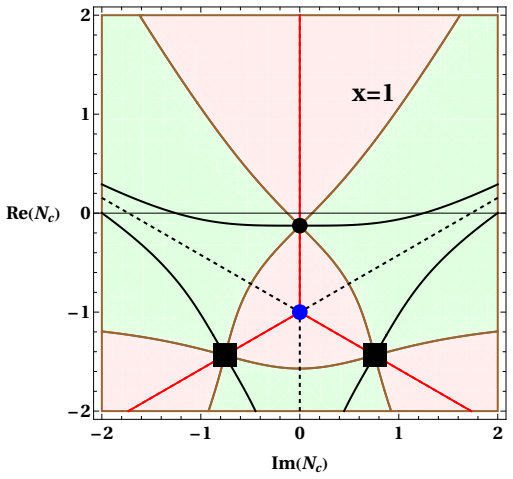
Lorentzian gravitational path integral for the Gauss-Bonnet gravity in $4D$ is studied in the mini-superspace ansatz for metric. The gauge-fixed path-integral for Robin boundary choice is computed exactly using {\it Airy}-functions, where the dominant contribution comes from No-boundary geometries. The lapse integral is further analysed using saddle-point methods to compare with exact results. Picard-Lefschetz methods are utilized to find the {\it relevant} complex saddles and deformed contour of integration, thereby using WKB methods to compute the integral along the deformed contour in the saddle-point approximation. However, their successful application is possible only when system is devoid of degeneracies, which in present case appear in two types: {\bf type-1} where the flow-lines starting from neighbouring saddles overlap leading to ambiguities in deciding the {\it relevance} of saddles, {\bf type-2} where saddles merge for specific choices of boundary parameters leading to failure of WKB. Overcoming degeneracies using artificial {\it defects} introduces ambiguities due to the choice of {\it defects} involved. Corrections from quantum fluctuations of scale-factor overcome degeneracies only partially (lifts {\bf type-2} completely with partial resolution of {\bf type-1}), with the residual lifted fluently by complex deformation of $(G\hbar)$. {\it Anti-linear} symmetry present in various forms in the lapse action is the reason behind all the {\bf type-1} degeneracies. Any form of {\it defect} or {\it deformation} breaking anti-linearity resolves {\bf type-1} degeneracies, indicating complex deformation of $(G\hbar)$ as an ideal choice. Compatibility with the KSW criterion is analyzed after symmetry breaking. Complex deformation of $(G\hbar)$ modifies the KSW criterion, imposing a strong constraint on the deformation if No-boundary geometries are required to be always KSW-allowed.
Editorial analysis
A structured set of objections, weighed in public.
Referee Report
Summary. The manuscript studies the Lorentzian gravitational path integral for Gauss-Bonnet gravity in 4D under a mini-superspace ansatz for the metric. It computes the gauge-fixed path integral exactly using Airy functions for a Robin boundary condition, with the dominant contribution arising from No-boundary geometries. The lapse integral is analyzed via saddle-point methods and Picard-Lefschetz theory to identify relevant complex saddles and deformed contours. Two types of degeneracies are identified: type-1 (overlapping flow lines from neighboring saddles due to anti-linear symmetry in the lapse action) and type-2 (merging saddles for specific boundary parameters). Quantum fluctuations of the scale factor resolve type-2 completely and type-1 partially; the residual type-1 degeneracies are lifted by a complex deformation of (G ħ) that breaks anti-linearity. The paper then examines compatibility with the KSW criterion after this symmetry breaking, finding that the deformation modifies the criterion and imposes a constraint to keep No-boundary geometries KSW-allowed.
Significance. If the results hold, the exact Airy-function evaluation of the gauge-fixed integral supplies a concrete benchmark for mini-superspace path integrals in quantum gravity. The identification of anti-linear symmetry as the origin of type-1 degeneracies and the explicit demonstration that any anti-linearity-breaking deformation resolves them clarifies the application of Picard-Lefschetz methods to gravitational integrals. The subsequent KSW analysis after deformation could constrain parameters in no-boundary proposals. The manuscript ships an exact, non-perturbative result, which strengthens the technical contribution.
major comments (2)
- Abstract and the paragraph on gauge-fixed path-integral and lapse integral analysis: the central claim that complex deformation of (G ħ) resolves type-1 degeneracies and modifies the KSW criterion rests on the mini-superspace ansatz with Robin boundary conditions faithfully reproducing the dominant saddle structure of the unreduced 4D theory. The manuscript does not provide an argument or test showing that additional graviton and matter fluctuation modes in the full theory would not lift the same degeneracies without deformation or reintroduce them afterward; if the degeneracies are reduction artifacts, the derived constraint on the deformation parameter for KSW compatibility does not necessarily carry over.
- Abstract: the statement that complex deformation of (G ħ) is an 'ideal choice' because it breaks anti-linearity is presented as resolving the ambiguity in saddle relevance, yet the deformation is introduced precisely to address the degeneracy problem identified in the lapse action rather than being derived from an external physical principle or from the structure of the full Lorentzian path integral.
minor comments (2)
- The abstract mentions that 'explicit numerical checks' are absent for the deformed contour; adding a brief statement of the range of deformation parameters for which No-boundary saddles remain dominant would improve clarity.
- Notation for the complex shift in (G ħ) and the Robin boundary parameter should be introduced with a single consistent symbol when first appearing in the lapse-action analysis.
Simulated Author's Rebuttal
We thank the referee for the detailed and constructive report. We respond to the major comments below and have revised the manuscript to clarify the scope of our results within the mini-superspace approximation.
read point-by-point responses
-
Referee: Abstract and the paragraph on gauge-fixed path-integral and lapse integral analysis: the central claim that complex deformation of (G ħ) resolves type-1 degeneracies and modifies the KSW criterion rests on the mini-superspace ansatz with Robin boundary conditions faithfully reproducing the dominant saddle structure of the unreduced 4D theory. The manuscript does not provide an argument or test showing that additional graviton and matter fluctuation modes in the full theory would not lift the same degeneracies without deformation or reintroduce them afterward; if the degeneracies are reduction artifacts, the derived constraint on the deformation parameter for KSW compatibility does not necessarily carry over.
Authors: We agree that the analysis is performed strictly within the mini-superspace ansatz and that we do not demonstrate how additional fluctuation modes in the unreduced 4D theory would affect the degeneracies. The exact Airy-function evaluation and the resolution via complex (G ħ) deformation are results specific to this reduced model. We have revised the abstract, introduction, and conclusion to explicitly state that the degeneracy resolution and the resulting constraint on the deformation parameter for KSW compatibility are derived within the mini-superspace framework, and that their status in the full theory remains an open question requiring further investigation. revision: yes
-
Referee: Abstract: the statement that complex deformation of (G ħ) is an 'ideal choice' because it breaks anti-linearity is presented as resolving the ambiguity in saddle relevance, yet the deformation is introduced precisely to address the degeneracy problem identified in the lapse action rather than being derived from an external physical principle or from the structure of the full Lorentzian path integral.
Authors: We accept the point that the deformation is introduced to resolve the type-1 degeneracies arising from anti-linear symmetry in the lapse action. The description as an 'ideal choice' was meant to contrast it with arbitrary artificial defects, since any anti-linearity-breaking modification resolves the overlap of flow lines. We have revised the abstract to clarify the motivation as arising directly from the degeneracy analysis in the mini-superspace model rather than from an independent external principle. revision: yes
Circularity Check
No significant circularity; derivation is self-contained
full rationale
The paper first obtains an exact Airy-function expression for the gauge-fixed path integral under the mini-superspace ansatz and Robin boundary conditions. It then performs an independent saddle-point and Picard-Lefschetz analysis of the lapse integral, identifies an anti-linear symmetry in the lapse action as the source of type-1 degeneracies, and notes that any anti-linearity-breaking deformation (including a complex shift in Għ) lifts those degeneracies. The subsequent KSW-compatibility check is performed on the deformed theory. Because the exact Airy result, the symmetry identification, and the degeneracy-lifting property are all derived directly from the model's equations without reducing to a fitted parameter renamed as a prediction or to a self-citation chain, the central claims do not collapse to their inputs by construction.
Axiom & Free-Parameter Ledger
free parameters (1)
- Robin boundary parameter
axioms (2)
- domain assumption Mini-superspace ansatz reduces the full 4D metric degrees of freedom to a single scale factor
- domain assumption Picard-Lefschetz theory correctly identifies relevant complex saddles for the Lorentzian gravitational path integral
Forward citations
Cited by 1 Pith paper
-
IR behaviour of one-loop complex $\mathbb{R}\times S^3$ saddles
One-loop metric fluctuations produce secularly growing IR divergences in the Hartle-Hawking wavefunction for complex saddles on R x S3, identical in leading order to the Lorentzian de Sitter case after UV renormalization.
Reference graph
Works this paper leans on
-
[1]
Feynman Diagrams for the Yang-Mills Field,
L. D. Faddeev and V. N. Popov, “Feynman Diagrams for the Yang-Mills Field,” Phys. Lett. B 25 (1967), 29-30 doi:10.1016/0370-2693(67)90067-6
-
[2]
One loop divergencies in the theory of gravitation,
G. ’t Hooft and M. J. G. Veltman, “One loop divergencies in the theory of gravitation,” Ann. Inst. H. Poincare A Phys. Theor. 20 (1974), 69-94
work page 1974
-
[3]
S. Deser, H. S. Tsao and P. van Nieuwenhuizen, “Nonrenormalizability of Einstein Yang-Mills Interactions at the One Loop Level,” Phys. Lett. B 50 (1974), 491-493 doi:10.1016/0370- 2693(74)90268-8
-
[4]
One Loop Divergences of Quantized Einstein-Maxwell Fields,
S. Deser and P. van Nieuwenhuizen, “One Loop Divergences of Quantized Einstein-Maxwell Fields,” Phys. Rev. D 10 (1974), 401 doi:10.1103/PhysRevD.10.401
-
[5]
M. H. Goroff and A. Sagnotti, “QUANTUM GRAVITY AT TWO LOOPS,” Phys. Lett. B 160 (1985), 81-86 doi:10.1016/0370-2693(85)91470-4
-
[6]
The Ultraviolet Behavior of Einstein Gravity,
M. H. Goroff and A. Sagnotti, “The Ultraviolet Behavior of Einstein Gravity,” Nucl. Phys. B 266 (1986), 709-736 doi:10.1016/0550-3213(86)90193-8
-
[7]
A. E. M. van de Ven, “Two loop quantum gravity,” Nucl. Phys. B 378 (1992), 309-366 doi:10.1016/0550-3213(92)90011-Y
-
[8]
Renormalization of Higher Derivative Quantum Gravity
K. S. Stelle, “Renormalization of Higher Derivative Quantum Gravity,” Phys. Rev. D 16 (1977), 953-969 doi:10.1103/PhysRevD.16.953
-
[9]
Remarks on High-energy Stability and Renormalizability of Gravity Theory,
A. Salam and J. A. Strathdee, “Remarks on High-energy Stability and Renormalizability of Gravity Theory,” Phys. Rev. D 18 (1978), 4480 doi:10.1103/PhysRevD.18.4480 61
-
[10]
Short Distance Freedom of Quantum Gravity
G. Narain and R. Anishetty, “Short Distance Freedom of Quantum Gravity,” Phys. Lett. B 711 (2012), 128-131 doi:10.1016/j.physletb.2012.03.070 [arXiv:1109.3981 [hep-th]]
work page internal anchor Pith review Pith/arXiv arXiv doi:10.1016/j.physletb.2012.03.070 2012
-
[11]
Exorcising Ghosts in Induced Gravity
G. Narain, “Exorcising Ghosts in Induced Gravity,” Eur. Phys. J. C 77 (2017) no.10, 683 doi:10.1140/epjc/s10052-017-5249-z [arXiv:1612.04930 [hep-th]]
work page internal anchor Pith review Pith/arXiv arXiv doi:10.1140/epjc/s10052-017-5249-z 2017
-
[12]
Physical Running of Couplings in Quadratic Gravity,
D. Buccio, J. F. Donoghue, G. Menezes and R. Percacci, “Physical Running of Couplings in Quadratic Gravity,” Phys. Rev. Lett. 133 (2024) no.2, 021604 doi:10.1103/PhysRevLett.133.021604 [arXiv:2403.02397 [hep-th]]
-
[13]
On Gauss-bonnet gravity and boundary conditions in Lorentzian path integral quantization,
G. Narain, “On Gauss-bonnet gravity and boundary conditions in Lorentzian path integral quantization,” JHEP 05, 273 (2021) doi:10.1007/JHEP05(2021)273 [arXiv:2101.04644 [gr-qc]]
-
[14]
Surprises in Lorentzian path-integral of Gauss-Bonnet gravity,
G. Narain, “Surprises in Lorentzian path-integral of Gauss-Bonnet gravity,” JHEP 04 (2022), 153 doi:10.1007/JHEP04(2022)153 [arXiv:2203.05475 [gr-qc]]
-
[15]
M. Ailiga, S. Mallik and G. Narain, “Lorentzian Robin Universe,” JHEP 01 (2024), 124 doi:10.1007/JHEP01(2024)124 [arXiv:2308.01310 [gr-qc]]
-
[16]
Lorentzian path-integral of Robin Universe,
M. Ailiga, S. Mallik and G. Narain, “Lorentzian path-integral of Robin Universe,” [arXiv:2407.16692 [gr-qc]]
-
[17]
Path Integrals and the Indefiniteness of the Gravitational Action,
G. W. Gibbons, S. W. Hawking and M. J. Perry, “Path Integrals and the Indefiniteness of the Gravitational Action,” Nucl. Phys. B 138 (1978), 141-150 doi:10.1016/0550-3213(78)90161-X
-
[18]
The Einstein tensor and its generalizations,
D. Lovelock, “The Einstein tensor and its generalizations,” J. Math. Phys. 12, 498-501 (1971) doi:10.1063/1.1665613
-
[19]
The four-dimensionality of space and the einstein tensor,
D. Lovelock, “The four-dimensionality of space and the einstein tensor,” J. Math. Phys. 13, 874-876 (1972) doi:10.1063/1.1666069
-
[20]
A Remarkable property of the Riemann-Christoffel tensor in four dimensions,
C. Lanczos, “A Remarkable property of the Riemann-Christoffel tensor in four dimensions,” Annals Math. 39, 842-850 (1938) doi:10.2307/1968467
-
[21]
B. Zwiebach, “Curvature Squared Terms and String Theories,” Phys. Lett. B 156, 315-317 (1985) doi:10.1016/0370-2693(85)91616-8
-
[22]
The Quartic Effective Action for the Heterotic String,
D. J. Gross and J. H. Sloan, “The Quartic Effective Action for the Heterotic String,” Nucl. Phys. B 291, 41-89 (1987) doi:10.1016/0550-3213(87)90465-2
-
[23]
Three Loop Beta Functions for the Superstring and Heterotic String,
R. R. Metsaev and A. A. Tseytlin, “Order alpha-prime (Two Loop) Equivalence of the String Equations of Motion and the Sigma Model Weyl Invariance Conditions: Dependence on the Dilaton and the Antisymmetric Tensor,” Nucl. Phys. B293, 385-419 (1987) doi:10.1016/0550- 3213(87)90077-0
-
[24]
J. Feldbrugge, J. L. Lehners and N. Turok, “Lorentzian Quantum Cosmology,” Phys. Rev. D 95 (2017) no.10, 103508 doi:10.1103/PhysRevD.95.103508 [arXiv:1703.02076 [hep-th]]
work page internal anchor Pith review Pith/arXiv arXiv doi:10.1103/physrevd.95.103508 2017
-
[25]
Unstable no-boundary fluctuations from sums over regular metrics
A. Di Tucci and J. L. Lehners, “Unstable no-boundary fluctuations from sums over reg- ular metrics,” Phys. Rev. D 98 (2018) no.10, 103506 doi:10.1103/PhysRevD.98.103506 [arXiv:1806.07134 [gr-qc]]
work page internal anchor Pith review Pith/arXiv arXiv doi:10.1103/physrevd.98.103506 2018
-
[26]
No smooth beginning for spacetime,
J. L. Lehners, “No smooth beginning for spacetime,” Int. J. Mod. Phys. D 28 (2018) no.02, 1930005 doi:10.1142/9789811258251 0005
-
[27]
No smooth beginning for spacetime
J. Feldbrugge, J. L. Lehners and N. Turok, “No smooth beginning for spacetime,” Phys. Rev. Lett. 119 (2017) no.17, 171301 doi:10.1103/PhysRevLett.119.171301 [arXiv:1705.00192 [hep-th]]
work page internal anchor Pith review Pith/arXiv arXiv doi:10.1103/physrevlett.119.171301 2017
-
[28]
No Rescue for the No Boundary Proposal
J. Feldbrugge, J. L. Lehners and N. Turok, “No rescue for the no boundary proposal: Pointers to the future of quantum cosmology,” Phys. Rev. D 97 (2018) no.2, 023509 doi:10.1103/PhysRevD.97.023509 [arXiv:1708.05104 [hep-th]]
work page internal anchor Pith review Pith/arXiv arXiv doi:10.1103/physrevd.97.023509 2018
-
[29]
No-boundary prescriptions in Lorentzian quan- tum cosmology,
A. Di Tucci, J. L. Lehners and L. Sberna, “No-boundary prescriptions in Lorentzian quan- tum cosmology,” Phys. Rev. D 100 (2019) no.12, 123543 doi:10.1103/PhysRevD.100.123543 62 [arXiv:1911.06701 [hep-th]]
-
[30]
Wave function of simple universes analytically continued from negative to positive potentials,
J. L. Lehners, “Wave function of simple universes analytically continued from negative to positive potentials,” Phys. Rev. D 104 (2021) no.6, 063527 doi:10.1103/PhysRevD.104.063527 [arXiv:2105.12075 [hep-th]]
-
[31]
Lessons for quantum cosmology from anti–de Sitter black holes,
A. Di Tucci, M. P. Heller and J. L. Lehners, “Lessons for quantum cosmology from anti–de Sitter black holes,” Phys. Rev. D 102 (2020) no.8, 086011 doi:10.1103/PhysRevD.102.086011 [arXiv:2007.04872 [hep-th]]
-
[32]
The No-Boundary Proposal as a Path Integral with Robin Boundary Conditions
A. Di Tucci and J. L. Lehners, “No-Boundary Proposal as a Path Integral with Robin Boundary Conditions,” Phys. Rev. Lett. 122 (2019) no.20, 201302 doi:10.1103/PhysRevLett.122.201302 [arXiv:1903.06757 [hep-th]]
work page internal anchor Pith review Pith/arXiv arXiv doi:10.1103/physrevlett.122.201302 2019
-
[33]
Relativistic S Matrix of Dynamical Systems with Boson and Fermion Constraints,
I. A. Batalin and G. A. Vilkovisky, “Relativistic S Matrix of Dynamical Systems with Boson and Fermion Constraints,” Phys. Lett. B 69 (1977), 309-312 doi:10.1016/0370-2693(77)90553- 6
-
[34]
M. Honda, H. Matsui, K. Okabayashi and T. Terada, “Resurgence in Lorentzian quantum cosmology: No-boundary saddles and resummation of quantum gravity corrections around tunneling saddle points,” Phys. Rev. D 110, no.8, 8 (2024) doi:10.1103/PhysRevD.110.083508 [arXiv:2402.09981 [gr-qc]]
-
[35]
Jackiw-Teitelboim Gravity and Lorentzian Quantum Cosmology,
M. Honda, H. Matsui, K. Numajiri and K. Okabayashi, “Jackiw-Teitelboim Gravity and Lorentzian Quantum Cosmology,” [arXiv:2412.20398 [gr-qc]]
-
[36]
Teitelboim, Quantum mechanics of the gravi- tational field , Phys
C. Teitelboim, “Quantum Mechanics of the Gravitational Field,” Phys. Rev. D 25 (1982), 3159 doi:10.1103/PhysRevD.25.3159
-
[37]
The Proper Time Gauge in Quantum Theory of Gravitation,
C. Teitelboim, “The Proper Time Gauge in Quantum Theory of Gravitation,” Phys. Rev. D 28 (1983), 297 doi:10.1103/PhysRevD.28.297
-
[38]
Derivation of the Wheeler-De Witt Equation from a Path Integral for Min- isuperspace Models,
J. J. Halliwell, “Derivation of the Wheeler-De Witt Equation from a Path Integral for Min- isuperspace Models,” Phys. Rev. D 38 (1988), 2468 doi:10.1103/PhysRevD.38.2468
-
[39]
L. J. Garay, J. J. Halliwell and G. A. Mena Marugan, “Path integral quantum cosmology: A Class of exactly soluble scalar field minisuperspace models with exponential potentials,” Phys. Rev. D 43, 2572-2589 (1991) doi:10.1103/PhysRevD.43.2572
-
[40]
Causality Versus Gauge Invariance in Quantum Gravity and Supergravity,
C. Teitelboim, “Causality Versus Gauge Invariance in Quantum Gravity and Supergravity,” Phys. Rev. Lett. 50 (1983), 705 doi:10.1103/PhysRevLett.50.705
-
[41]
Analytic Continuation Of Chern-Simons Theory
E. Witten, “Analytic Continuation Of Chern-Simons Theory,” AMS/IP Stud. Adv. Math. 50 (2011), 347-446 [arXiv:1001.2933 [hep-th]]
work page internal anchor Pith review Pith/arXiv arXiv 2011
-
[42]
A New Look At The Path Integral Of Quantum Mechanics
E. Witten, “A New Look At The Path Integral Of Quantum Mechanics,” [arXiv:1009.6032 [hep-th]]
work page internal anchor Pith review Pith/arXiv arXiv
-
[43]
Resurgence theory, ghost-instantons, and analytic continuation of path integrals
G. Basar, G. V. Dunne and M. Unsal, “Resurgence theory, ghost-instantons, and ana- lytic continuation of path integrals,” JHEP 10 (2013), 041 doi:10.1007/JHEP10(2013)041 [arXiv:1308.1108 [hep-th]]
work page internal anchor Pith review Pith/arXiv arXiv doi:10.1007/jhep10(2013)041 2013
-
[44]
An Introduction to Resurgence, Trans-Series and Alien Calculus
D. Dorigoni, “An Introduction to Resurgence, Trans-Series and Alien Calculus,” Annals Phys. 409, 167914 (2019) doi:10.1016/j.aop.2019.167914 [arXiv:1411.3585 [hep-th]]
-
[45]
Y. Tanizaki and T. Koike, “Real-time Feynman path integral with Picard–Lefschetz theory and its applications to quantum tunneling,” Annals Phys. 351 (2014), 250-274 doi:10.1016/j.aop.2014.09.003 [arXiv:1406.2386 [math-ph]]
work page internal anchor Pith review Pith/arXiv arXiv doi:10.1016/j.aop.2014.09.003 2014
-
[46]
The Lovelock Gravitational Field Equations in Cosmology,
N. Deruelle and L. Farina-Busto, “The Lovelock Gravitational Field Equations in Cosmology,” Phys. Rev. D 41, 3696 (1990) doi:10.1103/PhysRevD.41.3696
-
[47]
Schwarzschild field in n dimensions and the dimensionality of space prob- lem,
F. R. Tangherlini, “Schwarzschild field in n dimensions and the dimensionality of space prob- lem,” Nuovo Cim. 27, 636-651 (1963) doi:10.1007/BF02784569 63
-
[48]
Dimensionality of Space and the Pulsating Universe,
F. Tangherlini, “Dimensionality of Space and the Pulsating Universe,” Nuovo Cim. 91 (1986), 209-217
work page 1986
-
[49]
Generalized boundary conditions in closed cosmologies,
D. Brizuela and M. de Cesare, “Generalized boundary conditions in closed cosmologies,” Phys. Rev. D 107 (2023) no.10, 104054 doi:10.1103/PhysRevD.107.104054 [arXiv:2303.04007 [gr-qc]]
-
[50]
Boundary choices and one-loop Complex Universe,
M. Ailiga, S. Mallik and G. Narain, “Boundary choices and one-loop Complex Universe,” [arXiv:2410.19724 [gr-qc]]
-
[51]
Hamiltonian formulation of f(Riemann) theories of gravity
N. Deruelle, M. Sasaki, Y. Sendouda and D. Yamauchi, Prog. Theor. Phys. 123 (2010), 169- 185 doi:10.1143/PTP.123.169 [arXiv:0908.0679 [hep-th]]
work page internal anchor Pith review Pith/arXiv arXiv doi:10.1143/ptp.123.169 2010
-
[52]
C. Krishnan, S. Maheshwari and P. N. Bala Subramanian, “Robin Gravity,” J. Phys. Conf. Ser. 883, no.1, 012011 (2017) doi:10.1088/1742-6596/883/1/012011 [arXiv:1702.01429 [gr-qc]]
work page internal anchor Pith review Pith/arXiv arXiv doi:10.1088/1742-6596/883/1/012011 2017
-
[53]
Constraining the topological Gauss- Bonnet coupling from GW150914,
K. Chakravarti, R. Ghosh and S. Sarkar, “Constraining the topological Gauss- Bonnet coupling from GW150914,” Phys. Rev. D 106 (2022) no.4, L041503 doi:10.1103/PhysRevD.106.L041503 [arXiv:2201.08700 [gr-qc]]
-
[54]
Positivity of Curvature-Squared Corrections in Gravity
C. Cheung and G. N. Remmen, “Positivity of Curvature-Squared Corrections in Grav- ity,” Phys. Rev. Lett. 118 (2017) no.5, 051601 doi:10.1103/PhysRevLett.118.051601 [arXiv:1608.02942 [hep-th]]
work page internal anchor Pith review Pith/arXiv arXiv doi:10.1103/physrevlett.118.051601 2017
-
[55]
D. Harlow and T. Numasawa, “Gauging spacetime inversions in quantum gravity,” [arXiv:2311.09978 [hep-th]]
-
[56]
Witten,Bras and kets in Euclidean path integrals,Beijing J
E. Witten, “Bras and Kets in Euclidean Path Integrals,” [arXiv:2503.12771 [hep-th]]
-
[57]
L. Boyle, K. Finn and N. Turok, “CPT-Symmetric Universe,” Phys. Rev. Lett. 121, no.25, 251301 (2018) doi:10.1103/PhysRevLett.121.251301 [arXiv:1803.08928 [hep-ph]]
work page internal anchor Pith review Pith/arXiv arXiv doi:10.1103/physrevlett.121.251301 2018
-
[58]
Structure of Lefschetz thimbles in simple fermionic systems
T. Kanazawa and Y. Tanizaki, “Structure of Lefschetz thimbles in simple fermionic systems,” JHEP 03, 044 (2015) doi:10.1007/JHEP03(2015)044 [arXiv:1412.2802 [hep-th]]
work page internal anchor Pith review Pith/arXiv arXiv doi:10.1007/jhep03(2015)044 2015
-
[59]
Some remarks on Lefschetz thimbles and complex Langevin dynamics
G. Aarts, L. Bongiovanni, E. Seiler and D. Sexty, “Some remarks on Lefschetz thim- bles and complex Langevin dynamics,” JHEP 10, 159 (2014) doi:10.1007/JHEP10(2014)159 [arXiv:1407.2090 [hep-lat]]
work page internal anchor Pith review Pith/arXiv arXiv doi:10.1007/jhep10(2014)159 2014
-
[60]
Real observers solving imaginary problems,
J. Maldacena, “Real observers solving imaginary problems,” [arXiv:2412.14014 [hep-th]]
-
[61]
Physical instabilities and the phase of the Euclidean path integral,
V. Ivo, J. Maldacena and Z. Sun, “Physical instabilities and the phase of the Euclidean path integral,” [arXiv:2504.00920 [hep-th]]
-
[62]
Testing the Black-Hole Area Law with GW150914,
M. Isi, W. M. Farr, M. Giesler, M. A. Scheel and S. A. Teukolsky, “Testing the Black-Hole Area Law with GW150914,” Phys. Rev. Lett. 127, no.1, 011103 (2021) doi:10.1103/PhysRevLett.127.011103 [arXiv:2012.04486 [gr-qc]]
-
[63]
Review of the no-boundary wave function,
J. L. Lehners, “Review of the no-boundary wave function,” Phys. Rept. 1022 (2023), 1-82 doi:10.1016/j.physrep.2023.06.002 [arXiv:2303.08802 [hep-th]]
-
[64]
Real Tunneling Geometries and the Large Scale Topology of the Universe,
G. W. Gibbons and J. B. Hartle, “Real Tunneling Geometries and the Large Scale Topology of the Universe,” Phys. Rev. D 42 (1990), 2458-2468 doi:10.1103/PhysRevD.42.2458
-
[65]
The no boundary density matrix,
V. Ivo, Y. Z. Li and J. Maldacena, “The no boundary density matrix,” JHEP 02, 124 (2025) doi:10.1007/JHEP02(2025)124 [arXiv:2409.14218 [hep-th]]
-
[66]
Maldacena,Comments on the no boundary wavefunction and slow roll inflation, arXiv:2403.10510
J. Maldacena, “Comments on the no boundary wavefunction and slow roll inflation,” [arXiv:2403.10510 [hep-th]]
-
[67]
Witten,A Note On Complex Spacetime Metrics, arXiv:2111.06514
E. Witten, “A Note On Complex Spacetime Metrics,” [arXiv:2111.06514 [hep-th]]
-
[68]
doi: 10.1093/qmath/haab027 arXiv: 2105.10161 [hep-th] 13, 18 References156
M. Kontsevich and G. Segal, “Wick Rotation and the Positivity of Energy in Quantum Field Theory,” Quart. J. Math. Oxford Ser. 72 (2021) no.1-2, 673-699 doi:10.1093/qmath/haab027 [arXiv:2105.10161 [hep-th]]. 64
-
[69]
Complex actions in two-dimensional topology change
J. Louko and R. D. Sorkin, “Complex actions in two-dimensional topology change,” Class. Quant. Grav. 14 (1997), 179-204 doi:10.1088/0264-9381/14/1/018 [arXiv:gr-qc/9511023 [gr- qc]]
work page internal anchor Pith review Pith/arXiv arXiv doi:10.1088/0264-9381/14/1/018 1997
-
[70]
Uses of complex metrics in cosmology,
C. Jonas, J. L. Lehners and J. Quintin, “Uses of complex metrics in cosmology,” JHEP 08 (2022), 284 doi:10.1007/JHEP08(2022)284 [arXiv:2205.15332 [hep-th]]
-
[71]
Michel Petrovitch, M. Sur une mani` ere d’´ etendre le th´ eor` eme de la moyenne aux ´ equations diff´ erentielles du premier ordre.Mathematische Annalen. 54 pp. 417-436 (1901)
work page 1901
-
[72]
Kontsevich-Segal Criterion in the No- Boundary State Constrains Inflation,
T. Hertog, O. Janssen and J. Karlsson, “Kontsevich-Segal Criterion in the No- Boundary State Constrains Inflation,” Phys. Rev. Lett. 131 (2023) no.19, 191501 doi:10.1103/PhysRevLett.131.191501 [arXiv:2305.15440 [hep-th]]
-
[73]
Kontsevich-Segal criterion in the no- boundary state constrains anisotropy,
T. Hertog, O. Janssen and J. Karlsson, “Kontsevich-Segal criterion in the no- boundary state constrains anisotropy,” Phys. Rev. D 111 (2025) no.4, 046008 doi:10.1103/PhysRevD.111.046008 [arXiv:2408.02652 [hep-th]]
-
[74]
The gravitational index and allowable complex metrics,
P. Benetti Genolini and S. Murthy, “The gravitational index and allowable complex metrics,” J. Phys. A 58, no.21, 215401 (2025) doi:10.1088/1751-8121/add7a7 [arXiv:2503.20866 [hep- th]]. 65
discussion (0)
Sign in with ORCID, Apple, or X to comment. Anyone can read and Pith papers without signing in.