Rise and fall of nonstabilizerness via random measurements
Pith reviewed 2026-05-19 03:49 UTC · model grok-4.3
The pith
Measurements in rotated non-Clifford bases drive random Clifford circuits to a steady state with non-trivial nonstabilizerness independent of the initial state.
A machine-rendered reading of the paper's core claim, the machinery that carries it, and where it could break.
Core claim
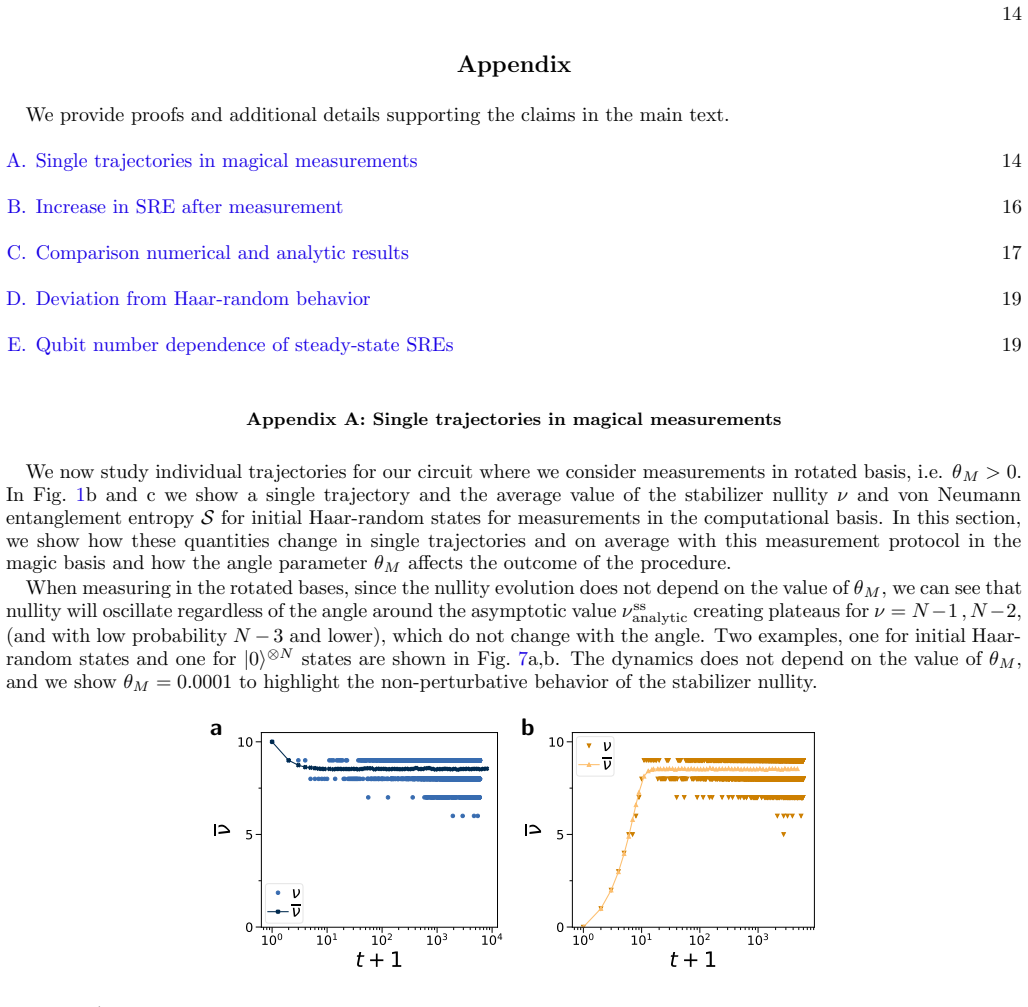
In monitored circuits with random Clifford unitaries and measurements in rotated non-Clifford bases, the dynamics leads to a steady state with non-trivial nonstabilizerness that is independent of the initial state. Haar-random states equilibrate in constant time, whereas stabilizer states exhibit linear-in-size relaxation time. For computational-basis measurements the stabilizer nullity instead decays in quantized steps and requires exponentially many measurements to vanish.
What carries the argument
Stabilizer nullity, which tracks nonstabilizerness and decays in discrete steps under computational-basis measurements but saturates at a non-zero value under rotated non-Clifford measurements.
If this is right
- Nonstabilizerness can be maintained indefinitely rather than eliminated when measurements are performed in non-Clifford bases.
- Stabilizer states lose their special structure more slowly than Haar-random states under the same non-Clifford measurement protocol.
- Coarse diagnostics such as stabilizer nullity miss dynamical features that finer measures like Stabilizer Rényi Entropies capture.
- Clifford scrambling provides strong protection against the loss of nonstabilizerness under standard-basis measurements.
Where Pith is reading between the lines
- The steady-state nonstabilizerness may set a practical limit on how much magic can be preserved in measurement-based quantum computation protocols.
- Similar monitored dynamics could be examined with other non-Clifford gate ensembles to test whether the emergence of a non-trivial steady state is generic.
- Finite-size correlations that violate the full-scrambling assumption may smooth the quantized decay steps in small systems.
Load-bearing premise
The analytical model for the quantized decay of stabilizer nullity assumes that each random Clifford unitary fully scrambles the state before the next measurement occurs.
What would settle it
Numerical simulation of small qubit systems that tracks whether the long-time nonstabilizerness value under rotated measurements remains the same when the circuit is initialized in a stabilizer state versus a random state.
Figures





read the original abstract
We investigate the dynamics of nonstabilizerness - also known as `magic' - in monitored quantum circuits composed of random Clifford unitaries and local projective measurements. For measurements in the computational basis, we derive an analytical model for dynamics of the stabilizer nullity, showing that it decays in quantized steps and requires exponentially many measurements to vanish, which reveals the strong protection through Clifford scrambling. On the other hand, for measurements performed in rotated non-Clifford bases, measurements can both create and destroy nonstabilizerness. Here, the dynamics leads to a steady-state with non-trivial nonstabilizerness, independent of the initial state. We find that Haar-random states equilibrate in constant time, whereas stabilizer states exhibit linear-in-size relaxation time. While the stabilizer nullity is insensitive to the rotation angle, Stabilizer R\'enyi Entropies expose a richer structure in their dynamics. Our results uncover sharp distinctions between coarse and fine-grained nonstabilizerness diagnostics and demonstrate how measurements can both suppress and sustain quantum computational resources.
Editorial analysis
A structured set of objections, weighed in public.
Referee Report
Summary. The manuscript studies the dynamics of nonstabilizerness (magic) in monitored quantum circuits of random Clifford unitaries followed by local projective measurements. For computational-basis measurements, an analytical model is derived for the decay of stabilizer nullity, which proceeds in quantized steps and requires exponentially many measurements to reach zero owing to Clifford scrambling. For measurements in rotated non-Clifford bases, both creation and destruction of nonstabilizerness occur, driving the system to a steady state with non-trivial nonstabilizerness that is independent of the initial state; Haar-random states equilibrate in constant time while stabilizer states exhibit linear-in-size relaxation. Stabilizer Rényi entropies reveal additional dynamical structure not captured by the nullity alone.
Significance. If the central claims are confirmed, the work is significant for clarifying how measurements can both suppress and sustain quantum computational resources in scrambled circuits. The analytical treatment of nullity decay under Clifford protection and the numerical demonstration of an initial-state-independent attractor under rotated measurements provide concrete, falsifiable predictions that distinguish coarse (nullity) from fine-grained (SRE) diagnostics. These results bear on resource theories in monitored dynamics and on the design of circuits that preserve or control magic.
major comments (2)
- [§3] §3 (analytical model for nullity decay): the derivation of quantized-step behavior assumes that each random Clifford layer fully scrambles the state to an effectively Haar distribution before the subsequent measurement. For finite L and early times this assumption may leave residual correlations, which would modify the predicted step structure and the exponential scaling of the number of measurements required to reach zero nullity.
- [§4] §4 (rotated-basis numerics and steady-state claims): the reported linear-in-L relaxation time for stabilizer initial states and the independence of the steady-state nonstabilizerness from the initial state rest on numerical trajectories whose finite-size scaling, error bars, and convergence diagnostics are not shown. Without these, it remains unclear whether the linear scaling is robust or influenced by post-hoc fitting or incomplete scrambling.
minor comments (2)
- [Abstract/Introduction] The abstract and introduction would benefit from a single sentence explicitly contrasting the two measurement bases and the two diagnostics (nullity vs. SREs).
- [Figures] Figure captions should state the system sizes, number of trajectories, and whether analytical curves are overlaid on the numerical data.
Simulated Author's Rebuttal
We thank the referee for their positive evaluation of our work and for the constructive comments, which help clarify the presentation of our results on nonstabilizerness dynamics in monitored Clifford circuits. We respond to each major comment below and indicate the revisions planned for the manuscript.
read point-by-point responses
-
Referee: [§3] §3 (analytical model for nullity decay): the derivation of quantized-step behavior assumes that each random Clifford layer fully scrambles the state to an effectively Haar distribution before the subsequent measurement. For finite L and early times this assumption may leave residual correlations, which would modify the predicted step structure and the exponential scaling of the number of measurements required to reach zero nullity.
Authors: We appreciate the referee's observation regarding the scrambling assumption. The analytical model relies on the rapid mixing properties of random Clifford circuits, which are known to scramble information on timescales logarithmic in system size. While residual correlations could in principle exist at very early times for finite L, our numerical simulations of the full circuit dynamics (not shown in the original manuscript) confirm that the quantized step structure and the exponential scaling of the number of measurements persist across the relevant parameter regime. In the revision we will add an explicit discussion of the approximation's validity, including a brief comparison between the analytical prediction and direct numerics for moderate L, to delineate the range where the model applies without modification. revision: partial
-
Referee: [§4] §4 (rotated-basis numerics and steady-state claims): the reported linear-in-L relaxation time for stabilizer initial states and the independence of the steady-state nonstabilizerness from the initial state rest on numerical trajectories whose finite-size scaling, error bars, and convergence diagnostics are not shown. Without these, it remains unclear whether the linear scaling is robust or influenced by post-hoc fitting or incomplete scrambling.
Authors: We agree that additional numerical diagnostics are necessary to substantiate the claims of linear-in-L relaxation for stabilizer initial states and initial-state independence of the steady state. In the revised manuscript we will include (i) finite-size scaling plots of the relaxation time versus L, (ii) error bars obtained by averaging over at least 100 independent trajectories, and (iii) explicit convergence checks showing that the steady-state value is reached and remains stable after the reported timescale. These additions will confirm that the observed linear scaling is robust and not an artifact of fitting or incomplete scrambling. revision: yes
Circularity Check
No significant circularity; derivations use standard Clifford scrambling and random averaging.
full rationale
The paper's analytical model for stabilizer nullity decay under computational-basis measurements follows from the established scrambling action of random Clifford layers, producing quantized decay steps via averaging over the Clifford group without any parameter fitted to the output data itself. The steady-state nonstabilizerness for rotated non-Clifford measurements is obtained by balancing creation and destruction channels, yielding initial-state independence as a direct consequence of the effective Haar-like distribution after scrambling; this does not reduce to a self-definition or a fitted input renamed as prediction. Relaxation timescales (constant-time for Haar states, linear-in-size for stabilizers) are likewise derived from the same mixing properties. No load-bearing self-citation, ansatz smuggling, or uniqueness theorem imported from the authors' prior work appears in the central claims; the results rest on externally standard properties of monitored Clifford circuits.
Axiom & Free-Parameter Ledger
axioms (2)
- domain assumption Random Clifford unitaries fully scramble the state on timescales short compared to measurement intervals.
- standard math Projective measurements in a fixed basis commute with the stabilizer formalism in the computational case.
Lean theorems connected to this paper
-
IndisputableMonolith/Cost/FunctionalEquation.leanwashburn_uniqueness_aczel unclear?
unclearRelation between the paper passage and the cited Recognition theorem.
analytical model for dynamics of the stabilizer nullity, showing that it decays in quantized steps and requires exponentially many measurements to vanish
What do these tags mean?
- matches
- The paper's claim is directly supported by a theorem in the formal canon.
- supports
- The theorem supports part of the paper's argument, but the paper may add assumptions or extra steps.
- extends
- The paper goes beyond the formal theorem; the theorem is a base layer rather than the whole result.
- uses
- The paper appears to rely on the theorem as machinery.
- contradicts
- The paper's claim conflicts with a theorem or certificate in the canon.
- unclear
- Pith found a possible connection, but the passage is too broad, indirect, or ambiguous to say the theorem truly supports the claim.
Forward citations
Cited by 3 Pith papers
-
Computing quantum magic of state vectors
Efficient algorithms compute stabilizer Rényi entropy and mana for quantum states from vectors at O(N d^{2N}) cost using fast Hadamard transform, with open-source implementation.
-
Operational interpretation of the Stabilizer Entropy
The stabilizer Rényi entropy governs the exponential rate at which Clifford orbits become indistinguishable from Haar-random states and sets the optimal distinguishability from stabilizer states in property testing.
-
Calibrating the Role of Entanglement in Variational Quantum Algorithms from a Geometric Perspective
Quantum state evolution in variational algorithms is governed by geometric phase rather than dynamical phase, with entanglement decoupled from evolution in hardware-efficient ansatzes but acting as a dynamical resourc...
Reference graph
Works this paper leans on
-
[1]
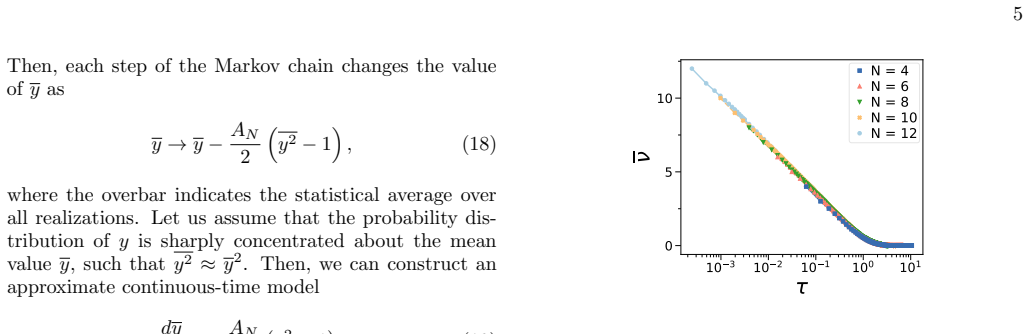
Thus, we need∼Nnumber of measurements to inject extensive magic into the initial stabilizer state, and only a constant number of measurements to remove a constant amount of magic for Haar random states. Now, we get a more accurate estimate of the steady state value of νby solving for the steady-state of the Markov chain approximately. To this end, let us ...
work page 2022
-
[2]
Gottesman, Stabilizer Codes and Quantum Error Correction, Ph.D
D. Gottesman,Stabilizer codes and quantum error correc- tion. Caltech Ph. D, Ph.D. thesis, Thesis, eprint: quant- ph/9705052 (1997)
-
[3]
The Heisenberg Representation of Quantum Computers
D. Gottesman, The heisenberg representation of quan- tum computers, arXiv quant-ph/9807006 (1998)
work page internal anchor Pith review Pith/arXiv arXiv 1998
-
[4]
S. Aaronson and D. Gottesman, Improved simulation of stabilizer circuits, Phys. Rev. A70, 052328 (2004)
work page 2004
-
[5]
M. A. Nielsen and I. L. Chuang,Quantum Computa- tion and Quantum Information: 10th Anniversary Edi- tion(Cambridge University Press, 2011)
work page 2011
- [6]
- [7]
- [8]
-
[9]
E. T. Campbell, B. M. Terhal, and C. Vuillot, Roads towards fault-tolerant universal quantum computation, Nature549, 172 (2017)
work page 2017
- [10]
- [11]
- [12]
-
[13]
A. Y. Kitaev, Fault-tolerant quantum computation by anyons, Ann. Phys.303, 2 (2003)
work page 2003
-
[14]
S. Bravyi and A. Kitaev, Universal quantum computa- tion with ideal clifford gates and noisy ancillas, Phys. Rev. A71, 022316 (2005)
work page 2005
-
[15]
E. Chitambar and G. Gour, Quantum resource theories, Rev. Mod. Phys.91, 025001 (2019)
work page 2019
- [16]
-
[17]
M. Howard and E. Campbell, Application of a resource theory for magic states to fault-tolerant quantum com- puting, Phys. Rev. Lett.118, 090501 (2017)
work page 2017
-
[18]
M. Horodecki and J. Oppenheim, (quantumness in the context of) resource theories, International Jour- nal of Modern Physics B27, 1345019 (2013), https://doi.org/10.1142/S0217979213450197
- [19]
-
[20]
M. Heinrich and D. Gross, Robustness of Magic and Symmetries of the Stabiliser Polytope, Quantum3, 132 (2019)
work page 2019
-
[21]
J. R. Seddon, B. Regula, H. Pashayan, Y. Ouyang, and E. T. Campbell, Quantifying quantum speedups: Im- proved classical simulation from tighter magic mono- tones, PRX Quantum2, 010345 (2021)
work page 2021
-
[22]
E. T. Campbell and D. E. Browne, Bound states for magic state distillation in fault-tolerant quantum com- putation, Phys. Rev. Lett.104, 030503 (2010)
work page 2010
-
[23]
M. Beverland, E. Campbell, M. Howard, and V. Kli- uchnikov, Lower bounds on the non-clifford resources for quantum computations, Quantum Science Tech.5, 035009 (2020)
work page 2020
-
[24]
J. Jiang and X. Wang, Lower bound for the t count via unitary stabilizer nullity, Physical Review Applied19, 034052 (2023)
work page 2023
- [25]
-
[26]
J. A. Monta˜ n` a L´ opez and P. Kos, Exact solution of long- range stabilizer r´ enyi entropy in the dual-unitary xxz model*, Journal of Physics A: Mathematical and The- oretical57, 475301 (2024)
work page 2024
-
[27]
X. Turkeshi, A. Dymarsky, and P. Sierant, Pauli spec- trum and nonstabilizerness of typical quantum many- body states, Physical Review B111, 10.1103/phys- revb.111.054301 (2025)
-
[28]
T. Haug and L. Piroli, Stabilizer entropies and nonstabi- lizerness monotones, Quantum7, 1092 (2023)
work page 2023
-
[29]
T. Haug and L. Piroli, Quantifying nonstabilizerness of matrix product states, Phys. Rev. B107, 035148 (2023)
work page 2023
-
[30]
P. S. Tarabunga, E. Tirrito, T. Chanda, and M. Dal- monte, Many-body magic via pauli-markov chains—from criticality to gauge theories, PRX Quantum4, 040317 (2023)
work page 2023
-
[31]
G. Lami and M. Collura, Nonstabilizerness via perfect pauli sampling of matrix product states, Phys. Rev. Lett. 131, 180401 (2023)
work page 2023
-
[32]
G. Passarelli, R. Fazio, and P. Lucignano, Nonstabilizer- ness of permutationally invariant systems, Phys. Rev. A 110, 022436 (2024)
work page 2024
- [33]
-
[34]
M. Frau, P. S. Tarabunga, M. Collura, M. Dalmonte, and E. Tirrito, Nonstabilizerness versus entanglement in matrix product states, Phys. Rev. B110, 045101 (2024)
work page 2024
-
[35]
T. Haug and M. Kim, Scalable measures of magic re- source for quantum computers, PRX Quantum4, 010301 (2023)
work page 2023
-
[36]
S. F. E. Oliviero, L. Leone, A. Hamma, and S. Lloyd, Measuring magic on a quantum processor, npj Quantum Information8, 148 (2022)
work page 2022
-
[37]
T. Haug, S. Lee, and M. S. Kim, Efficient quantum al- gorithms for stabilizer entropies, Phys. Rev. Lett.132, 240602 (2024)
work page 2024
-
[38]
Efficient witnessing and testing of magic in mixed quantum states
T. Haug and P. S. Tarabunga, Efficient witnessing and testing of magic in mixed quantum states, arXiv preprint arXiv:2504.18098 (2025)
work page internal anchor Pith review Pith/arXiv arXiv 2025
-
[39]
A. Gu, S. F. E. Oliviero, and L. Leone, Doped stabilizer states in many-body physics and where to find them, Phys. Rev. A110, 062427 (2024)
work page 2024
-
[40]
D. Rattacaso, L. Leone, S. F. E. Oliviero, and A. Hamma, Stabilizer entropy dynamics after a quantum quench, Phys. Rev. A108, 042407 (2023)
work page 2023
-
[41]
S. F. E. Oliviero, L. Leone, and A. Hamma, Magic-state resource theory for the ground state of the transverse- field ising model, Phys. Rev. A106, 042426 (2022)
work page 2022
-
[42]
J. Odavi´ c, T. Haug, G. Torre, A. Hamma, F. Franchini, and S. M. Giampaolo, Complexity of frustration: A new source of non-local non-stabilizerness, SciPost Phys.15, 131 (2023)
work page 2023
-
[43]
G. Passarelli, P. Lucignano, D. Rossini, and A. Rus- somanno, Chaos and magic in the dissipative quantum 12 kicked top, Quantum9, 1653 (2025)
work page 2025
- [44]
-
[45]
B. Magni and X. Turkeshi, Quantum complexity and chaos in many-qudit doped clifford circuits (2025), arXiv:2506.02127 [quant-ph]
- [46]
-
[47]
E. Tirrito, P. S. Tarabunga, G. Lami, T. Chanda, L. Leone, S. F. Oliviero, M. Dalmonte, M. Collura, and A. Hamma, Quantifying nonstabilizerness through en- tanglement spectrum flatness, Physical Review A109, L040401 (2024)
work page 2024
- [48]
-
[49]
A. Gu, S. F. Oliviero, and L. Leone, Magic-induced computational separation in entanglement theory, PRX Quantum6, 020324 (2025)
work page 2025
-
[50]
D. Ben-Zion, J. McGreevy, and T. Grover, Disentangling quantum matter with measurements, Phys. Rev. B101, 115131 (2020)
work page 2020
-
[51]
S. Choi, Y. Bao, X.-L. Qi, and E. Altman, Quantum er- ror correction in scrambling dynamics and measurement- induced phase transition, Physical Review Letters125, 030505 (2020)
work page 2020
-
[52]
L. Fidkowski, J. Haah, and M. B. Hastings, How dynam- ical quantum memories forget, Quantum5, 382 (2021)
work page 2021
-
[53]
W. Brown and O. Fawzi, Short random circuits define good quantum error correcting codes, in2013 IEEE In- ternational Symposium on Information Theory(2013) pp. 346–350
work page 2013
-
[54]
B. Skinner, J. Ruhman, and A. Nahum, Measurement- induced phase transitions in the dynamics of entangle- ment, Phys. Rev. X9, 031009 (2019)
work page 2019
-
[55]
Y. Li, X. Chen, and M. P. A. Fisher, Measurement- driven entanglement transition in hybrid quantum cir- cuits, Phys. Rev. B100, 134306 (2019)
work page 2019
-
[56]
Y. Li, X. Chen, and M. P. A. Fisher, Quantum zeno effect and the many-body entanglement transition, Phys. Rev. B98, 205136 (2018)
work page 2018
- [57]
- [58]
-
[59]
G. E. Fux, E. Tirrito, M. Dalmonte, and R. Fazio, Entan- glement – nonstabilizerness separation in hybrid quan- tum circuits, Phys. Rev. Res.6, L042030 (2024)
work page 2024
-
[60]
A. Russomanno, G. Passarelli, D. Rossini, and P. Lucig- nano, Efficient evaluation of the nonstabilizerness in uni- tary and monitored quantum many-body systems (2025), arXiv:2502.01431 [quant-ph]
-
[61]
M. J. Gullans and D. A. Huse, Dynamical purifica- tion phase transition induced by quantum measurements, Phys. Rev. X10, 041020 (2020)
work page 2020
-
[62]
S. F. Oliviero, L. Leone, and A. Hamma, Transitions in entanglement complexity in random quantum circuits by measurements, Physics Letters A418, 127721 (2021)
work page 2021
-
[63]
S. True and A. Hamma, Transitions in Entanglement Complexity in Random Circuits, Quantum6, 818 (2022)
work page 2022
-
[64]
C.-M. Jian, Y.-Z. You, R. Vasseur, and A. W. W. Ludwig, Measurement-induced criticality in random quantum cir- cuits, Phys. Rev. B101, 104302 (2020)
work page 2020
-
[65]
O. Lunt, M. Szyniszewski, and A. Pal, Measurement- induced criticality and entanglement clusters: A study of one-dimensional and two-dimensional clifford circuits, Phys. Rev. B104, 155111 (2021)
work page 2021
-
[66]
M. Coppola, E. Tirrito, D. Karevski, and M. Collura, Growth of entanglement entropy under local projective measurements, Phys. Rev. B105, 094303 (2022)
work page 2022
- [67]
-
[68]
Multipartite entanglement structure of monitored quantum circuits
A. Lira-Solanilla, X. Turkeshi, and S. Pappalardi, Mul- tipartite entanglement structure of monitored quantum circuits (2024), arXiv:2412.16062 [quant-ph]
work page internal anchor Pith review Pith/arXiv arXiv 2024
- [69]
- [70]
-
[71]
S. Zhou, Z.-C. Yang, A. Hamma, and C. Chamon, Single t gate in a clifford circuit drives transition to universal entanglement spectrum statistics, SciPost Phys.9, 087 (2020)
work page 2020
-
[72]
X. Turkeshi, E. Tirrito, and P. Sierant, Magic spread- ing in random quantum circuits, Nature Communications 16, 2575 (2025)
work page 2025
-
[73]
E. Tirrito, L. Lumia, A. Paviglianiti, G. Lami, A. Silva, X. Turkeshi, and M. Collura, Magic phase transitions in monitored gaussian fermions (2025), arXiv:2507.07179 [quant-ph]
-
[74]
A. Paviglianiti, G. Lami, M. Collura, and A. Silva, Es- timating non-stabilizerness dynamics without simulating it, arXiv:2405.06054 (2024)
-
[75]
P. Niroula, C. D. White, Q. Wang, S. Johri, D. Zhu, C. Monroe, C. Noel, and M. J. Gullans, Phase transition in magic with random quantum circuits, Nature Physics 20, 1786 (2024)
work page 2024
-
[76]
F. B. Trigueros and J. A. M. Guzm´ an, Nonstabilizer- ness and error resilience in noisy quantum circuits (2025), arXiv:2506.18976 [quant-ph]
work page internal anchor Pith review Pith/arXiv arXiv 2025
-
[77]
X. Wang, M. M. Wilde, and Y. Su, Quantifying the magic of quantum channels, New J. Phys.21, 103002 (2019)
work page 2019
-
[78]
L. Leone and L. Bittel, Stabilizer entropies are monotones for magic-state resource theory, Physical Review A110, L040403 (2024)
work page 2024
-
[79]
Exact entanglement probability distribution of bi-partite randomised stabilizer states
O. Dahlsten and M. B. Plenio, Exact entanglement prob- ability distribution of bi-partite randomised stabilizer states, arXiv preprint quant-ph/0511119 (2005)
work page internal anchor Pith review Pith/arXiv arXiv 2005
-
[80]
G. T´ oth and O. G¨ uhne, Entanglement detection in the stabilizer formalism, Phys. Rev. A72, 022340 (2005)
work page 2005
discussion (0)
Sign in with ORCID, Apple, or X to comment. Anyone can read and Pith papers without signing in.