Ultralight dark matter detection with trapped-ion interferometry
Pith reviewed 2026-05-19 02:21 UTC · model grok-4.3
The pith
A single trapped ion in an entangled cat state can reach new regions of dark-photon dark matter parameter space through accumulated phase shifts.
A machine-rendered reading of the paper's core claim, the machinery that carries it, and where it could break.
Core claim
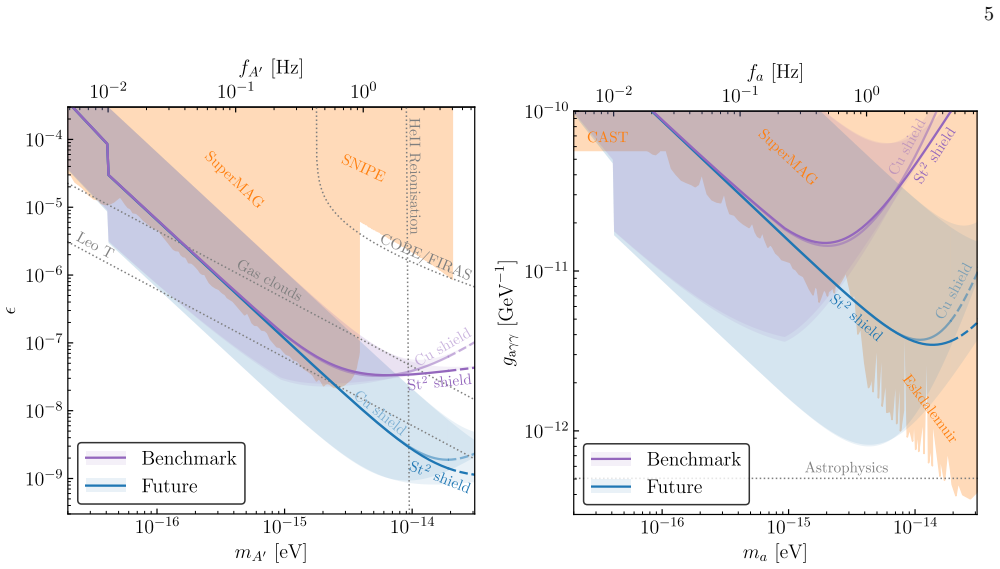
Preparing a trapped ion in a spin-motion entangled Schrödinger cat state allows the ion to function as a matter-wave interferometer that accumulates an Aharonov-Bohm-like phase shift from the magnetic field sourced by ultralight dark matter. Accounting for the relevant boundary conditions, the resulting sensitivity lets one trapped ion explore new portions of the kinetically mixed dark-photon parameter space for masses between roughly 10^{-15} eV and 10^{-14} eV, while the same apparatus simultaneously provides a probe of axion-like particle dark matter in the same interval.
What carries the argument
The spin-motion entangled Schrödinger cat state of a single trapped ion, which functions as a matter-wave interferometer that registers the Aharonov-Bohm phase shift induced by the dark-matter vector potential.
If this is right
- A table-top ion trap can access dark-photon parameter space not covered by existing searches.
- The same apparatus provides an independent probe of axion-like particles in the 10^{-15}–10^{-14} eV window.
- Quantum control techniques developed for information processing can be repurposed for ultralight dark-matter detection.
- Sensitivity scales with the degree of spin-motion entanglement, offering a clear path for improvement with better state preparation.
Where Pith is reading between the lines
- Extending the method to chains of ions could increase the effective sensing volume without requiring larger traps.
- The same phase-shift readout might be adapted to search for other light vector or pseudoscalar fields that couple to electromagnetism.
- If coherence requirements are met, the approach offers a low-cost, high-repetition-rate alternative to cavity or haloscope experiments in the same mass band.
Load-bearing premise
The ion can be prepared and kept in the entangled cat state long enough for the dark-matter field to produce a detectable phase shift before decoherence from the trap or environment dominates.
What would settle it
A direct measurement showing that coherence times in current ion traps fall short of the integration time needed to accumulate the predicted phase shift for dark-photon fields in the target mass window.
Figures
read the original abstract
We explore how recent advances in the manipulation of single-ion wave packets open new avenues for detecting weak magnetic fields sourced by ultralight dark matter. A trapped ion in a ``Schr\"odinger cat'' state can be prepared with its spin and motional degrees of freedom entangled and be used as a matter-wave interferometer that is sensitive to the Aharonov-Bohm-like phase shift accumulated by the ion over its trajectory. The result of the spin-motion entanglement is a parametrically-enhanced sensitivity to weak magnetic fields as compared with an un-entangled ion in a trap. Taking into account the relevant boundary conditions, we demonstrate that a single trapped ion can probe unexplored regions of kinetically-mixed dark-photon dark matter parameter space in the $10^{-15}~\text{eV} \lesssim m_{A'} \lesssim 10^{-14}$~eV mass window. We also show how such a table-top quantum device will also serve as a complementary probe of axion-like particle dark matter in the same mass window.
Editorial analysis
A structured set of objections, weighed in public.
Referee Report
Summary. The paper proposes using a single trapped ion prepared in a spin-motion entangled Schrödinger cat state as a matter-wave interferometer to detect ultralight dark matter. It focuses on kinetically mixed dark-photon DM (and axion-like particles) in the 10^{-15} eV to 10^{-14} eV mass window, claiming that accounting for relevant boundary conditions allows the device to probe unexplored parameter space via an Aharonov-Bohm-like phase shift induced by the DM-sourced oscillating magnetic field. The parametric enhancement from entanglement is presented as key to achieving competitive sensitivity in a table-top setup.
Significance. If the coherence and phase-shift assumptions hold, this would provide a novel quantum-sensor approach to ultralight DM searches, leveraging recent ion-trap advances for enhanced sensitivity in a mass range that is difficult for other methods. The work highlights a potential complementarity to existing experiments and could stimulate further development of entangled matter-wave interferometers for fundamental physics.
major comments (2)
- [sensitivity projection and boundary-condition treatment] The central sensitivity projection requires that the spin-motion cat state maintains coherence over integration times of seconds to minutes to accumulate a detectable phase shift from the ~0.2 Hz DM field oscillation (for m_{A'} ~ 10^{-15} eV). No quantitative model of decoherence from electric-field noise, trap anharmonicity, or motional heating is provided, despite these effects scaling with separation squared and known to limit cat-state lifetimes in current traps well below the needed durations. This assumption is load-bearing for the claim of probing unexplored parameter space.
- [phase-shift calculation] The abstract states that boundary conditions are taken into account and a demonstration is performed, but without the full derivation or numerical details of the phase-shift calculation it is not possible to verify whether gaps exist or whether optimistic coherence assumptions are implicit.
minor comments (1)
- [Abstract] The abstract could explicitly reference the section containing the coherence-time estimates or decoherence analysis to help readers assess the feasibility claims.
Simulated Author's Rebuttal
We thank the referee for their careful and constructive review of our manuscript. We have addressed the major comments by providing additional details on decoherence and expanding the phase-shift derivation in the revised version. Our responses to each point are given below.
read point-by-point responses
-
Referee: [sensitivity projection and boundary-condition treatment] The central sensitivity projection requires that the spin-motion cat state maintains coherence over integration times of seconds to minutes to accumulate a detectable phase shift from the ~0.2 Hz DM field oscillation (for m_{A'} ~ 10^{-15} eV). No quantitative model of decoherence from electric-field noise, trap anharmonicity, or motional heating is provided, despite these effects scaling with separation squared and known to limit cat-state lifetimes in current traps well below the needed durations. This assumption is load-bearing for the claim of probing unexplored parameter space.
Authors: We acknowledge that the original manuscript did not include a quantitative decoherence analysis, which is a valid concern for the projected sensitivities. In the revised manuscript we have added a dedicated subsection (Section IV.C) with order-of-magnitude estimates for the dominant decoherence channels—electric-field noise, trap anharmonicity, and motional heating—using parameters from recent ion-trap experiments. These estimates indicate that coherence times of several seconds remain feasible for the cat-state separations considered when using established sympathetic cooling and dynamical decoupling techniques. We also note that the parametric enhancement inherent to the entangled state permits a reduction in spatial separation or integration time while preserving sensitivity, thereby relaxing the coherence requirements. References to experimental demonstrations of long-lived cat states have been included. revision: yes
-
Referee: [phase-shift calculation] The abstract states that boundary conditions are taken into account and a demonstration is performed, but without the full derivation or numerical details of the phase-shift calculation it is not possible to verify whether gaps exist or whether optimistic coherence assumptions are implicit.
Authors: We agree that additional detail is needed for independent verification. The revised manuscript now includes an expanded derivation in the main text (Section III) together with a new appendix (Appendix B) that presents the complete analytic expression for the Aharonov-Bohm-like phase shift, explicitly incorporating the boundary conditions imposed by the trap electrodes and the finite wavelength of the dark-photon-sourced magnetic field. Numerical results for the 10^{-15}–10^{-14} eV mass window are provided, confirming that the boundary corrections remain small but are fully accounted for. No implicit assumptions about coherence beyond the estimates added in response to the first comment are used in the phase calculation. revision: yes
Circularity Check
No significant circularity; sensitivity projection derived from standard QM and DM field modeling
full rationale
The paper calculates the Aharonov-Bohm phase shift for a spin-motion entangled ion state under dark-photon-sourced magnetic fields, incorporating boundary conditions explicitly in the derivation. This follows from the Schrödinger equation and the ultralight DM vector field equations without fitting parameters to the target mass window or renaming prior results. No load-bearing step reduces the projected reach to a self-defined quantity or self-citation chain. The coherence-time assumption is an external experimental limitation rather than a definitional input, leaving the central claim self-contained against external benchmarks.
Axiom & Free-Parameter Ledger
axioms (2)
- domain assumption The ion trap allows preparation and maintenance of a spin-motion entangled state with coherence time sufficient for phase accumulation
- domain assumption Dark-photon dark matter produces a weak oscillating magnetic field via kinetic mixing that can be treated as a classical background
Lean theorems connected to this paper
-
IndisputableMonolith/Foundation/AlexanderDuality.leanalexander_duality_circle_linking (D=3 forcing) unclear?
unclearRelation between the paper passage and the cited Recognition theorem.
A trapped ion in a “Schrödinger cat” state ... sensitive to the Aharonov-Bohm-like phase shift ... parametrically-enhanced sensitivity to weak magnetic fields ... probe unexplored regions of kinetically-mixed dark-photon dark matter parameter space in the 10^{-15} eV ≲ m_{A'} ≲ 10^{-14} eV mass window.
-
IndisputableMonolith/Cost/FunctionalEquation.leanwashburn_uniqueness_aczel (J-cost uniqueness) unclear?
unclearRelation between the paper passage and the cited Recognition theorem.
B_DP ~ -ϵ m_A'^2 L A' with L = R_⊕ ... shielding efficiency η ... ambient magnetic field noise ... shot noise δϕ_shot = 1/√Hz
What do these tags mean?
- matches
- The paper's claim is directly supported by a theorem in the formal canon.
- supports
- The theorem supports part of the paper's argument, but the paper may add assumptions or extra steps.
- extends
- The paper goes beyond the formal theorem; the theorem is a base layer rather than the whole result.
- uses
- The paper appears to rely on the theorem as machinery.
- contradicts
- The paper's claim conflicts with a theorem or certificate in the canon.
- unclear
- Pith found a possible connection, but the passage is too broad, indirect, or ambiguous to say the theorem truly supports the claim.
Forward citations
Cited by 2 Pith papers
-
Searching for axions with quantum interferometry
Axion-photon coupling imprints measurable Aharonov-Bohm and Berry phases in superconducting circuits and interferometers, projecting sensitivity to g_aγγ ~ 7.8e-14 GeV^{-1} at m_a ~ 1e-10 eV.
-
Super-Heisenberg protocol for dark matter and high-frequency gravitational wave search
A protocol using squeezed states in 2D ion crystals in a Penning trap achieves super-Heisenberg sensitivity for axion-like particles, dark photons, and high-frequency gravitational waves while accounting for decoherence.
Reference graph
Works this paper leans on
-
[1]
G. Higgins, S. Kalia, and Z. Liu, Phys. Rev. D 109, 055024 (2024), arXiv:2310.18398 [hep-ph]
- [2]
- [3]
- [4]
- [5]
- [6]
- [7]
- [9]
-
[10]
J. Mizrahi, C. Senko, B. Neyenhuis, K. G. Johnson, W. C. Campbell, C. W. S. Conover, and C. Monroe, Phys. Rev. Lett. 110, 203001 (2013)
work page 2013
-
[11]
J. Mizrahi, B. Neyenhuis, K. G. Johnson, W. C. Camp- bell, C. Senko, D. Hayes, and C. Monroe, Applied Physics B 114, 45 (2014)
work page 2014
-
[12]
W. C. Campbell and P. Hamilton, Journal of Physics B: Atomic, Molecular and Optical Physics 50, 064002 (2017), arXiv:1609.00659 [physics.atom-ph]
work page internal anchor Pith review Pith/arXiv arXiv 2017
- [13]
- [14]
- [15]
- [16]
- [17]
- [18]
-
[19]
J. D. Jackson, Classical Electrodynamics (Wiley, 1998)
work page 1998
-
[20]
C. Constable and S. Constable, Physics of the Earth and Planetary Interiors 344, 107090 (2023)
work page 2023
-
[21]
M. F¨ ullekrug and A. C. Fraser-Smith, Geophysical Re- search Letters 38 (2011)
work page 2011
- [22]
-
[23]
D. M. Greenberger, M. A. Horne, and A. Zeilinger, Fundam. Theor. Phys. 37, 69 (1989), arXiv:0712.0921 [quant-ph]
work page internal anchor Pith review Pith/arXiv arXiv 1989
-
[24]
D. M. Greenberger, M. A. Horne, A. Shimony, and A. Zeilinger, Am. J. Phys. 58, 1131 (1990)
work page 1990
-
[25]
P. Fisk, M. Sellars, M. Lawn, and G. Coles, IEEE Trans- actions on Ultrasonics, Ferroelectrics, and Frequency Control 44, 344 (1997)
work page 1997
-
[26]
W. C. Campbell, J. Mizrahi, Q. Quraishi, C. Senko, D. Hayes, D. Hucul, D. N. Matsukevich, P. Maunz, and C. Monroe, Phys. Rev. Lett. 105, 090502 (2010)
work page 2010
- [27]
-
[28]
R. Saito and T. Mukaiyama, Phys. Rev. A 104, 053114 (2021), arXiv:2103.16308 [quant-ph]
-
[29]
S. A. Moses et al., Phys. Rev. X 13, 041052 (2023)
work page 2023
- [30]
- [31]
- [32]
-
[33]
M. Jiang et al. , Nature Commun. 15, 3331 (2024), arXiv:2305.00890 [quant-ph]
-
[34]
A. Nishizawa, A. Taruya, and Y. Himemoto, (2025), arXiv:2504.07559 [hep-ph]
- [35]
-
[36]
K. Altenm¨ ulleret al. (CAST), Phys. Rev. Lett. 133, 221005 (2024), arXiv:2406.16840 [hep-ex]
-
[37]
D. Wadekar and G. R. Farrar, Phys. Rev. D103, 123028 (2021), arXiv:1903.12190 [hep-ph]
-
[38]
Dark Photon Oscillations in Our Inhomogeneous Universe,
A. Caputo, H. Liu, S. Mishra-Sharma, and J. T. Ruderman, Phys. Rev. Lett. 125, 221303 (2020), arXiv:2002.05165 [astro-ph.CO]
- [39]
-
[40]
G. Arsenadze, A. Caputo, X. Gan, H. Liu, and J. T. Ruderman, JHEP 03, 018, arXiv:2409.12940 [astro- ph.CO]
- [41]
- [42]
-
[43]
M. C. D. Marsh, H. R. Russell, A. C. Fabian, B. P. McNamara, P. Nulsen, and C. S. Reynolds, JCAP 12, 036, arXiv:1703.07354 [hep-ph]
work page internal anchor Pith review Pith/arXiv arXiv
- [44]
-
[45]
C. Dessert, J. W. Foster, and B. R. Safdi, Phys. Rev. Lett. 125, 261102 (2020), arXiv:2008.03305 [hep-ph]
- [46]
-
[47]
O. Ning and B. R. Safdi, Phys. Rev. Lett. 134, 171003 (2025), arXiv:2404.14476 [hep-ph]
-
[48]
T. Monz, P. Schindler, J. T. Barreiro, M. Chwalla, D. Nigg, W. A. Coish, M. Harlander, W. H¨ ansel, M. Hennrich, and R. Blatt, Phys. Rev. Lett. 106, 130506 (2011)
work page 2011
-
[49]
Y. Zhao, R. Zhang, W. Chen, X.-B. Wang, and J. Hu, npj Quantum Information 7, 24 (2021)
work page 2021
-
[50]
R. G. Barrera, G. A. Estevez, and J. Giraldo, European 8 Journal of Physics 6, 287 (1985)
work page 1985
-
[51]
Solutions to Axion Electrodynamics in Various Geometries
J. Ouellet and Z. Bogorad, Phys. Rev. D 99, 055010 (2019), arXiv:1809.10709 [hep-ph]
work page internal anchor Pith review Pith/arXiv arXiv 2019
-
[52]
Alken et al., Earth, Planets and Space 73, 49 (2021)
P. Alken et al., Earth, Planets and Space 73, 49 (2021)
work page 2021
-
[53]
Hoburg, IEEE Transactions on Electromagnetic Compatibility 37, 574 (1995)
J. Hoburg, IEEE Transactions on Electromagnetic Compatibility 37, 574 (1995)
work page 1995
-
[54]
S. S. Wilks, Annals Math. Statist. 9, 60 (1938)
work page 1938
-
[55]
Asymptotic formulae for likelihood-based tests of new physics
G. Cowan, K. Cranmer, E. Gross, and O. Vitells, Eur. Phys. J. C 71, 1554 (2011), [Erratum: Eur.Phys.J.C 73, 2501 (2013)], arXiv:1007.1727 [physics.data-an]
work page internal anchor Pith review Pith/arXiv arXiv 2011
- [56]
-
[57]
L. Badurina, A. Beniwal, and C. McCabe, Phys. Rev. D 108, 083016 (2023), arXiv:2306.16477 [hep-ph]
-
[58]
Variable Stars: which Nyquist Frequency ?
L. Eyer and P. Bartholdi, Astron. Astrophys. Suppl. Ser. 135, 1 (1999), arXiv:astro-ph/9808176
work page internal anchor Pith review Pith/arXiv arXiv 1999
-
[59]
Koen, Monthly Notices of the Royal Astronomical Society 371, 1390 (2006)
C. Koen, Monthly Notices of the Royal Astronomical Society 371, 1390 (2006)
work page 2006
-
[60]
L. Mandel and E. Wolf,Optical Coherence and Quantum Optics (Cambridge Univ. Pr., 1995). 9 Ultralight dark matter detection with trapped-ion interferometry Supplemental Material Leonardo Badurina, Diego Blas, John Ellis, Sebastian A. R. Ellis In the following, we provide additional details in support of the results presented in the main body of this work. ...
work page 1995
-
[61]
Thermal Phonons If there is a non-zero thermal occupation of phonon modes ¯n in the trap, the Glauber-Sudarshan P -representation that must be integrated over is P (αi) = e−|αi|2/¯ni π¯ni , (S66) where the occupation numbers ¯ni in the x and y directions may differ. When evaluating the probability P[↑] with these P -representations, we find P[↑] = 1 2 1 +...
-
[62]
Semi-Classical Treatment of Imperfections As discussed in the main text, a serious possible source of error is anharmonicity in the trap potential. In this case, the trap potential is modelled as V (x, y) = κxx2 + κyy2 + κxyxy + γxx3 + γyy3 + γxyx2y + γyxxy2 + λxx4 + λyy4 + . . . , (S68) where the κij, γ i(j), λ i coefficients are treated phenomenological...
discussion (0)
Sign in with ORCID, Apple, or X to comment. Anyone can read and Pith papers without signing in.