Recognition: unknown
Searching for axions with quantum interferometry
Pith reviewed 2026-05-10 14:32 UTC · model grok-4.3
The pith
Axion dark matter imprints a measurable Aharonov-Bohm phase in rf-SQUIDs that reaches couplings of 7.8×10^{-14} GeV^{-1}.
A machine-rendered reading of the paper's core claim, the machinery that carries it, and where it could break.
Core claim
Axion-photon interactions imprint both Aharonov-Bohm and Berry phases in experimentally motivated quantum setups. For a coherently oscillating axion dark matter background, the induced effective current generates a time dependent magnetic flux in an rf-SQUID, leading to a measurable voltage signal through the Josephson phase. For representative benchmarks this AB phase search reaches the minimum axion-photon coupling g_aγγ^min ∼ 7.8×10^{-14} GeV^{-1} at axion mass m_a ∼ 10^{-10} eV, with projected sensitivity that can improve on existing limits by one to two orders of magnitude. A geometric phase is also identified in a Mach-Zehnder interferometer with an adiabatically rotating magneticfield
What carries the argument
The time-dependent magnetic flux generated by the axion-induced effective current inside an rf-SQUID, which is read out through the resulting Josephson phase and voltage.
If this is right
- The AB-phase search reaches g_aγγ min ∼ 7.8×10^{-14} GeV^{-1} at m_a ∼ 10^{-10} eV.
- Projected sensitivity improves existing limits by one to two orders of magnitude in that mass window.
- A Mach-Zehnder interferometer with rotating magnetic field furnishes a geometric-phase probe of meV-scale axions even if they are not dark matter.
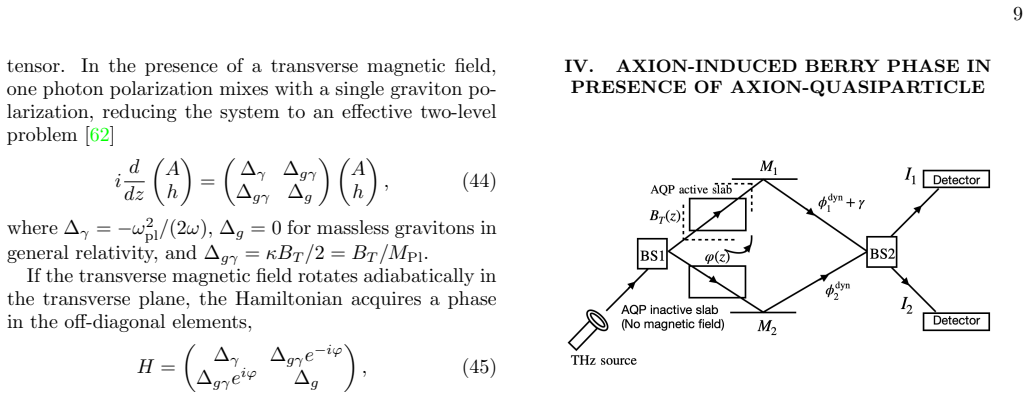
- In a three-level photon-axion quasiparticle system the Berry phase becomes measurable at THz frequencies and is dominated by the quasiparticle sector.
- Quantum phase observables in superconducting circuits provide a new framework for axion searches with immediate phenomenological reach.
Where Pith is reading between the lines
- The same phase imprinting could be combined with quantum-enhanced readout techniques to push sensitivity further.
- The approach may extend to other light particles that couple to electromagnetism through similar effective currents.
- Tabletop realization would test whether the axion-induced flux remains distinguishable from environmental fluctuations over long observation times.
Load-bearing premise
A coherently oscillating axion dark matter background produces a clean time-dependent magnetic flux inside an rf-SQUID that is not overwhelmed by thermal noise, flux trapping, or Josephson-junction decoherence.
What would settle it
An rf-SQUID experiment that records no voltage signal above background at the frequency corresponding to axion mass 10^{-10} eV after sufficient integration time would rule out the projected sensitivity.
Figures


read the original abstract
Quantum phase measurements offer a complementary route to axion searches. We show that axion-photon interactions can imprint both Aharonov-Bohm (AB) and Berry phases in experimentally motivated quantum setups. For a coherently oscillating axion dark matter background, the induced effective current generates a time dependent magnetic flux in an rf-SQUID, leading to a measurable voltage signal through the Josephson phase. For representative benchmarks, this AB phase search reaches the minimum axion-photon coupling $g_{a\gamma\gamma}^{\mathrm{min}}\sim 7.8\times10^{-14}~\mathrm{GeV}^{-1}$ at axion mass $m_a\sim 10^{-10}~\mathrm{eV}$, with projected sensitivity that can improve on existing limits in that parameter space by roughly one to two orders of magnitude. We also identify a geometric phase observable in a Mach-Zehnder interferometer with an adiabatically rotating magnetic field, providing a proof-of-principle phase-based probe of meV-scale axions even when they do not constitute the dark matter, although sensitivity on the coupling remains weaker than current bounds with conservative tabletop benchmarks. Extending the analysis to a three level photon-axion quasiparticle (AQP)-axion system, with the AQP realized in a topological magnetic insulator, we find a potentially measurable THz Berry phase dominated by the AQP sector, furnishing a nontrivial validation of the formalism in a richer coupled system. These setups establish quantum phase observables as a useful new framework for axion searches, with immediate phenomenological promise in superconducting circuits and longer term potential in quantum enhanced interferometry.
Editorial analysis
A structured set of objections, weighed in public.
Referee Report
Summary. The manuscript proposes using quantum phase observables—specifically Aharonov-Bohm phase shifts induced by axion-photon coupling in an rf-SQUID and Berry phases in a Mach-Zehnder interferometer or three-level axion-quasiparticle system—to search for axions. For coherently oscillating axion dark matter, it derives a time-dependent flux through the SQUID loop that produces a measurable Josephson voltage, projecting a minimum coupling sensitivity of g_aγγ^min ∼ 7.8×10^{-14} GeV^{-1} at m_a ∼ 10^{-10} eV that improves existing limits by 1–2 orders of magnitude; a weaker but proof-of-principle Berry-phase signal is also claimed for meV-scale axions and a THz-scale AQP system.
Significance. If the noise and decoherence assumptions hold, the work would establish quantum interferometry in superconducting circuits as a viable new channel for ultra-light axion dark matter, complementary to existing haloscope and helioscope approaches, with immediate experimental accessibility in existing rf-SQUID technology.
major comments (3)
- [rf-SQUID analysis / abstract benchmark] The central sensitivity projection (abstract and the rf-SQUID benchmark section) converts the axion-induced effective current directly into flux and Josephson voltage but provides no explicit noise spectral density S_Φ(f), thermal-noise floor, 1/f-noise contribution, or flux-trapping probability at f ≈ 24 kHz; without these the quoted one-to-two-order improvement cannot be verified and rests on the untested assumption that the signal exceeds integrated noise.
- [rf-SQUID analysis] The claim that the induced voltage is measurable above background (abstract and SQUID section) omits a systematic-error budget for Josephson-junction decoherence, loop inductance variations, and temperature-dependent critical-current fluctuations; these are load-bearing for the g_aγγ^min figure because any realistic degradation would erase the projected improvement.
- [Mach-Zehnder / AQP sections] The Berry-phase calculation for the Mach-Zehnder and AQP systems (later sections) is presented as a proof-of-principle but lacks a quantitative comparison of the phase shift magnitude against realistic interferometer visibility and phase-noise limits, leaving the statement that sensitivity is “weaker than current bounds” without a clear numerical anchor.
minor comments (2)
- [SQUID section] Notation for the axion-induced effective current and the conversion to flux should be defined explicitly with an equation number rather than left implicit in the text.
- [abstract] The abstract quotes a precise numerical sensitivity (7.8×10^{-14}) without referencing the device parameters (area, inductance, temperature) used to obtain it; a short table or footnote would improve reproducibility.
Simulated Author's Rebuttal
We thank the referee for the careful and constructive review of our manuscript on axion searches via quantum phase observables. The comments highlight important aspects of noise modeling and quantitative validation that will strengthen the presentation. We address each major comment below and will incorporate the suggested clarifications in the revised version.
read point-by-point responses
-
Referee: [rf-SQUID analysis / abstract benchmark] The central sensitivity projection (abstract and the rf-SQUID benchmark section) converts the axion-induced effective current directly into flux and Josephson voltage but provides no explicit noise spectral density S_Φ(f), thermal-noise floor, 1/f-noise contribution, or flux-trapping probability at f ≈ 24 kHz; without these the quoted one-to-two-order improvement cannot be verified and rests on the untested assumption that the signal exceeds integrated noise.
Authors: We agree that an explicit noise analysis is required to substantiate the projected sensitivity. In the revised manuscript we will add a dedicated subsection deriving the flux noise spectral density S_Φ(f) from standard rf-SQUID models, including the thermal-noise floor at typical operating temperatures (∼ 4 K) and an estimate of the 1/f contribution at ∼24 kHz. We will also provide a conservative upper bound on flux-trapping probability drawn from existing SQUID literature and demonstrate that the axion-induced voltage signal remains above the integrated noise for the benchmark parameters, thereby confirming the claimed one-to-two-order improvement under realistic conditions. revision: yes
-
Referee: [rf-SQUID analysis] The claim that the induced voltage is measurable above background (abstract and SQUID section) omits a systematic-error budget for Josephson-junction decoherence, loop inductance variations, and temperature-dependent critical-current fluctuations; these are load-bearing for the g_aγγ^min figure because any realistic degradation would erase the projected improvement.
Authors: We acknowledge the need for a systematic-error budget. The revised rf-SQUID section will include quantitative estimates for Josephson-junction decoherence times, loop-inductance variations, and critical-current fluctuations based on published rf-SQUID data. Using conservative values, we will show that these effects introduce at most a factor-of-two degradation in the effective sensitivity, which still leaves the projected g_aγγ^min competitive with existing limits. If the analysis indicates a larger impact, we will adjust the benchmark accordingly and state the revised figure explicitly. revision: yes
-
Referee: [Mach-Zehnder / AQP sections] The Berry-phase calculation for the Mach-Zehnder and AQP systems (later sections) is presented as a proof-of-principle but lacks a quantitative comparison of the phase shift magnitude against realistic interferometer visibility and phase-noise limits, leaving the statement that sensitivity is “weaker than current bounds” without a clear numerical anchor.
Authors: We agree that a direct numerical comparison will make the proof-of-principle statements more transparent. In the revised Mach-Zehnder and AQP sections we will add explicit calculations comparing the axion-induced Berry phase shift to representative interferometer visibility (∼90 %) and phase-noise floors reported for tabletop Mach-Zehnder and THz AQP devices. These numbers will anchor the statement that the resulting sensitivity remains weaker than current bounds while still demonstrating a measurable phase signal under conservative assumptions. revision: yes
Circularity Check
No circularity: sensitivity projections are forward calculations from standard axion-photon coupling and phase formulas
full rationale
The central result (g_aγγ^min ∼ 7.8×10^{-14} GeV^{-1} at m_a ∼ 10^{-10} eV) is obtained by applying the axion-photon interaction Lagrangian to a coherently oscillating DM background, computing the induced time-dependent flux through an rf-SQUID loop, and converting to Josephson voltage using standard device parameters and phase relations. This is a parameter-based projection, not a fit to data or a self-referential definition. No load-bearing step reduces to a self-citation chain, fitted input renamed as prediction, or ansatz smuggled via prior work by the same authors. The derivation remains self-contained against external benchmarks (standard QED effective theory and SQUID physics) and does not exhibit any of the enumerated circularity patterns.
Axiom & Free-Parameter Ledger
axioms (2)
- domain assumption Axions couple to photons through the interaction term g_aγγ a F F̃
- domain assumption Quantum phase shifts (Aharonov-Bohm and Berry) remain measurable in the proposed superconducting and interferometric setups under realistic conditions
Forward citations
Cited by 1 Pith paper
-
Searching for ultralight bosons with Josephson junction interferometry
Josephson junctions can detect ultralight boson potentials through induced phase shifts, enabling probes of photophilic scalars, Lorentz-violating scalars, and axion monopole-dipole interactions depending on source po...
Reference graph
Works this paper leans on
-
[1]
andω∼1.2 eV, the oscillation scale is ∆ osc ∼ m2 g/(2ω)∼4×10 −49 eV, requiringdφ/dz≪4×10 −49 eV for adiabatic evolution (see Eq. (41)). However, in a real- istic laboratory setup with magnetic-field variation over Lrot ∼1 m, one hasdφ/dz∼2π/L rot ∼10 −6 eV, which violates the adiabaticity condition by many orders of magnitude. Consequently, despite a form...
-
[2]
An Improved Experimental Limit on the Electric Dipole Moment of the Neutron
C. A. Bakeret al., “An Improved experimental limit on the electric dipole moment of the neutron,”Phys. Rev. Lett.97(2006) 131801,arXiv:hep-ex/0602020
work page Pith review arXiv 2006
-
[3]
CP Conservation in the Presence of Instantons,
R. D. Peccei and H. R. Quinn, “CP Conservation in the Presence of Instantons,”Phys. Rev. Lett.38 (1977) 1440–1443
1977
-
[4]
A New Light Boson?,
S. Weinberg, “A New Light Boson?,”Phys. Rev. Lett. 40(1978) 223–226
1978
-
[5]
Constraints Imposed by CP Conservation in the Presence of Instantons,
R. D. Peccei and H. R. Quinn, “Constraints Imposed by CP Conservation in the Presence of Instantons,” Phys. Rev. D16(1977) 1791–1797
1977
-
[6]
Problem of StrongPandTInvariance in the Presence of Instantons,
F. Wilczek, “Problem of StrongPandTInvariance in the Presence of Instantons,”Phys. Rev. Lett.40 (1978) 279–282
1978
-
[7]
Axial vector vertex in spinor electrodynamics,
S. L. Adler, “Axial vector vertex in spinor electrodynamics,”Phys. Rev.177(1969) 2426–2438
1969
-
[8]
A PCAC puzzle:π 0 →γγ in theσmodel,
J. S. Bell and R. Jackiw, “A PCAC puzzle:π 0 →γγ in theσmodel,”Nuovo Cim. A60(1969) 47–61
1969
-
[9]
The Strong CP Problem and Axions
R. D. Peccei, “The Strong CP problem and axions,” Lect. Notes Phys.741(2008) 3–17, arXiv:hep-ph/0607268
work page Pith review arXiv 2008
-
[10]
Axions and the Strong CP Problem,
J. E. Kim and G. Carosi, “Axions and the Strong CP Problem,”Rev. Mod. Phys.82(2010) 557–602, arXiv:0807.3125 [hep-ph]. [Erratum: Rev.Mod.Phys. 91, 049902 (2019)]
-
[11]
Cosmology of the Invisible Axion,
J. Preskill, M. B. Wise, and F. Wilczek, “Cosmology of the Invisible Axion,”Phys. Lett. B120(1983) 127–132
1983
-
[12]
A Cosmological Bound on the Invisible Axion,
L. F. Abbott and P. Sikivie, “A Cosmological Bound on the Invisible Axion,”Phys. Lett. B120(1983) 133–136
1983
-
[13]
The Not So Harmless Axion,
M. Dine and W. Fischler, “The Not So Harmless Axion,”Phys. Lett. B120(1983) 137–141
1983
-
[14]
P. Svrcek and E. Witten, “Axions In String Theory,” JHEP06(2006) 051,arXiv:hep-th/0605206
work page Pith review arXiv 2006
-
[15]
D. J. E. Marsh, “Axion Cosmology,”Phys. Rept.643 (2016) 1–79,arXiv:1510.07633 [astro-ph.CO]
work page Pith review arXiv 2016
-
[16]
A. Arvanitaki, S. Dimopoulos, S. Dubovsky, N. Kaloper, and J. March-Russell, “String Axiverse,” Phys. Rev. D81(2010) 123530,arXiv:0905.4720 [hep-th]
work page internal anchor Pith review arXiv 2010
-
[17]
cajohare/axionlimits: Axionlimits
C. O’Hare, “cajohare/axionlimits: Axionlimits.” https://cajohare.github.io/AxionLimits/, July, 2020
2020
-
[18]
A. Arzaet al., “The COSMIC WISPers White Paper: The physics case for Weakly Interacting Slim Particles,”arXiv:2603.03433 [hep-ph]
-
[19]
A new era in the search for dark matter,
G. Bertone and T. Tait, M. P., “A new era in the search for dark matter,”Nature562no. 7725, (2018) 51–56,arXiv:1810.01668 [astro-ph.CO]. 17
-
[20]
Axion dark matter: What is it and why now?,
F. Chadha-Day, J. Ellis, and D. J. E. Marsh, “Axion dark matter: What is it and why now?,”Sci. Adv.8 no. 8, (2022) abj3618,arXiv:2105.01406 [hep-ph]
-
[21]
Cosmology of axion dark matter,
C. A. J. O’Hare, “Cosmology of axion dark matter,” PoSCOSMICWISPers(2024) 040, arXiv:2403.17697 [hep-ph]
-
[22]
A SQUID-based microwave cavity search for dark-matter axions
S. J. Asztalos, G. Carosi, C. Hagmann, D. Kinion, K. van Bibber, M. Hotz, L. J. Rosenberg, G. Rybka, J. Hoskins, J. Hwang, P. Sikivie, D. B. Tanner, R. Bradley, J. Clarke, and ADMX Collaboration, “SQUID-Based Microwave Cavity Search for Dark-Matter Axions,”Phys. Rev. Lett.104no. 4, (Jan., 2010) 041301,arXiv:0910.5914 [astro-ph.CO]. [22]ADMXCollaboration, ...
work page Pith review arXiv 2010
-
[23]
ADMX SLIC: Results from a Superconducting LC Circuit Investigating Cold Axions,
N. Crisosto, P. Sikivie, N. S. Sullivan, D. B. Tanner, J. Yang, and G. Rybka, “ADMX SLIC: Results from a SuperconductingLCCircuit Investigating Cold Axions,”Phys. Rev. Lett.124no. 24, (2020) 241101, arXiv:1911.05772 [astro-ph.CO]
-
[24]
Stern,ADMX Status,PoSICHEP2016(2016) 198 [1612.08296]
I. Stern, “ADMX Status,”PoSICHEP2016(2016) 198,arXiv:1612.08296 [physics.ins-det]
-
[25]
First results from a microwave cavity axion search at 24µeV,
B. M. Brubakeret al., “First results from a microwave cavity axion search at 24µeV,”Phys. Rev. Lett.118 no. 6, (2017) 061302,arXiv:1610.02580 [astro-ph.CO]. [30]HAYSTACCollaboration, L. Zhonget al., “Results from phase 1 of the HAYSTAC microwave cavity axion experiment,”Phys. Rev. D97no. 9, (2018) 092001, arXiv:1803.03690 [hep-ex]. [31]HAYSTACCollaboratio...
-
[26]
S. Beurtheyet al., “MADMAX Status Report,” arXiv:2003.10894 [physics.ins-det]
-
[27]
First Results from ABRACADABRA-10 cm: A Search for Sub- µeV Ax- ion Dark Matter,
J. L. Ouelletet al., “First Results from ABRACADABRA-10 cm: A Search for Sub-µeV Axion Dark Matter,”Phys. Rev. Lett.122no. 12, (2019) 121802,arXiv:1810.12257 [hep-ex]
-
[28]
Search for Low-Mass Axion Dark Matter with ABRACADABRA-10 cm,
C. P. Salemiet al., “Search for Low-Mass Axion Dark Matter with ABRACADABRA-10 cm,”Phys. Rev. Lett.127no. 8, (2021) 081801,arXiv:2102.06722 [hep-ex]. [38]DMRadioCollaboration, L. Brouweret al., “Projected sensitivity of DMRadio-m3: A search for the QCD axion below 1µeV,”Phys. Rev. D106 no. 10, (2022) 103008,arXiv:2204.13781 [hep-ex]
-
[29]
Tunable axion plasma haloscopes,
M. Lawson, A. J. Millar, M. Pancaldi, E. Vitagliano, and F. Wilczek, “Tunable axion plasma haloscopes,” Phys. Rev. Lett.123no. 14, (2019) 141802, arXiv:1904.11872 [hep-ph]. [40]BREADCollaboration, J. Liuet al., “Broadband Solenoidal Haloscope for Terahertz Axion Detection,” Phys. Rev. Lett.128no. 13, (2022) 131801, arXiv:2111.12103 [physics.ins-det]. [41]...
-
[30]
M. Baryakhtar, J. Huang, and R. Lasenby, “Axion and hidden photon dark matter detection with multilayer optical haloscopes,”Phys. Rev. D98no. 3, (2018) 035006,arXiv:1803.11455 [hep-ph]
-
[31]
Search for Dark Matter Axions with CAST-CAPP,
C. M. Adairet al., “Search for Dark Matter Axions with CAST-CAPP,”Nature Commun.13no. 1, (2022) 6180,arXiv:2211.02902 [hep-ex]. [44]ORGANCollaboration, A. P. Quiskamp, G. R. Flower, S. Samuels, B. T. McAllister, P. Altin, E. N. Ivanov, M. Goryachev, and M. E. Tobar, “Near-quantum-limited axion dark matter search with the ORGAN experiment around 26µeV,”Phy...
- [32]
-
[33]
Proposal to Detect Dark Matter using Axionic Topological Antiferromagnets,
D. J. E. Marsh, K.-C. Fong, E. W. Lentz, L. Smejkal, and M. N. Ali, “Proposal to Detect Dark Matter using Axionic Topological Antiferromagnets,”Phys. Rev. Lett.123no. 12, (2019) 121601,arXiv:1807.08810 [hep-ph]
-
[34]
Axion quasiparticles for axion dark matter detection,
J. Sch¨ utte-Engel, D. J. E. Marsh, A. J. Millar, A. Sekine, F. Chadha-Day, S. Hoof, M. Ali, K.-C. Fong, E. Hardy, and L. ˇSmejkal, “Axion quasiparticles for axion dark matter detection,”JCAP08(2021) 066,arXiv:2102.05366 [hep-ph]
-
[35]
M. Cicoliet al., “Axions at the meV Crossroads: Theory, Cosmology, Astrophysics, and Experiments,” arXiv:2603.18167 [hep-ph]
-
[36]
Tunable wire metamaterials for an axion haloscope,
N. Kowitt, R. Balafendiev, D. Sun, M. Wooten, A. Droster, M. A. Gorlach, K. van Bibber, and P. A. Belov, “Tunable wire metamaterials for an axion haloscope,”Phys. Rev. Applied20no. 4, (2023) 18 044051,arXiv:2306.15734 [hep-ex]
-
[37]
Significance of electromagnetic potentials in the quantum theory,
Y. Aharonov and D. Bohm, “Significance of electromagnetic potentials in the quantum theory,” Phys. Rev.115(1959) 485–491
1959
-
[38]
Quantal phase factors accompanying adiabatic changes,
M. V. Berry, “Quantal phase factors accompanying adiabatic changes,”Proc. Roy. Soc. Lond. A392 (1984) 45–57
1984
-
[39]
Probing mixing of photons and axion-like particles by geometric phase,
A. Capolupo, G. Lambiaseand, and G. Vitiello, “Probing mixing of photons and axion-like particles by geometric phase,”Adv. High Energy Phys.2015 (2015) 826051,arXiv:1510.07288 [hep-ph]
-
[40]
Berry phase in axion physics, SM global structure, and generalized symmetries,
Q.-H. Cao, S. Ge, Y. Liu, and J.-C. Wang, “Berry phase in axion physics, SM global structure, and generalized symmetries,”arXiv:2411.04749 [hep-ph]
-
[41]
Hidden Photons in Aharonov-Bohm-Type Experiments,
P. Arias, C. Diaz, M. A. Diaz, J. Jaeckel, B. Koch, and J. Redondo, “Hidden Photons in Aharonov-Bohm-Type Experiments,”Phys. Rev. D94 no. 1, (2016) 015017,arXiv:1603.01282 [hep-ph]
-
[42]
Searching for dark matter axions with Berry phase,
G. Lambiase and G. Papini, “Searching for dark matter axions with Berry phase,”Eur. Phys. J. C82 no. 12, (2022) 1109
2022
-
[43]
Magnetoelectric polarizability and axion electrodynamics in crystalline insulators,
A. M. Essin, J. E. Moore, and D. Vanderbilt, “Magnetoelectric polarizability and axion electrodynamics in crystalline insulators,”Phys. Rev. Lett.102(2009) 146805,arXiv:0810.2998 [cond-mat.mes-hall]
-
[44]
Cheshireθterms, Aharonov-Bohm effects, and axions,
S. Chen, A. Cherman, G. Choi, and M. Neuzil, “Cheshireθterms, Aharonov-Bohm effects, and axions,”Phys. Rev. D112no. 4, (2025) 045012, arXiv:2410.23355 [hep-th]
-
[45]
Ultralight dark matter detection with trapped-ion interferometry
L. Badurina, D. Blas, J. Ellis, and S. A. R. Ellis, “Ultralight dark matter detection with trapped-ion interferometry,”arXiv:2507.17825 [hep-ph]
work page internal anchor Pith review arXiv
-
[46]
Enhanced Dark Matter Quantum Sensing via Geometric Phase,
X. Ma and J. Sheng, “Enhanced Dark Matter Quantum Sensing via Geometric Phase,” arXiv:2603.23599 [hep-ph]
-
[47]
M. M¨ uck, B. Chesca, and Y. Zhang,Radio Frequency SQUIDs and their Applications, pp. 505–540. Springer Netherlands, Dordrecht, 2001. https://doi.org/10.1007/978-94-010-0450-3_19
-
[48]
Tinkham,Introduction to superconductivity
M. Tinkham,Introduction to superconductivity. Dover Publications, Mineola, N.Y, 2nd ed. ed., 2004 - 1996
2004
-
[49]
Mixing of the Photon with Low Mass Particles,
G. Raffelt and L. Stodolsky, “Mixing of the Photon with Low Mass Particles,”Phys. Rev. D37(1988) 1237
1988
-
[50]
V. L. Ginzburg and L. D. Landau,On the Theory of Superconductivity, pp. 113–137. Springer Berlin Heidelberg, Berlin, Heidelberg, 2009. https://doi.org/10.1007/978-3-540-68008-6_4
-
[51]
J. I. Read, “The Local Dark Matter Density,”J. Phys. G41(2014) 063101,arXiv:1404.1938 [astro-ph.GA]
work page Pith review arXiv 2014
-
[52]
dc squid readout electronics with up to 100 mhz closed-loop bandwidth,
D. Drung, C. Assmann, J. Beyer, M. Peters, F. Ruede, and T. Schurig, “dc squid readout electronics with up to 100 mhz closed-loop bandwidth,”IEEE Transactions on Applied Superconductivity15no. 2, (2005) 777–780
2005
-
[53]
Model for 1/f Flux Noise in SQUIDs and Qubits,
R. H. Koch, D. P. DiVincenzo, and J. Clarke, “Model for 1/f Flux Noise in SQUIDs and Qubits,”Phys. Rev. Lett.98no. 26, (2007) 267003, arXiv:cond-mat/0702025
-
[54]
Low-drift broadband directly coupled dc squid read-out electronics,
N. Oukhanski, R. Stolz, V. Zakosarenko, and H.-G. Meyer, “Low-drift broadband directly coupled dc squid read-out electronics,”Physica C: Superconductivity 368no. 1, (2002) 166–170. https://www.sciencedirect.com/science/article/ pii/S0921453401011601
2002
-
[55]
Alesini et al., Galactic axions search with a superconducting resonant cavity, Phys
D. Alesiniet al., “Galactic axions search with a superconducting resonant cavity,”Phys. Rev. D99 no. 10, (2019) 101101,arXiv:1903.06547 [physics.ins-det]
-
[56]
D. Alesiniet al., “Search for invisible axion dark matter of mass m a = 43µeV with the QUAX–aγ experiment,”Phys. Rev. D103no. 10, (2021) 102004, arXiv:2012.09498 [hep-ex]
-
[57]
Alesini et al., Search for Galactic axions with a high-Q dielectric cavity, Phys
D. Alesiniet al., “Search for Galactic axions with a high-Q dielectric cavity,”Phys. Rev. D106no. 5, (2022) 052007,arXiv:2208.12670 [hep-ex]. [71]QUAXCollaboration, R. Di Voraet al., “Search for galactic axions with a traveling wave parametric amplifier,”Phys. Rev. D108no. 6, (2023) 062005, arXiv:2304.07505 [hep-ex]
-
[58]
Limits on the abundance and coupling of cosmic axions at 4.5< m a <5.0µeV,
S. DePanfilis, A. C. Melissinos, B. E. Moskowitz, J. T. Rogers, Y. K. Semertzidis, W. U. Wuensch, H. J. Halama, A. G. Prodell, W. B. Fowler, and F. A. Nezrick, “Limits on the abundance and coupling of cosmic axions at 4.5< m a <5.0µeV,”Phys. Rev. Lett.59(Aug, 1987) 839–842.https: //link.aps.org/doi/10.1103/PhysRevLett.59.839
-
[59]
Results of a Laboratory Search for Cosmic Axions and Other Weakly Coupled Light Particles,
W. Wuensch, S. De Panfilis-Wuensch, Y. K. Semertzidis, J. T. Rogers, A. C. Melissinos, H. J. Halama, B. E. Moskowitz, A. G. Prodell, W. B. Fowler, and F. A. Nezrick, “Results of a Laboratory Search for Cosmic Axions and Other Weakly Coupled Light Particles,”Phys. Rev. D40(1989) 3153
1989
-
[60]
Results from a search for cosmic axions,
C. Hagmann, P. Sikivie, N. S. Sullivan, and D. B. Tanner, “Results from a search for cosmic axions,” Phys. Rev. D42(Aug, 1990) 1297–1300.https: //link.aps.org/doi/10.1103/PhysRevD.42.1297
-
[61]
First results from a second generation galactic axion experiment
C. Hagmannet al., “First results from a second generation galactic axion experiment,”Nucl. Phys. B Proc. Suppl.51(1996) 209–212, arXiv:astro-ph/9607022. [76]ORGANCollaboration, B. T. McAllister, G. Flower, J. Kruger, E. N. Ivanov, M. Goryachev, J. Bourhill, and M. E. Tobar, “The ORGAN Experiment: An axion haloscope above 15 GHz,”Phys. Dark Univ.18 (2017) ...
work page Pith review arXiv 1996
-
[62]
A. Quiskamp, B. T. McAllister, P. Altin, E. N. Ivanov, M. Goryachev, and M. E. Tobar, “Exclusion of Axionlike-Particle Cogenesis Dark Matter in a Mass Window above 100µeV,”Phys. Rev. Lett.132no. 3, (2024) 031601,arXiv:2310.00904 [hep-ex]
-
[63]
J. A. Devlinet al., “Constraints on the Coupling between Axionlike Dark Matter and Photons Using an Antiproton Superconducting Tuned Detection Circuit in a Cryogenic Penning Trap,”Phys. Rev. Lett.126 no. 4, (2021) 041301,arXiv:2101.11290 [astro-ph.CO]
-
[64]
Ein neuer interferenzrefraktor,
L. Zehnder, “Ein neuer interferenzrefraktor,” Zeitschrift f¨ ur Instrumentenkunde11(August, 1891) 19 275–285
-
[65]
Ueber einen interferenzrefraktor,
L. Mach, “Ueber einen interferenzrefraktor,” Zeitschrift f¨ ur Instrumentenkunde12(March, 1892) 89–93
-
[66]
Homodyne demodulation scheme for fiber optic sensors using phase generated carrier,
A. Dandridge, A. Tveten, and T. Giallorenzi, “Homodyne demodulation scheme for fiber optic sensors using phase generated carrier,”IEEE Transactions on Microwave Theory and Techniques30 no. 10, (1982) 1635–1641
1982
-
[67]
Hariharan,Optical interferometry
P. Hariharan,Optical interferometry. Academic Press, Amsterdam ;, 2nd ed. ed., 2003.http://catdir.loc. gov/catdir/description/els041/2003050272.html
2003
-
[68]
Optics and interferometry with atoms and molecules,
A. D. Cronin, J. Schmiedmayer, and D. E. Pritchard, “Optics and interferometry with atoms and molecules,” Rev. Mod. Phys.81(Jul, 2009) 1051–1129.https: //link.aps.org/doi/10.1103/RevModPhys.81.1051
-
[69]
Revisiting the bound on axion-photon coupling from Globular Clusters,
A. Ayala, I. Dom´ ınguez, M. Giannotti, A. Mirizzi, and O. Straniero, “Revisiting the bound on axion-photon coupling from Globular Clusters,”Phys. Rev. Lett. 113no. 19, (2014) 191302,arXiv:1406.6053 [astro-ph.SR]
-
[70]
Advancing globular cluster constraints on the axion-photon coupling,
M. J. Dolan, F. J. Hiskens, and R. R. Volkas, “Advancing globular cluster constraints on the axion-photon coupling,”JCAP10(2022) 096, arXiv:2207.03102 [hep-ph]
-
[71]
Phase Sensitivity of a Mach-Zehnder Interferometer,
L. Pezze’ and A. Smerzi, “Phase Sensitivity of a Mach-Zehnder Interferometer,” arXiv:quant-ph/0511059
- [72]
-
[73]
Dynamical axion field in topological magnetic insulators,
R. Li, J. Wang, X.-L. Qi, and S.-C. Zhang, “Dynamical axion field in topological magnetic insulators,”Nature Physics6no. 4, (Apr., 2010) 284–288,arXiv:0908.1537 [cond-mat.other]
-
[74]
Observation of the axion quasiparticle in 2D MnBi 2Te4,
J.-X. Qiuet al., “Observation of the axion quasiparticle in 2D MnBi 2Te4,”Nature641no. 8061, (2025) 62–69,arXiv:2504.12572 [cond-mat.mes-hall]
-
[75]
Axionic Antiferromagnetic Insulator Phase in a Correlated and Spin–Orbit Coupled System,
A. Sekine and K. Nomura, “Axionic Antiferromagnetic Insulator Phase in a Correlated and Spin–Orbit Coupled System,”J. Phys. Soc. Jap.83no. 10, (2014) 104709,arXiv:1401.4523 [cond-mat.str-el]
-
[76]
C. M. Caves, “Quantum Mechanical Noise in an Interferometer,”Phys. Rev. D23(1981) 1693–1708. [93]LIGO ScientificCollaboration, J. Abadieet al., “A Gravitational wave observatory operating beyond the quantum shot-noise limit: Squeezed light in application,”Nature Phys.7(2011) 962–965, arXiv:1109.2295 [quant-ph]
-
[77]
Optimal quantum-enhanced interferometry using a laser power source,
M. D. Lang and C. M. Caves, “Optimal quantum-enhanced interferometry using a laser power source,”Phys. Rev. Lett.111(2013) 173601, arXiv:1306.2677 [quant-ph]
-
[78]
T. Eberle, S. Steinlechner, J. Bauchrowitz, V. Handchen, H. Vahlbruch, M. Mehmet, H. Muller-Ebhardt, and R. Schnabel, “Quantum Enhancement of the Zero-Area Sagnac Interferometer Topology for Gravitational Wave Detection,”Phys. Rev. Lett.104(2010) 251102,arXiv:1007.0574 [quant-ph]
-
[79]
Production and Detection of Axion-like Particles by Interferometry,
H. Tam and Q. Yang, “Production and Detection of Axion-like Particles by Interferometry,”Phys. Lett. B 716(2012) 435–440,arXiv:1107.1712 [hep-ph]
-
[80]
Collective-Mode Enhanced Matter-Wave Optics,
C. Deppneret al., “Collective-Mode Enhanced Matter-Wave Optics,”Phys. Rev. Lett.127no. 10, (2021) 100401
2021
discussion (0)
Sign in with ORCID, Apple, or X to comment. Anyone can read and Pith papers without signing in.