Dynamic Solutions for Hybrid Quantum-HPC Resource Allocation
Pith reviewed 2026-05-19 00:51 UTC · model grok-4.3
The pith
Malleability and workflow strategies let hybrid HPC-quantum systems release classical resources during quantum offloads and reallocate them afterward.
A machine-rendered reading of the paper's core claim, the machinery that carries it, and where it could break.
Core claim
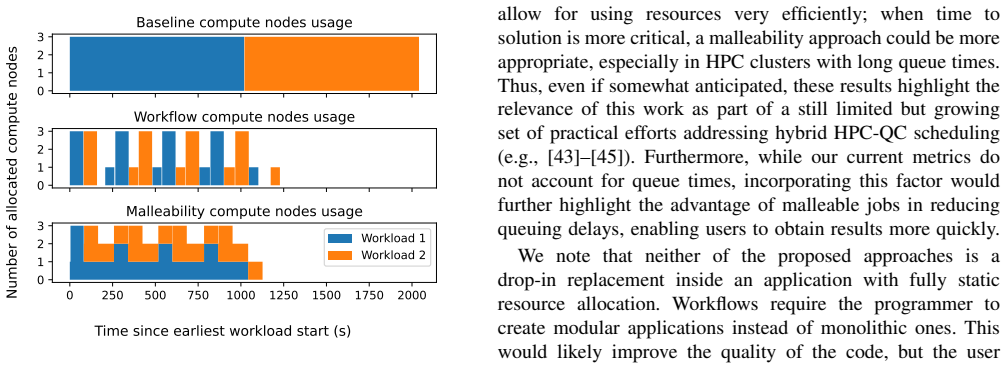
The paper claims that a malleability-based approach together with a workflow-based strategy allows hybrid HPC-quantum workloads to release classical resources when computations are offloaded to the quantum computer and to reallocate those resources once quantum processing finishes, with experiments on a hybrid use case demonstrating the resulting gains in utilization.
What carries the argument
The malleability-based approach and workflow-based strategy that support releasing classical resources during quantum offloads and reallocating them afterward.
If this is right
- Classical resources stay available for other jobs while the quantum computer runs its portion of the workload.
- Overall utilization rises because the classical side no longer idles during the quantum phase.
- Both the malleability method and the workflow method produce measurable gains on a tested hybrid application.
- Resource managers can treat quantum offloads as explicit points where classical capacity can be freed and later reclaimed.
Where Pith is reading between the lines
- Similar release-and-reallocate logic could apply to other accelerators such as GPUs inside the same HPC environment.
- Job schedulers would need new interfaces that recognize quantum-phase boundaries to make the approach routine.
- The techniques might extend to multi-user queues where one user's quantum task frees nodes for another's classical work.
Load-bearing premise
Hybrid HPC-quantum workloads can be structured such that offloading to the quantum computer allows seamless release and later reallocation of classical resources without prohibitive overheads or compatibility barriers.
What would settle it
An experiment on the same hybrid use case that measures either no net reduction in idle classical resources or an overhead from release and reallocation larger than the time saved by quantum acceleration would undermine the practical benefit.
Figures

read the original abstract
The integration of quantum computers within classical High-Performance Computing (HPC) infrastructures is receiving increasing attention, with the former expected to serve as accelerators for specific computational tasks. However, combining HPC and quantum computers presents significant technical challenges, including resource allocation. This paper presents a novel malleability-based approach, alongside a workflow-based strategy, to optimize resource utilization in hybrid HPC-quantum workloads. With both these approaches, we can release classical resources when computations are offloaded to the quantum computer and reallocate them once quantum processing is complete. Our experiments with a hybrid HPC-quantum use case show the benefits of dynamic allocation, highlighting the potential of those solutions.
Editorial analysis
A structured set of objections, weighed in public.
Referee Report
Summary. The manuscript proposes a malleability-based approach together with a workflow-based strategy for dynamic resource allocation in hybrid HPC-quantum systems. The central claim is that these methods permit classical resources to be released when work is offloaded to a quantum device and reallocated upon completion, with experiments on a hybrid use case demonstrating the resulting benefits in resource utilization.
Significance. The problem of efficient resource management at the HPC-quantum boundary is timely. If the proposed techniques can be shown to operate with low overhead on production schedulers and real quantum hardware, the work would provide a practical contribution to hybrid-system design. At present the absence of quantitative evidence prevents a clear assessment of whether the claimed gains are realized.
major comments (2)
- Abstract and experimental description: the manuscript asserts that 'experiments with a hybrid HPC-quantum use case show the benefits of dynamic allocation,' yet supplies no methodology, quantitative metrics (e.g., utilization improvement, reallocation latency), baselines, or error analysis. This omission is load-bearing for the central claim and must be remedied before the result can be evaluated.
- Malleability-based approach section: the strategy presupposes that the underlying HPC runtime (e.g., Slurm or equivalent) supports malleable job resizing with negligible reconfiguration cost and that quantum turnaround is short enough for freed nodes to remain useful. No scheduler details, measured overheads, or compatibility discussion are provided; these assumptions are central to the feasibility argument.
minor comments (1)
- Clarify whether quantum access in the reported experiments used real hardware, emulation, or simulation, and state the specific scheduler and quantum backend employed.
Simulated Author's Rebuttal
We thank the referee for the constructive and timely comments. We address each major point below and describe the revisions that will be incorporated to strengthen the manuscript.
read point-by-point responses
-
Referee: Abstract and experimental description: the manuscript asserts that 'experiments with a hybrid HPC-quantum use case show the benefits of dynamic allocation,' yet supplies no methodology, quantitative metrics (e.g., utilization improvement, reallocation latency), baselines, or error analysis. This omission is load-bearing for the central claim and must be remedied before the result can be evaluated.
Authors: We agree that the current description of the experiments is insufficient to allow evaluation of the claimed benefits. In the revised manuscript we will add a dedicated experimental section that details the hybrid use-case workflow, the precise quantitative metrics (including measured utilization gains and reallocation latencies), the chosen baselines, and the associated error analysis. These additions will directly support the central claim. revision: yes
-
Referee: Malleability-based approach section: the strategy presupposes that the underlying HPC runtime (e.g., Slurm or equivalent) supports malleable job resizing with negligible reconfiguration cost and that quantum turnaround is short enough for freed nodes to remain useful. No scheduler details, measured overheads, or compatibility discussion are provided; these assumptions are central to the feasibility argument.
Authors: We acknowledge that the feasibility discussion must be grounded in concrete scheduler considerations. The revised section will include an explicit compatibility analysis with production schedulers such as Slurm, any measured or reported reconfiguration overheads, and the range of quantum turnaround times for which node reallocation remains advantageous. This will clarify the practical scope of the approach. revision: yes
Circularity Check
No circularity: descriptive engineering paper with no derivations or fitted predictions
full rationale
The manuscript presents two practical strategies (malleability-based and workflow-based) for releasing and reallocating classical HPC resources around quantum offloads. No equations, first-principles derivations, parameter fits, or predictions appear anywhere in the text. Claims rest on experimental demonstration of a hybrid use case rather than any self-referential construction, self-citation chain, or renaming of known results. The work is therefore self-contained as an applied systems contribution with no load-bearing circular steps.
Axiom & Free-Parameter Ledger
Forward citations
Cited by 2 Pith papers
-
A Test Taxonomy and Continuous Integration Ecosystem for Dynamic Resource Management in HPC
Introduces a test taxonomy and HPC CI ecosystem to improve validation of dynamic resource management frameworks, evaluated via the DMR case study.
-
Hybrid Quantum-HPC Middleware Systems for Adaptive Resource, Workload and Task Management
The authors present Pilot-Quantum, a middleware for adaptive resource management in hybrid quantum-HPC systems, along with execution motifs and a performance modeling toolkit called Q-Dreamer.
Reference graph
Works this paper leans on
-
[1]
Np-hard but no longer hard to solve? using quantum computing to tackle optimization problems,
R. Au-Yeung, N. Chancellor, and P. Halffmann, “Np-hard but no longer hard to solve? using quantum computing to tackle optimization problems,” Frontiers in Quantum Science and Technology , vol. 2, Feb. 2023
work page 2023
-
[2]
Bringing quantum acceleration to supercomputers,
M. Ruefenacht, B. G. Taketani et al. , “Bringing quantum acceleration to supercomputers,” IQM/LRZ Technical Report, https://www. quantu m. lrz. de/fileadmin/QIC/Downloads/IQM HPC-QC-Integration-White paper. pdf, 2022
work page 2022
-
[3]
Integrating quantum computing resources into scientific hpc ecosystems,
T. Beck, A. Baroni et al. , “Integrating quantum computing resources into scientific hpc ecosystems,” Future Generation Computer Systems , vol. 161, pp. 11–25, 2024
work page 2024
-
[4]
Integration of quantum accelerators into hpc: Toward a unified quantum platform,
A. Elsharkawy, X. Guo, and M. Schulz, “Integration of quantum accelerators into hpc: Toward a unified quantum platform,” in2024 IEEE International Conference on Quantum Computing and Engineering (QCE), vol. 01, 2024, pp. 774–783
work page 2024
-
[5]
Pilot-quantum: A quantum-hpc middleware for resource, workload and task management,
P. Mantha, F. J. Kiwit et al., “Pilot-quantum: A quantum-hpc middleware for resource, workload and task management,” 2024
work page 2024
-
[6]
Bbq-mis: A parallel quantum algorithm for graph coloring problems,
C. Vercellino, G. Vitali et al., “Bbq-mis: A parallel quantum algorithm for graph coloring problems,” in 2023 IEEE International Conference on Quantum Computing and Engineering (QCE) , vol. 02, 2023, pp. 141–147
work page 2023
-
[7]
S. Kim and I.-S. Suh, “Performance analysis of an optimization al- gorithm for metamaterial design on the integrated high-performance computing and quantum systems,” 2024
work page 2024
-
[8]
Challenges in hpcqc integration,
A. Elsharkawy, X.-T. M. To et al. , “Challenges in hpcqc integration,” in 2023 IEEE International Conference on Quantum Computing and Engineering (QCE), vol. 02, 2023, pp. 405–406
work page 2023
-
[9]
Building a software stack for quantum-hpc integration,
A. Shehata, P. Groszkowski et al. , “Building a software stack for quantum-hpc integration,” 2025
work page 2025
-
[10]
A survey on integrating quantum computers into high performance computing systems,
P. D ¨obler and M. S. Jattana, “A survey on integrating quantum computers into high performance computing systems,” 2025
work page 2025
-
[11]
Accelerating HPC With Quantum Computing: It Is a Software Challenge Too,
M. Schulz, M. Ruefenacht et al. , “Accelerating HPC With Quantum Computing: It Is a Software Challenge Too,” Computing in Science & Engineering, vol. 24, no. 4, pp. 60–64, Jul. 2022
work page 2022
-
[12]
High-performance computing with quantum processing units,
K. A. Britt and T. S. Humble, “High-performance computing with quantum processing units,” ACM Journal on Emerging Technologies in Computing Systems (JETC) , vol. 13, no. 3, pp. 1–13, 2017
work page 2017
-
[13]
A Conceptual Architecture for a Quantum-HPC Middleware,
N. Saurabh, S. Jha, and A. Luckow, “A Conceptual Architecture for a Quantum-HPC Middleware,” Aug. 2023
work page 2023
-
[14]
Assessing the elephant in the room in scheduling for current hybrid hpc-qc clusters,
P. Viviani, R. Rocco et al. , “Assessing the elephant in the room in scheduling for current hybrid hpc-qc clusters,” 2025
work page 2025
-
[15]
Workflows community summit 2022: A roadmap revolution,
R. Ferreira Da Silva, R. Badia et al. , “Workflows community summit 2022: A roadmap revolution,” Oak Ridge National Laboratory (ORNL), Oak Ridge, TN (United States), Tech. Rep., 03 2023
work page 2022
-
[16]
Paving the way to hybrid quantum–classical scientific workflows,
S. S. Cranganore, V . De Maio et al. , “Paving the way to hybrid quantum–classical scientific workflows,” Future Generation Computer Systems, vol. 158, pp. 346–366, 2024
work page 2024
-
[17]
Rigoletto: A workflow definition language for hybrid quantum-classical scientific applications,
V . De Maio, D. Bork, and I. Brandic, “Rigoletto: A workflow definition language for hybrid quantum-classical scientific applications,” in 2024 26th International Conference on Business Informatics (CBI) , 2024, pp. 40–49
work page 2024
-
[18]
Streamflow: Cross-breeding cloud with HPC,
I. Colonnelli, B. Cantalupo et al. , “Streamflow: Cross-breeding cloud with HPC,” IEEE Trans. Emerg. Top. Comput., vol. 9, no. 4, pp. 1723– 1737, 2021
work page 2021
-
[19]
Clustering aggregation as maximum-weight independent set,
N. Li and L. J. Latecki, “Clustering aggregation as maximum-weight independent set,” in Neural Information Processing Systems , 2012
work page 2012
-
[20]
A clustering aggregation algorithm on neutral-atoms and annealing quantum processors,
R. Scotti, G. Bettonte et al. , “A clustering aggregation algorithm on neutral-atoms and annealing quantum processors,” 2024
work page 2024
-
[21]
DMRlib: Easy-coding and Efficient Resource Management for Job Malleability,
S. Iserte, R. Mayo et al., “DMRlib: Easy-coding and Efficient Resource Management for Job Malleability,” IEEE Transactions on Computers , vol. 70, pp. 1443–1457, Sep. 2020
work page 2020
-
[22]
Hybrid classical-quantum clustering aggregation,
E. C. Engineering, “Hybrid classical-quantum clustering aggregation,” https://github.com/E4-Computer-Engineering/clustering-mis, 2025
work page 2025
-
[23]
J. MacQueen, “Multivariate observations,” in Proceedings ofthe 5th Berkeley Symposium on Mathematical Statisticsand Probability , vol. 1, 1967, pp. 281–297
work page 1967
-
[24]
A density-based algorithm for discovering clusters in large spatial databases with noise,
M. Ester, H.-P. Kriegel et al., “A density-based algorithm for discovering clusters in large spatial databases with noise,” in Proceedings of the Second International Conference on Knowledge Discovery and Data Mining, ser. KDD’96. AAAI Press, 1996, p. 226–231
work page 1996
-
[25]
fastcluster: Fast hierarchical, agglomerative clustering routines forrandpython,
D. M ¨ullner, “fastcluster: Fast hierarchical, agglomerative clustering routines forrandpython,” Journal of Statistical Software , vol. 53, no. 9, 2013
work page 2013
-
[26]
Optimization by simulated annealing,
S. Kirkpatrick, C. D. Gelatt, and M. P. Vecchi, “Optimization by simulated annealing,” Science, vol. 220, no. 4598, pp. 671–680, 1983
work page 1983
-
[27]
A terminology for scientific workflow systems,
F. Suter, T. Coleman et al. , “A terminology for scientific workflow systems,” Future Generation Computer Systems , vol. 174, p. 107974, 2026
work page 2026
-
[28]
Nextflow enables reproducible computational workflows,
P. Di Tommaso, M. Chatzou et al. , “Nextflow enables reproducible computational workflows,” Nature biotechnology , vol. 35, no. 4, pp. 316–319, 2017
work page 2017
-
[29]
Pycompss: Parallel computational work- flows in python,
E. Tejedor, Y . Becerra et al., “Pycompss: Parallel computational work- flows in python,” The International Journal of High Performance Computing Applications, vol. 31, no. 1, pp. 66–82, 2017
work page 2017
-
[30]
Introducing SWIRL: an intermediate representation language for scientific workflows,
I. Colonnelli, D. Medic et al. , “Introducing SWIRL: an intermediate representation language for scientific workflows,” in Formal Methods - 26th International Symposium, FM 2024, Milan, Italy, September 9-13, 2024, Proceedings, Part I, ser. Lecture Notes in Computer Science, vol. 14933. Springer, 2024, pp. 226–244
work page 2024
-
[31]
M. R. Crusoe, S. Abeln et al., “Methods included: Standardizing com- putational reuse and portability with the common workflow language,” Communication of the ACM , 2022
work page 2022
-
[32]
Federated learning meets HPC and cloud,
I. Colonnelli, B. Casella et al. , “Federated learning meets HPC and cloud,” in Astrophysics and Space Science Proceedings , vol. 60. Springer, 2023, p. 193–199
work page 2023
-
[33]
Packing Schemes for Gang Scheduling,
D. G. Feitelson, “Packing Schemes for Gang Scheduling,” in Pro- ceedings of the Workshop on Job Scheduling Strategies for Parallel Processing, ser. IPPS ’96. Berlin, Heidelberg: Springer-Verlag, Apr. 1996, pp. 89–110
work page 1996
-
[34]
Towards the democratization and standardization of dynamic resources with MPI spawning,
S. Iserte, I. Mart ´ın-´Alvarez et al. , “Towards the democratization and standardization of dynamic resources with MPI spawning,” in in Pro- ceedings of the International Conference on Parallel Processing & Applied Mathematics (PPAM). Best Paper Award , 2024
work page 2024
-
[35]
A Survey on Malleability Solutions for High-Performance Distributed Computing,
J. I. Aliaga, M. Castillo et al., “A Survey on Malleability Solutions for High-Performance Distributed Computing,”Applied Science, vol. 12, pp. 1–32, May 2022
work page 2022
-
[36]
Malleability in Modern HPC Sys- tems: Current Experiences, Challenges, and Future Opportunities,
A. Tarraf, M. Schreiber et al. , “Malleability in Modern HPC Sys- tems: Current Experiences, Challenges, and Future Opportunities,” IEEE Transactions on Parallel and Distributed Systems , pp. 1–14, Jun. 2024, conference Name: IEEE Transactions on Parallel and Distributed Sys- tems
work page 2024
-
[37]
A Study of the Effect of Process Malleability in the Energy Efficiency on GPU-based Clusters,
S. Iserte and K. Rojek, “A Study of the Effect of Process Malleability in the Energy Efficiency on GPU-based Clusters,” Journal of Supercom- puting, vol. 76, pp. 255–274, Oct. 2020
work page 2020
-
[38]
Dynamic Reconfiguration of Non-iterative Scientific Applications: A Case Study with HPG-aligner,
S. Iserte, H. Mart ´ınezet al., “Dynamic Reconfiguration of Non-iterative Scientific Applications: A Case Study with HPG-aligner,” International Journal of High Performance Computing Application, vol. 33, pp. 1–10, Aug. 2018
work page 2018
-
[39]
DMR API: Improving Cluster Productivity by Turning Applications into Malleable,
S. Iserte, R. Mayo et al. , “DMR API: Improving Cluster Productivity by Turning Applications into Malleable,” Parallel Computing, vol. 78, pp. 54–66, Jul. 2018
work page 2018
-
[40]
Bridging the Gap Between Genericity and Programmability of Dynamic Resources in HPC,
D. Huber, S. Iserte et al. , “Bridging the Gap Between Genericity and Programmability of Dynamic Resources in HPC,” in ISC High Performance 2025 Research Paper Proceedings (40th International Conference), Jun. 2025, pp. 1–11
work page 2025
-
[41]
Resource optimization with MPI process malleability for dynamic workloads in HPC clusters,
S. Iserte, I. Mart ´ın-´Alvarez et al. , “Resource optimization with MPI process malleability for dynamic workloads in HPC clusters,” Future Generation Computer Systems , p. 107949, Jun. 2025
work page 2025
-
[42]
Hyperqueue: Efficient and ergonomic task graphs on hpc clusters,
J. Ber ´anek, A. B ¨ohm et al., “Hyperqueue: Efficient and ergonomic task graphs on hpc clusters,” SoftwareX, vol. 27, p. 101814, 2024
work page 2024
-
[43]
R. Wille, L. Schmid et al. , “Qdmi - quantum device management interface: Hardware-software interface for the munich quantum software stack,” in 2024 IEEE International Conference on Quantum Computing and Engineering (QCE) , vol. 02, 2024, pp. 573–574
work page 2024
-
[44]
Slurm heterogeneous jobs for hybrid classical-quantum workflows,
A. Esposito and U.-U. Haus, “Slurm heterogeneous jobs for hybrid classical-quantum workflows,” 2025
work page 2025
-
[45]
Distributed quantum circuit cutting for hybrid quantum-classical high-performance computing,
M. Tejedor, B. Casas et al. , “Distributed quantum circuit cutting for hybrid quantum-classical high-performance computing,” 2025
work page 2025
discussion (0)
Sign in with ORCID, Apple, or X to comment. Anyone can read and Pith papers without signing in.