Hidden simplicity in the scattering for neutron stars and black holes
Pith reviewed 2026-05-18 18:48 UTC · model grok-4.3
The pith
Kerr generating functions capture scattering of any probe on Kerr black holes to all loop orders.
A machine-rendered reading of the paper's core claim, the machinery that carries it, and where it could break.
Core claim
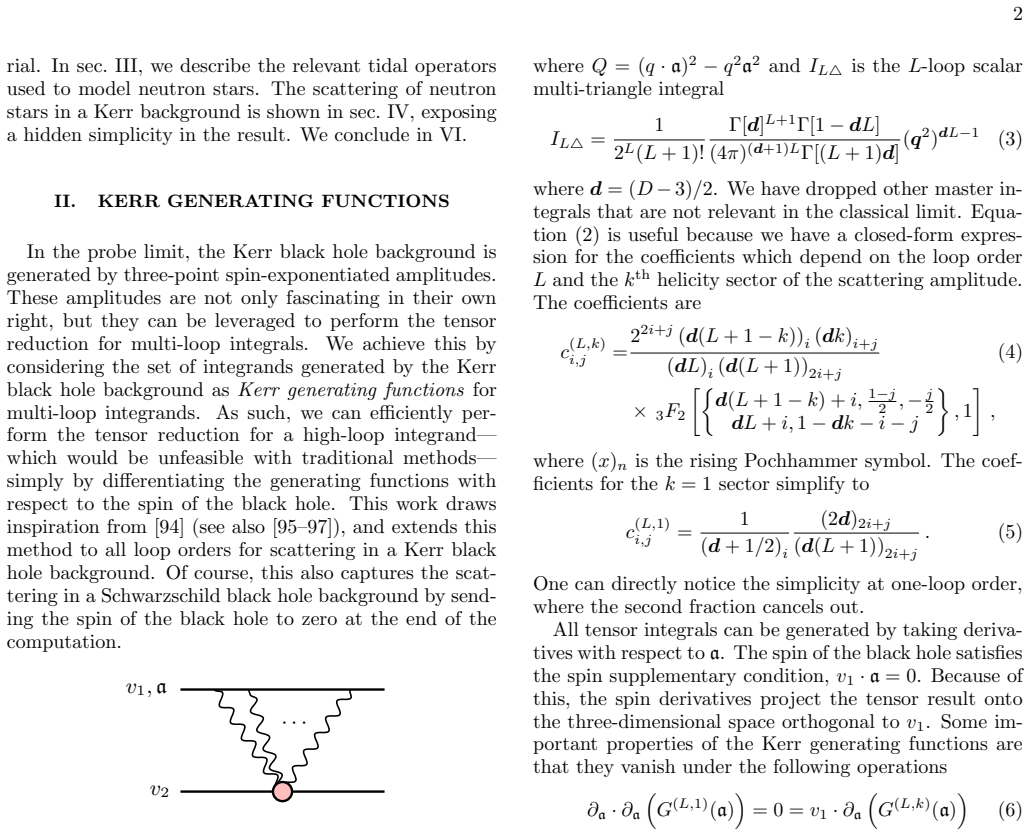
Heavy particle effective theory applied to spinning black holes linearizes propagators and exponentiates numerators. This enables the definition of Kerr generating functions that describe the scattering of any probe on a Kerr black hole background to all loop orders. The generating functions perform tensor reduction of multi-loop integrands by differentiation with respect to spin. As a first application, compact all-loop-order results are given for several helicity sectors of the leading non-linear tidal operators, along with a full four-loop O(G^5) result.
What carries the argument
Kerr generating functions that encode all-order scattering on Kerr backgrounds and reduce tensors via spin differentiation.
If this is right
- Scattering amplitudes for probes on spinning black holes become computable to high loop orders.
- Tensor reduction in gravitational loop integrals simplifies to differentiation with respect to spin.
- Non-linear tidal effects in neutron star-black hole systems can be calculated systematically at four loops and beyond.
- Integrands organize compactly by the helicity configuration of exchanged gravitons.
Where Pith is reading between the lines
- The approach may extend to other spinning compact objects such as white dwarfs or pulsars.
- Results could connect to post-Minkowskian expansions for more accurate gravitational wave modeling of binary inspirals.
- Direct numerical checks of the four-loop tidal amplitude would test the generating functions.
- The observed simplicity might indicate deeper algebraic structures in general relativity scattering problems.
Load-bearing premise
Heavy particle effective theory for spinning black holes provides a framework where propagators linearize and numerators exponentiate.
What would settle it
Computing the leading non-linear tidal scattering amplitude at four loops independently and finding it differs from the result obtained via the Kerr generating functions would falsify the approach.
Figures
read the original abstract
Heavy particle effective theory applied to spinning black holes provides a natural framework in which propagators linearize and numerators exponentiate. In this work, we exploit these two features to introduce Kerr generating functions, which describe the scattering of any probe on a Kerr black hole background to all loop orders. These generating functions can be used to perform the tensor reduction of multi-loop integrands simply by differentiation with respect to the spin. As a first application of the Kerr generating functions, we study the leading non-linear tidal effects of a neutron star in a Kerr black hole background. We organize the integrand by the helicity configuration of the exchanged gravitons and provide compact all-loop-order results for several helicity sectors and a full four-loop $\mathcal{O}(G^5)$ result for the leading non-linear tidal operators.
Editorial analysis
A structured set of objections, weighed in public.
Referee Report
Summary. The manuscript introduces Kerr generating functions based on the linearization of propagators and exponentiation of numerators in heavy particle effective theory for spinning black holes. These functions are claimed to describe the scattering of any probe on a Kerr black hole to all loop orders and to enable tensor reduction of multi-loop integrands through differentiation with respect to the spin. The authors apply this framework to compute leading non-linear tidal effects for a neutron star in a Kerr background, organizing results by graviton helicity and providing all-loop expressions for several sectors along with a complete four-loop O(G^5) result for the leading non-linear tidal operators.
Significance. If the all-order simplifications hold, this represents a substantial advance in the computation of gravitational scattering amplitudes involving spinning compact objects. The ability to perform tensor reduction via spin differentiation could streamline higher-loop calculations in effective theories for black holes and neutron stars, with potential implications for gravitational wave phenomenology. The provision of explicit all-loop results in selected sectors and a full four-loop computation demonstrates the practical utility of the approach.
major comments (2)
- Abstract: The central claim that Kerr generating functions describe scattering to all loop orders rests on the non-perturbative exponentiation of numerators in HPET. However, the manuscript supplies compact all-loop results only for several helicity sectors of exchanged gravitons and a complete four-loop O(G^5) result for leading non-linear tidal operators. Explicit checks are needed to confirm that the exponentiation captures every spin-dependent structure from graviton vertices, loop momentum routing, and neutron-star tidal insertions outside those sectors; otherwise the differentiation step for tensor reduction would under- or over-count the reduced integrand for generic probes and configurations.
- Section on HPET framework and generating functions: The opening statement that 'propagators linearize and numerators exponentiate' is used to justify the all-order results, but the text does not demonstrate that this linearization and exponentiation holds for the full multi-loop integrand when arbitrary probes and generic helicity configurations are included. A concrete verification or counter-example check at five loops or in an additional helicity sector would be required to support the load-bearing all-order statement.
minor comments (2)
- The abstract is information-dense; a brief parenthetical definition or one-sentence example of a Kerr generating function would improve accessibility for readers outside the immediate subfield.
- Notation for the helicity sectors and the precise definition of the leading non-linear tidal operators should be cross-referenced to the relevant equations in the main text for easier navigation.
Simulated Author's Rebuttal
We thank the referee for their careful reading of our manuscript and for their insightful comments. We have addressed each of the major comments below, providing clarifications and making revisions to the manuscript where necessary to strengthen the presentation of our results.
read point-by-point responses
-
Referee: Abstract: The central claim that Kerr generating functions describe scattering to all loop orders rests on the non-perturbative exponentiation of numerators in HPET. However, the manuscript supplies compact all-loop results only for several helicity sectors of exchanged gravitons and a complete four-loop O(G^5) result for leading non-linear tidal operators. Explicit checks are needed to confirm that the exponentiation captures every spin-dependent structure from graviton vertices, loop momentum routing, and neutron-star tidal insertions outside those sectors; otherwise the differentiation step for tensor reduction would under- or over-count the reduced integrand for generic probes and configurations.
Authors: The non-perturbative exponentiation of numerators is a key feature of the HPET formulation for Kerr black holes, stemming from the exponential representation of the spin-dependent interactions in the effective theory. This property holds for the full integrand at any loop order because it arises from the structure of the vertices and the heavy particle propagators, independent of the specific helicity configuration or the nature of the probe. The Kerr generating functions are constructed to include all such contributions, and the tensor reduction via differentiation is valid by construction for generic cases. The explicit results in selected sectors serve as non-trivial checks of this framework. To further address the referee's concern, we have revised the abstract and the introduction to emphasize that the all-order description follows directly from the HPET properties, with the provided computations illustrating the method's applicability. revision: partial
-
Referee: Section on HPET framework and generating functions: The opening statement that 'propagators linearize and numerators exponentiate' is used to justify the all-order results, but the text does not demonstrate that this linearization and exponentiation holds for the full multi-loop integrand when arbitrary probes and generic helicity configurations are included. A concrete verification or counter-example check at five loops or in an additional helicity sector would be required to support the load-bearing all-order statement.
Authors: We appreciate the referee pointing this out. In the HPET framework, the linearization of propagators occurs because the heavy particle is taken to have velocity aligned with its momentum, reducing the propagator to a simple form without anti-particle poles. The exponentiation of numerators follows from the fact that spin insertions in the Kerr background can be resummed into an exponential factor due to the properties of the spin tensor and the background. This holds for the full multi-loop integrand as the loop corrections are built from these basic building blocks. We have demonstrated this through the derivation of the generating functions and their use in computing the tidal effects up to four loops. A five-loop explicit computation is not feasible within the current scope due to computational complexity, but the general proof is provided in the framework section. We have added further details and a schematic diagram illustrating the exponentiation for a generic multi-loop diagram to clarify this point. revision: yes
Circularity Check
No circularity: Kerr generating functions derived from standard HPET properties without self-referential reduction
full rationale
The paper's derivation begins from the established features of Heavy Particle Effective Theory applied to spinning black holes, where propagators linearize and numerators exponentiate as stated in the abstract. These properties are treated as inputs from the effective theory framework rather than derived within the manuscript. The Kerr generating functions are then introduced by exploiting these features to enable all-loop descriptions and tensor reduction via spin differentiation. Explicit results are provided for selected helicity sectors and a complete four-loop O(G^5) computation for leading non-linear tidal operators, organized by exchanged-graviton helicity. No steps reduce by construction to fitted parameters, self-citations that bear the central load, or renamings of known results; the chain remains self-contained against external EFT benchmarks and does not equate outputs to inputs via definition or prior author work alone.
Axiom & Free-Parameter Ledger
axioms (1)
- domain assumption Heavy particle effective theory applies to spinning black holes such that propagators linearize and numerators exponentiate.
invented entities (1)
-
Kerr generating functions
no independent evidence
Lean theorems connected to this paper
-
IndisputableMonolith/Cost/FunctionalEquation.leanwashburn_uniqueness_aczel unclear?
unclearRelation between the paper passage and the cited Recognition theorem.
Heavy particle effective theory ... propagators linearize and numerators exponentiate ... Kerr generating functions ... differentiation with respect to the spin ... compact all-loop-order results for several helicity sectors
-
IndisputableMonolith/Foundation/AlphaCoordinateFixation.leancostAlphaLog_fourth_deriv_at_zero echoes?
echoesECHOES: this paper passage has the same mathematical shape or conceptual pattern as the Recognition theorem, but is not a direct formal dependency.
Meven,(0) = cL K(L,0) with K(L,0) = 1/4 cosh(q·a) ...
What do these tags mean?
- matches
- The paper's claim is directly supported by a theorem in the formal canon.
- supports
- The theorem supports part of the paper's argument, but the paper may add assumptions or extra steps.
- extends
- The paper goes beyond the formal theorem; the theorem is a base layer rather than the whole result.
- uses
- The paper appears to rely on the theorem as machinery.
- contradicts
- The paper's claim conflicts with a theorem or certificate in the canon.
- unclear
- Pith found a possible connection, but the passage is too broad, indirect, or ambiguous to say the theorem truly supports the claim.
Forward citations
Cited by 3 Pith papers
-
Twisted Feynman Integrals: from generating functions to spin-resummed post-Minkowskian dynamics
Twisted Feynman integrals are introduced with graded Symanzik polynomials, classified as exponential periods, and shown to have geometry not inferable from generalized Baikov leading singularities.
-
Weak-Field Limits of Black Hole Metrics from the KMOC formalism: Schwarzschild, Kerr, Reissner-Nordstr\"om, and Kerr-Newman
Weak-field limits of four black hole metrics are reproduced from three-point amplitudes using the KMOC formalism, including a gravitational-electromagnetic interference term for Kerr-Newman.
-
Weak-Field Limits of Black Hole Metrics from the KMOC formalism: Schwarzschild, Kerr, Reissner-Nordstr\"om, and Kerr-Newman
Weak-field limits of Schwarzschild, Kerr, RN, and KN black hole metrics are reproduced from three-point amplitudes with exponential spin structure via the KMOC formula by extracting momentum impulses and matching to g...
Reference graph
Works this paper leans on
-
[1]
From Scattering Amplitudes to Classical Potentials in the Post-Minkowskian Expansion
C. Cheung, I. Z. Rothstein, and M. P. Solon, Phys. Rev. Lett.121, 251101 (2018), arXiv:1808.02489 [hep-th]
work page internal anchor Pith review Pith/arXiv arXiv 2018
-
[2]
Z. Bern, C. Cheung, R. Roiban, C.-H. Shen, M. P. Solon, and M. Zeng, Phys. Rev. Lett.122, 201603 (2019), arXiv:1901.04424 [hep-th]
work page internal anchor Pith review Pith/arXiv arXiv 2019
- [3]
- [4]
- [5]
-
[6]
D. Brammer, H. Frellesvig, R. Morales, and M. Wil- helm, JHEP10, 212, arXiv:2505.10274 [hep-th]
-
[7]
D. A. Kosower, B. Maybee, and D. O’Connell, JHEP 02, 137, arXiv:1811.10950 [hep-th]
work page internal anchor Pith review Pith/arXiv arXiv
-
[8]
A. Cristofoli, R. Gonzo, D. A. Kosower, and D. O’Connell, Phys. Rev. D106, 056007 (2022), arXiv:2107.10193 [hep-th]
-
[9]
E. Herrmann, J. Parra-Martinez, M. S. Ruf, and M. Zeng, Phys. Rev. Lett.126, 201602 (2021), arXiv:2101.07255 [hep-th]
-
[10]
E. Herrmann, J. Parra-Martinez, M. S. Ruf, and M. Zeng, JHEP10, 148, arXiv:2104.03957 [hep-th]
-
[11]
A. Elkhidir, D. O’Connell, M. Sergola, and I. A. Vazquez-Holm, JHEP07, 272, arXiv:2303.06211 [hep- th]
-
[12]
A. Herderschee, R. Roiban, and F. Teng, JHEP06, 004, arXiv:2303.06112 [hep-th]
-
[13]
A. Brandhuber, G. R. Brown, G. Chen, S. De An- gelis, J. Gowdy, and G. Travaglini, JHEP06, 048, arXiv:2303.06111 [hep-th]
-
[14]
A. Georgoudis, C. Heissenberg, and I. Vazquez-Holm, JHEP2023(06), 126, arXiv:2303.07006 [hep-th]
-
[15]
A. Georgoudis, C. Heissenberg, and R. Russo, JHEP03, 089, arXiv:2312.07452 [hep-th]
-
[16]
C. Heissenberg, Phys. Rev. D111, 126012 (2025), arXiv:2501.02904 [hep-th]
-
[17]
A. Georgoudis, V. Goncalves, C. Heissenberg, and J. Parra-Martinez, (2025), arXiv:2506.20733 [hep-th]
- [18]
- [19]
- [20]
-
[21]
C. Heissenberg, Phys. Rev. Lett.131, 011603 (2023), arXiv:2210.15689 [hep-th]
-
[22]
S. Mougiakakos, M. M. Riva, and F. Vernizzi, Phys. Rev. Lett.129, 121101 (2022), arXiv:2204.06556 [hep- th]
-
[23]
G. K¨ alin and R. A. Porto, JHEP11, 106, arXiv:2006.01184 [hep-th]
-
[24]
G. K¨ alin, Z. Liu, and R. A. Porto, Phys. Rev. Lett.125, 261103 (2020), arXiv:2007.04977 [hep-th]
- [25]
- [26]
- [27]
-
[28]
Gravitational Bremsstrahlung in the post-Minkowskian effective field theory,
S. Mougiakakos, M. M. Riva, and F. Vernizzi, Phys. Rev. D104, 024041 (2021), arXiv:2102.08339 [gr-qc]
- [29]
- [30]
- [31]
- [32]
- [33]
- [34]
- [35]
- [36]
- [37]
- [38]
-
[39]
M. Driesse, G. U. Jakobsen, G. Mogull, J. Plefka, B. Sauer, and J. Usovitsch, Phys. Rev. Lett.132, 241402 (2024), arXiv:2403.07781 [hep-th]
- [40]
- [41]
-
[42]
Spinning bodies in general relativ- ity from bosonic worldline oscillators,
K. Haddad, G. U. Jakobsen, G. Mogull, and J. Plefka, JHEP02, 019, arXiv:2411.08176 [hep-th]
-
[43]
Emergence of Calabi-Yau manifolds in high-precision black hole scattering
M. Driesse, G. U. Jakobsen, A. Klemm, G. Mogull, C. Nega, J. Plefka, B. Sauer, and J. Usovitsch, Nature 641, 603 (2025), arXiv:2411.11846 [hep-th]
work page Pith review arXiv 2025
-
[44]
Spinning the Probe in Kerr with WQFT,
J. Hoogeveen, G. U. Jakobsen, and J. Plefka, JHEP10, 201, arXiv:2506.14626 [hep-th]
- [45]
- [46]
-
[47]
On- shell heavy particle effective theories,
R. Aoude, K. Haddad, and A. Helset, JHEP05, 051, arXiv:2001.09164 [hep-th]
- [48]
-
[49]
Classical gravitational scattering amplitude at O(G2S∞ 1 S∞ 2 ),
R. Aoude, K. Haddad, and A. Helset, Phys. Rev. D108, 024050 (2023), arXiv:2304.13740 [hep-th]
-
[50]
N. Arkani-Hamed, T.-C. Huang, and Y.-t. Huang, JHEP11, 070, arXiv:1709.04891 [hep-th]
-
[51]
A. Guevara, A. Ochirov, and J. Vines, JHEP09, 056, arXiv:1812.06895 [hep-th]
-
[52]
The simplest massive S-matrix: from minimal coupling to Black Holes,
M.-Z. Chung, Y.-T. Huang, J.-W. Kim, and S. Lee, JHEP04, 156, arXiv:1812.08752 [hep-th]
-
[53]
Black-hole scattering with general spin direc- tions from minimal-coupling amplitudes,
A. Guevara, A. Ochirov, and J. Vines, Phys. Rev. D 100, 104024 (2019), arXiv:1906.10071 [hep-th]
- [54]
-
[55]
Haddad, JHEP05, 177, arXiv:2303.02624 [hep-th]
K. Haddad, JHEP05, 177, arXiv:2303.02624 [hep-th]
- [56]
-
[57]
N. Arkani-Hamed, Y.-t. Huang, and D. O’Connell, JHEP01, 046, arXiv:1906.10100 [hep-th]
-
[58]
Complete Hamiltonian for spinning bi- nary systems at first post-Minkowskian order,
M.-Z. Chung, Y.-t. Huang, J.-W. Kim, and S. Lee, JHEP05, 105, arXiv:2003.06600 [hep-th]
-
[59]
A. Guevara, B. Maybee, A. Ochirov, D. O’connell, and J. Vines, JHEP03, 201, arXiv:2012.11570 [hep-th]
-
[60]
Quadratic- in-spin Hamiltonian at O(G2) from scattering ampli- tudes,
D. Kosmopoulos and A. Luna, JHEP07, 037, arXiv:2102.10137 [hep-th]
- [61]
- [62]
-
[63]
M. Chiodaroli, H. Johansson, and P. Pichini, JHEP02, 156, arXiv:2107.14779 [hep-th]
-
[64]
K. Haddad, Phys. Rev. D105, 026004 (2022), arXiv:2109.04427 [hep-th]
-
[65]
The 2PM Hamiltonian for binary Kerr to quartic in spin,
W.-M. Chen, M.-Z. Chung, Y.-t. Huang, and J.-W. Kim, JHEP08, 148, arXiv:2111.13639 [hep-th]
-
[66]
A. Cristofoli, R. Gonzo, N. Moynihan, D. O’Connell, A. Ross, M. Sergola, and C. D. White, JHEP06, 181, arXiv:2112.07556 [hep-th]
-
[67]
Guevara, (2021), arXiv:2112.05111 [hep-th]
A. Guevara, (2021), arXiv:2112.05111 [hep-th]
-
[68]
F. Alessio and P. Di Vecchia, Phys. Lett. B832, 137258 (2022), arXiv:2203.13272 [hep-th]
- [69]
-
[70]
NLO deflections for spinning particles and Kerr black holes,
G. Menezes and M. Sergola, JHEP10, 105, arXiv:2205.11701 [hep-th]
- [71]
-
[72]
L. Cangemi, M. Chiodaroli, H. Johansson, A. Ochi- rov, P. Pichini, and E. Skvortsov, Phys. Rev. Lett.131, 221401 (2023), arXiv:2212.06120 [hep-th]
- [73]
- [74]
- [75]
- [76]
- [77]
-
[78]
From higher-spin gauge interactions to Compton amplitudes for root-Kerr,
L. Cangemi, M. Chiodaroli, H. Johansson, A. Ochi- rov, P. Pichini, and E. Skvortsov, JHEP09, 196, arXiv:2311.14668 [hep-th]
- [79]
- [80]
discussion (0)
Sign in with ORCID, Apple, or X to comment. Anyone can read and Pith papers without signing in.