Fate of Topological Dirac Magnons in van der Waals Ferromagnets at Finite Temperature
Pith reviewed 2026-05-18 16:30 UTC · model grok-4.3
The pith
Thermal magnon bound states explain observed damping and shifts in CrBr3 Dirac magnons near the Curie temperature.
A machine-rendered reading of the paper's core claim, the machinery that carries it, and where it could break.
Core claim
Using nonlinear spin-wave theory with magnon self-energy corrections and a T-matrix resummation that captures two-magnon bound states, the calculations quantitatively reproduce temperature- and momentum-dependent energy shifts and linewidths observed experimentally in the gapless Dirac magnon material CrBr3, even near the Curie temperature. For gapped Dirac magnon materials the topological magnon gap undergoes a thermally induced reduction but exhibits no evidence of thermally driven topological transitions. Classical atomistic spin dynamics simulations confirm the gap's robustness up to the Curie temperature, and a minimum ratio of Dzyaloshinskii-Moriya interaction to Heisenberg exchange of
What carries the argument
nonlinear spin-wave theory with magnon self-energy corrections and T-matrix resummation that captures two-magnon bound states
If this is right
- Energy shifts and linewidths in CrBr3 are reproduced across a wide temperature range including near the Curie temperature.
- The topological gap in CrI3, CrSiTe3 and CrGeTe3 reduces with temperature but stays open throughout the ordered phase.
- Two-magnon bound states enhance magnon damping especially at low temperatures.
- A Dzyaloshinskii-Moriya to Heisenberg exchange ratio of roughly 5 percent suffices to keep the gap observable against thermal broadening.
- Classical atomistic spin dynamics simulations independently corroborate the gap robustness up to the Curie temperature.
Where Pith is reading between the lines
- The same many-body framework could be used to predict finite-temperature spin transport velocities in other two-dimensional magnets.
- Bound-state contributions may set practical limits on magnon coherence times in proposed topological magnonic devices.
- Systematic variation of the DMI strength across a series of van der Waals compounds would provide a direct test of the proposed 5 percent visibility threshold.
Load-bearing premise
The microscopic spin Hamiltonian parameters taken from prior literature remain valid at finite temperature without additional renormalization or higher-order magnon interactions beyond the resummation.
What would settle it
A measurement showing either the topological gap in CrI3 closing at a temperature well below the Curie point or a clear mismatch between the calculated and observed temperature dependence of linewidths in CrBr3 would falsify the central claim.
Figures




read the original abstract
Dirac magnons, the bosonic counterparts of Dirac fermions in graphene, provide a unique platform to explore symmetry-protected band crossings and quantum geometry in magnetic insulators, while promising high-velocity, low-dissipation spin transport for next-generation magnonic technologies. However, their stability under realistic, finite-temperature conditions remains an open question. Here, we develop a comprehensive microscopic theory of thermal magnon-magnon interactions in van der Waals honeycomb ferromagnets, focusing on both gapless and gapped Dirac magnons. Using nonlinear spin-wave theory with magnon self-energy corrections and a T-matrix resummation that captures two-magnon bound states, we quantitatively reproduce temperature- and momentum-dependent energy shifts and linewidths observed experimentally in the gapless Dirac magnon material CrBr$_3$, even near the Curie temperature. Our approach resolves discrepancies between prior theoretical predictions and experiment and highlight the significant role of bound states in enhancing magnon damping at low temperatures. For gapped Dirac magnon materials such as CrI$_3$, CrSiTe$_3$, and CrGeTe$_3$, we find a thermally induced reduction of the topological magnon gap but no evidence of thermally driven topological transitions. Classical atomistic spin dynamics simulations corroborate the gap' s robustness up to the Curie temperature. Furthermore, we establish a practical criterion for observing topological gaps by determining the minimum ratio of Dzyaloshinskii-Moriya interaction to Heisenberg exchange required to overcome thermal broadening throughout the ordered phase, typically around 5%. Our results clarify the interplay of thermal many-body effects and topology in low-dimensional magnets and provide a reliable framework for interpreting spectroscopic experiments.
Editorial analysis
A structured set of objections, weighed in public.
Referee Report
Summary. The manuscript develops a microscopic theory of thermal magnon-magnon interactions in van der Waals honeycomb ferromagnets using nonlinear spin-wave theory, magnon self-energy corrections, and T-matrix resummation to capture two-magnon bound states. It claims to quantitatively reproduce the temperature- and momentum-dependent energy shifts and linewidths measured in the gapless Dirac magnon material CrBr₃ even near the Curie temperature, resolving prior theory-experiment discrepancies. For gapped Dirac magnon systems (CrI₃, CrSiTe₃, CrGeTe₃), it reports a thermally induced reduction of the topological gap without closure or topological transition, corroborated by classical atomistic spin dynamics simulations, and proposes a minimum D/J ratio of ~5% for observing gaps throughout the ordered phase.
Significance. If the quantitative reproduction of CrBr₃ data holds under the fixed literature parameters, the work is significant for providing a practical framework to interpret finite-temperature spectroscopic data on topological magnons, clarifying the role of bound states in damping, and establishing a criterion for gap observability. The corroboration with classical spin dynamics simulations is a strength that adds robustness to the gap-stability conclusions.
major comments (2)
- [§5] §5 (CrBr₃ results and comparison to experiment): The central claim of quantitative reproduction of experimental energy shifts and linewidths lacks error bars on theoretical curves, an explicit description of the fitting or parameter-selection procedure, and direct overlay with raw data points. This is load-bearing because the agreement may depend on the specific unadjusted values of J, D, and K taken from prior literature rather than emerging robustly from the formalism.
- [§3.2] §3.2 (T-matrix resummation and self-energy): The assumption that literature values of the microscopic Hamiltonian parameters remain valid without renormalization at finite temperature is not justified, particularly near Tc where magnon density is high. The dilute-interaction approximation underlying the T-matrix may require additional checks against magnon-phonon coupling or four-magnon processes omitted from the resummation.
minor comments (2)
- [Figure 4] Figure 4 (linewidth vs temperature): Adding experimental error bars or uncertainty bands would improve clarity of the comparison.
- [Abstract] The abstract states 'highlight the significant role' but should read 'highlights' for grammatical consistency.
Simulated Author's Rebuttal
We thank the referee for the careful reading of our manuscript and the constructive comments. We address each major point below, providing clarifications on our methodology and indicating where revisions will strengthen the presentation.
read point-by-point responses
-
Referee: §5 (CrBr₃ results and comparison to experiment): The central claim of quantitative reproduction of experimental energy shifts and linewidths lacks error bars on theoretical curves, an explicit description of the fitting or parameter-selection procedure, and direct overlay with raw data points. This is load-bearing because the agreement may depend on the specific unadjusted values of J, D, and K taken from prior literature rather than emerging robustly from the formalism.
Authors: The parameters J, D, and K are taken unchanged from the cited literature values determined at low temperature; no fitting or adjustment was performed in our calculations, as stated in Section 2. The quantitative match to the temperature- and momentum-dependent shifts and linewidths in CrBr₃ arises from the inclusion of magnon self-energy corrections and T-matrix resummation of two-magnon bound states, which were absent in earlier linear spin-wave treatments. In the revised manuscript we will add an explicit paragraph describing the literature sources and selection criteria for these parameters, include direct overlays of the theoretical curves with the raw experimental data points in the relevant figures, and discuss numerical convergence and the leading sources of theoretical uncertainty. Because the calculations are deterministic for fixed parameters, conventional statistical error bars are not applicable; we will instead quantify the sensitivity to small variations in the input parameters. revision: yes
-
Referee: §3.2 (T-matrix resummation and self-energy): The assumption that literature values of the microscopic Hamiltonian parameters remain valid without renormalization at finite temperature is not justified, particularly near Tc where magnon density is high. The dilute-interaction approximation underlying the T-matrix may require additional checks against magnon-phonon coupling or four-magnon processes omitted from the resummation.
Authors: We agree that the magnon density becomes appreciable near Tc and that a fully renormalized finite-temperature Hamiltonian would be desirable. Our approach fixes the microscopic parameters at their low-T literature values and computes the leading thermal corrections through the self-energy and T-matrix; this is a controlled approximation whose validity is supported by the independent, non-perturbative classical atomistic spin-dynamics simulations reported in the manuscript, which reproduce the same gap-stability conclusions without invoking the T-matrix. Magnon-phonon coupling and higher-order four-magnon processes are indeed omitted and constitute natural extensions. In the revision we will expand the discussion of the T-matrix validity range, add a brief estimate of the magnon-density regime where the ladder resummation remains reliable, and explicitly note the absence of magnon-phonon effects as a limitation. revision: partial
Circularity Check
No significant circularity detected in the derivation chain
full rationale
The paper applies nonlinear spin-wave theory plus T-matrix resummation to a microscopic Hamiltonian whose parameters are taken from prior literature, then computes finite-temperature magnon shifts and linewidths for comparison with experiment. This constitutes a forward calculation whose outputs (energy shifts, damping) are not equivalent to the inputs by construction; the T-matrix step introduces independent many-body content that is not forced by the zero-temperature parameters or by self-citation. No load-bearing step reduces to a fitted quantity renamed as prediction or to an unverified self-citation chain. The quantitative reproduction of data is presented as validation rather than tautological output.
Axiom & Free-Parameter Ledger
free parameters (1)
- microscopic Hamiltonian parameters (J, D, K)
axioms (2)
- domain assumption Magnon-magnon interactions can be treated perturbatively via self-energy plus T-matrix resummation without requiring full diagrammatic summation or quantum Monte Carlo.
- domain assumption Classical atomistic spin dynamics simulations provide an independent check on the quantum gap robustness up to Tc.
Lean theorems connected to this paper
-
IndisputableMonolith/Cost/FunctionalEquation.leanwashburn_uniqueness_aczel unclear?
unclearRelation between the paper passage and the cited Recognition theorem.
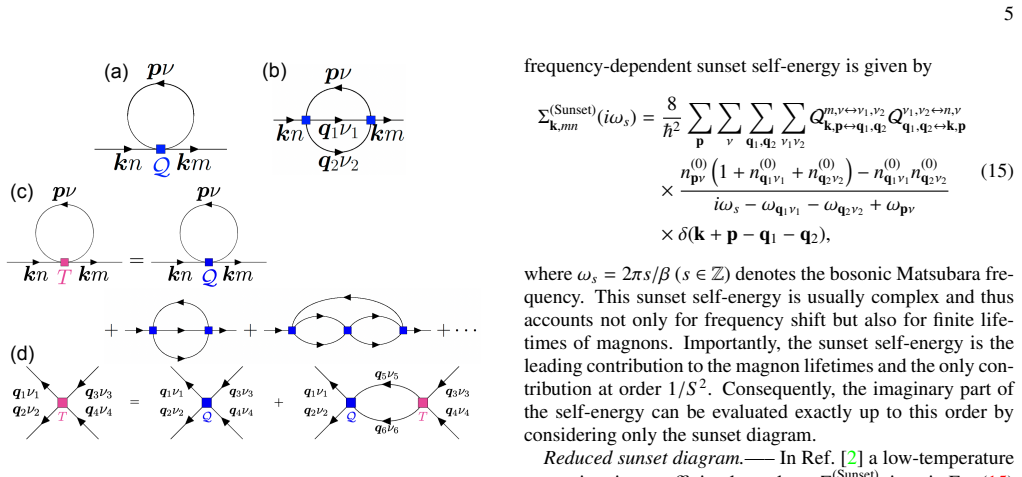
Using nonlinear spin-wave theory with magnon self-energy corrections and a T-matrix resummation that captures two-magnon bound states... Hartree diagram... sunset diagram... Bethe-Salpeter equation
-
IndisputableMonolith/Foundation/RealityFromDistinction.leanreality_from_one_distinction unclear?
unclearRelation between the paper passage and the cited Recognition theorem.
We adopt an established spin model... parameters J1, J2, J3, A, Dz taken from prior literature
What do these tags mean?
- matches
- The paper's claim is directly supported by a theorem in the formal canon.
- supports
- The theorem supports part of the paper's argument, but the paper may add assumptions or extra steps.
- extends
- The paper goes beyond the formal theorem; the theorem is a base layer rather than the whole result.
- uses
- The paper appears to rely on the theorem as machinery.
- contradicts
- The paper's claim conflicts with a theorem or certificate in the canon.
- unclear
- Pith found a possible connection, but the passage is too broad, indirect, or ambiguous to say the theorem truly supports the claim.
Forward citations
Cited by 2 Pith papers
-
Transport of Dirac magnons driven by gauge fields
Gauge fields induce a quantized transverse spin conductivity σ^{xy}=α² sgn(m) ℏ/4π in Dirac magnons of a honeycomb ferromagnet, with AC resonance at the topological gap, as a magnonic analog of the quantum Hall effect.
-
Winding feature and thermal evolution of the Dirac magnons in CrI$_3$
Inelastic neutron scattering reveals the magnon winding around the K-point in CrI3 as the signature of Dirac magnons together with T^2 thermal renormalization from magnon-magnon interactions.
Reference graph
Works this paper leans on
-
[1]
T/T C ≪1 We turn to the renormalization and linewidth of the magnon dispersion in the spin model of CrBr3 at small temperatures far below the critical temperatureT C, and discuss the qualitative and quantitative differences arising from the various levels of approximation introduced in Sec. II. To comply with literature [6], we define the rescaled energy ...
-
[2]
T/T C ≲1 FIG. 8. Three-magnon scatterings, which need to be included for a more quantitatively accurate description of the magnon linewidth at high temperatures nearT C. Next we discuss thermal magnon renormalizations at higher temperatures, i.e., 20 K and 30 K, where a direct comparison between the theory and experimental data reported in Ref. [6] is pos...
-
[3]
We employed Langevin dynamics to incorporate the effect of thermal fluctuations
Classical spin dynamics We also examined temperature-renormalized magnons in CrBr3 using classical spin-dynamics simulations based on the stochastic Landau-Lifshitz-Gilbert equation [68] given by dSi dt =− γ 1+α 2 G [Si ×B eff i +α GSi ×(S i ×B eff i )],(33) whereγis the gyromagnetic ratio,α G is the Gilbert damping, Si is a unit-length spin vector andB e...
-
[4]
Stability of Dirac magnons Finally, we also investigate the damped Dirac magnons at the K point of CrBr 3 at finite temperatures. Figure 10 shows the temperature dependence of the single-magnon spectral function obtained with theoff-shellT-matrix resummation at the K point. The Dirac magnon, which exhibits a sharp single- peak structure at the lowest temp...
-
[5]
Recap of previous works Ref. [37] theoretically studied magnon spectra in CrI3 at fi- nite temperatures, using the Hartree approximation (without self-consistency). The authors found an inversion of Chern numbers±1 between the lower and upper bands triggered by temperature-driven gap closing and reopening at K point. A successive comment [42] pointed out ...
-
[6]
To obtain the data presented in Figs
Predictions based on the resummation: Absence of the gap closing and reopening Since the predicted topological transition is considered to be achieved at very high temperature just atT C or slightly below it, before evaluating the presence or absence of the gap closing and reopening, it is important to examine whether any particular approximation scheme p...
-
[7]
Observability of the topological gap So far, our T-matrix resummation scheme has shown that the topological gap in CrI 3 remains robust even in the high- temperature regime nearT C. While the robustness of the gap implies the absence of a topological transition involving the inversion of magnon Chern numbers, it does not necessarily guarantee the observab...
-
[8]
vL ν1,ν2 (q1,q 2) Γ 4Nmuc vR ν5,ν6 (q5,q 6) # 1+n (0) q5ν5 +n (0) q6ν6 z−ω q5ν5 −ω q6ν6
Solution of the Bethe-Salpeter equation In the following, we denote the decomposition of the four-point (two-in-two-out) vertex as Qν1,ν2↔ν3,ν4 q1,q2↔q3,q4 =v L ν1,ν2 (q1,q 2) Γ 4Nmuc vR ν3,ν4 (q3,q 4) .(B1) whereΓis a 5N 2 subNbond ×5N 2 subNbond-dimensional matrix, andv L ν1,ν2 (q1,q 2) vR ν3,ν4 (q3,q 4) is a 5N 2 subNbond-dimensional row (column) vecto...
-
[9]
Decomposition of the vertex The 5N 2 subNbond ×5N 2 subNbond-dimensional matrixΓcan be block-diagonalizable intoN bond irreducible 5N 2 sub ×5N 2 sub- dimensional matricesΓ {r,r′}. This block-diagonalization is explicitly given in the form Qν1,ν2↔ν3,ν4 q1,q2↔q3,q4 =v L ν1,ν2(q1,q 2) Γ 4Nmuc vR ν3,ν4(q3,q 4) = 1 4Nmuc vL ν1,ν2(q1,q 2) M {r,r′}pai...
-
[10]
Short-wavelength limit The T-matrix self-energy [49] is given by Σ(T) k,mn(iωn)=− 4 ℏ X p X ν 1 βℏ X iωs 1 iωs −ω pν T m,ν↔n,ν k,p↔k,p(iωn +iω s).(B9) Using the Kramers-Kronig relation (dispersion relation) [57]: Re h T m,ν↔m,ν k,p↔k,p (ω) i =Q m,ν↔m,ν k,p↔k,p − P π Z ∞ −∞ dω′ Im h T m,ν↔m,ν k,p↔k,p (ω′) i ω−ω ′ T m,ν↔m,ν k,p↔k,p (ω+iϵ)=Re h...
-
[11]
Expectation values The unitary transformation from the atomic bases to the normal bases, which is originally introduced in the main text, is explicitly given by ( ˆakα = PNsub ν=1 [Uk]αν ˆbkν ˆa† kα = PNsub ν=1 [Uk]∗ αν ˆb† kν .(C1) Expectation values in terms of the normal bases are given by Dˆb† kν ˆbk′ν′ E =δ k,k′ δνν′ n(0) kνDˆbkν ˆb† k′...
-
[12]
Four-magnon mean-fields The four-magnon Hamiltonian in terms of the atomic bases are given by H (4) = X α,β,γ,δ X q1,q2,q3,q4 Qα,β↔γ,δ q1,q2↔q3,q4 ˆa† q1,α ˆa† q2,β ˆaq3,γ ˆaq4,δ, Qα,β,↔γ,δ q1,q2↔q3,q4 = 1 2 1 4N δ(q1 +q 2 −q 3 −q 4) × hn δαγδβδJ 00 q1−q3,αβ +δ αδδβγJ 00 q1−q4,αβ +δ αδδβγJ 00 q2−q3,βα +δ αγδβδJ 00 q2−q4,βα o − n δαβδαγJ+− q4,γδ +δ βδδγδJ+...
-
[13]
Self-consistent Hartree approximation To obtain self-consistent solutions D ˆa† p,α ˆap,β E , we iteratively solve the eigenvalue problem given by SH (2) k +H (4) k,MF nD ˆa† p,α ˆap,β Eo ˜Uk = ˜Uk ˜Wk,(C7) where ˜Wk =diag ( ˜ωk−,˜ωk+). Eigenvalues { ˜ωk±}, eigenvectors n ˜Uk o , and expectation values nD ˆa† p,α ˆap,β Eo are determined self- consistently...
-
[14]
J. Fransson, A. M. Black-Schaffer, and A. V . Balatsky, Magnon Dirac materials, Phys. Rev. B94, 075401 (2016)
work page 2016
-
[15]
S. S. Pershoguba, S. Banerjee, J. C. Lashley, J. Park, H. Ågren, G. Aeppli, and A. V . Balatsky, Dirac magnons in honeycomb ferromagnets, Phys. Rev. X8, 011010 (2018)
work page 2018
-
[16]
L. Chen, J.-H. Chung, B. Gao, T. Chen, M. B. Stone, A. I. Kolesnikov, Q. Huang, and P. Dai, Topological spin excitations in honeycomb ferromagnet cri3, Phys. Rev. X8, 041028 (2018)
work page 2018
-
[17]
B. Yuan, I. Khait, G.-J. Shu, F. C. Chou, M. B. Stone, J. P. Clancy, A. Paramekanti, and Y .-J. Kim, Dirac magnons in a honeycomb lattice quantumXYmagnet CoTiO 3, Phys. Rev. X 10, 011062 (2020)
work page 2020
- [18]
-
[19]
S. E. Nikitin, B. Fåk, K. W. Kr ¨amer, T. Fennell, B. Nor- mand, A. M. L¨auchli, and C. R¨uegg, Thermal evolution of dirac magnons in the honeycomb ferromagnet crbr3, Phys. Rev. Lett. 129, 127201 (2022)
work page 2022
-
[20]
S.-H. Do, J. A. M. Paddison, G. Sala, T. J. Williams, K. Kaneko, K. Kuwahara, A. F. May, J. Yan, M. A. McGuire, M. B. Stone, M. D. Lumsden, and A. D. Christianson, Gaps in topological magnon spectra: Intrinsic versus extrinsic effects, Phys. Rev. B 106, L060408 (2022)
work page 2022
-
[21]
H. Katsura, N. Nagaosa, and P. A. Lee, Theory of the thermal Hall effect in quantum magnets, Phys. Rev. Lett.104, 066403 (2010). 29
work page 2010
- [22]
-
[23]
A. Mook, J. Henk, and I. Mertig, Edge states in topological magnon insulators, Phys. Rev. B90, 024412 (2014)
work page 2014
-
[24]
S. A. Owerre, A first theoretical realization of honeycomb topo- logical magnon insulator, Journal of Physics: Condensed Mat- ter28, 386001 (2016)
work page 2016
-
[25]
S. K. Kim, H. Ochoa, R. Zarzuela, and Y . Tserkovnyak, Real- ization of the haldane-kane-mele model in a system of localized spins, Phys. Rev. Lett.117, 227201 (2016)
work page 2016
-
[26]
M. Malki and G. S. Uhrig, Topological magnetic excitations, Europhysics Letters132, 20003 (2020)
work page 2020
-
[27]
R. Shindou, R. Matsumoto, S. Murakami, and J.-i. Ohe, Topo- logical chiral magnonic edge mode in a magnonic crystal, Phys. Rev. B87, 174427 (2013)
work page 2013
-
[28]
P. A. McClarty, Topological magnons: A review, Annual Re- view of Condensed Matter Physics13, 171 (2022)
work page 2022
- [29]
-
[30]
T. J. Williams, A. A. Aczel, M. D. Lumsden, S. E. Nagler, M. B. Stone, J.-Q. Yan, and D. Mandrus, Magnetic correlations in the quasi-two-dimensional semiconducting ferromagnet crsite3, Phys. Rev. B92, 144404 (2015)
work page 2015
-
[31]
C.-T. Kuo, M. Neumann, K. Balamurugan, H. J. Park, S. Kang, H. W. Shiu, J. H. Kang, B. H. Hong, M. Han, T. W. Noh, and J.-G. Park, Exfoliation and raman spectroscopic fingerprint of few-layer nips3 van der waals crystals, Scientific Reports6, 10.1038/srep20904 (2016)
-
[32]
M.-W. Lin, H. L. Zhuang, J. Yan, T. Z. Ward, A. A. Puretzky, C. M. Rouleau, Z. Gai, L. Liang, V . Meunier, B. G. Sumpter, P. Ganesh, P. R. C. Kent, D. B. Geohegan, D. G. Mandrus, and K. Xiao, Ultrathin nanosheets of crsite3: a semiconducting two-dimensional ferromagnetic material, Journal of Materials Chemistry C4, 315–322 (2016)
work page 2016
-
[33]
B. Huang, G. Clark, E. Navarro-Moratalla, D. R. Klein, R. Cheng, K. L. Seyler, D. Zhong, E. Schmidgall, M. A. McGuire, D. H. Cobden, W. Yao, D. Xiao, P. Jarillo-Herrero, and X. Xu, Layer-dependent ferromagnetism in a van der waals crystal down to the monolayer limit, Nature546, 270–273 (2017)
work page 2017
-
[34]
C. Gong, L. Li, Z. Li, H. Ji, A. Stern, Y . Xia, T. Cao, W. Bao, C. Wang, Y . Wang, Z. Q. Qiu, R. J. Cava, S. G. Louie, J. Xia, and X. Zhang, Discovery of intrinsic ferromagnetism in two-dimensional van der waals crystals, Nature546, 265–269 (2017)
work page 2017
-
[35]
Q. H. Wang, A. Bedoya-Pinto, M. Blei, A. H. Dismukes, A. Hamo, S. Jenkins, M. Koperski, Y . Liu, Q.-C. Sun, E. J. Telford, H. H. Kim, M. Augustin, U. V ool, J.-X. Yin, L. H. Li, A. Falin, C. R. Dean, F. Casanova, R. F. L. Evans, M. Chshiev, A. Mishchenko, C. Petrovic, R. He, L. Zhao, A. W. Tsen, B. D. Gerardot, M. Brotons-Gisbert, Z. Guguchia, X. Roy, S. ...
work page 2022
-
[36]
D. R. Klein, D. MacNeill, J. L. Lado, D. Soriano, E. Navarro- Moratalla, K. Watanabe, T. Taniguchi, S. Manni, P. Canfield, J. Fern ´andez-Rossier, and P. Jarillo-Herrero, Probing mag- netism in 2d van der waals crystalline insulators via electron tunneling, Science360, 1218–1222 (2018)
work page 2018
-
[37]
D. Ghazaryan, M. T. Greenaway, Z. Wang, V . H. Guarochico- Moreira, I. J. Vera-Marun, J. Yin, Y . Liao, S. V . Morozov, O. Kristanovski, A. I. Lichtenstein, M. I. Katsnelson, F. With- ers, A. Mishchenko, L. Eaves, A. K. Geim, K. S. Novoselov, and A. Misra, Magnon-assisted tunnelling in van der waals het- erostructures based on crbr3, Nature Electronics1, ...
work page 2018
-
[38]
H. H. Kim, B. Yang, S. Li, S. Jiang, C. Jin, Z. Tao, G. Nichols, F. Sfigakis, S. Zhong, C. Li, S. Tian, D. G. Cory, G.-X. Miao, J. Shan, K. F. Mak, H. Lei, K. Sun, L. Zhao, and A. W. Tsen, Evolution of interlayer and intralayer magnetism in three atom- ically thin chromium trihalides, Proceedings of the National Academy of Sciences116, 11131–11136 (2019)
work page 2019
-
[39]
F. Zhu, L. Zhang, X. Wang, F. J. dos Santos, J. Song, T. Mueller, K. Schmalzl, W. F. Schmidt, A. Ivanov, J. T. Park, J. Xu, J. Ma, S. Lounis, S. Bl ¨ugel, Y . Mokrousov, Y . Su, and T. Br ¨uckel, Topological magnon insulators in two-dimensional van der waals ferromagnets crsite3 and crgete3: Toward intrinsic gap- tunability, Science Advances7, 10.1126/sci...
-
[40]
Z. Cai, S. Bao, Z.-L. Gu, Y .-P. Gao, Z. Ma, Y . Shangguan, W. Si, Z.-Y . Dong, W. Wang, Y . Wu, D. Lin, J. Wang, K. Ran, S. Li, D. Adroja, X. Xi, S.-L. Yu, X. Wu, J.-X. Li, and J. Wen, Topological magnon insulator spin excitations in the two-dimensional ferromagnet crbr3, Phys. Rev. B104, L020402 (2021)
work page 2021
-
[41]
F. J. Dyson, General theory of spin-wave interactions, Phys. Rev.102, 1217 (1956)
work page 1956
-
[42]
A. B. Harris, D. Kumar, B. I. Halperin, and P. C. Hohenberg, Dynamics of an antiferromagnet at low temperatures: Spin- wave damping and hydrodynamics, Phys. Rev. B3, 961 (1971)
work page 1971
-
[43]
M. I. Kaganov and A. V . Chubukov, Interacting magnons, So- viet Physics Uspekhi30, 1015–1040 (1987)
work page 1987
-
[44]
M. E. Zhitomirsky and A. L. Chernyshev, Colloquium: Sponta- neous magnon decays, Rev. Mod. Phys.85, 219 (2013)
work page 2013
-
[45]
A. Mook, K. Plekhanov, J. Klinovaja, and D. Loss, Interaction- stabilized topological magnon insulator in ferromagnets, Phys. Rev. X11, 021061 (2021)
work page 2021
- [46]
-
[47]
J. Bao, M. Gohlke, J. G. Rau, and N. Shannon, Magnon spec- tra of cuprates beyond spin wave theory, Phys. Rev. Res.7, L012053 (2025)
work page 2025
-
[48]
S. P. Bayrakci, T. Keller, K. Habicht, and B. Keimer, Spin- wave lifetimes throughout the Brillouin zone, Science312, 1926–1929 (2006)
work page 1926
-
[49]
S. P. Bayrakci, D. A. Tennant, P. Leininger, T. Keller, M. C. R. Gibson, S. D. Wilson, R. J. Birgeneau, and B. Keimer, Life- times of antiferromagnetic magnons in two and three dimen- sions: Experiment, theory, and numerics, Phys. Rev. Lett.111, 017204 (2013)
work page 2013
- [50]
-
[51]
H. Sun, D. Bhowmick, B. Yang, and P. Sengupta, Interacting topological dirac magnons, Phys. Rev. B107, 134426 (2023)
work page 2023
-
[52]
S. Banerjee and S. Humeniuk, Interacting dirac magnons in the van der waals ferromagnet crbr 3, Phys. Rev. B112, 094407 (2025)
work page 2025
-
[53]
C. H. Cobb, V . Jaccarino, J. P. Remeika, R. Silberglitt, and H. Yasuoka, Field dependence of the magnetization and spin- wave correlations in ferromagnetic crbr3, Phys. Rev. B3, 1677 (1971). 30
work page 1971
-
[54]
W. B. Yelon and R. Silberglitt, Renormalization of large-wave- vector magnons in ferromagnetic crbr3 studied by inelastic neu- tron scattering: Spin-wave correlation effects, Phys. Rev. B4, 2280 (1971)
work page 1971
-
[55]
topological phase transitions of dirac magnons in honeycomb ferromag- nets
Y .-M. Li, B. Wei, and K. Chang, Comment on “topological phase transitions of dirac magnons in honeycomb ferromag- nets”, Phys. Rev. Lett.132, 219601 (2024)
work page 2024
- [56]
- [57]
-
[58]
H. Zhu, H. Shi, Z. Tang, and B. Tang, Interacting topological magnons in a checkerboard ferromagnet, Chinese Physics B33, 037503 (2024)
work page 2024
-
[59]
H. Shi, H. Zhu, B. Tang, and C. Yang, Interacting floquet topo- logical magnons in laser-irradiated heisenberg honeycomb fer- romagnets, Physics Letters A528, 130054 (2024)
work page 2024
-
[60]
L. Chen, J.-H. Chung, M. B. Stone, A. I. Kolesnikov, B. Winn, V . O. Garlea, D. L. Abernathy, B. Gao, M. Augustin, E. J. G. Santos, and P. Dai, Magnetic field effect on topological spin excitations in cri3, Phys. Rev. X11, 031047 (2021)
work page 2021
- [61]
-
[62]
R. Silberglitt and A. B. Harris, Effect of bound states on the excitation spectrum of a heisenberg ferromagnet at low temper- ature, Phys. Rev. Lett.19, 30 (1967)
work page 1967
-
[63]
R. Silberglitt and A. B. Harris, Dynamics of the heisenberg fer- romagnet at low temperatures, Phys. Rev.174, 640 (1968)
work page 1968
-
[64]
T. Nomura and J.-i. Igarashi, Analysis of resonant inelastic x- ray scattering in la2Cuo4, Phys. Rev. B71, 035110 (2005)
work page 2005
-
[65]
T. Nagao and J.-i. Igarashi, Two-magnon excitations in reso- nant inelastic x-ray scattering from quantum heisenberg anti- ferromagnets, Phys. Rev. B75, 214414 (2007)
work page 2007
-
[66]
B. Fauseweh and G. S. Uhrig, Low-temperature thermodynam- ics of multiflavored hardcore bosons by the br¨uckner approach, Phys. Rev. B92, 214417 (2015)
work page 2015
-
[67]
L. Chen, J.-H. Chung, B. Gao, T. Chen, M. B. Stone, A. I. Kolesnikov, Q. Huang, and P. Dai, Topological spin excita- tions in honeycomb ferromagnet CrI 3, Phys. Rev. X8, 041028 (2018)
work page 2018
-
[68]
T. Holstein and H. Primakoff, Field dependence of the intrinsic domain magnetization of a ferromagnet, Phys. Rev.58, 1098 (1940)
work page 1940
-
[69]
V . A. Alyoshin, V . A. Berezin, and V . A. Tulin, rf susceptibility of single-crystal crbr3 near the curie temperature, Phys. Rev. B 56, 719 (1997)
work page 1997
-
[70]
E. Rastelli,Statistical Mechanics of Magnetic Excitations: From Spin Waves to Stripes and Checkerboards(WORLD SCI- ENTIFIC, 2011)
work page 2011
-
[71]
Y . Liu, L. Zhai, S. Yan, D. Wang, and X. Wan, Magnon-magnon interaction in monolayer mnbi 2te4, Phys. Rev. B108, 174425 (2023)
work page 2023
-
[72]
A. Mook, R. Hoyer, J. Klinovaja, and D. Loss, Magnons, magnon bound pairs, and their hybrid spin-multipolar topology, Phys. Rev. B107, 064429 (2023)
work page 2023
-
[73]
R. P. Reklis, Numerical calculation of two-spin-wave bound states in some two-dimensional heisenberg ferromagnets, Phys. Rev. B9, 4939 (1974)
work page 1974
- [74]
-
[75]
Wortis, Bound states of two spin waves in the heisenberg ferromagnet, Phys
M. Wortis, Bound states of two spin waves in the heisenberg ferromagnet, Phys. Rev.132, 85 (1963)
work page 1963
-
[76]
K. Wada, T. Ishikawa, and T. Oguchi, Two-magnon bound states in the triangular and honeycomb heisen- berg ferromagnets, Progress of Theoretical Physics 54, 1589 (1975), https://academic.oup.com/ptp/article- pdf/54/6/1589/5225388/54-6-1589.pdf
work page 1975
-
[77]
M. Nayak and F. Mila, Possibility to detect the bound state of the heisenberg ferromagnetic chain at intermediate temperature, Phys. Rev. B105, 094407 (2022)
work page 2022
-
[78]
R. Silberglitt and J. B. Torrance, Effect of single-ion anisotropy on two-spin-wave bound state in a heisenberg ferromagnet, Phys. Rev. B2, 772 (1970)
work page 1970
-
[79]
T. Tonegawa, Two-magnon bound states in the heisenberg ferro- magnet with anisotropic exchange and uniaxial anisotropy en- ergies, Progress of Theoretical Physics Supplement46, 61–83 (1970)
work page 1970
-
[80]
A. Legros, S.-S. Zhang, X. Bai, H. Zhang, Z. Dun, W. A. Phe- lan, C. D. Batista, M. Mourigal, and N. P. Armitage, Observa- tion of 4- and 6-magnon bound states in the spin-anisotropic frustrated antiferromagnet fei 2, Phys. Rev. Lett.127, 267201 (2021)
work page 2021
discussion (0)
Sign in with ORCID, Apple, or X to comment. Anyone can read and Pith papers without signing in.