Spin-supersolidity induced quantum criticality and magnetocaloric effect in the triangular-lattice antiferromagnet Rb₂Co(SeO₃)₂
Pith reviewed 2026-05-18 12:29 UTC · model grok-4.3
The pith
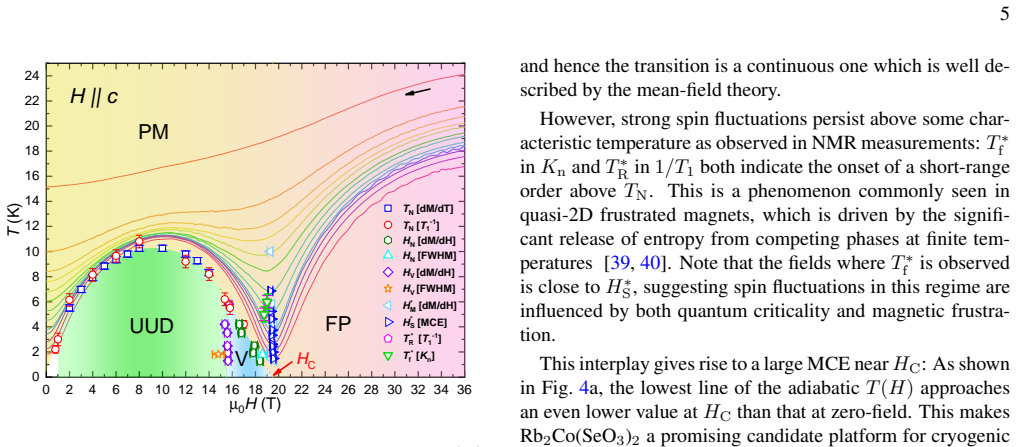
Rb2Co(SeO3)2 enters a spin supersolid phase with gapless excitations from 15.8 to 18.5 T before a continuous quantum phase transition at 19.5 T.
A machine-rendered reading of the paper's core claim, the machinery that carries it, and where it could break.
Core claim
In Rb₂Co(SeO₃)₂ the ground state evolves from a gapped UUD magnetic order below 15.8 T to a spin supersolid with gapless excitations between 15.8 T and 18.5 T, as shown by the transition from thermal activation to power-law behavior in 1/T1, the slow saturation of the NMR spectral ratio, and the susceptibility anomaly. A continuous quantum phase transition occurs at H_C ≈ 19.5 T with νz ≈ 1, detected via the Grüneisen ratio extracted from magnetocaloric data, accompanied by universal scaling and strong spin fluctuations that generate large high-temperature magnetocaloric signals.
What carries the argument
The spin supersolid phase with gapless excitations, which occupies the intermediate field window and directly precedes the quantum critical point at 19.5 T.
If this is right
- A large high-temperature magnetocaloric effect appears near H_C driven by frustration and quantum criticality.
- Universal quantum critical scaling with νz ≈ 1 holds in the vicinity of 19.5 T.
- Strong spin fluctuations persist over a broad temperature range around the critical field.
- The compound functions as a platform for studying field-tuned quantum criticality in frustrated magnets.
Where Pith is reading between the lines
- Similar field-induced supersolid windows may exist in other triangular-lattice Ising materials with comparable exchange parameters.
- Specific-heat or thermal-conductivity measurements could independently confirm the gapless nature of the supersolid excitations.
- The observed magnetocaloric response suggests the material could be tested for cooling performance at millikelvin temperatures.
Load-bearing premise
The power-law temperature dependence of 1/T1 together with the slow saturation of the NMR spectral ratio are interpreted as signatures of a spin supersolid rather than other possible gapless or partially disordered states.
What would settle it
Direct measurement of a finite spin gap persisting through the 15.8–18.5 T window or a clear departure from νz ≈ 1 scaling in higher-resolution Grüneisen-ratio data would falsify the supersolid and continuous-transition claims.
Figures


read the original abstract
We performed high-field magnetization, magnetocaloric effect (MCE), and NMR measurements on the Ising triangular-lattice antiferromagnet Rb$_2$Co(SeO$_3$)$_2$. The observations of the 1/3-magnetization plateau, the split NMR lines, and the thermal activation behaviors of the spin-lattice relaxation rate $1/T_1$ between 2 T and 15.8 T provide unambiguous evidence of a gapped up-up-down (UUD) magnetic ordered phase. For fields between 15.8 T and 18.5 T, the anomaly in the magnetic susceptibility, the slow saturation of the NMR line spectral ratio with temperature, and the power-law temperature dependence of $1/T_1$ suggest the ground state to be a spin supersolid with gapless spin excitations. With further increasing the field, the Gr\"{u}neisen ratio, extracted from the MCE data, reveals a continuous quantum phase transition at $H_{\rm C}\approx$ 19.5 T and a universal quantum critical scaling with the exponents ${\nu}z~\approx~$1. Near $H_{\rm C}$, the large high-temperature MCE signal and the broad peaks in the NMR Knight shift and $1/T_1$, manifest the strong spin fluctuations driven by both magnetic frustration and quantum criticality. These results establish Rb$_2$Co(SeO$_3$)$_2$ as a candidate platform for cryogenic magnetocaloric cooling.
Editorial analysis
A structured set of objections, weighed in public.
Referee Report
Summary. The manuscript reports high-field magnetization, magnetocaloric effect (MCE), and NMR measurements on the Ising triangular-lattice antiferromagnet Rb₂Co(SeO₃)₂. It identifies a gapped up-up-down (UUD) ordered phase between 2 T and 15.8 T based on the 1/3-magnetization plateau, split NMR lines, and thermally activated 1/T₁. Between 15.8 T and 18.5 T, anomalies in susceptibility, slow saturation of the NMR spectral ratio, and power-law T dependence of 1/T₁ are interpreted as evidence for a spin supersolid with gapless excitations. A continuous quantum phase transition at H_C ≈ 19.5 T with νz ≈ 1 is inferred from the Grüneisen ratio extracted from MCE data, with additional signatures of strong spin fluctuations near H_C. The work positions the material as a platform for cryogenic magnetocaloric cooling.
Significance. If the phase assignments and quantum-critical scaling hold, the results add a new experimental realization of spin supersolidity and field-tuned quantum criticality in a frustrated Ising magnet, with the combination of MCE-derived Grüneisen ratio and NMR relaxation providing a multi-probe characterization of the critical regime. The reported large high-temperature MCE signal near H_C is a concrete strength that directly supports the suggested cooling application.
major comments (2)
- [NMR results, 15.8–18.5 T window] § on NMR results (field range 15.8–18.5 T): the assignment of gapless spin-supersolid excitations rests on the power-law form of 1/T₁ and the slow saturation of the spectral ratio, yet the manuscript provides no quantitative comparison or fit to theoretical predictions for alternative gapless states (e.g., incommensurate order or a spin liquid); this interpretive uniqueness is load-bearing for the central supersolid claim.
- [MCE and quantum-critical scaling] MCE and Grüneisen-ratio analysis near H_C ≈ 19.5 T: the reported νz ≈ 1 is stated without the explicit fitting procedure, temperature range used, or error bars on the exponent; the scaling collapse or power-law extraction therefore cannot be independently assessed from the presented data.
minor comments (2)
- [Figures 2–4] Figure captions and text should explicitly state whether raw magnetization and NMR spectra are shown or only processed quantities; inclusion of representative raw data would strengthen reproducibility.
- [Abstract and discussion] The abstract and main text use “suggest” for the supersolid assignment; a brief sentence clarifying that alternative gapless scenarios have not been quantitatively ruled out would improve precision.
Simulated Author's Rebuttal
We thank the referee for the thorough review and constructive feedback on our manuscript. We appreciate the recognition of the significance of our findings on spin supersolidity and quantum criticality in Rb₂Co(SeO₃)₂. We address the major comments below and will revise the manuscript accordingly where appropriate.
read point-by-point responses
-
Referee: [NMR results, 15.8–18.5 T window] § on NMR results (field range 15.8–18.5 T): the assignment of gapless spin-supersolid excitations rests on the power-law form of 1/T₁ and the slow saturation of the spectral ratio, yet the manuscript provides no quantitative comparison or fit to theoretical predictions for alternative gapless states (e.g., incommensurate order or a spin liquid); this interpretive uniqueness is load-bearing for the central supersolid claim.
Authors: We agree that providing quantitative comparisons to theoretical predictions for alternative gapless states would strengthen our interpretation. In the revised manuscript, we will add a discussion section comparing the observed temperature dependence of 1/T₁ (power-law exponent) and the NMR spectral ratio behavior to expectations from spin supersolid theory as well as alternative scenarios such as incommensurate order or a gapless spin liquid. While the overall set of observations—including the susceptibility anomaly and consistency with the triangular lattice Ising model predictions—favor the spin supersolid phase, we acknowledge the value of explicit comparisons to rule out alternatives more rigorously. revision: yes
-
Referee: [MCE and quantum-critical scaling] MCE and Grüneisen-ratio analysis near H_C ≈ 19.5 T: the reported νz ≈ 1 is stated without the explicit fitting procedure, temperature range used, or error bars on the exponent; the scaling collapse or power-law extraction therefore cannot be independently assessed from the presented data.
Authors: We thank the referee for pointing out this omission. In the revised manuscript, we will include a detailed description of the Grüneisen ratio analysis, specifying the temperature range over which the power-law fit was performed, the fitting procedure used to extract νz ≈ 1, and the associated error bars. We will also provide additional details or a figure showing the scaling behavior to allow for independent verification of the quantum critical scaling. revision: yes
Circularity Check
No circularity: purely experimental data interpretation
full rationale
The paper reports direct experimental measurements (magnetization, MCE, NMR 1/T1 and spectral ratios) on Rb2Co(SeO3)2. Phase assignments (UUD plateau, spin supersolid window, QCP at 19.5 T) are based on observed anomalies and standard temperature/field dependencies without any theoretical derivation, model fitting, or equation chain that reduces outputs to inputs by construction. No self-citations, ansatzes, or uniqueness theorems are invoked to force the central claims; the work is self-contained against external benchmarks such as known NMR signatures of gapped vs. gapless states.
Axiom & Free-Parameter Ledger
free parameters (2)
- H_C =
19.5 T
- νz =
1
axioms (1)
- domain assumption Rb2Co(SeO3)2 realizes an Ising triangular-lattice antiferromagnet with dominant nearest-neighbor interactions.
invented entities (1)
-
spin supersolid phase
no independent evidence
Forward citations
Cited by 2 Pith papers
-
NMR evidence of spin supersolid and Pomeranchuk effect behaviors in the triangular-lattice antiferromagnet Rb$_2$Ni$_2$(SeO$_3$)$_3$
NMR data identifies spin supersolid phases and a Pomeranchuk-like effect in Rb2Ni2(SeO3)3.
-
Emergent Spin Supersolids in Frustrated Quantum Materials
Spin supersolids featuring coexisting longitudinal spin order breaking lattice symmetry and transverse order breaking spin U(1) symmetry have been established in frustrated quantum magnets through consistent experimen...
Reference graph
Works this paper leans on
-
[1]
Spin liquids in frustrated magnets,
L. Balents, “Spin liquids in frustrated magnets,” Nature 464, 199–208 (2010)
work page 2010
-
[2]
Deconfined quantum critical points,
T. Senthil, A. Vishwanath, L. Balents, S. Sachdev, and M. P. A. Fisher, “Deconfined quantum critical points,” Science 303, 1490–1494 (2004)
work page 2004
-
[3]
Quantum Phase Diagram of the Triangular-Lattice XXZ Model in a Magnetic Field,
D. Yamamoto, G. Marmorini, and I. Danshita, “Quantum Phase Diagram of the Triangular-Lattice XXZ Model in a Magnetic Field,” Phys. Rev. Lett.112, 127203 (2014)
work page 2014
-
[4]
Spin nematic phase in S= 1 triangular antiferromagnets,
H. Tsunetsugu and M. Arikawa, “Spin nematic phase in S= 1 triangular antiferromagnets,” J. Phys. Soc. Jpn. 75, 083701 (2006)
work page 2006
-
[5]
Bose–Einstein condensation of a two-magnon bound state in a spin-1 triangular lattice,
J. Sheng, J.-W. Mei, L. Wang, X. Xu, W. Jiang, L. Xu, H. Ge, N. Zhao, T. Li, A. Candini, B. Xi, J. Zhao, Y . Fu, J. Yang, Y . Zhang, G. Biasiol, S. Wang, J. Zhu, P. Miao, X. Tong, D. Yu, R. Mole, Y . Cui, L. Ma, Z. Zhang, Z. Ouyang, W. Tong, A. Podlesnyak, L. Wang, F. Ye, D. Yu, W. Yu, L. Wu, and Z. Wang, “Bose–Einstein condensation of a two-magnon bound ...
work page 2025
-
[6]
Supersolid Order from Disorder: Hard-Core Bosons on the Triangular Lattice,
R. G. Melko, A. Paramekanti, A. A. Burkov, A. Vishwanath, D. N. Sheng, and L. Balents, “Supersolid Order from Disorder: Hard-Core Bosons on the Triangular Lattice,” Phys. Rev. Lett. 95, 127207 (2005)
work page 2005
-
[7]
Supersolid Hard-Core Bosons on the Triangular Lattice,
S. Wessel and M. Troyer, “Supersolid Hard-Core Bosons on the Triangular Lattice,” Phys. Rev. Lett.95, 127205 (2005)
work page 2005
-
[8]
Supersolid Phase of Hard- Core Bosons on a Triangular Lattice,
M. Boninsegni and N. Prokof’ev, “Supersolid Phase of Hard- Core Bosons on a Triangular Lattice,” Phys. Rev. Lett. 95, 237204 (2005)
work page 2005
-
[9]
Persistent supersolid phase of hard-core bosons on the triangular lattice,
D. Heidarian and K. Damle, “Persistent supersolid phase of hard-core bosons on the triangular lattice,” Phys. Rev. Lett. 95, 127206 (2005)
work page 2005
-
[10]
Extended super- solid phase of frustrated hard-core bosons on a triangular lat- tice,
F. Wang, F. Pollmann, and A. Vishwanath, “Extended super- solid phase of frustrated hard-core bosons on a triangular lat- tice,” Phys. Rev. Lett.102, 017203 (2009)
work page 2009
-
[11]
Supersolidity in the Trian- gular Lattice Spin- 1/2 XXZ Model: A Variational Perspec- tive,
D. Heidarian and A. Paramekanti, “Supersolidity in the Trian- gular Lattice Spin- 1/2 XXZ Model: A Variational Perspec- tive,” Phys. Rev. Lett.104, 015301 (2010)
work page 2010
-
[12]
Giant magne- tocaloric effect in spin supersolid candidate Na 2BaCo(PO4)2,
J. Xiang, C. Zhang, Y . Gao, W. Schmidt, K. Schmalzl, C.-W. Wang, B. Li, N. Xi, X.-Y . Liu, H. Jin, G. Li, J. Shen, Z. Chen, Y . Qi, Y . Wan, W. Jin, W. Li, P. Sun, and G. Su, “Giant magne- tocaloric effect in spin supersolid candidate Na 2BaCo(PO4)2,” Nature 625, 270–275 (2024)
work page 2024
-
[13]
Quantum theory of defects in crystals,
A. F. Andreev and I. M. Lifshitz, “Quantum theory of defects in crystals,” Sov. Phys. Usp29, 1107 (1969)
work page 1969
-
[14]
The flow of a dense superfluid,
D. J Thouless, “The flow of a dense superfluid,” Ann. Phys.52, 403–427 (1969)
work page 1969
-
[15]
A. J. Leggett, “Can a Solid Be “Superfluid”?” Phys. Rev. Lett. 25, 1543–1546 (1970)
work page 1970
-
[16]
A stripe phase with supersolid properties in spin-orbit-coupled bose-einstein condensates,
J.R. Li, J. Lee, W. Huang, R. Zhong, S. Guo, G. Xu, Z. Xu, and R. J. Cava, “A stripe phase with supersolid properties in spin-orbit-coupled bose-einstein condensates,” Nature543, 91– 94 (2017)
work page 2017
-
[17]
Supersolid formation in a quantum gas breaking a contin- uous translational symmetry,
J. L ´eonard, A. Morales, P. Zupancic, T. Esslinger, and T. Don- ner, “Supersolid formation in a quantum gas breaking a contin- uous translational symmetry,” Nature543, 87–90 (2017)
work page 2017
-
[18]
Su- persolid symmetry breaking from compressional oscillations in a dipolar quantum gas,
L. Tanzi, S.M Roccuzzo, E. Lucioni, F. Fam `a, A. Fioretti, C. Gabbanini, G. Modugno, A. Recati, and S. Stringari, “Su- persolid symmetry breaking from compressional oscillations in a dipolar quantum gas,” Nature574, 382–385 (2019)
work page 2019
-
[19]
Two- dimensional supersolidity in a dipolar quantum gas,
M. A. Norcia, C. Politi, L. Klaus, E. Poli, M. Sohmen, M. J. Mark, R. N. Bisset, L. Santos, and F. Ferlaino, “Two- dimensional supersolidity in a dipolar quantum gas,” Nature 596, 357–361 (2021)
work page 2021
-
[20]
Absence of supersolidity in solid helium in porous vycor glass,
D. Y . Kim and M. H. W. Chan, “Absence of supersolidity in solid helium in porous vycor glass,” Phys. Rev. Lett. 109, 155301 (2012)
work page 2012
-
[21]
Colloquium: Supersolids: What and where are they?
M. Boninsegni and N. V . Prokof’ev, “Colloquium: Supersolids: What and where are they?” Rev. Mod. Phys. 84, 759–776 (2012)
work page 2012
-
[22]
Emerging supersolidity in photonic-crystal polariton conden- sates,
D. Trypogeorgos, A. Gianfrate, M. Landini, D. Nigro, D. Ger- ace, I. Carusotto, F. Riminucci, K. W. Baldwin, L. N. Pfeiffer, G. I. Martone, M. D. Giorgi, D. Ballarini, and D. Sanvitto, “Emerging supersolidity in photonic-crystal polariton conden- sates,” Nature639, 337–341 (2025)
work page 2025
-
[23]
Supersolid order of frustrated hard-core bosons in a tri- angular lattice system,
H. C. Jiang, M. Q. Weng, Z. Y . Weng, D. N. Sheng, and L. Ba- lents, “Supersolid order of frustrated hard-core bosons in a tri- angular lattice system,” Phys. Rev. B79, 020409 (2009)
work page 2009
-
[24]
Spin supersolidity in nearly ideal easy-axis triangular quantum antiferromagnet Na2BaCo(PO4)2,
Y . Gao, Y .-C. Fan, H. Li, F. Yang, X.-T. Zeng, X.-L. Sheng, R. Zhong, Y . Qi, Y . Wan, and W. Li, “Spin supersolidity in nearly ideal easy-axis triangular quantum antiferromagnet Na2BaCo(PO4)2,” npj Quantum Mater.7, 89 (2022)
work page 2022
-
[25]
Phase diagram of the antiferromagnetic XXZ model on the triangular lattice,
D. Sellmann, X.-F. Zhang, and S. Eggert, “Phase diagram of the antiferromagnetic XXZ model on the triangular lattice,” Phys. Rev. B 91, 081104 (2015)
work page 2015
-
[26]
J. Sheng, L. Wang, Andrea. Candini, W. Jiang, L. Huang, B. Xi, J. Zhao, G. Han, N. Zhao, Y . Fu, J. Ren, J. Yang, P. Miao, X. Tong, D. Yu, S. Wang, Q. Liu, M. Kofu, R. Mole, G. Biasiol, D. Yu, I. Zaliznyak, J.-W. Mei, and L. Wu, “Two-dimensional quantum universality in the spin- 1 2 triangular-lattice quantum antiferromagnet Na2BaCo(PO4)2,” Proc. Natl. Ac...
work page 2022
-
[27]
C. Zhang, J. Xiang, Q. Zhu, L. Wu, S. Zhang, J. Xu, W. Yin, P. Sun, W. Li, G. Su, and W. Jin, “Structural, magnetic, and magnetocaloric properties of triangular-lattice transition-metal phosphates,” Phys. Rev. Mater.8, 044409 (2024)
work page 2024
- [28]
-
[29]
NMR study of supersolid phases in the triangular-lattice antiferromagnet Na2BaCo(PO4)2,
X. Xu, Z. Wu, Y . Chen, Q. Huang, Z. Hu, X. Shi, K. Du, S. Li, R. Bian, R. Yu, Y . Cui, H. Zhou, and W. Yu, “NMR study of supersolid phases in the triangular-lattice antiferromagnet Na2BaCo(PO4)2,” arXiv:2504.08570 (2025)
-
[30]
Enhanced magnetocaloric effect in frus- trated magnets,
M. E. Zhitomirsky, “Enhanced magnetocaloric effect in frus- trated magnets,” Phys. Rev. B67, 104421 (2003)
work page 2003
-
[31]
Frustrated magnetism in the layered triangular lattice materials K2Co(SeO3)2 and Rb2Co(SeO3)2,
R. Zhong, S. Guo, and R. J. Cava, “Frustrated magnetism in the layered triangular lattice materials K2Co(SeO3)2 and Rb2Co(SeO3)2,” Phys. Rev. Mater.4, 084406 (2020)
work page 2020
-
[32]
Continuum Excita- tions in a Spin Supersolid on a Triangular Lattice,
M. Zhu, V . Romerio, N. Steiger, S. D. Nabi, N. Murai, S. Ohira- Kawamura, K. Yu. Povarov, Y . Skourski, R. Sibille, L. Keller, Z. Yan, S. Gvasaliya, and A. Zheludev, “Continuum Excita- tions in a Spin Supersolid on a Triangular Lattice,” Phys. Rev. Lett. 133, 186704 (2024)
work page 2024
-
[33]
From RVB to supersolidity: the saga of the Ising- Heisenberg model on the triangular lattice,
F. Mila, “From RVB to supersolidity: the saga of the Ising- Heisenberg model on the triangular lattice,” J. Club Condens. Matter Phys. (2024)
work page 2024
-
[34]
Wannier states and spin supersolid physics in the triangular antiferromagnet K 2Co(SeO3)2,
M. Zhu, L. M. Chinellato, V . Romerio, N. Murai, S. Ohira- Kawamura, C. Balz, Z. Yan, S. Gvasaliya, Y . Kato, C. D. Batista, and A. Zheludev, “Wannier states and spin supersolid physics in the triangular antiferromagnet K 2Co(SeO3)2,” npj Quantum Mater. 10, 74 (2025)
work page 2025
-
[35]
Phase Dia- gram and Spectroscopic Signatures of Supersolids in Quantum Ising Magnet K2Co(SeO3)2,
T. Chen, A. Ghasemi, J. Zhang, L. Shi, Z. Tagay, Y . Chen, L. Chen, E.-S. Choi, M. Jaime, M. Lee, Y . Hao, H. Cao, B. Winn, A. A. Podlesnyak, D. M. Pajerowski, R. Zhong, X. Xu, N. P. Armitage, R. Cava, and C. Broholm, “Phase Dia- gram and Spectroscopic Signatures of Supersolids in Quantum Ising Magnet K2Co(SeO3)2,” arXiv:2402.15869 (2024)
-
[36]
M. Ghorbani Zavareh, Y . Skourski, K. P. Skokov, D. Yu. 7 Karpenkov, L. Zvyagina, A. Waske, D. Haskel, M. Zher- nenkov, J. Wosnitza, and O. Gutfleisch, “Direct measurement of the magnetocaloric effect in La(Fe, Si, Co)13 compounds in pulsed magnetic fields,” Phys. Rev. Appl.8, 014037 (2017)
work page 2017
-
[37]
Nuclear spin-lattice relaxation in magnetic insulators,
D. Beeman and P. Pincus, “Nuclear spin-lattice relaxation in magnetic insulators,” Phys. Rev.166, 359–375 (1968)
work page 1968
-
[38]
Adiabatic measurements of magneto-caloric ef- fects in pulsed high magnetic fields up to 55 T,
T. Kihara, Y . Kohama, Y . Hashimoto, S. Katsumoto, and M. Tokunaga, “Adiabatic measurements of magneto-caloric ef- fects in pulsed high magnetic fields up to 55 T,” Rev. Sci. In- strum. 84, 074901 (2013)
work page 2013
-
[39]
Proximate de- confined quantum critical point in SrCu2(BO3)2,
Y . Cui, L. Liu, H. Lin, K.-H. Wu, W. Hong, X. Liu, C. Li, Z. Hu, N. Xi, S. Li, R. Yu, A. W. Sandvik, and W. Yu, “Proximate de- confined quantum critical point in SrCu2(BO3)2,” Science380, 1179–1184 (2023)
work page 2023
-
[40]
Deconfined quantum critical point: A review of progress,
Y . Cui, R. Yu, and W. Yu, “Deconfined quantum critical point: A review of progress,” Chin. Phys. Lett.42, 047503 (2025)
work page 2025
-
[41]
Absence of high-field spin supersolid phase in Rb 2Co(SeO3)2 with a triangular lat- tice,
K. Shi, Y . Q. Han, B. C. Yu, L. S. Ling, W. Tong, C. Y . Xi, T. Shang, Z. Wang, L. Pi, and L. Ma, “Absence of high-field spin supersolid phase in Rb 2Co(SeO3)2 with a triangular lat- tice,” arXiv:2509.06281 (2025)
discussion (0)
Sign in with ORCID, Apple, or X to comment. Anyone can read and Pith papers without signing in.