EMPalm: Exfiltrating Palm Biometric Data via Electromagnetic Side-Channel
Pith reviewed 2026-05-18 08:42 UTC · model grok-4.3
The pith
Electromagnetic emissions from palm recognition devices leak enough detail to reconstruct palmprint and palmvein images and spoof authentication systems.
A machine-rendered reading of the paper's core claim, the machinery that carries it, and where it could break.
Core claim
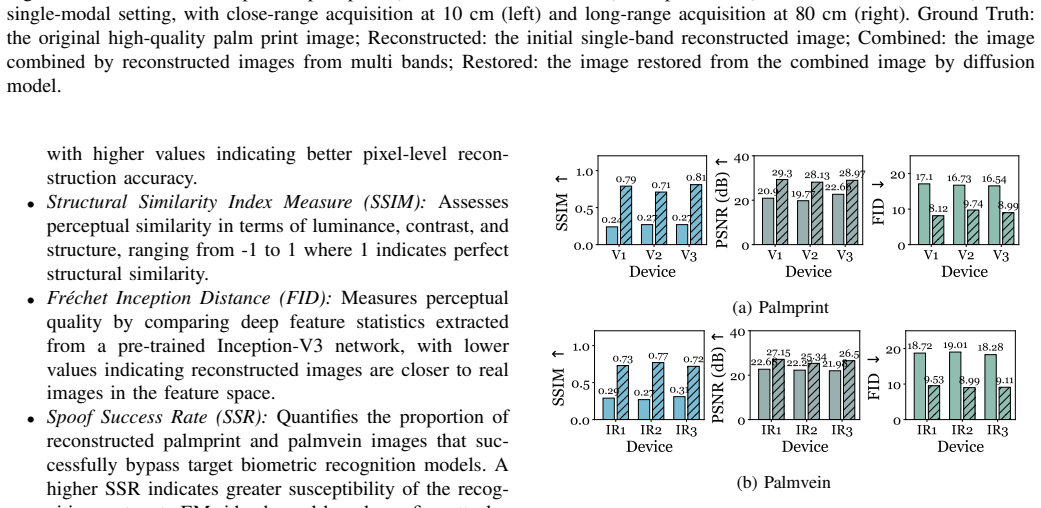
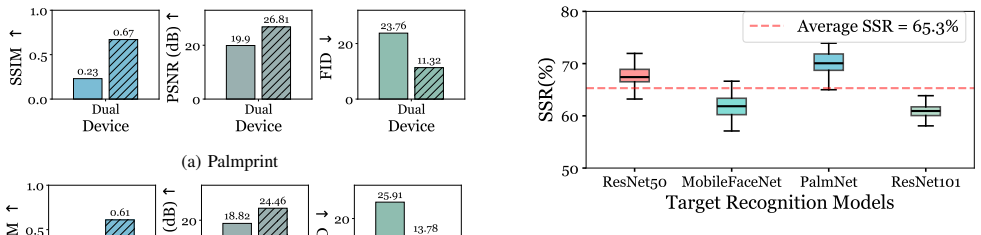
The authors establish that EM side-channel leakage from dual-modal palm acquisition devices enables the covert recovery of both palmprint and palmvein images. Their method separates the interleaved modality transmissions, combines informative frequency bands, reconstructs the images, and applies a diffusion model to restore domain-specific fine features. This process yields high-fidelity reconstructions across multiple prototype and commercial devices, with structural similarity up to 0.79, peak signal-to-noise ratio up to 29.88 dB, and Fréchet inception distance as low as 6.82. When used to attack four state-of-the-art palm recognition models on 6,000 samples from 100 users, the approachach
What carries the argument
The EMPalm attack framework, which processes eavesdropped electromagnetic signals by separating interleaved palmprint and palmvein transmissions, identifying and combining their informative frequency bands, performing initial image reconstruction, and then using a diffusion model to enhance biometric feature fidelity.
Load-bearing premise
The assumption that the interleaved transmissions of the two modalities can be reliably separated and that their informative frequency bands can be identified and combined without device-specific calibration or prior knowledge of the exact hardware timing.
What would settle it
Capture electromagnetic emissions from a commercial palm scanner while it processes known palm samples, apply the separation and reconstruction pipeline to generate images, and verify whether those images produce SSIM scores near 0.79 and enable spoofing success rates around 65 percent against independent recognition models.
Figures





read the original abstract
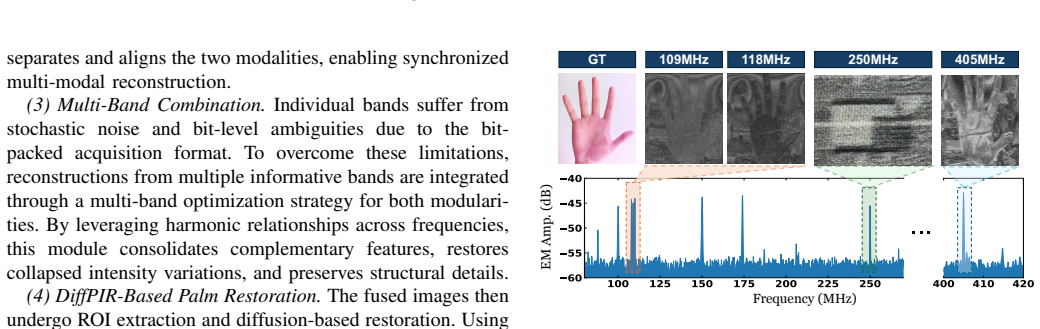
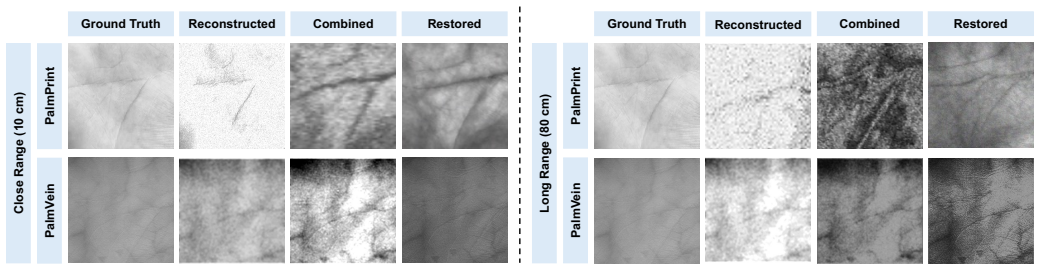
Palm recognition has emerged as a dominant biometric authentication technology in critical infrastructure. These systems operate in either single-modal form, using palmprint or palmvein individually, or dual-modal form, fusing the two modalities. Despite this diversity, they share similar hardware architectures that inadvertently emit electromagnetic (EM) signals during operation. Our research reveals that these EM emissions leak palm biometric information, motivating us to develop EMPalm--an attack framework that covertly recovers both palmprint and palmvein images from eavesdropped EM signals. Specifically, we first separate the interleaved transmissions of the two modalities, identify and combine their informative frequency bands, and reconstruct the images. To further enhance fidelity, we employ a diffusion model to restore fine-grained biometric features unique to each domain. Evaluations on seven prototype and two commercial palm acquisition devices show that EMPalm can recover palm biometric information with high visual fidelity, achieving SSIM scores up to 0.79, PSNR up to 29.88 dB, and FID scores as low as 6.82 across all tested devices, metrics that collectively demonstrate strong structural similarity, high signal quality, and low perceptual discrepancy. To assess the practical implications of the attack, we further evaluate it against four state-of-the-art palm recognition models, achieving a model-wise average spoofing success rate of 65.30% over 6,000 samples from 100 distinct users.
Editorial analysis
A structured set of objections, weighed in public.
Referee Report
Summary. The manuscript presents EMPalm, an electromagnetic side-channel attack framework that recovers palmprint and palmvein images from EM emissions of palm biometric acquisition devices. The approach involves separating interleaved modality transmissions, identifying informative frequency bands, image reconstruction, and using a diffusion model for feature restoration. The authors evaluate the attack on seven prototype and two commercial devices, reporting reconstruction metrics of SSIM up to 0.79, PSNR up to 29.88 dB, and FID as low as 6.82, and demonstrate a 65.30% average spoofing success rate on four state-of-the-art palm recognition models using 6,000 samples from 100 users.
Significance. If the separation and reconstruction methods generalize without device-specific tuning, this work would be significant in highlighting previously unexplored side-channel vulnerabilities in palm biometric systems used for critical infrastructure authentication. The multi-device evaluation across nine devices and the large-scale spoofing assessment with 6,000 samples provide concrete empirical evidence of the attack's potential impact and practicality.
major comments (1)
- [Methods (modality separation and frequency-band identification)] The central claim requires reliable separation of interleaved palmprint and palmvein modality transmissions without device-specific calibration or prior timing knowledge, followed by identification and combination of informative frequency bands. The manuscript provides insufficient detail on the exact separation algorithm, any mathematical formulation, pseudocode, or automated band-selection procedure (see the description in the abstract and the methods section on signal processing). This is load-bearing for the reported results because the SSIM up to 0.79, PSNR up to 29.88 dB, FID as low as 6.82, and 65.30% spoofing rate all depend on successful decomposition; without these specifics it is unclear whether the metrics would transfer to unseen hardware.
minor comments (2)
- [Abstract and Evaluation] The abstract and evaluation sections report SSIM, PSNR, and FID scores as well as the spoofing success rate but omit error bars, standard deviations, and the number of trials or samples averaged per metric, which would strengthen the quantitative claims.
- [Reconstruction enhancement] Provide more information on the diffusion model's training data, architecture details, and whether any device-specific fine-tuning was performed to support reproducibility.
Simulated Author's Rebuttal
We thank the referee for their thorough and constructive review of our manuscript. We have carefully considered the major comment on the methods for modality separation and frequency-band identification. Our point-by-point response follows, along with an indication of the revisions we will make to strengthen the paper.
read point-by-point responses
-
Referee: The central claim requires reliable separation of interleaved palmprint and palmvein modality transmissions without device-specific calibration or prior timing knowledge, followed by identification and combination of informative frequency bands. The manuscript provides insufficient detail on the exact separation algorithm, any mathematical formulation, pseudocode, or automated band-selection procedure (see the description in the abstract and the methods section on signal processing). This is load-bearing for the reported results because the SSIM up to 0.79, PSNR up to 29.88 dB, FID as low as 6.82, and 65.30% spoofing rate all depend on successful decomposition; without these specifics it is unclear whether the metrics would transfer to unseen hardware.
Authors: We thank the referee for highlighting the importance of providing explicit details on the modality separation and frequency-band identification procedures, which are indeed central to the attack framework and its reported performance. We agree that the original manuscript's description of the signal processing steps would benefit from additional specificity to better demonstrate how these operations function without device-specific calibration or prior timing knowledge. In the revised manuscript, we will expand the methods section to include the mathematical formulation of the separation algorithm, pseudocode for the automated band-selection procedure (based on spectral analysis and SNR thresholding), and further elaboration on the generalizability of these steps across hardware. These additions will clarify the load-bearing aspects of the pipeline and support the transferability of the reconstruction and spoofing metrics. revision: yes
Circularity Check
No circularity: empirical side-channel attack with physical evaluations
full rationale
The paper describes an attack pipeline that separates interleaved EM transmissions from dual-modal palm devices, identifies informative frequency bands, reconstructs images, and applies a diffusion model for feature restoration. All central results (SSIM up to 0.79, PSNR up to 29.88 dB, 65.30% spoofing rate) are obtained from direct measurements on seven prototype and two commercial devices using 6,000 samples from 100 users. No equations, fitted parameters, or derivations are presented that reduce outputs to inputs by construction. The work contains no self-citation chains, uniqueness theorems, or ansatzes that load-bear the claims; the separation and reconstruction steps are treated as engineering techniques validated externally by hardware experiments rather than by internal redefinition.
Axiom & Free-Parameter Ledger
Lean theorems connected to this paper
-
IndisputableMonolith/Foundation/RealityFromDistinction.leanreality_from_one_distinction unclear?
unclearRelation between the paper passage and the cited Recognition theorem.
we first separate the interleaved transmissions of the two modalities, identify and combine their informative frequency bands, and reconstruct the images... employ a diffusion model to restore fine-grained biometric features
What do these tags mean?
- matches
- The paper's claim is directly supported by a theorem in the formal canon.
- supports
- The theorem supports part of the paper's argument, but the paper may add assumptions or extra steps.
- extends
- The paper goes beyond the formal theorem; the theorem is a base layer rather than the whole result.
- uses
- The paper appears to rely on the theorem as machinery.
- contradicts
- The paper's claim conflicts with a theorem or certificate in the canon.
- unclear
- Pith found a possible connection, but the passage is too broad, indirect, or ambiguous to say the theorem truly supports the claim.
Reference graph
Works this paper leans on
-
[1]
Feature extraction methods for palmprint recognition: A survey and evaluation,
L. Fei, G. Lu, W. Jia, S. Teng, and D. Zhang, “Feature extraction methods for palmprint recognition: A survey and evaluation,”IEEE Transactions on Systems, Man, and Cybernetics: Systems, vol. 49, no. 2, pp. 346–363, 2019
work page 2019
-
[2]
Deep learning in palmprint recognition-a comprehensive survey,
C. Gao, Z. Yang, W. Jia, L. Leng, B. Zhang, and A. B. J. Teoh, “Deep learning in palmprint recognition-a comprehensive survey,”arXiv preprint arXiv:2501.01166, 2025
-
[3]
A novel hybrid fusion combining palmprint and palm vein for large-scale palm-based recognition,
D. Fan, X. Liang, W. Jia, J. Chen, and D. Zhang, “A novel hybrid fusion combining palmprint and palm vein for large-scale palm-based recognition,”IEEE Transactions on Systems, Man, and Cybernetics: Systems, vol. 54, no. 7, pp. 4471–4484, 2024
work page 2024
-
[4]
Next generation identification,
F. B. of Investigation, “Next generation identification,” https://le.fbi.gov/ science-and-lab/biometrics-and-fingerprints, 2013, accessed: 2025-08- 24
work page 2013
-
[5]
Centralized large margin cosine loss for open-set deep palmprint recognition,
D. Zhong and J. Zhu, “Centralized large margin cosine loss for open-set deep palmprint recognition,”IEEE Transactions on Circuits and Systems for Video Technology, vol. 30, no. 6, pp. 1559–1568, 2019
work page 2019
-
[6]
K. W. Bowyer and M. J. Burge,Handbook of iris recognition. Springer, 2016
work page 2016
-
[7]
Palm print and vein recognition module,
S. O. INTELLIGENCE, “Palm print and vein recognition module,” https: //www.sunnyaiot.com/shuangmuxiangji, 2022, accessed: 2025-08-24
work page 2022
-
[8]
Joint palmprint and palmvein verification by dual competitive coding,
N. Luo, Z. Guo, G. Wu, and C. Song, “Joint palmprint and palmvein verification by dual competitive coding,” in2011 3rd International Conference on Advanced Computer Control, 2011, pp. 538–542
work page 2011
-
[9]
Handpass 100 dual-modal palm scanning camera,
HandPass, “Handpass 100 dual-modal palm scanning camera,” https: //deptrum.com/en/site/product details/454, 2018, accessed: 2025-08-24
work page 2018
-
[10]
J. C. Maxwell,The Scientific Papers of James Clerk Maxwell...Uni- versity Press, 1890, vol. 2
-
[11]
Emiris: Eavesdropping on iris information via electromagnetic side channel,
W. Li, J. Wang, G. Zhang, Y . Yang, R. Spolaor, X. Cheng, and P. Hu, “Emiris: Eavesdropping on iris information via electromagnetic side channel,”NDSS, 2025
work page 2025
-
[12]
Tempest comeback: A realistic audio eavesdropping threat on mixed-signal socs,
J. Choi, H.-Y . Yang, and D.-H. Cho, “Tempest comeback: A realistic audio eavesdropping threat on mixed-signal socs,” inProceedings of the 2020 ACM SIGSAC Conference on Computer and Communications Security, 2020, pp. 1085–1101
work page 2020
-
[13]
Em eye: Characterizing electromagnetic side-channel eavesdropping on embedded cameras,
Y . Long, Q. Jiang, C. Yan, T. Alam, X. Ji, W. Xu, and K. Fu, “Em eye: Characterizing electromagnetic side-channel eavesdropping on embedded cameras,”NDSS, 2024
work page 2024
-
[14]
DPA, “Bnd relocates to belin,” https://www.welt.de/regionales/bayern/ article184668046/Bundesnachrichtendienst-Der-Umzug-der-Spione. html, 2018, accessed: 2025-08-24
work page 2018
-
[15]
Amazon one — palm-based identity service,
Amazon Web Services, “Amazon one — palm-based identity service,” https://aws.amazon.com/one/, 2023, accessed: 2025-08-24
work page 2023
-
[16]
Histograms of oriented gradients for human detection,
N. Dalal and B. Triggs, “Histograms of oriented gradients for human detection,” in2005 IEEE computer society conference on computer vision and pattern recognition (CVPR’05), vol. 1. Ieee, 2005, pp. 886–893
work page 2005
-
[17]
A survey of palmprint recognition,
A. Kong, D. Zhang, and M. Kamel, “A survey of palmprint recognition,” pattern recognition, vol. 42, no. 7, pp. 1408–1418, 2009
work page 2009
-
[18]
A comparative study of palmprint recognition algorithms,
D. Zhang, W. Zuo, and F. Yue, “A comparative study of palmprint recognition algorithms,”ACM computing surveys (CSUR), vol. 44, no. 1, pp. 1–37, 2012
work page 2012
-
[19]
Contactless palm vein recognition using a mutual foreground-based local binary pattern,
W. Kang and Q. Wu, “Contactless palm vein recognition using a mutual foreground-based local binary pattern,”IEEE transactions on Information Forensics and Security, vol. 9, no. 11, pp. 1974–1985, 2014
work page 1974
-
[20]
Palmprint and palmvein recognition based on dcnn and a new large-scale contactless palmvein dataset,
L. Zhang, Z. Cheng, Y . Shen, and D. Wang, “Palmprint and palmvein recognition based on dcnn and a new large-scale contactless palmvein dataset,”Symmetry, vol. 10, no. 4, p. 78, 2018
work page 2018
-
[21]
Demosaicking: color filter array interpolation,
B. K. Gunturk, J. Glotzbach, Y . Altunbasak, R. W. Schafer, and R. M. Mersereau, “Demosaicking: color filter array interpolation,”IEEE Signal processing magazine, vol. 22, no. 1, pp. 44–54, 2005
work page 2005
-
[22]
MIPI Alliance, “Mipi csi-2 specifications,” https://www.mipi.org/ specifications/csi-2, 2023, accessed: 2025-08-24
work page 2023
-
[23]
Mipi csi interface definitions and protocol layer overview,
A. Lee, “Mipi csi interface definitions and protocol layer overview,” https://huaqianlee.github.io/2021/09/22/Camera/MIPI%20interface% 20overview/, 2021, accessed: 2025-08-24
work page 2021
-
[24]
Palm scanning gains ground as retail biometric of choice,
W. Grant, “Palm scanning gains ground as retail biometric of choice,” PaymentsJournal, June 2025, accessed: 2025-08-24
work page 2025
-
[25]
Chaos communication congress 2018,
CCC, “Chaos communication congress 2018,” https://media.ccc.de/v/ 35c3-9545-venenerkennung hacken#t=759, accessed: 2025-08-24
work page 2018
-
[26]
Remote video eavesdropping using a software- defined radio platform,
M. Marinov, “Remote video eavesdropping using a software- defined radio platform,” inMS Thesis, 2014. [Online]. Available: https://api.semanticscholar.org/CorpusID:261364519
work page 2014
-
[27]
Cadence Design Systems, “Mipi csi-2 tx controller,” https://www.cadence.com/en US/home/tools/silicon-solutions/ protocol-ip/interface-ip/mipi/mipi-csi-2-tx-controller.html, 2025, accessed: 2025-08-24
work page 2025
-
[28]
Denoising diffusion models for plug-and-play image restoration,
Y . Zhu, K. Zhang, J. Liang, J. Cao, B. Wen, R. Timofte, and L. V . Gool, “Denoising diffusion models for plug-and-play image restoration,” 2023, accessed: 2025-08-24. [Online]. Available: https://arxiv.org/abs/2305.08995
-
[29]
Denoising diffusion restoration models,
B. Kawar, M. Elad, S. Ermon, and J. Song, “Denoising diffusion restoration models,” 2022. [Online]. Available: https://arxiv.org/abs/ 2201.11793
-
[30]
Ettus Research, “Ettus research usrp products,” https://www.ettus.com/ products/, accessed: 2025-08-27
work page 2025
-
[31]
Palm vein recognition under unconstrained and weak-cooperative conditions,
D. Luo, Y . Qiao, D. Xie, S. Zhang, and W. Kang, “Palm vein recognition under unconstrained and weak-cooperative conditions,”IEEE Transac- tions on Information Forensics and Security, vol. 19, pp. 4601–4614, 2024
work page 2024
-
[32]
Focal contrastive learning for palm vein authentication,
Y . Ma, H. Huang, D. Luo, S. Zhang, W. Kang, and D. Xie, “Focal contrastive learning for palm vein authentication,”IEEE Transactions on instrumentation and measurement, vol. 72, pp. 1–15, 2023
work page 2023
-
[33]
Multispectral palm image fusion for accurate contact-free palmprint recognition,
Y . Hao, Z. Sun, T. Tan, and C. Ren, “Multispectral palm image fusion for accurate contact-free palmprint recognition,” in2008 15th IEEE International Conference on Image Processing. IEEE, 2008, pp. 281– 284
work page 2008
-
[34]
L. Zhang, L. Li, A. Yang, Y . Shen, and M. Yang, “Towards contactless palmprint recognition: A novel device, a new benchmark, and a collabo- rative representation based identification approach,”Pattern Recognition, vol. 69, pp. 199–212, 2017
work page 2017
-
[35]
Casia palmprint image database,
CASIA, “Casia palmprint image database,” http://biometrics.idealtest. org, 2005, accessed: 2025-08-24
work page 2005
-
[36]
Pce-palm: Palm crease energy based two-stage realistic pseudo-palmprint generation,
J. Jin, L. Shen, R. Zhang, C. Zhao, G. Jin, J. Zhang, S. Ding, Y . Zhao, and W. Jia, “Pce-palm: Palm crease energy based two-stage realistic pseudo-palmprint generation,” inProceedings of the AAAI Conference on Artificial Intelligence, vol. 38, no. 3, 2024, pp. 2616–2624
work page 2024
-
[37]
J. Jin, C. Zhao, R. Zhang, S. Shang, J. Xu, J. Zhang, S. Wang, Y . Zhao, S. Ding, W. Jiaet al., “Diff-palm: Realistic palmprint generation with polynomial creases and intra-class variation controllable diffusion models,” inProceedings of the Computer Vision and Pattern Recognition Conference, 2025, pp. 26 367–26 376
work page 2025
-
[38]
Deep Residual Learning for Image Recognition
K. He, X. Zhang, S. Ren, and J. Sun, “Deep residual learning for image recognition,”arXiv preprint arXiv:1512.03385, 2015
work page internal anchor Pith review Pith/arXiv arXiv 2015
-
[39]
Mobilefacenets: Efficient cnns for accurate real-time face verification on mobile devices,
S. Chen, Y . Liu, X. Gao, and Z. Han, “Mobilefacenets: Efficient cnns for accurate real-time face verification on mobile devices,” inChinese conference on biometric recognition. Springer, 2018, pp. 428–438
work page 2018
-
[40]
Palmnet: Gabor- pca convolutional networks for touchless palmprint recognition,
A. Genovese, V . Piuri, K. N. Plataniotis, and F. Scotti, “Palmnet: Gabor- pca convolutional networks for touchless palmprint recognition,”IEEE Transactions on Information Forensics and Security, vol. 14, no. 12, pp. 3160–3174, 2019
work page 2019
-
[41]
Arcface: Additive angular margin loss for deep face recognition,
J. Deng, J. Guo, N. Xue, and S. Zafeiriou, “Arcface: Additive angular margin loss for deep face recognition,” inProceedings of the IEEE/CVF 13 conference on computer vision and pattern recognition, 2019, pp. 4690– 4699
work page 2019
-
[42]
Pvtree: Realistic and controllable palm vein generation for recognition tasks,
S. Shang, C. Zhao, R. Zhang, J. Jin, J. Zhang, R. Guo, S. Ding, Y . Wu, Y . Zhao, and W. Jia, “Pvtree: Realistic and controllable palm vein generation for recognition tasks,” inProceedings of the AAAI Conference on Artificial Intelligence, vol. 39, no. 7, 2025, pp. 6767–6775
work page 2025
-
[43]
Z. Zhan, Z. Zhang, S. Liang, F. Yao, and X. Koutsoukos, “Graphics peeping unit: Exploiting em side-channel information of gpus to eaves- drop on your neighbors,” in2022 IEEE Symposium on Security and Privacy (SP), 2022, pp. 1440–1457
work page 2022
-
[44]
Magattack: Remote app sensing with your phone,
Z. Zhu, H. Pan, Y .-C. Chen, X. Ji, F. Zhang, and C.-W. You, “Magattack: Remote app sensing with your phone,” inProceedings of the 2016 ACM International Joint Conference on Pervasive and Ubiquitous Computing: Adjunct, 2016, pp. 241–244
work page 2016
-
[45]
T. Ni, J. Li, X. Zhang, C. Zuo, W. Wang, W. Xu, X. Luo, and Q. Zhao, “Exploiting contactless side channels in wireless charging power banks for user privacy inference via few-shot learning,” inProceedings of the 29th Annual International Conference on Mobile Computing and Networking, 2023, pp. 1–15
work page 2023
-
[46]
Uncovering user interactions on smartphones via contactless wireless charging side channels,
T. Ni, X. Zhang, C. Zuo, J. Li, Z. Yan, W. Wang, W. Xu, X. Luo, and Q. Zhao, “Uncovering user interactions on smartphones via contactless wireless charging side channels,” in2023 IEEE Symposium on Security and Privacy (SP), 2023, pp. 3399–3415
work page 2023
-
[47]
Magattack: Guessing application launching and operation via smartphone,
Y . Cheng, X. Ji, W. Xu, H. Pan, Z. Zhu, C.-W. You, Y .-C. Chen, and L. Qiu, “Magattack: Guessing application launching and operation via smartphone,” inProceedings of the 2019 ACM Asia conference on computer and communications security, 2019, pp. 283–294
work page 2019
-
[48]
Magspy: Revealing user privacy leakage via magnetometer on mobile devices,
Y . Fu, L. Yang, H. Pan, Y .-C. Chen, G. Xue, and J. Ren, “Magspy: Revealing user privacy leakage via magnetometer on mobile devices,” IEEE Transactions on Mobile Computing, 2024
work page 2024
-
[49]
Magneto: Fingerprinting usb flash drives via unintentional magnetic emissions,
O. A. Ibrahim, S. Sciancalepore, G. Oligeri, and R. D. Pietro, “Magneto: Fingerprinting usb flash drives via unintentional magnetic emissions,”ACM Trans. Embed. Comput. Syst., vol. 20, no. 1, Dec
-
[50]
Available: https://doi.org/10.1145/3422308
[Online]. Available: https://doi.org/10.1145/3422308
-
[51]
Experimental analysis of side-channel emissions for iot devices activities’ profiling,
A. Amodei, D. Capriglione, L. Ferrigno, G. Miele, L. Tari, G. Tomasso, and G. Cerro, “Experimental analysis of side-channel emissions for iot devices activities’ profiling,” in2023 IEEE International Workshop on Metrology for Industry 4.0 & IoT (MetroInd4.0&IoT), 2023, pp. 42–47
work page 2023
-
[52]
{GlitchHiker}: Uncovering vulnerabilities of image signal transmission with{IEMI},
Q. Jiang, X. Ji, C. Yan, Z. Xie, H. Lou, and W. Xu, “{GlitchHiker}: Uncovering vulnerabilities of image signal transmission with{IEMI},” in32nd USENIX Security Symposium (USENIX Security 23), 2023, pp. 7249–7266
work page 2023
-
[53]
Q. Jiang, Y . Ren, Y . Long, C. Yan, Y . Sun, X. Ji, K. Fu, and W. Xu, “Ghosttype: The limits of using contactless electromagnetic interference to inject phantom keys into analog circuits of keyboards,” inNetwork and Distributed Systems Security (NDSS) Symposium, 2024
work page 2024
-
[54]
Ghostshot: Manipulating the image of ccd cameras with electromagnetic interference,
Y . Ren, Q. Jiang, C. Yan, X. Ji, and W. Xu, “Ghostshot: Manipulating the image of ccd cameras with electromagnetic interference,” inNDSS, 2025. 14 APPENDIX Temporal Alternation and Signal Separation.Through detailed analysis of the captured electromagnetic emanations, we observe that the dual-modal biometric system exhibits a consistent frame-interleaved...
work page 2025
discussion (0)
Sign in with ORCID, Apple, or X to comment. Anyone can read and Pith papers without signing in.