Generic balanced synchrony patterns in network dynamics
Pith reviewed 2026-05-18 08:32 UTC · model grok-4.3
The pith
For a generic vector field on a coupled cell network, every synchrony pattern is balanced.
A machine-rendered reading of the paper's core claim, the machinery that carries it, and where it could break.
Core claim
For a generic admissible vector field f, the synchrony patterns of solutions to the ODE are always balanced equivalence relations on the cells. These relations are inherited from the cell types and arrow types of the network and cannot be broken by the dynamics except in ways already allowed by the graph geometry.
What carries the argument
Genericity of the vector field in the open dense subset of admissible vector fields; it forces the only invariant synchrony patterns to be the balanced ones defined by the network.
Load-bearing premise
The equations must be generic within the class allowed by the network's cell and arrow types.
What would settle it
Exhibit one concrete network together with one vector field from the open dense generic set whose solutions display a synchrony pattern that fails to be a balanced equivalence relation.
Figures

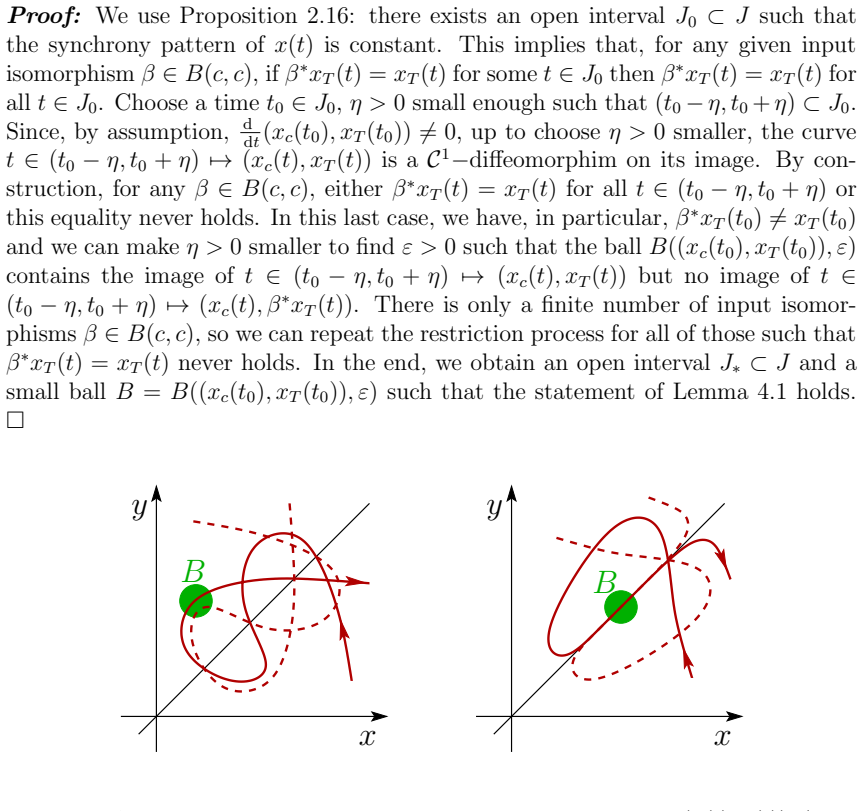
read the original abstract
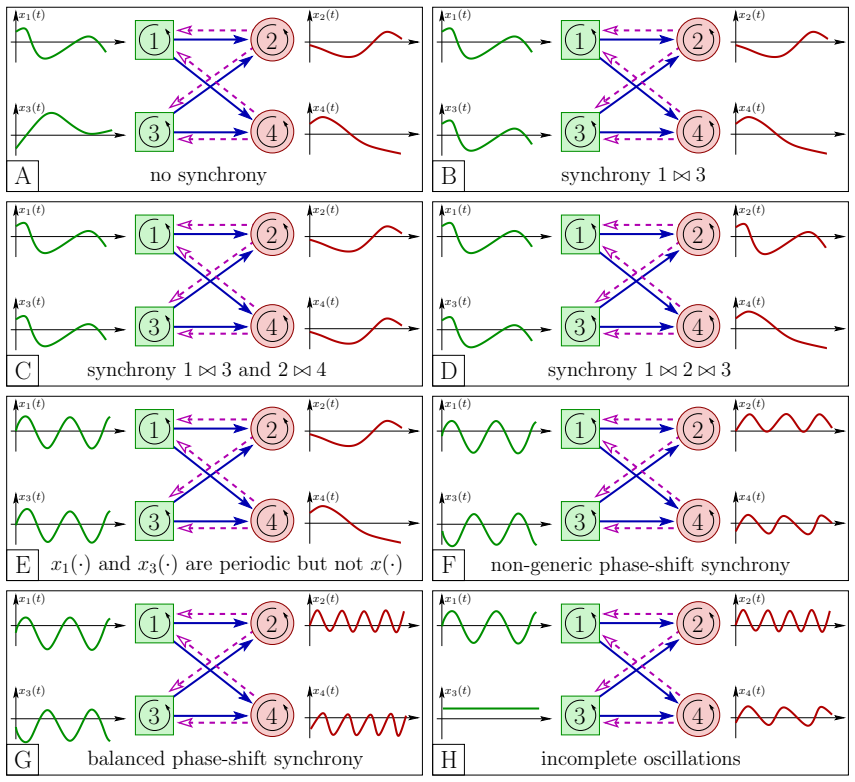
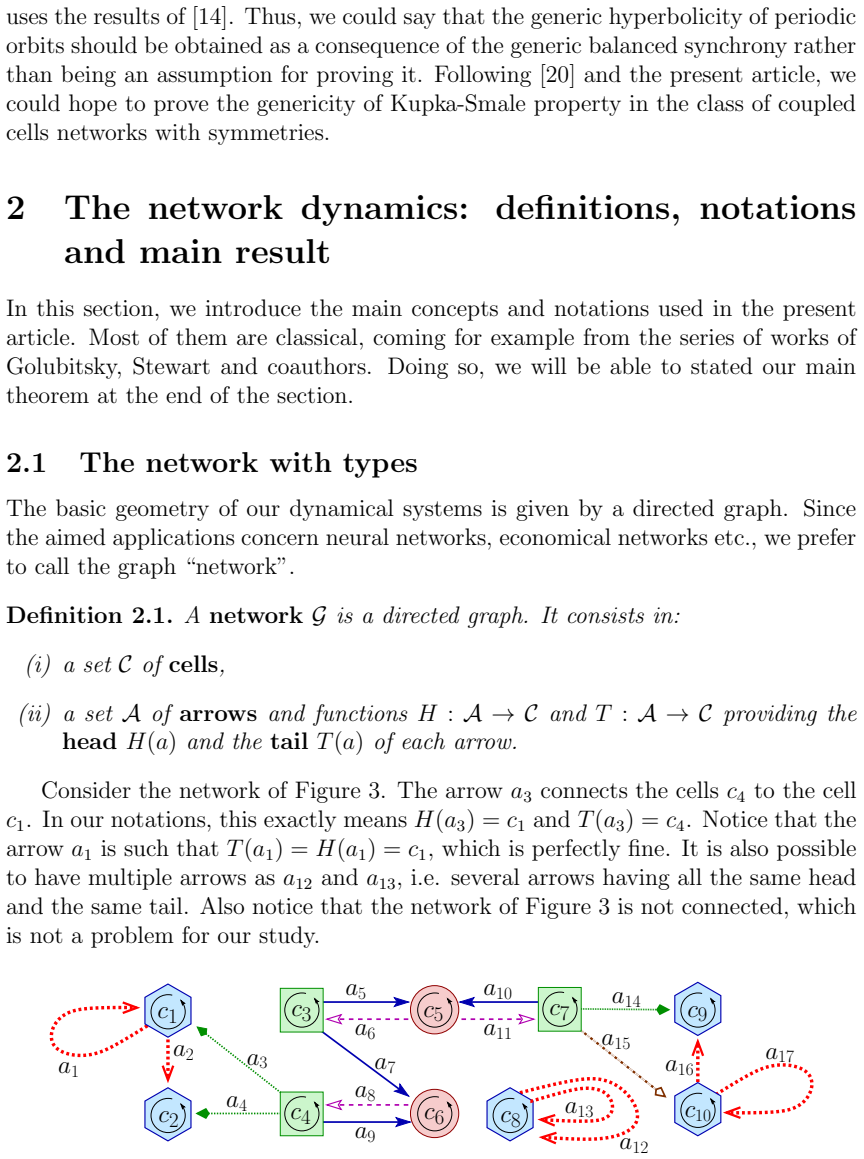
A coupled cell network is a type of ordinary differential equation $\dot x(t)=f(x(t))$, with structural constraints on the vector field $f$, encoded in a directed graph, whose cells and arrows are labeled by type. The generated dynamics can model, for example, those of neural networks or ecological systems. These systems and the synchrony patterns observed in their solutions have been intensely studied, particularly by Golubitsky, Stewart, and their coauthors. In the present article, we show that, for a generic vector field $f$, the synchrony patterns of the solutions of $\dot x(t)=f(x(t))$ are always balanced. This roughly means that for almost all $f$, the observed synchrony patterns, such as synchronization in two different cells, are inherited from the structural symmetries imposed by the graph and the cell types. Any other synchronization, not directly imposed by the geometry of the graph and the cell types, cannot occur. By doing so, we are completing the proof of several conjectures, including the rigid synchrony conjecture, the full oscillation conjecture and the observation of constant states. This article is the published version of the results stated by the second author in his PhD thesis.
Editorial analysis
A structured set of objections, weighed in public.
Referee Report
Summary. The manuscript proves that for a generic admissible vector field f on a coupled cell network (defined by a directed graph with cell and arrow types), the synchrony patterns realized by solutions of the ODE ẋ = f(x) are always balanced. This means observed synchronies must be inherited from the network structure and symmetries; non-balanced patterns are non-generic. The result completes the rigid synchrony conjecture, the full oscillation conjecture, and the constant-state observation in the Golubitsky–Stewart framework.
Significance. If the central claim holds, the work supplies the missing transversality and density arguments that close several long-standing conjectures in network dynamics. It confirms that the admissible vector field space is partitioned such that non-balanced synchrony lies in a lower-dimensional subset, providing a rigorous generic foundation for the theory with direct implications for modeling synchronization in neural and ecological networks.
major comments (1)
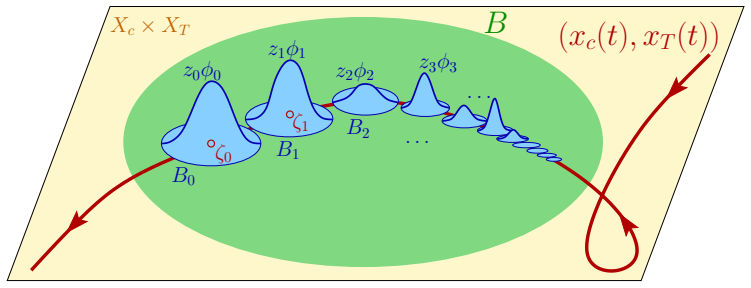
- §3.2, Theorem 3.4: the reduction to the balanced subspace via the implicit-function theorem along orbits is stated, but the verification that the algebraic condition for non-balanced synchrony is indeed nontrivial (i.e., defines a proper subvariety) is only sketched for the constant and periodic cases; an explicit codimension calculation for the general orbit would strengthen the density claim.
minor comments (2)
- The notation for cell and arrow types in §2.1 is introduced without a small illustrative network diagram; adding one would clarify the distinction between balanced and unbalanced patterns for readers new to the framework.
- Reference list omits the original 2006 Golubitsky–Stewart paper on coupled cell networks; including it would improve historical context.
Simulated Author's Rebuttal
We thank the referee for their positive evaluation of the manuscript and for the constructive suggestion regarding the density argument. We address the major comment below and will revise the manuscript accordingly.
read point-by-point responses
-
Referee: §3.2, Theorem 3.4: the reduction to the balanced subspace via the implicit-function theorem along orbits is stated, but the verification that the algebraic condition for non-balanced synchrony is indeed nontrivial (i.e., defines a proper subvariety) is only sketched for the constant and periodic cases; an explicit codimension calculation for the general orbit would strengthen the density claim.
Authors: We agree that an explicit codimension calculation for general orbits would strengthen the density claim. In the revised manuscript we will add a detailed computation in §3.2, extending the existing sketches for constant and periodic solutions. The argument proceeds by considering the jet-space formulation of the synchrony condition and verifying that the non-balanced equations impose at least one independent algebraic constraint of positive codimension on the space of admissible vector fields, using the same transversality setup already employed for the reduction via the implicit-function theorem. revision: yes
Circularity Check
No significant circularity; derivation is self-contained
full rationale
The paper proves that for generic admissible vector fields on a coupled cell network, all realized synchrony patterns are balanced by demonstrating that any non-balanced pattern imposes a nontrivial algebraic condition on the vector field, thereby defining a lower-dimensional subset of the admissible space. This is a direct application of transversality and the implicit-function theorem within the established Golubitsky-Stewart framework, completing the rigid synchrony, full oscillation, and constant-state conjectures. The manuscript supplies the missing density argument without introducing self-referential definitions, fitted parameters renamed as predictions, or load-bearing self-citations whose content is unverified; the reference to the second author's PhD thesis is merely provenance for the published version of the same independent proof.
Axiom & Free-Parameter Ledger
axioms (2)
- standard math The space of admissible vector fields for a coupled cell network admits a topology in which 'generic' means belonging to an open and dense subset.
- domain assumption Coupled cell networks are defined by a directed graph with typed cells and arrows that constrain the form of the vector field f.
Lean theorems connected to this paper
-
IndisputableMonolith/Foundation/RealityFromDistinction.leanreality_from_one_distinction unclear?
unclearRelation between the paper passage and the cited Recognition theorem.
Theorem 2.17: There exists a generic set G ⊂ C¹_G of admissible vector fields such that, for any f ∈ G and for any solution x(·) of ẋ(t)=f(x(t)) in any open time interval J, the synchrony pattern ▷◁_{x,J} is balanced.
-
IndisputableMonolith/Cost/FunctionalEquation.leanwashburn_uniqueness_aczel unclear?
unclearRelation between the paper passage and the cited Recognition theorem.
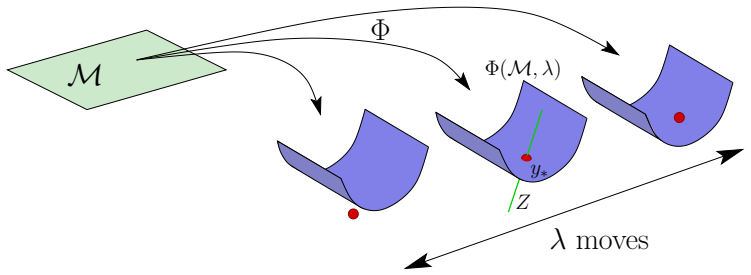
Proposition 3.5 (black-box genericity via Henry’s theorem on left-Fredholm operators and infinite-dimensional perturbation spaces Z)
What do these tags mean?
- matches
- The paper's claim is directly supported by a theorem in the formal canon.
- supports
- The theorem supports part of the paper's argument, but the paper may add assumptions or extra steps.
- extends
- The paper goes beyond the formal theorem; the theorem is a base layer rather than the whole result.
- uses
- The paper appears to rely on the theorem as machinery.
- contradicts
- The paper's claim conflicts with a theorem or certificate in the canon.
- unclear
- Pith found a possible connection, but the passage is too broad, indirect, or ambiguous to say the theorem truly supports the claim.
discussion (0)
Sign in with ORCID, Apple, or X to comment. Anyone can read and Pith papers without signing in.