Probing departures from ΛCDM by late-time datasets
Pith reviewed 2026-05-18 08:32 UTC · model grok-4.3
The pith
Analysis of late-time data reveals up to 2.74 sigma preference for dynamical dark energy models over Lambda CDM.
A machine-rendered reading of the paper's core claim, the machinery that carries it, and where it could break.
Core claim
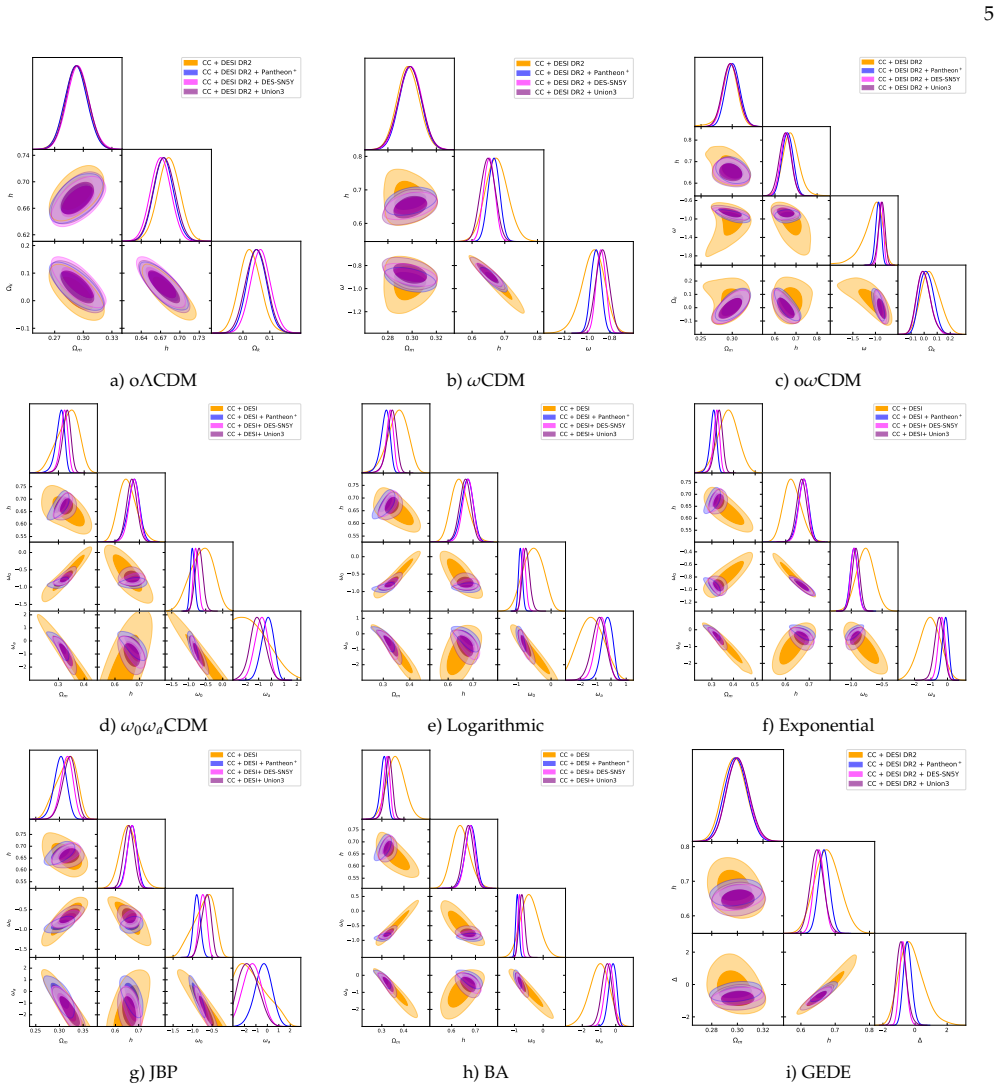
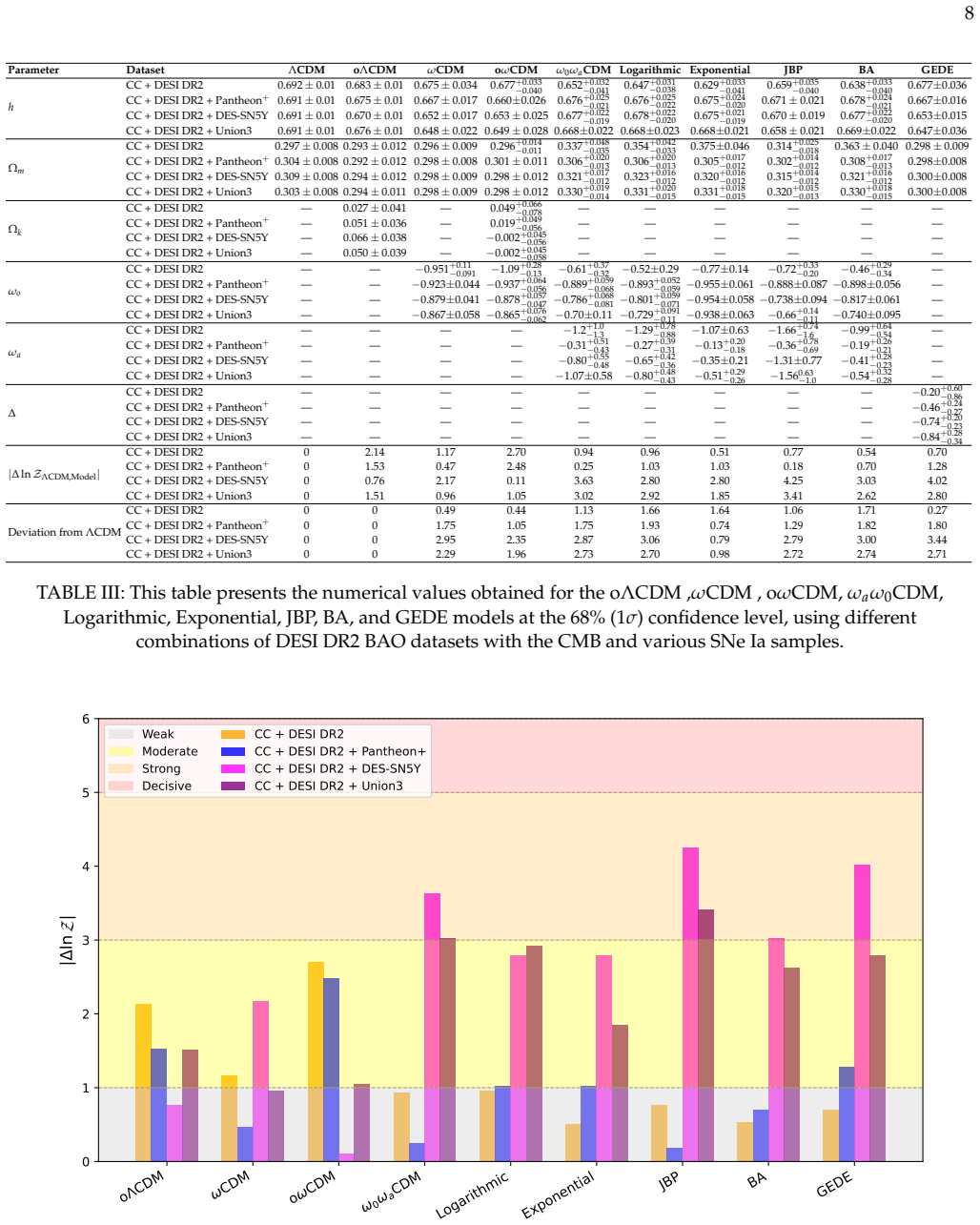
When DES-Dovekie or Union3 supernova data are combined with CC + DESI DR2, the deviation from ΛCDM reaches the 2-2.74σ level in the ωCDM, ω0ωaCDM, Logarithmic, JBP, BA, and GEDE models, with consistent evidence across models for ω0 > -1 and ωa < 0 indicating a Quintom-B scenario. The oΛCDM and oωCDM models favor an open Universe in most cases but nearly flat with the newer supernova data. Pantheon+ yields smaller deviations below 2σ.
What carries the argument
Parametrized dynamical dark energy models fitted to late-time datasets including cosmic chronometers, DESI DR2 baryon acoustic oscillations, and Type Ia supernova catalogs to assess statistical preference over Lambda CDM.
If this is right
- The preference for dynamical dark energy strengthens with the use of DES-Dovekie or Union3 supernova samples alongside CC and DESI DR2.
- Evidence consistently supports a Quintom-B type evolution where the equation of state parameter is greater than -1 at present and becomes less than -1 in the past.
- Curvature terms in the models tend to indicate an open universe unless combined with specific supernova data that favor flatness.
- The Lambda CDM model remains viable as the deviations do not reach levels sufficient to rule it out.
Where Pith is reading between the lines
- Future surveys could confirm or refute this by providing higher precision measurements in the same late-time regime.
- The dependence on supernova catalog choice suggests that reconciling differences between Pantheon+, DES-Dovekie, and Union3 is key to solidifying the result.
- This late-time preference for evolving dark energy might be tested against early universe probes to see if a consistent picture emerges.
- Models of dark energy that naturally produce Quintom-B crossing could gain theoretical attention if this holds.
Load-bearing premise
The chosen parametric forms for dark energy are assumed to adequately describe possible deviations and that systematic uncertainties in the datasets are not dominant.
What would settle it
A dataset combination showing no significant deviation from Lambda CDM or lacking the Quintom-B signature of ω0 > -1 and ωa < 0 would falsify the reported level of preference for dynamical dark energy.
Figures



read the original abstract
Observational data play a pivotal role in identifying cosmological models that are both theoretically consistent and empirically viable. In this work, we investigate the level of preference for dynamical dark energy over a cosmological constant using current late-time observational datasets, including Cosmic Chronometers , Baryon Acoustic Oscillations from DESI DR2, and different Type Ia supernova catalogs (Pantheon$^+$, DES-Dovekie, Union3). We analyze various dynamical dark energy models, including $\omega$CDM, o$\omega$CDM, $\omega_0\omega_a$CDM, Logarithmic, Exponential, JBP, BA, and GEDE. In most cases, the o$\Lambda$CDM and o$\omega$CDM models favor an open Universe. For the o$\omega$CDM, the inclusion of DES-Dovekie or Union3 data together with CC and DESI DR2 favors a nearly flat geometry. Using the CC + DESI DR2 dataset, the preference for dynamical dark energy lies between the $1$-$2\sigma$ level. When different supernova catalogs (DES-Dovekie or Union3) are included, the deviation from $\Lambda$CDM in the $\omega$CDM, $\omega_0\omega_a$CDM, Logarithmic, JBP, BA, and GEDE models increases to the $2$-$2.74\sigma$ level, while the Pantheon$^{+}$ sample yields deviations below the $2\sigma$ level. We find consistent evidence for $\omega_0 > -1$ and $\omega_a < 0$ across all dark energy models, indicating a preference for dynamical dark energy characterized by a Quintom-B type scenario. The $\Lambda$CDM paradigm has long served as the standard framework of modern cosmology; however recent DESI DR2 results have exposed emerging tensions with the cosmological constant $\Lambda$, hinting at possible new physics in the dark energy sector. Even so, the currently available data are still not strong enough to definitively rule out the $\Lambda$CDM model.
Editorial analysis
A structured set of objections, weighed in public.
Referee Report
Summary. The paper investigates preferences for dynamical dark energy over ΛCDM using late-time datasets: Cosmic Chronometers (CC), DESI DR2 BAO, and Type Ia supernova catalogs (Pantheon+, DES-Dovekie, Union3). It fits multiple parametric models including ωCDM, oωCDM, ω0ωaCDM, Logarithmic, JBP, BA, and GEDE, reporting 1-2σ deviations from ΛCDM with CC+DESI DR2 alone, rising to 2-2.74σ when DES-Dovekie or Union3 are added. Consistent evidence is found for a Quintom-B scenario (ω0 > -1, ωa < 0) across models, with some curvature models favoring open geometries that approach flatness upon inclusion of certain SN data.
Significance. If robust, the multi-model analysis and consistent Quintom-B preference across independent parametric forms would add useful late-time constraints to the emerging DESI tensions with ΛCDM. The explicit comparison of three SN catalogs is a strength, as is the focus on falsifiable parametric departures rather than purely phenomenological fits. However, the moderate significance levels (below 3σ) limit the immediate impact unless accompanied by clear robustness demonstrations.
major comments (2)
- [Results section] Results section (discussion of CC + DESI DR2 + DES-Dovekie/Union3 combinations): the reported increase to 2-2.74σ deviations in ωCDM, ω0ωaCDM, Logarithmic, JBP, BA, and GEDE models assumes that systematic uncertainties in the DES-Dovekie and Union3 catalogs are fully captured by the reported covariances and remain sub-dominant to statistical errors. No dedicated robustness tests (e.g., inflating systematic floors, alternative calibrations, or host-galaxy corrections) are described, which directly affects whether the central claim of enhanced preference for dynamical dark energy holds or is sensitive to catalog choice.
- [Results section] Methodology and results for oωCDM and oΛCDM: the statement that inclusion of DES-Dovekie or Union3 favors a nearly flat geometry is presented without a quantitative assessment of the degeneracy between Ωk and the dark-energy parameters (e.g., via contour plots or correlation coefficients). This is load-bearing for the claim that curvature effects are mitigated by the SN data.
minor comments (3)
- [Model definitions] The exact functional forms for the Logarithmic, Exponential, JBP, BA, and GEDE models should be written explicitly in the model-definition section to allow direct reproduction.
- Table or figure reporting best-fit values and uncertainties for ω0 and ωa across all models and dataset combinations would improve clarity; currently the Quintom-B preference is stated qualitatively.
- Minor: ensure consistent use of σ-level reporting (e.g., specify whether 2-2.74σ refers to Δχ² or posterior odds for each model individually).
Simulated Author's Rebuttal
We thank the referee for their thorough review and constructive comments on our manuscript. We address each of the major comments in detail below and outline the revisions we plan to make.
read point-by-point responses
-
Referee: [Results section] Results section (discussion of CC + DESI DR2 + DES-Dovekie/Union3 combinations): the reported increase to 2-2.74σ deviations in ωCDM, ω0ωaCDM, Logarithmic, JBP, BA, and GEDE models assumes that systematic uncertainties in the DES-Dovekie and Union3 catalogs are fully captured by the reported covariances and remain sub-dominant to statistical errors. No dedicated robustness tests (e.g., inflating systematic floors, alternative calibrations, or host-galaxy corrections) are described, which directly affects whether the central claim of enhanced preference for dynamical dark energy holds or is sensitive to catalog choice.
Authors: The referee correctly notes that our analysis uses the covariance matrices as provided by the DES-Dovekie and Union3 teams without additional robustness tests for systematics. While these covariances are designed to account for known systematics, we agree that demonstrating insensitivity to potential unaccounted errors would strengthen the conclusions. In the revised version, we will add a paragraph in the Results section performing robustness checks by scaling up the diagonal elements of the covariance matrices by factors of 1.2 and 1.5 and re-computing the significance of deviations from ΛCDM. This will show that the preferences remain at similar levels, supporting our claims. revision: yes
-
Referee: [Results section] Methodology and results for oωCDM and oΛCDM: the statement that inclusion of DES-Dovekie or Union3 favors a nearly flat geometry is presented without a quantitative assessment of the degeneracy between Ωk and the dark-energy parameters (e.g., via contour plots or correlation coefficients). This is load-bearing for the claim that curvature effects are mitigated by the SN data.
Authors: We appreciate this suggestion for improving the presentation. The manuscript currently states the best-fit Ωk values and their uncertainties for the different dataset combinations, indicating a move towards flatness. To provide the requested quantitative assessment, we will compute and report the correlation coefficients between Ωk and the dark energy equation-of-state parameters in the revised text. Additionally, we will include relevant 2D posterior contour plots in the supplementary material or as an updated figure to visualize the degeneracy and its breaking by the supernova data. revision: yes
Circularity Check
Minimal circularity from standard statistical fitting to external datasets
full rationale
The paper conducts parameter estimation and model comparison for dynamical dark energy scenarios using independent late-time observational datasets (Cosmic Chronometers, DESI DR2 BAO, and multiple SNIa catalogs). Reported significances (1-2.74σ deviations) and Quintom-B preferences arise from direct likelihood or chi-squared comparisons against these external data sources, without any claimed derivation, prediction, or first-principles result that reduces by construction to fitted inputs or self-referential definitions. No load-bearing self-citations, uniqueness theorems, or ansatzes imported from prior author work are evident in the derivation chain; the analysis remains self-contained against external benchmarks, with only the generic low-level fitting circularity inherent to any data-driven cosmological inference.
Axiom & Free-Parameter Ledger
free parameters (3)
- ω0
- ωa
- Ωk
axioms (2)
- standard math Flat or curved FLRW metric with standard matter and radiation content
- domain assumption Gaussian likelihoods for CC, BAO, and SN distance moduli
Lean theorems connected to this paper
-
IndisputableMonolith/Cost/FunctionalEquation.leanwashburn_uniqueness_aczel unclear?
unclearRelation between the paper passage and the cited Recognition theorem.
We analyze various dynamical dark energy models, including ωCDM, oωCDM, ω0ωaCDM, Logarithmic, Exponential, JBP, BA, and GEDE... consistent evidence for ω0 > -1 and ωa < 0... Quintom-B type scenario.
-
IndisputableMonolith/Foundation/RealityFromDistinction.leanreality_from_one_distinction unclear?
unclearRelation between the paper passage and the cited Recognition theorem.
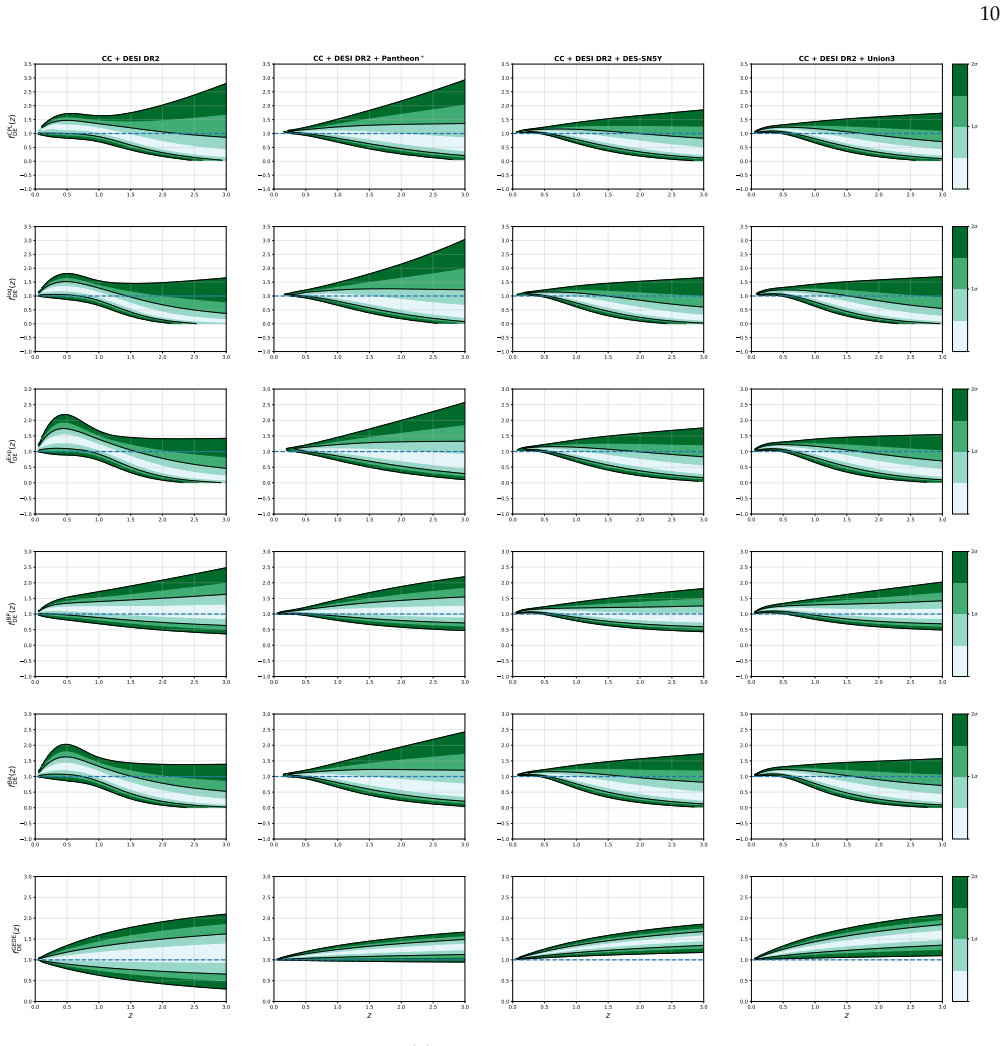
E(z) = [Ωr(1+z)^4 + Ωm(1+z)^3 + Ωk(1+z)^2 + ΩΛ fDE(z)] with fDE(z) = exp[3 ∫ (1+w(z'))/(1+z') dz']
What do these tags mean?
- matches
- The paper's claim is directly supported by a theorem in the formal canon.
- supports
- The theorem supports part of the paper's argument, but the paper may add assumptions or extra steps.
- extends
- The paper goes beyond the formal theorem; the theorem is a base layer rather than the whole result.
- uses
- The paper appears to rely on the theorem as machinery.
- contradicts
- The paper's claim conflicts with a theorem or certificate in the canon.
- unclear
- Pith found a possible connection, but the passage is too broad, indirect, or ambiguous to say the theorem truly supports the claim.
Forward citations
Cited by 1 Pith paper
-
The open-Universe signal: A model artifact rather than genuine curvature
The mild open-universe signal in late-Universe data is an artifact of assuming the basic ΛCDM model rather than evidence for genuine spatial curvature.
Reference graph
Works this paper leans on
-
[1]
according to the Jeffreys’ scale. The inclusion of Pantheon+ data shows moderate evidence for oΛCDM (1.53) and oωCDM (2.48), while all others show weak evidence. The inclusion of DES-SN5Y data shows strong evidence (|∆lnZ |>3) for several dark energy models: ω0ωaCDM (3.63), JBP (4.25), BA (3.03) and GEDE (4.02), indicative of notable deviations fromΛCDM. ...
work page 2025
-
[2]
A. G. Riess, et al., Observational evidence from super- novae for an accelerating universe and a cosmological constant, The astronomical journal 116 (3) (1998) 1009
work page 1998
-
[3]
Measurements of Omega and Lambda from 42 High-Redshift Supernovae
S. Perlmutter, et al., Measurements ofΩandΛfrom 42 High Redshift Supernovae, Astrophys. J. 517 (1999) 565–586.arXiv:astro-ph/9812133,doi:10.1086/ 307221
work page internal anchor Pith review Pith/arXiv arXiv 1999
-
[4]
Einstein, Cosmological Considerations in the General Theory of Relativity, Sitzungsber
A. Einstein, Cosmological Considerations in the General Theory of Relativity, Sitzungsber. Preuss. Akad. Wiss. Berlin (Math. Phys. ) 1917 (1917) 142–152
work page 1917
-
[5]
Weinberg, Anthropic Bound on the Cosmological Con- stant, Phys
S. Weinberg, Anthropic Bound on the Cosmological Con- stant, Phys. Rev. Lett. 59 (1987) 2607.doi:10.1103/ PhysRevLett.59.2607
work page 1987
-
[6]
Y. B. Zel’dovich, The Cosmological Constant And The Theory Of Elementary Particles, So- viet Physics Uspekhi 11 (3) (1968) 381.doi: 10.1070/PU1968v011n03ABEH003927
-
[7]
Weinberg, The Cosmological Constant Problem, Rev
S. Weinberg, The Cosmological Constant Problem, Rev. Mod. Phys. 61 (1989) 1–23.doi:10.1103/ RevModPhys.61.1
work page 1989
-
[8]
S. M. Carroll, The cosmological constant, Living reviews in relativity 4 (1) (2001) 1–56
work page 2001
-
[9]
Cosmological Constant - the Weight of the Vacuum
T. Padmanabhan, Cosmological constant: The Weight of the vacuum, Phys. Rept. 380 (2003) 235–320.arXiv: hep-th/0212290,doi:10.1016/S0370-1573(03) 00120-0
work page internal anchor Pith review Pith/arXiv arXiv doi:10.1016/s0370-1573(03 2003
- [10]
-
[11]
J. A. Frieman, M. S. Turner, D. Huterer, Dark energy and the accelerating universe, Annu. Rev. Astron. Astrophys. 46 (1) (2008) 385–432
work page 2008
- [12]
-
[13]
T. P . Sotiriou, V . Faraoni, f (r) theories of gravity, Reviews of Modern Physics 82 (1) (2010) 451–497
work page 2010
-
[14]
A. De Felice, S. Tsujikawa, f (r) theories, Living Reviews in Relativity 13 (1) (2010) 1–161
work page 2010
-
[15]
S. Capozziello, M. De Laurentis, Extended theories of gravity, Physics Reports 509 (4-5) (2011) 167–321. 13
work page 2011
-
[16]
Accelerating Universes with Scaling Dark Matter
M. Chevallier, D. Polarski, Accelerating universes with scaling dark matter, Int. J. Mod. Phys. D 10 (2001) 213–224.arXiv:gr-qc/0009008,doi:10.1142/ S0218271801000822
work page internal anchor Pith review Pith/arXiv arXiv 2001
-
[17]
E. V . Linder, Exploring the expansion history of the universe, Phys. Rev. Lett. 90 (2003) 091301.arXiv: astro-ph/0208512,doi:10.1103/PhysRevLett. 90.091301
work page internal anchor Pith review Pith/arXiv arXiv doi:10.1103/physrevlett 2003
-
[18]
C.-G. Park, J. de Cruz P ´erez, B. Ratra, Is theω 0ωaCDM cosmological parameterization evidence for dark energy dynamics partially caused by the excess smoothing of Planck CMB anisotropy data? (10 2024).arXiv:2410. 13627
work page 2024
-
[19]
Modified Gravity Theories on a Nutshell: Inflation, Bounce and Late-time Evolution
S. Nojiri, S. D. Odintsov, V . K. Oikonomou, Modified Gravity Theories on a Nutshell: In- flation, Bounce and Late-time Evolution, Phys. Rept. 692 (2017) 1–104.arXiv:1705.11098, doi:10.1016/j.physrep.2017.06.001
work page internal anchor Pith review Pith/arXiv arXiv doi:10.1016/j.physrep.2017.06.001 2017
-
[20]
E. Piedipalumbo, S. Vignolo, P . Feola, S. Capozziello, In- teracting quintessence cosmology from Noether symme- tries: Comparing theoretical predictions with observa- tional data, Phys. Dark Univ. 42 (2023) 101274.arXiv: 2307.02355,doi:10.1016/j.dark.2023.101274
-
[21]
Exploring cosmic origins with CORE: B-mode component separation
M. Benetti, S. Capozziello, Connecting early and late epochs by f(z)CDM cosmography, JCAP 12 (2019) 008. arXiv:1910.09975,doi:10.1088/1475-7516/ 2019/12/008
-
[22]
E. V . Linder, Cosmological tests of generalized friedmann models, Astronomy and Astrophysics (ISSN 0004-6361), vol. 206, no. 2, Nov. 1988, p. 175-189. 206 (1988) 175–189
work page 1988
-
[24]
T. M. C. Abbott, et al., Dark Energy Survey year 1 results: Cosmological constraints from galaxy clustering and weak lensing, Phys. Rev. D 98 (4) (2018) 043526.arXiv: 1708.01530,doi:10.1103/PhysRevD.98.043526
work page internal anchor Pith review Pith/arXiv arXiv doi:10.1103/physrevd.98.043526 2018
-
[25]
S. Basilakos, S. Nesseris, Conjoined constraints on mod- ified gravity from the expansion history and cosmic growth, Phys. Rev. D 96 (6) (2017) 063517.arXiv:1705. 08797,doi:10.1103/PhysRevD.96.063517
-
[26]
S. Joudaki, et al., KiDS-450 + 2dFLenS: Cosmological pa- rameter constraints from weak gravitational lensing to- mography and overlapping redshift-space galaxy clus- tering, Mon. Not. Roy. Astron. Soc. 474 (4) (2018) 4894– 4924.arXiv:1707.06627,doi:10.1093/mnras/ stx2820
work page internal anchor Pith review Pith/arXiv arXiv doi:10.1093/mnras/ 2018
-
[27]
M. M. Ivanov, A. Obuljen, C. Cuesta-Lazaro, M. W. Toomey, Full-shape analysis with simulation-based priors: Cosmological parameters and the structure growth anomaly, Phys. Rev. D 111 (6) (2025) 063548. arXiv:2409.10609,doi:10.1103/PhysRevD.111. 063548
-
[28]
S.-F. Chen, M. M. Ivanov, O. H. E. Philcox, L. Wenzl, Sup- pression without Thawing: Constraining Structure For- mation and Dark Energy with Galaxy Clustering, Phys. Rev. Lett. 133 (23) (2024) 231001.arXiv:2406.13388, doi:10.1103/PhysRevLett.133.231001
-
[29]
P . A. Ade, N. Aghanim, C. Armitage-Caplan, M. Arnaud, M. Ashdown, F. Atrio-Barandela, J. Aumont, C. Bacci- galupi, A. J. Banday, R. Barreiro, et al., Planck 2013 results. xvi. cosmological parameters, Astronomy & Astrophysics 571 (2014) A16
work page 2013
-
[30]
M. Betoule, R. Kessler, J. Guy, J. Mosher, D. Hardin, R. Biswas, P . Astier, P . El-Hage, M. Konig, S. Kuhlmann, et al., Improved cosmological constraints from a joint analysis of the sdss-ii and snls supernova samples, As- tronomy & Astrophysics 568 (2014) A22
work page 2014
-
[31]
P . A. Ade, N. Aghanim, M. Arnaud, M. Ashdown, J. Au- mont, C. Baccigalupi, A. Banday, R. Barreiro, J. Bartlett, N. Bartolo, et al., Planck 2015 results-xiii. cosmological parameters, Astronomy & Astrophysics 594 (2016) A13
work page 2015
- [32]
- [33]
-
[34]
A. Adame, et al., Desi 2024 vi: cosmological constraints from the measurements of baryon acoustic oscillations, Journal of Cosmology and Astroparticle Physics 2025 (02) (2025) 021
work page 2024
-
[35]
M. A. Karim, J. Aguilar, S. Ahlen, S. Alam, L. Allen, C. Al- lende Prieto, O. Alves, A. Anand, U. Andrade, E. Armen- gaud, et al., Desi dr2 results ii: Measurements of baryon acoustic oscillations and cosmological constraints, arXiv e-prints (2025) arXiv–2503
work page 2025
- [36]
- [37]
-
[38]
S. R. Choudhury, T. Okumura, Updated cosmological constraints in extended parameter space with planck pr4, desi baryon acoustic oscillations, and supernovae: Dy- namical dark energy, neutrino masses, lensing anomaly, and the hubble tension, The Astrophysical Journal Letters 976 (1) (2024) L11
work page 2024
- [39]
-
[40]
S. Lee, Constrainingλcdm,ωcdm, andω 0ωacdm models with desi dr2 bao: Redshift-resolved diagnostics and the role ofr d, arXiv preprint arXiv:2507.01380 (2025). 14
- [41]
-
[42]
R. Mazumdar, M. M. Gohain, K. Bhuyan, Constraint on symmetric teleparallel gravity with different dark energy parametrizations from desi dr2 bao data, arXiv preprint arXiv:2507.05975 (2025)
-
[43]
M. I. Scrimgeour, T. Davis, C. Blake, J. B. James, G. B. Poole, L. Staveley-Smith, S. Brough, M. Colless, C. Con- treras, W. Couch, et al., The wigglez dark energy survey: the transition to large-scale cosmic homogeneity, Monthly Notices of the Royal Astronomical Society 425 (1) (2012) 116–134
work page 2012
-
[44]
A 14 $h^{-3}$ Gpc$^3$ study of cosmic homogeneity using BOSS DR12 quasar sample
P . Laurent, et al., A 14h −3 Gpc3 study of cosmic homogeneity using BOSS DR12 quasar sample, JCAP 11 (2016) 060.arXiv:1602.09010,doi:10.1088/ 1475-7516/2016/11/060
work page internal anchor Pith review Pith/arXiv arXiv 2016
-
[45]
M. Chevallier, D. Polarski, Accelerating universes with scaling dark matter, International Journal of Modern Physics D 10 (02) (2001) 213–223
work page 2001
-
[46]
E. V . Linder, Exploring the expansion history of the uni- verse, Physical review letters 90 (9) (2003) 091301
work page 2003
-
[47]
G. Efstathiou, Constraining the equation of state of the universe from distant type ia supernovae and cosmic mi- crowave background anisotropies, Monthly Notices of the Royal Astronomical Society 310 (3) (1999) 842–850
work page 1999
- [48]
-
[49]
S. Pan, W. Yang, A. Paliathanasis, Imprints of an extended chevallier–polarski–linder parametrization on the large scale of our universe, The European Physical Journal C 80 (3) (2020) 274
work page 2020
-
[50]
N. Dimakis, A. Karagiorgos, A. Zampeli, A. Paliathana- sis, T. Christodoulakis, P . A. Terzis, General analytic so- lutions of scalar field cosmology with arbitrary potential, Physical Review D 93 (12) (2016) 123518
work page 2016
- [51]
- [52]
-
[53]
E. Barboza Jr, J. Alcaniz, A parametric model for dark en- ergy, Physics Letters B 666 (5) (2008) 415–419
work page 2008
-
[54]
X. Li, A. Shafieloo, Evidence for emergent dark energy, The Astrophysical Journal 902 (1) (2020) 58
work page 2020
- [55]
-
[56]
J. Vazquez, I. Gomez-Vargas, A. Slosar, Updated version of a simple mcmc code for cosmological parameter esti- mation where only expansion history matters,https: //github.com/ja-vazquez/SimpleMC(2020)
work page 2020
-
[57]
´E. Aubourg, S. Bailey, J. E. Bautista, F. Beutler, V . Bhard- waj, D. Bizyaev, M. Blanton, M. Blomqvist, A. S. Bolton, J. Bovy, et al., Cosmological implications of baryon acoustic oscillation measurements, Physical Review D 92 (12) (2015) 123516.doi:https://doi.org/10. 1103/PhysRevD.92.123516
work page 2015
-
[58]
W. K. Hastings, Monte carlo sampling methods using markov chains and their applications (1970)
work page 1970
- [59]
-
[60]
R. Jimenez, A. Loeb, Constraining cosmological param- eters based on relative galaxy ages, The Astrophysical Journal 573 (1) (2002) 37
work page 2002
-
[61]
M. Moresco, A. Cimatti, R. Jimenez, L. Pozzetti, G. Zamorani, M. Bolzonella, J. Dunlop, F. Lamareille, M. Mignoli, H. Pearce, et al., Improved constraints on the expansion rate of the universe up to z 1.1 from the spectroscopic evolution of cosmic chronometers, Journal of Cosmology and Astroparticle Physics 2012 (08) (2012) 006
work page 2012
-
[62]
M. Moresco, Raising the bar: new constraints on the hub- ble parameter with cosmic chronometers at z 2, Monthly Notices of the Royal Astronomical Society: Letters 450 (1) (2015) L16–L20
work page 2015
-
[63]
M. Moresco, L. Pozzetti, A. Cimatti, R. Jimenez, C. Maras- ton, L. Verde, D. Thomas, A. Citro, R. Tojeiro, D. Wilkin- son, A 6% measurement of the hubble parameter at z 0.45: direct evidence of the epoch of cosmic re- acceleration, Journal of Cosmology and Astroparticle Physics 2016 (05) (2016) 014
work page 2016
-
[64]
S. Vagnozzi, A. Loeb, M. Moresco, Eppur `e piatto? the cosmic chronometers take on spatial curvature and cos- mic concordance, The Astrophysical Journal 908 (1) (2021) 84
work page 2021
-
[65]
M. Moresco, R. Jimenez, L. Verde, L. Pozzetti, A. Cimatti, A. Citro, Setting the stage for cosmic chronometers. i. as- sessing the impact of young stellar populations on hub- ble parameter measurements, The Astrophysical Journal 868 (2) (2018) 84
work page 2018
-
[66]
M. Moresco, R. Jimenez, L. Verde, A. Cimatti, L. Pozzetti, Setting the stage for cosmic chronometers. ii. impact of stellar population synthesis models systematics and full covariance matrix, The Astrophysical Journal 898 (1) (2020) 82
work page 2020
-
[67]
Aghanim, et al., Planck 2018 results
N. Aghanim, et al., Planck 2018 results. vi. cosmological parameters, Astron. Astrophys 641 (2020) A6
work page 2018
-
[68]
B. S ´anchez, D. Brout, M. Vincenzi, M. Sako, K. Herner, R. Kessler, T. Davis, D. Scolnic, M. Acevedo, J. Lee, et al., The dark energy survey supernova program: Light curves and 5 yr data release, The Astrophysical Journal 975 (1) (2024) 5
work page 2024
-
[69]
M. Goliath, R. Amanullah, P . Astier, A. Goobar, R. Pain, Supernovae and the nature of the dark energy, Astron- omy & Astrophysics 380 (1) (2001) 6–18
work page 2001
-
[70]
Marginal Likelihoods from Monte Carlo Markov Chains
A. Heavens, Y. Fantaye, A. Mootoovaloo, H. Eggers, Z. Hosenie, S. Kroon, E. Sellentin, Marginal likeli- 15 hoods from monte carlo markov chains, arXiv preprint arXiv:1704.03472 (2017)
work page internal anchor Pith review Pith/arXiv arXiv 2017
-
[71]
E. Komatsu, J. Dunkley, M. Nolta, C. L. Bennett, B. Gold, G. Hinshaw, N. Jarosik, D. Larson, M. Limon, L. Page, et al., Five-year wilkinson microwave anisotropy probe* observations: cosmological interpretation, The Astro- physical Journal Supplement Series 180 (2) (2009) 330
work page 2009
-
[72]
G. Mangano, G. Miele, S. Pastor, M. Peloso, A precision calculation of the effective number of cosmological neu- trinos, Physics Letters B 534 (1-4) (2002) 8–16
work page 2002
-
[73]
G. Hinshaw, J. Weiland, R. Hill, N. Odegard, D. Larson, C. Bennett, J. Dunkley, B. Gold, M. Greason, N. Jarosik, et al., Five-year wilkinson microwave anisotropy probe* observations: data processing, sky maps, and basic results, The Astrophysical Journal Supplement Series 180 (2) (2009) 225
work page 2009
-
[74]
P . de Bernardis, P . A. Ade, J. J. Bock, J. Bond, J. Bor- rill, A. Boscaleri, K. Coble, B. Crill, G. De Gasperis, P . Farese, et al., A flat universe from high-resolution maps of the cosmic microwave background radiation, Nature 404 (6781) (2000) 955–959
work page 2000
-
[75]
Y. Cai, X. Ren, T. Qiu, M. Li, X. Zhang, The quin- tom theory of dark energy after desi dr2, arXiv preprint arXiv:2505.24732 (2025)
work page internal anchor Pith review Pith/arXiv arXiv 2025
-
[76]
G. Ye, M. Martinelli, B. Hu, A. Silvestri, Hints of nonmin- imally coupled gravity in desi 2024 baryon acoustic os- cillation measurements, Physical Review Letters 134 (18) (2025) 181002
work page 2024
- [77]
-
[78]
Extended Dark Energy analysis using DESI DR2 BAO measurements
K. Lodha, R. Calderon, W. Matthewson, A. Shafieloo, M. Ishak, J. Pan, C. Garcia-Quintero, D. Huterer, G. Val- ogiannis, L. Ure ˜na-L´opez, et al., Extended dark energy analysis using desi dr2 bao measurements, arXiv preprint arXiv:2503.14743 (2025)
work page internal anchor Pith review Pith/arXiv arXiv 2025
-
[79]
H. Chaudhary, S. Capozziello, V . K. Sharma, I. G ´omez- Vargas, G. Mustafa, Evidence for evolving dark en- ergy from lrg1 and low-zsne ia data, arXiv preprint arXiv:2508.10514 (2025)
work page internal anchor Pith review arXiv 2025
-
[80]
I. D. Gialamas, G. H ¨utsi, K. Kannike, A. Racioppi, M. Raidal, M. Vasar, H. Veerm ¨ae, Interpreting desi 2024 bao: late-time dynamical dark energy or a local effect?, Physical Review D 111 (4) (2025) 043540
work page 2024
-
[81]
P . Ade, J. Aguirre, Z. Ahmed, S. Aiola, A. Ali, D. Alonso, M. A. Alvarez, K. Arnold, P . Ashton, J. Austermann, et al., The simons observatory: science goals and fore- casts, Journal of Cosmology and Astroparticle Physics 2019 (02) (2019) 056
work page 2019
discussion (0)
Sign in with ORCID, Apple, or X to comment. Anyone can read and Pith papers without signing in.