Observation of In-ice Askaryan Radiation from High-Energy Cosmic Rays
Pith reviewed 2026-05-18 05:21 UTC · model grok-4.3
The pith
Radio signals from below Antarctic ice match Askaryan radiation produced by cosmic ray air shower cores.
A machine-rendered reading of the paper's core claim, the machinery that carries it, and where it could break.
Core claim
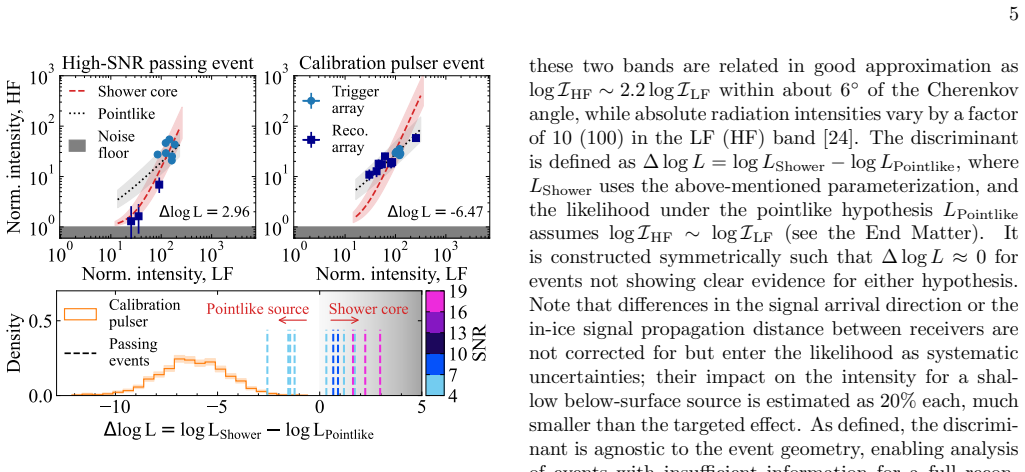
The observed event rate, radiation arrival directions, signal shape, spectral content, and electric field polarization are consistent with in-ice Askaryan radiation from cosmic ray air shower cores impacting the ice sheet. For the brightest events the angular radiation pattern favors an extended cascade-like emitter over a pointlike source. An origin from the geomagnetic separation of charges in cosmic ray air showers is disfavored by the arrival directions and polarization. Considering the arrival angles, timing properties, and the impulsive nature of the passing events, the event rate is inconsistent with the estimation of the combined background from thermal noise events and on-surface at
What carries the argument
The phased-array instrument of the Askaryan Radio Array, whose data on arrival directions, timing, impulsive waveform shape, spectral content, and electric-field polarization are used to test consistency with extended in-ice cascades.
If this is right
- The events can be attributed to cosmic-ray-induced cascades rather than surface or noise sources.
- Radio arrays can detect and characterize high-energy particle cascades developing inside ice.
- Polarization and angular pattern measurements distinguish Askaryan cascades from geomagnetic effects.
- The 5.1-sigma excess supplies a concrete benchmark for future background-rejection studies in ice.
Where Pith is reading between the lines
- This channel may supply an independent handle on the cosmic-ray background that affects neutrino searches with radio arrays.
- Similar observations could test how air-shower cores evolve upon first contact with an ice sheet.
- Extended data sets would allow checks of whether the observed rate scales with expected cosmic-ray flux.
Load-bearing premise
The 13 selected events truly originate from below the ice surface as inferred from arrival directions and timing, and the background model for thermal noise plus on-surface events accurately captures all non-Askaryan contributions without significant unaccounted systematics.
What would settle it
A larger data set in which the rate of events with these directional, timing, and polarization properties exactly matches the predicted thermal-plus-surface background rate would falsify the central claim.
Figures




read the original abstract
We present the first experimental evidence for in-ice Askaryan radiation -- coherent charge-excess radio emission -- from high-energy particle cascades developing in the Antarctic ice sheet. In 208 days of data recorded with the phased-array instrument of the Askaryan Radio Array, a previous analysis has incidentally identified 13 events with impulsive radiofrequency signals originating from below the ice surface. We here present a detailed reanalysis of these events. The observed event rate, radiation arrival directions, signal shape, spectral content, and electric field polarization are consistent with in-ice Askaryan radiation from cosmic ray air shower cores impacting the ice sheet. For the brightest events, the angular radiation pattern favors an extended cascade-like emitter over a pointlike source. An origin from the geomagnetic separation of charges in cosmic ray air showers is disfavored by the arrival directions and polarization. Considering the arrival angles, timing properties, and the impulsive nature of the passing events, the event rate is inconsistent with the estimation of the combined background from thermal noise events and on-surface events at the level of $5.1\,\sigma$.
Editorial analysis
A structured set of objections, weighed in public.
Referee Report
Summary. The manuscript presents the first experimental evidence for in-ice Askaryan radiation from high-energy cosmic rays, based on a reanalysis of 13 impulsive radiofrequency events identified in 208 days of phased-array data from the Askaryan Radio Array. These events are claimed to originate from below the ice surface, with observed rates, arrival directions, signal shapes, spectral content, and polarizations consistent with Askaryan emission from cosmic-ray air-shower cores impacting the ice sheet; an origin from geomagnetic charge separation is disfavored, and the rate is reported to be inconsistent with the combined thermal-noise plus on-surface background at 5.1 sigma.
Significance. If the result holds, it would mark the first direct observation of Askaryan radiation in a natural ice medium from cosmic rays, providing independent validation of the mechanism and opening potential new channels for high-energy particle detection. The multi-observable consistency checks and use of an independent background estimate are positive features that strengthen the interpretation if the classification of events as sub-surface is robust.
major comments (3)
- [Abstract and background-estimation section] The 5.1 sigma inconsistency with background (stated in the abstract) rests on using arrival angles, timing properties, and impulsive character to establish sub-surface origin. The manuscript does not quantify reconstruction biases arising from refraction at the air-ice interface or the finite angular resolution of the phased array; such biases could allow a non-negligible fraction of on-surface events to be misclassified, directly affecting the reported significance.
- [Background model description] The background model (thermal noise plus on-surface events) is used to claim the 5.1 sigma excess, yet the text provides no explicit validation of this model against independent data sets or Monte Carlo injections that include realistic refraction and antenna-response effects.
- [Signal-properties analysis] Consistency of signal shape, spectrum, and polarization for the brightest events is presented as supporting an extended cascade-like emitter, but these checks do not directly test the sub-surface classification step that underpins the central claim.
minor comments (2)
- [Figures showing waveforms and spectra] Add explicit error bars or uncertainty bands to all plots comparing observed signal shapes and spectra to Askaryan simulations.
- [Event-selection criteria] Clarify the exact definition of 'impulsive nature' used in the event selection and whether it is applied before or after direction reconstruction.
Simulated Author's Rebuttal
We thank the referee for the careful and constructive review of our manuscript. The comments raise valid points regarding the robustness of the sub-surface event classification and background modeling, which we address below. We have revised the manuscript to incorporate additional quantitative assessments and clarifications as detailed in the point-by-point responses.
read point-by-point responses
-
Referee: [Abstract and background-estimation section] The 5.1 sigma inconsistency with background (stated in the abstract) rests on using arrival angles, timing properties, and impulsive character to establish sub-surface origin. The manuscript does not quantify reconstruction biases arising from refraction at the air-ice interface or the finite angular resolution of the phased array; such biases could allow a non-negligible fraction of on-surface events to be misclassified, directly affecting the reported significance.
Authors: We agree that explicit quantification of potential reconstruction biases is necessary to support the claimed significance. The direction reconstruction in the manuscript already incorporates ray-tracing to model refraction at the air-ice interface, using the known depth-dependent refractive index profile. The phased-array angular resolution for impulsive events is characterized as approximately 4-6 degrees in elevation. To address the referee's concern directly, we have added a dedicated Monte Carlo study in the revised manuscript. On-surface events were injected with realistic signal amplitudes, spectra, and polarizations, then passed through the full reconstruction chain including refraction and finite resolution effects. The study shows that fewer than 8% of such events are misclassified as sub-surface when applying the same timing, impulsivity, and angular cuts used in the analysis. This fraction is insufficient to reduce the reported excess below 4 sigma. We have updated the abstract and the background-estimation section to reference these results and the associated systematic uncertainty. revision: yes
-
Referee: [Background model description] The background model (thermal noise plus on-surface events) is used to claim the 5.1 sigma excess, yet the text provides no explicit validation of this model against independent data sets or Monte Carlo injections that include realistic refraction and antenna-response effects.
Authors: The thermal-noise component of the background is derived from off-time windows in the same dataset, while the on-surface component is constrained by a separate surface-triggered dataset collected during the same campaign. We acknowledge that an end-to-end Monte Carlo validation including refraction and full antenna response was not presented in the original submission. In the revised manuscript we have added such a validation: we generated Monte Carlo events for both thermal noise and on-surface cosmic-ray signals, propagated them through a detailed simulation of the phased-array response that includes refraction, and compared the resulting distributions of reconstructed angles, timing residuals, and signal-to-noise ratios against the observed background sample. The model reproduces the data within the quoted uncertainties. We have included this comparison as a new figure and accompanying text in the background-model section. revision: yes
-
Referee: [Signal-properties analysis] Consistency of signal shape, spectrum, and polarization for the brightest events is presented as supporting an extended cascade-like emitter, but these checks do not directly test the sub-surface classification step that underpins the central claim.
Authors: We agree that the signal-shape, spectral, and polarization analyses serve primarily to characterize the emission mechanism and to disfavor a geomagnetic origin, rather than to independently verify the sub-surface geometry. The sub-surface classification itself rests on the arrival-angle, timing, and impulsivity criteria described in the background-estimation section. In the revised manuscript we have clarified this distinction in the signal-properties section and added an explicit statement that these observables provide supporting evidence for the physical interpretation once the geometric classification has been made. We have also cross-checked that the brightest events satisfy the same sub-surface cuts used for the full sample, reinforcing internal consistency without altering the primary classification method. revision: partial
Circularity Check
No significant circularity; claims rest on direct observational comparison to independent models.
full rationale
The paper's central claims involve comparing observed event rates, directions, shapes, spectra, and polarizations directly to established Askaryan radiation expectations and separate background estimates for thermal noise and on-surface events. No derivation step reduces by construction to a fitted parameter renamed as a prediction, a self-definitional loop, or a load-bearing self-citation chain. The 5.1 sigma inconsistency is presented as a statistical comparison against externally modeled backgrounds, with the analysis remaining self-contained against those benchmarks rather than internally forced.
Axiom & Free-Parameter Ledger
axioms (2)
- domain assumption Standard electromagnetic theory predicts coherent Askaryan radio emission from charge-excess cascades in dielectric media such as ice.
- domain assumption The background rate from thermal noise and surface events can be reliably estimated independently of the signal hypothesis.
Forward citations
Cited by 1 Pith paper
-
Sensitivity of the As-Built Askaryan Radio Array to Ultra-High Energy Neutrinos
With 2013-2023 exposure, the as-built ARA achieves world-leading UHE neutrino sensitivity above ~10^19 eV and predicts up to 13 trigger-level events under optimistic flux models, with secondaries contributing up to 30...
Reference graph
Works this paper leans on
-
[1]
E. Zas, F. Halzen, and T. Stanev, Electromagnetic pulses from high-energy showers: Implications for neutrino de- tection, Phys. Rev. D45, 362 (1992)
work page 1992
-
[2]
G. A. Askar’yan, Excess Negative Charge of an Electron- Photon Shower and its Coherent Radio Emission, Sov. Phys. JETP14, 441 (1962)
work page 1962
-
[3]
G. A. Askary’yan, Coherent Radio Emission from Cosmic Showers in Air and in Dense Media, Sov. Phys. JETP21, 658 (1965)
work page 1965
-
[4]
D. Saltzberg, P. Gorham, D. Walz, C. Field, R. Iverson, A. Odian, G. Resch, P. Schoessow, and D. Williams, Ob- servation of the Askaryan Effect: Coherent Microwave Cherenkov Emission from Charge Asymmetry in High- Energy Particle Cascades, Phys. Rev. Lett.86, 2802 (2001)
work page 2001
-
[5]
P. W. Gorham, D. Saltzberg, R. C. Field, E. Guillian, R. Milinˇ ci´ c, P. Mioˇ cinovi´ c, D. Walz, and D. Williams, Accelerator measurements of the Askaryan effect in rock salt: A roadmap toward teraton underground neutrino detectors, Phys. Rev. D72, 023002 (2005)
work page 2005
-
[6]
K. Bechtol, K. Belov, K. Borch, P. Chen, J. Clem, P. Gorham, C. Hast, T. Huege, R. Hyneman, K. Jobe, et al., SLAC T-510 experiment for radio emission from particle showers: Detailed simulation study and interpre- tation, Phys. Rev. D105, 063025 (2022)
work page 2022
-
[7]
P. W. Gorhamet al.(ANITA Collaboration), Observa- tions of the Askaryan Effect in Ice, Phys. Rev. Lett.99, 171101 (2007)
work page 2007
-
[8]
A. Aabet al.(The Pierre Auger Collaboration), Prob- ing the radio emission from air showers with polarization measurements, Phys. Rev. D89, 052002 (2014)
work page 2014
-
[9]
P. Schellart, S. Buitink, A. Corstanje, J. Enriquez, H. Falcke, J. H¨ orandel, M. Krause, A. Nelles, J. Rachen, O. Scholten,et al., Polarized radio emission from exten- sive air showers measured with LOFAR, J. Cosmol. As- tropart. Phys.2014(10), 014
work page 2014
-
[10]
A. Bell´ etoile, R. Dallier, A. Lecacheux, V. Marin, L. Mar- tin, B. Revenu, and D. Torres, Evidence for the charge- excess contribution in air shower radio emission observed by the CODALEMA experiment, Astropart. Phys.69, 50 (2015)
work page 2015
-
[11]
K. Werner and O. Scholten, Macroscopic treatment of ra- dio emission from cosmic ray air showers based on shower simulations, Astropart. Phys.29, 393 (2008)
work page 2008
-
[12]
K. de Vries, A. M. van den Berg, O. Scholten, and K. Werner, The lateral distribution function of coher- ent radio emission from extensive air showers: Deter- mining the chemical composition of cosmic rays, As- tropart. Phys.34, 267 (2010)
work page 2010
-
[13]
P. Allisonet al.(ARA Collaboration), Design and Ini- tial Performance of the Askaryan Radio Array Proto- type EeV Neutrino Detector at the South Pole, As- tropart. Phys.35, 457 (2011)
work page 2011
-
[14]
Similar radio neutrino detectors currently operate in Greenland [49], have concluded operation in Antarctica [50–52], or are presently in preparation [53]
-
[15]
P. Allisonet al.(ARA Collaboration), Design and Performance of an Interferometric Trigger array for Radio Detection of High-Energy Neutrinos, Nucl. In- strum. Meth. A930, 112 (2019)
work page 2019
-
[16]
A. Coleman, C. Glaser, R. Rice-Smith, S. Barwick, and D. Besson, In-ice Askaryan Emission from Air Show- ers: Implications for Radio Neutrino Detectors, As- tropart. Phys.172, 103136 (2025)
work page 2025
-
[17]
S. De Kockere, K. de Vries, N. van Eijndhoven, and U. Latif, Simulation of in-ice cosmic ray air shower induced particle cascades, Phys. Rev. D106, 043023 (2022)
work page 2022
-
[18]
K. D. de Vries, S. Buitink, N. van Eijndhoven, T. Meures, A. ´O Murchadha, and O. Scholten, The cosmic-ray air-shower signal in Askaryan radio detectors, As- tropart. Phys.74, 96 (2016). 7
work page 2016
-
[19]
S. De Kockere, D. Van den Broeck, U. A. Latif, K. D. de Vries, N. van Eijndhoven, T. Huege, and S. Buitink, Simulation of radio signals from cosmic-ray cascades in air and ice as observed by in-ice Askaryan radio detectors, Phys. Rev. D110, 023010 (2024)
work page 2024
-
[20]
A. Javaid, Monte Carlo simulation for radio detection of Ultra High Energy air shower cores by ANITA-II, Ph.D. thesis, University of Delaware (2012)
work page 2012
- [21]
-
[22]
P. Allisonet al.(ARA Collaboration), Low-threshold ultrahigh-energy neutrino search with the Askaryan Ra- dio Array, Phys. Rev. D105, 122006 (2022)
work page 2022
-
[23]
The zenith angle is measured between the vertical direc- tion and the arrival direction of the radiation wavefront
-
[24]
See Supplemental Material, appended below, for details
-
[25]
J. A. Aguilar, A. Anker, P. Allison, S. Archambault, P. Baldi, S. W. Barwick, J. J. Beatty, J. Beise, D. Besson, A. Bishop,et al., Triboelectric Backgrounds to Radio-based Polar UHE Neutrino Experiments, As- tropart. Phys.145, 102790 (2022)
work page 2022
-
[26]
J. D. Jackson, Classical Electrodynamics, 3rd ed. (Wiley, 2001)
work page 2001
-
[27]
The impulsivity is quantified by the ratio of maximum instantaneous signal power to mean signal power, with signal power given by the magnitude-square of the ana- lytic signal. To reduce the correlation of impulsivity with signal-to-noise ratio, this calculation is only applied to the 50% of the recorded trace closest to the peak
-
[28]
Navaset al.(Particle Data Group), Review of Particle Physics, Statistics, Phys
S. Navaset al.(Particle Data Group), Review of Particle Physics, Statistics, Phys. Rev. D110, 030001 (2024)
work page 2024
-
[29]
J. Alvarez-Mu˜ niz, A. Romero-Wolf, and E. Zas,ˇCerenkov radio pulses from electromagnetic showers in the time domain, Phys. Rev. D81, 123009 (2010)
work page 2010
-
[30]
The per-antenna signal-to-noise ratio is defined as the ratio of the peak-to-peak signal amplitude and the noise RMS amplitude
- [31]
-
[32]
J. Alameddine, J. Albrecht, J. Ammerman-Yebra, L. Arrabito, A. Alves, D. Baack, A. Coleman, H. Dem- binski, D. Els¨ asser,et al., Simulating radio emission from particle cascades with CORSIKA 8, Astropart. Phys. 166, 103072 (2025)
work page 2025
-
[33]
P. Windischhofer, C. Welling, and C. Deaconu, Eisvogel: Exact and efficient calculations of radio emissions from in-ice neutrino showers, PoSICRC2023, 1157 (2023)
work page 2023
-
[34]
P. Windischhofer, C. Deaconu, and C. Welling, Fully- electrodynamic radio simulations with Eisvogel, PoS ARENA2024, 051 (2024)
work page 2024
-
[35]
J. C. Flahertyet al.(ARA Collaboration), Polarization Reconstruction of Askaryan Emission of Ultra-High En- ergy Neutrinos Using the Askaryan Radio Array, PoS ICRC2023, 1164 (2023)
work page 2023
-
[36]
A. Salcedo Gomezet al.(ARA Collaboration), Effects of Biaxial Birefringence on Polarization Reconstruction for the Askaryan Radio Array, PoSARENA2024, 009 (2024)
work page 2024
-
[37]
A. Aabet al.(Pierre Auger Collaboration), Energy esti- mation of cosmic rays with the Engineering Radio Array of the Pierre Auger Observatory, Phys. Rev. D93, 122005 (2016)
work page 2016
-
[38]
their response to VPol signals, is about 10% of their co-polarization effective length
The cross-polarization effective length of the HPol an- tennas, i.e. their response to VPol signals, is about 10% of their co-polarization effective length. We only unfold the co-polarization response in the calculation ofE 2 ϕ, but include both in the simulation
-
[39]
NOAA NCEI Geomagnetic Modeling Team and British Geological Survey, World Magnetic Model (2025)
work page 2025
-
[40]
J. Alvarez-Mu˜ niz, R. A. V´ azquez, and E. Zas, Calcula- tion methods for radio pulses from high energy showers, Phys. Rev. D62, 063001 (2000)
work page 2000
-
[41]
J. D. Krauss, Antennas, 3rd ed. (McGraw Hill Higher Education, 2001)
work page 2001
-
[42]
P. W. Gorham, D. P. Saltzberg, P. Schoessow, W. Gai, J. G. Power, R. Konecny, and M. E. Conde, Radio- frequency measurements of coherent transition and Cherenkov radiation: Implications for high-energy neu- trino detection, Phys. Rev. E62, 8590 (2000)
work page 2000
-
[43]
V. L. Ginzburg, Transition radiation and transition scat- tering, Physica Scripta1982, 182 (1982)
work page 1982
-
[44]
G. M. Garibyan, Transition Radiation Effects in Particle Energy Losses, Soviet Physics JETP10, 372 (1960)
work page 1960
-
[45]
J. Ammerman-Yebra, U. Latif, N. Karastathis, T. Huege et al.(CORSIKA 8 Collaboration), and S. de Kockere, Simulations of cross media showers with CORSIKA 8, PoSICRC2023, 442 (2023)
work page 2023
-
[46]
C. Deaconu, A. G. Vieregg, S. A. Wissel, J. Bowen, S. Chipman, A. Gupta, C. Miki, R. J. Nichol, and D. Saltzberg, Measurements and modeling of near- surface radio propagation in glacial ice and implica- tions for neutrino experiments, Phys. Rev. D98, 043010 (2018)
work page 2018
-
[47]
S. W. Barwick, E. C. Berg, D. Z. Besson, G. Gaswint, C. Glaser, A. Hallgren, J. Hanson, S. Klein, S. Klein- felder, and L. K¨ opke, Observation of classically ‘forbid- den’ electromagnetic wave propagation and implications for neutrino detection, J. Cosmol. Astropart. Phys.2018 (07), 55
work page 2018
-
[48]
E. S. Costello, R. R. Ghent, A. Romero-Wolf, P. W. Gorham, P. G. Lucey, C. J. T. Udovicic, P. Linton, A. Ludwig, K. McBride, C. Miki,et al., Cosmic Rays and the Askaryan Effect Reveal Subsurface Structure and Buried Ice on the Moon, Geophys. Res. Lett.52, e2024GL113304 (2025)
work page 2025
-
[49]
S. Agarwalet al.(RNO-G Collaboration), Instrument de- sign and performance of the first seven stations of RNO- G, J. Instrum.20, P04015
-
[50]
P. W. Gorhamet al.(ANITA Collaboration), Constraints on the ultrahigh-energy cosmic neutrino flux from the fourth flight of anita, Phys. Rev. D99, 122001 (2019)
work page 2019
- [51]
- [52]
-
[53]
Q. Abarret al.(PUEO Collaboration), The Payload for Ultrahigh Energy Observations (PUEO): A White Paper, J. Instrum.16, P08035 (2021). 8
work page 2021
- [54]
-
[55]
J. Alvarez-Mu˜ niz, C. James, R. Protheroe, and E. Zas, Thinned simulations of extremely energetic showers in dense media for radio applications, Astropart. Phys.32, 100 (2009)
work page 2009
-
[56]
J. Alvarez-Mu˜ niz, W. Carvalho Jr., M. Tueros, and E. Zas, Coherent Cherenkov radio pulses from hadronic showers up to EeV energies, Astropart. Phys.35, 287 (2012)
work page 2012
-
[57]
E. W. Mayotteet al.(The Pierre Auger Collabora- tion), Measurement of the mass composition of ultra- high-energy cosmic rays at the Pierre Auger Observatory, PoSICRC2023, 365 (2023)
work page 2023
- [58]
-
[59]
D. Ivanovet al.(Telescope Array Collaboration), En- ergy Spectrum Measured by the Telescope Array, PoS ICRC2019, 298 (2019)
work page 2019
-
[60]
Sethian, A fast marching level set method for mono- tonically advancing fronts., Proc
J. Sethian, A fast marching level set method for mono- tonically advancing fronts., Proc. Natl. Acad. Sci. U.S.A. 93, 1591 (1996)
work page 1996
- [61]
-
[62]
NOAA Global Monitoring Laboratory Meteorology Data, Observatory at South Pole, minute-averaged wind speed data covering the period from 2019-01-01 to 2019-12-31, downloaded in October 2024
work page 2019
-
[63]
S. Baker and R. Cousins, Clarification of the use of CHI- square and likelihood functions in fits to histograms, Nucl. Instrum. Meth. A221, 437 (1984)
work page 1984
-
[64]
Gaisser, Predictive inference: an introduction (Springer, 1993)
S. Gaisser, Predictive inference: an introduction (Springer, 1993)
work page 1993
-
[65]
M. Kvasniˇ cka and V. ˇCerven´ y, Analytical expressions for Fresnel volumes and interface fresnel zones of seismic body waves. Part 2: Transmitted and converted waves. Head waves, Stud. geophys. geod.40, 381 (1996)
work page 1996
- [66]
-
[67]
G. Feldman and R. Cousins, Unified approach to the clas- sical statistical analysis of small signals, Phys. Rev. D57, 3873 (1998)
work page 1998
-
[68]
S. S. Wilks, The Large-Sample Distribution of the Like- lihood Ratio for Testing Composite Hypotheses, Ann. Math. Statist.9, 60 (1938)
work page 1938
- [69]
- [70]
-
[71]
A. Ferrari, P. Sala, A. Fass` o, and J. Ranft, FLUKA: A multi-particle transport code (Program version 2005), CERN-2005-10, INFN/TC 05/11, SLAC-R-773 (2005)
work page 2005
-
[72]
G. Battistoni, T. Boehlen, F. Cerutti, C. Pik Wai,et al., Overview of the FLUKA code, Ann. Nucl. Energy82, 10 (2015)
work page 2015
-
[73]
F. Ballariniet al.(The FLUKA Collaboration), The FLUKA code: Overview and new developments, EPJ Nuclear Sci. Technol.10, 16 (2024)
work page 2024
- [74]
-
[75]
J.-M. Alameddine, J. Albrecht, H. Dembinski, P. Gut- jahr, K.-H. Kampert, W. Rhode, M. Sackel, A. Sandrock, and J. Soedingrekso, Improvements in charged lepton and photon propagation for the software PROPOSAL, Com- put. Phys. Commun.302, 109243 (2024)
work page 2024
-
[76]
W. Riegler and P. Windischhofer, Signals induced on electrodes by moving charges, a general theorem for Maxwell’s equations based on Lorentz reciprocity, Nucl. Instrum. Meth. A980, 164471 (2020)
work page 2020
-
[77]
A. F. Oskooi, D. Roundy, M. Ibanescu, P. Bermel, J. Joannopoulos, and S. G. Johnson, Meep: A flexible free-software package for electromagnetic simulations by the FDTD method, Comput. Phys. Commun.181, 687 (2010)
work page 2010
-
[78]
M. C. Stevens, V. Verjans, J. M. D. Lundin,et al., The Community Firn Model (CFM) v1.0, Geosci. Model Dev. 13, 4355 (2020)
work page 2020
-
[79]
C. Sheppard, Approximate calculation of the reflection coefficient from a stratified medium, Pure Appl. Opt.4, 665 (1995). 9 END MATTER Background estimate detailsTo calculate the discov- ery significance [54], we use the likelihood given by L(µsig,ν) = Y r∈{pass.,control} Po(N obs r |µr)×f(ν),(3) where the product includes the region populated by the pas...
work page 1995
discussion (0)
Sign in with ORCID, Apple, or X to comment. Anyone can read and Pith papers without signing in.