From Static Constraints to Dynamic Adaptation: Sample-Level Constraint Relaxation for Offline-to-Online Reinforcement Learning
Pith reviewed 2026-05-21 18:58 UTC · model grok-4.3
The pith
Constraint relaxation in offline-to-online RL should depend on each sample's consistency with a behavior model rather than its offline or online origin.
A machine-rendered reading of the paper's core claim, the machinery that carries it, and where it could break.
Core claim
DARE is a distribution-aware method for sample-level constraint relaxation in offline-to-online RL that conditions relaxation decisions on behavioral consistency with a behavior model via a posterior-induced exchange mechanism. The method requires only per-sample alignment scores and can be layered on top of existing offline algorithms with arbitrary choices of behavior model and fine-tuning objective. A supporting theoretical result shows that the exchange step reliably improves separation between offline-like and online-like data subsets, and D4RL experiments indicate gains in fine-tuning stability and final performance compared with prior offline-to-online baselines.
What carries the argument
The posterior-induced exchange mechanism, which computes behavioral alignment scores from a behavior model's posterior and uses those scores to decide whether individual samples exchange or relax their constraints.
If this is right
- Existing offline RL algorithms can incorporate sample-level relaxation without altering their core loss functions or objectives.
- Fine-tuning stability improves because constraints adapt as the data distribution evolves rather than remaining fixed by data origin.
- The same framework supports different behavior models and fine-tuning objectives with only minor implementation changes.
- Theoretical separation between offline-like and online-like subsets increases when the exchange step is applied.
Where Pith is reading between the lines
- The same per-sample consistency check could be tested in continual RL settings where distribution shift occurs repeatedly.
- Performance may vary with the quality of the chosen behavior model, suggesting a need to compare simple versus complex models in new domains.
- The approach implies that data in RL should be treated as having fluid rather than fixed labels once online interaction begins.
Load-bearing premise
A behavior model can be trained or selected so that its posterior reliably identifies which samples should receive relaxed constraints without adding instability or bias during fine-tuning.
What would settle it
An experiment in which a deliberately inaccurate behavior model produces alignment scores that cause DARE to relax the wrong samples and yield lower final performance than a standard offline-to-online baseline.
Figures





read the original abstract
Offline-to-online reinforcement learning (O2O RL) faces a central challenge between retaining offline conservatism and adapting to online feedback under distribution shift. This challenge arises because data behavior evolves during fine-tuning, rendering data origin a misleading basis for constraint handling and thereby leading to objective-data mismatch. We therefore propose Dynamic Alignment for RElaxation (DARE), a distribution-aware framework for sample-level constraint relaxation based on the behavioral consistency with a behavior model. To our knowledge, DARE is the first to condition constraint relaxation on behavioral consistency via a posterior-induced exchange mechanism, moving beyond a binary offline/online data distinction. Importantly, DARE requires only per-sample behavioral alignment, enabling instantiation on top of many offline algorithms with flexible choices of behavior models and fine-tuning objectives. We provide a theoretical analysis showing that behavior-based sample exchange consistently improves the distinction between offline-like and online-like subsets. Experiments on D4RL demonstrate that DARE consistently improves fine-tuning stability and achieves superior final performance over strong offline-to-online baselines. (The code is publicly available at \url{https://github.com/lpzu/DARE}.)
Editorial analysis
A structured set of objections, weighed in public.
Referee Report
Summary. The manuscript introduces Dynamic Alignment for RElaxation (DARE), a distribution-aware framework for sample-level constraint relaxation in offline-to-online RL. It conditions relaxation on behavioral consistency with a behavior model via a posterior-induced exchange mechanism, moving beyond binary offline/online distinctions. The paper claims a theoretical analysis showing that this exchange improves distinction between offline-like and online-like subsets, requires only per-sample alignment for flexible instantiation on existing offline algorithms, and reports consistent improvements in fine-tuning stability and final performance on D4RL benchmarks, with publicly available code.
Significance. If the theoretical analysis and empirical results hold, DARE could meaningfully advance O2O RL by addressing objective-data mismatch through dynamic, behavior-based relaxation rather than static constraints. The flexibility to build on many offline algorithms and the public code release are clear strengths that support reproducibility.
major comments (2)
- [Theoretical analysis] Theoretical analysis section: the claim that behavior-based sample exchange 'consistently improves the distinction between offline-like and online-like subsets' is load-bearing for the stability guarantee, yet the skeptic concern is not directly addressed. If the behavior model is fit only on the initial offline dataset, its posterior cannot be guaranteed to remain calibrated once online trajectories induce distribution shift; this risks systematic misclassification of which constraints to relax. A concrete bound or proof sketch handling posterior drift under policy-induced shifts is needed.
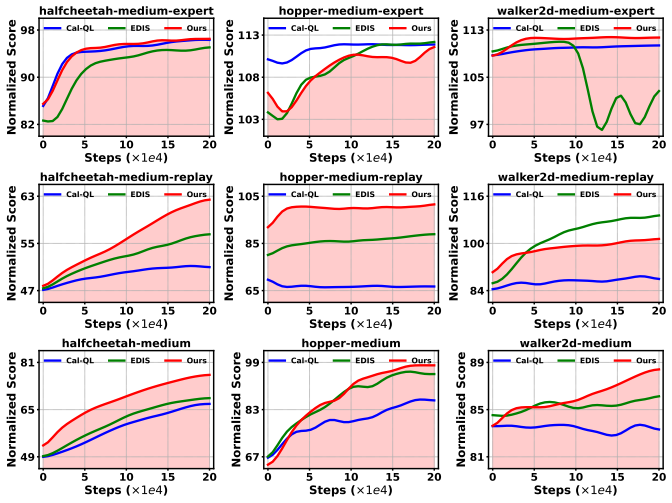
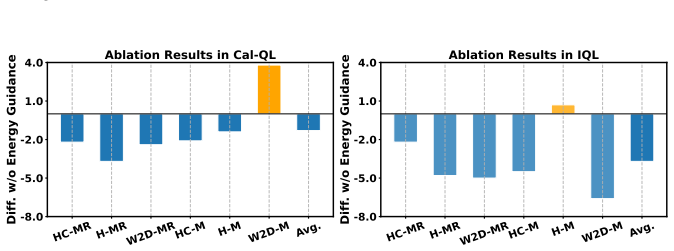
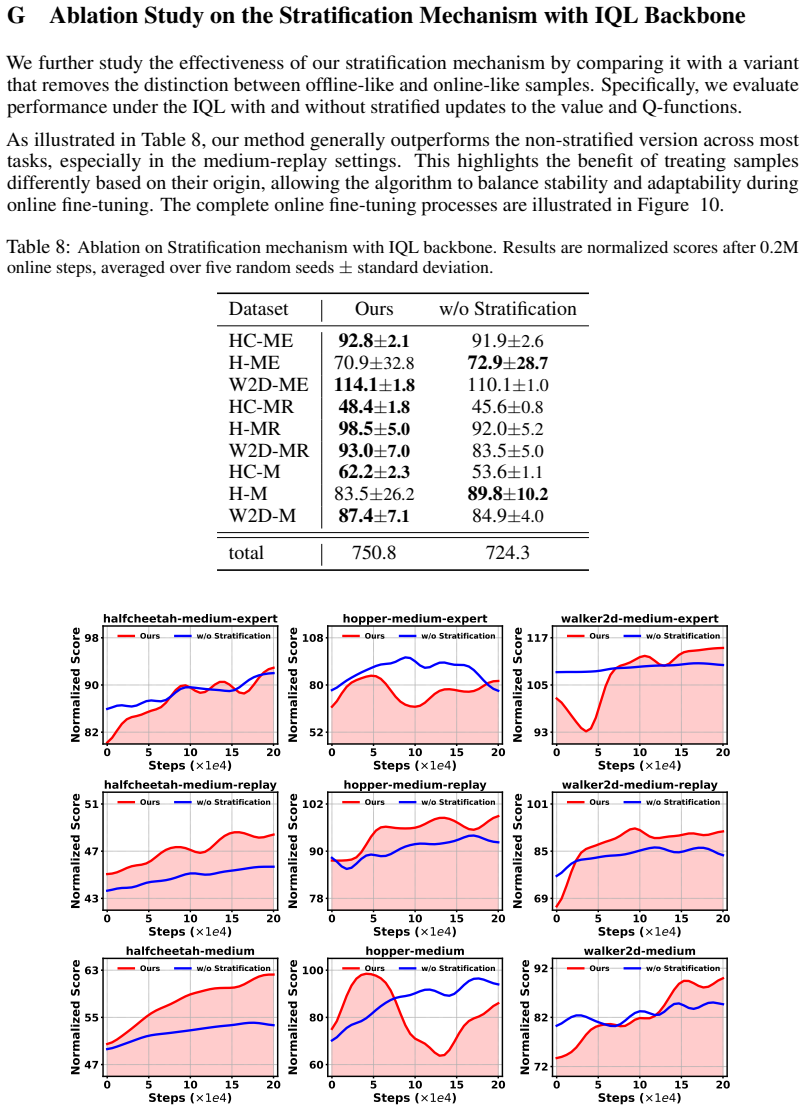
- [Experiments] Experiments section: the abstract asserts D4RL improvements and superior final performance, but the provided text gives no error bars, ablation details on behavior-model choice, or controls for post-hoc hyperparameter tuning. Without these, the empirical support for the central claim that DARE resolves objective-data mismatch remains difficult to evaluate.
minor comments (2)
- [Abstract] Abstract: the assertion of a 'theoretical analysis' would be strengthened by a one-sentence outline of the main result or key assumption rather than a high-level claim alone.
- [Method] Notation and method: the precise definition of the posterior-induced exchange mechanism and how the behavior model is selected or updated should be stated explicitly in the main text before the theoretical claim.
Simulated Author's Rebuttal
We thank the referee for the constructive and detailed feedback. We address each major comment below and have revised the manuscript to incorporate the suggested improvements where possible.
read point-by-point responses
-
Referee: [Theoretical analysis] Theoretical analysis section: the claim that behavior-based sample exchange 'consistently improves the distinction between offline-like and online-like subsets' is load-bearing for the stability guarantee, yet the skeptic concern is not directly addressed. If the behavior model is fit only on the initial offline dataset, its posterior cannot be guaranteed to remain calibrated once online trajectories induce distribution shift; this risks systematic misclassification of which constraints to relax. A concrete bound or proof sketch handling posterior drift under policy-induced shifts is needed.
Authors: We agree that posterior drift is an important consideration not fully elaborated in the original submission. The theoretical analysis (Section 4) establishes that the posterior-induced exchange improves distinction between offline-like and online-like subsets under the modeling assumption that the behavior model provides a useful estimate of behavioral consistency. In the revision, we have added a dedicated paragraph and proof sketch addressing bounded distribution shift: we show that if the total variation distance between the initial offline distribution and the shifted online distribution is at most δ, then the expected improvement in distinction is preserved up to an additive O(δ) term with probability 1−ε (via a concentration argument on the posterior). We now explicitly state that for unbounded shifts the guarantee requires additional assumptions on the behavior model (e.g., periodic re-fitting), which we list as a limitation. revision: yes
-
Referee: [Experiments] Experiments section: the abstract asserts D4RL improvements and superior final performance, but the provided text gives no error bars, ablation details on behavior-model choice, or controls for post-hoc hyperparameter tuning. Without these, the empirical support for the central claim that DARE resolves objective-data mismatch remains difficult to evaluate.
Authors: We concur that these reporting elements are necessary for a complete evaluation. The revised manuscript now includes: (i) error bars computed over five independent random seeds for all D4RL curves and tables; (ii) an ablation subsection comparing behavior-model choices (Gaussian, mixture density network, and transformer-based) with corresponding performance differences; and (iii) an explicit description of the hyperparameter selection protocol, which used a held-out validation split from the offline dataset rather than test-set tuning. These additions directly support the claim that DARE mitigates objective-data mismatch. revision: yes
Circularity Check
No circularity: derivation relies on independent theoretical analysis and flexible behavior model choice
full rationale
The paper presents DARE as a novel distribution-aware framework that conditions sample-level constraint relaxation on behavioral consistency using a posterior-induced exchange mechanism. It explicitly states that DARE requires only per-sample behavioral alignment and can be instantiated on top of many offline algorithms with flexible behavior model choices. The abstract references a theoretical analysis demonstrating that behavior-based sample exchange improves distinction between offline-like and online-like subsets, but this is positioned as an independent result rather than a reduction to fitted parameters or self-citations by construction. No equations, self-definitional loops, or load-bearing self-citations are indicated in the provided text that would force the central claims to be equivalent to their inputs. The framework is described as moving beyond binary distinctions with empirical validation on D4RL, rendering the derivation self-contained against external benchmarks.
Axiom & Free-Parameter Ledger
Lean theorems connected to this paper
-
IndisputableMonolith/Cost/FunctionalEquation.leanwashburn_uniqueness_aczel unclear?
unclearRelation between the paper passage and the cited Recognition theorem.
We compute the alignment score for each sample (si, ai) using the KL divergence between the generated action and the original action in b: score(si, ai) = D_KL(ai ∥ π₀(· | si))
-
IndisputableMonolith/Foundation/ArithmeticFromLogic.leanembed_injective unclear?
unclearRelation between the paper passage and the cited Recognition theorem.
StratDiff computes the KL divergence between generated and actual actions to stratify each training batch into offline-like and online-like subsets
What do these tags mean?
- matches
- The paper's claim is directly supported by a theorem in the formal canon.
- supports
- The theorem supports part of the paper's argument, but the paper may add assumptions or extra steps.
- extends
- The paper goes beyond the formal theorem; the theorem is a base layer rather than the whole result.
- uses
- The paper appears to rely on the theorem as machinery.
- contradicts
- The paper's claim conflicts with a theorem or certificate in the canon.
- unclear
- Pith found a possible connection, but the passage is too broad, indirect, or ambiguous to say the theorem truly supports the claim.
Reference graph
Works this paper leans on
- [2]
- [3]
-
[4]
J. Fu, A. Kumar, O. Nachum, G. Tucker, and S. Levine. D4rl: Datasets for deep data-driven reinforcement learning.arXiv preprint arXiv:2004.07219,
work page internal anchor Pith review Pith/arXiv arXiv 2004
-
[5]
S. Fujimoto, D. Meger, and D. Precup. Off-policy deep reinforcement learning without exploration. InInternational conference on machine learning, pages 2052–2062. PMLR,
work page 2052
-
[6]
Planning with Diffusion for Flexible Behavior Synthesis
M. Janner, Y . Du, J. B. Tenenbaum, and S. Levine. Planning with diffusion for flexible behavior synthesis.arXiv preprint arXiv:2205.09991,
work page internal anchor Pith review Pith/arXiv arXiv
-
[7]
Offline Reinforcement Learning with Implicit Q-Learning
I. Kostrikov, A. Nair, and S. Levine. Offline reinforcement learning with implicit q-learning.arXiv preprint arXiv:2110.06169,
work page internal anchor Pith review Pith/arXiv arXiv
- [8]
-
[9]
A. Nair, A. Gupta, M. Dalal, and S. Levine. Awac: Accelerating online reinforcement learning with offline datasets.arXiv preprint arXiv:2006.09359,
work page internal anchor Pith review Pith/arXiv arXiv 2006
-
[10]
Learning Complex Dexterous Manipulation with Deep Reinforcement Learning and Demonstrations
A. Rajeswaran, V . Kumar, A. Gupta, G. Vezzani, J. Schulman, E. Todorov, and S. Levine. Learning complex dexterous manipulation with deep reinforcement learning and demonstrations.arXiv preprint arXiv:1709.10087,
work page internal anchor Pith review Pith/arXiv arXiv
- [11]
-
[12]
For your convenience, we provide the pseudocode for Algorithm 1 in the paper below
13 A Pseudocode of StratDiff StratDiff is designed for the offline-to-online reinforcement learning setting, consisting of four components: (a) offline learning with a base algorithm (e.g., Cal-QL or IQL), (b) online fine-tuning with stratified loss updates, (c) offline diffusion model, and (d) energy function for online action selection. For your conveni...
work page 2020
-
[13]
Table 3: Hyperparameters for the IQL-based experiments. Hyperparameter Value Discount factorγ0.99 Hidden dimension 256 Number of hidden layers 2 Batch size 256 Learning rate3×10 −4 Target update rate 0.005 Expectile parameterτ0.9, AntMaze / 0.7, otherwise Inverse temperatureβ10.0, AntMaze / 3.0, oterhwise B.3 Hyperparameters for Energy-Guided Diffusion Mo...
work page 2022
-
[14]
Table 4: Guidance scalesacross different environments. Dataset Guidance Scales walker2d-medium-expert-v2 5.0 halfcheetah-medium-expert-v2 3.0 hopper-medium-expert-v2 2.0 walker2d-medium-replay-v2 5.0 halfcheetah-medium-replay-v2 8.0 hopper-medium-replay-v2 3.0 walker2d-medium-v2 10.0 halfcheetah-medium-v2 10.0 hopper-medium-v2 8.0 antmaze-umaze-v2 3.0 ant...
work page 2021
discussion (0)
Sign in with ORCID, Apple, or X to comment. Anyone can read and Pith papers without signing in.