On the exchange of stability for the subcritical laminar flow
Pith reviewed 2026-05-18 00:08 UTC · model grok-4.3
The pith
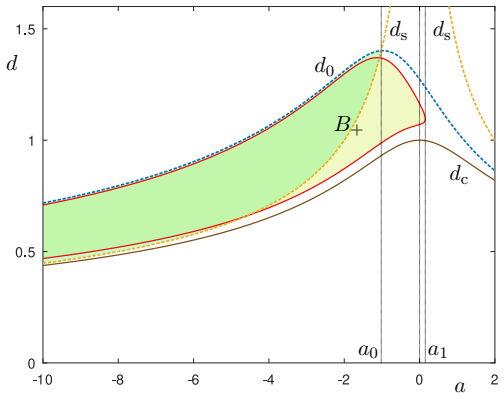
For each vorticity a, a critical depth d0(a) flips the sign of the second eigenvalue along the Stokes wave bifurcation branch.
A machine-rendered reading of the paper's core claim, the machinery that carries it, and where it could break.
Core claim
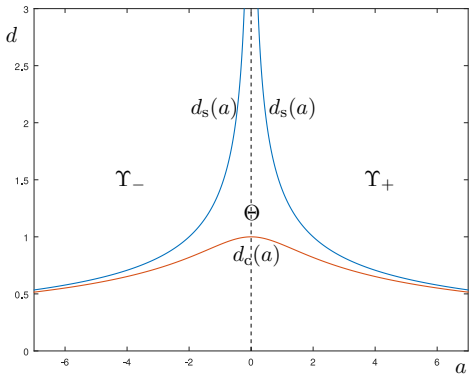
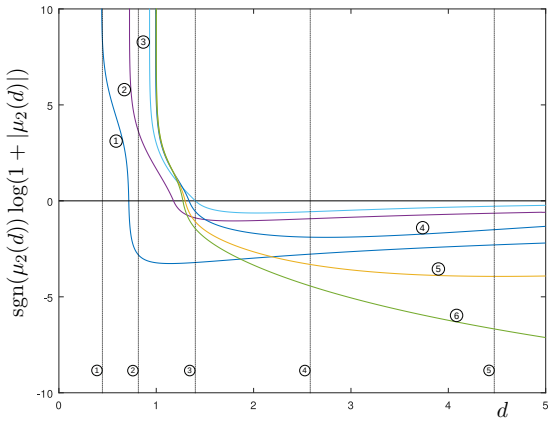
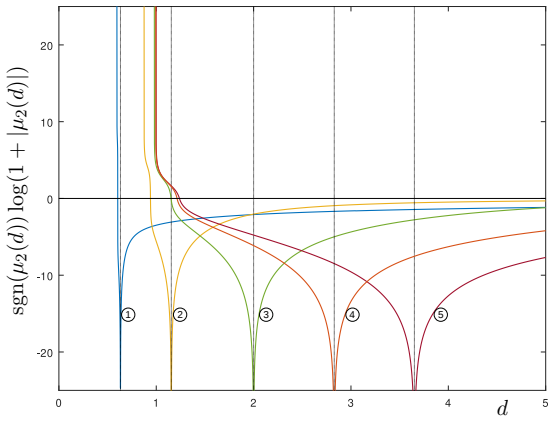
The central claim is that for each a there exists a critical depth d0(a) such that the second eigenvalue is positive for d < d0(a) and negative for d > d0(a). This sign controls the validity of the principle of exchange of stabilities and the monotonicity of the period along the bifurcation curve. The paper demonstrates that d0(a) < ds(a) for a > a0 ≈ -1.01803, while d0(a) > ds(a) for a < a0, and describes the domain where formal stability holds.
What carries the argument
The sign of the second eigenvalue of the Fréchet derivative along the analytic bifurcation branch of Stokes waves from subcritical laminar flow with constant vorticity.
If this is right
- If the second eigenvalue is positive, the exchange of stabilities principle is valid and the wave period increases along the curve.
- If negative, the principle is violated and the period decreases.
- The transition depth d0(a) lies before the stagnation depth for a above a0 and after for a below a0.
- Formal stability holds in a particular region of the (a, d) plane.
Where Pith is reading between the lines
- This could imply different bifurcation behaviors for subharmonic waves depending on whether depth is above or below d0(a).
- The comparison with stagnation depth suggests that for certain vorticities, stability properties change before flow stagnation occurs.
- Similar eigenvalue analysis might apply to flows with non-constant vorticity if the branch existence can be established.
Load-bearing premise
The existence of an analytic branch of Stokes waves bifurcating from the subcritical laminar flow with the wave period as parameter, along with the first eigenvalue remaining negative on this branch.
What would settle it
A numerical computation of the second eigenvalue for a chosen a at depths just below and above the estimated d0(a) to check for the predicted sign change would confirm or refute the result.
Figures

read the original abstract
We consider steady water waves in a two-dimensional channel bounded below by a flat, rigid bottom and above by a free surface. Surface tension is neglected, and the flow is rotational with constant vorticity $a$. We analyze an analytic branch of Stokes waves bifurcating from a subcritical laminar flow, with the wave period serving as the bifurcation parameter. Along this branch, the first eigenvalue of the Fr\'{e}chet derivative remains negative. Our main focus is the second eigenvalue; its sign plays a crucial role in the analysis of subharmonic bifurcations. This small eigenvalue determines the validity of the principle of exchange of stabilities: a positive sign confirms it, while a negative sign indicates its violation. Furthermore, a positive second eigenvalue corresponds to an increasing period along the bifurcation curve near the critical point, whereas a negative sign implies period decrease. We investigate how the sign of the second eigenvalue depends on the Bernoulli constant $R$ (equivalently, the laminar flow depth $d$) and the vorticity $a$. We show that for each $a$ there exists a critical depth $d_0(a)$ such that the second eigenvalue is positive for $d<d_0(a)$ and negative for $d>d_0(a)$. In the laminar flow, a stagnation point forms when the depth exceeds a threshold $d_s(a)$. We demonstrate that $d_0(a) < d_s(a)$ for $a > a_0 \approx -1.01803$, whereas $d_0(a) > d_s(a)$ for $a < a_0$. We also verify the property of formal stability by a description of the domain in $(a,d)$ variables, where this property holds. Numerical illustrations of these properties are presented in the paper.
Editorial analysis
A structured set of objections, weighed in public.
Referee Report
Summary. The paper considers steady rotational water waves with constant vorticity a in a channel, analyzing an analytic branch of Stokes waves bifurcating from the subcritical laminar flow with wave period as the bifurcation parameter. It establishes that the first eigenvalue of the Fréchet derivative remains negative along this branch, then focuses on the sign of the second eigenvalue, proving existence of a critical depth d0(a) such that the eigenvalue is positive for d < d0(a) and negative for d > d0(a). The authors compare d0(a) to the stagnation depth ds(a) in the laminar flow, showing d0(a) < ds(a) for a > a0 ≈ -1.01803 and the reverse for a < a0, with numerical illustrations and a description of the domain where formal stability holds.
Significance. If the central claims hold, the work clarifies the validity of the principle of exchange of stabilities for subcritical rotational Stokes waves and its relation to period monotonicity along the bifurcation curve. The analytic application of Crandall-Rabinowitz theory to the period-bifurcation branch, combined with the explicit comparison of d0(a) and ds(a) across the transition at a0, supplies concrete information on when subharmonic bifurcations may be expected or precluded, which is useful for further stability and bifurcation analyses in the field.
major comments (1)
- [Numerical computations and figures] Numerical section (around the computation of a0 ≈ -1.01803 and the sign comparisons): The determination that d0(a) crosses ds(a) at a0 and the inequalities d0(a) ≷ ds(a) for a ≷ a0 rest on numerical continuation of the second eigenvalue along the branch. No discretization error estimates, mesh-convergence study, or validation against an exactly solvable limit (e.g., the irrotational case a=0) are supplied. Because ds(a) is defined by an algebraic condition on the laminar profile, an O(10^{-3}) shift in the computed zero-crossing can reverse the claimed inequality near a0, which is load-bearing for the main result on the transition.
minor comments (2)
- [Abstract] The abstract states the main theorems and numerical observations but supplies no derivation details or proof sketches for the analytic continuation and eigenvalue perturbation arguments; a brief outline in the introduction would improve readability.
- [Introduction and setup] Notation for the Bernoulli constant R and its equivalence to laminar depth d is introduced without an explicit equation relating them; adding the relation (likely in §2) would clarify the parameter space.
Simulated Author's Rebuttal
We thank the referee for the careful reading of our manuscript and for the constructive comment on the numerical section. We address the point below and will strengthen the presentation of the numerical results in the revised version.
read point-by-point responses
-
Referee: [Numerical computations and figures] Numerical section (around the computation of a0 ≈ -1.01803 and the sign comparisons): The determination that d0(a) crosses ds(a) at a0 and the inequalities d0(a) ≷ ds(a) for a ≷ a0 rest on numerical continuation of the second eigenvalue along the branch. No discretization error estimates, mesh-convergence study, or validation against an exactly solvable limit (e.g., the irrotational case a=0) are supplied. Because ds(a) is defined by an algebraic condition on the laminar profile, an O(10^{-3}) shift in the computed zero-crossing can reverse the claimed inequality near a0, which is load-bearing for the main result on the transition.
Authors: We agree that the numerical evidence for the transition value a0 and the relative ordering of d0(a) and ds(a) would benefit from additional validation. In the revised manuscript we will include a mesh-convergence study for the second-eigenvalue computations, explicit discretization-error estimates, and a direct comparison with the irrotational case a=0 (where independent checks are available). These additions will confirm that the reported crossing at a0 ≈ -1.01803 is stable under refinement and that the sign-change inequalities hold as stated. revision: yes
Circularity Check
No circularity: derivation relies on independent bifurcation analysis and operator properties
full rationale
The paper's central results follow from applying Crandall-Rabinowitz bifurcation theory to the Fréchet derivative of the water-wave operator at the subcritical laminar flow, establishing an analytic branch with the first eigenvalue remaining negative. The sign change of the second eigenvalue at d0(a) is obtained by direct analysis of this derivative along the branch, with ds(a) defined separately via the algebraic stagnation condition on the laminar profile. These quantities are not defined in terms of each other, nor is any prediction fitted to or renamed from the target inequalities. No load-bearing self-citation, ansatz smuggling, or uniqueness theorem imported from prior author work appears in the derivation chain. The numerical illustrations of a0 and the d0 vs ds comparison are presented as verification rather than as the source of the claims. The derivation is therefore self-contained against external mathematical benchmarks.
Axiom & Free-Parameter Ledger
free parameters (1)
- a0 =
-1.01803
axioms (2)
- domain assumption Existence of an analytic branch of Stokes waves bifurcating from subcritical laminar flow with constant vorticity, using wave period as bifurcation parameter.
- domain assumption The first eigenvalue of the Fréchet derivative remains negative along the entire branch.
Lean theorems connected to this paper
-
IndisputableMonolith/Cost/FunctionalEquation.leanwashburn_uniqueness_aczel unclear?
unclearRelation between the paper passage and the cited Recognition theorem.
We show that for each a there exists a critical depth d0(a) such that the second eigenvalue is positive for d<d0(a) and negative for d>d0(a).
-
IndisputableMonolith/Foundation/RealityFromDistinction.leanreality_from_one_distinction unclear?
unclearRelation between the paper passage and the cited Recognition theorem.
μ₂ = −A λ₂ with A = 2 κ² τ* H(τ* d) and H(z) > 0
What do these tags mean?
- matches
- The paper's claim is directly supported by a theorem in the formal canon.
- supports
- The theorem supports part of the paper's argument, but the paper may add assumptions or extra steps.
- extends
- The paper goes beyond the formal theorem; the theorem is a base layer rather than the whole result.
- uses
- The paper appears to rely on the theorem as machinery.
- contradicts
- The paper's claim conflicts with a theorem or certificate in the canon.
- unclear
- Pith found a possible connection, but the passage is too broad, indirect, or ambiguous to say the theorem truly supports the claim.
Reference graph
Works this paper leans on
-
[1]
A. Constantin and W. Strauss. Exact steady periodic water waves with vorticity. Communications on Pure and Applied Mathematics, 57(4):481–527, 2004
work page 2004
-
[2]
V. Kozlov and N. Kuznetsov. Dispersion equation for water waves with vorticity and Stokes waves on flows with counter-currents.Archive for Rational Mechanics and Analysis, 214(3):971–1018, 2014. 24
work page 2014
-
[3]
A. Constantin and E. Varvaruca. Steady periodic water waves with constant vortic- ity: Regularity and local bifurcation.Archive for Rational Mechanics and Analysis, 199(1):33–67, 2011
work page 2011
-
[4]
A. Constantin, W. Strauss, and E. V˘ arv˘ aruc˘ a. Global bifurcation of steady gravity water waves with critical layers.Acta Mathematica, 217(2):195–262, 2016
work page 2016
-
[5]
V. Kozlov and N. Kuznetsov. The Benjamin–Lighthill conjecture for near-critical values of Bernoulli’s constant.Archive for Rational Mechanics and Analysis, 197(2):433–488, 2010
work page 2010
-
[6]
K. Varholm. Global bifurcation of waves with multiple critical layers.SIAM Journal on Mathematical Analysis, 52(5):5066–5089, 2020
work page 2020
-
[7]
M.G. Crandall and P.H. Rabinowitz. Bifurcation, perturbation of simple eigen- values, and linearized stability.Archive for Rational Mechanics and Analysis, 52(2):161–180, 1973
work page 1973
-
[8]
H. Kielh¨ ofer.Bifurcation Theory: An Introduction with Applications to Partial Differential Equations, volume 156 ofApplied Mathematical Sciences. Springer New York, New York, NY, 2012
work page 2012
-
[9]
V. Kozlov. On the first subharmonic bifurcations in a branch of Stokes water waves.Journal of Differential Equations, 379:676–720, 2024
work page 2024
-
[10]
B. Buffoni, E. N. Dancer, and J. F. Toland. The regularity and local bifurcation of steady periodic water waves.Archive for Rational Mechanics and Analysis, 152(3):207–240, 2000
work page 2000
-
[11]
B. Buffoni, E. N. Dancer, and J. F. Toland. The sub-harmonic bifurcation of Stokes waves.Archive for Rational Mechanics and Analysis, 152(3):241–271, 2000
work page 2000
-
[12]
V. Kozlov. On the first bifurcation of Stokes waves.Algebra i Analiz, 36(2):70–92, 2024
work page 2024
-
[13]
A. Constantin and W.A. Strauss. Stability properties of steady water waves with vorticity.Communications on Pure and Applied Mathematics, 60(6):911–950, 2007
work page 2007
-
[14]
G. Dai, F. Li, and Y. Zhang. Bifurcation structure and stability of steady gravity water waves with constant vorticity.Journal of Differential Equations, 332:306– 332, 2022
work page 2022
-
[15]
V. Kozlov. On loops in water wave branches and monotonicity of water waves. Journal of Mathematical Fluid Mechanics, 25(1):9, 2023. 25
work page 2023
discussion (0)
Sign in with ORCID, Apple, or X to comment. Anyone can read and Pith papers without signing in.