Emergent synchrony in oscillator networks with adaptive arbitrary-order interactions
Pith reviewed 2026-05-18 00:17 UTC · model grok-4.3
The pith
An adaptive Kuramoto model with hyperedges of arbitrary order yields exact closed equations for the collective order parameter in the thermodynamic limit.
A machine-rendered reading of the paper's core claim, the machinery that carries it, and where it could break.
Core claim
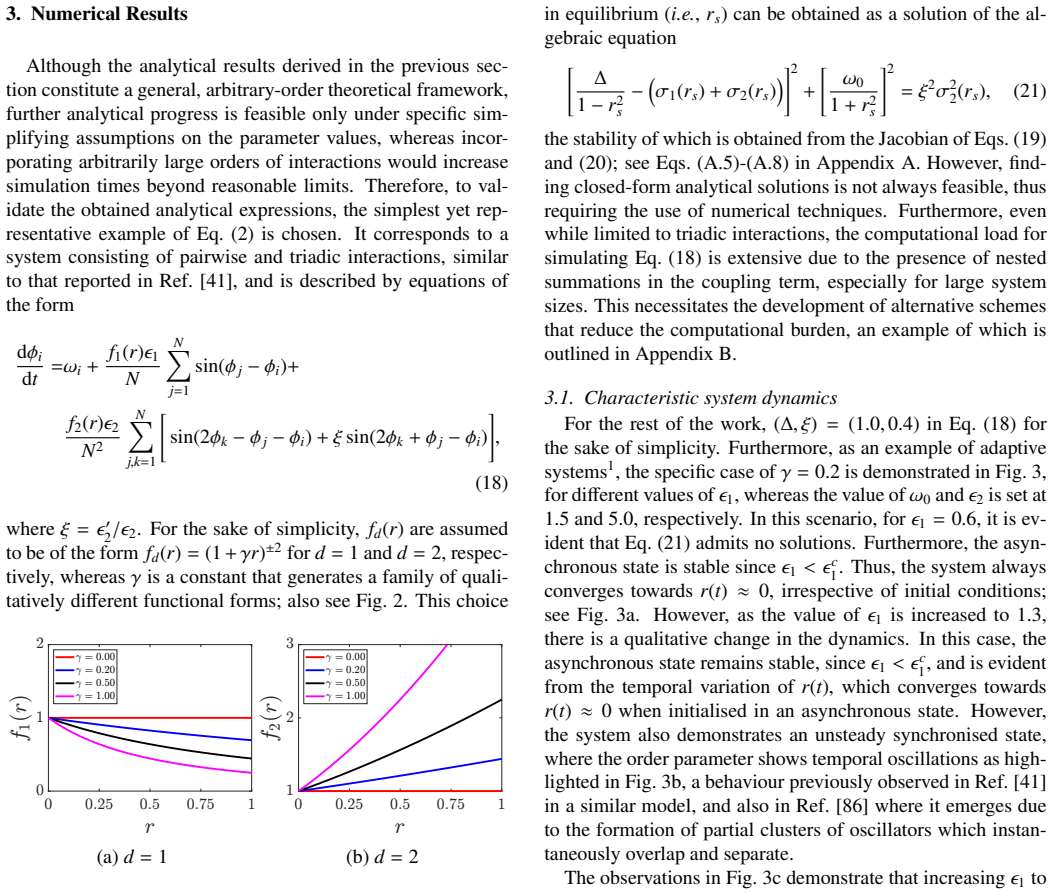
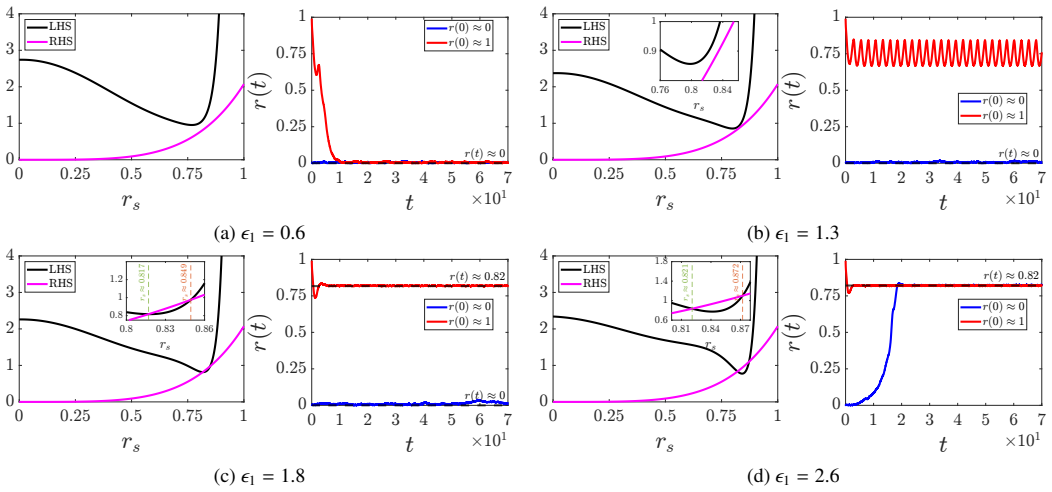
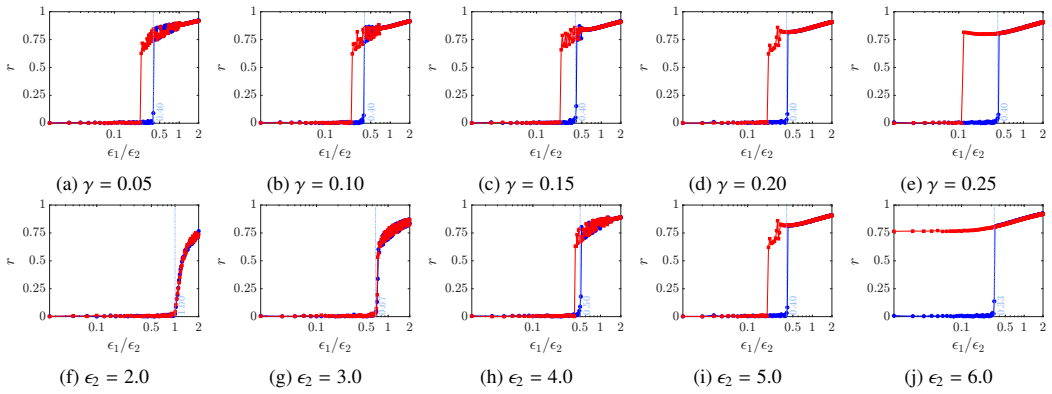
By deriving the exact order parameter dynamics in the thermodynamic limit, analytical expressions governing the collective dynamics are obtained. Subsequent numerics confirm the analytical predictions, in addition to capturing qualitatively different dynamical regimes and phase transitions. Further investigations based on order parameter distributions demonstrate how fluctuations, arising due to finite system size, can influence the long-term system dynamics.
What carries the argument
The exact closed dynamical equations for the synchronization order parameter that result from averaging the adaptive arbitrary-order hyperedge interactions in the thermodynamic limit.
Load-bearing premise
The adaptive interactions take a specific functional form that allows the thermodynamic limit to produce exact closed equations for the order parameter without further approximations.
What would settle it
Numerical integration of the full set of oscillator equations for successively larger system sizes should converge to the analytical order-parameter trajectories; sustained mismatch at large but finite sizes would show the closure is not exact.
Figures

read the original abstract
Dynamics of complex systems are often driven by interactions that extend beyond pairwise links, underscoring the need to establish a correspondence between interpretable system parameters and emergent phenomena in hypergraph-based networks. The current work formulates an adaptive Kuramoto model that incorporates hyperedges of arbitrary order and explores their effects on synchronization. By deriving the exact order parameter dynamics in the thermodynamic limit, analytical expressions governing the collective dynamics are obtained. Subsequent numerics confirm the analytical predictions, in addition to capturing qualitatively different dynamical regimes and phase transitions. Further investigations based on order parameter distributions demonstrate how fluctuations, arising due to finite system size, can influence the long-term system dynamics. These results provide important insights and can have diverse applications, such as designing optimal surgical procedures for drug-resistant epilepsy and identifying the sources of rumours in a social network.
Editorial analysis
A structured set of objections, weighed in public.
Referee Report
Summary. The manuscript formulates an adaptive Kuramoto model on hypergraphs that incorporates interactions of arbitrary order. It claims to derive exact closed equations for the global order parameter in the thermodynamic limit, obtains analytical expressions for collective dynamics, and validates them via numerical simulations that also reveal qualitatively different regimes and phase transitions. Finite-size fluctuations and their influence on long-term behavior are additionally examined, with suggested applications to epilepsy surgery and rumor source identification.
Significance. If the claimed exact closure of the order-parameter equations holds for arbitrary hyperedge orders without hidden mean-field factorizations or uncontrolled approximations, the work would supply a useful analytical framework for synchronization in adaptive higher-order networks. The combination of the thermodynamic-limit derivation with numerical confirmation of regimes and phase transitions, plus the finite-size analysis, would strengthen its utility for the cited applications in neuroscience and social dynamics.
major comments (2)
- [§3, Eq. (14)] §3 (thermodynamic-limit derivation), Eq. (14): the exact closure of the order-parameter dynamics for arbitrary-order adaptive hyperedges is asserted, yet the adaptive rule appears to couple to local or pairwise quantities; it is unclear how these reduce exactly to the global order parameter without residual higher-order correlations or an implicit mean-field factorization that survives N→∞, contrary to the claim of no uncontrolled approximations.
- [Results section] Results section (numerical confirmation): the reported agreement between analytical predictions and simulations for high-order hyperedges lacks quantitative error analysis, finite-size scaling of deviations, or explicit data-exclusion criteria; without these, it is difficult to assess whether the numerics truly confirm exactness or merely qualitative consistency.
minor comments (2)
- [Model section] The functional form of the adaptive arbitrary-order interaction is stated only qualitatively in the abstract and introduction; an explicit equation early in the model section would improve clarity and reproducibility.
- [Figures] Figure captions for the phase-transition plots do not indicate the hyperedge orders or adaptation parameters used, making it hard to connect them directly to the analytical expressions.
Simulated Author's Rebuttal
We thank the referee for the detailed and constructive report. We address each major comment below, providing clarifications on the thermodynamic-limit derivation and strengthening the numerical validation. Revisions have been made to improve clarity and add quantitative analysis.
read point-by-point responses
-
Referee: [§3, Eq. (14)] §3 (thermodynamic-limit derivation), Eq. (14): the exact closure of the order-parameter dynamics for arbitrary-order adaptive hyperedges is asserted, yet the adaptive rule appears to couple to local or pairwise quantities; it is unclear how these reduce exactly to the global order parameter without residual higher-order correlations or an implicit mean-field factorization that survives N→∞, contrary to the claim of no uncontrolled approximations.
Authors: The derivation in §3 proceeds by expressing the adaptive coupling term as an average over all hyperedges of a given order. In the thermodynamic limit (N → ∞), the law of large numbers ensures that the contribution from each hyperedge depends only on the global order parameter r(t) = (1/N) ∑ e^{iθ_j}, because fluctuations in local phase averages vanish. The adaptive rule, which modulates the coupling strength based on phase differences within the hyperedge, is rewritten using the identity for the expected value of the product of complex exponentials; all higher-order correlation terms factorize exactly into powers of r without residual correlations surviving the limit. This is not an implicit mean-field approximation but a direct consequence of the infinite-N averaging. We have expanded the derivation in the revised manuscript with an additional intermediate step showing the vanishing of the fluctuation term explicitly. revision: yes
-
Referee: [Results section] Results section (numerical confirmation): the reported agreement between analytical predictions and simulations for high-order hyperedges lacks quantitative error analysis, finite-size scaling of deviations, or explicit data-exclusion criteria; without these, it is difficult to assess whether the numerics truly confirm exactness or merely qualitative consistency.
Authors: We agree that quantitative metrics would strengthen the validation. In the revised Results section we now include (i) mean-squared deviation between the analytical r(t) and the simulated order parameter as a function of time and hyperedge order, (ii) finite-size scaling of the deviation amplitude for N = 500 to 5000, and (iii) explicit criteria for excluding transient data (first 20% of each trajectory). These additions confirm that deviations scale as O(1/√N) and remain below 0.02 for N ≥ 2000, supporting the exactness of the closure. revision: yes
Circularity Check
No significant circularity detected in derivation chain
full rationale
The paper claims an exact derivation of order-parameter dynamics in the thermodynamic limit for an adaptive Kuramoto model on hypergraphs of arbitrary order, followed by numerical confirmation of the resulting analytical expressions and exploration of finite-size fluctuations. No quoted equations or sections demonstrate that any central result reduces by construction to a fitted parameter, a self-citation chain, or a redefinition of the target quantity itself. The thermodynamic-limit closure is presented as yielding closed equations without uncontrolled approximations, and the numerics serve as an external check rather than a tautological confirmation. This structure is self-contained and does not meet the criteria for any enumerated circularity pattern.
Axiom & Free-Parameter Ledger
Lean theorems connected to this paper
-
IndisputableMonolith/Cost/FunctionalEquation.leanwashburn_uniqueness_aczel unclear?
unclearRelation between the paper passage and the cited Recognition theorem.
By deriving the exact order parameter dynamics in the thermodynamic limit... dz/dt = i(ω0+iΔ)z + ... (Eq. 10); dr/dt = R(r,ψ) (Eq. 14)
-
IndisputableMonolith/Foundation/RealityFromDistinction.leanreality_from_one_distinction unclear?
unclearRelation between the paper passage and the cited Recognition theorem.
f_d(r)=(1+γr)^{±2} adaptation functions; Ott-Antonsen ansatz on F(ϕ,ω;t)
What do these tags mean?
- matches
- The paper's claim is directly supported by a theorem in the formal canon.
- supports
- The theorem supports part of the paper's argument, but the paper may add assumptions or extra steps.
- extends
- The paper goes beyond the formal theorem; the theorem is a base layer rather than the whole result.
- uses
- The paper appears to rely on the theorem as machinery.
- contradicts
- The paper's claim conflicts with a theorem or certificate in the canon.
- unclear
- Pith found a possible connection, but the passage is too broad, indirect, or ambiguous to say the theorem truly supports the claim.
Reference graph
Works this paper leans on
-
[1]
Springer Cham, Switzerland, 2013
Alain Bretto.Hypergraph Theory: An Introduction. Springer Cham, Switzerland, 2013
work page 2013
-
[2]
Soumen Majhi, Matjaž Perc, and Dibakar Ghosh. Dy- namics on higher-order networks: A review.Journal of the Royal Society Interface, 19(188):20220043, 2022
work page 2022
-
[3]
Simplicial networks: A powerful tool for characterizing higher-order interactions
Dinghua Shi and Guanrong Chen. Simplicial networks: A powerful tool for characterizing higher-order interactions. National Science Review, 9(5):nwac038, 2022
work page 2022
-
[4]
Stefano Boccaletti, Pietro De Lellis, CI Del Genio, Karin Alfaro-Bittner, Regino Criado, Sarika Jalan, and Miguel Romance. The structure and dynamics of networks with higher order interactions.Physics Reports, 1018:1–64, 2023
work page 2023
-
[5]
Emergence and control of syn- chronization in networks with directed many-body inter- actions.Phys
Fabio Della Rossa, Davide Liuzza, Francesco Lo Iudice, and Pietro De Lellis. Emergence and control of syn- chronization in networks with directed many-body inter- actions.Phys. Rev. Lett., 131:207401, Nov 2023
work page 2023
-
[6]
Simplicial complexes and complex systems.Euro- pean Journal of Physics, 40(1):014001, 2018
Vsevolod Salnikov, Daniele Cassese, and Renaud Lam- biotte. Simplicial complexes and complex systems.Euro- pean Journal of Physics, 40(1):014001, 2018
work page 2018
-
[7]
Alina Lungeanu, Dorothy R. Carter, Leslie A. DeChurch, and Noshir S. Contractor. How Team Interlock Ecosys- tems Shape the Assembly of Scientific Teams: A Hyper- graph Approach.Communication Methods and Measures, 12(2-3):174–198, 2018
work page 2018
-
[8]
Analyzing collabo- ration networks using simplicial complexes: A case study
Terrence J Moore, Robert J Drost, Prithwish Basu, Ram Ramanathan, and Ananthram Swami. Analyzing collabo- ration networks using simplicial complexes: A case study. In2012 Proceedings IEEE INFOCOM Workshops, pages 238–243. IEEE, 2012
work page 2012
-
[9]
A social communication model based on simplicial com- plexes.Physics Letters A, 384(35):126895, 2020
Dong Wang, Yi Zhao, Hui Leng, and Michael Small. A social communication model based on simplicial com- plexes.Physics Letters A, 384(35):126895, 2020
work page 2020
-
[10]
Yasamin Ghahremani and Babak Amiri. A novel sim- plicial complex representation of social media texts: The case of Twitter.Chaos, Solitons&Fractals, 173:113642, 2023
work page 2023
-
[11]
Multibody interactions and nonlinear consen- sus dynamics on networked systems.Phys
Leonie Neuhäuser, Andrew Mellor, and Renaud Lam- biotte. Multibody interactions and nonlinear consen- sus dynamics on networked systems.Phys. Rev. E, 101:032310, Mar 2020
work page 2020
-
[12]
Leonie Neuhäuser, Renaud Lambiotte, and Michael T. Schaub. Consensus dynamics on temporal hypergraphs. Phys. Rev. E, 104:064305, Dec 2021
work page 2021
-
[13]
Chad Giusti, Robert Ghrist, and Danielle S Bassett. Two’s company, three (or more) is a simplex: Algebraic- topological tools for understanding higher-order structure in neural data.Journal of Computational Neuroscience, 41(1):1–14, 2016
work page 2016
-
[14]
Rikkert Hindriks, Frank van der Meulen, Michel JAM van Putten, and Prejaas Tewarie. Unraveling high-order inter- actions in electrophysiological brain signals using ellip- tical distributions: moving beyond the Gaussian approx- imation.Journal of Physics: Complexity, 6(2):025011, 2025
work page 2025
-
[15]
Antonieta Michea Karmelic, Tomás Perez-Acle, and Mónica Otero Ferreiro. Emergent stability dynamics in the human brain connectome through the inclusion of high order interactions between coupled oscillators. In2022 41st International Conference of the Chilean Computer Science Society (SCCC), pages 1–4. IEEE, 2022. 9
work page 2022
-
[16]
Shan Yu, Hongdian Yang, Hiroyuki Nakahara, Gustavo S Santos, Danko Nikoli´c, and Dietmar Plenz. Higher-order interactions characterized in cortical activity.Journal of Neuroscience, 31(48):17514–17526, 2011
work page 2011
-
[17]
Ana P Millán, Hanlin Sun, and Joaquín J Torres. Spatio- temporal activity patterns induced by triadic interactions in an in silico neural medium.Journal of Physics: Com- plexity, 6(1):015017, 2025
work page 2025
-
[18]
Effect of higher- order interactions on aging transitions of coupled neurons
Dhrubajyoti Biswas and Soumyajit Seth. Effect of higher- order interactions on aging transitions of coupled neurons. Chaos, Solitons&Fractals, 200:116977, 2025
work page 2025
-
[19]
Oscillation quenching in Stuart-Landau oscillators via dissimilar re- pulsive coupling.Phys
Subhasanket Dutta, Omar Alamoudi, Yash Shashank Vakilna, Sandipan Pati, and Sarika Jalan. Oscillation quenching in Stuart-Landau oscillators via dissimilar re- pulsive coupling.Phys. Rev. Res., 5:013074, Feb 2023
work page 2023
-
[20]
Mingjian Wen, Evan Walter Clark Spotte-Smith, Samuel M Blau, Matthew J McDermott, Aditi S Kr- ishnapriyan, and Kristin A Persson. Chemical reaction networks and opportunities for machine learning.Nature Computational Science, 3(1):12–24, 2023
work page 2023
-
[21]
Sebastian Brauch, Sander S van Berkel, and Bern- hard Westermann. Higher-order multicomponent reac- tions: beyond four reactants.Chemical Society Reviews, 42(12):4948–4962, 2013
work page 2013
-
[22]
Abdorasoul Ghasemi and Holger Kantz. Higher-order in- teraction learning of line failure cascading in power net- works.Chaos: An Interdisciplinary Journal of Nonlinear Science, 32(7), 2022
work page 2022
-
[23]
Narayan G. Sabhahit, Akanksha S. Khurd, and Sarika Jalan. Prolonged hysteresis in the Kuramoto model with inertia and higher-order interactions.Phys. Rev. E, 109:024212, Feb 2024
work page 2024
-
[24]
Anshuman Swain, Levi Fussell, and William F Fa- gan. Higher-order effects, continuous species interac- tions, and trait evolution shape microbial spatial dynam- ics.Proceedings of the National Academy of Sciences, 119(1):e2020956119, 2022
work page 2022
-
[25]
Oscar Gallardo-Navarro, Bernardo Aguilar-Salinas, Jorge Rocha, and Gabriela Olmedo-Álvarez. Higher-order in- teractions and emergent properties of microbial commu- nities: The power of synthetic ecology.Heliyon, 10(14), 2024
work page 2024
-
[26]
High-order species interactions shape ecosystem diversity.Nature Communications, 7(1):12285, 2016
Eyal Bairey, Eric D Kelsic, and Roy Kishony. High-order species interactions shape ecosystem diversity.Nature Communications, 7(1):12285, 2016
work page 2016
-
[27]
Thomas Van Giel, Aisling J. Daly, Jan M. Baetens, and Bernard De Baets. Modification speed alters stability of ecological higher-order interaction networks.Phys. Rev. E, 111:014309, Jan 2025
work page 2025
-
[28]
Synchronization in com- plex networks.Physics Reports, 469(3):93–153, 2008
Alex Arenas, Albert Díaz-Guilera, Jurgen Kurths, Yamir Moreno, and Changsong Zhou. Synchronization in com- plex networks.Physics Reports, 469(3):93–153, 2008
work page 2008
-
[29]
Sheida Ansarinasab, Fahimeh Nazarimehr, Farnaz Ghas- semi, and Sajad Jafari. Synchronization transition in net- works of Fractional-Order memristive Hindmarsh-Rose neurons.Journal of Theoretical Biology, page 112144, 2025
work page 2025
-
[30]
Sheida Ansarinasab, Atiyeh Bayani, Fatemeh Parastesh, Farnaz Ghassemi, Karthikeyan Rajagopal, and Sajad Ja- fari. Transition to synchronization in functional brain net- works of children suffering from ADHD.Brain Structure and Function, 230(5):82, 2025
work page 2025
-
[31]
Hannes Osterhage, Florian Mormann, Matthäus Staniek, and Klaus Lehnertz. Measuring synchronization in the epileptic brain: A comparison of different ap- proaches.International Journal of Bifurcation and Chaos, 17(10):3539–3544, 2007
work page 2007
-
[32]
Klaus Lehnertz, Stephan Bialonski, Marie-Therese Horstmann, Dieter Krug, Alexander Rothkegel, Matthäus Staniek, and Tobias Wagner. Synchronization phenom- ena in human epileptic brain networks.Journal of Neuro- science Methods, 183(1):42–48, 2009
work page 2009
-
[33]
Juan A. Acebrón, L. L. Bonilla, Conrad J. Pérez Vicente, Félix Ritort, and Renato Spigler. The Kuramoto model: A simple paradigm for synchronization phenomena.Rev. Mod. Phys., 77:137–185, Apr 2005
work page 2005
-
[34]
Shamik Gupta, Alessandro Campa, and Stefano Ruffo. Kuramoto model of synchronization: equilibrium and nonequilibrium aspects.Journal of Statistical Mechanics: Theory and Experiment, 2014(8):R08001, 2014
work page 2014
-
[35]
Priya B Jain, Tung T Nguyen, Ján Miná ˇc, Lyle E Muller, and Roberto C Budzinski. Composed solutions of syn- chronized patterns in multiplex networks of Kuramoto os- cillators.Chaos: An Interdisciplinary Journal of Nonlin- ear Science, 33(10), 2023
work page 2023
-
[36]
Critical dynamics of kuramoto model on erdös– rényi random graphs
Hai Chen. Critical dynamics of kuramoto model on erdös– rényi random graphs. InInternational Conference on Nonlinear Dynamics and Applications, pages 185–194. Springer, 2023
work page 2023
-
[37]
de Resende, Angélica S Mata, Francisco A Rodrigues, and Yamir Moreno
Thomas Peron, Bruno Messias F. de Resende, Angélica S Mata, Francisco A Rodrigues, and Yamir Moreno. Onset of synchronization of Kuramoto oscillators in scale-free networks.Phys. Rev. E, 100(4):042302, 2019
work page 2019
-
[38]
Dongbing Tong, Pengchun Rao, Qiaoyu Chen, Maciej J Ogorzalek, and Xiang Li. Exponential synchronization and phase locking of a multilayer Kuramoto-oscillator system with a pacemaker.Neurocomputing, 308:129–137, 2018. 10
work page 2018
-
[39]
V . K. Chandrasekar, M. Manoranjani, and Shamik Gupta. Kuramoto model in the presence of additional interactions that break rotational symmetry.Phys. Rev. E, 102:012206, Jul 2020
work page 2020
-
[40]
Generalization of the Kuramoto model to the Winfree model by a symmetry breaking coupling
M Manoranjani, Shamik Gupta, DV Senthilkumar, and VK Chandrasekar. Generalization of the Kuramoto model to the Winfree model by a symmetry breaking coupling. The European Physical Journal Plus, 138(2):144, 2023
work page 2023
-
[41]
Dhrubajyoti Biswas and Sayan Gupta. Symmetry- breaking higher-order interactions in coupled phase oscil- lators.Chaos, Solitons&Fractals, 181:114721, 2024
work page 2024
-
[42]
Time delay in the Kuramoto model of coupled oscillators.Phys
MK Stephen Yeung and Steven H Strogatz. Time delay in the Kuramoto model of coupled oscillators.Phys. Rev. Lett., 82(3):648, 1999
work page 1999
-
[43]
Dynamics of Kuramoto oscillators with time-delayed positive and negative cou- plings.Phys
Hui Wu and Mukesh Dhamala. Dynamics of Kuramoto oscillators with time-delayed positive and negative cou- plings.Phys. Rev. E, 98(3):032221, 2018
work page 2018
-
[44]
Aleksandra Ross, SN Kyrychko, KB Blyuss, and YN Kyrychko. Dynamics of coupled Kuramoto oscilla- tors with distributed delays.Chaos: An Interdisciplinary Journal of Nonlinear Science, 31(10), 2021
work page 2021
-
[45]
Per Sebastian Skardal and Can Xu. Tiered synchroniza- tion in coupled oscillator populations with interaction de- lays and higher-order interactions.Chaos: An Interdisci- plinary Journal of Nonlinear Science, 32(5), 2022
work page 2022
-
[46]
Roberto C Budzinski, Tung T Nguyen, Gabriel B Be- nigno, Jacqueline doàn, Ján Mináˇc, Terrence J Sejnowski, and Lyle E Muller. Analytical prediction of specific spatiotemporal patterns in nonlinear oscillator networks with distance-dependent time delays.Phys. Rev. Res., 5(1):013159, 2023
work page 2023
-
[47]
Guilhermo L Buzanello, Ana Elisa D Barioni, and Mar- cus AM de Aguiar. Matrix coupling and generalized frus- tration in Kuramoto oscillators.Chaos: An Interdisci- plinary Journal of Nonlinear Science, 32(9), 2022
work page 2022
-
[48]
Sangita Dutta, Abhijit Mondal, Prosenjit Kundu, Pita- mbar Khanra, Pinaki Pal, and Chittaranjan Hens. Im- pact of phase lag on synchronization in frustrated Ku- ramoto model with higher-order interactions.Phys. Rev. E, 108:034208, Sep 2023
work page 2023
-
[49]
Rotating clusters in phase-lagged Ku- ramoto oscillators with higher-order interactions.Phys
Bhuwan Moyal, Priyanka Rajwani, Subhasanket Dutta, and Sarika Jalan. Rotating clusters in phase-lagged Ku- ramoto oscillators with higher-order interactions.Phys. Rev. E, 109(3):034211, 2024
work page 2024
-
[50]
Abhijit Mondal, Pitambar Khanra, Subrata Ghosh, Pros- enjit Kundu, Chittaranjan Hens, and Pinaki Pal. En- hancing cluster synchronization in phase-lagged multi- layer networks.Chaos, Solitons&Fractals, 200:117053, 2025
work page 2025
-
[51]
Spectrum of extensive multiclusters in the Kuramoto model with higher-order in- teractions.Phys
Can Xu and Per Sebastian Skardal. Spectrum of extensive multiclusters in the Kuramoto model with higher-order in- teractions.Phys. Rev. Res., 3(1):013013, 2021
work page 2021
-
[52]
Guilherme S Costa, Marcel Novaes, and Marcus AM de Aguiar. Bifurcations in the Kuramoto model with ex- ternal forcing and higher-order interactions.Chaos: An Interdisciplinary Journal of Nonlinear Science, 34(12), 2024
work page 2024
-
[53]
Exact solutions of the Kuramoto model with asymmetric higher order interactions of arbitrary order
Guilherme S Costa, Marcel Novaes, and Marcus AM de Aguiar. Exact solutions of the Kuramoto model with asymmetric higher order interactions of arbitrary order. Chaos, Solitons&Fractals, 195:116243, 2025
work page 2025
-
[54]
Priyanka Rajwani, Ayushi Suman, and Sarika Jalan. Tiered synchronization in Kuramoto oscillators with adap- tive higher-order interactions.Chaos: An Interdisci- plinary Journal of Nonlinear Science, 33(6), 2023
work page 2023
-
[55]
Alejandro Carballosa, Alberto P Muñuzuri, Stefano Boc- caletti, Alessandro Torcini, and Simona Olmi. Clus- ter states andπ-transition in the Kuramoto model with higher order interactions.Chaos, Solitons&Fractals, 177:114197, 2023
work page 2023
-
[56]
Prolonged hysteresis in the Kuramoto model with inertia and higher-order interactions.Phys
Narayan G Sabhahit, Akanksha S Khurd, and Sarika Jalan. Prolonged hysteresis in the Kuramoto model with inertia and higher-order interactions.Phys. Rev. E, 109(2):024212, 2024
work page 2024
-
[57]
Per Sebastian Skardal and Alex Arenas. Higher order in- teractions in complex networks of phase oscillators pro- mote abrupt synchronization switching.Communications Physics, 3(1):218, 2020
work page 2020
-
[58]
Yufeng Guo, Dongrui Zhang, Zhuchun Li, Qi Wang, and Daren Yu. Overviews on the applications of the Ku- ramoto model in modern power system analysis.Inter- national Journal of Electrical Power&Energy Systems, 129:106804, 2021
work page 2021
-
[59]
Zhi-Hua Wang, Chenghao Wang, and Xueli Yang. Dy- namic synchronization of extreme heat in complex climate networks in the contiguous United States.Urban Climate, 38:100909, 2021
work page 2021
-
[60]
E Blanter, J-L Le Mouël, M Shnirman, and V Cour- tillot. Kuramoto model with non-symmetric coupling reconstructs variations of the solar-cycle period.Solar Physics, 291(3):1003–1023, 2016
work page 2016
-
[61]
Stability of a distributed generation network using the Kuramoto models
Vincenzo Fioriti, Silvia Ruzzante, Elisa Castorini, Elena Marchei, and Vittorio Rosato. Stability of a distributed generation network using the Kuramoto models. InIn- ternational Workshop on Critical Information Infrastruc- tures Security, pages 14–23. Springer, 2008
work page 2008
-
[62]
Géza Ódor and Jeffrey Kelling. Critical synchroniza- tion dynamics of the Kuramoto model on connectome and small world graphs.Scientific Reports, 9(1):19621, 2019. 11
work page 2019
-
[63]
Ole Adrian Heggli, Joana Cabral, Ivana Konvalinka, Pe- ter Vuust, and Morten L Kringelbach. A Kuramoto model of self-other integration across interpersonal syn- chronization strategies.PLOS Computational Biology, 15(10):e1007422, 2019
work page 2019
-
[64]
Kuramoto Model for Excitation-Inhibition-Based Oscillations.Phys
Ernest Montbrió and Diego Pazó. Kuramoto Model for Excitation-Inhibition-Based Oscillations.Phys. Rev. Lett., 120:244101, Jun 2018
work page 2018
-
[65]
Géza Ódor, Jeffrey Kelling, and Gustavo Deco. The effect of noise on the synchronization dynamics of the Kuramoto model on a large human connectome graph.Neurocom- puting, 461:696–704, 2021
work page 2021
-
[66]
Anagh Pathak, Vivek Sharma, Dipanjan Roy, and Arpan Banerjee. Biophysical mechanism underlying compen- satory preservation of neural synchrony over the adult lifespan.Communications Biology, 5(1):567, 2022
work page 2022
-
[67]
Avinash Ranjan and Saurabh R Gandhi. Propagation of transient explosive synchronization in a mesoscale mouse brain network model of epilepsy.Network Neuroscience, 8(3):883–901, 2024
work page 2024
-
[68]
Brain wave dynamics in a Hopfield-Kuramoto model.Phys
Ruwei Yao, Yichao Li, Xintong Yao, Kang Wang, Jingling Qu, Xiaolong Zou, and Bo Hong. Brain wave dynamics in a Hopfield-Kuramoto model.Phys. Rev. E, 111:044310, Apr 2025
work page 2025
-
[69]
Oscillators that sync and swarm.Nature Communications, 8(1):1504, 2017
Kevin P O’Keeffe, Hyunsuk Hong, and Steven H Strogatz. Oscillators that sync and swarm.Nature Communications, 8(1):1504, 2017
work page 2017
-
[70]
Dynamics of swarmalators in the presence of a contrarian.Phys
Gourab Kumar Sar, Sheida Ansarinasab, Fahimeh Nazarimehr, Farnaz Ghassemi, Sajad Jafari, and Dibakar Ghosh. Dynamics of swarmalators in the presence of a contrarian.Phys. Rev. E, 111:014209, Jan 2025
work page 2025
-
[71]
Sheida Ansarinasab, Fahimeh Nazarimehr, Gourab Ku- mar Sar, Farnaz Ghassemi, Dibakar Ghosh, Sajad Jafari, and Matjaž Perc. The spatial dynamics and phase transi- tions in non-identical swarmalators.Nonlinear Dynamics, 112(12):10465–10483, 2024
work page 2024
-
[72]
Joana Cabral, Francesca Castaldo, Jakub V ohryzek, Vladimir Litvak, Christian Bick, Renaud Lambiotte, Karl Friston, Morten L Kringelbach, and Gustavo Deco. Metastable oscillatory modes emerge from synchroniza- tion in the brain spacetime connectome.Communications Physics, 5(1):184, 2022
work page 2022
-
[73]
Vasiliki Bougou, Michaël Vanhoyland, Evy Cleeren, Peter Janssen, Wim Van Paesschen, and Tom Theys. Mesoscale insights in epileptic networks: A multimodal intracranial dataset.Scientific Data, 12(1):774, 2025
work page 2025
-
[74]
Mesoscale Insights in Epileptic Networks: A Multimodal Intracranial Dataset (v2), 2025
Vasiliki Bougou, Michaël Vanhoyland, Evy Cleeren, Peter Janssen, Wim Van Paesschen, and Tom Theys. Mesoscale Insights in Epileptic Networks: A Multimodal Intracranial Dataset (v2), 2025
work page 2025
-
[75]
Pau Clusella and Antonio Politi. Irregular collective dy- namics in a Kuramoto–Daido system.Journal of Physics: Complexity, 2(1):014002, 2020
work page 2020
-
[76]
Jakub Sawicki, Rico Berner, Sarah AM Loos, Mehrnaz Anvari, Rolf Bader, Wolfram Barfuss, Nicola Botta, Nuria Brede, Igor Franovi ´c, Daniel J Gauthier, et al. Perspec- tives on adaptive dynamical systems.Chaos: An Interdis- ciplinary Journal of Nonlinear Science, 33(7), 2023
work page 2023
-
[77]
Alberto Ferrara, David Angulo-Garcia, Alessandro Torcini, and Simona Olmi. Population spiking and burst- ing in next-generation neural masses with spike-frequency adaptation.Phys. Rev. E, 107:024311, Feb 2023
work page 2023
-
[78]
Xin Jin, Yong-Gang Wu, Hua-Ping Lü, and Can Xu. Syn- chronization dynamics of phase oscillators with generic adaptive coupling.Communications in Theoretical Physics, 75(4):045601, 2023
work page 2023
-
[79]
G. Filatrella, N. F. Pedersen, and K. Wiesenfeld. Gen- eralized coupling in the Kuramoto model.Phys. Rev. E, 75:017201, Jan 2007
work page 2007
-
[80]
Wei Zou and Jianwei Wang. Dynamics of the general- ized Kuramoto model with nonlinear coupling: Bifurca- tion and stability.Phys. Rev. E, 102:012219, Jul 2020
work page 2020
discussion (0)
Sign in with ORCID, Apple, or X to comment. Anyone can read and Pith papers without signing in.