SkyReels-Text: Fine-Grained Font-Controllable Text Editing for Poster Design
Pith reviewed 2026-05-17 21:49 UTC · model grok-4.3
The pith
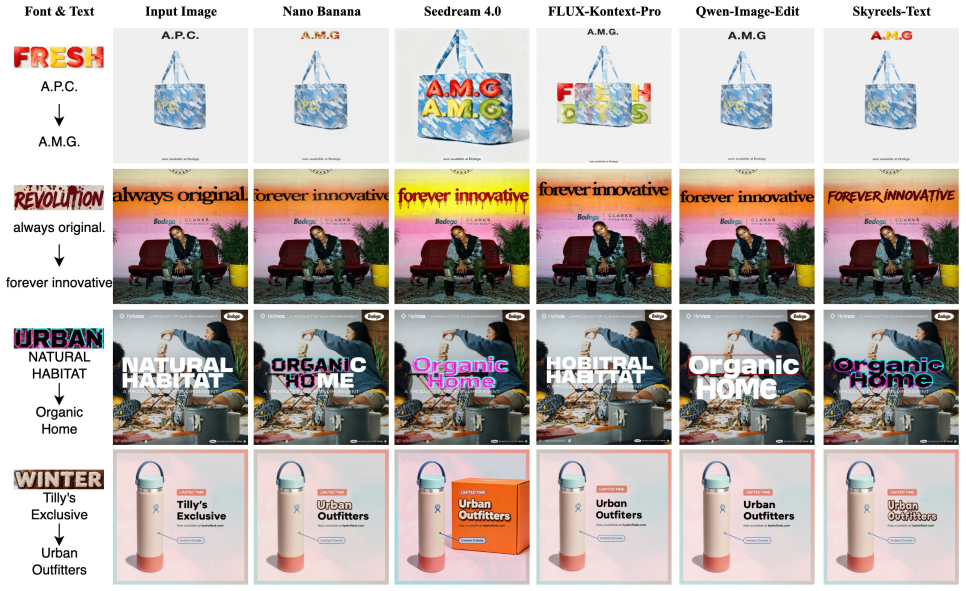
SkyReels-Text enables fine-grained font control for editing multiple text regions in posters using cropped glyph patches without labels or fine-tuning.
A machine-rendered reading of the paper's core claim, the machinery that carries it, and where it could break.
Core claim
The SkyReels-Text framework performs precise poster text editing by enabling simultaneous changes to multiple text regions in distinct typographic styles, using only cropped glyph patches to specify the desired fonts, without font labels or test-time fine-tuning, while preserving the appearance of non-edited regions.
What carries the argument
The font-controllable framework that uses cropped glyph patches to drive typography and style in the editing process.
Load-bearing premise
Cropped glyph patches alone provide sufficient information to control font and style for arbitrary unseen typographies accurately in a single forward pass.
What would settle it
A demonstration that supplying cropped glyph patches from an unseen font produces text that does not match the provided typography or alters the non-edited parts of the poster.
Figures


read the original abstract
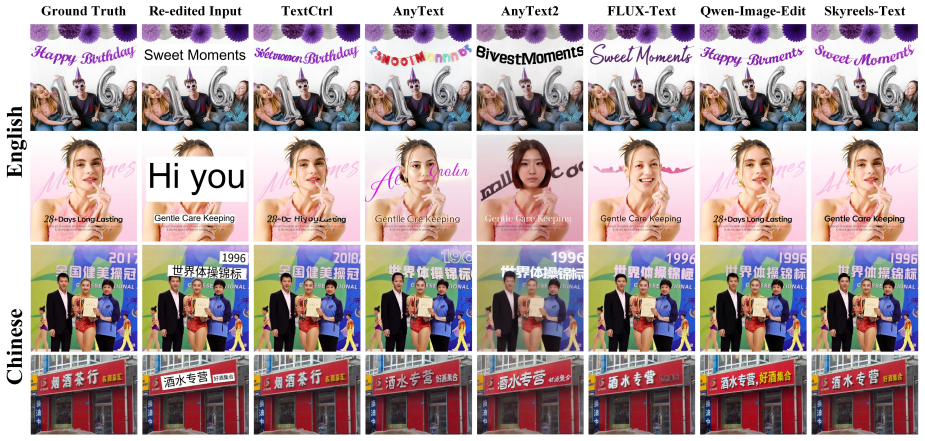
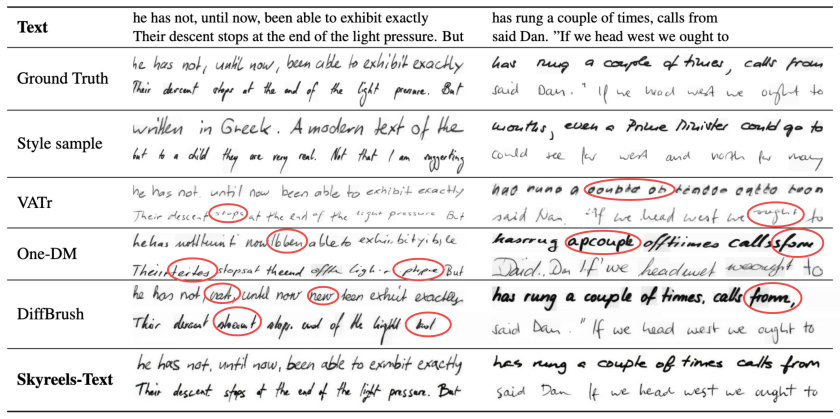
Artistic design, particularly poster design, often demands rapid yet precise modification of textual content while preserving visual harmony and typographic intent, especially across diverse font styles. Although modern image editing models have grown increasingly powerful, they still fall short in fine-grained, font-aware text manipulation, limiting their utility in professional workflows. To address this issue, we present SkyReels-Text, a novel font-controllable framework for precise poster text editing. Our method enables simultaneous editing of multiple text regions, each rendered in distinct typographic styles, while preserving the visual appearance of non-edited regions. Notably, our model requires neither font labels nor test-time fine-tuning: users can simply provide cropped glyph patches corresponding to their desired typography - even if the font is not included in any standard library. Extensive experiments on multiple benchmarks demonstrate that SkyReels-Text achieves state-of-the-art performance in both text fidelity and visual realism, offering unprecedented control over font families and stylistic nuances. This work bridges the gap between general-purpose image editing and professional-grade typographic design. Code and models are publicly available at https://github.com/SkyworkAI/SkyReels-Text.
Editorial analysis
A structured set of objections, weighed in public.
Referee Report
Summary. The manuscript presents SkyReels-Text, a novel framework for fine-grained, font-controllable text editing in poster designs. The method allows users to edit multiple text regions simultaneously, each with distinct typographic styles specified via cropped glyph patches, without requiring font labels or test-time fine-tuning. It claims to preserve the visual appearance of non-edited regions and demonstrates state-of-the-art performance in text fidelity and visual realism on multiple benchmarks.
Significance. If the central claims hold, this work provides a practical advance in bridging general image editing models with professional typographic requirements in design workflows. The ability to handle arbitrary fonts via glyph patches without adaptation or labels is particularly notable, and the public availability of code and models strengthens the contribution.
major comments (3)
- [§3.2] §3.2: The glyph patch encoder is described as a standard vision transformer without dedicated style disentanglement heads; this raises concerns about whether it can reliably extract fine-grained typographic attributes (e.g., weight, contrast, serif details) for unseen fonts in a single forward pass, which is central to the no-adaptation claim.
- [Table 4] Table 4: The user study results report preference rates, but the number of participants and the diversity of test fonts (including out-of-distribution ones) are not specified, making it difficult to assess the robustness of the fine-grained control.
- [§4.3] §4.3: The ablation study on the number of text regions edited simultaneously shows performance drop for >3 regions, but does not address whether this is due to insufficient style encoding from multiple glyph patches or other factors.
minor comments (2)
- [Abstract] Abstract: The abstract mentions 'multiple benchmarks' but does not name them; this should be clarified for readers.
- [Figure 3] Figure 3: The qualitative examples would benefit from zoomed-in insets highlighting the typographic details to better illustrate the fine-grained control.
Simulated Author's Rebuttal
We thank the referee for the constructive feedback and for acknowledging the practical contributions of SkyReels-Text. We respond to each major comment below, indicating planned revisions to the manuscript where appropriate.
read point-by-point responses
-
Referee: [§3.2] The glyph patch encoder is described as a standard vision transformer without dedicated style disentanglement heads; this raises concerns about whether it can reliably extract fine-grained typographic attributes (e.g., weight, contrast, serif details) for unseen fonts in a single forward pass, which is central to the no-adaptation claim.
Authors: The glyph patch encoder employs a standard ViT but is trained end-to-end on the font-controllable editing task using a diverse collection of fonts. This objective encourages the encoder to prioritize typographic attributes relevant to accurate rendering, enabling effective extraction for unseen fonts in a single forward pass without adaptation or labels. Our benchmark results on out-of-distribution fonts support this capability. We will revise §3.2 to provide a clearer explanation of the encoder's role within the overall pipeline and include supplementary visualizations of encoded glyph features to illustrate captured attributes such as weight and serif details. revision: partial
-
Referee: [Table 4] The user study results report preference rates, but the number of participants and the diversity of test fonts (including out-of-distribution ones) are not specified, making it difficult to assess the robustness of the fine-grained control.
Authors: We agree that these details should have been included to allow proper evaluation of the user study. In the revised manuscript we will update Table 4 and the associated experimental description to report the number of participants and the composition of the test fonts, explicitly noting the inclusion of out-of-distribution fonts. revision: yes
-
Referee: [§4.3] The ablation study on the number of text regions edited simultaneously shows performance drop for >3 regions, but does not address whether this is due to insufficient style encoding from multiple glyph patches or other factors.
Authors: The performance drop beyond three simultaneous regions arises primarily from the increased demands on the diffusion model to maintain spatial consistency and balance multiple independent editing conditions at once. The glyph patch encoder processes each patch independently, and style fidelity remains high in our internal checks even as region count increases. We will revise §4.3 to discuss these contributing factors explicitly and add a short analysis clarifying that the degradation is not attributable to style encoding insufficiency alone. revision: partial
Circularity Check
No significant circularity in the model framework or claims
full rationale
The paper presents SkyReels-Text as a trained generative model for font-controllable text editing that takes cropped glyph patches as style input without labels or fine-tuning. No mathematical derivations, equations, or self-referential fits appear in the abstract or described approach. Claims rest on empirical results across benchmarks rather than reducing to self-definitions, fitted inputs renamed as predictions, or load-bearing self-citation chains. This is a standard empirical ML setup that remains self-contained against external validation, with the central assumption about glyph patch sufficiency being a testable modeling hypothesis rather than a circular construction.
Axiom & Free-Parameter Ledger
free parameters (1)
- Neural network weights
axioms (1)
- domain assumption Glyph patches contain sufficient visual information to control font rendering and stylistic nuances in edited poster images.
Lean theorems connected to this paper
-
IndisputableMonolith/Cost/FunctionalEquation.leanwashburn_uniqueness_aczel unclear?
unclearRelation between the paper passage and the cited Recognition theorem.
dual-stream visual conditioning mechanism that leverages user-provided glyph patches as explicit visual references... Zin = Concat(zt, VAE(Xref), VAE(Xglyph))
-
IndisputableMonolith/Foundation/AlphaCoordinateFixation.leanJ_uniquely_calibrated_via_higher_derivative unclear?
unclearRelation between the paper passage and the cited Recognition theorem.
text-aware weighted reconstruction loss L = E[||Xgt - Xhat||^2 ⊙ (1 + λ·M)] with λ=5
What do these tags mean?
- matches
- The paper's claim is directly supported by a theorem in the formal canon.
- supports
- The theorem supports part of the paper's argument, but the paper may add assumptions or extra steps.
- extends
- The paper goes beyond the formal theorem; the theorem is a base layer rather than the whole result.
- uses
- The paper appears to rely on the theorem as machinery.
- contradicts
- The paper's claim conflicts with a theorem or certificate in the canon.
- unclear
- Pith found a possible connection, but the passage is too broad, indirect, or ambiguous to say the theorem truly supports the claim.
Reference graph
Works this paper leans on
-
[1]
Qwen2.5-vl technical report, 2025
Shuai Bai, Keqin Chen, Xuejing Liu, Jialin Wang, Wenbin Ge, Sibo Song, Kai Dang, Peng Wang, Shijie Wang, Jun Tang, Humen Zhong, Yuanzhi Zhu, Mingkun Yang, Zhao- hai Li, Jianqiang Wan, Pengfei Wang, Wei Ding, Zheren Fu, Yiheng Xu, Jiabo Ye, Xi Zhang, Tianbao Xie, Zesen Cheng, Hang Zhang, Zhibo Yang, Haiyang Xu, and Junyang Lin. Qwen2.5-vl technical report,...
work page 2025
-
[2]
eDiff-I: Text-to-Image Diffusion Models with an Ensemble of Expert Denoisers
Yogesh Balaji, Seungjun Nah, Xun Huang, Arash Vahdat, Ji- aming Song, Qinsheng Zhang, Karsten Kreis, Miika Aittala, Timo Aila, Samuli Laine, et al. ediff-i: Text-to-image dif- fusion models with an ensemble of expert denoisers.arXiv preprint arXiv:2211.01324, 2022. 3
work page internal anchor Pith review Pith/arXiv arXiv 2022
-
[3]
Haoxing Chen, Zhuoer Xu, Zhangxuan Gu, Yaohui Li, Changhua Meng, Huijia Zhu, Weiqiang Wang, et al. Diffute: Universal text editing diffusion model.Advances in Neural Information Processing Systems, 36:63062–63074, 2023. 6
work page 2023
-
[4]
Jingye Chen, Yupan Huang, Tengchao Lv, Lei Cui, Qifeng Chen, and Furu Wei. Textdiffuser: Diffusion models as text painters.Advances in Neural Information Processing Sys- tems, 36:9353–9387, 2023. 3, 6
work page 2023
-
[5]
Hyung Won Chung, Le Hou, Shayne Longpre, Barret Zoph, Yi Tay, William Fedus, Yunxuan Li, Xuezhi Wang, Mostafa Dehghani, Siddhartha Brahma, et al. Scaling instruction- finetuned language models.Journal of Machine Learning Research, 25(70):1–53, 2024. 3
work page 2024
-
[6]
Cheng Cui, Ting Sun, Suyin Liang, Tingquan Gao, Zelun Zhang, Jiaxuan Liu, Xueqing Wang, Changda Zhou, Hongen Liu, Manhui Lin, Yue Zhang, Yubo Zhang, Handong Zheng, Jing Zhang, Jun Zhang, Yi Liu, Dianhai Yu, and Yanjun Ma. Paddleocr-vl: Boosting multilingual document parsing via a 0.9b ultra-compact vision-language model, 2025. 4
work page 2025
-
[7]
Paddleocr 3.0 technical report, 2025
Cheng Cui, Ting Sun, Manhui Lin, Tingquan Gao, Yubo Zhang, Jiaxuan Liu, Xueqing Wang, Zelun Zhang, Changda Zhou, Hongen Liu, Yue Zhang, Wenyu Lv, Kui Huang, Yichao Zhang, Jing Zhang, Jun Zhang, Yi Liu, Dianhai Yu, and Yanjun Ma. Paddleocr 3.0 technical report, 2025. 4
work page 2025
-
[8]
One-dm: One-shot diffusion mimicker for handwritten text generation
Gang Dai, Yifan Zhang, Quhui Ke, Qiangya Guo, and Shuangping Huang. One-dm: One-shot diffusion mimicker for handwritten text generation. InEuropean Conference on Computer Vision, pages 410–427. Springer, 2024. 7
work page 2024
-
[9]
Beyond isolated words: Diffusion brush for handwritten text-line generation
Gang Dai, Yifan Zhang, Yutao Qin, Qiangya Guo, Shuang- ping Huang, and Shuicheng Yan. Beyond isolated words: Diffusion brush for handwritten text-line generation. In Proceedings of the IEEE/CVF International Conference on Computer Vision, pages 19054–19064, 2025. 7
work page 2025
-
[10]
Brian Davis, Chris Tensmeyer, Brian Price, Curtis Wiging- ton, Bryan Morse, and Rajiv Jain. Text and style condi- tioned gan for generation of offline handwriting lines.arXiv preprint arXiv:2009.00678, 2020. 7
-
[11]
Gemini 2.5 flash image.https : / / developers
Google. Gemini 2.5 flash image.https : / / developers . googleblog . com / en / introducing - gemini - 2 - 5 - flash - image,
-
[12]
Jiaxi Gu, Xiaojun Meng, Guansong Lu, Lu Hou, Niu Minzhe, Xiaodan Liang, Lewei Yao, Runhui Huang, Wei Zhang, Xin Jiang, et al. Wukong: A 100 million large-scale chinese cross-modal pre-training benchmark.Advances in Neural Information Processing Systems, 35:26418–26431,
-
[13]
Improving diffusion models for scene text editing with dual encoders
Jiabao Ji, Guanhua Zhang, Zhaowen Wang, Bairu Hou, Zhifei Zhang, Brian Price, and Shiyu Chang. Improving diffusion models for scene text editing with dual encoders. arXiv preprint arXiv:2304.05568, 2023. 6
-
[14]
Lei Kang, Pau Riba, Marcal Rusinol, Alicia Fornes, and Mauricio Villegas. Content and style aware generation of text-line images for handwriting recognition.IEEE Transac- tions on Pattern Analysis and Machine Intelligence, 44(12): 8846–8860, 2021. 5, 7
work page 2021
-
[15]
Geometry score: A method for comparing generative adversarial networks
Valentin Khrulkov and Ivan Oseledets. Geometry score: A method for comparing generative adversarial networks. In International conference on machine learning, pages 2621–
-
[16]
Cvl-database: An off-line database for writer re- trieval, writer identification and word spotting
Florian Kleber, Stefan Fiel, Markus Diem, and Robert Sab- latnig. Cvl-database: An off-line database for writer re- trieval, writer identification and word spotting. In2013 12th international conference on document analysis and recogni- tion, pages 560–564. IEEE, 2013. 5
work page 2013
-
[17]
Flux.https://github.com/ black-forest-labs/flux, 2024
Black Forest Labs. Flux.https://github.com/ black-forest-labs/flux, 2024. 2, 3
work page 2024
-
[18]
Flux.1 kontext: Flow matching for in-context image generation and editing in latent space,
Black Forest Labs, Stephen Batifol, Andreas Blattmann, Frederic Boesel, Saksham Consul, Cyril Diagne, Tim Dock- horn, Jack English, Zion English, Patrick Esser, Sumith Ku- lal, Kyle Lacey, Yam Levi, Cheng Li, Dominik Lorenz, Jonas M¨uller, Dustin Podell, Robin Rombach, Harry Saini, Axel Sauer, and Luke Smith. Flux.1 kontext: Flow matching for in-context i...
-
[19]
Rui Lan, Yancheng Bai, Xu Duan, Mingxing Li, Dongyang Jin, Ryan Xu, Lei Sun, and Xiangxiang Chu. Flux-text: A simple and advanced diffusion transformer baseline for scene text editing.arXiv preprint arXiv:2505.03329, 2025. 2, 3, 5, 6
-
[20]
Jian Ma, Mingjun Zhao, Chen Chen, Ruichen Wang, Di Niu, Haonan Lu, and Xiaodong Lin. Glyphdraw: Seamlessly ren- dering text with intricate spatial structures in text-to-image generation.arXiv preprint arXiv:2303.17870, 2023. 3
-
[21]
U-V Marti and Horst Bunke. The iam-database: an english sentence database for offline handwriting recognition.Inter- national journal on document analysis and recognition, 5(1): 39–46, 2002. 5
work page 2002
-
[22]
Diffusionpen: Towards controlling the style of handwritten text generation
Konstantina Nikolaidou, George Retsinas, Giorgos Sfikas, and Marcus Liwicki. Diffusionpen: Towards controlling the style of handwritten text generation. InEuropean Confer- ence on Computer Vision, pages 417–434. Springer, 2024. 7
work page 2024
-
[23]
Gpt-image-1.https : / / openai
OpenAI. Gpt-image-1.https : / / openai . com / index / introducing - 4o - image - generation,
-
[24]
DINOv2: Learning Robust Visual Features without Supervision
Maxime Oquab, Timoth ´ee Darcet, Th ´eo Moutakanni, Huy V o, Marc Szafraniec, Vasil Khalidov, Pierre Fernandez, Daniel Haziza, Francisco Massa, Alaaeldin El-Nouby, et al. Dinov2: Learning robust visual features without supervision. arXiv preprint arXiv:2304.07193, 2023. 4
work page internal anchor Pith review Pith/arXiv arXiv 2023
-
[25]
PaddlePaddle. Pp-ocrv4.https : / / github . com / PaddlePaddle/PaddleOCR/blob/release/2.7/ doc/doc_ch/PP-OCRv4_introduction.md, 2023. 4
work page 2023
-
[26]
Hand- written text generation from visual archetypes
Vittorio Pippi, Silvia Cascianelli, and Rita Cucchiara. Hand- written text generation from visual archetypes. InProceed- ings of the IEEE/CVF Conference on Computer Vision and Pattern Recognition, pages 22458–22467, 2023. 7
work page 2023
-
[27]
Hwd: A novel evaluation score for styled hand- written text generation
Vittorio Pippi, Fabio Quattrini, , Silvia Cascianelli, and Rita Cucchiara. Hwd: A novel evaluation score for styled hand- written text generation. InProceedings of the British Ma- chine Vision Conference, 2023. 5
work page 2023
-
[28]
Chitwan Saharia, William Chan, Saurabh Saxena, Lala Li, Jay Whang, Emily L Denton, Kamyar Ghasemipour, Raphael Gontijo Lopes, Burcu Karagol Ayan, Tim Salimans, et al. Photorealistic text-to-image diffusion models with deep language understanding.Advances in neural information processing systems, 35:36479–36494, 2022. 3
work page 2022
-
[29]
Improved techniques for training gans.Advances in neural information processing systems, 29, 2016
Tim Salimans, Ian Goodfellow, Wojciech Zaremba, Vicki Cheung, Alec Radford, and Xi Chen. Improved techniques for training gans.Advances in neural information processing systems, 29, 2016. 5
work page 2016
-
[30]
LAION-400M: Open Dataset of CLIP-Filtered 400 Million Image-Text Pairs
Christoph Schuhmann, Richard Vencu, Romain Beaumont, Robert Kaczmarczyk, Clayton Mullis, Aarush Katta, Theo Coombes, Jenia Jitsev, and Aran Komatsuzaki. Laion-400m: Open dataset of clip-filtered 400 million image-text pairs. arXiv preprint arXiv:2111.02114, 2021. 5
work page internal anchor Pith review Pith/arXiv arXiv 2021
-
[31]
Seedream 4.0: Toward next-generation multimodal image generation, 2025
Team Seedream, :, Yunpeng Chen, Yu Gao, Lixue Gong, Meng Guo, Qiushan Guo, Zhiyao Guo, Xiaoxia Hou, Weilin Huang, Yixuan Huang, Xiaowen Jian, Huafeng Kuang, Zhichao Lai, Fanshi Li, Liang Li, Xiaochen Lian, Chao Liao, Liyang Liu, Wei Liu, Yanzuo Lu, Zhengxiong Luo, Tong- tong Ou, Guang Shi, Yichun Shi, Shiqi Sun, Yu Tian, Zhi Tian, Peng Wang, Rui Wang, Xun...
work page 2025
-
[32]
Seedream 4.0: Toward Next-generation Multimodal Image Generation
Team Seedream, Yunpeng Chen, Yu Gao, Lixue Gong, Meng Guo, Qiushan Guo, Zhiyao Guo, Xiaoxia Hou, Weilin Huang, Yixuan Huang, et al. Seedream 4.0: Toward next- generation multimodal image generation.arXiv preprint arXiv:2509.20427, 2025. 2, 3
work page internal anchor Pith review Pith/arXiv arXiv 2025
-
[33]
pytorch-fid: FID Score for PyTorch
Maximilian Seitzer. pytorch-fid: FID Score for PyTorch. https://github.com/mseitzer/pytorch-fid,
-
[34]
Anytext: Multilingual visual text gener- ation and editing
Yuxiang Tuo, Wangmeng Xiang, Jun-Yan He, Yifeng Geng, and Xuansong Xie. Anytext: Multilingual visual text gener- ation and editing. 2023. 3, 5, 6
work page 2023
-
[35]
Yuxiang Tuo, Yifeng Geng, and Liefeng Bo. Anytext2: Vi- sual text generation and editing with customizable attributes. arXiv preprint arXiv:2411.15245, 2024. 6
-
[36]
Dreamtext: High fidelity scene text synthesis
Yibin Wang, Weizhong Zhang, Honghui Xu, and Cheng Jin. Dreamtext: High fidelity scene text synthesis. InProceed- ings of the Computer Vision and Pattern Recognition Con- ference, pages 28555–28563, 2025. 3
work page 2025
-
[37]
Chenfei Wu, Jiahao Li, Jingren Zhou, Junyang Lin, Kaiyuan Gao, Kun Yan, Sheng ming Yin, Shuai Bai, Xiao Xu, Yilei Chen, Yuxiang Chen, Zecheng Tang, Zekai Zhang, Zhengyi Wang, An Yang, Bowen Yu, Chen Cheng, Dayiheng Liu, De- qing Li, Hang Zhang, Hao Meng, Hu Wei, Jingyuan Ni, Kai Chen, Kuan Cao, Liang Peng, Lin Qu, Minggang Wu, Peng Wang, Shuting Yu, Tingk...
-
[38]
Yu Xie, Jielei Zhang, Pengyu Chen, Ziyue Wang, Weihang Wang, Longwen Gao, Peiyi Li, Huyang Sun, Qiang Zhang, Qian Qiao, et al. Textflux: An ocr-free dit model for high- fidelity multilingual scene text synthesis.arXiv preprint arXiv:2505.17778, 2025. 2, 3
-
[39]
An Yang, Anfeng Li, Baosong Yang, Beichen Zhang, Binyuan Hui, Bo Zheng, Bowen Yu, Chang Gao, Chengen Huang, Chenxu Lv, et al. Qwen3 technical report.arXiv preprint arXiv:2505.09388, 2025. 4
work page internal anchor Pith review Pith/arXiv arXiv 2025
-
[40]
Yukang Yang, Dongnan Gui, Yuhui Yuan, Weicong Liang, Haisong Ding, Han Hu, and Kai Chen. Glyphcontrol: Glyph conditional control for visual text generation.Advances in Neural Information Processing Systems, 36:44050–44066,
-
[41]
Tianwei Yin, Micha ¨el Gharbi, Taesung Park, Richard Zhang, Eli Shechtman, Fredo Durand, and Bill Freeman. Im- proved distribution matching distillation for fast image syn- thesis.Advances in neural information processing systems, 37:47455–47487, 2024. 5
work page 2024
-
[42]
Weichao Zeng, Yan Shu, Zhenhang Li, Dongbao Yang, and Yu Zhou. Textctrl: Diffusion-based scene text editing with prior guidance control.Advances in Neural Information Pro- cessing Systems, 37:138569–138594, 2024. 6
work page 2024
-
[43]
The unreasonable effectiveness of deep features as a perceptual metric
Richard Zhang, Phillip Isola, Alexei A Efros, Eli Shecht- man, and Oliver Wang. The unreasonable effectiveness of deep features as a perceptual metric. InProceedings of the IEEE conference on computer vision and pattern recogni- tion, pages 586–595, 2018. 5
work page 2018
discussion (0)
Sign in with ORCID, Apple, or X to comment. Anyone can read and Pith papers without signing in.