Event-Chain Analysis for Automated Driving and ADAS Systems: Ensuring Safety and Meeting Regulatory Timing Requirements
Pith reviewed 2026-05-17 06:37 UTC · model grok-4.3
The pith
Event-chain modeling derives and validates end-to-end timing constraints for automated driving systems at the architectural level.
A machine-rendered reading of the paper's core claim, the machinery that carries it, and where it could break.
Core claim
Our methodology enables the derivation, modeling, and validation of end-to-end timing constraints at the architectural level and facilitates early verification through simulation. Through a detailed case study, we demonstrate how this Event-Chain-centric approach enhances regulatory compliance, optimizes system design, and supports model-based safety analysis techniques, with results showing early identification of compliance issues, systematic parameter optimization, and quantitative evidence generation through probabilistic analysis.
What carries the argument
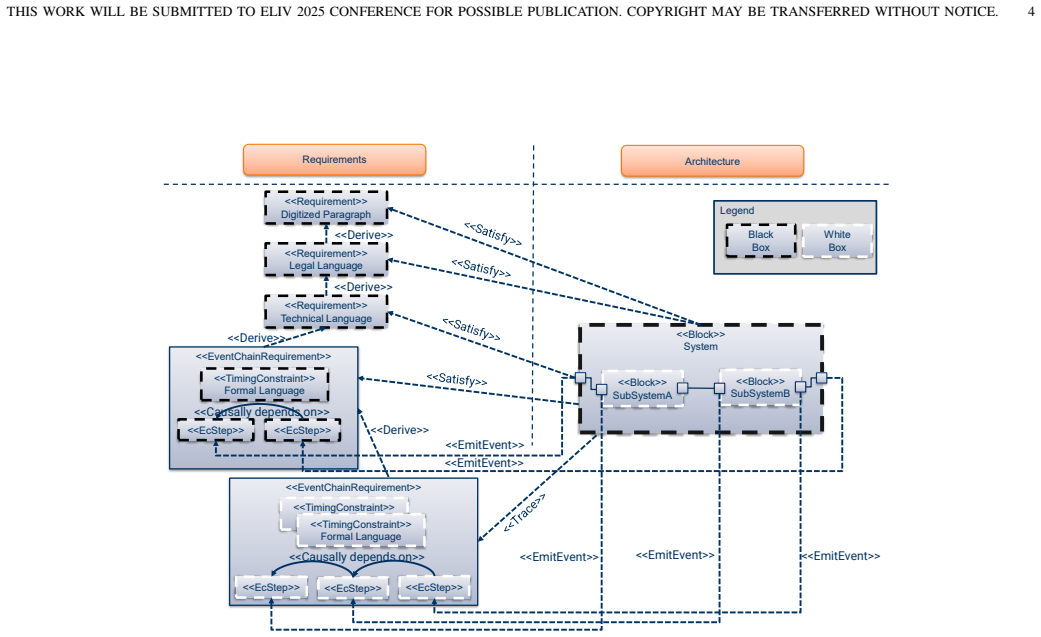
Event-Chain Modeling, a white-box technique that maps timing behavior across functional components to provide transparent analysis aligned with regulatory requirements.
If this is right
- Derivation of end-to-end timing constraints directly from the system architecture.
- Early verification of compliance through simulation rather than late-stage testing.
- Systematic optimization of parameters to meet timing bounds.
- Generation of quantitative evidence for regulatory dossiers via probabilistic methods.
- Integration with model-based safety analysis for ADS and ADAS.
Where Pith is reading between the lines
- Extending the method to dynamic environments could help address variable timing due to sensor noise or traffic conditions.
- Adoption might reduce development costs by catching timing faults early in the design cycle.
- This could connect to formal methods for proving timing properties in safety-critical software.
Load-bearing premise
A white-box event-chain model can be constructed and validated for complex real-world ADS architectures without prohibitive effort or loss of fidelity in capturing actual timing behavior.
What would settle it
A direct comparison showing that the event-chain model's predicted timing violations do not match those observed in physical vehicle tests for a specific ADS function would disprove the reliability of the early verification approach.
Figures


read the original abstract
Automated Driving Systems (ADS), including Advanced Driver Assistance Systems (ADAS), must fulfill not only high functional expectations but also stringent timing constraints mandated by international regulations and standards. Regulatory frameworks such as UN regulations, NCAP standards, ISO norms, and NHTSA guidelines impose strict bounds on system reaction times to ensure safe vehicle operation. This paper presents a structured, White-Box methodology based on Event-Chain Modeling to address these timing challenges. Unlike Black-Box approaches, Event-Chain Analysis offers transparent insights into the timing behavior of each functional component - from perception and planning to actuation and human interaction. This perspective is also aligned with multiple regulations, which require that homologation dossiers provide evidence that the chosen system architecture is suitable to ensure compliance with the specified requirements. Our methodology enables the derivation, modeling, and validation of end-to-end timing constraints at the architectural level and facilitates early verification through simulation. Through a detailed case study, we demonstrate how this Event-Chain-centric approach enhances regulatory compliance, optimizes system design, and supports model-based safety analysis techniques, with results showing early identification of compliance issues, systematic parameter optimization, and quantitative evidence generation through probabilistic analysis.
Editorial analysis
A structured set of objections, weighed in public.
Referee Report
Summary. The manuscript presents a white-box Event-Chain Modeling methodology for deriving, modeling, and validating end-to-end timing constraints in ADS and ADAS systems to ensure compliance with regulatory timing requirements. It highlights the advantages over black-box approaches by providing transparent insights into functional components' timing behaviors and includes a case study showing early compliance issue identification, parameter optimization, and probabilistic quantitative evidence generation.
Significance. If the results hold, this work could provide a practical framework for early verification of timing constraints in safety-critical automotive software systems, aiding in regulatory alignment and model-based safety analysis. The emphasis on architectural-level modeling and simulation-based verification is a positive contribution to the field of software engineering for autonomous systems.
major comments (2)
- Case Study: The case study illustrates the approach but reports no specific numerical data, error bounds, or direct validation against physical measurements or established benchmarks. This weakens the support for claims of quantitative evidence generation and early issue identification, as the effectiveness cannot be fully assessed without these metrics.
- Methodology: The assumption that a detailed white-box event-chain model can be built and validated for complex real-world ADS architectures without significant effort or loss of fidelity is not sufficiently addressed or demonstrated, which is critical for the methodology's claimed applicability.
Simulated Author's Rebuttal
We thank the referee for the detailed and constructive comments on our manuscript. We address each major comment point by point below, indicating where revisions will be made to strengthen the paper.
read point-by-point responses
-
Referee: Case Study: The case study illustrates the approach but reports no specific numerical data, error bounds, or direct validation against physical measurements or established benchmarks. This weakens the support for claims of quantitative evidence generation and early issue identification, as the effectiveness cannot be fully assessed without these metrics.
Authors: We acknowledge that the case study section presents the methodology through a representative example but does not include detailed numerical outputs such as specific timing values, error bounds from multiple runs, or comparisons to physical benchmarks. The probabilistic analysis is simulation-based and generates quantitative compliance probabilities, yet these are not reported with sufficient granularity in the current text. We will revise the case study to include concrete simulation results, including timing distributions, Monte Carlo-derived probabilities with confidence intervals, and explicit checks against regulatory thresholds. Direct validation against physical measurements lies outside the scope of this architectural modeling paper, which relies on component-level timing data from literature and standards; we will add a clarification on this limitation and note it as an avenue for future empirical work. revision: yes
-
Referee: Methodology: The assumption that a detailed white-box event-chain model can be built and validated for complex real-world ADS architectures without significant effort or loss of fidelity is not sufficiently addressed or demonstrated, which is critical for the methodology's claimed applicability.
Authors: We agree that the practical effort and potential fidelity trade-offs for scaling the white-box approach to full-scale ADS architectures require explicit discussion. The manuscript emphasizes modularity to allow incremental modeling of critical event chains rather than complete system reconstruction, and the case study applies this to a subsystem. However, we did not provide quantitative estimates of modeling effort or explicit fidelity validation steps. We will add a dedicated subsection on methodology applicability, covering incremental construction, use of measured or standardized component timings to preserve fidelity, and acknowledged limitations for highly complex systems. This will better substantiate the claims of broad applicability. revision: yes
Circularity Check
No significant circularity
full rationale
The paper presents a white-box event-chain modeling methodology for deriving and validating end-to-end timing constraints in ADS/ADAS architectures, supported by a case study that applies the approach to component-level chains with probabilistic analysis. No load-bearing step reduces to a self-definition, fitted input renamed as prediction, or self-citation chain; the central claims rest on the explicit construction and simulation of the model rather than on any result being equivalent to its inputs by construction. The derivation is self-contained as a structured modeling technique aligned with regulatory requirements.
Axiom & Free-Parameter Ledger
axioms (1)
- domain assumption White-box access to component timing behavior is feasible and sufficient to capture end-to-end constraints for regulatory purposes.
Lean theorems connected to this paper
-
IndisputableMonolith/Foundation/ArithmeticFromLogic.leanLogicNat recovery and embed_strictMono unclear?
unclearRelation between the paper passage and the cited Recognition theorem.
Event-Chain Engineering is a model-based approach for evaluating systems based on the sequences of discrete events... Timing requirements... are specified between individual Event-Chain Steps.
-
IndisputableMonolith/Cost/FunctionalEquation.leanwashburn_uniqueness_aczel and Jcost_pos_of_ne_one unclear?
unclearRelation between the paper passage and the cited Recognition theorem.
We use chronSIM for Monte Carlo simulation... probabilistic sensor model
What do these tags mean?
- matches
- The paper's claim is directly supported by a theorem in the formal canon.
- supports
- The theorem supports part of the paper's argument, but the paper may add assumptions or extra steps.
- extends
- The paper goes beyond the formal theorem; the theorem is a base layer rather than the whole result.
- uses
- The paper appears to rely on the theorem as machinery.
- contradicts
- The paper's claim conflicts with a theorem or certificate in the canon.
- unclear
- Pith found a possible connection, but the passage is too broad, indirect, or ambiguous to say the theorem truly supports the claim.
Forward citations
Cited by 1 Pith paper
-
Toward Automated Virtual Electronic Control Unit (ECU) Twins for Shift-Left Automotive Software Testing
Prototype automates creation of virtual ECU twins via agentic feedback-driven modeling in SystemC to enable early shift-left software testing in automotive development.
Reference graph
Works this paper leans on
-
[1]
Event- chain-focused development of system architectures makes complex systems manageable,
F. Mayer, F. Kraft, J. Apelt, R. Münzenberger, and C. Winkler, “Event- chain-focused development of system architectures makes complex systems manageable,” in21st International Congress and Exhibition - ELIV (Electronics in Vehicles). Bonn, Germany: VDI Wissensforum, 2023, author copy
work page 2023
-
[2]
Event-chain-centric architecture design of driver assistance systems,
F. Heckmann and R. Münzenberger, “Event-chain-centric architecture design of driver assistance systems,” inEmbedded Software Engineering Congress, 2021, author copy
work page 2021
-
[3]
Methodology for certification-compliant effect-chain modeling,
I. Gräßler, D. Wiechel, A.-S. Koch, T. Sturm, and T. Markfelder, “Methodology for certification-compliant effect-chain modeling,”Sys- tems, vol. 11, p. 154, 03 2023
work page 2023
-
[4]
Automotive regulatory guide – 2023,
ACEA, “Automotive regulatory guide – 2023,” https://www.acea.auto/ publication/automotive-regulatory-guide-2023/, accessed: 2025-08-31
work page 2023
-
[5]
Modeling, Analysis, and Control with Petri Nets,
M. Silva, “Modeling, Analysis, and Control with Petri Nets,” in Encyclopedia of Systems and Control, J. Baillieul and T. Samad, Eds. Cham: Springer International Publishing, 2021, pp. 1301–1311. [Online]. Available: https://doi.org/10.1007/978-3-030-44184-5_53
-
[6]
Object-oriented development in an industrial environment,
I. Jacobson, “Object-oriented development in an industrial environment,” SIGPLAN Not., vol. 22, no. 12, pp. 183–191, Dec. 1987. [Online]. Available: https://dl.acm.org/doi/10.1145/38807.38824
-
[7]
chronval: Worst-case timing analysis,
“chronval: Worst-case timing analysis,” https://www.inchron.com/ chronval/, INCHRON AG, 2025, professional model-based formal ver- ification tool for worst-case timing analysis and regulatory compliance verification in automotive systems
work page 2025
-
[8]
chronview: Trace visualization, analysis, and test,
“chronview: Trace visualization, analysis, and test,” https://www. inchron.com/chronview/, INCHRON AG, 2025, professional trace- analysis tool for visualization and statistical analysis of large hardware traces and regulatory compliance verification in automotive systems
work page 2025
-
[9]
chronsim: Event-chain simulation platform for automotive systems,
“chronsim: Event-chain simulation platform for automotive systems,” https://www.inchron.com/products/chromsim/, INCHRON AG, 2025, professional simulation tool for timing analysis and regulatory com- pliance verification in automotive systems
work page 2025
-
[10]
Bang Wang,Coverage control in sensor networks, 2010, vol. 15, no. 1
work page 2010
discussion (0)
Sign in with ORCID, Apple, or X to comment. Anyone can read and Pith papers without signing in.