Assessment of Simulation-based Inference Methods for Stochastic Compartmental Models in Epidemiological Research
Pith reviewed 2026-05-17 02:52 UTC · model grok-4.3
The pith
Likelihood-free Bayesian methods accurately estimate parameters in stochastic SIS, SIR and SEIR epidemic models from noisy data.
A machine-rendered reading of the paper's core claim, the machinery that carries it, and where it could break.
Core claim
Likelihood-free inference via particle-filter pseudo-marginal MCMC and conditional normalizing flows yields accurate and robust parameter estimates for stochastic compartmental models even when likelihoods are intractable, as shown by successful recovery of parameters in simulated SIS, SIR, and SEIR trajectories and by maintained performance on real epidemiological observations from an Ethiopian cohort subject to noise and irregular sampling.
What carries the argument
Pseudo-marginal particle Markov chain Monte Carlo using particle filters for unbiased likelihood estimates, together with conditional normalizing flows, applied to stochastic compartmental models equipped with observation models.
If this is right
- The methods support fast nowcasts and short-term forecasts that can inform control of epidemic outbreaks.
- They capture stochastic dynamics across classical SIS, SIR, and multi-variant SEIR models.
- Performance remains stable under real-world noise and irregular data sampling as seen in the Ethiopian cohort.
- Public release of code and synthetic datasets enables construction of reusable inference pipelines for public health applications.
Where Pith is reading between the lines
- The same workflow could be tested on models that add spatial structure or explicit intervention effects without changing the core inference machinery.
- Hybrid use of MCMC for calibration and normalizing flows for rapid sampling might further reduce computation time for ongoing surveillance.
- Results point toward replacing simplified deterministic models with stochastic ones in operational forecasting systems when data irregularities are present.
- Wider deployment could allow parameter tracking from limited or delayed reports during future outbreaks.
Load-bearing premise
The observation models and noise structures chosen for the simulation study adequately represent the irregularities and biases found in real epidemiological surveillance data.
What would settle it
Application of the same methods to additional real outbreak datasets with independently known transmission parameters that produces systematic bias or high uncertainty in recovered values would falsify the claim of operational robustness.
Figures
read the original abstract
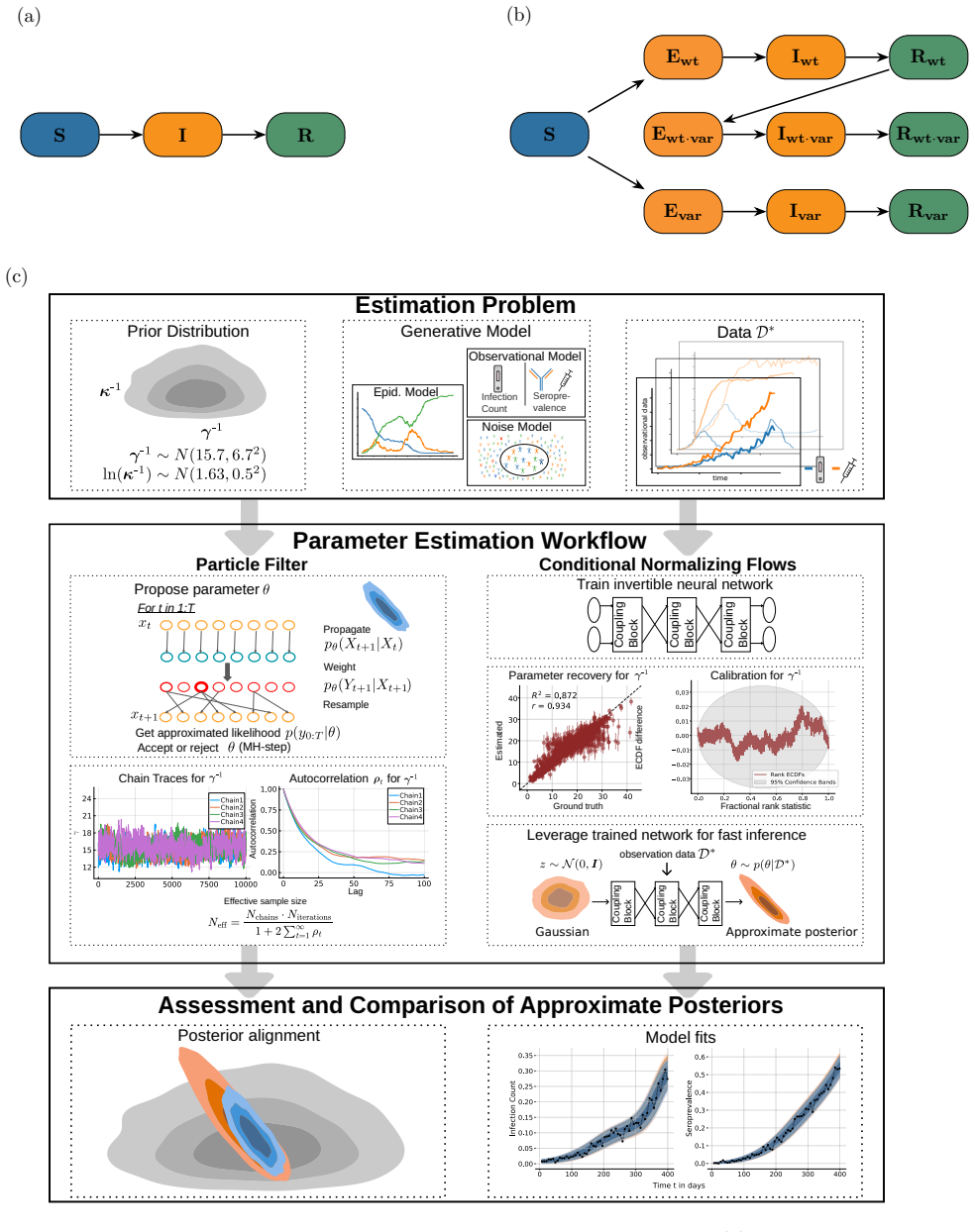
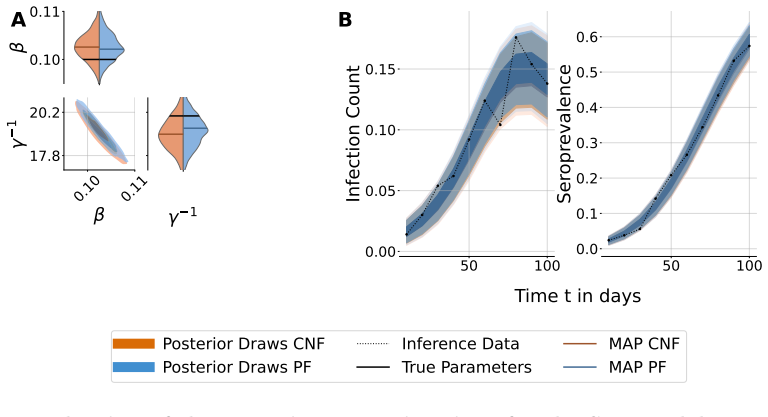
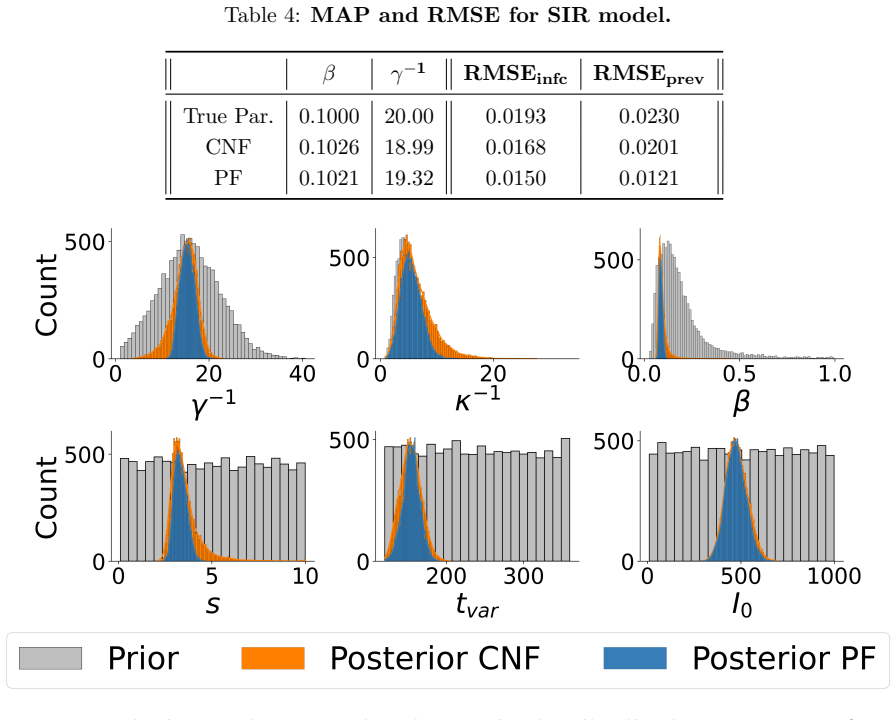
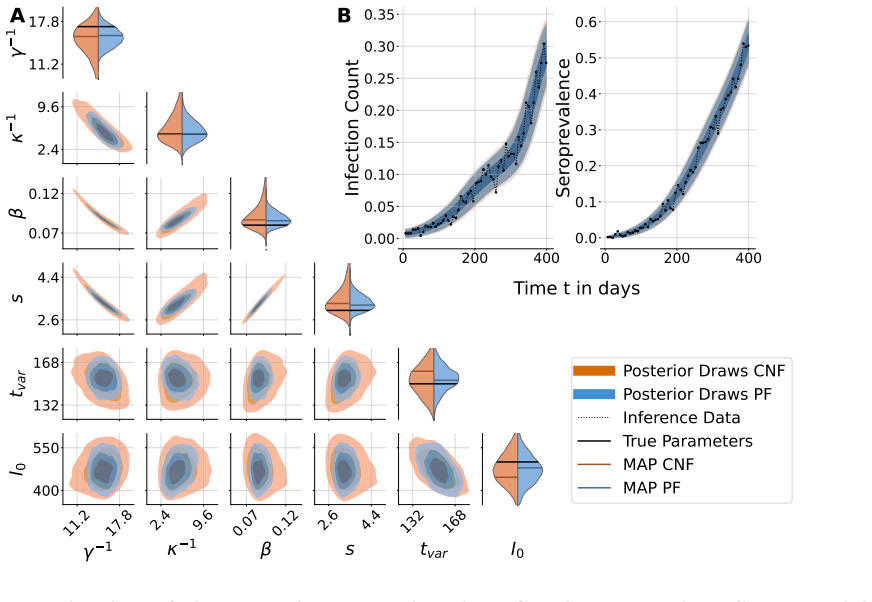
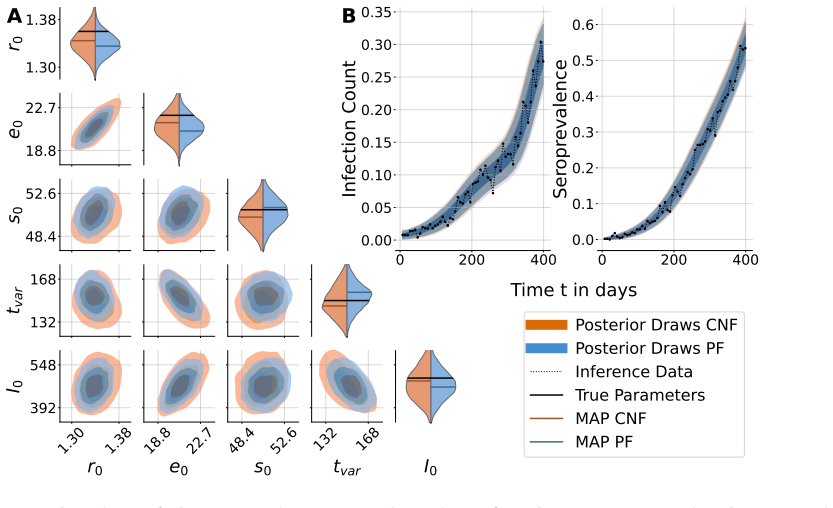
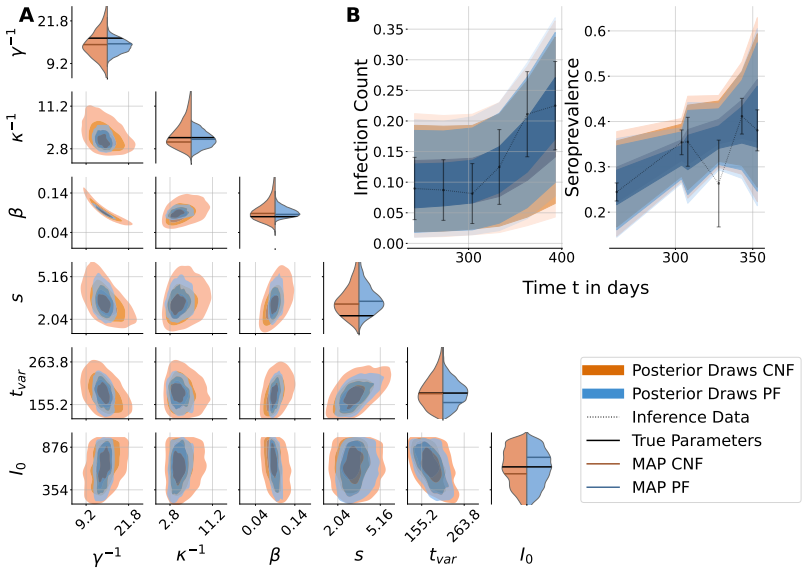
Global pandemics, such as the recent COVID-19 crisis, highlight the need for stochastic epidemic models that can capture the randomness inherent in the spread of disease. Such models must be accompanied by methods for estimating parameters in order to generate fast nowcasts and short-term forecasts that can inform public health decisions. This paper presents a comparison of two advanced Bayesian inference methods: 1) pseudo-marginal particle Markov chain Monte Carlo, using an unbiased likelihood estimate obtained by Particle Filter (PF), and 2) Conditional Normalizing Flows (CNF). We investigate their performance on three commonly used compartmental models: A classical Susceptible-Infected-Susceptible (SIS), a Susceptible-Infected-Recovered (SIR) model and a two-variant Susceptible-Exposed-Infected-Recovered (SEIR) model, complemented by an observation model that maps latent trajectories to empirical data. Addressing the challenges of intractable likelihoods for parameter inference in stochastic settings, our analysis highlights how these likelihood-free methods provide accurate and robust inference capabilities. The results of our simulation study further underscore the effectiveness of these approaches in capturing the stochastic dynamics of epidemics, providing prediction capabilities for the control of epidemic outbreaks. Results on an Ethiopian cohort study demonstrate operational robustness under real-world noise and irregular data sampling. To facilitate reuse and to enable building pipelines that ultimately contribute to better informed decision making in public health, we make code and synthetic datasets publicly available.
Editorial analysis
A structured set of objections, weighed in public.
Referee Report
Summary. The manuscript compares two likelihood-free Bayesian inference methods—pseudo-marginal particle Markov chain Monte Carlo (PF-PMCMC) using a particle filter and Conditional Normalizing Flows (CNF)—for parameter estimation in stochastic SIS, SIR, and two-variant SEIR compartmental models. An observation model maps latent states to data. Performance is assessed via simulation studies with known ground-truth parameters and via application to an Ethiopian cohort study; the authors conclude that both methods deliver accurate, robust inference and operational robustness under real-world noise and irregular sampling. Code and synthetic datasets are released publicly.
Significance. If the central claims hold, the work supplies a practical benchmark of two modern likelihood-free methods for stochastic epidemic models, directly supporting nowcasting and short-term forecasting in public-health settings. The public release of code and synthetic data is a clear strength that enables reuse and pipeline building.
major comments (1)
- [Abstract and Ethiopian-cohort results] Abstract and Ethiopian-cohort results section: the claim that the cohort results 'demonstrate operational robustness under real-world noise and irregular data sampling' is load-bearing for the paper’s central robustness conclusion. No sensitivity analysis is reported that perturbs the observation-model noise structure (e.g., time-varying underreporting or clustered missingness) and re-runs inference; without such a check, any mismatch between the assumed noise and actual surveillance irregularities directly undermines the robustness statement for real data that lack ground truth.
minor comments (1)
- Add quantitative diagnostics (e.g., posterior predictive p-values or discrepancy measures) comparing simulated versus observed data features in addition to the visual checks already presented.
Simulated Author's Rebuttal
We thank the referee for the constructive feedback. We address the major comment below and outline the revisions we will make.
read point-by-point responses
-
Referee: [Abstract and Ethiopian-cohort results] Abstract and Ethiopian-cohort results section: the claim that the cohort results 'demonstrate operational robustness under real-world noise and irregular data sampling' is load-bearing for the paper’s central robustness conclusion. No sensitivity analysis is reported that perturbs the observation-model noise structure (e.g., time-varying underreporting or clustered missingness) and re-runs inference; without such a check, any mismatch between the assumed noise and actual surveillance irregularities directly undermines the robustness statement for real data that lack ground truth.
Authors: We agree that the robustness claim for the Ethiopian cohort application is central and would be strengthened by explicit sensitivity checks on the observation model. Our simulation studies already vary observation noise levels and sampling irregularity to evaluate performance under controlled mismatches, but we did not re-run the real-data inference under perturbed noise structures such as time-varying underreporting or clustered missingness. We will add this sensitivity analysis to the revised manuscript, including results under alternative noise assumptions, to provide stronger support for the operational robustness statement. revision: yes
Circularity Check
No circularity in simulation-based assessment of inference methods
full rationale
The paper performs an empirical comparison of PF-PMCMC and CNF on SIS/SIR/SEIR models via simulation studies with known ground-truth parameters and applies the methods to an Ethiopian cohort dataset. Performance is evaluated using standard metrics such as parameter recovery accuracy and posterior predictive checks against external benchmarks (simulated trajectories and observed data features). These results are generated from independent simulation runs and real-data application rather than reducing to quantities defined by fitted parameters or self-referential definitions within the paper. The observation model is introduced as a separate component mapping latent states to data, with no evidence that predictions or robustness claims are equivalent to inputs by construction. The work is self-contained against external benchmarks and makes code and synthetic data available for verification.
Axiom & Free-Parameter Ledger
axioms (2)
- domain assumption Stochastic compartmental models generate trajectories whose likelihood is intractable under partial observations.
- standard math Particle filters produce unbiased estimates of the likelihood for use in pseudo-marginal MCMC.
Lean theorems connected to this paper
-
IndisputableMonolith/Cost/FunctionalEquation.leanwashburn_uniqueness_aczel unclear?
unclearRelation between the paper passage and the cited Recognition theorem.
We investigate their performance on three commonly used compartmental models: A classical Susceptible-Infected-Susceptible (SIS), a Susceptible-Infected-Recovered (SIR) model and a two-variant Susceptible-Exposed-Infected-Recovered (SEIR) model, complemented by an observation model that maps latent trajectories to empirical data.
-
IndisputableMonolith/Foundation/RealityFromDistinction.leanreality_from_one_distinction unclear?
unclearRelation between the paper passage and the cited Recognition theorem.
Results on an Ethiopian cohort study demonstrate operational robustness under real-world noise and irregular data sampling.
What do these tags mean?
- matches
- The paper's claim is directly supported by a theorem in the formal canon.
- supports
- The theorem supports part of the paper's argument, but the paper may add assumptions or extra steps.
- extends
- The paper goes beyond the formal theorem; the theorem is a base layer rather than the whole result.
- uses
- The paper appears to rely on the theorem as machinery.
- contradicts
- The paper's claim conflicts with a theorem or certificate in the canon.
- unclear
- Pith found a possible connection, but the passage is too broad, indirect, or ambiguous to say the theorem truly supports the claim.
discussion (0)
Sign in with ORCID, Apple, or X to comment. Anyone can read and Pith papers without signing in.