The broad-lined type Ic supernova 2020lao experienced an energetic explosion with no central-engine signatures
Pith reviewed 2026-05-17 02:37 UTC · model grok-4.3
The pith
SN 2020lao reached specific kinetic energy typical of engine-driven supernovae yet showed no central-engine signatures.
A machine-rendered reading of the paper's core claim, the machinery that carries it, and where it could break.
Core claim
SN 2020lao is a SN Ic-BL whose spectra and light curves imply a specific kinetic energy of 5 to 7 times 10 to the 51st erg per solar mass, comparable to engine-driven events, yet it exhibits no optical afterglow and no radio or X-ray emission. The progenitor radius is tightly limited to less than a few solar radii by the absence of shock-cooling emission. Given the high energetics, the non-detections indicate that any launched relativistic jet was either viewed far off axis or choked inside the star; if no jet formed, SN 2020lao is simply an extreme nonrelativistic Ic-BL.
What carries the argument
Arnett-type fits to the bolometric light curve combined with Fe II velocity measurements to derive nickel mass, ejecta mass, and kinetic energy, set against the absence of afterglow in optical, radio, and X-ray data.
If this is right
- The progenitor was a compact Wolf-Rayet-like star with radius less than a few solar radii.
- Any relativistic jet, if launched, produced no detectable afterglow, consistent with either an off-axis view or a choked jet.
- SN 2020lao synthesized a similar nickel mass to SN 2006aj but reached five to ten times higher specific kinetic energy.
- Limits are set on the presence of relativistic ejecta and dense circumstellar material around the explosion site.
Where Pith is reading between the lines
- High specific kinetic energy in broad-lined type Ic supernovae does not by itself require a successful central engine or relativistic jet.
- A larger sample of early-observed Ic-BL events could reveal how often jets form but fail to break out.
- Refined three-dimensional explosion models might reduce uncertainties in the derived kinetic energies for events like this one.
Load-bearing premise
That Arnett-model fits to the light curve and Fe II velocities give accurate ejecta mass and kinetic energy without large systematic errors from asphericity or mixing.
What would settle it
Deeper radio or X-ray observations that detect emission above the current upper limits would indicate relativistic ejecta or dense circumstellar material and thereby challenge the conclusion that no central-engine signatures are present.
Figures






read the original abstract
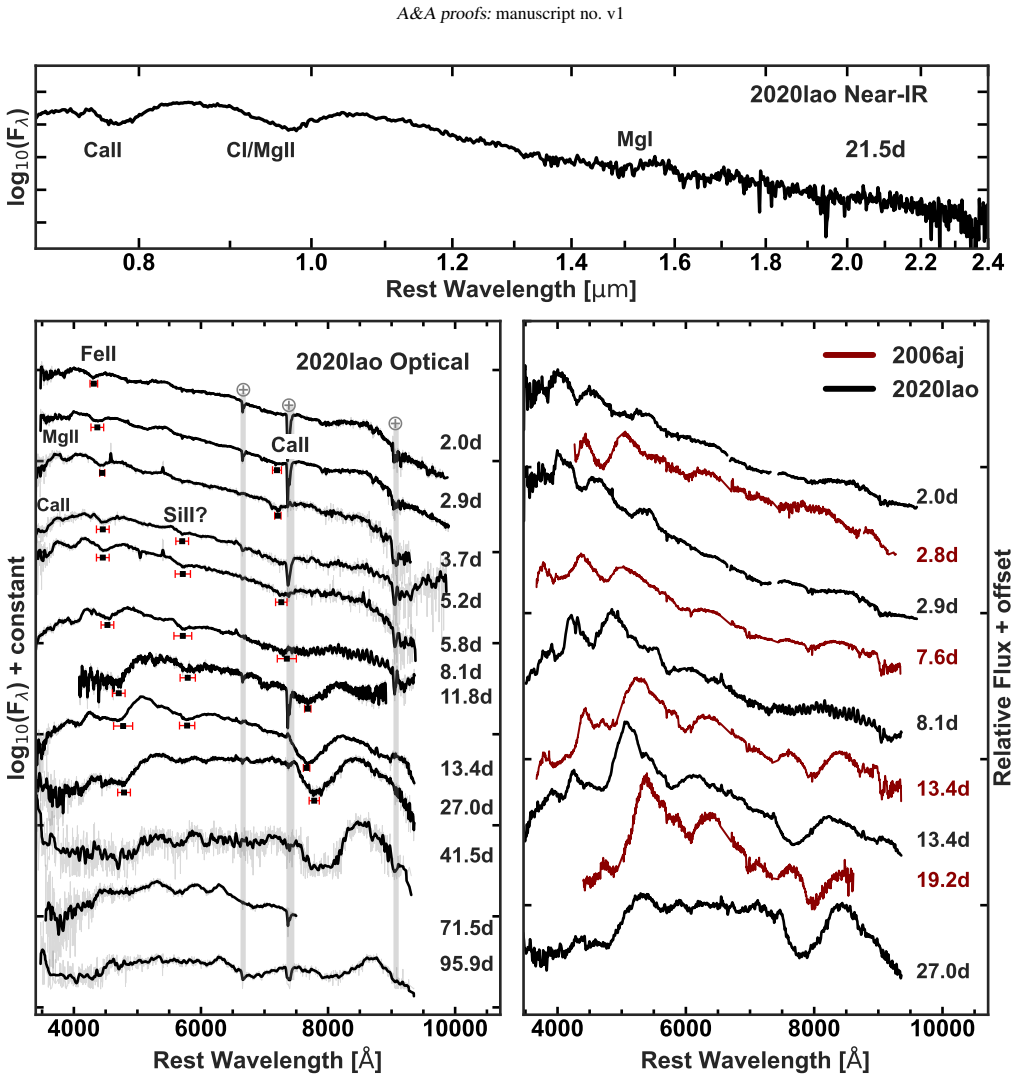
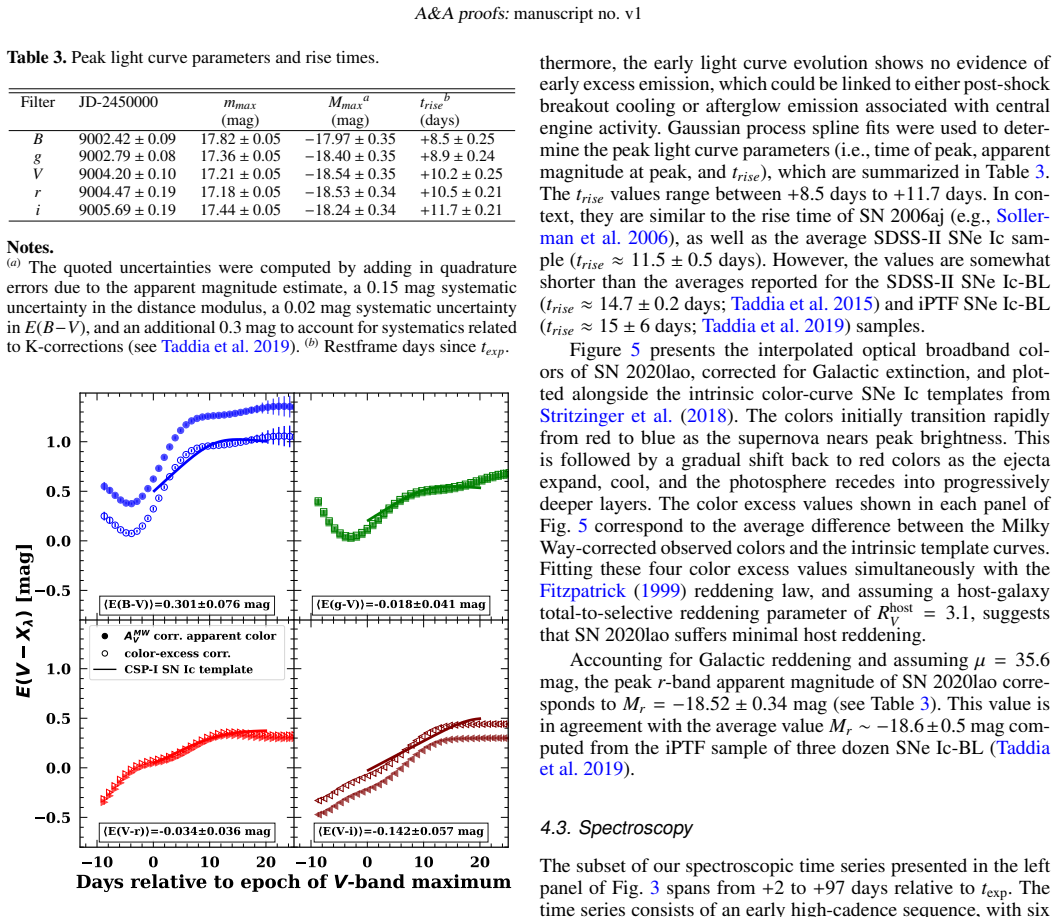
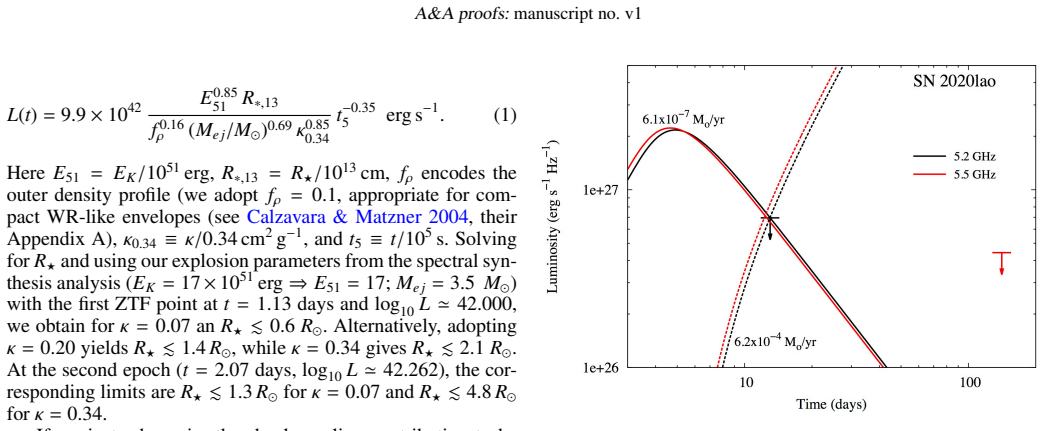
We present infant-phase observations of the SN Ic-BL 2020lao, including optical spectroscopy beginning 48 hrs after explosion. The explosion time was constrained by power-law fits to the rising TESS and ZTF light curves, with the first ZTF detection occurring 27 hrs after explosion. The optical light curves show a rapid rise lasting 8.8 days and a peak luminosity typical of SNe Ic-BL (Mr=-18.5 mag). Unlike some engine-driven SN Ic-BL events, the light curve of SN 2020lao shows no evidence of an optical afterglow or excess emission, and the absence of shock-cooling in the TESS and ZTF data constrains the progenitor to a Wolf-Rayet-like star with radius less than a few times the solar radius, ruling out any extended envelope. The spectra resemble those of the X-ray-flash-associated SN 2006aj but with higher expansion velocities. From Arnett-type fits to the bolometric light curve and measured FeII velocities, we infer a Ni mass of 0.2 solar masses, an ejecta mass of 3.2 solar masses, and a kinetic energy of about 23x10^51 erg, corresponding to a specific kinetic energy of 7x10^51 erg per solar mass. Spectral synthesis modeling broadly reproduces the photospheric spectra of SN 2020lao and suggests a specific kinetic energy of 5x10^51 erg per solar mass. SN 2020lao and SN 2006aj synthesized comparable amounts of Ni, yet SN 2020lao exhibits specific kinetic energy values 5-10 times larger. VLA and Swift/XRT non-detections reveal no afterglow emission, allowing limits on relativistic ejecta and dense circumstellar material. Given that SN 2020lao reaches a specific kinetic energy typical of engine-driven SNe Ic-BL, the lack of an optical excess with the non-detections in the radio and X-ray bands suggests that if a relativistic jet was launched, it was either viewed far off axis or choked before breakout. If there was no relativistic jet, SN 2020lao would be an extreme nonrelativistic SN Ic-BL.
Editorial analysis
A structured set of objections, weighed in public.
Referee Report
Summary. The paper presents early-time observations of the broad-lined Type Ic supernova SN 2020lao using TESS, ZTF photometry, and spectroscopy starting ~48 hours after explosion. Explosion time is tightly constrained via power-law fits to the rising light curves. The event shows a rapid rise to a typical Ic-BL peak luminosity with no optical excess or afterglow, no shock-cooling signature (implying a compact Wolf-Rayet progenitor), and spectra similar to SN 2006aj but with higher velocities. Arnett-type modeling of the bolometric light curve combined with Fe II velocities yields M_Ni ≈ 0.2 M⊙, M_ej ≈ 3.2 M⊙, and E_kin ≈ 23 × 10^51 erg (specific KE ~7 × 10^51 erg M⊙^{-1}); spectral synthesis suggests ~5 × 10^51 erg M⊙^{-1}. Radio and X-ray non-detections are used to argue that any relativistic jet was viewed far off-axis or choked, or that the event is an extreme non-relativistic Ic-BL.
Significance. If the high specific kinetic energy holds after accounting for modeling systematics, the result is significant for understanding the diversity of engine-driven versus non-engine Ic-BL events: it demonstrates that energetic explosions can occur without detectable central-engine signatures in optical or high-energy bands. Credit is due for the precise explosion-time constraint from TESS/ZTF data and the multi-wavelength limits on relativistic ejecta and CSM.
major comments (1)
- [physical parameters derivation and spectral synthesis sections] The central claim that SN 2020lao reaches specific kinetic energies typical of engine-driven Ic-BL events rests on the Arnett-type fits and Fe II λ5169 velocity measurements (described in the physical parameters and spectral synthesis sections). These assume spherical symmetry, constant opacity, central 56Ni deposition, and that the Fe II absorption minimum traces the photospheric velocity for E_kin = ½ M_ej v_ph^2. In aspherical or mixed Ic-BL ejecta, viewing-angle effects and decoupling of Fe II from the true photosphere can systematically inflate the inferred specific KE; if the true value falls below ~3–4 × 10^51 erg M⊙^{-1}, the premise for the off-axis/choked-jet interpretation is weakened. The manuscript should quantify these systematics or test with alternative (e.g., aspherical) models.
minor comments (2)
- [abstract and results sections] In the abstract and main text, the kinetic energy is given as 'about 23x10^51 erg'; this should be formatted consistently as 23 × 10^51 erg for clarity and to avoid ambiguity with scientific notation.
- [light-curve analysis section] The bolometric light-curve construction method (filter integration or SED fitting) and any assumed opacity value should be stated explicitly with references, as these enter directly into the Arnett parameters.
Simulated Author's Rebuttal
We thank the referee for their careful and constructive review of our manuscript on SN 2020lao. The feedback on the physical parameter estimates is particularly helpful, and we have revised the text to better address potential modeling systematics while preserving the core observational results.
read point-by-point responses
-
Referee: [physical parameters derivation and spectral synthesis sections] The central claim that SN 2020lao reaches specific kinetic energies typical of engine-driven Ic-BL events rests on the Arnett-type fits and Fe II λ5169 velocity measurements (described in the physical parameters and spectral synthesis sections). These assume spherical symmetry, constant opacity, central 56Ni deposition, and that the Fe II absorption minimum traces the photospheric velocity for E_kin = ½ M_ej v_ph^2. In aspherical or mixed Ic-BL ejecta, viewing-angle effects and decoupling of Fe II from the true photosphere can systematically inflate the inferred specific KE; if the true value falls below ~3–4 × 10^51 erg M⊙^{-1}, the premise for the off-axis/choked-jet interpretation is weakened. The manuscript should quantify these systematics or test with alternative (e.g., aspherical) models.
Authors: We agree that the Arnett model and Fe II velocity measurements rely on standard assumptions of spherical symmetry, constant opacity, and central nickel deposition, and that asphericity or viewing-angle effects in Ic-BL events could introduce systematic uncertainties in the derived specific kinetic energy. Our spectral synthesis modeling, however, provides an independent constraint yielding ~5 × 10^51 erg M⊙^{-1}, in good agreement with the Arnett-derived value of ~7 × 10^51 erg M⊙^{-1}. This consistency across methods supports the robustness of the result. We have added a dedicated paragraph in the revised Physical Parameters section discussing these limitations, including references to 3D explosion simulations that explore viewing-angle biases in Fe II velocities. Even allowing for a factor-of-two reduction due to such effects, the specific KE remains among the highest for non-relativistic Ic-BL events. Full aspherical radiative-transfer modeling lies beyond the scope of this primarily observational study. revision: partial
Circularity Check
No significant circularity; kinetic energy derived from standard fits to observed data
full rationale
The paper's central derivation infers Ni mass, ejecta mass, and kinetic energy directly from Arnett-type modeling of the bolometric light curve combined with measured Fe II velocities, plus separate spectral synthesis modeling that reproduces the observed spectra. These steps apply established external formalisms to the new photometry and spectroscopy for SN 2020lao; the resulting specific KE value is then compared to literature values for other Ic-BL events. No step renames a fitted parameter as a prediction, invokes a self-citation as a uniqueness theorem, or reduces the conclusion to an input by construction. The off-axis/choked-jet interpretation follows from the derived KE being high while radio/X-ray limits show no afterglow, using independent observational constraints. The analysis remains self-contained against external benchmarks.
Axiom & Free-Parameter Ledger
free parameters (3)
- Ni mass
- Ejecta mass
- Kinetic energy
axioms (2)
- domain assumption Arnett model assumptions hold for this event (homologous expansion, constant opacity, central energy deposition)
- domain assumption Fe II absorption minimum traces the photospheric velocity
Lean theorems connected to this paper
-
IndisputableMonolith/Foundation/RealityFromDistinction.leanreality_from_one_distinction unclear?
unclearRelation between the paper passage and the cited Recognition theorem.
From Arnett-type fits to the bolometric light curve and measured FeII velocities, we infer a Ni mass of 0.2 solar masses, an ejecta mass of 3.2 solar masses, and a kinetic energy of about 23x10^51 erg, corresponding to a specific kinetic energy of 7x10^51 erg per solar mass.
-
IndisputableMonolith/Cost/FunctionalEquation.leanwashburn_uniqueness_aczel unclear?
unclearRelation between the paper passage and the cited Recognition theorem.
Spectral synthesis modeling broadly reproduces the photospheric spectra of SN 2020lao and suggests a specific kinetic energy of 5x10^51 erg per solar mass.
What do these tags mean?
- matches
- The paper's claim is directly supported by a theorem in the formal canon.
- supports
- The theorem supports part of the paper's argument, but the paper may add assumptions or extra steps.
- extends
- The paper goes beyond the formal theorem; the theorem is a base layer rather than the whole result.
- uses
- The paper appears to rely on the theorem as machinery.
- contradicts
- The paper's claim conflicts with a theorem or certificate in the canon.
- unclear
- Pith found a possible connection, but the passage is too broad, indirect, or ambiguous to say the theorem truly supports the claim.
Reference graph
Works this paper leans on
- [1]
- [2]
-
[3]
Arnett, W. D. 1982, ApJ, 253, 785
work page 1982
- [4]
-
[5]
Ashall, C., Mazzali, P. A., Pian, E., et al. 2019, MNRAS, 487, 5824 Astropy Collaboration, Price-Whelan, A. M., Sip˝ocz, B. M., et al. 2018, AJ, 156, 123
work page 2019
-
[6]
Bellm, E. C., Kulkarni, S. R., Graham, M. J., et al. 2019, PASP, 131, 018002
work page 2019
- [7]
-
[8]
F., Bartel, N., Argo, M., et al
Bietenholz, M. F., Bartel, N., Argo, M., et al. 2021, ApJ, 908, 75
work page 2021
-
[9]
2020, astropy/photutils: 1.0.0
Bradley, L., Sip˝ocz, B., Robitaille, T., et al. 2020, astropy/photutils: 1.0.0
work page 2020
- [10]
- [11]
-
[12]
Calzavara, A. J. & Matzner, C. D. 2004, MNRAS, 351, 694
work page 2004
- [13]
- [14]
-
[15]
Chambers, K. C., Magnier, E. A., Metcalfe, N., et al. 2016, arXiv e-prints, arXiv:1612.05560
work page internal anchor Pith review Pith/arXiv arXiv 2016
-
[16]
Chevalier, R. A. & Fransson, C. 2006, ApJ, 651, 381
work page 2006
-
[17]
Chevalier, R. A. & Fransson, C. 2017, in Handbook of Supernovae, ed. A. W. Alsabti & P. Murdin, 875
work page 2017
-
[18]
Chugai, N. N. 2000, Astronomy Letters, 26, 797
work page 2000
-
[19]
B., Covarrubias, R., & Candia, P
Clocchiatti, A., Suntzeff, N. B., Covarrubias, R., & Candia, P. 2011, AJ, 141, 163
work page 2011
-
[20]
Corsi, A., Ho, A. Y . Q., Cenko, S. B., et al. 2023, ApJ, 953, 179
work page 2023
- [21]
-
[22]
Drout, M. R., Soderberg, A. M., Gal-Yam, A., et al. 2011, ApJ, 741, 97
work page 2011
-
[23]
Dwarkadas, V . V . 2025, Universe, 11, 161
work page 2025
- [24]
-
[25]
Finneran, G., Cotter, L., & Martin-Carrillo, A. 2025, A&A, 700, A200
work page 2025
-
[26]
Fitzpatrick, E. L. 1999, PASP, 111, 63
work page 1999
-
[27]
Forster, F., Bauer, F. E., Galbany, L., et al. 2020, Transient Name Server Discov- ery Report, 2020-1550, 1
work page 2020
- [28]
-
[29]
Galama, T. J., Vreeswijk, P. M., van Paradijs, J., et al. 1998, Nature, 395, 670
work page 1998
-
[30]
Galbany, L., Gutiérrez, C. P., Piscarreta, L., et al. 2025, J. Cosmology Astropart. Phys., 2025, 053
work page 2025
- [31]
-
[32]
Harris, C. E., Sarbadhicary, S. K., Chomiuk, L., et al. 2023, ApJ, 952, 24
work page 2023
-
[33]
Ho, A. Y . Q., Kulkarni, S. R., Perley, D. A., et al. 2020, ApJ, 902, 86
work page 2020
-
[34]
Hsiao, E. Y ., Phillips, M. M., Marion, G. H., et al. 2019, PASP, 131, 014002
work page 2019
-
[35]
Irwin, C. M., Nakar, E., & Piran, T. 2019, MNRAS, 489, 2844
work page 2019
- [36]
-
[37]
Izzo, L., de Ugarte Postigo, A., Maeda, K., et al. 2019, Nature, 565, 324
work page 2019
-
[38]
D., Leja, J., Conroy, C., & Speagle, J
Johnson, B. D., Leja, J., Conroy, C., & Speagle, J. S. 2021, ApJS, 254, 22
work page 2021
-
[39]
Jones, D. O., McGill, P., Manning, T. A., et al. 2024, arXiv e-prints, arXiv:2410.17322
-
[40]
A., Klose, S., Zhang, B., et al
Kann, D. A., Klose, S., Zhang, B., et al. 2011, ApJ, 734, 96
work page 2011
- [41]
-
[42]
Kulkarni, S. R., Frail, D. A., Wieringa, M. H., et al. 1998, Nature, 395, 663
work page 1998
-
[43]
Lazzati, D., Morsony, B. J., Blackwell, C. H., & Begelman, M. C. 2012, Astro- physical Journal, 750, 68
work page 2012
-
[44]
Leja, J., Carnall, A. C., Johnson, B. D., Conroy, C., & Speagle, J. S. 2019, ApJ, 876, 3
work page 2019
-
[45]
Lucy, L. B. 1999, A&A, 345, 211
work page 1999
- [46]
-
[47]
Lyman, J. D., Bersier, D., James, P. A., et al. 2016, MNRAS, 457, 328
work page 2016
-
[48]
MacFadyen, A. I. & Woosley, S. E. 1999, ApJ, 524, 262
work page 1999
- [49]
-
[50]
Margutti, R., Soderberg, A. M., Chomiuk, L., et al. 2012, ApJ, 751, 134
work page 2012
- [51]
-
[52]
Masci, F. J., Laher, R. R., Rusholme, B., et al. 2019, PASP, 131, 018003
work page 2019
- [53]
-
[54]
Mazzali, P. A. 2000, A&A, 363, 705
work page 2000
-
[55]
A., Deng, J., Nomoto, K., et al
Mazzali, P. A., Deng, J., Nomoto, K., et al. 2006, Nature, 442, 1018
work page 2006
-
[56]
Mazzali, P. A., Kawabata, K. S., Maeda, K., et al. 2005, Science, 308, 1284
work page 2005
-
[57]
Mazzali, P. A. & Lucy, L. B. 1993, A&A, 279, 447
work page 1993
-
[58]
Mazzali, P. A., McFadyen, A. I., Woosley, S. E., Pian, E., & Tanaka, M. 2014, MNRAS, 443, 67
work page 2014
- [59]
-
[60]
D., Margalit, B., Kasen, D., & Quataert, E
Metzger, B. D., Margalit, B., Kasen, D., & Quataert, E. 2015, Monthly Notices of the Royal Astronomical Society, 454, 3311
work page 2015
-
[61]
Modjaz, M., Gutiérrez, C. P., & Arcavi, I. 2019, Nature Astronomy, 3, 717
work page 2019
-
[62]
Modjaz, M., Liu, Y . Q., Bianco, F. B., & Graur, O. 2016, The Astrophysical Journal, 832, 108
work page 2016
-
[63]
Mould, J. R., Huchra, J. P., Freedman, W. L., et al. 2000, ApJ, 529, 786
work page 2000
- [64]
-
[65]
2018, Research Notes of the American Astronomical Society, 2, 230
Nicholl, M. 2018, Research Notes of the American Astronomical Society, 2, 230
work page 2018
-
[66]
Patat, F., Cappellaro, E., Danziger, J., et al. 2001, ApJ, 555, 900
work page 2001
-
[67]
Pian, E., Mazzali, P. A., Masetti, N., et al. 2006, Nature, 442, 1011
work page 2006
-
[68]
Piran, T., Nakar, E., Mazzali, P., & Pian, E. 2019, ApJ, 871, L25
work page 2019
-
[69]
Piro, A. L. & Morozova, V . S. 2019, Astrophysical Journal Letters, 871, L25
work page 2019
-
[70]
Piro, A. L. & Nakar, E. 2013, ApJ, 769, 67
work page 2013
-
[71]
Prentice, S. J. & Mazzali, P. A. 2017, MNRAS, 469, 2672
work page 2017
-
[72]
Prentice, S. J., Mazzali, P. A., Pian, E., et al. 2016, MNRAS, 458, 2973
work page 2016
- [73]
-
[74]
Ramirez-Ruiz, E., Celotti, A., & Rees, M. J. 2002, Monthly Notices of the Royal Astronomical Society, 337, 1349
work page 2002
-
[75]
Rayner, J. T., Toomey, D. W., Onaka, P. M., et al. 2003, PASP, 115, 362
work page 2003
-
[76]
Riess, A. G., Yuan, W., Macri, L. M., et al. 2022, ApJ, 934, L7
work page 2022
-
[77]
Schlafly, E. F. & Finkbeiner, D. P. 2011, ApJ, 737, 103
work page 2011
-
[78]
Shahbandeh, M., Hsiao, E. Y ., Ashall, C., et al. 2022, ApJ, 925, 175
work page 2022
-
[79]
Shingles, L., Smith, K. W., Young, D. R., et al. 2021, Transient Name Server AstroNote, 7, 1
work page 2021
-
[80]
Skrutskie, M. F., Cutri, R. M., Stiening, R., et al. 2006, AJ, 131, 1163
work page 2006
discussion (0)
Sign in with ORCID, Apple, or X to comment. Anyone can read and Pith papers without signing in.