SkipKV: Selective Skipping of KV Generation and Storage for Efficient Inference with Large Reasoning Models
Pith reviewed 2026-05-16 23:49 UTC · model grok-4.3
The pith
SkipKV reduces KV cache overhead in large reasoning models by evicting similar sentences at inference time while steering toward shorter outputs.
A machine-rendered reading of the paper's core claim, the machinery that carries it, and where it could break.
Core claim
SkipKV is a training-free KV compression technique that scores sentences for similarity, removes redundant ones to shrink the cache, and applies a steering vector to hidden activations so the model produces concise chain-of-thought reasoning without losing correctness on downstream tasks.
What carries the argument
Sentence-scoring metric that flags highly similar sentences for eviction, together with a dynamic steering vector that updates hidden states to suppress redundant generation.
If this is right
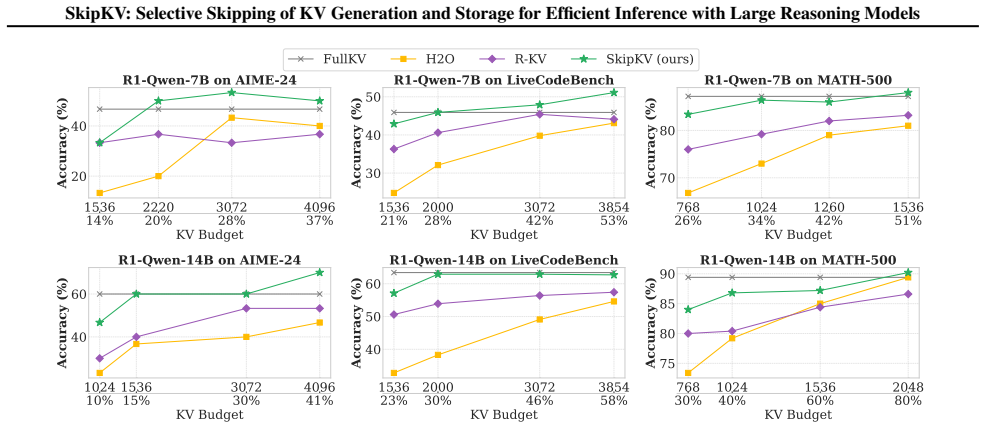
- Accuracy stays higher than token-level eviction baselines at identical compression ratios.
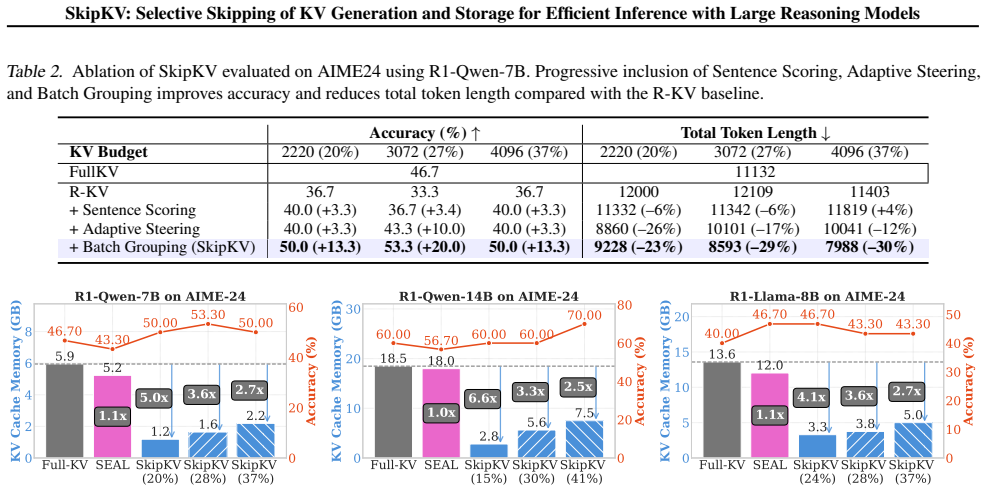
- Output sequences become up to 1.6 times shorter than those from state-of-the-art methods.
- Inference throughput rises by up to 1.7 times.
- Multi-batch inference remains stable, unlike padding-sensitive token-wise approaches.
Where Pith is reading between the lines
- The same sentence-level logic could be tested on long-context summarization or code-generation tasks.
- Shorter generations would directly cut energy use in large-scale deployment.
- Combining the eviction rule with quantization could produce additive savings without new training.
Load-bearing premise
Sentence-level similarity can be trusted to mark content whose removal leaves the reasoning chain and final answer intact.
What would settle it
A side-by-side run on any reasoning benchmark in which SkipKV removes similar sentences yet produces a different and incorrect final answer compared with the unpruned model.
Figures







read the original abstract
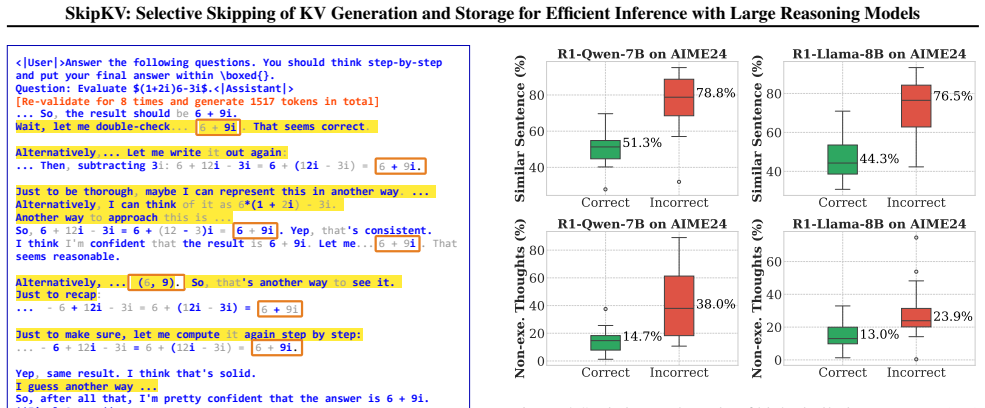
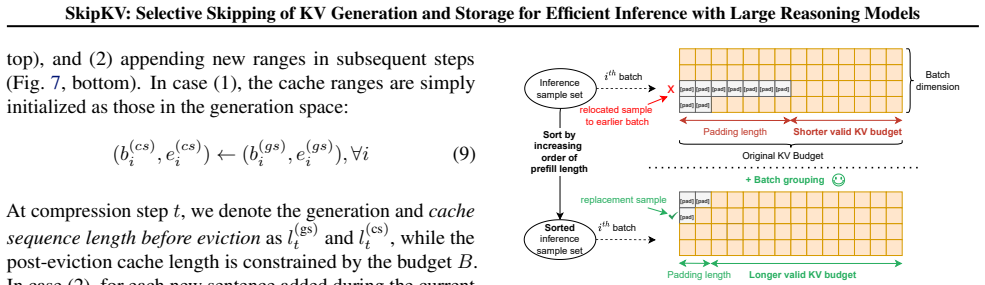
Large reasoning models (LRMs) often incur significant key-value (KV) cache overhead, due to their linear growth with the verbose chain-of-thought (CoT) reasoning. This incurs both memory overhead and throughput bottlenecks, limiting efficient deployment. To reduce KV cache size during inference, we first investigate the effectiveness of existing KV cache eviction methods for CoT reasoning. Interestingly, we find that due to unstable token-wise scoring and reduced effective KV budget caused by padding, state-of-the-art (SoTA) eviction methods fail to maintain accuracy in multi-batch settings. Additionally, these methods often generate longer sequences than the original model without eviction, as semantic-unaware token-wise eviction leads to repeated revalidation during reasoning. To address these issues, we present \textbf{SkipKV}, a \textbf{\textit{training-free}} KV compression method that performs selective \textit{eviction} and \textit{generation}, operating at a coarse-grained, sentence-level sequence removal for efficient CoT reasoning. In specific, it introduces a \textit{sentence-scoring metric} to identify and remove highly similar sentences while maintaining semantic coherence. To suppress redundant generation, SkipKV dynamically adjusts a steering vector to update the hidden activation states during inference, enforcing the LRM to generate concise responses. Extensive evaluations on multiple reasoning benchmarks demonstrate that SkipKV achieves up to $\mathbf{26.7}\%$ higher accuracy compared to baseline methods, at a similar compression budget. Additionally, compared to SoTA, SkipKV yields up to $\mathbf{1.6}\times$ shorter generation length while improving throughput by up to $\mathbf{1.7}\times$. Our code is released at: \href{https://github.com/TTTTTTris/SkipKV}{https://github.com/TTTTTTris/SkipKV}.
Editorial analysis
A structured set of objections, weighed in public.
Referee Report
Summary. The paper proposes SkipKV, a training-free KV cache compression method for large reasoning models that performs selective sentence-level eviction of highly similar sentences via a sentence-scoring metric and dynamically adjusts a steering vector during inference to suppress redundant generation. It reports up to 26.7% higher accuracy than baselines at comparable compression budgets, up to 1.6× shorter generation lengths, and up to 1.7× higher throughput across multiple reasoning benchmarks.
Significance. If the results hold under scrutiny, SkipKV would offer a practical advance for deploying verbose chain-of-thought models by addressing KV cache growth without retraining. The combination of maintained or improved accuracy with reduced length and higher throughput is notable, as most eviction techniques incur accuracy penalties; the open-sourced code further strengthens potential impact for efficient LRM inference.
major comments (3)
- [Abstract] Abstract and method description: the sentence-scoring metric used for eviction is introduced only at high level with no equation, pseudocode, or explicit similarity computation (e.g., embedding model or cosine threshold formula), which is load-bearing for verifying whether evicted sentences are truly redundant versus critical CoT steps.
- [§3] §3 (steering vector adjustment): the update rule and magnitude selection for the steering vector are described qualitatively without a concrete equation or sensitivity analysis, leaving open whether the reported gains depend on post-hoc tuning of the free parameters (sentence similarity threshold and steering vector magnitude) rather than being robustly training-free.
- [Evaluation] Evaluation section: no per-task accuracy breakdown, threshold sensitivity curves, or analysis of evicted sentences is provided to confirm that similarity-based removal preserves semantic coherence and final-answer correctness, undermining the central claim that the method avoids introducing new reasoning errors.
minor comments (2)
- [Abstract] The abstract lists concrete gains but omits the specific benchmarks and model sizes used; adding these would improve clarity.
- [Figures/Tables] Figure captions and tables could more explicitly state the compression budget and batch size settings to allow direct comparison with the SoTA baselines mentioned.
Simulated Author's Rebuttal
We thank the referee for the detailed and constructive feedback. We address each major comment below and have prepared revisions to improve the clarity and completeness of the manuscript.
read point-by-point responses
-
Referee: [Abstract] Abstract and method description: the sentence-scoring metric used for eviction is introduced only at high level with no equation, pseudocode, or explicit similarity computation (e.g., embedding model or cosine threshold formula), which is load-bearing for verifying whether evicted sentences are truly redundant versus critical CoT steps.
Authors: We agree the description was insufficiently precise. In the revised manuscript we will add the explicit sentence-scoring equation (average cosine similarity of Sentence-BERT embeddings), the fixed similarity threshold, and pseudocode for the eviction step. These additions will make it straightforward to verify that only redundant sentences are removed. revision: yes
-
Referee: [§3] §3 (steering vector adjustment): the update rule and magnitude selection for the steering vector are described qualitatively without a concrete equation or sensitivity analysis, leaving open whether the reported gains depend on post-hoc tuning of the free parameters (sentence similarity threshold and steering vector magnitude) rather than being robustly training-free.
Authors: We will insert the exact update rule equation for the steering vector (additive adjustment to hidden states). The magnitude is a single fixed hyper-parameter chosen once on a small held-out validation set and held constant across all experiments; no per-task or per-instance tuning occurs. We will also add a sensitivity plot over a range of magnitudes and thresholds to demonstrate robustness. revision: partial
-
Referee: [Evaluation] Evaluation section: no per-task accuracy breakdown, threshold sensitivity curves, or analysis of evicted sentences is provided to confirm that similarity-based removal preserves semantic coherence and final-answer correctness, undermining the central claim that the method avoids introducing new reasoning errors.
Authors: We will expand the evaluation section with per-task accuracy tables, threshold sensitivity curves, and qualitative examples of evicted sentences together with the corresponding final-answer correctness. These additions directly support the claim that semantic coherence and answer accuracy are preserved. revision: yes
Circularity Check
No circularity; training-free method with external benchmarks
full rationale
The paper presents SkipKV as a training-free approach using sentence-level similarity scoring for KV eviction and a steering vector for concise generation. No equations, parameters, or claims reduce the reported accuracy gains, length reductions, or throughput improvements to quantities fitted inside the same experiments or to self-referential definitions. Evaluations rely on external reasoning benchmarks, and the core operations do not invoke self-citations as load-bearing uniqueness theorems or smuggle ansatzes. The derivation chain is self-contained against independent data.
Axiom & Free-Parameter Ledger
free parameters (2)
- sentence similarity threshold
- steering vector magnitude
axioms (1)
- domain assumption Highly similar sentences in CoT reasoning can be removed while preserving overall semantic coherence and final answer correctness.
Reference graph
Works this paper leans on
-
[1]
ThinKV: Thought-Adaptive KV Cache Compression for Efficient Reasoning Models
Accessed: 2025-08-30. Ramachandran, A., Neseem, M., Sakr, C., Venkatesan, R., Khailany, B., and Krishna, T. Thinkv: Thought-adaptive kv cache compression for efficient reasoning models. arXiv preprint arXiv:2510.01290, 2025. Reimers, N. and Gurevych, I. Sentence-bert: Sentence em- beddings using siamese bert-networks. InProceedings of the 2019 Conference ...
work page internal anchor Pith review Pith/arXiv arXiv 2025
-
[2]
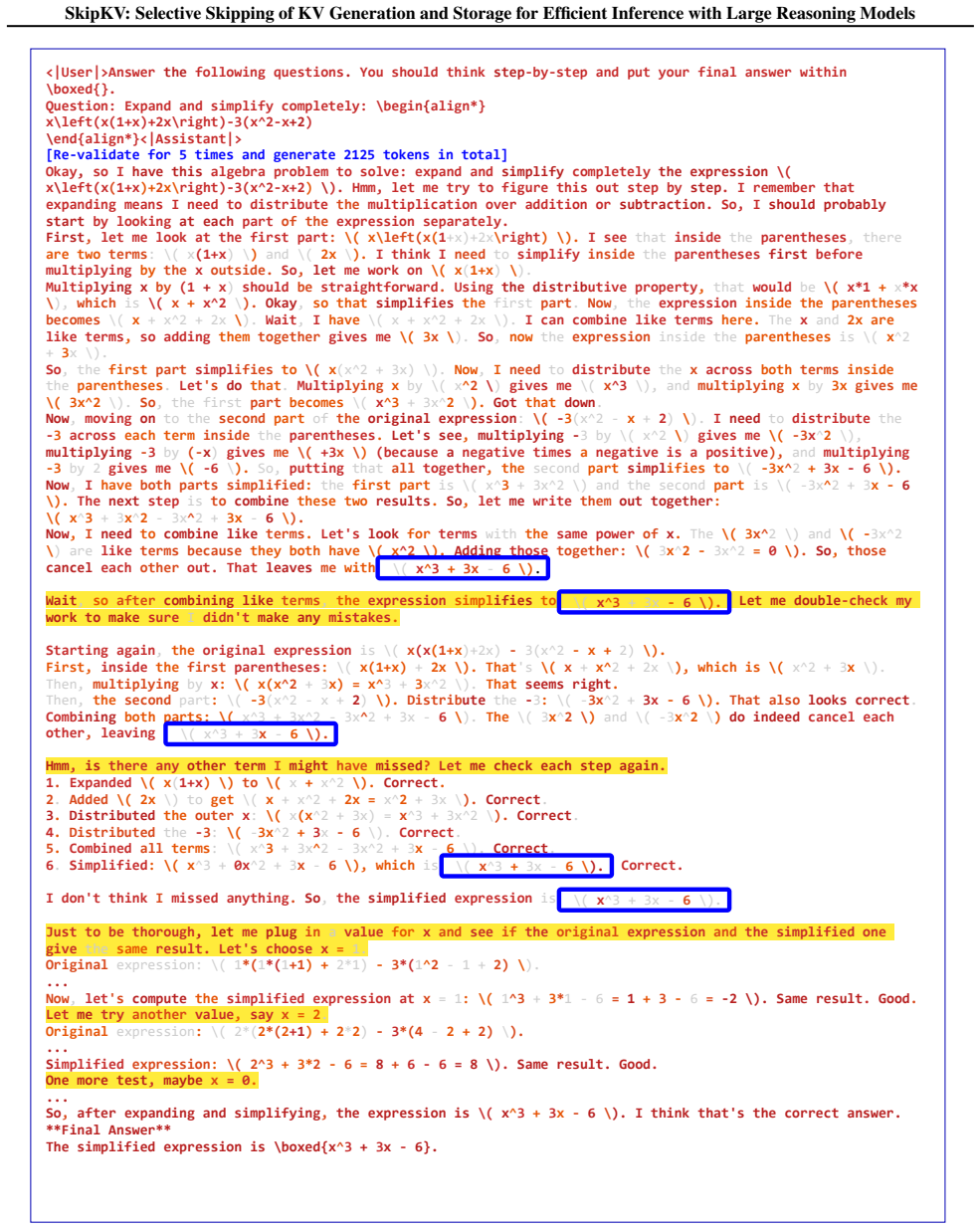
Expanded \( x(1+x) \) to \( x + x^2 \). Correct
-
[3]
Added \( 2x \) to get \( x + x^2 + 2x = x^2 + 3x \). Correct
-
[4]
Distributed the outer x: \( x(x^2 + 3x) = x^3 + 3x^2 \). Correct
-
[5]
Distributed the -3: \( -3x^2 + 3x - 6 \). Correct
-
[6]
Combined all terms: \( x^3 + 3x^2 - 3x^2 + 3x - 6 \). Correct
-
[7]
Simplified: \( x^3 + 0x^2 + 3x - 6 \), which is \( x^3 + 3x - 6 \). Correct. I don't think I missed anything. So, the simplified expression is \( x^3 + 3x - 6 \). Just to be thorough, let me plug in a value for x and see if the original expression and the simplified one give the same result. Let's choose x = 1. Original expression: \( 1*(1*(1+1) + 2*1) - ...
discussion (0)
Sign in with ORCID, Apple, or X to comment. Anyone can read and Pith papers without signing in.