Gravitational radiations from periodic orbits around a black hole in the effective field theory extension of general relativity
Pith reviewed 2026-05-16 23:49 UTC · model grok-4.3
The pith
Periodic orbits around black holes in an effective field theory extension of general relativity produce gravitational waveforms whose complexity increases with higher zoom numbers.
A machine-rendered reading of the paper's core claim, the machinery that carries it, and where it could break.
Core claim
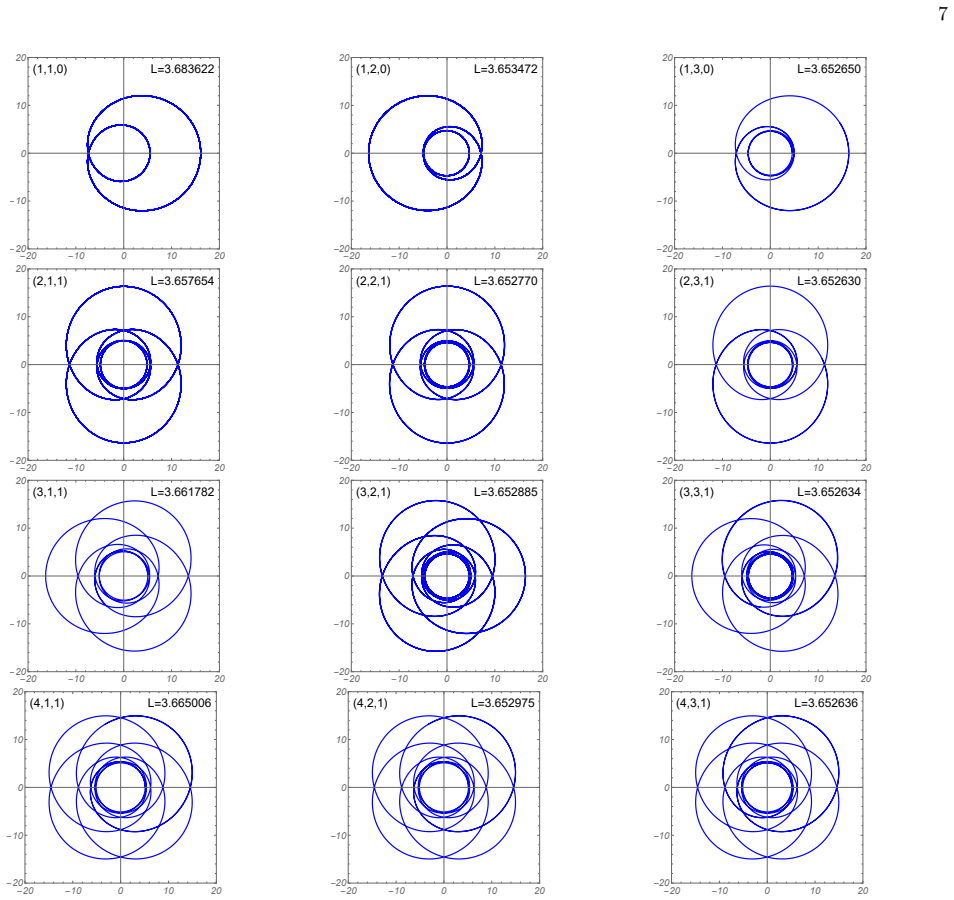
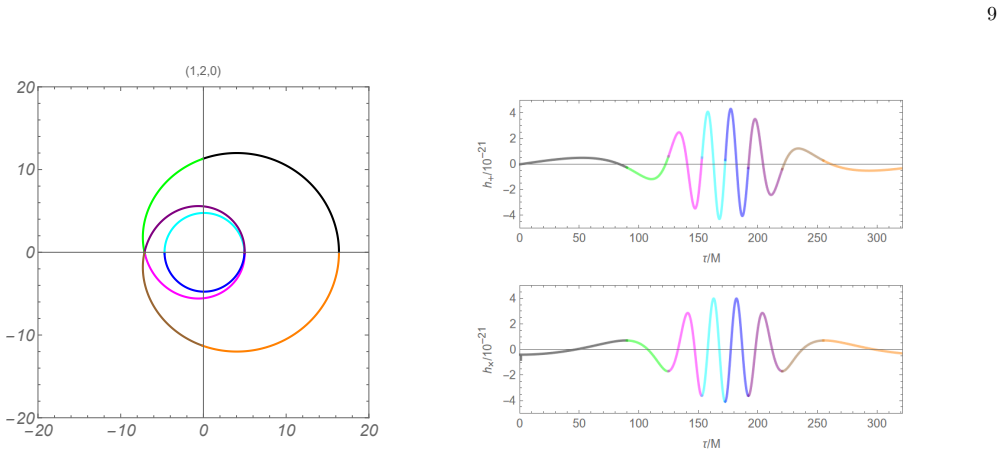
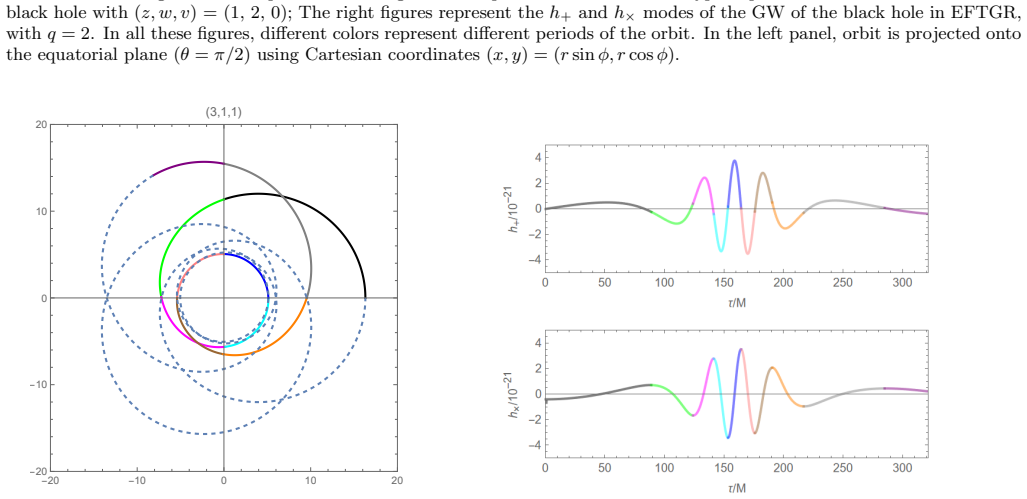
In the effective field theory extension of general relativity, periodic orbits of neutral particles around the modified black hole are characterized by the topological integers (z, w, v). The gravitational waveforms emitted by these orbits exhibit a direct connection to the zoom-whirl behavior, with higher values of the zoom number z resulting in increasingly intricate waveform substructures.
What carries the argument
The topological integers (z, w, v) classifying periodic orbits, which determine the number of zooms, whirls, and vertical oscillations in the trajectory and shape the emitted gravitational radiation.
If this is right
- Periodic orbits remain classifiable by the same three integers as in general relativity, but their detailed properties shift due to the higher curvature terms.
- Gravitational waveforms from these orbits carry identifiable signatures of the effective field theory parameters through their substructure patterns.
- The zoom-whirl dynamics provide a direct link between orbital topology and observable wave complexity in extreme-mass-ratio inspirals.
- Analysis of these waveforms can reveal strong-field deviations from general relativity in black hole spacetimes.
Where Pith is reading between the lines
- Future detectors sensitive to extreme-mass-ratio inspirals could use waveform substructure to bound the size of higher-order curvature corrections.
- Similar orbit-waveform connections might appear in other modified gravity models, suggesting a general diagnostic tool for spacetime modifications.
- Extending this to spinning black holes or charged particles could test the robustness of the zoom-number effect on waves.
Load-bearing premise
The effective field theory extension provides a physically valid modified black hole spacetime whose parameters can be treated as small corrections, and the Lagrangian formalism for neutral particle motion remains applicable without additional consistency conditions.
What would settle it
Detection of gravitational waves from an extreme-mass-ratio inspiral showing waveform substructures that do not increase in complexity with the inferred zoom number of the orbit.
Figures


read the original abstract
The study of periodic orbits in extreme-mass-ratio inspirals is essential for understanding the dynamics of small bodies orbiting supermassive black holes. In this paper, we study the periodic orbits and their corresponding gravitational wave emissions within the framework of an effective field theory-based extension of general relativity (EFTGR), which incorporates higher-order curvature terms into the Einstein-Hilbert action. We start with a brief analysis of the modified black hole spacetime in EFTGR and examine how its parameters influence the dynamics of a massive neutral particle using the Lagrangian formalism. Focusing on the impact of the higher-order curvature terms in EFTGR, we examine the properties of periodic orbits, which are characterized by three topological integers $(z, w, v)$ that uniquely classify their trajectories. By analyzing these orbits within EFTGR, we aim to provide new insights into how strong-field deviations from general relativity may manifest in observable phenomena. We then calculate the gravitational waveforms generated by these periodic orbits, identifying potential observational signatures. Our analysis reveals a direct connection between the zoom-whirl orbital behavior of the small compact object and the gravitational waveforms it emits: higher zoom numbers lead to increasingly intricate waveform substructures. The results contribute to a clearer understanding of the dynamical features of EFTGR and open new avenues for probing black hole properties via gravitational wave detection.
Editorial analysis
A structured set of objections, weighed in public.
Referee Report
Summary. The manuscript studies periodic orbits of neutral test particles around a black hole whose metric is deformed by higher-order curvature terms within an effective-field-theory extension of general relativity. It classifies the orbits by the topological integers (z, w, v), computes the gravitational waveforms they produce, and reports a direct link between zoom-whirl behavior and waveform morphology: larger zoom numbers generate more intricate substructures.
Significance. If the central mapping survives scrutiny, the work supplies a concrete route for translating strong-field modifications of gravity into observable features of extreme-mass-ratio waveforms, thereby furnishing potential templates for testing deviations from general relativity with future detectors.
major comments (2)
- [analysis of periodic orbits] The topological classification of periodic orbits by the integers (z, w, v) is imported from the general-relativistic literature without re-deriving the conditions on the radial and azimuthal periods that define these integers once the effective potential is modified by the higher-curvature terms. Because the turning-point structure can change, the claimed correspondence between zoom number and waveform intricacy rests on an unverified assumption; this point is load-bearing for the central claim.
- [gravitational waveforms] No explicit comparison of the computed waveforms against the general-relativistic limit is supplied, nor are error estimates or convergence checks with respect to the EFT parameters provided. Without these controls it is impossible to determine whether the reported substructures are genuine EFTGR signatures or artifacts of the numerical or analytic approximations employed.
minor comments (1)
- [abstract] The abstract states that the EFTGR action incorporates 'higher-order curvature terms' but does not specify the truncation order or the explicit form of the Lagrangian; this information should be stated at the outset for reproducibility.
Simulated Author's Rebuttal
We thank the referee for the careful reading and constructive comments on our manuscript. We have revised the paper to address the two major concerns and believe these changes strengthen the presentation of the results.
read point-by-point responses
-
Referee: [analysis of periodic orbits] The topological classification of periodic orbits by the integers (z, w, v) is imported from the general-relativistic literature without re-deriving the conditions on the radial and azimuthal periods that define these integers once the effective potential is modified by the higher-curvature terms. Because the turning-point structure can change, the claimed correspondence between zoom number and waveform intricacy rests on an unverified assumption; this point is load-bearing for the central claim.
Authors: We thank the referee for highlighting this point. The integers (z, w, v) are defined via the ratios of the radial and azimuthal periods obtained from integrating the geodesic equations. Although the effective potential is modified, the formal definitions remain applicable once the periods are recomputed for the EFTGR metric. In the revised manuscript we have added an explicit derivation (new subsection 3.2) that recomputes the radial and azimuthal periods for the modified potential, confirms that the turning-point conditions are unchanged in structure, and verifies with concrete examples that the zoom number continues to control waveform substructure complexity. revision: yes
-
Referee: [gravitational waveforms] No explicit comparison of the computed waveforms against the general-relativistic limit is supplied, nor are error estimates or convergence checks with respect to the EFT parameters provided. Without these controls it is impossible to determine whether the reported substructures are genuine EFTGR signatures or artifacts of the numerical or analytic approximations employed.
Authors: We agree that such controls are essential. The revised manuscript now includes a direct comparison of the waveforms obtained in the EFTGR spacetime with the GR limit (recovered by setting all higher-curvature coefficients to zero), demonstrating that the additional substructures vanish in the GR case. We have also added an appendix containing convergence tests with respect to the EFT parameters, integration step size, and truncation order, together with quantitative error estimates that confirm the reported features are robust. revision: yes
Circularity Check
No significant circularity; derivation proceeds from EFTGR action through modified orbits to computed waveforms
full rationale
The paper begins with the EFTGR action incorporating higher-curvature terms, derives the modified black-hole metric, applies the standard Lagrangian for neutral-particle geodesics in that metric, identifies periodic orbits via the same (z, w, v) integers used in GR, and numerically computes the resulting gravitational waveforms. No equation or claim reduces an output quantity to a parameter defined by the input; the reported connection between zoom number and waveform substructure is obtained by explicit integration of the geodesic equations and quadrupole formula in the deformed spacetime rather than by algebraic identity or self-referential fitting. The topological classification is imported from prior GR literature but is not load-bearing in a circular sense because the paper recomputes the orbital periods and turning points directly in the EFTGR effective potential before labeling and waveform generation.
Axiom & Free-Parameter Ledger
Lean theorems connected to this paper
-
IndisputableMonolith/Foundation/AlexanderDuality.leanalexander_duality_circle_linking echoes?
echoesECHOES: this paper passage has the same mathematical shape or conceptual pattern as the Recognition theorem, but is not a direct formal dependency.
periodic orbits, which are characterized by three topological integers (z, w, v) that uniquely classify their trajectories... q ≡ ωϕ/ωr − 1 = w + v/z
-
IndisputableMonolith/Cost/FunctionalEquation.leanwashburn_uniqueness_aczel contradicts?
contradictsCONTRADICTS: the theorem conflicts with this paper passage, or marks a claim that would need revision before publication.
fϵi_t(r) = 1 − 2M/r + ε_i δ_i1 (−1024 M^9/r^9 + ...)
What do these tags mean?
- matches
- The paper's claim is directly supported by a theorem in the formal canon.
- supports
- The theorem supports part of the paper's argument, but the paper may add assumptions or extra steps.
- extends
- The paper goes beyond the formal theorem; the theorem is a base layer rather than the whole result.
- uses
- The paper appears to rely on the theorem as machinery.
- contradicts
- The paper's claim conflicts with a theorem or certificate in the canon.
- unclear
- Pith found a possible connection, but the passage is too broad, indirect, or ambiguous to say the theorem truly supports the claim.
Forward citations
Cited by 2 Pith papers
-
An open-source numerical tool for rational orbits and gravitational radiation in static spherically symmetric spacetimes
Open-source numerical package for rational orbits and gravitational waves in static spherically symmetric spacetimes, validated on Schwarzschild and applied to an IMBH-Sgr A* EMRI.
-
Gravitational waves of extreme-mass-ratio inspirals in a rotating black hole with Dehnen dark matter halo
EMRI waveforms in a rotating black hole with Dehnen DM halo show amplitude and phase shifts from Kerr, with mismatch rising as DM mass parameter and black hole spin increase.
discussion (0)
Sign in with ORCID, Apple, or X to comment. Anyone can read and Pith papers without signing in.