Assessing Resilience in Authoritative DNS Infrastructure Supporting Government Services
Pith reviewed 2026-05-16 21:26 UTC · model grok-4.3
The pith
A scoring framework evaluates the resilience of authoritative DNS infrastructure for government services by assigning numerical values to attributes at four hierarchical levels and aggregating them for comparisons.
A machine-rendered reading of the paper's core claim, the machinery that carries it, and where it could break.
Core claim
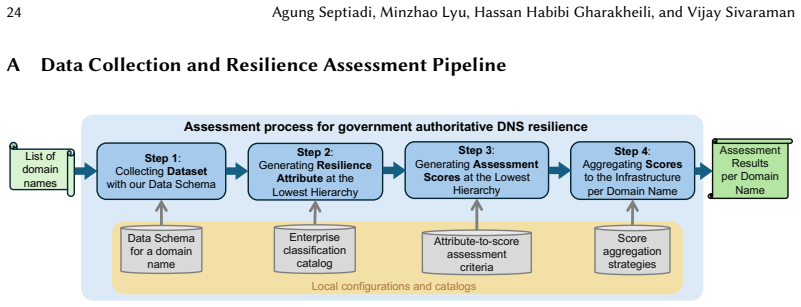
We introduce a comprehensive assessment framework with purpose-designed mechanisms to systematically evaluate the operational resilience of authoritative DNS infrastructure supporting government services. Our first contribution develops a multi-sourced data schema that characterizes a domain's authoritative DNS infrastructure across four hierarchical levels. Using data from six countries, our second contribution identifies resilience attributes at their finest hierarchy across three operational phases, assigns numerical scores to each attribute, and aggregates them algorithmically to enable consistent and cross-domain comparisons.
What carries the argument
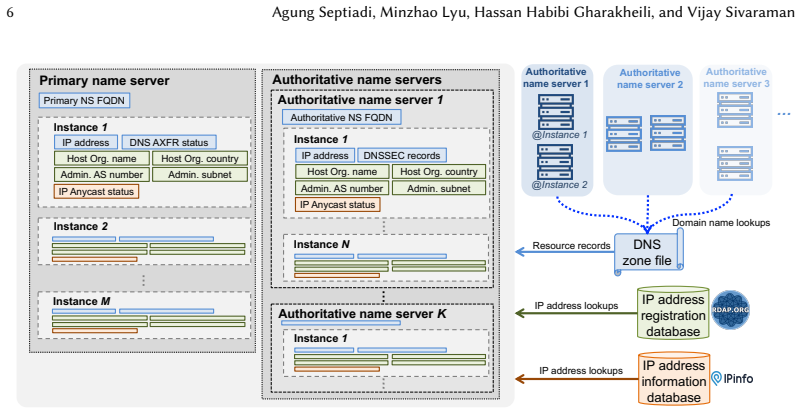
The multi-sourced data schema characterizing authoritative DNS infrastructure across four hierarchical levels (physical hosting infrastructure, server functionality, name servers, and individual hosting instances), together with numerical scoring and algorithmic aggregation of resilience attributes identified in three operational phases.
If this is right
- Resilience comparisons become feasible across different government domains and countries using a single numerical scale.
- Specific operational practices in infrastructure placement, configuration, and record dispatch can be isolated for targeted fixes.
- The framework supplies a holistic view that complements existing studies focused on website hosting and recursive resolution.
- Pinpointed weaknesses can guide infrastructure upgrades to reduce the risk of service disruptions.
Where Pith is reading between the lines
- National agencies could adopt the scoring method as a benchmark when auditing or procuring DNS services.
- Periodic re-application of the framework could track whether resilience improves after policy or technical changes.
- The same attribute hierarchy might be tested on non-government critical services such as health or finance domains.
Load-bearing premise
The multi-sourced data accurately reflects real infrastructure states and the selected attributes and scoring rules meaningfully capture operational resilience.
What would settle it
A documented outage or sustained performance failure in a government domain that the framework scores as highly resilient, or the absence of issues in a domain scored as low-resilience.
Figures






read the original abstract
Online government services are increasingly regarded as critical national infrastructure. Because these services directly influence public trust, any disruption can have significant societal and political consequences. Yet their supporting infrastructures remain vulnerable to outages from natural disasters, geopolitical tensions, and targeted attacks. Central to their operation is the authoritative Domain Name System (DNS) infrastructure, the single source of truth that maps government domain names to service endpoints. While indispensable, this infrastructure also represents a potential and critical point of system failure. In this paper, we introduce a comprehensive assessment framework with purpose-designed mechanisms to systematically evaluate the operational resilience of authoritative DNS infrastructure supporting government services. Complementing prior studies on website hosting, recursive resolution, and DNS record integrity, our work provides a holistic view of authoritative DNS operation. Our first contribution develops a multi-sourced data schema that characterizes a (government) domain's authoritative DNS infrastructure across four hierarchical levels: physical hosting infrastructure, server functionality, name servers, and individual hosting instances. Using data collected from six representative countries, our second contribution identifies resilience attributes at their finest applicable hierarchy across three operational phases: infrastructure placement, service configuration, and DNS record dispatch. Our method assigns numerical scores to each attribute and aggregates them algorithmically to enable consistent and cross-domain comparisons. We apply our method to government domains in the six countries, highlighting their strengths and weaknesses in authoritative DNS resilience and pinpointing operational practices that require improvement.
Editorial analysis
A structured set of objections, weighed in public.
Referee Report
Summary. The paper claims to introduce a comprehensive assessment framework for the operational resilience of authoritative DNS infrastructure supporting government services. It develops a multi-sourced data schema characterizing domains across four hierarchical levels (physical hosting infrastructure, server functionality, name servers, and individual hosting instances), identifies resilience attributes across three operational phases (infrastructure placement, service configuration, and DNS record dispatch) using data from six countries, assigns numerical scores to attributes, and aggregates them algorithmically for consistent cross-domain comparisons, while highlighting strengths, weaknesses, and areas for improvement.
Significance. If the scoring rules and aggregation can be shown to correlate with observable resilience indicators such as historical uptime or incident reports, the framework would offer a useful standardized approach for cross-domain comparisons of critical DNS infrastructure, complementing prior work on hosting and recursive resolution. The multi-country application demonstrates potential for identifying operational weaknesses, but without validation the practical significance remains limited.
major comments (3)
- [Abstract] Abstract: the central claim that assigning numerical scores and aggregating them 'algorithmically' produces 'consistent and cross-domain comparisons' is not supported by any presented scoring formulas, sensitivity analysis, data tables, or correlation with independent observables such as historical DNS uptime or resolution success rates for the six countries.
- [Contributions] The description of the multi-sourced data schema and attribute identification across four hierarchy levels and three phases provides no derivation or justification for the mapping of attributes to numerical scores; this is load-bearing for the claim that the resulting metrics meaningfully proxy operational resilience rather than arbitrary rankings.
- [Evaluation] Application to government domains in the six countries: the highlighting of strengths and weaknesses is asserted but cannot be evaluated without the actual aggregated scores, raw attribute values, or any error analysis showing how the framework responds to real infrastructure states.
minor comments (1)
- [Abstract] The abstract would benefit from a brief sentence situating the work relative to the cited prior studies on website hosting and recursive resolution.
Simulated Author's Rebuttal
We thank the referee for the constructive and detailed feedback. The comments highlight important areas where the presentation of our scoring methodology and evaluation results can be strengthened for clarity and verifiability. We address each major comment below and will perform a major revision to incorporate explicit formulas, justifications, and supporting data tables.
read point-by-point responses
-
Referee: [Abstract] Abstract: the central claim that assigning numerical scores and aggregating them 'algorithmically' produces 'consistent and cross-domain comparisons' is not supported by any presented scoring formulas, sensitivity analysis, data tables, or correlation with independent observables such as historical DNS uptime or resolution success rates for the six countries.
Authors: We acknowledge that the abstract does not sufficiently preview the supporting details. Section 4 of the manuscript defines the scoring rules for each resilience attribute (e.g., geographic diversity scored 0-10 based on number of distinct locations) and the aggregation algorithm (weighted sum normalized to [0,1]). To address the concern, we will revise the abstract to reference the key scoring components and add a sensitivity analysis subsection in the evaluation that tests score stability under attribute perturbations. Direct correlation with historical uptime is not feasible with currently available public data for all six countries; we will add a limitations paragraph noting this and outlining how future work could validate against incident reports. revision: partial
-
Referee: [Contributions] The description of the multi-sourced data schema and attribute identification across four hierarchy levels and three phases provides no derivation or justification for the mapping of attributes to numerical scores; this is load-bearing for the claim that the resulting metrics meaningfully proxy operational resilience rather than arbitrary rankings.
Authors: The attribute-to-score mappings are grounded in DNS operational best practices drawn from RFC 1035, ICANN resilience guidelines, and NIST cybersecurity frameworks for critical infrastructure. Each score reflects measurable properties such as redundancy or diversity that prior literature links to reduced outage risk. We agree that explicit derivation is needed and will insert a new subsection (3.3) in the methodology that justifies every mapping with references and a brief rationale table, ensuring the scores are not arbitrary. revision: yes
-
Referee: [Evaluation] Application to government domains in the six countries: the highlighting of strengths and weaknesses is asserted but cannot be evaluated without the actual aggregated scores, raw attribute values, or any error analysis showing how the framework responds to real infrastructure states.
Authors: We will expand the evaluation section to include a new table presenting both raw attribute values and final aggregated resilience scores for all domains across the six countries. We will also add an error analysis subsection that quantifies data collection uncertainties (e.g., incomplete WHOIS records) and demonstrates framework sensitivity to missing attributes via imputation tests. revision: yes
Circularity Check
No circularity: framework relies on external data collection and attribute definition
full rationale
The paper's central method collects multi-sourced data on authoritative DNS infrastructure across four hierarchy levels and three phases, then assigns numerical scores to identified attributes before algorithmic aggregation. No equations, fitted parameters, or derivations are presented that reduce to self-referential inputs or predictions. No self-citations invoke uniqueness theorems, ansatzes, or prior results from the same authors to justify the scoring or aggregation. The process is presented as a methodological schema grounded in observed infrastructure states rather than any loop that equates outputs to inputs by construction. This is the expected non-circular outcome for a descriptive assessment framework.
Axiom & Free-Parameter Ledger
axioms (2)
- domain assumption Multi-sourced data accurately represents the true state of physical hosting, server functionality, name servers, and instances.
- domain assumption The chosen resilience attributes at each hierarchy and phase are the right ones for measuring operational resilience.
Lean theorems connected to this paper
-
IndisputableMonolith/Foundation/RealityFromDistinction.leanreality_from_one_distinction unclear?
unclearRelation between the paper passage and the cited Recognition theorem.
Our method assigns numerical scores to each attribute and aggregates them algorithmically to enable consistent and cross-domain comparisons.
-
IndisputableMonolith/Cost/FunctionalEquation.leanwashburn_uniqueness_aczel unclear?
unclearRelation between the paper passage and the cited Recognition theorem.
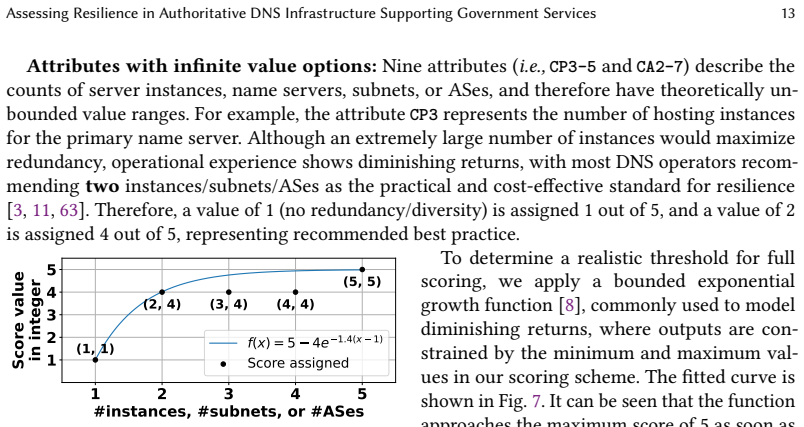
Each attribute is assigned a five-point numerical score... hierarchically aggregated using an impact-driven algorithm
What do these tags mean?
- matches
- The paper's claim is directly supported by a theorem in the formal canon.
- supports
- The theorem supports part of the paper's argument, but the paper may add assumptions or extra steps.
- extends
- The paper goes beyond the formal theorem; the theorem is a base layer rather than the whole result.
- uses
- The paper appears to rely on the theorem as machinery.
- contradicts
- The paper's claim conflicts with a theorem or certificate in the canon.
- unclear
- Pith found a possible connection, but the passage is too broad, indirect, or ambiguous to say the theorem truly supports the claim.
Reference graph
Works this paper leans on
-
[1]
ACSC. 2025. Annual Cyber Threat Report 2024-2025. https://www.cyber.gov.au/about-us/view-all-content/reports- and-statistics/annual-cyber-threat-report-2024-2025 Accessed: 2025-11-11
work page 2025
-
[2]
AGOR. 2025. AGOR Quarterly Report. https://www.finance.gov.au/government/managing-commonwealth-resources/ structure-australian-government-public-sector Accessed: 2025-07-21
work page 2025
-
[3]
Akamai. 2025. Designing DNS for Availability and Resilience Against DDoS Attacks. https://www.akamai.com/ resources/white-paper/designing-dns-for-availability-and-resilience-against-ddos-attacks Accessed: 2025-11-28
work page 2025
-
[4]
Akamai. 2025. Edge DNS. https://www.akamai.com/products/edge-dns Accessed: 2025-12-01
work page 2025
-
[5]
Gautam Akiwate, Raffaele Sommese, Mattijs Jonker, Zakir Durumeric, KC Claffy, Geoffrey M. Voelker, and Stefan Savage. 2022. Retroactive identification of targeted DNS infrastructure hijacking. InProc. ACM IMC. Nice, France
work page 2022
-
[6]
Eihal Alowaisheq, Siyuan Tang, Zhihao Wang, Fatemah Alharbi, Xiaojing Liao, and XiaoFeng Wang. 2020. Zombie Awakening: Stealthy Hijacking of Active Domains through DNS Hosting Referral. InProc. ACM CCS. Virtual Event
work page 2020
-
[7]
ANSSI. 2025. French Cybersecurity Agency. https://cyber.gouv.fr/ Accessed: 2025-11-14
work page 2025
-
[8]
Mahdi Arghavani, Haibo Zhang, David Eyers, and Abbas Arghavani. 2024. SUSS: Improving TCP Performance by Speeding Up Slow-Start. InProc. ACM SIGCOMM. Sydney, NSW, Australia
work page 2024
-
[9]
Brazil Government. 2025. Órgãos do Governo. https://www.gov.br/pt-br/orgaos-do-governo/ministerios-e-orgaos- com-status-de-ministerios Accessed: 2025-11-03
work page 2025
-
[10]
Rishabh Chhabra, Paul Murley, Deepak Kumar, Michael Bailey, and Gang Wang. 2021. Measuring DNS-over-HTTPS performance around the world. InProc. ACM IMC. Virtual Event
work page 2021
-
[11]
Cloudflare. 2020. Improving DNS security, performance, and reliability. https://www.cloudflare.com/en-au/improving- dns-security-performance-reliability/ Accessed: 2025-11-28
work page 2020
-
[12]
Cloudflare. 2025. Cloudflare DNS. https://www.cloudflare.com/application-services/products/dns/ Accessed: 2025-12- 01
work page 2025
-
[13]
CSIS. 2025. Significant Cyber Incidents. https://www.csis.org/programs/strategic-technologies-program/significant- cyber-incidents Accessed: 2025-11-11
work page 2025
-
[14]
Cybersecurity and Infrastructure Security Agency. 2025. get.gov. https://get.gov/about/data/ Accessed: 2025-04-20
work page 2025
-
[15]
Rasmus Dahlberg and Tobias Pulls. 2023. Timeless Timing Attacks and Preload Defenses in Tor’s DNS Cache. InProc. USENIX Security. Anaheim, CA, USA
work page 2023
-
[16]
datagouv. 2022. Lists of gouv.fr sites. https://www.data.gouv.fr/datasets/listes-des-sites-gouv-fr/ Accessed: 2022-07-22
work page 2022
-
[17]
Casey Deccio, Alden Hilton, Michael Briggs, Trevin Avery, and Robert Richardson. 2020. Behind Closed Doors: A Network Tale of Spoofing, Intrusion, and False DNS Security. InProc. ACM IMC. Virtual Event, USA
work page 2020
-
[18]
Hongying Dong, Yizhe Zhang, Hyeonmin Lee, Shumon Huque, and Yixin Sun. 2024. Exploring the Ecosystem of DNS HTTPS Resource Records: An End-to-End Perspective. InProc. ACM IMC. Madrid, Spain
work page 2024
-
[19]
Huayi Duan, Marco Bearzi, Jodok Vieli, David Basin, Adrian Perrig, Si Liu, and Bernhard Tellenbach. 2024. CAMP: Compositional Amplification Attacks against DNS. InProc. USENIX Security. Philadelphia, PA, USA
work page 2024
-
[20]
Ludwig Englbrecht, Stefan Meier, and Günther Pernul. 2020. Towards a Capability Maturity Model for Digital Forensic Readiness.Wireless Networks26, 7 (Oct. 2020)
work page 2020
-
[21]
European Commision. 2025. Digital Tracking. https://commission.europa.eu/strategy-and-policy/eu-budget/ performance-and-reporting/horizontal-priorities/digital-tracking_en Accessed: 2025-11-11
work page 2025
-
[22]
Evans, Julia. 2022. Why might you run your own DNS server? https://jvns.ca/blog/2022/01/05/why-might-you-run- your-own-dns-server-/ Accessed: 2025-11-28
work page 2022
-
[23]
ExamLabs. 2025. Understanding the Role of DNS Authoritative Name Servers. https://www.exam-labs.com/blog/ understanding-the-role-of-dns-authoritative-name-servers Accessed: 2025-11-28
work page 2025
-
[24]
Tillson Galloway, Kleanthis Karakolios, Zane Ma, Roberto Perdisci, Angelos Keromytis, and Manos Antonakakis. 2024. Practical Attacks Against DNS Reputation Systems. InProc. IEEE S&P
work page 2024
-
[25]
Google. 2025. Cloud DNS. https://cloud.google.com/dns/ Accessed: 2025-12-01
work page 2025
-
[26]
Government Digital Service and Central Digital and Data Office. 2025. List of .gov.uk domain names. https: //www.gov.uk/government/publications/list-of-gov-uk-domain-names Accessed: 2025-07-22
work page 2025
-
[27]
Harm Griffioen, Georgios Koursiounis, Georgios Smaragdakis, and Christian Doerr. 2024. Have you SYN me? Charac- terizing Ten Years of Internet Scanning. InProc. ACM IMC. Madrid, Spain
work page 2024
-
[28]
Rumaisa Habib, Kimberly Ruth, Gautam Akiwate, and Zakir Durumeric. 2025. Formalizing Dependence of Web Infrastructure. InProc. ACM SIGCOMM. São Francisco Convent, Coimbra, Portugal
work page 2025
-
[29]
Elias Heftrig, Haya Schulmann, Niklas Vogel, and Michael Waidner. 2024. The Harder You Try, The Harder You Fail: The KeyTrap Denial-of-Service Algorithmic Complexity Attacks on DNSSEC. InProc. ACM CCS
work page 2024
-
[30]
Thomas, Mattijs Jonker, Ricky Mok, Xiapu Luo, John Kristoff, Thomas C
Raphael Hiesgen, Marcin Nawrocki, Marinho Barcellos, Daniel Kopp, Oliver Hohlfeld, Echo Chan, Roland Dobbins, Christian Doerr, Christian Rossow, Daniel R. Thomas, Mattijs Jonker, Ricky Mok, Xiapu Luo, John Kristoff, Thomas C. Schmidt, Matthias Wählisch, and kc claffy. 2024. The Age of DDoScovery: An Empirical Comparison of Industry and , Vol. 1, No. 1, Ar...
work page 2024
-
[31]
Alden Hilton, Casey Deccio, and Jacob Davis. 2023. Fourteen Years in the Life: A Root Server’s Perspective on DNS Resolver Security. InProc. USENIX Security. Anaheim, CA, USA
work page 2023
-
[32]
Rebekah Houser, Shuai Hao, Chase Cotton, and Haining Wang. 2022. A Comprehensive, Longitudinal Study of Government DNS Deployment at Global Scale. InProc. IEEE/IFIP DSN
work page 2022
-
[33]
IPinfo. 2025. IPinfo: The Trusted Source For IP Address Data. https://ipinfo.io Accessed: 2025-11-14
work page 2025
-
[34]
Katsuki Isobe, Daishi Kondo, and Hideki Tode. 2022. A first look at the name resolution latency on handshake. InProc. ACM IMC. Nice, France
work page 2022
-
[35]
Liz Izhikevich, Gautam Akiwate, Briana Berger, Spencer Drakontaidis, Anna Ascheman, Paul Pearce, David Adrian, and Zakir Durumeric. 2022. ZDNS: a fast DNS toolkit for internet measurement. InProc. ACM IMC. Nice, France
work page 2022
-
[36]
Akshath Jain, Deepayan Patra, Peijing Xu, Justine Sherry, and Phillipa Gill. 2022. The ukrainian internet under attack: an NDT perspective. InProc. ACM IMC. Nice, France
work page 2022
-
[37]
Voelker, Roland van Rijswijk- Deij, and Stefan Savage
Mattijs Jonker, Gautam Akiwate, Antonia Affinito, kc Claffy, Alessio Botta, Geoffrey M. Voelker, Roland van Rijswijk- Deij, and Stefan Savage. 2022. Where .ru? Assessing the Impact of Conflict on Russian Domain Infrastructure. InProc. ACM IMC. Nice, France
work page 2022
-
[38]
Joshi, Sagar. 2025. 10 Biggest IT Outages in History: Who Pulled the Plug? https://learn.g2.com/biggest-it-outages- in-history Accessed: 2025-12-01
work page 2025
-
[39]
Aqsa Kashaf, Vyas Sekar, and Yuvraj Agarwal. 2020. Analyzing Third Party Service Dependencies in Modern Web Services: Have We Learned from the Mirai-Dyn Incident?. InProc. ACM IMC. Virtual Event
work page 2020
-
[40]
Mike Kosek, Luca Schumann, Robin Marx, Trinh Viet Doan, and Vaibhav Bajpai. 2022. DNS privacy with speed? evaluating DNS over QUIC and its impact on web performance. InProc. ACM IMC. Nice, France
work page 2022
-
[41]
Rashna Kumar, Sana Asif, Elise Lee, and Fabian E. Bustamante. 2023. Each at its Own Pace: Third-Party Dependency and Centralization Around the World.Proc. ACM Meas. Anal. Comput. Syst.7, 1 (March 2023)
work page 2023
-
[42]
Bustamante, Ihsan Ayyub Qazi, and Mariano G
Rashna Kumar, Esteban Carisimo, Lukas De Angelis Riva, Mauricio Buzzone, Fabián E. Bustamante, Ihsan Ayyub Qazi, and Mariano G. Beiró. 2024. Of Choices and Control - A Comparative Analysis of Government Hosting. InProc. ACM IMC. Madrid, Spain
work page 2024
-
[43]
Jungjae Lee, Yubin Choi, Minhyuk Song, and Sanghyun Park. 2024. ChatFive: Enhancing User Experience in Likert Scale Personality Test through Interactive Conversation with LLM Agents. InProc. ACM CUI. Luxembourg, Luxembourg
work page 2024
-
[44]
Edward P. Lewis and Alfred Hoenes. 2010. DNS Zone Transfer Protocol (AXFR). RFC 5936
work page 2010
-
[45]
Xiang Li, Dashuai Wu, Haixin Duan, and Qi Li. 2024. DNSBomb: A New Practical-and-Powerful Pulsing DoS Attack Exploiting DNS Queries-and-Responses. InIEEE Symposium on Security and Privacy
work page 2024
-
[46]
Xiang Li, Wei Xu, Baojun Liu, Mingming Zhang, Zhou Li, Jia Zhang, Deliang Chang, Xiaofeng Zheng, Chuhan Wang, Jianjun Chen, Haixin Duan, and Qi Li. 2024. TuDoor Attack: Systematically Exploring and Exploiting Logic Vulnerabilities in DNS Response Pre-processing with Malformed Packets. InIEEE Symposium on Security and Privacy
work page 2024
-
[47]
Kurt Erik Lindqvist and Joe Abley. 2006. Operation of Anycast Services. RFC 4786
work page 2006
-
[48]
Guannan Liu, Lin Jin, Shuai Hao, Yubao Zhang, Daiping Liu, Angelos Stavrou, and Haining Wang. 2023. Dial "N" for NXDomain: The Scale, Origin, and Security Implications of DNS Queries to Non-Existent Domains. InProc. ACM IMC. Montreal QC, Canada
work page 2023
-
[49]
Minzhao Lyu, Hassan Habibi Gharakheili, Craig Russell, and Vijay Sivaraman. 2021. Hierarchical Anomaly-Based Detection of Distributed DNS Attacks on Enterprise Networks.IEEE TNSM18, 1 (2021)
work page 2021
-
[50]
Minzhao Lyu, Hassan Habibi Gharakheili, Craig Russell, and Vijay Sivaraman. 2023. Enterprise DNS Asset Mapping and Cyber-Health Tracking via Passive Traffic Analysis.IEEE TNSM20, 3 (2023)
work page 2023
-
[51]
Minzhao Lyu, Hassan Habibi Gharakheili, and Vijay Sivaraman. 2022. Classifying and tracking enterprise assets via dual-grained network behavioral analysis.Computer Networks218 (2022)
work page 2022
-
[52]
Keyu Man, Xin’an Zhou, and Zhiyun Qian. 2021. DNS Cache Poisoning Attack: Resurrections with Side Channels. In Proc. ACM CCS. Virtual Event
work page 2021
-
[53]
McLeod, Saul. 2025. Likert Scale Questionnaire: Examples & Analysis. https://www.simplypsychology.org/likert- scale.html Accessed: 2025-12-01
work page 2025
-
[54]
Mitchell, Robert. 2025. What Is Internet Resilience? https://www.internetsociety.org/blog/2025/08/what-is-internet- resilience/ Accessed: 2025-11-11
work page 2025
-
[55]
Moss, Sebastian. 2025. 8.8 magnitude earthquake causes Internet outages in Kamchatka, Russia. https://www. datacenterdynamics.com/en/news/88-magnitude-earthquake-causes-internet-outages-in-kamchatka-russia/ Ac- cessed: 2025-10-30
work page 2025
-
[56]
Giovane C. M. Moura, Sebastian Castro, Wes Hardaker, Maarten Wullink, and Cristian Hesselman. 2020. Clouding up the Internet: how centralized is DNS traffic becoming?. InProc. ACM IMC. Virtual Event
work page 2020
-
[57]
Giovane C. M. Moura, Sebastian Castro, John Heidemann, and Wes Hardaker. 2021. TsuNAME: exploiting misconfigu- ration and vulnerability to DDoS DNS. InProc. ACM IMC(Virtual Event). , Vol. 1, No. 1, Article . Publication date: December 2025. Assessing Resilience in Authoritative DNS Infrastructure Supporting Government Services 23
work page 2021
-
[58]
Giovane C. M. Moura, Thomas Daniels, Maarten Bosteels, Sebastian Castro, Moritz Müller, Thymen Wabeke, Thijs van den Hout, Maciej Korczyński, and Georgios Smaragdakis. 2024. Characterizing and Mitigating Phishing Attacks at ccTLD Scale. InProc. ACM CCS
work page 2024
-
[59]
Schmidt, and Matthias Wählisch
Marcin Nawrocki, Mattijs Jonker, Thomas C. Schmidt, and Matthias Wählisch. 2021. The far side of DNS amplification: tracing the DDoS attack ecosystem from the internet core. InProc. ACM IMC(Virtual Event)
work page 2021
-
[60]
Alexandra Nisenoff, Ranya Sharma, and Nick Feamster. 2023. User Awareness and Behaviors Concerning Encrypted DNS Settings in Web Browsers. InProc. USENIX Security. Anaheim, CA, USA
work page 2023
-
[61]
Fariba Osali, Khwaja Zubair Sediqi, and Oliver Gasser. 2025. Sibling Prefixes: Identifying Similarities in IPv4 and IPv6 Prefixes. InProc. ACM IMC. USA
work page 2025
-
[62]
Pallarito, Ash and Abley, Joe. 2022. Cloudflare 1.1.1.1 incident on July 14, 2025. https://blog.cloudflare.com/cloudflare- 1-1-1-1-incident-on-july-14-2025/ Accessed: 2025-11-11
work page 2022
-
[63]
Michael A. Patton, Scott O. Bradner, Robert Elz, and Randy Bush. 1997. Selection and Operation of Secondary DNS Servers. RFC 2182
work page 1997
-
[64]
Presiden Republik Indonesia. 2018. Peraturan Presiden Nomor 95 Tahun 2018 tentang Sistem Pemerintahan Berbasis Elektronik. https://peraturan.bpk.go.id/Details/96913/perpres-no-95-tahun-2018 Accessed: 2025-11-12
work page 2018
-
[65]
Voelker, Stefan Savage, and Aaron Schulman
Audrey Randall, Enze Liu, Gautam Akiwate, Ramakrishna Padmanabhan, Geoffrey M. Voelker, Stefan Savage, and Aaron Schulman. 2020. Trufflehunter: Cache Snooping Rare Domains at Large Public DNS Resolvers. InProc. ACM IMC(Virtual Event)
work page 2020
-
[66]
Voelker, Stefan Savage, and Aaron Schulman
Audrey Randall, Enze Liu, Ramakrishna Padmanabhan, Gautam Akiwate, Geoffrey M. Voelker, Stefan Savage, and Aaron Schulman. 2021. Home is where the hijacking is: understanding DNS interception by residential routers. InProc. ACM IMC. Virtual Event
work page 2021
-
[67]
RDAP.org. 2025. The Registration Data Access Protocol. https://about.rdap.org Accessed: 2025-11-01
work page 2025
-
[68]
Robinson, Dan. 2025. A single DNS race condition brought Amazon’s cloud empire to its knees. https://www. theregister.com/2025/10/23/amazon_outage_postmortem/ Accessed: 2025-11-11
work page 2025
-
[69]
Secretary of State Science. 2025. State of digital government review. https://www.gov.uk/government/publications/ state-of-digital-government-review/state-of-digital-government-review Accessed: 2025-08-11
work page 2025
-
[70]
Sekretaris Kabinet Republik Indonesia. 2024. Kabinet Pemerintahan Indonesia. https://setkab.go.id/profil-kabinet/ Accessed: 2025-11-12
work page 2024
-
[71]
Raffaele Sommese, Gautam Akiwate, Antonia Affinito, Moritz Muller, Mattijs Jonker, and kc claffy. 2024. DarkDNS: Revisiting the Value of Rapid Zone Update. InProc. ACM on IMC. Madrid, Spain
work page 2024
-
[72]
Raffaele Sommese, KC Claffy, Roland van Rijswijk-Deij, Arnab Chattopadhyay, Alberto Dainotti, Anna Sperotto, and Mattijs Jonker. 2022. Investigating the impact of DDoS attacks on DNS infrastructure. InProc. ACM IMC. Nice, France
work page 2022
-
[73]
Raffaele Sommese, Mattijs Jonker, Jeroen van der Ham, and Giovane C. M. Moura. 2022. Assessing e-Government DNS Resilience. InProc. International Conference on Network and Service Management
work page 2022
-
[74]
Florian Steurer, Amreesh Phokeer, Philip Paeps, and Liz Izhikevich. 2025. Measuring Resilience of Authoritative DNS. InProc. ACM SIGCOMM Posters and Demos. Coimbra, Portugal
work page 2025
-
[75]
United Nation. 2024. E-Government Development Index (EGDI). https://publicadministration.un.org/egovkb/en- us/About/Overview/-E-Government-Development-Index Accessed: 2025-08-22
work page 2024
- [76]
-
[77]
Paul Wouters and Ondřej Surý. 2019. Algorithm Implementation Requirements and Usage Guidance for DNSSEC. RFC
work page 2019
-
[78]
https://www.rfc-editor.org/info/rfc8624
-
[79]
Yunpeng Xing, Chaoyi Lu, Baojun Liu, Haixin Duan, Junzhe Sun, and Zhou Li. 2024. Yesterday Once More: Global Measurement of Internet Traffic Shadowing Behaviors. InProc. ACM IMC. Madrid, Spain
work page 2024
-
[80]
Wei Xu, Xiang Li, Chaoyi Lu, Baojun Liu, Haixin Duan, Jia Zhang, Jianjun Chen, and Tao Wan. 2023. TsuKing: Coordinating DNS Resolvers and Queries into Potent DoS Amplifiers. InProc. ACM CCS. Copenhagen, Denmark
work page 2023
discussion (0)
Sign in with ORCID, Apple, or X to comment. Anyone can read and Pith papers without signing in.