Temporal Bragg Gratings: Broadband Reconfigurable Parametric Amplifiers
Pith reviewed 2026-05-16 18:53 UTC · model grok-4.3
The pith
Temporal Bragg gratings enable broadband reconfigurable parametric amplification via near-Bragg index modulation.
A machine-rendered reading of the paper's core claim, the machinery that carries it, and where it could break.
Core claim
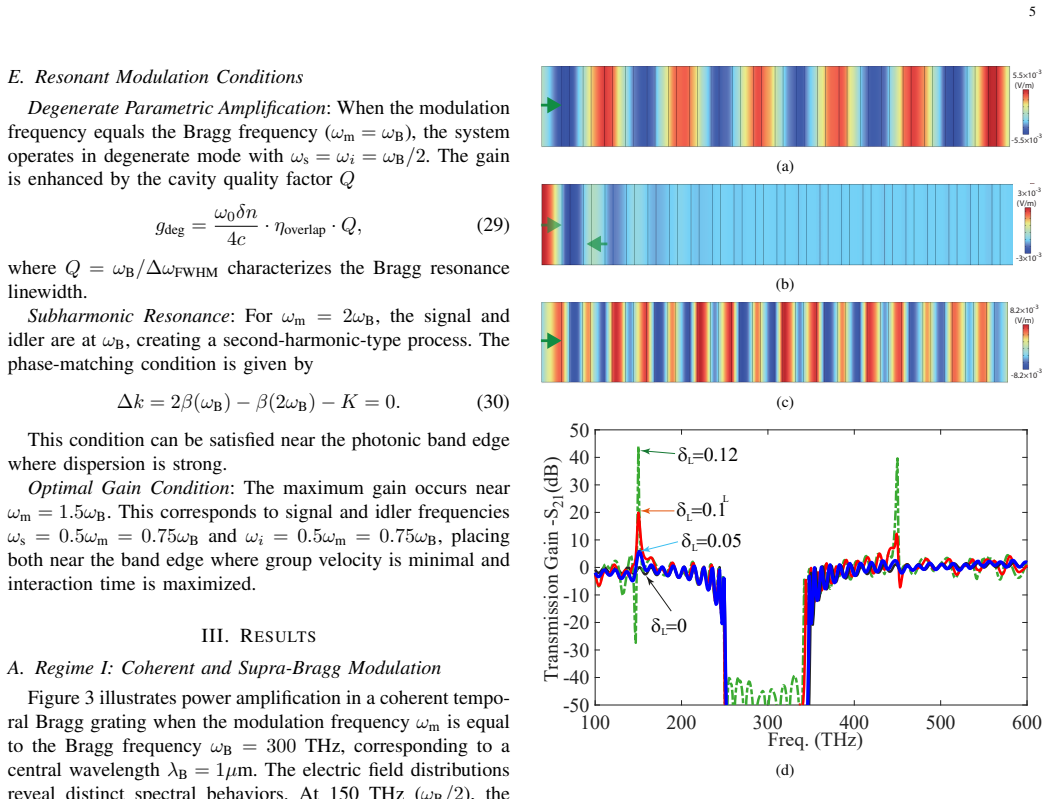
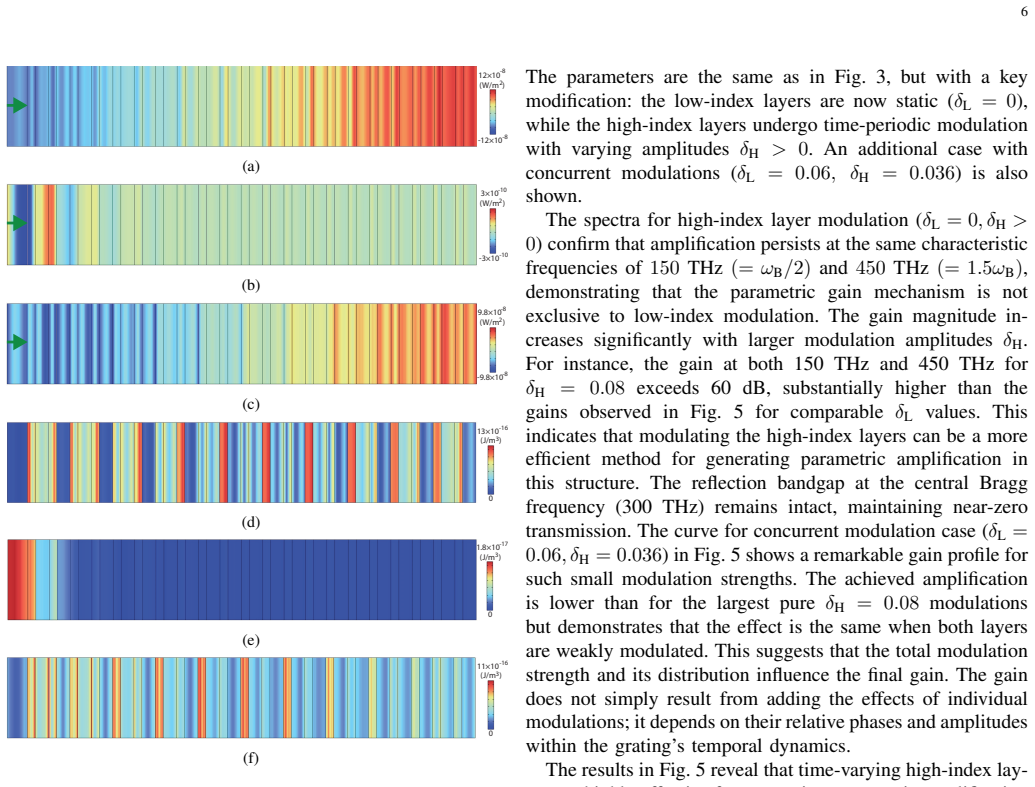
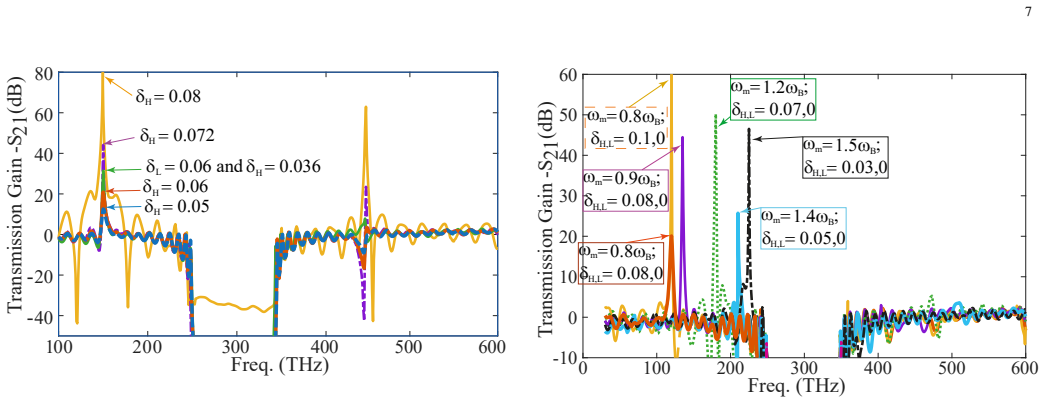
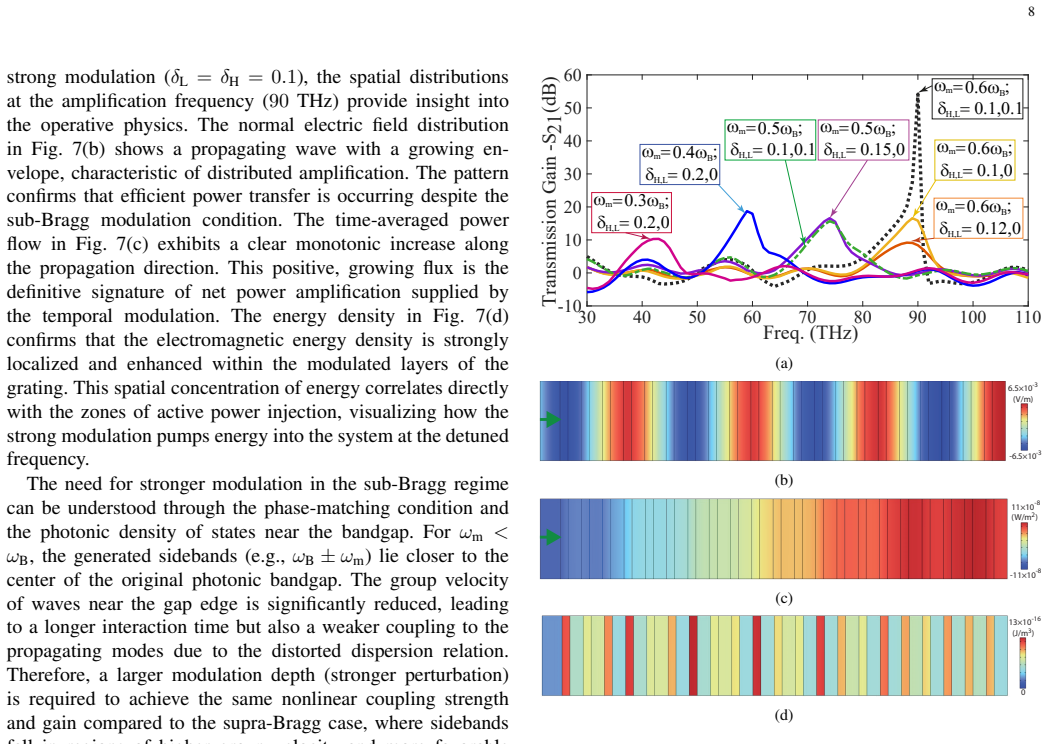
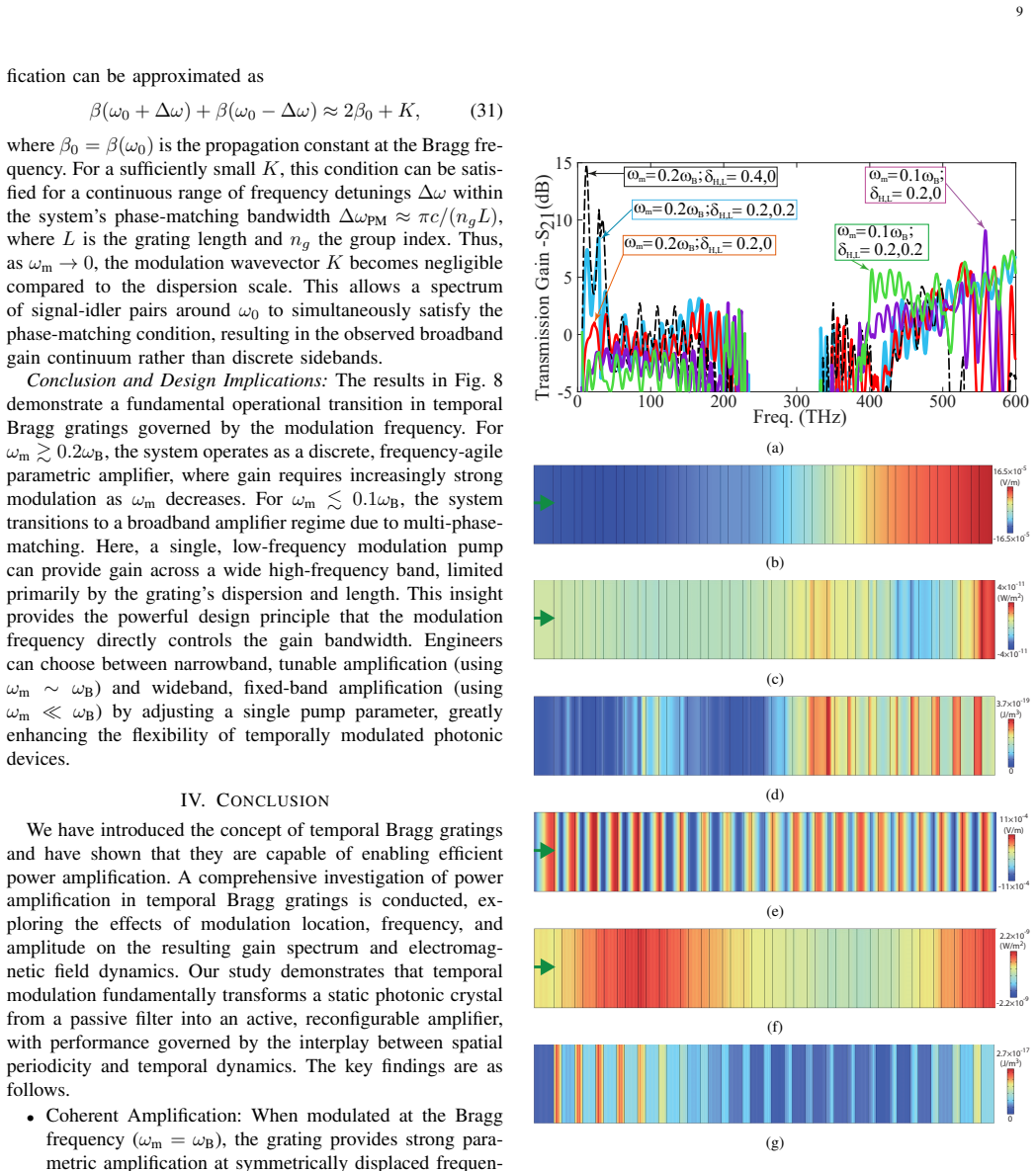
Temporal Bragg gratings consist of spatially periodic refractive-index structures whose index is modulated in time near the Bragg frequency. Numerical solutions of the resulting wave equation demonstrate that this temporal modulation produces parametric amplification whose peak frequencies can be shifted across a wide band by altering modulation parameters. High-index-layer modulation yields higher peak gain than low-index modulation for comparable index depths. The gain process is strongly asymmetric with respect to the Bragg condition, and in the deep sub-Bragg limit the discrete sideband structure collapses into a broadband continuum through simultaneous satisfaction of multiple phase-mil
What carries the argument
Temporal Bragg gratings: spatially periodic structures whose refractive index is varied in time near the Bragg frequency, creating time-dependent coupling between forward and backward waves that produces parametric gain.
If this is right
- Gain peaks can be shifted continuously across a broad frequency range simply by changing the temporal modulation frequency or amplitude.
- High-index-layer modulation produces higher amplification than low-index modulation at the same index depth.
- Supra-Bragg operation reaches useful gain with substantially weaker modulation than sub-Bragg operation.
- Extreme sub-Bragg detuning converts discrete sideband amplification into a continuous broadband gain spectrum through multi-phase-matching.
Where Pith is reading between the lines
- The same temporal-modulation principle could be applied to other wave systems such as acoustics or microwaves to create reconfigurable amplifiers without fixed spatial patterning.
- Design rules that favor supra-Bragg operation would minimize required modulation strength and associated power consumption.
- Inclusion of realistic material dispersion and loss would narrow the predicted gain bandwidth and set practical limits on achievable amplification.
- Integration with existing electro-optic or acousto-optic modulators could yield compact, electronically tunable optical amplifiers and frequency converters.
Load-bearing premise
The simulations assume ideal, lossless, instantaneous index modulation with no fabrication imperfections, material dispersion outside the modeled band, or nonlinear saturation.
What would settle it
Fabricate a temporally modulated periodic dielectric structure and measure its transmitted power spectrum while varying modulation frequency and depth; absence of the predicted tunable gain peaks or the sub-Bragg-to-broadband transition would falsify the central claim.
Figures

read the original abstract
This paper introduces temporal Bragg gratings as a new class of broadband, reconfigurable parametric amplifiers. We present a comprehensive investigation of power amplification in temporal Bragg gratings, spatially periodic structures with refractive index modulated near the Bragg frequency. Through systematic numerical simulations, we explore the effects of modulation location (high-index vs. low-index layers), frequency, and amplitude on gain spectra and field dynamics. Both layer types yield significant parametric amplification, with high-index modulation providing higher gain for comparable depths. Amplification is frequency-agile, with gain peaks tunable across a broad range, and exhibits strong asymmetry: the sub-Bragg regime requires substantially stronger modulation than supra-Bragg for comparable gain. In the extreme sub-Bragg limit, the system transitions from discrete sidebands to a broadband gain continuum via multi-phase-matching. These results establish a unified framework for designing reconfigurable optical amplifiers, tunable frequency converters, and broadband light sources using temporally modulated photonic crystals.
Editorial analysis
A structured set of objections, weighed in public.
Referee Report
Summary. The manuscript introduces temporal Bragg gratings as a new class of broadband reconfigurable parametric amplifiers consisting of spatially periodic refractive index modulations near the Bragg frequency. Through systematic numerical simulations, it reports significant parametric amplification for both high-index and low-index layer modulations (with higher gain for high-index), frequency-agile tunable gain peaks, strong asymmetry (sub-Bragg requiring stronger modulation than supra-Bragg for comparable gain), and a transition from discrete sidebands to a broadband gain continuum in the extreme sub-Bragg limit via multi-phase-matching.
Significance. If the reported trends prove robust, the work supplies a unified numerical framework for designing tunable optical amplifiers, frequency converters, and broadband sources based on temporally modulated photonic crystals. The systematic parameter sweeps over modulation location, frequency, and depth constitute a clear strength and enable concrete design guidelines.
major comments (2)
- [Numerical methods] Numerical methods section: the manuscript provides no information on the discretization scheme (e.g., FDTD grid size or time-stepping method), boundary conditions, or convergence tests. Because the central claims—gain spectra, sub-/supra-Bragg asymmetry, and the multi-phase-matching transition to a broadband continuum—rest entirely on these simulations, the absence of these details prevents independent verification of numerical accuracy.
- [Results on extreme sub-Bragg regime] Results on extreme sub-Bragg regime (likely §4 or equivalent): the transition to a broadband gain continuum is demonstrated only under the assumption of perfectly instantaneous, lossless index modulation at arbitrary depth and frequency. The paper does not examine how finite material response time or dispersion would detune the higher-order phase-matching conditions invoked to explain the continuum; this modeling choice directly affects the strongest claim and the reported quantitative gain values.
minor comments (1)
- [Abstract] Abstract: the phrase 'systematic numerical simulations' would be more informative if it indicated the range of modulation frequencies and depths explored.
Simulated Author's Rebuttal
We thank the referee for their constructive and detailed review. We address each major comment below and will revise the manuscript to improve clarity and reproducibility.
read point-by-point responses
-
Referee: [Numerical methods] Numerical methods section: the manuscript provides no information on the discretization scheme (e.g., FDTD grid size or time-stepping method), boundary conditions, or convergence tests. Because the central claims—gain spectra, sub-/supra-Bragg asymmetry, and the multi-phase-matching transition to a broadband continuum—rest entirely on these simulations, the absence of these details prevents independent verification of numerical accuracy.
Authors: We agree that additional details on the numerical implementation are necessary for independent verification. The simulations were performed with a custom 1D FDTD solver using a uniform spatial grid of 20 points per Bragg wavelength and a time step satisfying the CFL condition (Δt = Δx/(2c)). Perfectly matched layers were used at the domain boundaries to absorb outgoing waves. Convergence was confirmed by repeating key simulations with halved grid spacing, yielding gain spectra that agree to within 3% across the reported modulation depths and frequencies. In the revised manuscript we will add a dedicated Numerical Methods subsection that explicitly states the grid resolution, time-stepping scheme, boundary conditions, and convergence tests performed. revision: yes
-
Referee: [Results on extreme sub-Bragg regime] Results on extreme sub-Bragg regime (likely §4 or equivalent): the transition to a broadband gain continuum is demonstrated only under the assumption of perfectly instantaneous, lossless index modulation at arbitrary depth and frequency. The paper does not examine how finite material response time or dispersion would detune the higher-order phase-matching conditions invoked to explain the continuum; this modeling choice directly affects the strongest claim and the reported quantitative gain values.
Authors: The referee is correct that the model employs an idealized instantaneous, lossless index modulation. This choice isolates the parametric multi-phase-matching mechanism that produces the continuum. We will add a new paragraph in the revised manuscript that discusses the limitations of this assumption, including a qualitative estimate of the cutoff modulation frequency set by a finite material response time τ (roughly 1/τ) and the role of group-velocity dispersion in detuning higher-order phase-matching conditions. For ultrafast modulators (e.g., Kerr-based with sub-picosecond response), the reported continuum gain is expected to remain observable. If the referee considers it essential, we are prepared to include a brief set of additional simulations that incorporate a simple Debye-type relaxation for the index response. revision: partial
Circularity Check
No significant circularity; results from direct numerical simulation
full rationale
The paper derives its claims about parametric amplification, gain asymmetry, and the sub-Bragg continuum transition exclusively through systematic numerical simulations of the time-dependent wave equations under the stated modulation. No load-bearing step reduces a prediction to a fitted parameter, self-citation, or definitional tautology; the reported spectra and field dynamics are generated outputs of the model rather than rearrangements of its inputs. The modeling assumptions (lossless instantaneous modulation) are explicit and falsifiable by future experiments, but do not create circularity within the presented derivation chain.
Axiom & Free-Parameter Ledger
free parameters (2)
- modulation depth
- modulation frequency
axioms (1)
- standard math Electromagnetic wave propagation obeys Maxwell's equations in a linear, time-varying, spatially periodic dielectric.
invented entities (1)
-
temporal Bragg grating
no independent evidence
Lean theorems connected to this paper
-
IndisputableMonolith/Cost/FunctionalEquation.leanwashburn_uniqueness_aczel unclear?
unclearRelation between the paper passage and the cited Recognition theorem.
coupled-mode equations ... dA_p^+/dx = -j κ_p A_p^- e^{-j2Δ_p x} -j (ω_p/c) δn(x) Σ C_pq A_q^+ ...
-
IndisputableMonolith/Foundation/AlexanderDuality.leanalexander_duality_circle_linking unclear?
unclearRelation between the paper passage and the cited Recognition theorem.
multi-phase-matching ... β(ω0+Δω)+β(ω0-Δω)≈2β0+K for small K
What do these tags mean?
- matches
- The paper's claim is directly supported by a theorem in the formal canon.
- supports
- The theorem supports part of the paper's argument, but the paper may add assumptions or extra steps.
- extends
- The paper goes beyond the formal theorem; the theorem is a base layer rather than the whole result.
- uses
- The paper appears to rely on the theorem as machinery.
- contradicts
- The paper's claim conflicts with a theorem or certificate in the canon.
- unclear
- Pith found a possible connection, but the passage is too broad, indirect, or ambiguous to say the theorem truly supports the claim.
Reference graph
Works this paper leans on
-
[1]
A. Othonos, “Fiber Bragg gratings,”Rev. Sci. Instrum., vol. 68, no. 12, pp. 4309–4341, 1997
work page 1997
-
[2]
Fiber Bragg grating technology fundamentals and overview,
K. O. Hill and G. Meltz, “Fiber Bragg grating technology fundamentals and overview,”J. Light. Technol., vol. 15, no. 8, pp. 1263–1276, 2002
work page 2002
-
[3]
N. Ansari, E. Mohebbi, and K. Fallah, “Ultra-broadband and broad- angle absorbers with transition metal dichalcogenide monolayer using thue–morse quasi-photonic crystals,”Opt. Mater., vol. 107, p. 110039, 2020
work page 2020
-
[4]
Full-duplex reflective beamsteer- ing metasurface featuring magnetless nonreciprocal amplification,
S. Taravati and G. V . Eleftheriades, “Full-duplex reflective beamsteer- ing metasurface featuring magnetless nonreciprocal amplification,”Nat. Commun., vol. 14, p. 4414, 2021
work page 2021
-
[5]
Spatiotemporal photon blockade for nonreciprocal quantum absorption,
S. Taravati, “Spatiotemporal photon blockade for nonreciprocal quantum absorption,”arXiv preprint arXiv:2409.08137, 2024
-
[6]
4D wave transformations enabled by space-time metasurfaces: Foundations and illustrative examples,
S. Taravati and G. V . Eleftheriades, “4D wave transformations enabled by space-time metasurfaces: Foundations and illustrative examples,” IEEE Antennas Propag. Mag., vol. 65, no. 4, pp. 61–74, 2023
work page 2023
-
[7]
Efficient nonreciprocal frequency conversion with space- time Josephson junction metasurfaces,
S. Taravati, “Efficient nonreciprocal frequency conversion with space- time Josephson junction metasurfaces,” in2024 54th European Mi- crowave Conference (EuMC). IEEE, 2024, pp. 600–603
work page 2024
-
[8]
Electrically tunable space–time metasurfaces at optical frequencies,
J. Sisler, P. Thureja, M. Y . Grajower, R. Sokhoyan, I. Huang, and H. A. Atwater, “Electrically tunable space–time metasurfaces at optical frequencies,”Nat. Nanotechnol, pp. 1–8, 2024
work page 2024
-
[9]
Designing space-time metamaterials: The central role of dispersion engineering,
S. Taravati, “Designing space-time metamaterials: The central role of dispersion engineering,”arXiv preprint arXiv:2511.19541, 2025
-
[10]
Integrated waveguide Bragg gratings for microwave photonics signal processing,
M. Burla, L. R. Cort ´es, M. Li, X. Wang, L. Chrostowski, and J. Aza ˜na, “Integrated waveguide Bragg gratings for microwave photonics signal processing,”Optics express, vol. 21, no. 21, pp. 25 120–25 147, 2013
work page 2013
-
[11]
Tilted fiber Bragg grating sensors,
J. Albert, L.-Y . Shao, and C. Caucheteur, “Tilted fiber Bragg grating sensors,”Laser & Photonics Reviews, vol. 7, no. 1, pp. 83–108, 2013
work page 2013
-
[12]
Fiber Bragg grating sensor for accurate and sensitive detection of carbon dioxide concentration,
S. Song, L. Li, J. Chen, N. Zhong, Y . Liu, Y . He, H. Chang, B. Wan, D. Zhong, and Q. Xie, “Fiber Bragg grating sensor for accurate and sensitive detection of carbon dioxide concentration,”Sens. Actuator B Chem., vol. 404, p. 135264, 2024
work page 2024
-
[13]
Recent advancements of fiber Bragg grating sensors in biomedical application: a review,
R. Rohan, K. Venkadeshwaran, and P. Ranjan, “Recent advancements of fiber Bragg grating sensors in biomedical application: a review,”J. Opt., vol. 53, no. 1, pp. 282–293, 2024
work page 2024
-
[14]
Bragg grat- ing etalon-based optical fiber for ultrasound and optoacoustic detection,
T. A. La, O. ¨Ulgen, R. Shnaiderman, and V . Ntziachristos, “Bragg grat- ing etalon-based optical fiber for ultrasound and optoacoustic detection,” Nat. Commun., vol. 15, no. 1, p. 7521, 2024
work page 2024
-
[15]
Real-time monitoring of human breathing using wearable tilted fiber grating curvature sensors,
X. Xue, X. Han, L. Li, L. Min, D. You, and T. Guo, “Real-time monitoring of human breathing using wearable tilted fiber grating curvature sensors,”J. Light. Technol., vol. 41, no. 13, pp. 4531–4539, 2022
work page 2022
-
[16]
General design flow for waveguide Bragg gratings,
F. Br ¨uckerhoff-Pl¨uckelmann, T. Buskasper, J. R¨omer, L. Kr¨amer, B. Ma- lik, L. McRae, L. K ¨urpick, S. Palitza, C. Schuck, and W. Pernice, “General design flow for waveguide Bragg gratings,”Nanophotonics, vol. 14, no. 3, pp. 297–304, 2025
work page 2025
-
[17]
H. J. Eichler, P. G ¨unter, and D. W. Pohl,Laser-induced dynamic gratings. Springer, 2013, vol. 50
work page 2013
-
[18]
Dynamic modulation yields one-way beam splitting,
S. Taravati and A. A. Kishk, “Dynamic modulation yields one-way beam splitting,”Phys. Rev. B, vol. 99, no. 7, p. 075101, Jan. 2019
work page 2019
-
[19]
S. Taravati, “Giant linear nonreciprocity, zero reflection, and zero band gap in equilibrated space-time-varying media,”Phys. Rev. Appl., vol. 9, no. 6, p. 064012, Jun. 2018
work page 2018
-
[20]
Space-time modulation: Principles and applications,
S. Taravati and A. A. Kishk, “Space-time modulation: Principles and applications,”IEEE Microw. Mag., vol. 21, no. 4, pp. 30–56, 2020
work page 2020
-
[21]
Generalized space-time periodic diffraction gratings: Theory and applications,
S. Taravati and G. V . Eleftheriades, “Generalized space-time periodic diffraction gratings: Theory and applications,”Phys. Rev. Appl., vol. 12, no. 2, p. 024026, 2019
work page 2019
-
[22]
Advanced wave engineering via obliquely illuminated space-time-modulated slab,
S. Taravati and A. A. Kishk, “Advanced wave engineering via obliquely illuminated space-time-modulated slab,”IEEE Trans. Antennas Propa- gat., vol. 67, no. 1, pp. 270–281, 2019
work page 2019
-
[23]
Full-duplex nonreciprocal beam steering by time-modulated phase-gradient metasurfaces,
S. Taravati and G. V . Eleftheriades, “Full-duplex nonreciprocal beam steering by time-modulated phase-gradient metasurfaces,”Phys. Rev. Appl., vol. 14, no. 1, p. 014027, 2020
work page 2020
-
[24]
Temporal analog of Bragg gratings,
S. F. Koufidis, T. T. Koutserimpas, and M. W. McCall, “Temporal analog of Bragg gratings,”Optics Letters, vol. 48, no. 17, pp. 4500–4503, 2023
work page 2023
-
[25]
Microwave space-time-modulated metasurfaces,
S. Taravati and G. V . Eleftheriades, “Microwave space-time-modulated metasurfaces,”ACS Photonics, vol. 9, no. 2, pp. 305–318, 2022
work page 2022
-
[26]
Finite-difference time- domain simulation of wave transmission through space-time-varying media,
S. Taravati, A. A. Kishk, and G. V . Eleftheriades, “Finite-difference time- domain simulation of wave transmission through space-time-varying media,”arXiv preprint arXiv:2409.19923, 2024
-
[27]
One-way absorption and isolation in space-time-periodic superconducting metasurfaces,
S. Taravati, “One-way absorption and isolation in space-time-periodic superconducting metasurfaces,” in2024 Eighteenth International Congress on Artificial Materials for Novel Wave Phenomena (Meta- materials). IEEE, 2024, pp. 1–3
work page 2024
-
[28]
Lightweight low-noise linear isolator integrating phase-and amplitude-engineered temporal loops,
S. Taravati and G. V . Eleftheriades, “Lightweight low-noise linear isolator integrating phase-and amplitude-engineered temporal loops,” Adv. Mater. Technol, p. 2100674, 2021
work page 2021
-
[29]
Kapitza-inspired stabi- lization of non-foster circuits via time modulations,
A. Alex-Amor, G. Ptitcyn, and N. Engheta, “Kapitza-inspired stabi- lization of non-foster circuits via time modulations,”Phys. Rev. Appl., vol. 24, no. 2, p. 024022, 2025
work page 2025
-
[30]
S. Taravati, “Light transmission through space-time-modulated Joseph- son junction arrays and application to quantum angular-frequency beam multiplexing,”IEEE Trans. Antennas Propagat., 2025
work page 2025
-
[31]
A space-time holographic metasurface antenna,
G.-B. Wu, J. Y . Dai, Y . Sun, K. M. Shum, K. F. Chan, Q. Cheng, T. J. Cui, and C. H. Chan, “A space-time holographic metasurface antenna,” Sci. Adv., vol. 11, no. 38, p. eadx7090, 2025
work page 2025
-
[32]
Self-biased broadband magnet-free linear isolator based on one-way space-time coherency,
S. Taravati, “Self-biased broadband magnet-free linear isolator based on one-way space-time coherency,”Phys. Rev. B, vol. 96, no. 23, p. 235150, Dec. 2017
work page 2017
-
[33]
Space-time medium functions as a perfect antenna-mixer-amplifier transceiver,
S. Taravati and G. V . Eleftheriades, “Space-time medium functions as a perfect antenna-mixer-amplifier transceiver,”Phys. Rev. Appl., vol. 14, no. 5, p. 054017, 2020
work page 2020
-
[34]
Electrical resonances and power transfer mechanisms for time-varying circuits and systems,
A. Das and D. H. Werner, “Electrical resonances and power transfer mechanisms for time-varying circuits and systems,”AIP Advances, vol. 15, no. 11, 2025
work page 2025
-
[35]
Pure and linear frequency- conversion temporal metasurface,
S. Taravati and G. V . Eleftheriades, “Pure and linear frequency- conversion temporal metasurface,”Phys. Rev. Appl., vol. 15, no. 6, p. 064011, 2021
work page 2021
-
[36]
Aperiodic space-time modulation for pure frequency mix- ing,
S. Taravati, “Aperiodic space-time modulation for pure frequency mix- ing,”Phys. Rev. B, vol. 97, no. 11, p. 115131, 2018
work page 2018
-
[37]
Space-time metallic metasurfaces for frequency conversion and beamforming,
S. Moreno-Rodr ´ıguez, A. Alex-Amor, P. Padilla, J. F. Valenzuela- Vald´es, and C. Molero, “Space-time metallic metasurfaces for frequency conversion and beamforming,”Phys. Rev. Appl., vol. 21, no. 6, p. 064018, 2024
work page 2024
-
[38]
Beam steering toward multibeam radiation by time-coding metasurface antennas,
M. Nadi, A. Cheldavi, and S. H. Sedighy, “Beam steering toward multibeam radiation by time-coding metasurface antennas,”IEEE Trans- actions on Antennas and Propagation, vol. 72, no. 6, pp. 4829–4838, 2024
work page 2024
-
[39]
G.-B. Wu, J. Y . Dai, K. M. Shum, K. F. Chan, Q. Cheng, T. J. Cui, and C. H. Chan, “A synthetic moving-envelope metasurface antenna for independent control of arbitrary harmonic orders,”Nat. Commun., vol. 15, no. 1, p. 7202, 2024. 11
work page 2024
-
[40]
S. Taravati, “Frequency-multiplexed millimeter-wave fault-tolerant su- perconducting qubits enabled by an on-chip nonreciprocal control bus,” arXiv preprint arXiv:2512.17588, 2025
work page internal anchor Pith review arXiv 2025
-
[41]
A travelling-wave parametric amplifier,
A. Cullen, “A travelling-wave parametric amplifier,”Nat., vol. 181, no. 332, February 1958
work page 1958
-
[42]
A traveling-wave ferromagnetic amplifier,
P. Tien and H. Suhl, “A traveling-wave ferromagnetic amplifier,”Proc. IEEE, vol. 46, no. 4, pp. 700–706, 1958
work page 1958
-
[43]
Parametric amplification and frequency mixing in propagating circuits,
P. Tien, “Parametric amplification and frequency mixing in propagating circuits,”J. Appl. Phys., vol. 29, no. 9, pp. 1347–1357, 1958
work page 1958
-
[44]
Nonreciprocal sound propagation in space-time modulated media,
J. Li, C. Shen, X. Zhu, Y . Xie, and S. A. Cummer, “Nonreciprocal sound propagation in space-time modulated media,”Phys. Rev. B, vol. 99, no. 14, p. 144311, 2019
work page 2019
-
[45]
M. Sumetsky, “Transformation and amplification of light modulated by a traveling wave with a relatively low frequency,”Phys. Rev. Res., vol. 7, no. 4, p. 043066, 2025
work page 2025
-
[46]
Nonreciprocal entanglement of frequency-distinct qubits,
S. Taravati, “Nonreciprocal entanglement of frequency-distinct qubits,” Adv. Quantum Technol., vol. 8, no. 10, p. e2500171, 2025
work page 2025
discussion (0)
Sign in with ORCID, Apple, or X to comment. Anyone can read and Pith papers without signing in.