Secure Digital Semantic Communications: Fundamentals, Challenges, and Opportunities
Pith reviewed 2026-05-16 19:25 UTC · model grok-4.3
The pith
Digital semantic communications introduce distinct security vulnerabilities at bit, modulation, and protocol levels unlike analog methods.
A machine-rendered reading of the paper's core claim, the machinery that carries it, and where it could break.
Core claim
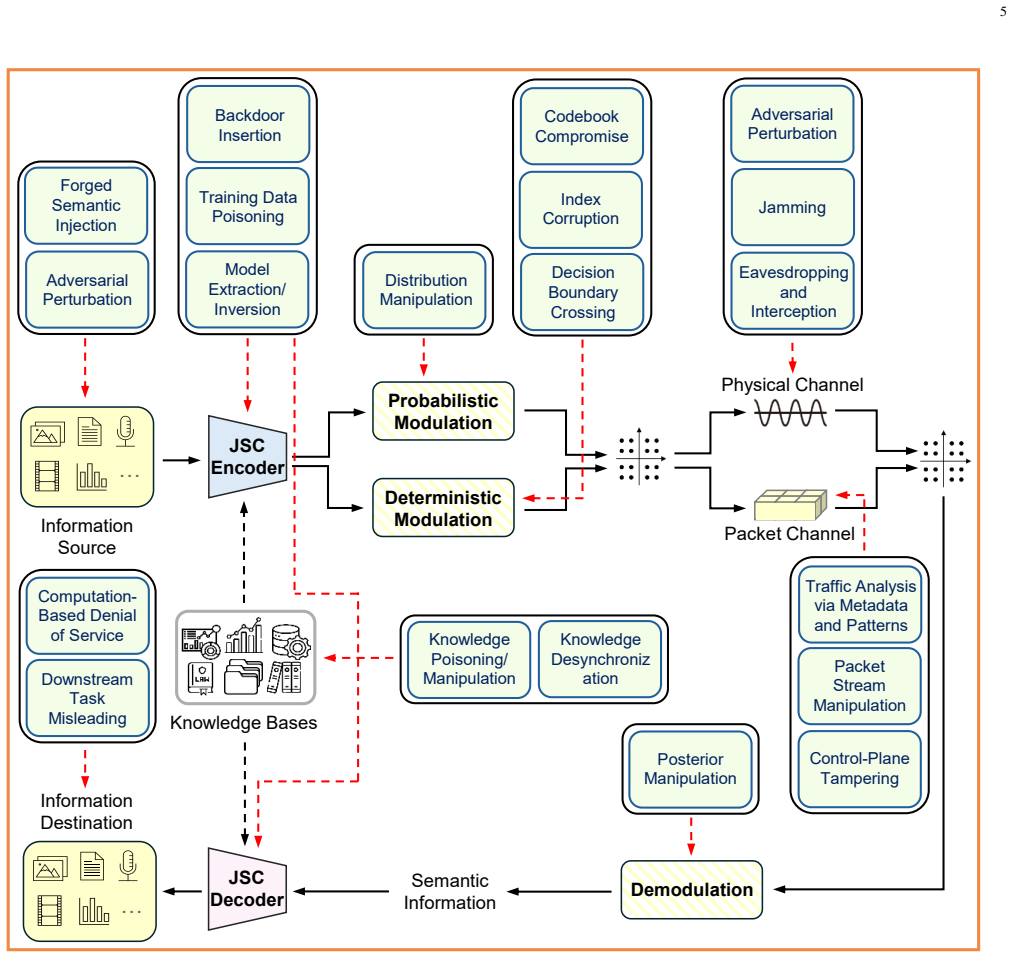
The paper establishes that digital SemCom, which transmits semantic information over a finite alphabet via explicit digital modulation following probabilistic or deterministic routes, creates vulnerabilities at the bit- or symbol-level semantic information, the modulation stage, and packet-based delivery and protocol operations; these differ from analog SemCom and require a dedicated organization of the threat landscape along with shared threats and potential defenses.
What carries the argument
The threat landscape specific to digital SemCom, organized around vulnerabilities in discrete semantic representation, modulation, and higher-layer protocol operations.
If this is right
- Targeted defenses can be designed for the discrete modulation and protocol stages of digital SemCom.
- Digital SemCom's compatibility with existing transceiver hardware makes addressing its specific threats essential for real-world deployment.
- Shared threats between analog and digital paradigms can be mitigated with strategies that apply across both.
- The organized landscape helps researchers identify gaps that future work on secure digital systems should fill.
- Open directions point toward systems that are simultaneously secure, efficient, and practical to implement.
Where Pith is reading between the lines
- The structure could guide protocol design for semantic communications in next-generation wireless standards.
- Empirical testing of the listed threats in deployed digital pipelines would validate or expand the categories.
- Hybrid approaches combining semantic defenses with classical cryptography might address both bit-level and meaning-level risks.
- Application-specific studies, such as in IoT or edge computing, could reveal additional digital SemCom vulnerabilities not covered here.
Load-bearing premise
Existing literature on secure semantic communications is mature enough to support a comprehensive and unbiased organization of the digital-specific threat landscape.
What would settle it
A subsequent study that uncovers major digital SemCom threats omitted from the organized landscape or demonstrates clear bias in the categorization would show the review is incomplete.
Figures




read the original abstract
Semantic communication (SemCom) has emerged as a promising paradigm for future wireless networks by prioritizing task-relevant meaning over raw data delivery, thereby reducing communication overhead and improving efficiency. However, shifting from bit-accurate transmission to task-oriented delivery introduces new security and privacy risks. These include semantic leakage, semantic manipulation, knowledge base vulnerabilities, model-related attacks, and threats to authenticity and availability. Most existing secure SemCom studies focus on analog SemCom, where semantic features are mapped to continuous channel inputs. In contrast, digital SemCom transmits semantic information through discrete bits or symbols within practical transceiver pipelines, offering stronger compatibility with realworld systems while exposing a distinct and underexplored attack surface. In particular, digital SemCom typically represents semantic information over a finite alphabet through explicit digital modulation, following two main routes: probabilistic modulation and deterministic modulation. These discrete mechanisms and practical transmission procedures introduce additional vulnerabilities affecting bit- or symbol-level semantic information, the modulation stage, and packet-based delivery and protocol operations. Motivated by these challenges and the lack of a systematic analysis of secure digital SemCom, this paper provides a structured review of the area. Specifically, we review SemCom fundamentals and clarify the architectural differences between analog and digital SemCom. We then summarize threats shared by both paradigms and organize the threat landscape specific to digital SemCom, followed by a discussion of potential defenses. Finally, we outline open research directions toward secure and deployable digital SemCom systems.
Editorial analysis
A structured set of objections, weighed in public.
Referee Report
Summary. The paper provides a structured literature review on secure digital semantic communications. It reviews SemCom fundamentals, clarifies the architectural differences between analog and digital SemCom (noting digital's use of discrete bits/symbols via probabilistic or deterministic modulation), summarizes threats shared by both paradigms, organizes the threat landscape specific to digital SemCom (covering semantic leakage, manipulation, knowledge base vulnerabilities, model attacks, and issues at bit/symbol, modulation, and packet levels), discusses potential defenses, and outlines open research directions for deployable systems.
Significance. If the categorization of threats and defenses proves accurate and balanced, the survey would provide a useful organizing framework for an emerging area, highlighting why digital SemCom's practical compatibility with existing transceiver pipelines creates a distinct attack surface compared to analog approaches. This could help direct research toward security mechanisms compatible with real-world wireless deployments.
major comments (2)
- [Threat landscape organization section] The organization of the digital-specific threat landscape (bit/symbol-level semantic information, modulation stage, packet-based delivery) is central to the paper's contribution, but the review should explicitly state the selection criteria for included papers and the total number reviewed per category to substantiate that the organization is comprehensive rather than selective.
- [Introduction and fundamentals review] The claim that digital SemCom exposes an 'underexplored attack surface' distinct from analog requires more concrete mapping to specific literature gaps; without this, the motivation for focusing on digital threats risks appearing asserted rather than evidenced by the cited works.
minor comments (3)
- [Fundamentals section] Define 'probabilistic modulation' and 'deterministic modulation' with a brief example or citation immediately upon first use in the fundamentals section, rather than assuming reader familiarity.
- [Architectural differences section] Ensure figure captions for any architecture diagrams explicitly label analog vs. digital pipelines to aid quick comparison.
- [Threats summary] Add a short table summarizing shared vs. digital-specific threats to improve readability and reinforce the paper's organizational contribution.
Simulated Author's Rebuttal
We thank the referee for the positive assessment and constructive feedback on our survey. We will revise the manuscript to address the two major comments by adding explicit details on literature selection and strengthening the evidence for the distinct attack surface in digital SemCom.
read point-by-point responses
-
Referee: [Threat landscape organization section] The organization of the digital-specific threat landscape (bit/symbol-level semantic information, modulation stage, packet-based delivery) is central to the paper's contribution, but the review should explicitly state the selection criteria for included papers and the total number reviewed per category to substantiate that the organization is comprehensive rather than selective.
Authors: We agree that adding explicit selection criteria and counts will improve transparency. In the revised manuscript, we will insert a new paragraph (likely in Section III or as a dedicated subsection) describing the literature search process, including databases queried (e.g., IEEE Xplore, arXiv), keywords used (e.g., 'semantic communication security', 'digital semantic modulation attacks'), inclusion criteria (peer-reviewed works from 2020 onward focusing on digital SemCom threats), and the total number of papers reviewed per subcategory (bit/symbol-level: X papers; modulation stage: Y papers; packet-based: Z papers). This will substantiate the organization without altering the existing structure. revision: yes
-
Referee: [Introduction and fundamentals review] The claim that digital SemCom exposes an 'underexplored attack surface' distinct from analog requires more concrete mapping to specific literature gaps; without this, the motivation for focusing on digital threats risks appearing asserted rather than evidenced by the cited works.
Authors: We will strengthen this by expanding the introduction and Section II with a concrete mapping. Specifically, we will add citations to recent analog SemCom security surveys (e.g., works on continuous semantic feature protection) and explicitly contrast them with the absence of equivalent analyses for discrete modulation and packet-level semantic integrity in digital pipelines. We will reference the limited coverage of bit/symbol vulnerabilities in existing digital SemCom papers to evidence the gap, while preserving the original claim that digital approaches remain compatible with legacy transceivers. revision: yes
Circularity Check
No significant circularity
full rationale
This paper is a structured literature survey that reviews semantic communication fundamentals, distinguishes analog versus digital architectures, summarizes shared threats, organizes the digital-specific threat landscape, discusses defenses, and lists open directions. It contains no derivations, equations, predictions, fitted parameters, or quantitative models. The contribution consists solely of selection and categorization of prior work, which does not reduce to any self-citation chain, ansatz, or input-by-construction step.
Axiom & Free-Parameter Ledger
Reference graph
Works this paper leans on
-
[1]
P. Zhang, W. Xu, Y . Liu, X. Qin, K. Niu, S. Cui, G. Shi, Z. Qin, X. Xu, F. Wang, Y . Meng, C. Dong, J. Dai, Q. Yang, Y . Sun, D. Gao, H. Gao, S. Han, and X. Song, “Intellicise wireless networks from semantic communications: A survey, research issues, and challenges,” IEEE Commun. Surv. Tutorials, vol. 27, no. 3, pp. 2051–2084, Jul. 2025
work page 2051
-
[2]
Less data, more knowledge: Building next-generation semantic communication networks,
C. Chaccour, W. Saad, M. Debbah, Z. Han, and H. V . Poor, “Less data, more knowledge: Building next-generation semantic communication networks,”IEEE Commun. Surv. Tutorials, vol. 27, no. 1, pp. 37–76, Jun. 2024
work page 2024
-
[3]
A survey of secure semantic communications,
R. Meng, S. Gao, D. Fan, H. Gao, Y . Wang, X. Xu, B. Wang, S. Lv, Z. Zhang, M. Sun, S. Han, C. Dong, X. Tao, and P. Zhang, “A survey of secure semantic communications,”J. Netw. Comput. Appl., vol. 239, p. 104181, Apr. 2025
work page 2025
-
[4]
Secure semantic communications: Fundamentals and challenges,
Z. Yang, M. Chen, G. Li, Y . Yang, and Z. Zhang, “Secure semantic communications: Fundamentals and challenges,”IEEE Netw., vol. 38, no. 6, pp. 513–520, Jun. 2024. 10
work page 2024
-
[5]
Secure semantic communications: Challenges, approaches, and opportunities,
M. Shen, J. Wang, H. Du, D. Niyato, X. Tang, J. Kang, Y . Ding, and L. Zhu, “Secure semantic communications: Challenges, approaches, and opportunities,”IEEE Netw., vol. 38, no. 4, pp. 197–206, Oct. 2023
work page 2023
-
[6]
Resource management, security, and privacy issues in semantic communications: A survey,
D. Won, G. Woraphonbenjakul, A. B. Wondmagegn, A. Tran, D. Lee, D. S. Lakew, and S. Cho, “Resource management, security, and privacy issues in semantic communications: A survey,”IEEE Commun. Surv. Tutorials, vol. 27, no. 3, pp. 1758–1797, Oct. 2024
work page 2024
-
[7]
A survey on semantic communication networks: Architecture, security, and privacy,
S. Guo, Y . Wang, N. Zhang, Z. Su, T. H. Luan, Z. Tian, and X. Shen, “A survey on semantic communication networks: Architecture, security, and privacy,”IEEE Commun. Surv. Tutorials, vol. 27, no. 5, pp. 2860–2894, Dec. 2024
work page 2024
-
[8]
Security and privacy challenges in semantic communication networks,
Q. T. Do, D. Won, T. S. Do, T. P. Truong, and S. Cho, “Security and privacy challenges in semantic communication networks,” inProc. ICAIIC 2025, Fukuoka, Japan, Feb. 2025, pp. 32–35
work page 2025
-
[9]
From analog to digital semantic communications: Architectures, challenges, and future directions,
J. Zou, W. Xie, J. Xiao, Y . Liang, J. M. Moualeu, and L. Yang, “From analog to digital semantic communications: Architectures, challenges, and future directions,”IEEE Wirel. Commun., vol. 32, no. 5, pp. 56–62, Sep. 2025
work page 2025
-
[10]
Toward compatible semantic communication: A perspective on digital coding and modula- tion,
G. Zhang, K. Zhou, Y . Cai, Q. Hu, and G. Yu, “Toward compatible semantic communication: A perspective on digital coding and modula- tion,”IEEE Commun. Mag., vol. 63, no. 12, pp. 156–162, Dec. 2025
work page 2025
-
[11]
Y . Bo, S. Shao, and M. Tao, “Deep learning-based superposition coded modulation for hierarchical semantic communications over broadcast channels,”IEEE Trans. Commun., vol. 73, no. 2, pp. 1186–1200, Aug. 2024
work page 2024
-
[12]
L. Guo, W. Chen, Y . Sun, and B. Ai, “Digital-sc: Digital semantic communication with adaptive network split and learned non-linear quantization,”IEEE Trans. Cogn. Commun. Netw., vol. 11, no. 4, pp. 2499–2511, Dec. 2024
work page 2024
-
[13]
W. Chen, S. Shao, Q. Yang, Z. Zhang, and P. Zhang, “A superposition code-based semantic communication approach with quantifiable and controllable security,”IEEE Trans. Mob. Comput., vol. 25, no. 2, pp. 2444–2461, Feb. 2026
work page 2026
-
[14]
Can knowledge improve security? a coding-enhanced jamming approach for semantic communication,
W. Chen, Q. Yang, S. Shao, Z. Shi, J. Chen, and X. S. Shen, “Can knowledge improve security? a coding-enhanced jamming approach for semantic communication,”IEEE J. Sel. Areas Commun. Early Access, pp. 1–16, Dec. 2025
work page 2025
-
[15]
Deep joint source-channel and encryption coding: Secure semantic communications,
T. Tung and D. G ¨und¨uz, “Deep joint source-channel and encryption coding: Secure semantic communications,” inProc. IEEE ICC, Rome, Italy, May 2023, pp. 5620–5625
work page 2023
discussion (0)
Sign in with ORCID, Apple, or X to comment. Anyone can read and Pith papers without signing in.