First measurement of the Hubble constant from a combined weak lensing and gravitational-wave standard siren analysis
Pith reviewed 2026-05-16 16:30 UTC · model grok-4.3
The pith
A joint analysis of gravitational-wave standard sirens with weak lensing and galaxy clustering data measures the Hubble constant at 67.9 km s^{-1} Mpc^{-1} with 6.4 percent uncertainty.
A machine-rendered reading of the paper's core claim, the machinery that carries it, and where it could break.
Core claim
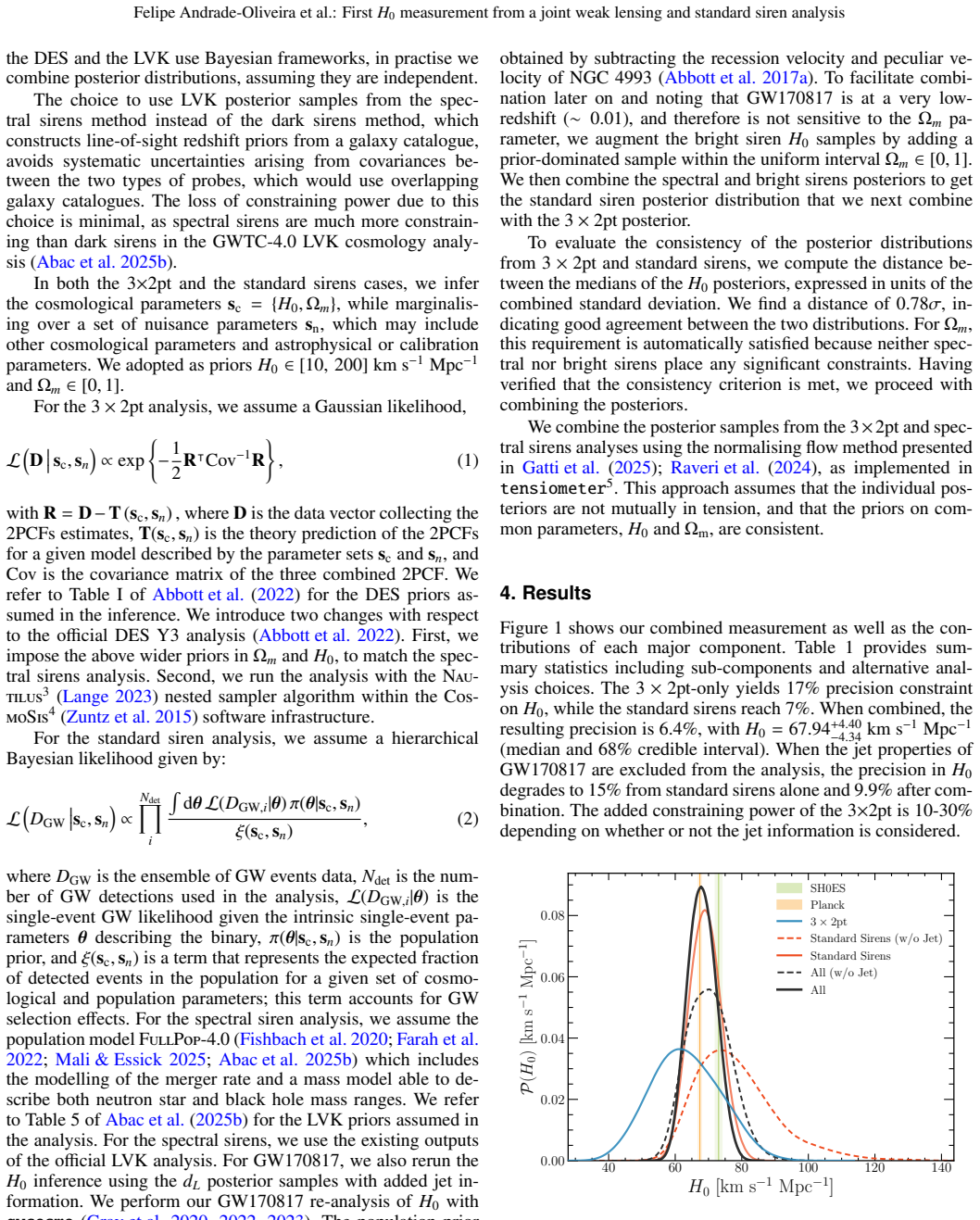
The authors construct a joint likelihood that combines the distance posterior from gravitational-wave standard sirens, including the inclination constraint from the superluminal jet of GW170817, with the 3x2pt weak-lensing and galaxy-clustering likelihood. This produces H0 = 67.9^{+4.4}_{-4.3} km s^{-1} Mpc^{-1} at 6.4 percent precision and improves the Omega_m constraint by 22 percent. The measurement remains consistent with other current determinations of the Hubble constant.
What carries the argument
The product of the standard-siren distance likelihood and the survey 3x2pt correlation-function likelihood, with the two datasets treated as statistically independent.
If this is right
- Standard sirens can be added to the cosmology pipelines of large galaxy surveys without requiring new hardware.
- The Hubble constant can be measured to 6.4 percent using existing gravitational-wave and survey catalogs.
- The matter density parameter Omega_m gains a 22 percent tighter bound from the combined data.
- Future gravitational-wave catalogs and survey releases will increase the precision of this joint approach.
Where Pith is reading between the lines
- The method offers an independent distance ladder that does not rely on the same calibration steps as Cepheid or supernova measurements.
- As the number of gravitational-wave events grows, the same framework can be applied to multiple sirens to reach sub-percent precision on H0.
- The approach can be tested by splitting the gravitational-wave sample into events with and without electromagnetic follow-up to check for hidden biases.
Load-bearing premise
The standard-siren likelihood and the weak-lensing plus clustering likelihood share no correlated systematics.
What would settle it
Detection of a statistically significant correlation between the gravitational-wave distance residuals and the lensing observables, or an independent H0 value lying well outside the reported 67.9^{+4.4}_{-4.3} interval, would falsify the joint result.
Figures

read the original abstract
We present a new measurement of the Hubble constant ($H_0$) resulting from the first joint analysis of standard sirens with weak gravitational lensing and galaxy clustering observables comprising three two-point correlation functions (3$\times$2pt). For the 3$\times$2pt component of the analysis, we use data from the Dark Energy Survey (DES) Year 3 release. For the standard sirens component, we use data from the Gravitational-Wave Transient Catalog 4.0 released by the LIGO-Virgo-KAGRA (LVK) Collaboration. For GW170817, the only standard siren for which extensive electromagnetic follow-up observations exist, we also use measurements of the host galaxy redshift and inclination angle estimates derived from observations of a superluminal jet from its remnant. Our joint analysis yields $H_0 = 67.9^{+4.4}_{-4.3}$~km~s$^{-1}$~Mpc$^{-1}$, a $6.4\%$ measurement, while improving the DES constraint on the total abundance of matter $\Omega_m$ by $22\%$. Removing the jet information degrades the $H_0$ precision to $9.9\%$. The measurement of $H_0$ remains a central problem in cosmology with a multitude of approaches being vigorously pursued in the community aiming to reconcile significantly discrepant measurements at the percent-level. In light of the impending new data releases from DES and LVK, and anticipating much more constraining power from 3$\times$2pt observables using newly commissioned survey instruments, we demonstrate that incorporating standard sirens into the cosmology framework of large cosmic surveys is a viable route towards that goal.
Editorial analysis
A structured set of objections, weighed in public.
Referee Report
Summary. The manuscript presents the first joint cosmological analysis combining gravitational-wave standard sirens from the LVK GWTC-4.0 catalog with DES Year 3 3×2pt weak-lensing and galaxy-clustering data. The authors multiply the respective likelihoods to obtain H0 = 67.9^{+4.4}_{-4.3} km s^{-1} Mpc^{-1} (6.4% precision) while reporting a 22% tightening of the DES constraint on Ω_m; removing the GW170817 jet-inclination information degrades the H0 precision to 9.9%.
Significance. If the independence assumption between the datasets holds, the work demonstrates a concrete route for incorporating standard sirens into the analysis pipelines of future wide-field surveys, potentially improving H0 constraints without requiring new instrumentation. The use of public catalogs, the explicit test removing jet information, and the focus on a single well-observed event are strengths that make the approach reproducible and extensible.
major comments (2)
- [Methods / Joint Likelihood] The joint posterior is obtained by multiplying the standard-siren likelihood and the DES 3×2pt likelihood (described in the Methods and Results sections). No cross-covariance matrix, mock-catalog validation, or null test is provided to justify the statistical independence assumption, despite overlapping redshift ranges between GW events and DES fields. This assumption directly determines the reported 6.4% H0 uncertainty and the 22% improvement on Ω_m, so its validity is load-bearing for the central claims.
- [Data and Likelihood for GW170817] For GW170817 the analysis incorporates the jet-inclination-derived distance and host redshift. No test is shown for possible residual correlations between these waveform-derived quantities and the DES lensing observables that could arise from shared large-scale structure or selection effects.
minor comments (2)
- [Abstract] The abstract states a 22% improvement on Ω_m but does not specify the baseline DES-only uncertainty value or the exact parameter combination used for the comparison; add this explicit number in the text.
- [Standard Sirens Component] Clarify whether the standard-siren likelihood includes the full GWTC-4.0 catalog or only a subset, and state the precise form of the distance posterior used.
Simulated Author's Rebuttal
We thank the referee for their constructive and detailed report. We address each major comment below. Where the manuscript requires strengthening, we have revised it accordingly; where full quantitative validation exceeds the scope of this work, we provide the strongest honest justification possible based on the data properties.
read point-by-point responses
-
Referee: [Methods / Joint Likelihood] The joint posterior is obtained by multiplying the standard-siren likelihood and the DES 3×2pt likelihood (described in the Methods and Results sections). No cross-covariance matrix, mock-catalog validation, or null test is provided to justify the statistical independence assumption, despite overlapping redshift ranges between GW events and DES fields. This assumption directly determines the reported 6.4% H0 uncertainty and the 22% improvement on Ω_m, so its validity is load-bearing for the central claims.
Authors: We agree that an explicit justification of the independence assumption is warranted. The standard-siren likelihood is driven by a single low-redshift event (GW170817) whose sky localization is a small fraction of the DES footprint, while the DES 3×2pt constraints are statistical averages over thousands of square degrees. Given the extreme sparsity of GW detections relative to the DES galaxy sample, any shared large-scale structure covariance is expected to be negligible compared with the reported uncertainties. We will add a new subsection to the Methods section that (i) states the independence assumption explicitly, (ii) provides a qualitative argument based on the differing selection functions and number densities, and (iii) includes an order-of-magnitude estimate demonstrating that the cross-term is sub-dominant. A full mock-catalog validation or cross-covariance matrix, however, would require joint simulations that are not available in the present analysis. revision: partial
-
Referee: [Data and Likelihood for GW170817] For GW170817 the analysis incorporates the jet-inclination-derived distance and host redshift. No test is shown for possible residual correlations between these waveform-derived quantities and the DES lensing observables that could arise from shared large-scale structure or selection effects.
Authors: The jet inclination is obtained from VLBI observations of the superluminal jet, and the host redshift is a spectroscopic measurement of NGC 4993; both are independent of the DES weak-lensing and clustering pipelines. The host galaxy constitutes a single object within the DES sample of millions, so its contribution to the global 3×2pt statistics is negligible. We will add a concise paragraph in the Data section explaining these points and confirming that no measurable bias is introduced at the current precision. revision: yes
- Full mock-catalog validation or explicit computation of a cross-covariance matrix between the GW standard-siren and DES 3×2pt likelihoods, which would require dedicated joint simulations beyond the scope of this first demonstration.
Circularity Check
No circularity: standard product of independent public-data likelihoods
full rationale
The derivation consists of a conventional Bayesian combination L_joint = L_siren(GWTC-4.0 + GW170817 EM data) × L_DES(Y3 3×2pt) under an explicit independence assumption. The reported H0 = 67.9^{+4.4}_{-4.3} posterior and the 22% tightening of Ω_m are direct numerical outputs of this product applied to external catalogs; no equation re-expresses the result as a function of itself, no fitted parameter is relabeled as a prediction, and no load-bearing step reduces to a self-citation chain. The analysis is therefore self-contained against external benchmarks and receives the default non-circularity finding.
Axiom & Free-Parameter Ledger
free parameters (2)
- H0
- Omega_m
axioms (2)
- domain assumption Gravitational-wave waveform models accurately recover luminosity distance
- domain assumption DES 3x2pt covariance and modeling are unbiased
Forward citations
Cited by 1 Pith paper
-
Prospects for multi-messenger discovery of the gravitational-wave background anisotropies via cross-correlation with galaxies
New simulations show that cross-correlating gravitational wave background anisotropies with galaxy distributions can enable discovery at angular scales of 4-6 degrees with next-generation observatories.
Reference graph
Works this paper leans on
-
[1]
Aasi, J. et al. 2015, Class. Quant. Grav., 32, 074001
work page 2015
-
[2]
Abac, A. G. et al. 2025b [arXiv:2509.04348]
work page internal anchor Pith review arXiv
-
[3]
Abac, A. G. et al. 2025c [arXiv:2508.18081]
-
[4]
Abac, A. G. et al. 2025d [arXiv:2508.18083]
work page internal anchor Pith review Pith/arXiv arXiv
-
[5]
Abac, A. G. et al. 2025e [arXiv:2508.18082]
work page internal anchor Pith review Pith/arXiv arXiv
-
[6]
Abbott, B. P. et al. 2019, Phys. Rev. X, 9, 031040
work page 2019
-
[7]
Abbott, B. P. et al. 2021, Astrophys. J., 909, 218
work page 2021
-
[8]
Abbott, R. et al. 2023, ApJ, 949, 76
work page 2023
-
[9]
Abbott, T. M. C. et al. 2022, Phys. Rev. D, 105, 023520
work page 2022
-
[10]
Acernese, F. et al. 2015, Class. Quant. Grav., 32, 024001
work page 2015
-
[11]
Aghanim, N. et al. 2020, Astron. Astrophys., 641, A6
work page 2020
-
[12]
Akutsu, T. et al. 2021, PTEP, 2021, 05A101
work page 2021
-
[13]
Amon, A. et al. 2022, Phys. Rev. D, 105, 023514
work page 2022
-
[14]
Blazek, J., MacCrann, N., Troxel, M. A., & Fang, X. 2019, Phys. Rev. D, 100, 103506
work page 2019
-
[15]
R., Alfradique, V ., Palmese, A., et al
Bom, C. R., Alfradique, V ., Palmese, A., et al. 2024, MNRAS, 535, 961
work page 2024
-
[16]
Camphuis, E. et al. 2025 [arXiv:2506.20707]
work page internal anchor Pith review Pith/arXiv arXiv 2025
-
[17]
Carrick, J., Turnbull, S. J., Lavaux, G., & Hudson, M. J. 2015, MNRAS, 450, 317
work page 2015
-
[18]
Casertano, S. et al. 2025 [arXiv:2510.23823]
work page internal anchor Pith review Pith/arXiv arXiv 2025
-
[19]
Cawthon, R. et al. 2022, MNRAS, 513, 5517
work page 2022
-
[20]
Crook, A. C., Huchra, J. P., Martimbeau, N., et al. 2007, ApJ, 655, 790 de Matos, I. S., Dalang, C., Baker, T., et al. 2025 [arXiv:2512.15380] De Vicente, J., Sánchez, E., & Sevilla-Noarbe, I. 2016, MNRAS, 459, 3078 Di Valentino, E. & Brout, D., eds. 2024, The Hubble Constant Tension (Springer)
- [21]
-
[22]
Elvin-Poole, J. et al. 2023, MNRAS, 523, 3649
work page 2023
-
[23]
Essick, R. et al. 2025, Phys. Rev. D, 112, 102001
work page 2025
- [24]
-
[25]
M., Fishbach, M., Essick, R., Holz, D
Farah, A. M., Fishbach, M., Essick, R., Holz, D. E., & Galaudage, S. 2022, ApJ, 931, 108
work page 2022
-
[26]
Finke, A., Foffa, S., Iacovelli, F., Maggiore, M., & Mancarella, M. 2021, JCAP, 08, 026
work page 2021
-
[27]
Fishbach, M., Essick, R., & Holz, D. E. 2020, ApJ, 899, L8
work page 2020
-
[28]
Flaugher, B., Diehl, H. T., Honscheid, K., et al. 2015, AJ, 150, 150
work page 2015
-
[29]
Friedrich, O. et al. 2021, MNRAS, 508, 3125
work page 2021
-
[30]
Gatti, M. et al. 2021, MNRAS, 504, 4312
work page 2021
-
[31]
Gatti, M. et al. 2025, Phys. Rev. D, 111, 063504
work page 2025
-
[32]
Giannini, G. et al. 2024, MNRAS, 527, 2010
work page 2024
- [33]
-
[34]
Gray, R. et al. 2020, Phys. Rev. D, 101, 122001
work page 2020
-
[35]
Gray, R. et al. 2023, JCAP, 12, 023
work page 2023
-
[36]
Heymans, C. et al. 2021, A&A, 646, A140
work page 2021
-
[37]
Holz, D. E. & Hughes, S. A. 2005, ApJ, 629, 15
work page 2005
-
[38]
Hotokezaka, K., Nakar, E., Gottlieb, O., et al. 2019, Nature Astron., 3, 940
work page 2019
-
[39]
Hou, Z. et al. 2018, Astrophys. J., 853, 3
work page 2018
-
[40]
Karathanasis, C., Mukherjee, S., & Mastrogiovanni, S. 2023, MNRAS, 523, 4539
work page 2023
- [41]
- [42]
-
[43]
Lange, J. U. 2023, MNRAS, 525, 3181
work page 2023
-
[44]
Louis, T. et al. 2025, JCAP, 11, 062
work page 2025
-
[45]
MacCrann, N. et al. 2021, MNRAS, 509, 3371
work page 2021
- [46]
- [47]
-
[48]
Mastrogiovanni, S., Laghi, D., Gray, R., et al. 2023, Phys. Rev. D, 108, 042002
work page 2023
-
[49]
Miyatake, H. et al. 2023, Phys. Rev. D, 108, 123517
work page 2023
-
[50]
Mooley, K. P., Deller, A. T., Gottlieb, O., et al. 2018, Nature, 561, 355
work page 2018
-
[51]
Mukherjee, S., Krolewski, A., Wandelt, B. D., & Silk, J. 2024, Astrophys. J., 975, 189 Müller, M., Mukherjee, S., & Ryan, G. 2024, Astrophys. J. Lett., 977, L45
work page 2024
-
[52]
Palmese, A., Bom, C. R., Mucesh, S., & Hartley, W. G. 2023, ApJ, 943, 56
work page 2023
-
[53]
Pandey, S. et al. 2022, Phys. Rev. D, 106, 043520
work page 2022
-
[54]
Porredon, A. et al. 2021, Phys. Rev. D, 103, 043503
work page 2021
-
[55]
Porredon, A. et al. 2022, Phys. Rev. D, 106, 103530
work page 2022
-
[56]
Prat, J. et al. 2022, Phys. Rev. D, 105, 083528
work page 2022
-
[57]
Raveri, M., Doux, C., & Pandey, S. 2024 [arXiv:2409.09101]
-
[58]
Riess, A. G. et al. 2022, Astrophys. J. Lett., 934, L7 Rodríguez-Monroy, M. et al. 2022, MNRAS, 511, 2665
work page 2022
-
[59]
Secco, L. F. et al. 2022, Phys. Rev. D, 105, 023515
work page 2022
-
[60]
Sevilla-Noarbe, I. et al. 2021, Astrophys. J. Suppl., 254, 24
work page 2021
-
[61]
Soares-Santos, M. et al. 2019, Astrophys. J. Lett., 876, L7
work page 2019
-
[62]
Inferring the properties of a population of compact binaries in presence of selection effects
Vitale, S., Gerosa, D., Farr, W. M., & Taylor, S. R. 2020 [arXiv:2007.05579]
work page internal anchor Pith review Pith/arXiv arXiv 2020
-
[63]
Wright, A. H. et al. 2025, Astron. Astrophys., 703, A158
work page 2025
-
[64]
Zuntz, J., Paterno, M., Jennings, E., et al. 2015, Astron. Comput., 12, 45 Article number, page 5
work page 2015
discussion (0)
Sign in with ORCID, Apple, or X to comment. Anyone can read and Pith papers without signing in.