Recognition: 2 theorem links
· Lean TheoremProspects for multi-messenger discovery of the gravitational-wave background anisotropies via cross-correlation with galaxies
Pith reviewed 2026-05-13 02:27 UTC · model grok-4.3
The pith
4.1-degree resolution allows discovery of gravitational-wave background anisotropies in five years
A machine-rendered reading of the paper's core claim, the machinery that carries it, and where it could break.
Core claim
For compact binaries up to redshift less than 3, cross-correlation with galaxies requires an angular resolution of 4.1 degrees to discover the anisotropies within five years, using a catalogue complete to limiting magnitude 24.7 with redshift uncertainty 0.003 times (1 plus z). Ten years of data improves this to 6.5 degrees. Without the galaxy tracer, discovery demands excluding loud events, 1.8-degree resolution, and a favourable rate.
What carries the argument
The angular cross-power spectrum between gravitational-wave sky maps and galaxy overdensities, which captures the shared clustering of merger sites.
If this is right
- Redshift binning reconstructs the evolution of the gravitational-wave background kernel.
- This reconstruction further constrains models of the compact binary population.
- Gravitational-wave only analysis across time bins requires excluding loudest events for potential discovery.
Where Pith is reading between the lines
- Different source populations could alter the required resolution for detection.
- Improved galaxy surveys would lower the resolution threshold needed.
- This cross-correlation technique may extend to other stochastic backgrounds in multi-messenger contexts.
Load-bearing premise
The assumed population of stellar-mass compact binary coalescences matches reality and the galaxy catalogue traces their locations without major biases.
What would settle it
No cross-correlation signal appears in the data even after five years of observations with 4.1-degree angular resolution and a suitable galaxy catalogue.
Figures




read the original abstract
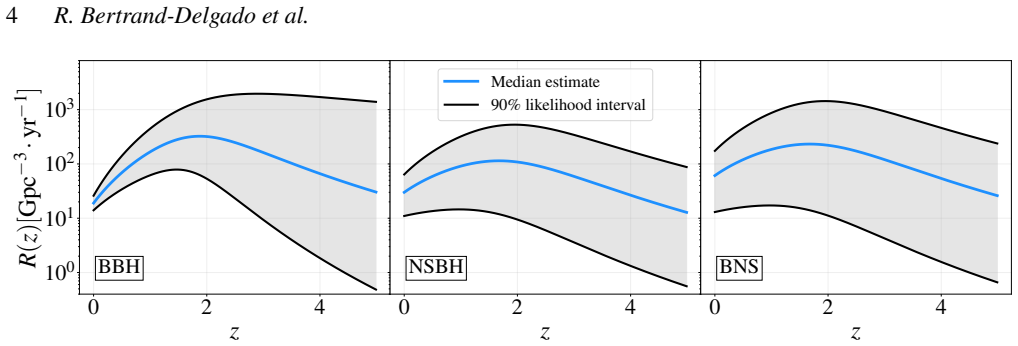
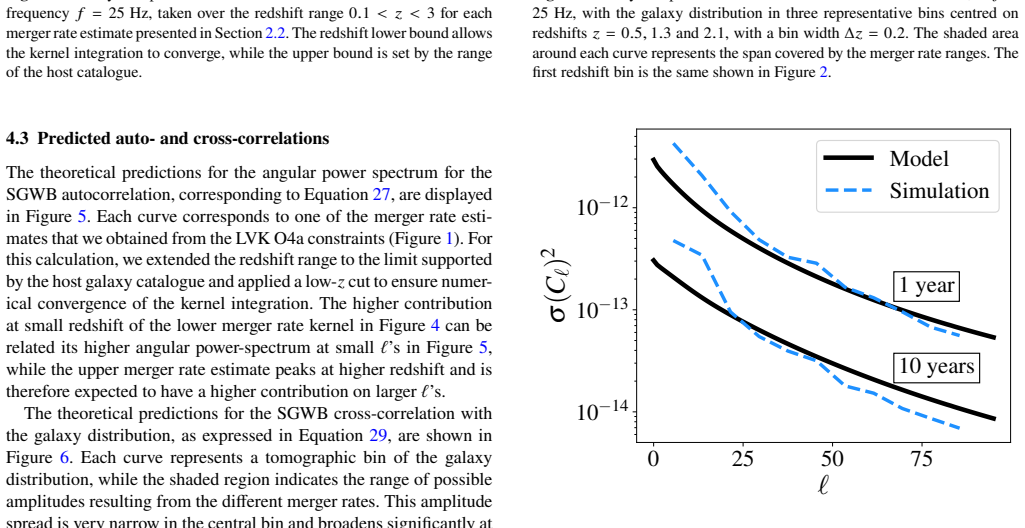
We present new empirically grounded forecasts for the detectability of the stochastic gravitational-wave background anisotropies assuming a population of stellar-mass compact binary coalescences as its source. We quantified the discovery potential using simulations based on the Euclid Flagship Galaxy Catalogue and LIGO-Virgo-KAGRA observational constraints in combination with detailed theoretical modelling. We considered the multi-messenger cross-correlation with galaxies as well as the gravitational wave-only cross-correlation across observation-time bins. For compact binaries up to redshift $z<3$, we found that an angular resolution of $\theta = 4.1$ deg ($\ell \geq 44$) is required for discovery within five years of observation via cross-correlation with a galaxy catalogue that is complete up to limiting magnitude $i < 24.7$ and has redshift uncertainties $\sigma_z = 0.003 (1+z)$. Extending the time range to ten years alleviates that requirement to $\theta = 6.5$ deg ($\ell \geq 28$). We also showed that binning the galaxies in redshift allows us to reconstruct the evolution of the kernel, which can be used to further constrain compact binary population models. Discovery without a multi-messenger tracer has proven significantly more challenging, requiring exclusion of the loudest events, $\theta = 1.8$ deg ($\ell \geq 95$), and a favourable coalescence rate. In light of the plans being carried out in the community for ongoing and upcoming galaxy surveys, this work bodes well for the multi-messenger discovery and exploration of the stochastic gravitational-wave background in the era of next-generation observatories such as the Einstein Telescope and Cosmic Explorer.
Editorial analysis
A structured set of objections, weighed in public.
Referee Report
Summary. The manuscript presents empirically grounded forecasts for the detectability of anisotropies in the stochastic gravitational-wave background sourced by stellar-mass compact binary coalescences. Using simulations from the Euclid Flagship Galaxy Catalogue combined with LIGO-Virgo-KAGRA observational constraints and theoretical modeling, it quantifies the discovery potential through multi-messenger cross-correlations with galaxies and GW-only cross-correlations across time bins. The key result is that for sources up to z < 3, an angular resolution of θ = 4.1 deg (ℓ ≥ 44) is required for discovery within five years via cross-correlation with a galaxy catalog complete to i < 24.7 with redshift uncertainty σ_z = 0.003(1 + z). Extending to ten years relaxes this to θ = 6.5 deg (ℓ ≥ 28). Redshift binning is shown to allow reconstruction of the kernel evolution for constraining population models, while GW-only detection is more challenging.
Significance. If the modeling assumptions hold, this paper offers valuable, concrete guidance for the multi-messenger detection of the stochastic GW background anisotropies in the era of next-generation detectors like the Einstein Telescope and Cosmic Explorer. The forecasts leverage existing observational constraints and planned galaxy surveys, providing a pathway to both discovery and additional constraints on compact binary populations through kernel reconstruction. This is particularly timely given ongoing developments in GW observatories and large-scale structure surveys.
major comments (1)
- [Cross-correlation forecasts and SNR calculation] The headline requirement of θ = 4.1 deg for 5-year discovery (abstract and cross-correlation results) relies on the assumption that the galaxy catalog traces the compact binary merger locations with correlation coefficient r ≈ 1 on relevant scales. The manuscript does not appear to marginalize over or simulate realistic host-galaxy biases (e.g., due to metallicity dependence or star-formation rate weighting), which could reduce the effective signal amplitude and increase the required angular resolution. This assumption is load-bearing for the quoted angular-resolution threshold.
minor comments (2)
- [Abstract] The abstract could more explicitly state the range of coalescence rates considered or the specific population model parameters from LVK constraints to allow readers to assess the sensitivity of the results.
- [Results section] Some figures showing the SNR as a function of ℓ or observation time might benefit from including sensitivity curves for reduced correlation coefficient r to illustrate robustness against host biases.
Simulated Author's Rebuttal
We thank the referee for their positive and constructive assessment of our manuscript. We address the single major comment below and agree that the assumption of near-perfect tracing merits explicit discussion. We will revise the paper accordingly.
read point-by-point responses
-
Referee: [Cross-correlation forecasts and SNR calculation] The headline requirement of θ = 4.1 deg for 5-year discovery (abstract and cross-correlation results) relies on the assumption that the galaxy catalog traces the compact binary merger locations with correlation coefficient r ≈ 1 on relevant scales. The manuscript does not appear to marginalize over or simulate realistic host-galaxy biases (e.g., due to metallicity dependence or star-formation rate weighting), which could reduce the effective signal amplitude and increase the required angular resolution. This assumption is load-bearing for the quoted angular-resolution threshold.
Authors: We agree that the quoted angular-resolution thresholds assume a high correlation coefficient (r ≈ 1) between the galaxy distribution and the compact-binary merger locations. In the current analysis we directly populate the Euclid Flagship galaxies with mergers whose rate is normalized to LIGO-Virgo-KAGRA constraints, thereby implicitly adopting r ≈ 1 on the scales of interest. We did not introduce additional host-galaxy selection effects such as metallicity-dependent suppression or explicit SFR weighting beyond the simulation’s built-in star-formation history. This is a deliberate simplification for the forecast, but we recognize it is load-bearing for the headline numbers. In the revised manuscript we will (i) add a dedicated paragraph in Section 3.2 explicitly stating the r ≈ 1 assumption, (ii) provide a simple scaling relation showing how the cross-correlation SNR and required θ degrade for r < 1, and (iii) discuss the plausible range of r based on existing literature on metallicity and SFR biases. These additions will make the robustness of the result transparent without altering the core methodology. revision: yes
Circularity Check
No significant circularity; forecasts rely on external catalogs and constraints
full rationale
The paper computes discovery thresholds for GW background anisotropies by evaluating the signal-to-noise ratio of the cross-power spectrum C_ℓ^{GW-g} using the external Euclid Flagship Galaxy Catalogue as the tracer population and LVK observational constraints to fix the compact-binary merger rate density. These inputs are independent of the paper's own results; the angular-resolution requirements (θ = 4.1 deg for 5 yr, etc.) are outputs of the SNR calculation rather than inputs that are redefined or refitted inside the work. No self-citation chain, ansatz smuggling, or fitted-parameter-renamed-as-prediction is present in the derivation. The modeling assumptions (e.g., r ≈ 1 correlation) are stated explicitly as modeling choices and do not reduce the quoted forecast to a tautology.
Axiom & Free-Parameter Ledger
free parameters (2)
- coalescence rate =
based on LVK constraints
- angular resolution thresholds =
4.1 deg, 6.5 deg
axioms (2)
- domain assumption The galaxy catalogue traces the distribution of compact binary mergers
- domain assumption The stochastic GW background is dominated by stellar-mass compact binaries
Lean theorems connected to this paper
-
IndisputableMonolith/Cost/FunctionalEquation.leanwashburn_uniqueness_aczel unclear?
unclearRelation between the paper passage and the cited Recognition theorem.
We quantified the discovery potential using simulations based on the Euclid Flagship Galaxy Catalogue and LIGO-Virgo-KAGRA observational constraints... angular resolution of θ = 4.1 deg (ℓ ≥ 44)
-
IndisputableMonolith/Foundation/RealityFromDistinction.leanreality_from_one_distinction unclear?
unclearRelation between the paper passage and the cited Recognition theorem.
Ω_GW(f_o, ê) = ... ∫ dz dθ R^[i](z,ê,θ) ... kernel W(r,f_o) := (1/4π) ∂_r Ω_GW
What do these tags mean?
- matches
- The paper's claim is directly supported by a theorem in the formal canon.
- supports
- The theorem supports part of the paper's argument, but the paper may add assumptions or extra steps.
- extends
- The paper goes beyond the formal theorem; the theorem is a base layer rather than the whole result.
- uses
- The paper appears to rely on the theorem as machinery.
- contradicts
- The paper's claim conflicts with a theorem or certificate in the canon.
- unclear
- Pith found a possible connection, but the passage is too broad, indirect, or ambiguous to say the theorem truly supports the claim.
Reference graph
Works this paper leans on
-
[1]
GW170817: Implications for the Stochastic Gravitational-Wave Background from Compact Binary Coalescences , author =. Phys. Rev. Lett. , volume =. 2018 , month =. doi:10.1103/PhysRevLett.120.091101 , url =
-
[2]
Linear Power Spectrum of Observed Source Number Counts , author =. Physical Review D , volume =. doi:10.1103/PhysRevD.84.043516 , urldate =
-
[3]
Euclid: Calibrating photometric redshifts with spectroscopic cross-correlations. , keywords =. doi:10.1051/0004-6361/202244795 , archivePrefix =. 2208.10503 , primaryClass =
-
[4]
Very Fast Stochastic Gravitational Wave Background Map Making Using Folded Data , author =. Physical Review D , volume =. doi:10.1103/PhysRevD.98.024001 , urldate =. arXiv , keywords =:1803.08285 , primaryclass =
-
[5]
LoVerde, Marilena and Afshordi, Niayesh , year = 2008, month = dec, journal =. Extended. doi:10.1103/PhysRevD.78.123506 , urldate =. arXiv , keywords =:0809.5112 , primaryclass =
-
[6]
Research in Astronomy and Astrophysics , author =
The astrophysical gravitational wave stochastic background , volume =. Research in Astronomy and Astrophysics , author =. 2011 , pages =. doi:10.1088/1674-4527/11/4/001 , number =
-
[7]
Scalar-induced gravitational waves from coherent initial states , volume =. Physical Review D , author =. 2026 , pages =. doi:10.1103/qd1s-9fxl , language =
-
[8]
Uncertainty in predicting the stochastic gravitational wave background from compact binary coalescences , volume =. Physical Review D , author =. 2026 , pages =. doi:10.1103/p3dn-x5sp , language =
-
[9]
Journal of Cosmology and Astroparticle Physics , author =
Reconstructing primordial curvature perturbations via scalar-induced gravitational waves with. Journal of Cosmology and Astroparticle Physics , author =. 2025 , pages =. doi:10.1088/1475-7516/2025/05/062 , abstract =
-
[10]
Likelihoods for stochastic gravitational wave background data analysis , volume =. Physical Review D , author =. 2025 , pages =. doi:10.1103/sjtb-gnz5 , abstract =
-
[11]
Cross-correlation of the astrophysical gravitational-wave background with galaxy clustering , volume =. Physical Review D , author =. 2020 , pages =. doi:10.1103/PhysRevD.102.043513 , language =
-
[12]
Reports on Progress in Physics , author =
Stochastic gravitational wave backgrounds , volume =. Reports on Progress in Physics , author =. 2018 , pages =. doi:10.1088/1361-6633/aae6b5 , abstract =
-
[13]
Abac, Adrian and Abramo, Raul and Albanesi, Simone and Albertini, Angelica and Agapito, Alessandro and Agathos, Michalis and Albertus, Conrado and Andersson, Nils and Andrade, Tomas and Andreoni, Igor and Angeloni, Federico and Antonelli, Marco and Antoniadis, John and Antonini, Fabio and Sedda, Manuel Arca and Artale, M. Celeste and Ascenzi, Stefano and ...
work page internal anchor Pith review Pith/arXiv arXiv doi:10.48550/arxiv.2503.12263
-
[14]
Raghunathan, S. and Ade, P. A. R. and Anbajagane, D. and Anderson, A. J. and Ansarinejad, B. and Archipley, M. and Austermann, J. E. and Balkenhol, L. and Barron, D. R. and Barry, P. S. and Beall, J. A. and Benabed, K. and Bender, A. N. and Benson, B. A. and Bianchini, F. and Bleem, L. E. and Bock, J. and Bocquet, S. and Bouchet, F. R. and Bryant, L. and ...
-
[15]
Monthly Notices of the Royal Astronomical Society , author =
Mapping gas around massive galaxies: cross-correlation of. Monthly Notices of the Royal Astronomical Society , author =. 2023 , note =. doi:10.1093/mnras/stad1167 , abstract =
-
[16]
Astronomy & Astrophysics , author =
How accurate is. Astronomy & Astrophysics , author =. 2007 , pages =. doi:10.1051/0004-6361:20066352 , number =
-
[17]
The Astrophysical Journal Supplement Series , author =
Core. The Astrophysical Journal Supplement Series , author =. 2019 , note =. doi:10.3847/1538-4365/ab1658 , abstract =
-
[18]
The Flagship galaxy mock catalogue: A comprehensive simulation for the Euclid mission
Euclid. Astronomy & Astrophysics , author =. 2025 , note =. doi:10.1051/0004-6361/202450853 , abstract =
-
[19]
Physical Review Letters , author =
Upper. Physical Review Letters , author =. 2017 , note =. doi:10.1103/PhysRevLett.118.121101 , abstract =
-
[20]
Upper Limits on the Isotropic Gravitational-Wave Background from the first part of LIGO, Virgo, and KAGRA's fourth Observing Run. arXiv e-prints , keywords =. doi:10.48550/arXiv.2508.20721 , archivePrefix =. 2508.20721 , primaryClass =
-
[21]
The population of merging compact binaries inferred using gravitational waves through. Physical Review X , author =. 2023 , note =. doi:10.1103/PhysRevX.13.011048 , abstract =
-
[22]
Search for the isotropic stochastic background using data from. Physical Review D , author =. 2019 , note =. doi:10.1103/PhysRevD.100.061101 , abstract =
-
[23]
Search for anisotropic gravitational-wave backgrounds using data from. Physical Review D , author =. 2021 , note =. doi:10.1103/PhysRevD.104.022005 , abstract =
-
[24]
Observation of. Physical Review Letters , author =. 2016 , note =. doi:10.1103/PhysRevLett.116.061102 , abstract =
-
[25]
2025 , note =. doi:10.48550/arXiv.2508.18082 , abstract =
work page internal anchor Pith review Pith/arXiv arXiv doi:10.48550/arxiv.2508.18082 2025
-
[26]
GWTC-4.0: Population Properties of Merging Compact Binaries
GWTC-4.0: Population Properties of Merging Compact Binaries. arXiv e-prints , keywords =. doi:10.48550/arXiv.2508.18083 , archivePrefix =. 2508.18083 , primaryClass =
work page internal anchor Pith review Pith/arXiv arXiv doi:10.48550/arxiv.2508.18083
-
[27]
Physical Review X , author =. 2023 , note =. doi:10.1103/PhysRevX.13.041039 , abstract =
-
[28]
Physical Review X , author =. 2021 , note =. doi:10.1103/PhysRevX.11.021053 , abstract =
-
[29]
Physical Review X , author =. 2019 , note =. doi:10.1103/PhysRevX.9.031040 , abstract =
-
[31]
Cosmological and. 2025 , note =. doi:10.48550/arXiv.2510.26848 , abstract =
-
[32]
Advanced. Classical and Quantum Gravity , author =. 2015 , note =. doi:10.1088/0264-9381/32/7/074001 , number =
-
[33]
Jiang, Boyuan and Saito, Ryo and Zhang, Ying-li , month = feb, year =. Universality of. doi:10.48550/arXiv.2602.06562 , abstract =
-
[34]
and Genel, Shy and Krause, Elisabeth and Somerville, Rachel S
Perez, Lucia A. and Genel, Shy and Krause, Elisabeth and Somerville, Rachel S. , month = feb, year =. The. doi:10.48550/arXiv.2602.04987 , abstract =
-
[35]
doi:10.48550/arXiv.2305.01602 , abstract =
Schulze, Florian and Dall'Armi, Lorenzo Valbusa and Lesgourgues, Julien and Ricciardone, Angelo and Bartolo, Nicola and Bertacca, Daniele and Fidler, Christian and Matarrese, Sabino , month = sep, year =. doi:10.48550/arXiv.2305.01602 , abstract =
-
[36]
Subtracting. Physical Review D , author =. 2023 , note =. doi:10.1103/PhysRevD.108.064040 , abstract =
-
[37]
Highlights in High-Energy Physics , author =
Probing beyond the. Highlights in High-Energy Physics , author =. 2025 , note =. doi:10.53941/hihep.2025.100022 , abstract =
-
[38]
Report of the Dark Energy Task Force
Report of the Dark Energy Task Force. arXiv e-prints , keywords =. doi:10.48550/arXiv.astro-ph/0609591 , archivePrefix =. astro-ph/0609591 , primaryClass =
-
[39]
Physical Review Letters , author =
Anisotropies in the. Physical Review Letters , author =. 2013 , pages =. doi:10.1103/PhysRevLett.111.011301 , language =
-
[40]
Journal of Cosmology and Astroparticle Physics , author =
On the anisotropy of the gravitational wave background from massless preheating , volume =. Journal of Cosmology and Astroparticle Physics , author =. 2014 , pages =. doi:10.1088/1475-7516/2014/06/047 , number =
-
[41]
Particle production during inflation and gravitational waves detectable by ground-based interferometers , volume =. Physical Review D , author =. 2012 , note =. doi:10.1103/PhysRevD.85.023534 , abstract =
-
[42]
Journal of Cosmology and Astroparticle Physics , author =
Primordial gravitational waves for universality classes of pseudoscalar inflation , volume =. Journal of Cosmology and Astroparticle Physics , author =. 2016 , note =. doi:10.1088/1475-7516/2016/06/031 , abstract =
-
[43]
Classical and Quantum Gravity , keywords =
Cosmological backgrounds of gravitational waves , volume =. Classical and Quantum Gravity , author =. 2018 , pages =. doi:10.1088/1361-6382/aac608 , number =
-
[44]
Inadequacies of the. Physical Review D , author =. 2013 , pages =. doi:10.1103/PhysRevD.88.084013 , language =
-
[45]
Journal of Cosmology and Astroparticle Physics , author =
Component. Journal of Cosmology and Astroparticle Physics , author =. 2016 , note =. doi:10.1088/1475-7516/2016/04/024 , abstract =
-
[46]
Spectral separation of the stochastic gravitational-wave background for. Physical Review D , author =. 2021 , note =. doi:10.1103/PhysRevD.103.103529 , abstract =
-
[47]
Distinguishing a stochastic gravitational-wave signal from correlated noise with joint parameter estimation:. Physical Review D , author =. 2023 , note =. doi:10.1103/PhysRevD.107.064055 , abstract =
-
[48]
Use and abuse of the. Physical Review D , author =. 2008 , pages =. doi:10.1103/PhysRevD.77.042001 , language =
-
[49]
The Astrophysical Journal , author =
Disentangling. The Astrophysical Journal , author =. 2022 , pages =. doi:10.3847/1538-4357/ac86cc , abstract =
-
[50]
Large-scale. Nature , author =. 1968 , pages =. doi:10.1038/217511a0 , language =
-
[51]
Suarez, Rebeca Gonzalez , month = may, year =. The. doi:10.48550/arXiv.2204.10029 , abstract =
-
[52]
The. Physical Review D , author =. 1994 , note =. doi:10.1103/PhysRevD.49.739 , abstract =
-
[53]
ArXiv e-prints(2026) 2601.14864
Mena-Fernández, J. and Avila, S. and Porredon, A. and Camacho, H. and Muir, J. and Sanchez, E. and Adamow, M. and Bechtol, K. and Camilleri, R. and Campailla, G. and Davis, T. M. and Deiosso, N. and Doux, C. and Drlica-Wagner, A. and Ferté, A. and Gruendl, R. A. and Hartley, W. G. and Pieres, A. and Raveri, M. and Rykoff, E. S. and Sevilla-Noarbe, I. and ...
-
[54]
Sanchez-Cid, D. and Ferté, A. and Blazek, J. and Samuroff, S. and Amon, A. and Andrade-Oliveira, F. and Coloma-Nadal, J. M. and Muir, J. and Porredon, A. and Prat, J. and Weaverdyck, N. and Yamamoto, M. and Anbajagane, D. and Becker, M. R. and Carrilho, P. and Chang, C. and Crocce, M. and Giannini, G. and d'Assignies, W. and DeRose, J. and Dodelson, S. an...
-
[55]
Collaboration, D. E. S. and Abbott, T. M. C. and Adamow, M. and Aguena, M. and Alarcon, A. and Allam, S. S. and Alves, O. and Amon, A. and Anbajagane, D. and Andrade-Oliveira, F. and Avila, S. and Bacon, D. and Baxter, E. J. and Beas-Gonzalez, J. and Bechtol, K. and Becker, M. R. and Bernstein, G. M. and Bertin, E. and Blazek, J. and Bocquet, S. and Brook...
- [56]
-
[57]
Cesare, Martina Di , month = may, year =. Status of the. doi:10.48550/arXiv.2505.18802 , abstract =
-
[59]
Constrained realizations of Gaussian fields - A simple algorithm
Constrained. The Astrophysical Journal , author =. 1991 , note =. doi:10.1086/186160 , abstract =
-
[60]
Simulation and modelling of the astrophysical gravitational wave background
Bertrand-Delgado, Raphael and Andrade-Oliveira, Felipe and Ebersold, Michael and Soares-Santos, Marcelle , year =. Simulation and modelling of the astrophysical gravitational wave background. , journal =
- [61]
-
[62]
Classical and Quantum Gravity , author =
Gwbench: a novel. Classical and Quantum Gravity , author =. 2021 , note =. doi:10.1088/1361-6382/ac1618 , abstract =
-
[63]
Sensitivity studies for third-generation gravitational wave observatories
Sensitivity. Classical and Quantum Gravity , author =. 2011 , note =. doi:10.1088/0264-9381/28/9/094013 , abstract =
-
[64]
The Astrophysical Journal , author =
Perturbations of a. The Astrophysical Journal , author =. 1967 , note =. doi:10.1086/148982 , abstract =
-
[65]
Dodelson, Scott and Schmidt, Fabian , month = jan, year =. Modern. doi:10.1016/C2017-0-01943-2 , note =
-
[66]
Physics of the Dark Universe , author =
Encyclopaedia. Physics of the Dark Universe , author =. 2014 , note =. doi:10.1016/j.dark.2014.01.003 , abstract =
-
[67]
Journal of Cosmology and Astroparticle Physics , author =
Unraveling. Journal of Cosmology and Astroparticle Physics , author =. 2023 , note =. doi:10.1088/1475-7516/2023/10/064 , abstract =
-
[68]
Journal of Cosmology and Astroparticle Physics , author =
Probing. Journal of Cosmology and Astroparticle Physics , author =. 2022 , note =. doi:10.1088/1475-7516/2022/11/009 , abstract =
-
[69]
The Astrophysical Journal , author =
Integrated. The Astrophysical Journal , author =. 2010 , pages =. doi:10.1088/2041-8205/715/1/L12 , number =
-
[70]
Next-generation global gravitational-wave detector network:. Physical Review D , author =. 2024 , pages =. doi:10.1103/PhysRevD.110.122006 , language =
-
[71]
Andrade-Oliveira, Felipe and Sanchez-Cid, David and Laghi, Danny and Soares-Santos, Marcelle , month = jan, year =. First measurement of the. doi:10.48550/arXiv.2601.04774 , abstract =
work page internal anchor Pith review doi:10.48550/arxiv.2601.04774
-
[72]
A Horizon Study for Cosmic Explorer: Science, Observatories, and Community
A Horizon Study for Cosmic Explorer: Science, Observatories, and Community. arXiv e-prints , keywords =. doi:10.48550/arXiv.2109.09882 , archivePrefix =. 2109.09882 , primaryClass =
work page internal anchor Pith review doi:10.48550/arxiv.2109.09882
-
[73]
Maggiore, Michele , month = mar, year =. High-. doi:10.48550/arXiv.gr-qc/9803028 , abstract =
work page internal anchor Pith review doi:10.48550/arxiv.gr-qc/9803028
-
[74]
Journal of Cosmology and Astroparticle Physics , author =
Non-. Journal of Cosmology and Astroparticle Physics , author =. 2023 , pages =. doi:10.1088/1475-7516/2023/10/014 , abstract =
-
[75]
New universal property of cosmological gravitational wave anisotropies , volume =. Physical Review D , author =. 2023 , note =. doi:10.1103/PhysRevD.107.103502 , abstract =
-
[76]
Progress of Theoretical and Experimental Physics , keywords =
Overview of KAGRA: Detector design and construction history. Progress of Theoretical and Experimental Physics , keywords =. doi:10.1093/ptep/ptaa125 , archivePrefix =. 2005.05574 , primaryClass =
-
[77]
2015, Classical and Quantum Gravity, 32, 024001, doi: 10.1088/0264-9381/32/2/024001
Advanced. Classical and Quantum Gravity , author =. 2015 , pages =. doi:10.1088/0264-9381/32/2/024001 , number =
-
[78]
Ebersold, Michael and Regimbau, Tania , month = jan, year =. Uncertainty in predicting the stochastic gravitational wave background from compact binary coalescences , url =. doi:10.48550/arXiv.2510.02163 , abstract =
-
[79]
Living Reviews in Relativity , author =
Detection methods for stochastic gravitational-wave backgrounds: a unified treatment , volume =. Living Reviews in Relativity , author =. 2017 , pages =. doi:10.1007/s41114-017-0004-1 , language =
-
[80]
and Sakellariadou, Mairi , month = jan, year =
Bagui, Eleni and Clesse, Sébastien and Lillo, Federico De and Jenkins, Alexander C. and Sakellariadou, Mairi , month = jan, year =. Popcorn in the sky:. doi:10.48550/arXiv.2601.07774 , abstract =
-
[81]
Detection of. Physical Review D , author =. 1997 , note =. doi:10.1103/PhysRevD.56.545 , abstract =
-
[82]
Characterizing the. Physical Review D , author =. 2020 , note =. doi:10.1103/PhysRevD.102.023527 , abstract =
discussion (0)
Sign in with ORCID, Apple, or X to comment. Anyone can read and Pith papers without signing in.