Asymptotically Optimal Tests for One- and Two-Sample Problems
Pith reviewed 2026-05-16 13:03 UTC · model grok-4.3
The pith
Threshold tests of relative entropy between empirical distributions are asymptotically optimal for one- and two-sample hypothesis testing.
A machine-rendered reading of the paper's core claim, the machinery that carries it, and where it could break.
Core claim
In the one-sample setting, a threshold test on the relative entropy between the empirical distribution and the nominal distribution is asymptotically optimal. In the two-sample setting, a similar threshold test on the relative entropy between the two empirical distributions is asymptotically optimal, and a strong converse holds for this test.
What carries the argument
The relative entropy, or Kullback-Leibler divergence, between empirical distributions, serving as the test statistic in a simple threshold test that achieves the optimal error exponent.
If this is right
- The one-sample Hoeffding test achieves the optimal asymptotic error rate.
- The two-sample relative entropy test matches the best possible exponent for distinguishing two unknown distributions.
- A strong converse implies that no other test can do better in the asymptotic regime.
- These tests provide an intuitive and computationally straightforward alternative to other optimal procedures.
Where Pith is reading between the lines
- If the relative entropy test is optimal asymptotically, it may serve as a benchmark for designing finite-sample tests with good performance.
- Similar divergence-based thresholds could extend to multi-sample or sequential hypothesis testing problems.
- Connections might exist to modern applications in machine learning where empirical distributions are compared via divergences.
Load-bearing premise
The observations are independent and identically distributed draws from the true distributions, with analysis focused on the limit as the number of samples goes to infinity.
What would settle it
Finding a pair of distributions where the error probability of the relative entropy threshold test decays at a strictly slower rate than the known optimal exponent given by the Chernoff information.
Figures

read the original abstract
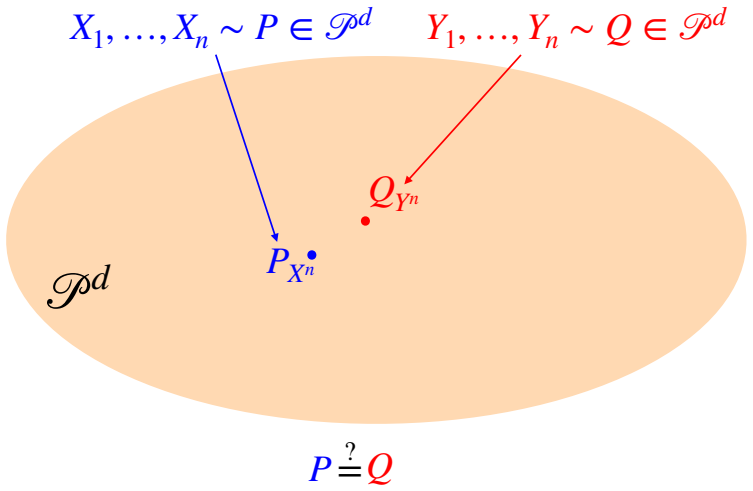
In this work, we revisit the one- and two-sample testing problems: binary hypothesis testing in which one or both distributions are unknown. For the one-sample test, we provide a more streamlined proof of the asymptotic optimality of Hoeffding's likelihood ratio test, which is equivalent to the threshold test of the relative entropy between the empirical distribution and the nominal distribution. The new proof offers an intuitive interpretation and naturally extends to the two-sample test where we show that a similar form of Hoeffding's test, namely a threshold test of the relative entropy between the two empirical distributions is also asymptotically optimal. A strong converse for the two-sample test is also obtained.
Editorial analysis
A structured set of objections, weighed in public.
Referee Report
Summary. The manuscript revisits one- and two-sample binary hypothesis testing problems with unknown distributions. For the one-sample case it supplies a streamlined proof that Hoeffding's likelihood-ratio test is asymptotically optimal and is equivalent to a threshold test on the relative entropy between the empirical distribution and the nominal distribution. The same approach is extended to the two-sample problem, where a threshold test on the relative entropy between the two empirical distributions is shown to be asymptotically optimal; a strong converse is also derived for the two-sample setting.
Significance. If the derivations hold, the work is significant because it supplies an intuitive large-deviation argument for the optimality of relative-entropy threshold tests, extends the classical one-sample result to the two-sample case, and adds a strong converse. These contributions clarify fundamental limits for hypothesis testing when distributions are unknown and reinforce the role of Sanov's theorem and related rate functions in establishing asymptotic optimality.
minor comments (3)
- [§2 and §3] §2 and §3: the statements of the main theorems should explicitly list the technical conditions on the alphabet size, the support of the distributions, and the rate at which the threshold is allowed to grow with n.
- The proof sketches rely on standard properties of the empirical measure; a short paragraph recalling the precise large-deviation upper and lower bounds used (e.g., the exact form of the rate function) would improve readability for readers outside the immediate subfield.
- Figure 1 (if present) or the numerical examples: the caption should state the exact sample sizes and the precise threshold values employed so that the plots can be reproduced from the stated optimality claims.
Simulated Author's Rebuttal
We thank the referee for the positive review and recommendation for minor revision. The referee's summary accurately captures the manuscript's contributions on the asymptotic optimality of Hoeffding's relative-entropy threshold tests for one- and two-sample problems, including the strong converse for the two-sample case.
Circularity Check
No significant circularity detected
full rationale
The paper supplies a streamlined proof of asymptotic optimality for Hoeffding's likelihood-ratio test (equivalently, a relative-entropy threshold test) in the one-sample setting and shows that an analogous relative-entropy threshold between two empirical distributions is asymptotically optimal for the two-sample problem, together with a strong converse. These claims rest on the standard large-deviation rate functions of empirical measures under i.i.d. sampling; the paper explicitly states that it does not re-derive those properties. No equation reduces a claimed prediction or optimality statement to a fitted parameter or to a self-citation whose content is itself the target result. The derivation chain therefore remains self-contained against external benchmarks and receives the default non-circularity finding.
Axiom & Free-Parameter Ledger
axioms (1)
- standard math Large-deviation principle for empirical distributions (Sanov's theorem)
discussion (0)
Sign in with ORCID, Apple, or X to comment. Anyone can read and Pith papers without signing in.