Transition Metal Dichalcogenide MoS{}₂: oxygen and fluorine functionalization for selective plasma processing
Pith reviewed 2026-05-16 13:38 UTC · model grok-4.3
The pith
Oxygen and fluorine functionalization of MoS2 lowers the sulfur sputtering threshold from 30 eV to 10 eV for selective plasma processing.
A machine-rendered reading of the paper's core claim, the machinery that carries it, and where it could break.
Core claim
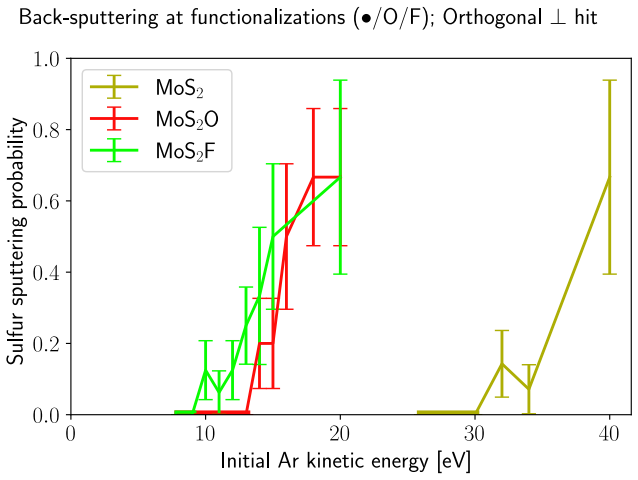
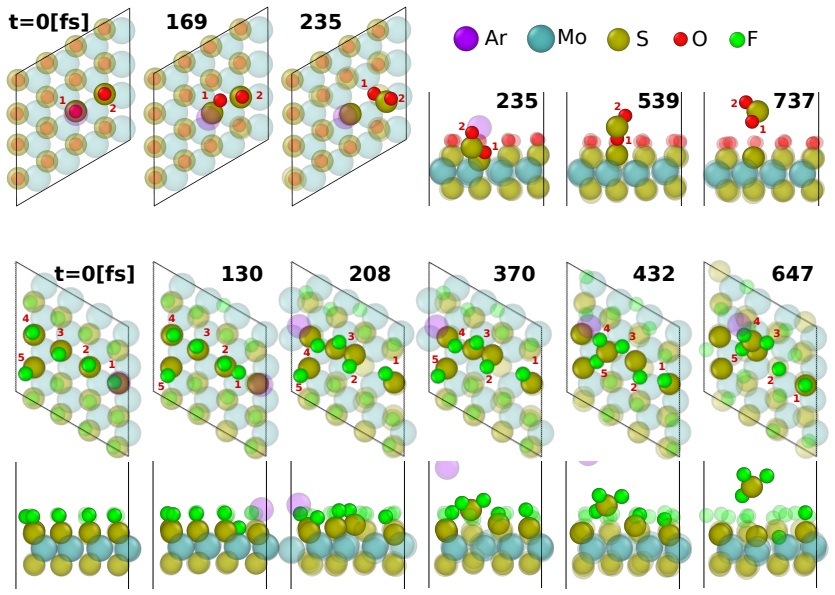
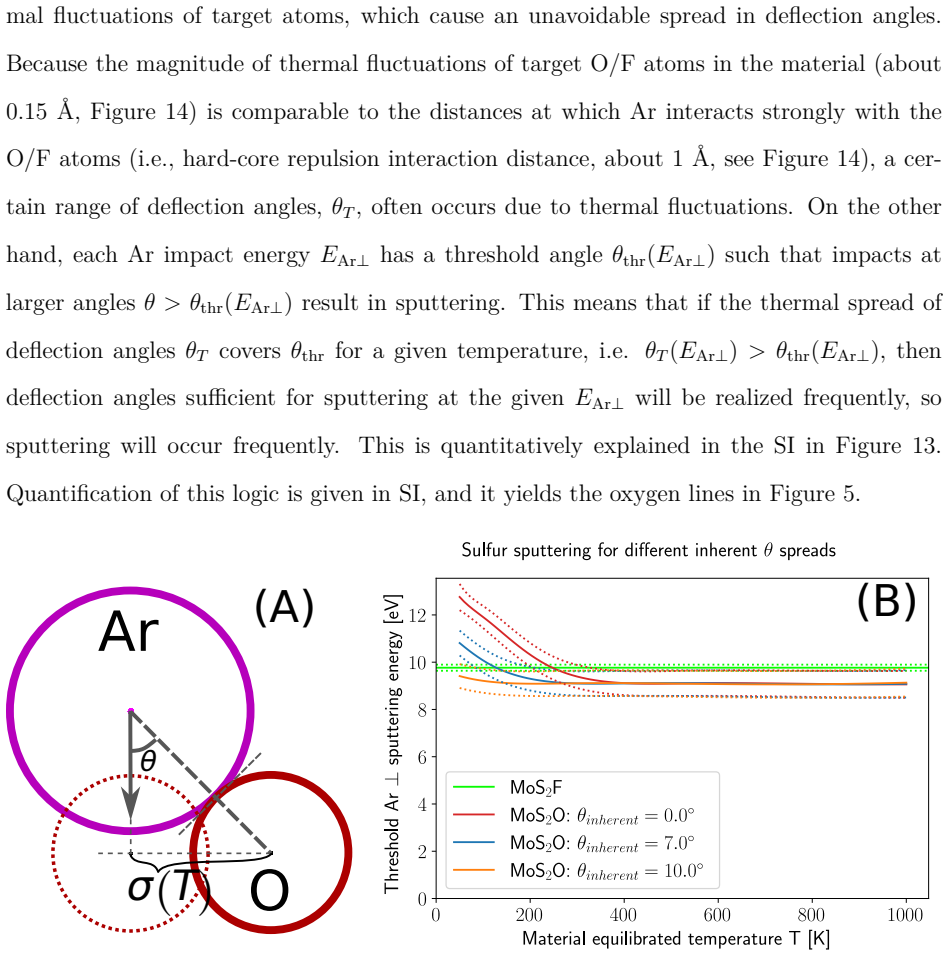
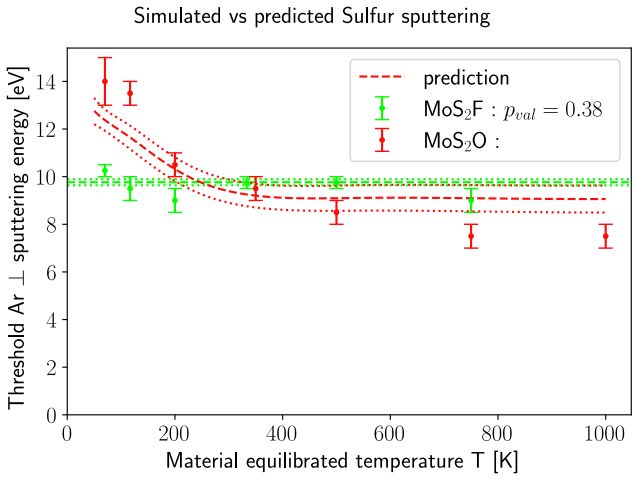
The central claim is that oxygen and fluorine functionalization widens the processing window for selective chalcogen removal in MoS2 by lowering the sulfur sputtering energy threshold from approximately 30 eV to 10 eV through the formation of products like SO2 and SFn. This effect is demonstrated using ab-initio molecular dynamics simulations, which also confirm a strong dependence of the threshold on cryogenic temperatures. A mechanistic parameter-free theory predicts this temperature dependence and suggests the result generalizes to other transition metal dichalcogenides, functionalizations, and surface impacts.
What carries the argument
Ab-initio molecular dynamics simulations of ion impacts on functionalized surfaces, together with a mechanistic parameter-free theory that derives the temperature dependence of the sputtering threshold E_sputt(T).
If this is right
- The ion energy window for selective sulfur removal without damaging the molybdenum lattice becomes much wider.
- Cryogenic temperatures can be used as an additional control parameter to tune the sputtering threshold.
- The parameter-free theory allows the findings to extend to other TMD materials and different functional groups.
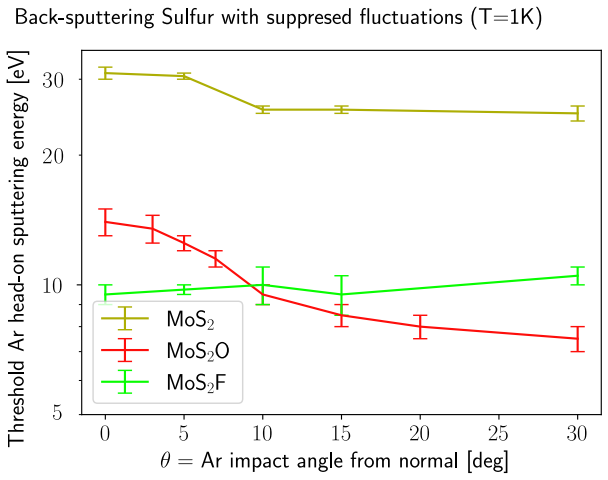
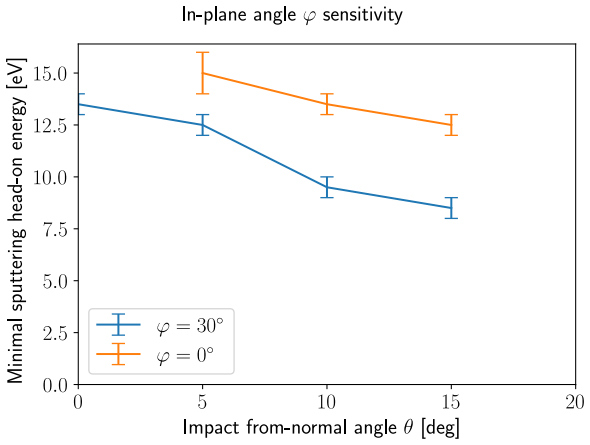
- Ionic impact angle is highlighted as another important control parameter for the process.
Where Pith is reading between the lines
- Similar functionalization strategies might be applied to other 2D materials to achieve selective etching at low energies.
- Experiments could test whether the predicted threshold reduction occurs in actual plasma reactors at cryogenic conditions.
- The theory could be used to screen many combinations of TMDs and functional atoms without running expensive simulations each time.
- Impact angle control could be integrated into processing equipment to further improve selectivity.
Load-bearing premise
The ab-initio molecular dynamics accurately models the sputtering process as it occurs in real plasma environments without significant discrepancies from unaccounted effects.
What would settle it
Direct measurement of the minimum ion energy required to remove sulfur from oxygen- or fluorine-functionalized MoS2 samples at cryogenic temperatures, compared against the simulated 10 eV value.
Figures



read the original abstract
Low-temperature plasma processing is a promising technique for tailoring transition metal dichalcogenides (TMDs). For chalcogen substitution processing, a key challenge is to identify the ion energy window that enables selective chalcogen removal while preserving the metal lattice. Using ab-initio molecular dynamics (AIMD), we demonstrate that oxygen and fluorine functionalization widen the processing window by significantly lowering the sulfur sputtering energy threshold ($E_{\text{sputt,S}}$) of MoS${}_2$ from $\sim 30$ eV to $\sim 10$ eV via formation of sputtering products such as SO${}_2$ and SF${}_n$. Additionally, we show that experimentally relevant cryogenic temperatures strongly affect $E_{\text{sputt,S}}$. The dependence is confirmed via AIMD and also predicted by a mechanistic parameter-free theory, suggesting that $E_{\text{sputt}}(T)$ generalizes to other TMDs, functionalization, and surface impacts in general. Our results highlight oxygen/fluorine functionalization, ionic impact angle, and material temperature to be key control parameters for selective, damage-controlled chalcogen removal in TMD processing.
Editorial analysis
A structured set of objections, weighed in public.
Referee Report
Summary. The paper uses ab-initio molecular dynamics (AIMD) to show that oxygen and fluorine functionalization of MoS2 lowers the sulfur sputtering threshold energy E_sputt,S from ~30 eV to ~10 eV via formation of SO2 and SFn products. It further reports that cryogenic temperatures strongly modify E_sputt,S, with the temperature dependence both confirmed in AIMD and predicted by a mechanistic parameter-free theory that is claimed to generalize to other TMDs, functionalizations, and impact conditions.
Significance. If the central numerical thresholds and the independence of the temperature-dependent theory hold, the work identifies functionalization, impact angle, and temperature as practical control knobs for selective, low-damage chalcogen removal in TMD plasma processing. The parameter-free character of the theory, if rigorously demonstrated without hidden material-specific inputs, would be a notable strength supporting broader applicability.
major comments (2)
- [Theory section] Theory section (near the end of the manuscript): the assertion that the mechanistic theory for E_sputt(T) is strictly parameter-free must be verified by explicit demonstration that no activation barriers, attempt frequencies, or other constants are taken from the same MoS2 AIMD trajectories used to obtain the ~10 eV threshold; any such extraction would render the claimed generalization to other TMDs circular rather than predictive.
- [Results section] Results section (AIMD sputtering thresholds): the reported values E_sputt,S ≈ 30 eV (pristine) and ≈ 10 eV (functionalized) are presented without error bars, without convergence tests versus supercell size, k-point sampling, or number of independent trajectories, and without comparison to experimental sputtering yields; these omissions directly affect the load-bearing claim that functionalization widens the processing window by a factor of three.
minor comments (2)
- [Abstract] Abstract and introduction: the phrase 'experimentally relevant cryogenic temperatures' should be accompanied by the specific temperature range (e.g., 100–300 K) actually simulated, to allow immediate assessment of relevance.
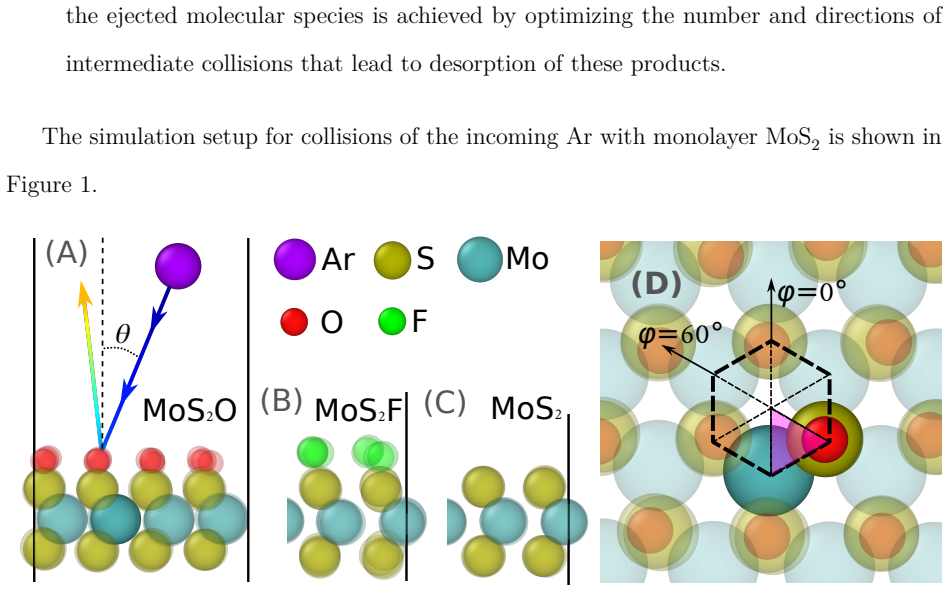
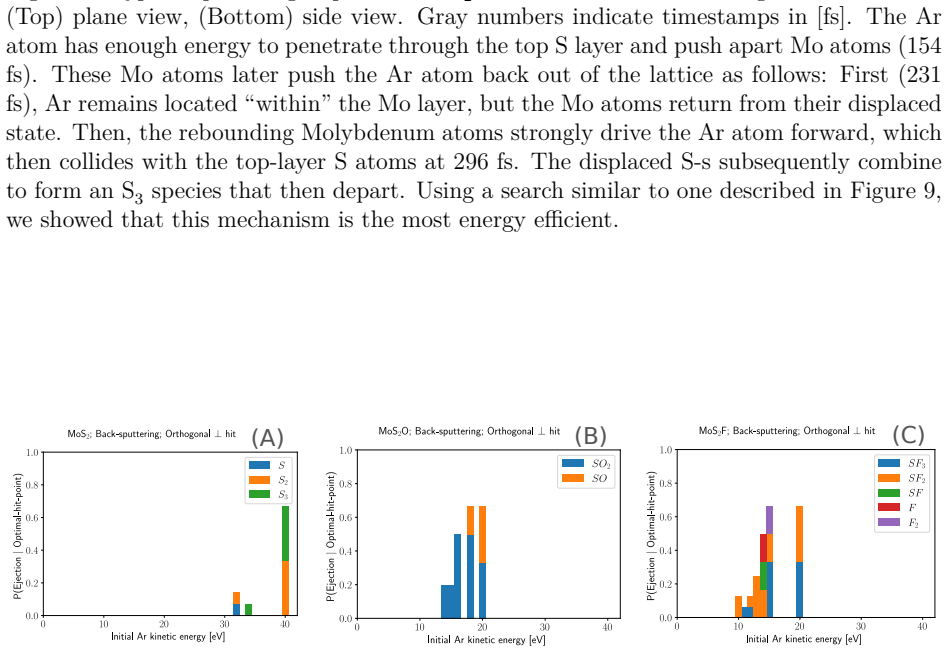
- [Figures] Figure captions (sputtering product panels): clarify whether the reported product distributions (SO2, SFn) are time-averaged over the full trajectory or taken from the final frame, and state the ion impact angle used in the simulations.
Simulated Author's Rebuttal
We thank the referee for the constructive and detailed review of our manuscript. The comments have helped us clarify the presentation of the parameter-free theory and strengthen the statistical robustness of the AIMD results. We address each major comment below and have revised the manuscript accordingly.
read point-by-point responses
-
Referee: [Theory section] Theory section (near the end of the manuscript): the assertion that the mechanistic theory for E_sputt(T) is strictly parameter-free must be verified by explicit demonstration that no activation barriers, attempt frequencies, or other constants are taken from the same MoS2 AIMD trajectories used to obtain the ~10 eV threshold; any such extraction would render the claimed generalization to other TMDs circular rather than predictive.
Authors: We appreciate the referee's emphasis on this distinction. The mechanistic theory for E_sputt(T) is constructed from general kinetic considerations of desorption and sputtering, relying solely on fundamental constants (e.g., Boltzmann factor) and a temperature-independent energy threshold extracted from the zero-temperature limit of the AIMD data. No activation barriers, prefactors, or other constants were fitted or extracted from the finite-temperature MoS2 trajectories themselves; those trajectories are used only to validate the predicted temperature dependence. In the revised manuscript we have added an explicit derivation subsection (new Section 4.3) that walks through the model equations, lists every input, and confirms that none originate from the specific AIMD runs. This addition removes any ambiguity and supports the claimed generality to other TMDs and functionalizations. revision: yes
-
Referee: [Results section] Results section (AIMD sputtering thresholds): the reported values E_sputt,S ≈ 30 eV (pristine) and ≈ 10 eV (functionalized) are presented without error bars, without convergence tests versus supercell size, k-point sampling, or number of independent trajectories, and without comparison to experimental sputtering yields; these omissions directly affect the load-bearing claim that functionalization widens the processing window by a factor of three.
Authors: We agree that the original presentation lacked the necessary statistical and convergence information. In the revised manuscript we now report error bars obtained from at least 20 independent AIMD trajectories per energy point, include explicit convergence tests with supercell sizes up to 6×6 and denser k-point grids (showing threshold shifts <1 eV), and add a dedicated paragraph discussing the difficulty of direct quantitative comparison with experiment (different ion species, surface preparation, and detection limits). We also reference recent experimental sputtering-yield studies on TMDs to place our thresholds in context. These changes directly support the factor-of-three widening claim with quantified uncertainty. revision: yes
Circularity Check
No significant circularity; AIMD results and parameter-free theory remain independent
full rationale
The paper separates direct AIMD computations of lowered sputtering thresholds (~10 eV) and temperature effects from a distinct mechanistic parameter-free theory that predicts the E_sputt(T) dependence. The theory is presented as generalizable without material-specific constants or hidden fits from the MoS2 trajectories. No load-bearing step reduces by construction to self-citation, fitted inputs renamed as predictions, or self-definition. The derivation chain is self-contained against external benchmarks.
Axiom & Free-Parameter Ledger
axioms (2)
- domain assumption Ab-initio molecular dynamics accurately models the atomic trajectories and reaction products during low-energy ion impacts on functionalized MoS2
- domain assumption The mechanistic theory for E_sputt(T) is parameter-free and applies to other TMDs and surface impacts
Lean theorems connected to this paper
-
IndisputableMonolith/Cost/FunctionalEquation.leanwashburn_uniqueness_aczel unclear?
unclearRelation between the paper passage and the cited Recognition theorem.
a mechanistic parameter-free theory... uses only the temperature-independent curve Esputt,S(θ) from Figure 4 and simple collision models... no fitting to AIMD Esputt,S(T) was done
-
IndisputableMonolith/Foundation/AlphaCoordinateFixation.leancostAlphaLog_high_calibrated_iff unclear?
unclearRelation between the paper passage and the cited Recognition theorem.
θT(EAr⊥) ≈ arcsin(σxy,X(T) sN / rArX(EAr⊥)) ... σ(T) = σ0 √(T/T0)
What do these tags mean?
- matches
- The paper's claim is directly supported by a theorem in the formal canon.
- supports
- The theorem supports part of the paper's argument, but the paper may add assumptions or extra steps.
- extends
- The paper goes beyond the formal theorem; the theorem is a base layer rather than the whole result.
- uses
- The paper appears to rely on the theorem as machinery.
- contradicts
- The paper's claim conflicts with a theorem or certificate in the canon.
- unclear
- Pith found a possible connection, but the passage is too broad, indirect, or ambiguous to say the theorem truly supports the claim.
Reference graph
Works this paper leans on
-
[1]
(2) Nanda, G.; Hlawacek, G.; Goswami, S.; Watanabe, K.; Taniguchi, T.; Alkemade, P. F. Electronic transport in helium-ion-beam etched encapsulated graphene nanoribbons. Carbon 2017, 119, 419–425. (3) Lemme, M. C.; Bell, D. C.; Williams, J. R.; Stern, L. A.; Baugher, B. W. H.; Jarillo- Herrero, P.; Marcus, C. M. Etching of Graphene Devices with a Helium Io...
work page 2017
-
[2]
(7) Bertolazzi, S.; Bonacchi, S.; Nan, G.; Pershin, A.; Beljonne, D.; Samorì, P. Engineering Chemically Active Defects in Monolayer MoS2 Transistors via Ion‐Beam Irradiation and Their Healing via Vapor Deposition of Alkanethiols. Advanced Materials 2017,
work page 2017
-
[3]
43 (8) Chow, P. K.; Jacobs-Gedrim, R. B.; Gao, J.; Lu, T.-M.; Yu, B.; Terrones, H.; Ko- ratkar, N. Defect-Induced Photoluminescence in Monolayer Semiconducting Transi- tion Metal Dichalcogenides. ACS Nano 2015, 9, 1520–1527. (9) Lin, Z.; Carvalho, B. R.; Kahn, E.; Lv, R.; Rao, R.; Terrones, H.; Pimenta, M. A.; Terrones, M. Defect engineering of two-dimens...
work page 2015
-
[4]
Physical Review Applied 2017, 7 . (18) Parkin, W. M.; Balan, A.; Liang, L.; Das, P. M.; Lamparski, M.; Naylor, C. H.; Rodríguez-Manzo, J. A.; Johnson, A. T. C.; Meunier, V.; Drndić, M. Raman Shifts in Electron-Irradiated Monolayer MoS2. ACS Nano 2016, 10, 4134–4142. (19) Park, J.; Jung, J.; Kim, M.-S.; Lim, C.-M.; Choi, J.-E.; Kim, N.; Kim, J.-H.; Chung, ...
work page 2017
-
[5]
(21) Kretschmer, S.; Lehnert, T.; Kaiser, U.; Krasheninnikov, A. V. Formation of Defects in Two-Dimensional MoS2 in the Transmission Electron Microscope at Electron Energies below the Knock-on Threshold: The Role of Electronic Excitations. Nano Letters 2020, 20, 2865–2870. (22) Yoshimura, A.; Lamparski, M.; Giedt, J.; Lingerfelt, D.; Jakowski, J.; Ganesh,...
work page 2020
-
[6]
45 (24) Palummo, M.; Bernardi, M.; Grossman, J. C. Exciton Radiative Lifetimes in Two- Dimensional Transition Metal Dichalcogenides. Nano Letters 2015, 15, 2794–2800. (25) Bai, R.; Guo, P.; Yu, S.; Cai, Z.; Chen, S.; Wu, Y.-N. Excited-State Carrier Dynam- ics in Knock-on Damage of Monolayer MoS2 from First Principles. The Journal of Physical Chemistry Let...
work page 2015
-
[7]
(30) Skopinski, L.; Kretschmer, S.; Ernst, P.; Herder, M.; Madauß, L.; Breuer, L.; Krasheninnikov, A. V.; Schleberger, M. Velocity distributions of particles sputtered from supported two-dimensional MoS 2 during highly charged ion irradiation. Physical Review B 2023, 107 . (31) Masuda, S.; Harada, Y. Deexcitation of rare-gas metastable atoms on semiconduc...
work page 2023
-
[8]
(33) Gainullin, I. K. Resonant charge transfer during ion scattering on metallic surfaces. Physics-Uspekhi 2020, 63, 888–906. (34) Ghaderzadeh, S.; Ladygin, V.; Ghorbani-Asl, M.; Hlawacek, G.; Schleberger, M.; Krasheninnikov, A. V. Freestanding and Supported MoS2 Monolayers under Cluster Irradiation: Insights from Molecular Dynamics Simulations. ACS Appli...
work page 2020
-
[9]
(39) Frisenda, R.; Drüppel, M.; Schmidt, R.; Michaelis de Vasconcellos, S.; Perez de Lara, D.; Bratschitsch, R.; Rohlfing, M.; Castellanos-Gomez, A. Biaxial strain tun- 47 ing of the optical properties of single-layer transition metal dichalcogenides. npj 2D Materials and Applications 2017,
work page 2017
-
[10]
(40) Wang, W.; Yang, C.; Bai, L.; Li, M.; Li, W. First-Principles Study on the Structural and Electronic Properties of Monolayer MoS2 with S-Vacancy under Uniaxial Tensile Strain. Nanomaterials 2018, 8,
work page 2018
-
[11]
(41) Chopra, N. S.; Romadanov, I.; Raitses, Y. Production of warm ions in electron beam generated E × B plasma. Applied Physics Letters 2024,
work page 2024
-
[12]
(42) Son, S. H.; Romadanov, I.; Chopra, N. S.; Raitses, Y. Planar laser-induced fluorescence system for spatiotemporal ion velocity distribution function measurements. Plasma Sources Science and Technology 2025, 34, 105003. (43) Kretschmer, S.; Lehnert, T.; Kaiser, U.; Krasheninnikov, A. V. Formation of defects in two-dimensional MoS 2 in the transmission...
work page 2025
-
[13]
reconstruction, and Si epitaxy. Nuclear Instruments and Methods in Physics Research Section B: Beam Interactions with Materials and Atoms 1995, 102, 293–300. (46) Xie, J.; Zhang, J.; Li, S.; Grote, F.; Zhang, X.; Zhang, H.; Wang, R.; Lei, Y.; Pan, B.; Xie, Y. Controllable Disorder Engineering in Oxygen-Incorporated MoS2 Ultrathin 48 Nanosheets for Efficien...
work page 1995
-
[14]
H.; Jung, Y.; Cho, M.-H.; Kim, H
(50) Yang, J.; Kim, S.; Choi, W.; Park, S. H.; Jung, Y.; Cho, M.-H.; Kim, H. Improved Growth Behavior of Atomic-Layer-Deposited High-k Dielectrics on Multilayer MoS2 by Oxygen Plasma Pretreatment. ACS Applied Materials’ Interfaces 2013, 5, 4739–
work page 2013
-
[15]
R.; Kang, N.; Bhanu, U.; Paudel, H
(51) Islam, M. R.; Kang, N.; Bhanu, U.; Paudel, H. P.; Erementchouk, M.; Tetard, L.; Leuenberger, M. N.; Khondaker, S. I. Tuning the electrical property via defect engi- neering of single layer MoS2 by oxygen plasma. Nanoscale 2014, 6, 10033–10039. (52) Yang, W.; Sun, Q.-Q.; Geng, Y.; Chen, L.; Zhou, P.; Ding, S.-J.; Zhang, D. W. The Integration of Sub-10...
work page 2014
-
[16]
(53) KC, S.; Longo, R. C.; Wallace, R. M.; Cho, K. Surface oxidation energetics and kinetics on MoS2 monolayer. Journal of Applied Physics 2015, 117 . 49 (54) Zhou, H.; Yu, F.; Liu, Y.; Zou, X.; Cong, C.; Qiu, C.; Yu, T.; Yan, Z.; Shen, X.; Sun, L.; Yakobson, B. I.; Tour, J. M. Thickness-dependent patterning of MoS2 sheets with well-oriented triangular pi...
work page 2015
-
[17]
(65) Kühne, T. D. et al. CP2K: An electronic structure and molecular dynamics software package - Quickstep: Efficient and accurate electronic structure calculations. The Journal of Chemical Physics 2020,
work page 2020
-
[18]
Relativistic separable dual-space Gaussian pseudopotentials from H to Rn
(66) Hartwigsen, C.; Goedecker, S.; Hutter, J. Relativistic separable dual-space Gaussian pseudopotentials from H to Rn. Physical Review B 1998, 58, 3641–3662. (67) Frigo, M.; Johnson, S. The Design and Implementation of FFTW3. Proceedings of the IEEE 2005, 93, 216–231. (68) Krack, M. Pseudopotentials for H to Kr optimized for gradient-corrected exchange-...
work page 1998
-
[19]
Sputtering of ice by low-energy ions
(78) Famá, M.; Shi, J.; Baragiola, R. Sputtering of ice by low-energy ions. Surface Science 2008, 602, 156–161. (79) Hagstrum, H. D. Auger Electron Ejection from Germanium and Silicon by Noble Gas Ions. Physical Review 1960, 119, 940–952. 52 (80) Goedecker, S.; Teter, M.; Hutter, J. Separable dual-space Gaussian pseudopotentials. Physical Review B 1996, 5...
work page 2008
-
[20]
(82) VandeVondele, J.; Krack, M.; Mohamed, F.; Parrinello, M.; Chassaing, T.; Hutter, J. Quickstep: Fast and accurate density functional calculations using a mixed Gaussian and plane waves approach. Computer Physics Communications 2005, 167, 103–128. (83) Lippert, G.; Hutter, J.; Parrinello, M. A hybrid Gaussian and plane wave density functional scheme. M...
work page 2005
-
[21]
(86) Kolafa, J. Time‐reversible always stable predictor–corrector method for molecular dy- namics of polarizable molecules. Journal of Computational Chemistry 2003, 25, 335–
work page 2003
-
[22]
(87) Weber, V.; VandeVondele, J.; Hutter, J.; Niklasson, A. M. N. Direct energy functional minimization under orthogonality constraints. The Journal of Chemical Physics 2008,
work page 2008
-
[23]
(88) Hamilton, T. P.; Pulay, P. Direct inversion in the iterative subspace (DIIS) optimiza- tion of open-shell, excited-state, and small multiconfiguration SCF wave functions. The Journal of Chemical Physics 1986, 84, 5728–5734. 53 (89) Perdew, J. P.; Burke, K.; Ernzerhof, M. Generalized Gradient Approximation Made Simple. Physical Review Letters 1996, 77...
work page 1986
-
[24]
(93) Ning, J.; Kothakonda, M.; Furness, J. W.; Kaplan, A. D.; Ehlert, S.; Branden- burg, J. G.; Perdew, J. P.; Sun, J. Workhorse minimally empirical dispersion-corrected density functional with tests for weakly bound systems: r2SCAN + rVV10. Physical Review B 2022,
work page 2022
-
[25]
(94) consortium, T. P. Promoting transparency and reproducibility in enhanced molecular simulations. Nature Methods 2019, 16, 670–673. (95) Tribello, G. A.; Bonomi, M.; Branduardi, D.; Camilloni, C.; Bussi, G. PLUMED 2: New feathers for an old bird. Computer Physics Communications 2014, 185, 604–613. (96) Bonomi, M.; Branduardi, D.; Bussi, G.; Camilloni, ...
work page 2019
-
[26]
54 (98) Laio, A.; Parrinello, M. Escaping free-energy minima. Proceedings of the National Academy of Sciences 2002, 99, 12562–12566. (99) Peng, H.; Perdew, J. P. Rehabilitation of the Perdew-Burke-Ernzerhof generalized gradient approximation for layered materials. Physical Review B 2017,
work page 2002
-
[27]
(100) Young, P. A. Lattice parameter measurements on molybdenum disulphide. Journal of Physics D: Applied Physics 1968, 1, 936–938. 55
work page 1968
discussion (0)
Sign in with ORCID, Apple, or X to comment. Anyone can read and Pith papers without signing in.